INTRODUCTION
As a primary tool for assessing some population parameters, the use of the photo-identification technique has improved our knowledge about the Guiana dolphin, Sotalia guianensis (van Bénéden, 1864), in its natural habitat (Flores, Reference Flores1999; Pizzorno, Reference Pizzorno1999; Simão et al., Reference Simão, Pizzorno, Perry and Siciliano2000; Santos et al., Reference Santos, Acuña and Rosso2001; Rossi-Santos et al., Reference Rossi-Santos, Wedekin and Monteiro-Filho2007). Using a dataset composed of photographs of dolphins' dorsal fins, it is possible to distinguish each individual based on natural markings (Würsig & Würsig, Reference Würsig and Würsig1977; Hammond et al., Reference Hammond, Mizroch and Donovan1990). One of the ecological parameters that can be assessed through a photo-ID catalogue is residency, which refers to the amount of time that a certain individual spends in a particular geographical area (Wells & Scott, Reference Wells, Scott, Hammond, Mizroch and Donovan1990; Wells, Reference Wells, Pryor and Norris1991).
Of the entire geographical distribution of this species, the largest aggregation of Guiana dolphins is reported to be located in western Ilha Grande Bay (23°02′S 44°26′W) (Lodi & Hetzel, Reference Lodi and Hetzel1998). However, data about many population features are scarce, which makes any conservation decision affecting the species in the area difficult. Ilha Grande Bay is an area of high primary productivity, which guarantees the sustainability of several marine species that inhabit it (Nogara, Reference Nogara2000). Previous studies in the area have shown that Guiana dolphins use the bay mainly for feeding purposes and as a care giving area (Lodi, Reference Lodi2003a, Reference Lodib).
Food resources and protection from potential predators are considered to be the main factors that influence the distribution and permanence of a species in a certain area (Mazzoil et al., Reference Mazzoil, Reif, Youngbluth, Murdoch, Bechdel, Howells, McCullock, Hansen and Bossart2008). Estuaries, such as Ilha Grande Bay, are usually considered to contain large concentrations of nutrients that support a great number of filter-feeding zooplankton and fish (Ballance, Reference Ballance1992). Guiana dolphins may inhabit this bay mainly because of the potential prey abundance that this area supports. Early studies indicated that the area is predator-free, representing a valuable place for caring for and teaching young offspring (Lodi, Reference Lodi2003a, Reference Lodib). However, with the increase of anthropogenic activities in the area, such as overfishing and boat traffic, as well as high levels of pollutants and contaminants, the natural stability of all species that inhabit this ecosystem, including S. guianensis, may become disturbed. The main objective of this work was to characterize the degree of residence of Guiana dolphins in Ilha Grande Bay, Brazil. The results provided by this study represent the first step in acquiring knowledge of diverse characteristics of S. guianensis in the area.
MATERIALS AND METHODS
Study area
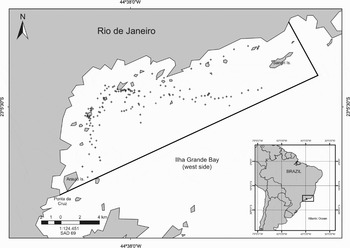
Ilha Grande Bay is located on the southern coast of Rio de Janeiro State, Brazil (23°02′S 44°26′W). According to its geographical, hydrological and physiographic aspects, it is divided into three different units: the east side, the central part and the west side (Mahiques, Reference Mahiques1987). The present study took place in a delimited area of 190 km2 on the west side of Ilha Grande Bay (Figure 1), which is characterized by shallow depths (~10 m on average). Previous studies have shown that Guiana dolphins are found mainly in this part of the bay (Lodi & Hetzel, Reference Lodi and Hetzel1998; Lodi, Reference Lodi2003a, Reference Lodib). The marine environment of Ilha Grande Bay's west side is considered a transition area between mainland and sea (Nogara, Reference Nogara2000). An organic matter influx from the continent takes place due to water input from continental rivers and from mangrove swamps around the bay. According to Signorini (Reference Signorini1980), during the summer, the west side of the bay receives nutrients from deep water (southern Atlantic central waters) that enters the bay by its west channel, causing an upwelling phenomenon. The area presents a great diversity of microhabitats, such as islands, mangrove swamps, rocky cliffs, muddy areas and sandy beaches (Lodi, Reference Lodi2003a). At the same time, the study area is of great economic interest, with different anthropogenic activities being developed around it.
Map of the study area showing the geographical position of Sotalia guianensis groups (+) at the delimited area of western Ilha Grande Bay, south-eastern Brazil.

Data collection
This research was conducted from May 2007 to March 2008 during all four seasons of the year, using a 7.5-m vessel (22 HP) that cruised at 4 knots along the west side of Ilha Grande Bay. Boat trips were performed only when climatic conditions were favourable for dolphin sightings (i.e. without rain and sea state <3). The boat travelled without any systematic route inside the delimited area until one or more groups of dolphins were sighted by experienced cetacean observers, who recorded the animals' geographical position using a GPS, time of sighting, group size and behaviour. Groups were approached to take the photographs with the boat at slow speed and keeping a physical distance of about 10 m along a parallel route. All photographs were taken using a digital camera (Canon EOS 20D Digital fitted with Canon Zoom EF 75-300 mm lens) and a 1 GB memory card. The photographs were taken by the same observer during the entire study period. The sampling protocol was to photograph as many animals as possible in each school. Field effort ended when there was no more space on the memory card and/or sudden climate changes took place.
Data analysis
Data gathered by the GPS device and the digital camera were transferred to computers for further laboratory analysis. All photographs were passed through an extensive sorting and selection process to prevent errors during the cataloguing process (Gunnlaugsson & Sigurjónsson, Reference Gunnlaugsson, Sigurjónsson, Hammond, Mizroch and Donovan1990; Stevick et al., Reference Stevick, Palsboll, Smith, Bravington and Hammond2001). For this reason, two experienced observers selected only pictures of ‘good’ or ‘excellent’ quality (well focused, with enough light and little blurring) during this stage. Nicks and notches along the dorsal fins were the main features used to distinguish individual dolphins (Würsig & Würsig, Reference Würsig and Würsig1977), but in many cases, scars and injuries on dolphins' bodies were used as auxiliary marks for identification.
We adopted the methodology proposed by Mazzoil et al. (Reference Mazzoil, McCullock, Defran and Murdoch2004) for sorting and selecting the digital photographs. Matches with previously identified individuals were made by visually comparing each new photograph with all others in an existing library of dorsal fin pictures. Animals that could not be matched received a new identification number. The best picture of each was added to the digital photo-ID catalogue. Animals without markings on their dorsal fins were classified as juveniles or calves, based on their appearance. Dolphins that had one-half to three-quarters of an adult body length were defined as juveniles. Small dolphins with no more than one-quarter of an adult body length and with pinkish-grey coloration were assumed to be calves. As young dolphins have no distinctive marks, they were not included in the catalogue.
A Pearson correlation (rp) was used to test whether our sample effort was representative. For this reason, sample standardization was performed by calculating the proportions of captured and recaptured individuals in each survey compared to the cumulative number of captured individuals (capture and recapture rates, respectively). Definitions used to determine residency in this paper are those stated by Ballance (Reference Ballance, Leatherwood and Reeves1990). Individuals seen only one time were considered non-residents. Resident dolphins were sighted more than once, and the term is used in a relative sense; that is, one animal can be said to exhibit a higher or lower degree of residence than another. Among resident dolphins, we observed three different aspects of residence: the number of times an animal was seen in the area; the time interval between the first and last sightings of each individual; and the average number of days between sightings of each dolphin. Analysing these three items together, we could determine the degree of residence (e.g. high, medium or low) of each individual. Photographs depicting individuals without distinctive markings on their dorsal fins (calves and juveniles) were used to estimate the proportion of immature individuals in the population.
RESULTS
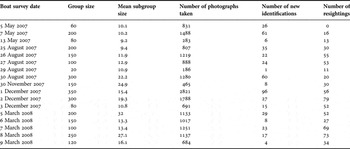
Twenty-three boat surveys were conducted in Ilha Grande Bay during all seasons of the year. Dolphins were seen in 17 surveys (73.9%) and were observed to be widely distributed in the study area (Figure 1). A total of 17,969 photographs were taken, of which 6014 pictures (33.5%) were characterized as being of ‘good’ or ‘excellent’ quality. Of these, about 45% (N = 2917) pictured animals without markings (calves and juveniles). The mean number of pictures taken in each survey was 1057 (±598). A total of 1043 subgroups were sighted, and the average subgroup size was 18.7 dolphins (±19.7). Group sizes in each survey ranged from 20 to 350 dolphins (mean 165 ± 93 dolphins). A summary of the sampling effort and data gathered throughout the surveys is presented in Table 1.
Summary of sample effort and data gathered during the study period in Ilha Grande Bay.

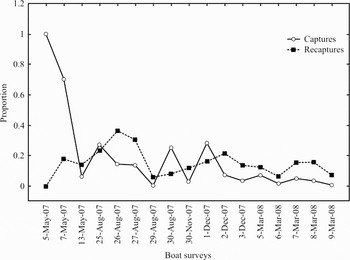
Overall, 462 Guiana dolphins were identified and catalogued based on markings found on their dorsal fins. There was no correlation between the number of animals captured in each survey and the cumulative number of captured individuals (r = –0.12, P = 0.66; N = 17). However, there was a significant positive relationship between the number of animals recaptured in each survey and the cumulative number of captured individuals (r = 0.66; P = 0.003; N = 17). This pattern was also observed when calculating recapture rates (number of recaptured individuals divided by the cumulative number of captured animals) and capture rates (number of captured individuals divided by the cumulative number of captured animals) (Figure 2). The number of animals recaptured in each survey ranged from 0 to 79 (mean 39.4 ± 23.6 animals).
Capture and recapture rates of Guiana dolphins in Ilha Grande Bay. From 2 December to 9 March the proportions of recaptured animals were higher than the capture rates.

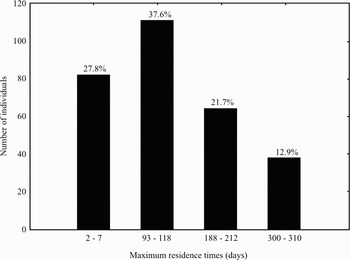
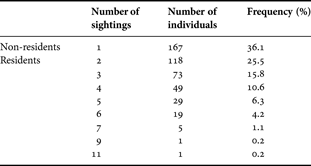
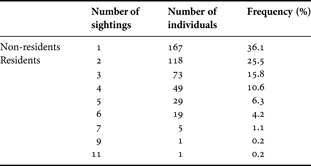
In Ilha Grande Bay, 167 Guiana dolphins (36.1%) were sighted only once and were regarded as non-resident dolphins (Table 2). The other 295 dolphins (63.9%) were seen two or more times and were therefore considered for evaluation of their degrees of residence in the study area. The number of times these dolphins were sighted ranged from 2 to 11 (Table 2). The time interval between the first and last sightings of any one dolphin ranged from 2 to 310 days, while the majority of the dolphins (N = 111; 37.6%) exhibited maximum residence periods of between 93 and 118 days (Figure 3). The average number of days between the first and last sightings was 121 days (± 99.1 days).
Maximum residence periods of resident Guiana dolphins in Ilha Grande Bay. The average number of days between first and last sightings was 121 days (± 99.1 days).

Frequencies of non-resident and resident Guiana dolphins. A total of 295 dolphins were used to establish degrees of residency within the population. None of the dolphins were sighted 8 or 10 times.
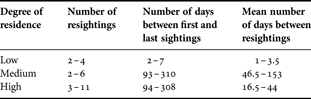
The average number of days between adjacent sightings for an individual was 35 days (±27.4 days), with durations ranging from 1 to 153 days. Some of the resident dolphins were sighted between 47 and 105 days (N = 113; 38.3%), while 99 dolphins (33.6%) had mean intervals of 17 and 44 days. Only one dolphin (0.3%) had a mean interval between resightings up to 150 days. Eighty-two animals (27.8%) were sighted at mean intervals ranging from 1 to 4 days.
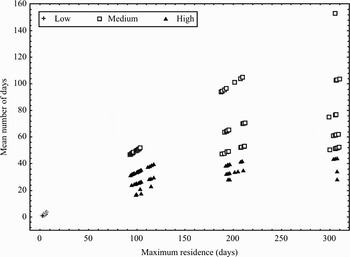
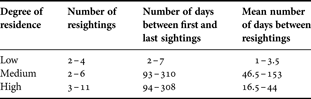
After considering all three parameters together, we were able to determine how many Sotalia guianensis dolphins had high, medium and low degrees of residence in Ilha Grande Bay (Figure 4). The reference numbers used for each parameter and degree of residence are presented in Table 3. In summary, 36.1% of the dolphins (N = 167) had null residence as they were not recaptured; 17.7% (N = 82 dolphins) had a low degree of residence; 24.8% (N = 114 dolphins) had a medium degree of residence; and 21.4% (N = 99 dolphins) had a high degree of residence in Ilha Grande Bay.
Scatterplot of maximum residence periods versus the mean number of days, showing distinct degrees of residence for Guiana dolphins in Ilha Grande Bay. High level = 99 dolphins; medium level = 114 dolphins; low level = 82 dolphins.

Reference numbers used for each parameter according to each degree of residence.
DISCUSSION
The number of identified animals levelled off with time, suggesting that most of the dolphins in Ilha Grande Bay were identified. Recapture rates tended to be higher than capture rates on the latest surveys and the correlation between the number of recaptures and the cumulative curve of identified individuals was positive. Additionally, the number of recaptures tended to increase during the study period and the number of new identifications tended to decrease with time. For this reason, we believe that our sample effort was representative for this population.
As stated by Ballance (Reference Ballance, Leatherwood and Reeves1990), each measure of residence must be interpreted with caution. Some dolphins were frequently sighted on consecutive days. An animal that visited Ilha Grande Bay only a few times on consecutive days would have a high number of resightings yet a relatively low degree of residence. Alternatively, an animal may have been frequently sighted over an extended period of up to 90 days. This would indicate a high degree of residence. The average number of days between sightings takes into account both the number of times an animal was sighted and the time between its first and last sightings. Individuals that visited Ilha Grande Bay on only a few occasions spaced widely apart in time exhibited a medium degree of residence. In general, Guiana dolphins exhibited varying degrees of residence in Ilha Grande Bay. The results provided by this study indicate that some individuals (46%) frequently used the bay during the sample period, exhibiting high and medium degrees of residence. Meanwhile, the majority of photo-identified dolphins (54%), namely low resident and non-resident dolphins, were less frequent. This fact suggests that this population has a fluid structure as different individuals were observed to compose it during the study period. The large proportion of dolphins seen only once indicates that many individuals spend most of their time outside of the study area, either offshore or in adjacent waters (Parra et al., Reference Parra, Corkeron and Marsh2006). Similar environmental features have been found for the S. guianensis population of Sepetiba Bay, which is 70 km from the study area. Nery et al. (Reference Nery, Espécie and Simão2008) found that 64% of the identified dolphins were seen only one time, suggesting that dolphins inhabiting Sepetiba Bay may also use Ilha Grande Bay as it offers resources and shelter against natural predators. Thus, Ilha Grande Bay appears to be an important part of the home range of Guiana dolphins on the southern coast of Rio de Janeiro State. Further comparisons between both photo-identification catalogues would be necessary to answer this question.
The absence of a standard method for residence analysis makes a comparison of this study's results to others' difficult. The main difference is related to the time scale considered. Several studies have observed that Guiana dolphins may show long-term residency in particular areas along the Brazilian coast (Azevedo et al., Reference Azevedo, Lailson-Brito, Cunha and Van Sluys2004; Flores & Bazzalo, Reference Flores and Bazzalo2004; Rossi-Santos et al., Reference Rossi-Santos, Wedekin and Monteiro-Filho2007; Nery et al., Reference Nery, Espécie and Simão2008). In Sepetiba Bay, for instance, one dolphin remained in the area for over 11 years (Nery et al., Reference Nery, Espécie and Simão2008). Our study draws conclusions regarding residency based on days instead of years. However, Ballance (Reference Ballance, Leatherwood and Reeves1990) gathered information about residency of bottlenose dolphins (Tursiops truncatus) in Kino Bay, Mexico, based on observations made during an eight-month study. A continuum of survey efforts in Ilha Grande Bay could be necessary to determine if a similar pattern to that already described for S. guianensis occurs.
Abundance, distribution and availability of resources in a certain habitat determine the home range size of a species (Ballance, Reference Ballance1992). Marine environments may be composed of a variety of microhabitats, each of them providing different resources for individuals in a population. Ilha Grande Bay presents a great diversity of microhabitats, which enhances local productivity (Nogara, Reference Nogara2000). Data about annual and spatial distributions and abundances of food resources (mainly fish, cephalopods and shrimps) are scarce for Ilha Grande Bay. However, many prey items described for Guiana dolphins are found in Ilha Grande Bay, such as squid (Loligo plei, L. sanpaulensis and Lolliguncula brevis) and demersal and pelagic fish (Trichiurus lepturus, Centropomus sp., Pomatomus saltatrix, Cynoscion leiarchus, C. striatus and C. jamaicensis) (Lodi, Reference Lodi2003a). A previous study of habitat use by Guiana dolphins in Ilha Grande Bay proposed that the area is used mainly for foraging and feeding purposes (Lodi, Reference Lodi2003a).
The presence of the dolphins in the area may be a response to their abundance and distribution of prey. In Sepetiba Bay, it was reported that fish communities vary according to the season of the year (Araújo et al., Reference Araújo, Cruz-Filho, Azevêdo and Santos1998). Some fish species showed habitat preferences, others had a patchy distribution around the bay, and still others could be found year-round (Araújo et al., Reference Araújo, Cruz-Filho, Azevêdo and Santos1998). We believe that such fluctuations in prey communities have a strong effect on the Guiana dolphins of Ilha Grande Bay. When food resources display a patchy distribution in the bay, dolphins may present a similar pattern to optimize their individual food intake. Delphinids spend considerable time and energy in locating, pursuing, capturing and processing prey (Williams et al., Reference Williams, Haun, Davis, Fuiman and Kohin2001). As the energy costs of living in water are high, they must acquire enough energy from the intake of prey. Wedekin et al. (Reference Wedekin, Daura-Jorge, Piacentini and Simões-Lopes2007) observed that Guiana dolphins in Norte Bay, southern Brazil, use a greater area during months with low resource availability (from March to September). It seems plausible that Guiana dolphins' ranges in Ilha Grande Bay extended beyond the area covered in this study, which may have affected individuals' residency identification.
Estuarine waters are an important breeding and calving area for Guiana dolphins (Santos et al., Reference Santos, Acuña and Rosso2001). The high proportion of calves and juveniles reported by the present study (45%) may be related to local resource availability. A similar proportion was described for Sepetiba Bay, south-eastern Brazil (47%) (Nery, Reference Nery2008). In Guanabara Bay, also in south-eastern Brazil, young animals corresponded to 26% of the total photographs taken (Azevedo, Reference Azevedo2005). Lodi (Reference Lodi2003b) found a high proportion of groups with calves in Ilha Grande Bay (88.9%), suggesting that it may represent an important calving area because of its sheltered waters (without strong winds and currents), absence of natural predators and prey availability. Besides, large groups are reported to live in the area. This may provide protection to newborns and increase opportunities for learning and development (Wells et al., Reference Wells, Scott, Irvine and Genoways1987). Thus, females with newborns would have a place for teaching and raising their calves without major threats to their safety.
Ilha Grande Bay is regarded as a priority area for marine conservation by the Brazilian Environmental Agency (IBAMA) because of the high levels of biodiversity described in the area (Creed et al., Reference Creed, Absalão, Brasil, Figueiredo, Ferreira, Pires, Serejo, Ventura, Creed, Pires and Figueiredo2007). Our findings suggest that this bay represents an important habitat for Sotalia guianensis dolphins as well. Preliminary abundance estimates have already been provided for this population, taking into consideration an overlap among confidence intervals of three different estimators for closed-population models (Espécie et al., Reference Espécie, Kiatkowski, Tardin, Simão and Nascimento2009). The results have indicated that Ilha Grande Bay holds the biggest population of Sotalia guianensis in its entire geographical distribution, ranging from 1041 to 1142 individuals (Espécie et al., Reference Espécie, Kiatkowski, Tardin, Simão and Nascimento2009). Conclusions based on short-term data tend to be transitory and simplistic (Scott et al., Reference Scott, Wells, Irvine, Leatherwood and Reeves1990). However, the results presented here provide the first report of the residence dynamics of Guiana dolphins in Ilha Grande Bay, showing that the area is regularly used by both adults and young individuals. The recurrent use of Ilha Grande Bay by some dolphins raises some concern about the long-term survival of local populations if the current habitat quality is not improved or at least maintained. Species with high levels of site fidelity and residency are vulnerable to population declines due to habitat degradation and loss (Warkentin & Hernandez, Reference Warkentin and Hernandez1996). According to Nery et al. (Reference Nery, Espécie and Simão2008), anthropogenic influences have been rapidly increasing in Sepetiba Bay due to its economic interest for Rio de Janeiro State, and Ilha Grande Bay may become a refuge for Sotalia guianensis when conditions worsen in Sepetiba Bay. Like many other coastal areas, Ilha Grande Bay is also suffering from intense economic development with little or no consideration for marine habitats and species. For this reason, further investigations into many ecological parameters of this S. guianensis population are still necessary for designing a conservation plan for this species in the area.
ACKNOWLEDGEMENTS
This project was made possible by the logistical support of Instituto Aqualie. We extend our thanks to Bill Rossiter (Cetacean Society International). We appreciate the comments and suggestions from Carlos Eduardo L. Esbérard and two anonymous referees of manuscript drafts. Our sincere thanks go to Sergio C. Moreira for preparing the map. Our deepest gratitude goes to Lauren Stanton for reviewing the English version of this paper. We would also like to thank Dona Elsa for housing us during data collection, Gilberto and Tico for their friendship and invaluable skills with the survey boat, and many trainee students from Laboratório de Bioacústica e Ecologia de Cetáceos, Universidade Federal Rural do Rio de Janeiro. This research was supported by Cetacean Society International (M.A.E., grant number 659-622-6826); the Conselho Nacional de Desenvolvimento Científico e Tecnológico (M.A.E., grant number 111555/2008-6); and the Fundação de Amparo à Pesquisa do Estado do Rio de Janeiro (R.H.O.T., grant number E-26/151.047/2007).