Introduction
Pigs are the main animal reservoir of H1N1, H3N2 and H1N2 influenza viruses. H1N1 and H3N2 strains have emerged in swine on several occasions, consecutively, with multiple cross-species transmissions from birds or humans (Brown, Reference Brown2000; Webby and Webster, Reference Webby and Webster2001). The first H1N2 viruses isolated were reassortants between H1N1 and H3N2 (Brown, Reference Brown2000). These three subtypes (H1N1, H3N2 and H1N2) are spreading within swine populations worldwide with a continuous evolution (i.e. antigenic drift or reassortment), which increases the genetic diversity of swine influenza viruses (Webster et al., Reference Webster, Bean, Gorman, Chambers and Kawaoka1992; Brown, Reference Brown2000; Vijaykrishna et al., Reference Vijaykrishna, Smith, Pybus, Zhu, Bhatt, Poon, Riley, Bahl, Ma and Cheung2011).
Although the first three human influenza pandemics involved viruses of avian origin, the recent swine-origin H1N1 pandemic that emerged in 2009 (H1N1 pdm) convinced scientists that more attention needs to be paid to the pivotal role of pigs in the emergence of pandemic strains (Garten et al., Reference Garten, Davis, Russell, Shu, Lindstrom, Balish, Sessions, Xu, Skepner, Deyde, Okomo-Adhiambo, Gubareva, Barnes, Smith, Emery, Hillman, Rivailler, Smagala, de Graaf, Burke, Fouchier, Pappas, Alpuche-Aranda, Lopez-Gatell, Olivera, Lopez, Myers, Faix, Blair, Yu, Keene, Dotson, Boxrud, Sambol, Abid, St George, Bannerman, Moore, Stringer, Blevins, Demmler-Harrison, Ginsberg, Kriner, Waterman, Smole, Guevara, Belongia, Clark, Beatrice, Donis, Katz, Finelli, Bridges, Shaw, Jernigan, Uyeki, Smith, Klimov and Cox2009; Smith et al., Reference Smith, Vijaykrishna, Bahl, Lycett, Worobey, Pybus, Ma, Cheung, Raghwani, Bhatt, Peiris, Guan and Rambaut2009). Beyond their zoonotic potential and the pandemic risk, influenza viruses need to be monitored because of their sanitary and economic impact on the swine supply chain, since they are a major cause of pathology in swine in developing countries, and create a need for systematic vaccination of pigs (Olsen et al., Reference Olsen, Brown, Easterday and Van Reeth2006).
Due to lack of epidemiological, clinical and laboratory data on swine influenza, the scientific communities agree that surveillance activities urgently need to be improved around the world, including East and Southeast Asia (Smith et al., Reference Smith, Vijaykrishna, Bahl, Lycett, Worobey, Pybus, Ma, Cheung, Raghwani, Bhatt, Peiris, Guan and Rambaut2009; Van Reeth and Nicoll, Reference Van Reeth and Nicoll2009; OFFLU, 2011).
Countries in East and Southeast Asia include Brunei, Cambodia, China (including Hong-Kong Special Administrative Region (SAR) and Taïwan), Indonesia, Lao People's Democratic Republic (PDR), Malaysia, Myanmar, the Philippines, Thailand and Vietnam. According to statistics provided by the Food and Agriculture Organization (FAO) of the United Nations Organization, this region produced approximately 515 million pigs in 2008, representing more than half of the worldwide pig production. The pig production in East and Southeast Asia is characterized by a wide mixture of production types. A majority of producers are smallholders and are semi-commercial, with their production aimed at home consumption and/or sale. Integrated production units are increasing in most developed countries within the region. The terms ‘small-scale’, ‘medium-scale’ and ‘large-scale’ do not have any precise definition (ACIAR, 2002). In the present review, we assume that a commercial system has more than 50 pigs per year reared in an industrial system, a backyard system has less than 50 pigs per year, and a semi-commercial system is a mixture between commercial and backyard (Liu et al., Reference Liu, Wei, Tong, Tang, Zhang, Fang, Yang and Cao2011). Backyard and semi-commercial systems are characterized by a poor level of biosecurity and a mixture of species on a single farm, which could increase the risk of influenza virus persistence and emergence on swine farms (Olsen et al., Reference Olsen, Brown, Easterday and Van Reeth2006).
The aim of this report is to provide a systematic review of our current knowledge on swine influenza in East and Southeast Asia, in order to identify the needs in terms of surveillance in the region.
Methods
Search strategy
Swine influenza is not a World Organization for Animal Health (OIE) notifiable disease, except for influenza virus infections in pigs that fulfill the criteria of a new emerging disease (this was the case with pandemic H1N1/2009 up to September 2010). Therefore, no official reports or notification on country status regarding swine influenza are available. In November 2011, we searched the GenBank database to identify strains of swine influenza especially of H1, H3, H5, H9 and other subtypes reported in each country of interest. In parallel, we searched the PubMed database, using the following search strategy:
1. ‘swine’ OR ‘pig*’
2. ‘influenza’ OR ‘flu’ OR ‘H1*’ OR ‘H2*’ OR ‘H3*’ OR ‘H4*’ OR ‘H5*’ OR ‘H7*’ OR ‘H9*’
3. ‘China’ OR ‘Myanmar’ OR ‘Cambodia’ OR ‘Laos’ OR ‘Thailand’ OR ‘Vietnam’ OR ‘Brunei’ OR ‘Malaysia’ OR ‘Indonesia’ OR ‘Philippines’ OR ‘Hong Kong’ OR ‘Asia’
4. 1 AND 2 AND 3
In order to include proceedings papers, an additional search using the same strategy was performed with ISI Web of KnowledgeSM to extract meeting documents that were unlisted in the MEDLINE® database. Finally, some unpublished data were also extracted from technical reports and steering committee reports on the OIE/FAO Network of Expertise on Animal Influenza website (http://www.offlu.net/index.html). Although unpublished, this kind of information may be considered as expert opinions.
Selection criteria
Since the aim of the research on the GenBank database was to assess the relative distribution of circulating subtypes, all subtype strains were included, even when the genome was not fully sequenced. Phylogenetic analyses will not be presented. With regard to published articles, titles and then abstracts were reviewed using the following inclusion criteria: articles had to report primary virological or sero-epidemiological data on swine infections by the influenza virus in at least one country of interest. Experimental studies were excluded. Since the swine-origin H1N1 pdm may be called ‘swine influenza’ even in humans, the term ‘veterinary science’ was used to limit the search to animal health. The remaining articles reporting human infection were excluded. In the second step, the limit ‘published in the last 10 years’ was used to focus on the most recent references, which may highlight current needs in terms of data and surveillance.
Data analysis
For each reference, the publication date, the country and the main topic (i.e. virology, serology, both or epidemiology) were registered. For the most recent references, the source of data was categorized as monitoring (i.e. systematic sample collection on healthy animals, including surveillance programs), swine influenza outbreak investigation, cross-sectional survey, pooled data provided by various databases, or not available. The following relevant variables were extracted from all selected articles and reports: the number of animals tested, the number of positive tests, the number of farms tested, the number of positive farms, laboratory assays including subtype testing, the time and the location (i.e. clinically affected farm, healthy farm, slaughterhouse and market) of sample collection, the age of the pigs and the farming system (i.e. backyard, semi-commercial and commercial), epidemiological context (i.e. details about neighboring farms), and season of epidemic peak and season of the lowest virus activity in the case of longitudinal studies. The isolation rate was computed for virological studies. The average value of isolation rates was also computed for each study design and compared using the Chi-squared test. The seroprevalence of each subtype was also reported. When H1 and H3 subtypes were both tested, the seroprevalence of influenza type A was estimated. Confidence intervals and relative precision were computed assuming an infinite population and dividing the standard deviation of each estimate by the estimate value.
Results
Selected articles
The initial PubMed research strategy retrieved 510 published articles, among which 286 were related to veterinary science. A total of 70 articles reporting virological or sero-epidemiological evidence of swine infection by an influenza virus in a country of interest were selected on the basis of their title and abstract. Two recent literature reviews on swine influenza in China were available (Yu et al., Reference Yu, Zhang, Zhou, Li, Pan, Yan, Shi, Liu and Tong2009; Liu et al., Reference Liu, Wei, Tong, Tang, Zhang, Fang, Yang and Cao2011). The additional search on ISI Web of KnowledgeSM retrieved 52 articles of conference proceedings, among which seven matched the selection criteria. A total of 77 references (66 published in the last 10 years) were analyzed. A list of selected articles for the literature review from the PubMed database and conference proceedings provided by ISI Web of Knowledge is available with the authors.
As shown in Fig. 1A, the number of articles increased substantially in the last 3 years. Data were mainly provided by continuous monitoring and swine influenza outbreak investigations. The number of pooled data analyses increased in the last 2 years. The country from which most publishing originates is China, including Hong-Kong SAR and Taïwan, with a total of 56 published articles, followed by Thailand, with a total of 12 published articles (Fig. 1B). Virology is the most frequent topic of investigation. In comparison, serological and epidemiological studies represented only 10% and 4% of the references, respectively (Fig. 1C).
References published on swine influenza in East and Southeast Asia in June 2011 retrieved on PubMed and ISI Web of Knowledge, according to the source of data (A), the country of origin of data (B) and the main topic (C).

Virology studies
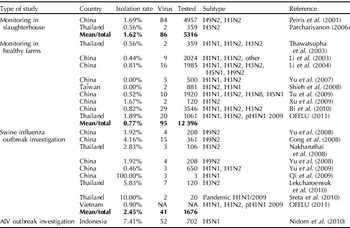
We identified four different study designs involving virus isolation. One approach consisted of systematic visits to slaughterhouses to collect samples in both healthy and formerly sick pigs. A second approach, also often related to national surveillance programs, consisted of single or repeated sample collection in randomly selected farms. Although selected farms usually had predominantly healthy pigs, some specimens were collected from sick animals. Nine other studies published in China and Thailand were based on the detection and reporting of outbreaks on pig farms, and on the viruses isolated from the sick animals. Finally, a single case study reported a high isolation rate of avian-origin SIV, obtained from an outbreak investigation of avian influenza virus (AIV), during outbreaks of H5N1 HPAI (highly pathogenic avian influenza) in poultry in Indonesia (Nidom et al., Reference Nidom, Takano, Yamada, Sakai-Tagawa, Daulay, Aswadi, Suzuki, Suzuki, Shinya, Iwatsuki-Horimoto, Muramoto and Kawaoka2010). The average isolation rates according to each approach are presented in Table 1. The isolation rate was significantly higher when samples were collected on clinically affected farms in comparison with other strategies (P<0.05). Surprisingly, the highest isolation rate was obtained in the study that investigated commercial farms near previous H5N1 outbreaks in poultry farms in Indonesia.
Virological surveys on swine Influenza in East and Southeast Asia published in the last 10 years

NA, not available.
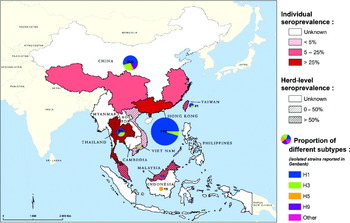
As of November 2011, genomic data from a total of 710 strains have been published in the GenBank database by authors from Hong Kong SAR, 205 by authors from the People's Republic of China (21 by authors from Taiwan), 61 by authors from Thailand, 15 by authors from Indonesia, 6 by authors from Vietnam and 1 by authors from Malaysia. Several strains collected during surveillance activities have been sequenced in Hong-Kong SAR through research on H1N1 pdm (Smith et al., Reference Smith, Vijaykrishna, Bahl, Lycett, Worobey, Pybus, Ma, Cheung, Raghwani, Bhatt, Peiris, Guan and Rambaut2009; Vijaykrishna et al., Reference Vijaykrishna, Smith, Pybus, Zhu, Bhatt, Poon, Riley, Bahl, Ma and Cheung2011). The relative distribution of each subtype, on the basis of the hemagglutinin subtype, is presented in Fig. 2.
Swine influenza in East and Southeast Asia. Isolated subtypes (GenBank), herd-level and individual seroprevalence of swine influenza type A last published in China (Liu et al., Reference Liu, Wei, Tong, Tang, Zhang, Fang, Yang and Cao2011), Taiwan (Shieh et al., Reference Shieh, Chang, Chen, Li and Chan2008), Malaysia (Suriya et al., Reference Suriya, Hassan, Omar, Aini, Tan, Lim and Kamaruddin2008), Thailand (Parchariyanon, Reference Parchariyanon2006) and Vietnam (Trevennec et al., Reference Trevennec, Mortier, Lyazrhi, Huong, Chevalier and Roger2011).

The first emergence of swine influenza in East and Southeast Asia was reported in 1969 in Taiwan during the Hong-Kong human epidemic involving H3N2 influenza virus (Kundin, Reference Kundin1970). The human-like H3N2 swine influenza virus spread within the Asian swine population along several reassortants, including human seasonal, classical swine and avian H5 viruses (Yu et al., Reference Yu, Zhang, Hua, Zhang, Liu, Liao and Tong2007; Cong et al., Reference Cong, Wang, Guan, Chang, Zhang, Yang, Wang, Meng, Ren, Wang and Ding2010; Ngo et al., Reference Ngo, Hiromoto, Pham, Le, Nguyen, Le, Takemae and Saito2011). This subtype has been reported in Hong-Kong SAR (Vijaykrishna et al., Reference Vijaykrishna, Smith, Pybus, Zhu, Bhatt, Poon, Riley, Bahl, Ma and Cheung2011), in mainland China (Yu et al., Reference Yu, Zhang, Hua, Zhang, Liu, Liao and Tong2007), in Taiwan (GenBank), in Thailand (Chutinimitkul et al., Reference Chutinimitkul, Thippamom, Damrongwatanapokin, Payungporn, Thanawongnuwech, Amonsin, Boonsuk, Sreta, Bunpong, Tantilertcharoen, Chamnanpood, Parchariyanon, Theamboonlers and Poovorawan2008; Takemae et al., Reference Takemae, Parchariyanon, Damrongwatanapokin, Uchida, Ruttanapumma, Watanabe, Yamaguchi and Saito2008) and in Vietnam (Ngo et al., Reference Ngo, Hiromoto, Pham, Le, Nguyen, Le, Takemae and Saito2011). Surveillance results have led to contradictory conclusions, but this subtype may still be spreading in China (Bi et al., Reference Bi, Fu, Chen, Peng, Sun, Wang, Pu, Zhang, Gao, Ma, Tian, Brown and Liu2010; Vijaykrishna et al., Reference Vijaykrishna, Smith, Pybus, Zhu, Bhatt, Poon, Riley, Bahl, Ma and Cheung2011).
The H1N1 subtype was first isolated in 1991 (Kupradinun et al., Reference Kupradinun, Peanpijit, Bhodhikosoom, Yoshioka, Endo and Nerome1991; Vijaykrishna et al., Reference Vijaykrishna, Smith, Pybus, Zhu, Bhatt, Poon, Riley, Bahl, Ma and Cheung2011). This classical swine virus lineage remained the predominant one since its emergence until 2002 (Vijaykrishna et al., Reference Vijaykrishna, Smith, Pybus, Zhu, Bhatt, Poon, Riley, Bahl, Ma and Cheung2011). This lineage or clustering reassortants have been reported in mainland China (Liu et al., Reference Liu, Wei, Tong, Tang, Zhang, Fang, Yang and Cao2011; Vijaykrishna et al., Reference Vijaykrishna, Smith, Pybus, Zhu, Bhatt, Poon, Riley, Bahl, Ma and Cheung2011), in Taiwan (Shieh et al., Reference Shieh, Chang, Chen, Li and Chan2008) and in Thailand (Chutinimitkul et al., Reference Chutinimitkul, Thippamom, Damrongwatanapokin, Payungporn, Thanawongnuwech, Amonsin, Boonsuk, Sreta, Bunpong, Tantilertcharoen, Chamnanpood, Parchariyanon, Theamboonlers and Poovorawan2008; Takemae et al., Reference Takemae, Parchariyanon, Damrongwatanapokin, Uchida, Ruttanapumma, Watanabe, Yamaguchi and Saito2008). The European avian-like H1N1 emerged in China in 1993 (Guan et al., Reference Guan, Shortridge, Krauss, Li, Kawaoka and Webster1996), long before the first report of the Eurasian avian-like H1N1, which emerged in 2001 and became the predominant H1 lineage since 2005 in China (Vijaykrishna et al., Reference Vijaykrishna, Smith, Pybus, Zhu, Bhatt, Poon, Riley, Bahl, Ma and Cheung2011) and Thailand (Takemae et al., Reference Takemae, Parchariyanon, Damrongwatanapokin, Uchida, Ruttanapumma, Watanabe, Yamaguchi and Saito2008). The US origin H1N2 has been reported since 2002 and is still circulating in China (Xu et al., Reference Xu, Zhu, Yang, Zhang, Qiao, Chen, Xin and Chen2009; Bi et al., Reference Bi, Fu, Chen, Peng, Sun, Wang, Pu, Zhang, Gao, Ma, Tian, Brown and Liu2010; Vijaykrishna et al., Reference Vijaykrishna, Smith, Pybus, Zhu, Bhatt, Poon, Riley, Bahl, Ma and Cheung2011) and Thailand (Takemae et al., Reference Takemae, Parchariyanon, Damrongwatanapokin, Uchida, Ruttanapumma, Watanabe, Yamaguchi and Saito2008). In 2009, the emergence of H1N1 pdm may be involved in some changes in the H1 distribution. This new virus has been isolated in China (Vijaykrishna et al., Reference Vijaykrishna, Smith, Pybus, Zhu, Bhatt, Poon, Riley, Bahl, Ma and Cheung2011) and Thailand (Sreta et al., Reference Sreta, Tantawet, Na Ayudhya, Thontiravong, Wongphatcharachai, Lapkuntod, Bunpapong, Tuanudom, Suradhat, Vimolket, Poovorawan, Thanawongnuwech, Amonsin and Kitikoon2010). This lineage is currently spreading in swine, and the first reassortants with a swine influenza virus have been identified in Hong-Kong SAR (Vijaykrishna et al., Reference Vijaykrishna, Poon, Zhu, Ma, Li, Cheung, Smith, Peiris and Guan2010).
Pig infections with H5N1 and H9N2 avian-origin viruses have only been reported in Asia. The HPAI H5N1 subtype has been isolated several times from Chinese (Zhu et al., Reference Zhu, Yang, Chen, Cao, Zhong, Jiao, Deng, Yu, Yang, Bu, Kawaoka and Chen2008) and Indonesian pigs (Takano et al., Reference Takano, Nidom, Kiso, Muramoto, Yamada, Shinya, Sakai-Tagawa and Kawaoka2009; Nidom et al., Reference Nidom, Takano, Yamada, Sakai-Tagawa, Daulay, Aswadi, Suzuki, Suzuki, Shinya, Iwatsuki-Horimoto, Muramoto and Kawaoka2010), with evidence of pig-to-pig transmission of an HPAI H5N1 avian-origin virus in Indonesia (Nidom et al., Reference Nidom, Takano, Yamada, Sakai-Tagawa, Daulay, Aswadi, Suzuki, Suzuki, Shinya, Iwatsuki-Horimoto, Muramoto and Kawaoka2010). The avian H9N2 subtype has been reported in China and Hong Kong SAR on several occasions (Peiris et al. Reference Peiris, Guan, Markwell, Ghose, Webster and Shortridge2001; Cong et al., Reference Cong, Wang, Yan, Peng, Jiang and Liu2008; Yu et al., Reference Yu, Hua, Wei, Zhou, Tian, Li, Liu and Tong2008, Reference Yu, Zhou, Li, Ma, Yan, Wang, Yang, Huang and Tong2011). Unusual subtypes have also been isolated sporadically, including the equine-origin H3N8 (Tu et al., Reference Tu, Zhou, Jiang, Li, Zhang, Guo, Zou, Chen and Jin2009) and the avian-origin H6N6 (Zhang et al., Reference Zhang, Kong, Qi, Long, Cao, Huang, Qi, Cao, Wang, Zhao, Ning, Liao and Wan2011).
Serological data
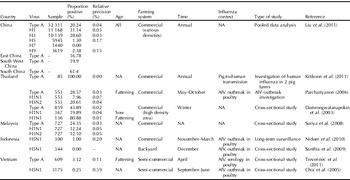
Since a detailed review was performed in China in 2011 (Liu et al., Reference Liu, Wei, Tong, Tang, Zhang, Fang, Yang and Cao2011), we did not perform additional analysis for this country. The synthesis of seroprevalence studies at the individual level was thus computed on the basis of 9 references. The average seroprevalence of influenza type A could be extracted or computed on the basis of the literature review in China (Liu et al., Reference Liu, Wei, Tong, Tang, Zhang, Fang, Yang and Cao2011), three references in Thailand (Damrongwatanapokin et al., Reference Damrongwatanapokin, Parchariyanon and Pinyochon2003; Parchariyanon, Reference Parchariyanon2006; Kitikoon et al., Reference Kitikoon, Sreta, Tuanudom, Amonsin, Suradhat, Oraveerakul, Poovorawan and Thanawongnuwech2011), one reference in Malaysia (Suriya et al., Reference Suriya, Hassan, Omar, Aini, Tan, Lim and Kamaruddin2008) and one in Vietnam (Trevennec et al., Reference Trevennec, Mortier, Lyazrhi, Huong, Chevalier and Roger2011). As shown in Table 2, the seroprevalence of influenza A ranges from 3.1% in semi-commercial pig farms in the spring in Vietnam (Trevennec et al., Reference Trevennec, Mortier, Lyazrhi, Huong, Chevalier and Roger2011) to an average of 61.4% in industrial pig farms in south China (Liu et al., Reference Liu, Wei, Tong, Tang, Zhang, Fang, Yang and Cao2011). Pigs from all age groups from two farms that were tested in Thailand in 2011 were found seropositive to swine influenza (Kitikoon et al., Reference Kitikoon, Sreta, Tuanudom, Amonsin, Suradhat, Oraveerakul, Poovorawan and Thanawongnuwech2011).
Serological surveys on swine influenza in East and Southeast Asia in the last 10 years

NA, not available.
The proportion of each subtype was provided from the pooled data analysis in China, in which H1, H3, H5, and H9 subtypes were tested (Liu et al., Reference Liu, Wei, Tong, Tang, Zhang, Fang, Yang and Cao2011), from studies in Thailand on H1N1 and H3N2 subtypes (two publications) (Damrongwatanapokin et al., Reference Damrongwatanapokin, Parchariyanon and Pinyochon2003; Parchariyanon, Reference Parchariyanon2006) and Malaysia (one publication), where H1N1 and H3N2 were tested (Suriya et al., Reference Suriya, Hassan, Omar, Aini, Tan, Lim and Kamaruddin2008). The overall results indicate a higher proportion of H1N1 in comparison with other subtypes, which is consistent with the virus isolation data. There has been an increase in seroprevalence of H1N1 over the last 10 years in China (Liu et al., Reference Liu, Wei, Tong, Tang, Zhang, Fang, Yang and Cao2011), whereas the H3N2 seroprevalence has been decreasing (Song et al., Reference Song, Xiao, Huang, Fu, Jiang, Kitamura, Liu, Liu and Gao2010), except in Thailand, where it remains as the predominant subtype (OFFLU, 2011).
Although Asian pigs have been largely exposed to the HPAI H5N1 virus in the last 10 years, there is no serological evidence that the virus can spread significantly within swine populations. Surveillance results over large samples indicate that H5N1 may spread at a very low level in swine populations in Vietnam and Thailand with a seroprevalence of 0.25% (n=3000) (Choi et al., Reference Choi, Nguyen, Ozaki, Webby, Puthavathana, Buranathal, Chaisingh, Auewarakul, Hanh, Ma, Hui, Guan, Peiris and Webster2005) and 1% (n=300) in Indonesia (Santhia et al., Reference Santhia, Ramy, Jayaningsih, Samaan, Putra, Dibia, Sulaimin, Joni, Leung, Sriyal, Peiris, Wandra and Kandun2009; Nidom et al., Reference Nidom, Takano, Yamada, Sakai-Tagawa, Daulay, Aswadi, Suzuki, Suzuki, Shinya, Iwatsuki-Horimoto, Muramoto and Kawaoka2010). Investigations on H5N1 AIV outbreaks in poultry did not detect systematic evidence of H5N1 infection in pigs (Parchariyanon, Reference Parchariyanon2006; Santhia et al., Reference Santhia, Ramy, Jayaningsih, Samaan, Putra, Dibia, Sulaimin, Joni, Leung, Sriyal, Peiris, Wandra and Kandun2009; Song et al., Reference Song, Xiao, Huang, Fu, Jiang, Kitamura, Liu, Liu and Gao2010; Trevennec et al., Reference Trevennec, Mortier, Lyazrhi, Huong, Chevalier and Roger2011).
The H4 subtype has been measured in only one study in China and its relative seroprevalence appears to be important with up to 15% of pigs positive (Ninomiya et al., Reference Ninomiya, Takada, Okazaki, Shortridge and Kida2002). The H9 subtype seroprevalence has been evaluated only in China and was found in less than 3% of tested animals (Song et al., Reference Song, Xiao, Huang, Fu, Jiang, Kitamura, Liu, Liu and Gao2010; Liu et al., Reference Liu, Wei, Tong, Tang, Zhang, Fang, Yang and Cao2011).
The herd-level seroprevalence of swine influenza type A was computed for three countries: 17.1% in Vietnam (Trevennec et al., Reference Trevennec, Mortier, Lyazrhi, Huong, Chevalier and Roger2011), 60% in China (Taïwan) (Shieh et al., Reference Shieh, Chang, Chen, Li and Chan2008) and 83% in Malaysia (Suriya et al., Reference Suriya, Hassan, Omar, Aini, Tan, Lim and Kamaruddin2008).
Risk factors
Variables extracted from selected references allowed us to identify some risk factors for swine influenza. Seroprevalence of swine influenza in East and Southeast Asia has an epidemic peak during the fall and the winter seasons (Li et al., Reference Li, Xin, Yang, Li, Qin, Xuehui, Chen, Yu, Bi and Tong2003; Shieh et al., Reference Shieh, Chang, Chen, Li and Chan2008) and decreases in the spring (Trevennec et al., Reference Trevennec, Mortier, Lyazrhi, Huong, Chevalier and Roger2011), which is similar to the seasonal pattern described in Europe or the USA (Olsen et al., Reference Olsen, Brown, Easterday and Van Reeth2006). However, in Northern countries, multiple studies have shown that the disease can be observed all year round due to the total confinement of animals in industrial production (Olsen et al., Reference Olsen, Brown, Easterday and Van Reeth2006). In East and Southeast Asia, since the majority of pigs are kept in open houses (Bastianelli et al., Reference Bastianelli, Derail and Klotz2007), we assume that the seasonality is an important pattern of the disease. The seroprevalence of influenza A is also associated with high-level animal densities (Liu et al., Reference Liu, Wei, Tong, Tang, Zhang, Fang, Yang and Cao2011).
Farm-level risk factors of swine influenza have been poorly investigated. A study undertaken in Malaysia, identified farm size, purchase of pigs, presence of domestic pets and avian species on the farm site, and distance to the closest neighboring farm as major risk factors for swine influenza (Suriya et al., Reference Suriya, Hassan, Omar, Aini, Tan, Lim and Kamaruddin2008). In Vietnam, high seroprevalence is associated with breeding farms that produce 20–40 pigs per year (Trevennec et al., Reference Trevennec, Mortier, Lyazrhi, Huong, Chevalier and Roger2011). Surprisingly, the presence of poultry on a farm was shown to decrease the risk of swine influenza infection. The authors suggest that instead of poultry, seropositive farms mainly have mammalian pets such as cats and dogs, which has already been found to increase the risk of swine infection by influenza viruses (Suriya et al., Reference Suriya, Hassan, Omar, Aini, Tan, Lim and Kamaruddin2008). Poultry was also not associated with the risk of swine influenza in a longitudinal survey in Chinese smallholders (Shu et al., Reference Shu, Zhou, Sharp, He, Zhang, Zou and Webster1996), and in a cross-sectional survey in a semi-commercial system in Vietnam (Trevennec et al., Reference Trevennec, Mortier, Lyazrhi, Huong, Chevalier and Roger2011). Specific studies have also been conducted in pig farms during avian influenza H5N1 outbreaks in poultry in Taiwan (Shieh et al., Reference Shieh, Chang, Chen, Li and Chan2008), Thailand (Parchariyanon, Reference Parchariyanon2006) and Indonesia (Nidom et al., Reference Nidom, Takano, Yamada, Sakai-Tagawa, Daulay, Aswadi, Suzuki, Suzuki, Shinya, Iwatsuki-Horimoto, Muramoto and Kawaoka2010). Even though the AIV has been isolated from pigs, no increase in seroprevalence was observed in swine (Nidom et al., Reference Nidom, Takano, Yamada, Sakai-Tagawa, Daulay, Aswadi, Suzuki, Suzuki, Shinya, Iwatsuki-Horimoto, Muramoto and Kawaoka2010). In the framework of the pandemic H1N1/2009 in pig farms, epidemiological investigations are ongoing but, to our knowledge, no results have been published to date (OFFLU, 2010).
Discussion
Data on swine influenza in East and Southeast Asia have been provided in greater quantity and quality over the last 3 years. This increase may be due to greater investment and improvement of surveillance networks on influenza viruses in domestic animals in some countries and a higher interest in swine in the scientific community. Both are direct consequences of the H5N1 HPAI crisis in 2005 and the recent emergence of H1N1 pdm in 2009. The latter may also be the reason for which the number of synthesis articles or reviews, such as pooled data analyses, has increased in 2009–2010. Nevertheless, published data are provided by a small number of countries, notably China and Thailand. The map of the region (Fig. 2) highlights the limited knowledge on viral circulation in the whole region, especially in the centrally located countries. There were no data on swine influenza in Cambodia, Myanmar and Lao PDR; although it is likely that these countries are as affected as their neighbors. Varying levels of economic development may partially explain this observation as this is linked to surveillance capacity.
There have been several emergences of swine influenza in the region, and also considerable evidence of multiple introductions of H1 North American reassortants and avian-like H1 European strains. Such intercontinental flows increase the risk of genetic reassortments between strains from different geographical origins. This idea is well illustrated by the genesis of H1N1 pdm (i.e. reassortment between North American triple reassortants and Eurasian Avian-like viruses), which probably occurred in Asia (Smith et al., Reference Smith, Vijaykrishna, Bahl, Lycett, Worobey, Pybus, Ma, Cheung, Raghwani, Bhatt, Peiris, Guan and Rambaut2009). Generally, the phylogenetic diversity of swine influenza virus is greater in Eurasia than in North America and both populations are becoming more diverse over time (Shi et al., Reference Shi, Lei, Zhu, Sievers and Higgins2010). East and Southeast Asia are considered to be the influenza ‘epicentre’, especially because of high animal densities, the mixing of animal species and low levels of biosecurity (Shortridge and Stuart-Harris, Reference Shortridge and Stuart-Harris1982). Indeed, such epidemiological context may favor viral spread and the local genetic diversity of influenza viruses. However, the globalization of the pig market, including live animal movements, may cause viral diffusion worldwide, suggesting that some general trends may be observed at various locations. The frequency of the Asian origin human-like H3N2 seems to have decreased not only in Southeast Asia but also in both America and Europe (Vincent et al., Reference Vincent, Ma, Lager, Janke and Richt2008; Kuntz-Simon and Madec, Reference Kuntz-Simon and Madec2009). Because the Southeast Asian pork market is highly connected, inter- and intra-continental surveillance of gene flows will benefit the region.
Repeated interspecific transmissions of avian or human viruses in pigs are more frequently reported in Asia than in the other continents, which underline the importance of monitoring cross-species transmission of influenza viruses in this region. However, low seroprevalences of H5 and H9 subtypes in swine also show that despite their constant exposure to avian viruses, pigs remain poorly infected by these subtypes. This leads to the following question: are such avian influenza infections in pigs more likely to give rise to emerging strains if they are driven by repeated cross-species introductions or by low-level transmission of AIVs among pigs?
This literature review shows low isolation rates and underlines the requirement for large sample collections for virological surveillance. This may in part be related to the short shedding period, freezing and thawing of swabs, and also poor cold chain management as viral isolation could not be done in local laboratories. An option for increasing the isolation rate is to collect more samples from pigs on clinically affected farms. Unfortunately, no clear case definition of a suspect farm remains and swine infection may be asymptomatic. Furthermore, since the influenza virus is a major agent of porcine respiratory disease complex and may be associated with other pathogens, such as the porcine reproductive and respiratory syndrome virus (Nakharuthai et al., Reference Nakharuthai, Boonsoongnern, Poolperm, Wajjwalku, Urairong, Chumsing, Lertwitcharasarakul and Lekcharoensuk2008; Yu et al., Reference Yu, Hua, Wei, Zhou, Tian, Li, Liu and Tong2008), the influenza virus cannot be monitored as a unique pathogen and a global surveillance system of respiratory syndromes on pig farms is required. Such clinical surveillance requires heavy investments to set up an efficient surveillance network, the ability to report clinical cases on time, and the capacity to manage large sample collections from collection to analysis. Some countries will have fewer resources at their disposal than others, and may meet various barriers in the field.
Firstly, the effective participation of swine workers to report clinically affected animals may vary greatly with the industry sector, which is constituted in East and Southeast Asia of about 80% small-scale production systems and 20% medium- to large-scale production systems (ACIAR, 2002; Cocks et al., Reference Cocks, Abila, Bouchot, Benigno, Morzaria, Inthavong, Long, Bourgeois-Luthi, Scoizet and Sieng2009). In the small-scale and family production sector, pigs do not represent a major source of family income (ACIAR, 2002; Cocks et al., Reference Cocks, Abila, Bouchot, Benigno, Morzaria, Inthavong, Long, Bourgeois-Luthi, Scoizet and Sieng2009). The lack of disease awareness and the lack of concern for biosecurity may be frequent and cause under-reporting. In the medium- to large-scale commercial sector, even though the awareness of swine workers is supposed to be higher (Cocks et al., Reference Cocks, Abila, Bouchot, Benigno, Morzaria, Inthavong, Long, Bourgeois-Luthi, Scoizet and Sieng2009), there may be reluctance to report symptoms to the authorities, which may incur much heavier economic losses (weak or no compensation). Secondly, the lack of reference laboratories with swine influenza expertise is well recognized in East and Southeast Asia (OFFLU, 2011), and virological assays, such as real-time PCR, virus isolation or sequencing are not available in all countries (Inui, Reference Inui2009). Given these concerns, the clinical and virological surveillance programs of swine influenza and emerging influenza viruses in swine in East and Southeast Asia must include a capacity building component and the development of partnerships among laboratories for the sharing of expertise and eventually for organization of shipments.
In brief, virus isolation is essential to track gene flows, to improve diagnosis and to produce vaccines. However, in developing countries, where technical capacities and financial resources may be limited, we have identified three main critical points related to the development of an efficient surveillance network: the risk of under-reporting of clinical cases, the lack of laboratory capacity and difficulties in managing large numbers of samples, including collection, storage and analyses. Surveillance of swine influenza in the region needs to be based on simple, low-cost activities adapted to the context and capacities of each country.
Serologic surveillance is often thought of as having limited value because of the endemic status of swine influenza, as well as the use of vaccination in some countries. Thus, positive results are not specific to emergence and serological test interpretations are challenged by cross-reactivity. This explains why serological studies may be neglected in comparison with virological studies. Nevertheless, the large majority of pig farms in East and Southeast Asia are not vaccinated against influenza. We suggest that the serological tool may be exploited in East and Southeast Asia, because it offers the opportunity to perform large numbers of tests easily, rapidly and at relatively low cost.
A serious lack of knowledge about the disease determinants, including farming systems, commercial practices and environment was observed. Further studies need to be conducted to identify (i) the annual and seasonal fluctuations in seroprevalence, (ii) the relative proportions of circulating subtypes and (iii) at-risk populations. This information will help (i) to target the virological surveillance on at-risk time and location, (ii) to identify emerging subtypes using adapted serological testing and (iii) to plan sentinel surveillance based on serological profiles. Studies on these various surveillance options are ongoing and will be discussed after completion.
Conclusion
The published literature on swine influenza in East and Southeast Asia has improved our knowledge on virology in the last decade. Improvement in surveillance systems is essential to better track the virus in the entire region, in order to identify inter- and intra-continental gene flow. However, molecular analyses require high laboratory capacities and large sample collections. In East and Southeast Asia, surveillance networks are unequally efficient, depending on the country. Faced with limited resources, there is a need to develop modern and highly cost-effective alternative strategies. In a context of weak infrastructure and of a lack of laboratory capacity, serological data would help to improve surveillance activities by detecting some past and recent emergences. Further development of surveillance strategies, using sero-epidemiological data and other health indicators is under consideration.
Acknowledgements
This study was mainly funded by the French Ministry of Foreign Affairs (MAE) via the FSP project (GRIPAVI 2006-26) and the Lavoisier Program for scholarship. Special thanks to Marie Gély, from CIRAD for her support on mapping tools and Marisa Peyre, from CIRAD for assistance.