Political consulting is not a wholly new enterprise. Advisers have provided services informally to politicians for centuries. In recent years, however, political consulting has become increasingly formalized. Sabato (1981) offers an operational definition of contemporary political consultants: a campaign professional who is engaged primarily in the provision of advice and services (such as polling, media creation and production, direct mail fundraising) to candidates, their campaigns, and other political committees. Fueled primarily by developments in the United States, the political consulting industry experienced tremendous growth in the 20th century since the establishment of the first modern political consulting firm in 1934 (Friedenberg 1997; Baumgartner 2000; Thurber and Nelson 2000; Lathrop 2003; Plasser and Plasser 2002). Presidential candidates have sought the expertise of political marketing professionals consistently since Alfred Landon's 1936 campaign (Baumgartner 2000). Since 1969, when Joseph Napolitan (who had worked on Hubert Humphrey's campaign in 1968) founded the American Association of Political Consultants with 25 members, the organization has grown substantially, currently boasting over 4,000 members. (Baumgartner [2000] estimates the number of political consultants across the United States to exceed 35,000.) This proliferation of political consultants instigated the formation of an industry that has become increasingly specialized and professionalized (Thurber 1998; Baumgartner 2000).
Scholars who have monitored and evaluated the growth in the political consulting industry offer mixed assessments of its normative implications. In one of the earliest works, Kelley (1956) expresses skepticism about adopting corporate tactics in electoral politics. Nimmo (1970) is similarly apprehensive. Later studies more explicitly condemn the industry. Rosenbloom (1973), for example, suggests consultants violate the principles of democratic accountability (as does Lathrop 2003); Sabato (1981) is equivocally pessimistic. Survey research suggests the American public is equally unenthusiastic, consistently expressing less satisfaction with political consultants than with other groups of political actors, including lobbyists and elected officials (Panagopoulos and Thurber 2003). Even as a few studies take a more optimistic viewpoint (e.g., Luntz 1988), political scientists have generally been offended by consultants' “cavalier approach to the linchpin of democracy and their tendency to mock the sanctity of elections” (Lathrop 2003, 173).
Criticism aside, this relatively new set of political actors plays an influential role in election outcomes. Herrnson (1995) has shown that campaigns that hire consultants are more successful in fundraising than those that do not, for example. Medvic and Lenart (1997) find that the presence of a professional consultant on a campaign increases the candidate's voteshare by 5 percentage points on average, even after controls for spending and candidate quality are taken into consideration. Moreover, the authors find that a candidate's voteshare rises by 2.5 percentage points for each additional consultant hired by the campaign (Medvic and Lenart 1997).
In the era of candidate-centered campaigns (Wattenberg 1990) in which political parties are no longer the primary sponsors, orchestrators, and executors of electoral campaigns on behalf of candidates, the demand for professional expertise in campaign management has grown. To meet this demand, increasingly more academic institutions nationwide have developed formal training programs in campaign management. Leading universities offer specialized graduate and professional degrees. It is clear that the political consulting industry has matured substantially over the past three decades.
To what extent has the phenomenon of the emergence and growth of the political consulting industry over the past few decades attracted the interest and attention of the media? As campaign professionals have become ubiquitous, have media outlets and journalists increasingly turned their attention to this set of political actors? In theory, increased media attention to political consultants could have broad implications, including raising the profile of the industry, expanding public awareness of behind-the-scenes political actors, and generating higher demand for specialized consulting services amongst candidates and political organizations at all levels of government. This paper focuses on tracking media attention to political consultants.
Data and Methodology
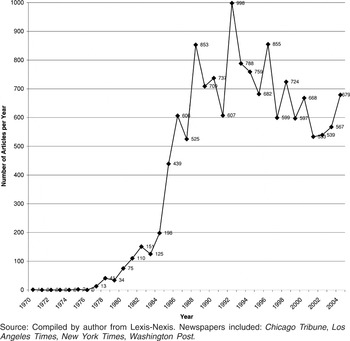
Documenting patterns of media attention to political consultants over the past few decades is essentially an empirical matter. To conduct such an analysis, I compile data acquired from Lexis-Nexis. I count the total number of articles that appeared in four major national newspapers (New York Times, Washington Post, Los Angeles Times, and Chicago Tribune) that included explicit mentions of “political consultants.” Cumulative data for each year from 1970 to 2004 is displayed in Figure 1.

Media Mentions of Political Consultants (Major Newspapers)
Analysis and Discussion
The data presented in Figure 1 confirm a pattern of dramatic growth in media attention to the political consulting industry over the period 1970–2004. While political consultants were scarcely mentioned in the 1970s, the number of mentions climbed steadily during the 1980s. Seventy-five mentions of political consultants appeared in the outlets included in the study in 1980, more than doubling from 34 in 1979. By 1985, there were 439 mentions of political consultants and 737 in 1990. The data indicate a steady growth in the media's attention to political consultants throughout the 1980s and early 1990s, reaching a maximum of 998 mentions in 1992. Mentions appear to stabilize in the 1990s and into the new millennium.
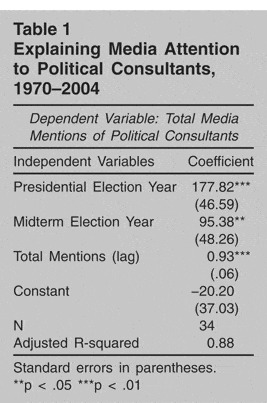
The data presented in Figure 1 suggest a strong upward trend in media attention to political consultants over this period. Still, the level of media attention may vary as a consequence of other factors, including the context of election cycle. I conduct a multiple regression analysis to examine the influence of election cycle context and to help explain overall variation in media attention to political consultants further. The model I estimate explains the total number of mentions of political consultants in each year included in the analysis as a function of the election cycle context (presidential or midterm cycle; off-year cycles is the base category). I also include a lagged dependent variable in the model to account for autocorrelation. The results of the analysis are presented in Table 1. The findings reveal that media attention to political consultants is highest during presidential years. The data also show that midterm election cycles typically generate increased media interest in political consultants than do off-year cycles.
Explaining Media Attention to Political Consultants, 1970–2004

These findings suggest the media's attention to the political consulting industry grew substantially between the 1970s and the early 1990s. Media attention to political consultants appears to have reached a point of saturation since the mid-1990s, although it has remained relatively high. To some extent, these results buttress the claims of explosive growth of the political consulting industry advanced by other researchers. In fact, the increased media attention I observe to the political consulting profession may have helped to fuel part of the industry's expansion and professionalization. It is also conceivable that increased media attention to political consulting boosted overall public awareness of this set of political professionals, although the lack of available data makes it difficult to evaluate this supposition. Nevertheless, survey research suggests the public remains largely unfamiliar with political consultants (Panagopoulos and Thurber 2004). Despite increases in the media's attention to political consultants, Murray Chotiner,1
Political consultant on Richard Nixon's campaign for president in 1968.
Created the infamous “Daisy Ad” for the Lyndon B. Johnson campaign in 1964 as well as media campaigns for over 200 other candidates including President Jimmy Carter in 1976.
Political consultant for Bill Clinton in 1992, Al Gore in 2000 and John Kerry in 2004.
Author Bio
Costas Panagopoulos is a postdoctoral fellow at the Institution for Social and Policy Studies as Yale University. He is also visiting assistant professor and director of the Elections and Campaign Management program at Fordham University.