
I. INTRODUCTION
Under the harsh service environment of hot die casting molds, thermal fatigue cracking is one of the most important failure modes. In previous studies, improving the thermal fatigue resistance has been mainly focused on the optimization of alloy composition, heat treatment, and surface treatment. Reference Skumavc, Tusek, Nagode and Klobcar1–Reference Kundalkar, Mavalankar and Tewari5 Refining the grain size and microstructure are beneficial to improve the thermal fatigue resistance, the morphology and distribution of carbides in die steel have a close relationship with the thermal fatigue properties of the steel.
Secondary carbides have been recognized as an important strengthening mechanism in die steel. The alloying elements, such as Cr, Mo, and V, precipitate in martensite as carbides during tempering, and contribute to the mechanical properties of die steel via grain refinement, solid solution hardening, and precipitation hardening. Tiny carbides can hinder the grain growth and the expansion of the fatigue crack, in addition, the diffuse distribution of carbides can increase the thermal resistance of die steel, thus improving the thermal fatigue resistance of steel. However, bulky carbides along the grain boundary will deteriorate the thermal fatigue resistance of steel, because thermal fatigue crack prefers to expand along them. An important aspect of thermal fatigue crack initiation and propagation mechanism in hot-work die steel is the growth of carbides and the difference of the expansion coefficient between carbides and matrix, which causes cracks to initiate on the grain boundary. Reference Xia, Chen, Ge and Wang6 Increasing of tempering temperature will result in precipitation and coarsening of spherical carbides, and this is the main cause of the performance degradation. Reference Zhou, Wu, Shi, Li and Min7 If the coarsening of fine carbides can be postponed, the tempering and thermal fatigue resistance will be improved.
Generally, spheroidization, dissolution, coagulation and growth of carbides will happen within each reheating/deformation cycle to reach the lowest surface energy of particles. Reference Bombac, Fazarinc, Saha Podder and Kugler8 Though there are sufficient researches to show that deformation significantly enhances precipitation kinetics (i.e., strain-induced precipitation), most of the researches are on superalloy tested near the austenitizing temperature experienced a much greater deformation. Reference Pohl, Lang and Schatte9–Reference Huang, Yang, Gao, Wu and Li13 The precipitation behavior of carbides in hot-work die steel during strain-controlled test has received much less attention.
Mechanical and thermal stress fluctuations initiate fine cracks that grow larger and finally lead to failure of hot-work dies. Reference Mellouli, Haddar, Koster and Ferid Ayedi14 Because it is difficult to distinguish the effect of mechanical strain on the microstructure when the temperature and strain fields vary simultaneously. This work was mainly focused on the uniaxially loaded strain-controlled tests with different mechanical strains at a constant temperature. The effect of mechanical strain amplitude on the morphology and distribution of carbides in hot-work die steel specimens was compared and investigated.
II. EXPERIMENTAL PROCEDURES
A. Material and heat treatment
The investigated material is AISI H13 hot-work die steel, which is wildly used in the high pressure die casting and forging industry. Its chemical composition is shown in Table I. The heat treatment includes austenitizing for 30 min at 1030 °C in vacuum furnace, followed by oil cooling to room temperature and finally tempering twice for 2 h at 590 °C. After heat treatment, the hardness of H13 steels reach 45–47 HRC.
Chemical composition of the researched H13 steel.

B. Strain-induced precipitation tests
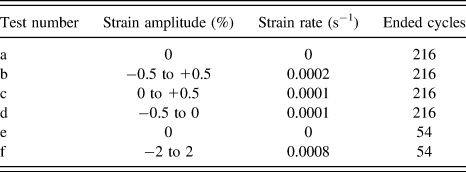
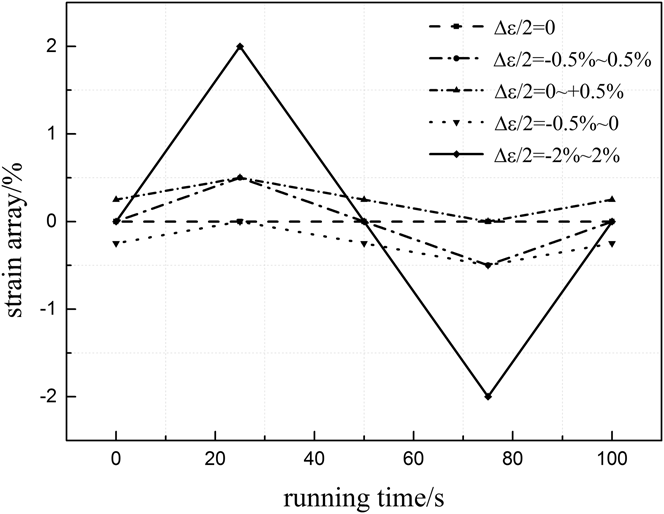
This experiment was carried out by the MTS Landmark Servohydraulic Test System (USA) which is appended with a TruHeat HF 3010 type electromagnetic induction power supply (Huttinger Elektronik GmBH, Freiburg, Germany) and a FlexTest 40 controller (MTS Systems Corp., Minneapolis, Minnesota). The tests were designed with mechanical strain amplitude of 0, −0.5% to 0.5%, 0 to 0.5%, −0.5% to 0, −2% to 2% at a constant temperature of 700 °C, with a cycle time of 100 s. Some of the tests were lasted for 6 h, which means 216 cycles (Table II) and the others were lasted for 1.5 h, means 54 cycles. The mechanical strain was loaded in the form of triangular (Fig. 1).
Key parameters of the tests.

Triangular strain waveform.

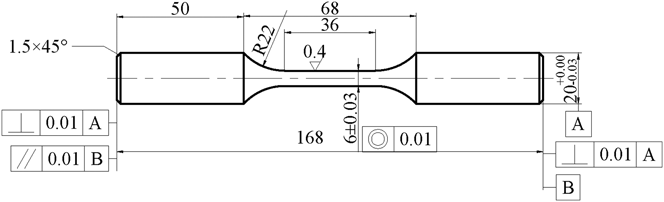
During the test, the surface temperature of the specimen was measured by a K-type Chromel-Alumel thermo-couple spot welded to the specimen. The standard shape and size of the specimen is shown in Fig. 2.
Geometry of the test specimen (mm).

C. Microstructure and microhardness observation
After the tests, all specimens were cut parallel to the loading direction for further investigation by Nikon LV 150 optical microscopy (Nikon Corp., Tokyo, Japan) and Zeiss Supra-40 scanning electron microscopy (SEM; Carl Zeiss AG, Jena, Germany). The metallographic samples were prepared through mechanical grinding and polishing and then were etched in 4% nital at room temperature for 10–15 s.
Specific information of carbides was detected by JEM-200CX transmission electron microscopy (TEM; JEOL Ltd., Tokyo, Japan). The TEM samples were prepared by carbon extraction replicas technique as follows. First, the polished samples were etched for 10–15 s in 4% nital. Then, a carbon coating was evaporated onto the polished and etched surface, followed by immersing the samples in 10% nital to detach the carbon layer from the specimens. The carbon replicas were recovered on round copper grids.
The hardness of each sample along the transverse direction after the tests was detected on MH-3 Microhardness Tester (Beijing Hai Cheng Xinfeng Science and Technology Co. Ltd., Beijing, China), with the loading of 500 g, and the result was an average of 5 measured values.
III. RESULTS AND DISCUSSION
A. Deformation of specimen
According to ASTM E 2368-04ε1 standard, during the thermal mechanical fatigue test, total strain, thermal strain, and mechanical strain have a relationship as follows:
 $${\varepsilon _{\rm{t}}} = {\varepsilon _{\rm{m}}} + {\varepsilon _{{\rm{th}}}}\quad .$$
εt—total strain, the strain component measured on the test specimen, and is the sum of the thermal strain and the mechanical strain. εth—thermal strain, the strain component resulting from a change in temperature under free expansion conditions. During the tests, εth = constant. εm—mechanical strain, the strain component resulting when the free expansion thermal strain is subtracted from the total strain.
When the sample was heated from ambient temperature to 700 °C, the thermal strain was obtained by the following equation:
 $${\varepsilon _{{\rm{th}}}} = \alpha \cdot \Delta T\quad .$$
Where α is the coefficient of thermal expansion of H13, it is about 1.35 × 10⁻⁵/°C Reference Peng, Jiejiang and Yamin15 ; ΔT is the change of the temperature. So εth (700 °C) ≈ 0.92%, during the test, it was calculated by the testing system automatically. Among the samples tested for 6 h, the total axial strain of the sample strained with Δε/2 = 0 to +0.5% is always the biggest because the loading direction is in line with the direction of thermal expansion, causing strain increases. Similarly, the axial total strain of the sample strained with Δε/2 = −0.5 to 0% is always the smallest because the loading direction is in the opposite direction of thermal expansion, offsetting part of the strain. Nevertheless, the total axial strain of the sample strain with Δε/2 = ±0.5% is more complicated, when the mechanical strain is tensile stress, the total axial strain is greater than that without mechanical strain, when the mechanical strain is compressive stress, the total axial strain is less than that without mechanical strain.
Figure 3 shows the optical micrographs of the polished metallographic specimens before etched. It is obvious to find that the edges of the samples without mechanical strain are smooth, while there are wrinkles in different degrees at the edges of b–d samples, and even some cracks can be observed at the edge of sample f, which indicates that a certain amount of deformation has happened on the samples with mechanical strain, and when the mechanical strain is bigger, it is much easier to initiate cracks. In addition, the deformation of sample c is more obvious than sample b and c, because it always has the bigger total axial strain for the loading mechanical strain is always tensile stress.
Optical micrographs of the specimens before etched (a) 6 h, Δε/2 = 0, (b) 6 h, Δε/2 = −0.5% to +0.5%, (c) 6 h, Δε/2 = 0 to +0.5%, (d) 6 h, Δε/2 = −0.5% to 0, (e) 1.5 h, Δε/2 = 0, and (f) 1.5 h, Δε/2 = −2% to +2%.

B. Microstructure
Microstructure of specimens after the tests were examined by SEM, as shown in Fig. 4 and 5. It is easy to know that the main microstructure of all the specimens is tempered martensite with many precipitated carbides. However, the amount, size, and shape of carbides vary significantly according to the test conditions. Most of the carbides are spherical but some long rod-shaped or irregular shape of carbides also exist, and those nonspherical carbides tend to be more bulky, whose size even exceed 200 nm. The testing temperature is much higher than the common tempering temperature of H13, so the matrix is highly recovered, and the precipitation and coarsening of carbides happen, different experimental conditions create different driving forces of precipitation and coarsening, which results in the differences of the size and morphology of carbides.
Distribution of carbides at the magnification of 5000 (a) 6 h, Δε/2 = 0, (b) 6 h, Δε/2 = −0.5% to +0.5%, (c) 6 h, Δε/2 = 0 to +0.5%, (d) 6 h, Δε/2 = −0.5% to 0, (e) 1.5 h, Δε/2 = 0, and (f) 1.5 h, Δε/2 = −2% to +2%.

Morphology of carbides at the magnification of 20,000 (a) 6 h, Δε/2 = 0, (b) 6 h, Δε/2 = −0.5% to +0.5%, (c) 6 h, Δε/2 = 0 to +0.5%, (d) 6 h, Δε/2 = −0.5% to 0, (e) 1.5 h, Δε/2 = 0, and (f) 1.5 h, Δε/2 = −2% to +2%.

Comparing with Fig. 4(a), the carbides in Figs. 4(b)–4(d) are obviously more bulky, while, the carbides in Fig. 4(f) are larger than that in Fig. 4(e), this is in coincidence with the deformation degree of each sample. Because deformation can enhance precipitation kinetics, bigger deformation results in a larger driving force of precipitation and coarsening. It means that external mechanical strain accelerated the precipitation and coarsening of carbides. And this is more obvious when the mechanical strain amplitude is larger and the testing time is shorter. It also can be found that the coarsening effect is more significant when the loaded mechanical strain is always tensile stress or compressive stress.
Overall, the carbides in Fig. 5(b) are finer than those in Figs. 5(c) and 5(d), though they are much bigger than those in Fig. 5(a). Meanwhile, comparing with Figs. 5(a), 5(c), and 5(d) not only have more carbides with large dimension, but also have many fine carbides, which indicates that external mechanical strain also promoted the precipitation of fine carbides.
In addition, the carbides of the samples tested for 1.5 h are obviously more than those of the specimens tested for 6 h. The reason is that with the extending of the testing time, the carbides continuously gather together and grow up, thus small carbides disappear, and larger size of carbides form.
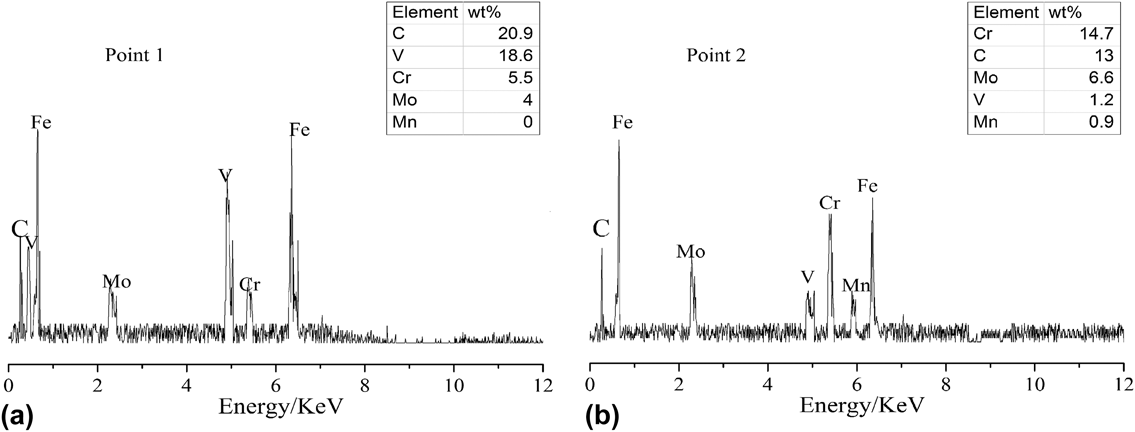
According to the EDS analysis (Fig. 6), most of the long rod-shaped precipitations are carbides riched in V or Mo, and the bulky carbides are more likely to be clusters of different kinds of carbides, most of which contain very high content of Cr, because the M23C6 type carbides rich in Cr are easier to agglomerate and grow up. During each reheating/deformation cycle, dissolution of fine carbides, agglomeration and growth of larger carbides are occurring to attain the lowest surface energy of the particles.
EDS analysis of the carbides 1, 2 in Fig. 5.

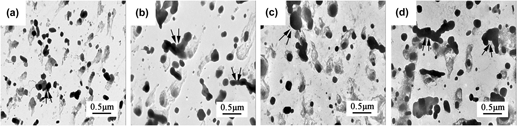
Samples prepared by carbon extraction replicas technique were detected by TEM to observe the morphology of carbides (Fig. 7).
Morphology of carbides detected by TEM (a) 6 h, Δε/2 = 0, (b) 6 h, Δε/2 = −0.5% to +0.5%, (c) 6 h, Δε/2 = 0 to +0.5%, and (d) 6 h, Δε/2 = −0.5% to 0.

TEM works confirm that the size of the carbides particles are mainly in the range of 30–200 nm, though several carbides are bigger than 200 nm. In addition, the carbides in mechanical strain-free specimen are on the whole relatively smaller, although a small amount of them reach the size of 100 nm, but most of them are long rod carbides with the length approximate to 100 nm. In contrast of the mainly spherical carbides in specimens b–d, there are obviously more rod-shaped carbides in sample a.
Figure 8 shows the different degrees of the coagulation of precipitates. The coagulation is more obvious in mechanical strained samples than that in mechanical strain-free sample. Most of the carbides bigger than 200 nm in Fig. 5 should be the result of the coagulations of the fine carbides in Fig. 8. Meanwhile, the amount of fine carbides doesn’t decrease significantly. The external mechanical strains enhanced the internal deformation of the samples, which produced more nucleation sites and accelerate the diffusion of solute atoms, so both the precipitation and coarsening of carbides were promoted by mechanical strains, and this is consistent with the result of SEM.
Coagulation of carbides detected by TEM (a) 6 h, Δε/2 = 0, (b) 6 h, Δε/2 = −0.5% to +0.5%, (c) 6 h, Δε/2 = 0 to +0.5%, and (d) 6 h, Δε/2 = −0.5% to 0.

C. Microhardness of samples
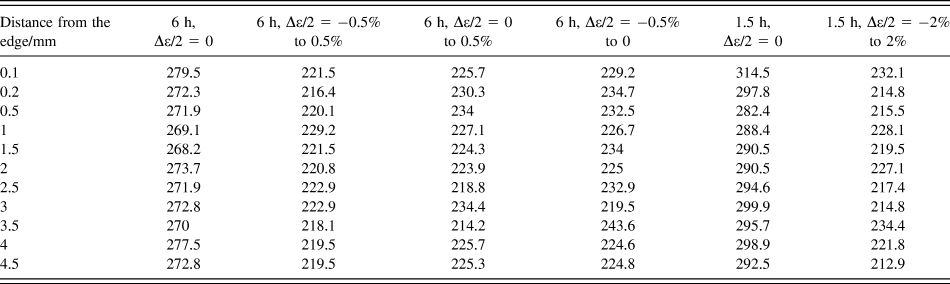
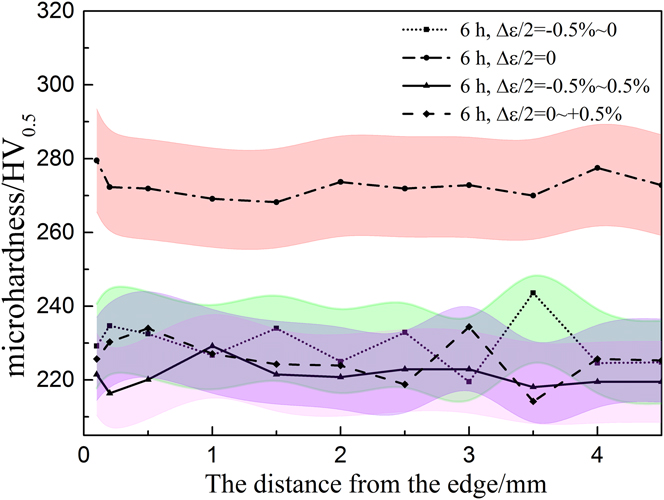
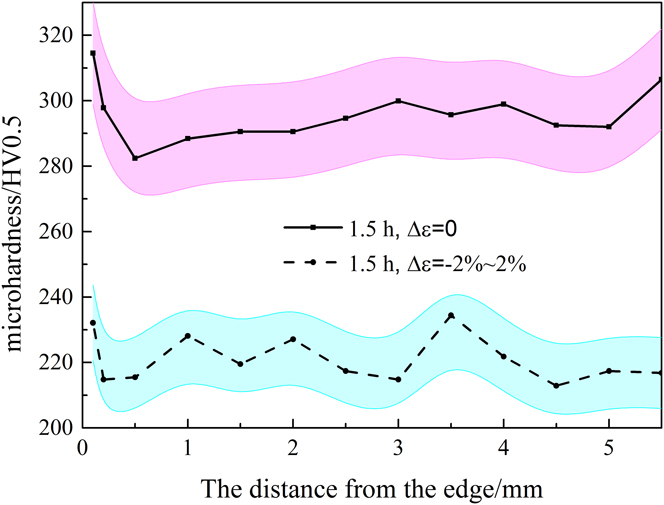
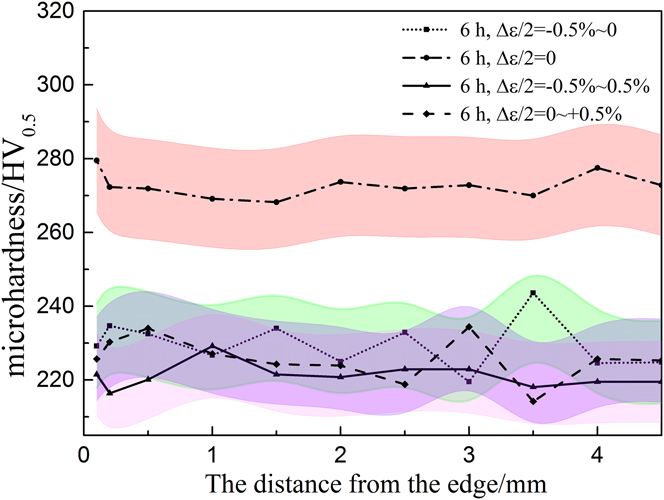
The microhardness of each sample along the transverse direction after the tests is presented in Table III, and the curves of microhardness versus the distance from the edge are shown in Fig. 9 and 10. It is easy to see that the hardness of the mechanical strained samples is much lower than that of the mechanical strain-free sample. The hardness of the sample with Δε/2 = ±0.5% holding for 6 h is lower than that of the mechanical strain-free sample at the same condition about 50 HV0.5, however, the hardness of the sample with Δε/2 = ±2% holding for 1.5 h is lower than that of the mechanical strain-free sample at the same condition about 75 HV0.5, from the different gaps we can conclude that the larger mechanical strain accelerated the cyclic softening process.
Microhardness of each sample along the transverse direction/HV0.5.

Microhardness of each sample tested for 6 h.
Microhardness of each sample tested for 1.5 h.

Because of the difference in free energy between the carbides and matrix, under the effect of long-term high temperature and stress, the precipitation and dissolution of carbides happen, and the size, distribution and morphology of the carbides will be altered. It is widely believed that tiny carbides are beneficial to the hardness of the matrix, because dispersion distribution of fine carbides can effectively pin the dislocation, increase the resistance of dislocation motion, so as to improve the thermal tempering stability and creep resistance of the material. Gathered or grown up carbides will weaken the dispersion strengthening effect, thereby reduce the matrix strength and hardness.
During the reheating/deformation cycles, the carbides at the grain boundary precipitate and grow up continuously; the tiny carbides in the intracrystalline dissolve and larger carbides grow up, so the size of carbides increased. As a result, precipitation, growth of carbides at the grain boundary and the coagulation of the carbides in the intracrystalline caused the change of the microstructure, and then caused the material softening. Reference Chen, Huang, Li and Jin16
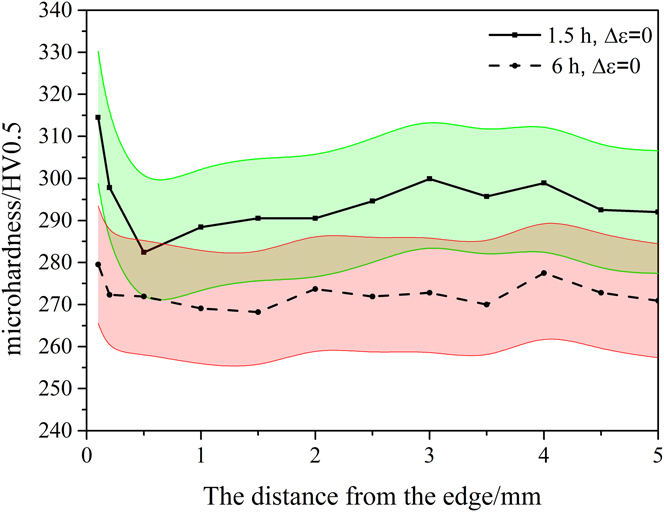
Figure 11 shows that the testing time is an important factor that affect the softening of the material during the service process, because the longer time insures the carbides have enough time to diffuse, gather and grow up, thus results in a decline of the hardness of the material.
Microhardness of samples with Δε/2 = 0 tested for 6 and 1.5 h.

D. Precipitation and coarsening of carbides
According to the classical nucleation theory, the carbides precipitation nucleation rate can be obtained as following Reference Zhang17 :
 $$I = {N_\beta }{{kT} \over h}\exp \left( { - {{{G^ * } + {Q^ * }} \over {kT}}} \right)\quad ,$$
 $${G^ * } = {{16\pi {\sigma ^3}V_{\rm{m}}^2} \over {3\Delta G_{\rm{m}}^2}}\quad ,$$
where Nβ is the number of nucleation sites; k and h are the Boltzman constant and Planck constant respectively; T is the absolute temperature;
 ${Q^*}$
is the activation energy for atoms to diffuse through the carbide/matrix interface;
 ${G^*}$
is the activation energy of carbides nucleation, σ is the specific surface energy of carbides; V
m is the molar volume of precipitated carbides; ΔG
m is the driving force of carbides precipitation.
The precipitation of the second phase in steel is in the control of the diffusion kinetic and thermodynamic driving force, improving the driving force of carbides precipitation can reduce nucleation activation energy, thus increasing the nucleation rate of carbides and decrease the size of carbides. Reducing the diffusion activation energy, increasing the diffusion ability of atoms, will be beneficial to the precipitation of carbides. Reference Jung, Park and Kim18–Reference Wang, Sun and Yang20
At a certain temperature, diffusion controls the process of deformation induced precipitation. The precipitation kinetics is determined by two main factors: the degree of supersaturation of the elements in the matrix; the diffusion capacity of the elements. Considering that carbon is interstitial atom and its diffusivity is much higher than that of substitutional components such as Cr, Mo, V, the diffusion of the Cr, Mo, V is considered to be the rate determining step of the growth and coarsening of carbides. Reference Mukherjee, Prahl and Bleck10,Reference Hu, Li, Wu and Zhang21
Yuna Wu et al. indicated that both temperature-induced and strain-induced of the alloy would result in dynamic precipitation, and the internal deformation strain had a greater impact than temperature on the dynamic precipitation. Reference Wu, Liao and Liu22 Many researches showed that deformation enhances precipitation kinetics, the defects existing in the matrix are the main cause of deformation induced precipitation. There are more activated dislocations in the matrix channel comparing with that in mechanical strain-free sample because of the larger deformation, which promotes the nucleation at dislocations and subgrain boundaries and thus resulting in numerous tiny particles are homogeneously observed in strained samples. Grain boundaries, subgrain boundaries, dislocations, dislocation nodes in the three-dimensional network of dislocations and the deformation zone act as preferential nucleation sites for the strain-induced precipitation, and the precipitation kinetics are greatly accelerated by the applied strain. The solubility of carbon in the matrix decreases when alloy is deformed by the axial tensile stress, so as to cause the carbon clustering in the regions of stress concentration and combining with carbide-forming elements such as Cr, Mo, V, which promotes the fine carbides to precipitate from the matrix. Reference Hong, Kim and Min23,Reference Xie, Yu and Sun24 Carbides precipitation effectively reduces the system energy, so the whole system will be in a more stable state. Reference Pohl, Lang and Schatte9–Reference Lang, Zhou and Hou12,Reference Jung, Park and Kim18
Many studies indicated that the coarsening kinetics of carbides follows the rule of Ostwald ripening as shown in the following equation:
 $${\bar r^n} - \bar r_0^n = Kt\quad .$$
Where
 $\bar r$
is the average radius,
 ${\bar r_0}$
is the original average radius, n is coarsening exponent, K is a constant that depends on the diffusivity, and t is the time. The role of interfacial energy, the carbon concentration distribution around different carbide particles was different, which cause carbon atoms surrounded by small particles to diffuse toward large particles and then precipitate, resulting in small particles gradually shrink and disappear, large particles grow rapidly, eventually leaving only large particles.
Reference Hu, Li, Wu and Zhang21,Reference Miyata, Omura and Kushida25
However, the effect of stress is not explicitly included in the coarsening equation. C.H. Iwashita et al. noted that when the material was exposed to stress, the coarsening rates were approximately three orders of magnitude greater than those in the stress-free case. Carbide coarsening process occurs by a combination of grain boundary and volume diffusion. Increasing volume or grain boundary both can reduce the activation energy barrier needed for the diffusing species to move to a new lattice point. The general form for such a reaction is:
 $$D = {D_0}\exp \left( { - {{\Delta {G_0} - \Delta G(\sigma )} \over {RT}}} \right)\quad .$$
Where ΔG 0 is the stress-free activation energy for diffusion, ΔG(σ) is the stress dependent contribution to the activation energy, and σ is the applied stress. Reference Iwashita and Wei26
Abu et al. Reference Kabir, Sanjari and Su27 indicated that the forming of strain-induced precipitates is a function of deformation temperature, strain, and strain rate. Generally, with the increasing of strain, precipitates increase, because the increased strain generates more nucleation sites, which accelerate the diffusion of solute atoms; the amount and coarsening degree of precipitates are higher at lower strain rates because lower strain rates ensure longer time to nucleate and grow.
The strain rate of 0.0002 s−1 in sample b leads to a deformation time of 25 s for a strain of 0.5, while the deformation time at a strain rate of 0.0001 s−1 in sample c or d is 50 s. This just can explain why the sizes of carbides in sample c and d are slightly bigger (Fig. 5), and the agglomeration of carbides is more obvious than that in sample b (Fig. 8).
IV. CONCLUSION
The results show that the mechanical load gives rise to the changes of the microstructure, and affect the properties of material ulteriorly. The following conclusions can be drawn:
-
(1) During each reheating/deformation cycle, dissolution of fine carbides, agglomeration and growth of larger carbides are occurring to reach the lowest surface energy of the particles.
-
(2) Comparing with mechanical strain-free sample, the coagulation of carbides is more obvious in mechanical strained samples.
-
(3) Mechanical load promotes the precipitation and coarsening of carbides. Mechanical strain amplitude and strain rate both affect the processes of precipitation and coarsening.
-
(4) Precipitation is increased by the strain enhanced because of more nucleation sites produced and accelerate the diffusion of solute atoms. Moreover, the results show that lower strain rates are more beneficial for precipitation and coarsening of carbides under the same strain because they provide a longer time to nucleate and grow into nuclei.
ACKNOWLEDGMENTS
This work is supported by the National Natural Science Foundation of China (grant number 51171104).