In December 2001 holiday shoppers in Buenos Aires could find a local version of the popular Monopoly board game called Deuda Eterna (“Eternal Debt”) on stores' shelves. In Deuda Eterna, players obtain capital and must maneuver around the board while avoiding a number of pitfalls: military coups, capital flight, protectionism in rich countries, and, worst of all, the International Monetary Fund (IMF). The players' goal is simple: “overcome the disadvantages and dispense with the IMF!”Footnote 1
International organizations (IOs) suffuse world politics, but as the existence of Deuda Eterna attests, the IMF stands out as an unusually important IO. The IMF wields its authority and largesse to orchestrate relations between governments and markets. Its resources are substantial: between January 2002 and July 2013 the IMF made more than $737.5 billion in funds available to needy members. And its policy tools are sharp. In exchange for access to funding, the IMF requires governments to agree to meet a set of policy targets. If the borrower fails to meet the targets, the IMF can turn off the flow of money to the government. The IMF's expansive mandate means that conditional lending is but one of the varied activities the institution pursues. Yet conditional lending is the reason many consider the IMF to be “the most powerful international institution in history.”Footnote 2
The conventional view of the IMF as a cookie cutter, rigidly prescribing the same medicine for different patients, has become inaccurate.Footnote 3 Scholars document significant variation in each of the three policy tools that make conditional lending possible: the relative size of loans, the extent of conditionality attached to loans, and the punishment for noncompliance.Footnote 4 Variation does not necessarily imply bias, however. Assume that IMF officials sincerely use available policy tools to maximize the probability that a program will succeed. Assume that borrowing governments vary along many relevant dimensions. Conditional on available information and beliefs about the state of the world, the IMF optimizes: it is tough where and when it needs to be and gentle when conditions merit leniency. Policy-makers and activists who rail against the IMF's capriciousness mistake flexibility for bias.
Political scientists, however, have extracted evidence of systematic patterns of bias from the data. Some countries appear to get better deals from the IMF for reasons that have little to do with their prospects for success. The institution's major stakeholders intervene during the lending process, contravening staff members' judgment, to inflate the pot of available funds and water down the conditions attached to loans for favored borrowers.Footnote 5 Systemically important countries receive preferential treatment.Footnote 6
My research also suggests that IMF lending is systematically biased. Preferential treatment is largely driven by the degree of similarity between beliefs held by IMF officials and important economic policy-makers in the borrowing country. Ideational proximity between the IMF and the policy team in the borrower is the key explanatory variable. In order to use this variable to explain variation in treatment of borrowers, I assume that the IMF's ideational culture is stable during the observation period (1980–2000) while allowing the policy team's beliefs to vary in their distance from the IMF.
This theoretical move requires some unpacking. Organizations are, after all, “open systems” that have to learn and adapt in response to changes in their environments.Footnote 7 There is indeed evidence that the IMF responded to the flurries of criticism that followed its interventions in Latin America in the early 1980s and East Asia in the late 1990s.Footnote 8 Yet it is reasonable to assume ideational stability because particular socialization processes work to reinforce belief continuity within the organization. Recruitment practices, as I will describe, ensure that many IMF officials share a formative socializing experience—namely, graduate economics training in a handful of highly ranked American universities.Footnote 9 Changes in recruitment patterns are imperceptible during the observation window.
“Presocialization” through the selection of cohorts that are predisposed to share the IMF's dominant ideas is coupled with elements of the operational culture that preserve belief continuity. The fact that members of the IMF's management tend to measure their time with the institution in decades strengthens the ideational culture's internal consistency.Footnote 10 The organization is rigidly hierarchical, so younger staff members have limited ability (and even less incentive) to go against the grain cut by senior officials above them. The pressure on staff members who deal with prospective borrowers to conform to the dominant views is intense.Footnote 11
This article marshals new data to test the argument. I gathered data on the number of conditions and the relative size of loans for 486 programs in the years between 1980 and 2000. I collected data on waivers, which allow countries that have missed binding conditions to continue to access funds, as an indicator for enforcement. I rely on indirect indicators, gleaned from a new data set that contains biographical details of more than 2,000 policy-makers in ninety developing countries, to construct a measure of the proportion of the top policy officials that are fellow neoliberals. The evidence from a battery of statistical tests reveals that as the proportion of neoliberals in the borrowing government increases, IMF deals get comparatively sweeter.
The Elements of IMF Lending
The lending process is kick-started when a member state approaches the IMF to obtain financing. Other members can in principle erect roadblocks to prevent the IMF from moving forward.Footnote 12 In practice the request for help triggers a series of bureaucratic routines that culminate with the loan proposal put before the Executive Board for a vote.Footnote 13 The principle of neutrality—the IMF makes funds available to any kind of government, provided it can credibly demonstrate a financing need—is enshrined in the Articles of Agreement that define the institution's mandate.Footnote 14 The IMF is the rare credit union that never rejects a loan applicant.
The IMF is, however, endowed with a set of tools to ensure that its resources are put to productive ends. To mitigate moral hazard problems IMF loans were capped at 300 percent of quota.Footnote 15 While most loans fall somewhere in the interval between 100 and 300 percent of quota, the distribution is skewed: loans in the data set used here ranged between 15 percent (Bulgaria's 1994 standby agreement) and 1,939 percent (Korea's December 1997 loan). The limit on access is not a hard-and-fast rule; in “exceptional circumstances” the staff can waive the ceiling on loan size. Between 1980 and 2000 the IMF approved thirty-one programs that exceeded 300 percent of quota.Footnote 16 Rules governing the size of loans are flexible because the decision environment is uncertain: while “the probability that the program succeeds in stemming a crisis is generally an increasing function of the IMF resources committed,” officials have to assess on a case-by-case basis the prospects for the program, which depend on a wide range of unpredictable economic and political factors.Footnote 17
Conditionality is the IMF's most controversial policy tool. When a borrower agrees to terms and the staff and management have settled on the size of the disbursement, the borrower can access only a fraction of the total amount specified in the loan agreement. Access to additional tranches is contingent on compliance with policy targets, which are spelled out in the Letter of Intent signed by the economic authorities in the borrowing country.Footnote 18
Conditionality plays several roles in helping the IMF's staff and management to carry out the institution's mandate. The primary goal of binding conditionality is to limit the borrower's policy discretion to ensure “full and expeditious repayment” of the loan.Footnote 19 The IMF views itself as providing a lifeline to countries suffering balance-of-payments problems that are in good part a consequence of unwise policies; giving loans without narrowing the range of policy actions available to the government risks feeding a permanent payments crisis (or, worse, rewarding failed policies).
A second-order goal of conditional lending is to improve overall economic performance. Conditionality is a way to ensure that the borrower follows a consistent, comprehensive reform program, since unfettered governments that institute effective reforms in one area of the economy often let policies deteriorate in another.Footnote 20 Conditionality can play a role in catalyzing inflows of private capital, as well, by signaling that the borrower is serious about stabilizing and reforming the economy.Footnote 21
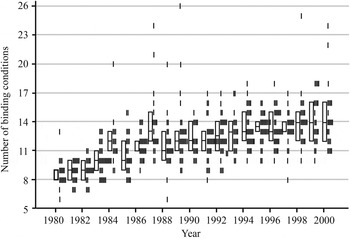
Since policy discretion is decreasing in the degree of conditionality, governments dislike paying the “sovereignty cost” that a comprehensive IMF program entails.Footnote 22 Not all countries that go to the IMF pay the same cost, however. While the general trend is upward, in each year programs vary widely in the breadth of conditionality. Figure 1 tracks the number of binding conditions in each of the 486 programs included in the data set.Footnote 23 “Binding conditions” refer to what are known in IMF parlance as “performance criteria.” These are the conditions with teeth: violating a performance criterion will trigger the program's suspension unless a country can obtain a waiver for noncompliance from the Executive Board.
Number of binding conditions in IMF loans

Conditionality is not included in the IMF's Articles of Agreement. It was only after the IMF turned its attention to the developing world in the 1970s that loans began to include numerous conditions, and the practice has evolved without any precise rules to guide staff members and management on how best to apply the policy tool. An institution-wide review of conditionality in 1978 produced guidelines intended to make treatment of borrowers more consistent.Footnote 24 But by the mid-1980s those guidelines were discarded as the scope of conditions was expanded to target “structural” distortions in borrowers' economies (eliminating subsidies, freeing prices of goods, liberalizing trade, privatizing state-owned assets, etc.). There is no limit on the number of conditions that can be attached to a loan, aside from what is perceived to be politically feasible.
Enforcement is the IMF's third policy tool. At regular reviews IMF staff members assess the progress of countries under lending arrangements. If IMF officials find that the borrower has not lived up to the terms of the agreement, the program is suspended and funds are withheld—unless staff members recommend waivers for the missed conditions. Unlike access to IMF resources, which is in principle capped, or conditionality, which is guided by established economic theory and practice, the decision to issue waivers or suspend a program because of noncompliance is entirely based on the staff and management's subjective assessments of the situation.Footnote 25
It should be clear from the brief review of the three elements of conditional lending that decision making at the IMF involves a significant degree of judgment. Rules, where they exist, are ambiguous.Footnote 26 While the institution has developed some “best practices” with respect to conditional lending, the process is far from routinized. This opens space for preferential treatment (or, less felicitously, biases) to creep into the IMF's decision making.
What Shapes IMF Decision Making?
The possibility that IMF decisions are politically motivated has not escaped the attention of scholars. In the past decade a small literature has sprung up to document and explain patterns of the IMF's preferential treatment of borrowers. This line of research has produced evidence for a variety of biases in the way that the IMF deals with its members.
The standard view is that powerful external actors intervene to shape the terms of access, conditionality, and enforcement in ways that serve their material interests. Stone and Copelovitch have, separately, developed the most sophisticated versions of this explanation. Powerful states like the United States do not want to shape the terms of every decision that the IMF makes with respect to conditional loans.Footnote 27 The evidence that IMF officials are delegated a high degree of discretion is too strong to ignore.Footnote 28 During normal times, the IMF's staff and management are allowed to make the decisions. The principals are content to let agents (the IMF's staff of highly trained economists) use the tools at their disposal to tackle difficult problems facing the low- and middle-income countries that have been the institution's main constituency for the past thirty years.
Discretion evaporates when powerful members decide that the borrower requires special treatment. For Stone, the United States mobilizes its extensive diplomatic resources to lobby for better terms when regimes in which it has a strategic interest get into trouble. Copelovitch suggests that geopolitical factors are less important than the interests of major stakeholders' financial communities; when big financial institutions are sucked into crises in the developing world, they lean on their country's representative at the IMF to help arrange generous bailouts. Provided that the other powerful member states do not object, the bankers usually get their way. The underlying assumption of this type of explanation is that discretion is always on loan from member states, because IOs depend on the material and symbolic resources that states provide.Footnote 29
Others suggest that biases can emerge even when IMF staff and management are relatively unconstrained. An IO that takes its mandate seriously and can resist tampering by external interests might need to adjust its policies to accommodate “special” cases. Just like banks, some countries are simply too big to fail. Pop-Eleches argues that when countries whose economic health is integral to the functioning of the global financial system are plunged into crisis, they can count on special treatment from the IMF.Footnote 30
The degree of discretion accorded by the institution's principals is one dimension along which explanations for preferential treatment vary. A second dimension concerns the clarity of the choice setting and the motives that guide decisions. In rationalist approaches to the study of IOs, decisions are made on the basis of cost-benefit calculation. Agents optimize by selecting the policy mix that maximizes an expected payoff function.Footnote 31 Stated simply, IOs' choices reflect the logic of expected consequences.Footnote 32
Others emphasize the ritual over the rational when it comes to IOs' decision-making processes.Footnote 33 The choice settings faced by IOs may be too ambiguous and uncertain to permit optimization by decision makers.Footnote 34 Instead of following decision rules that maximize expected payoffs, officials fall back on social scripts to guide their choices. Organizational culture supplies the rules that enable staff members to confront problems they encounter as they try to carry out the organization's mandate. Rather than asking whether a policy mix is optimal, decision makers in an IO may ask (perhaps reflexively) whether, given their identity, the action is appropriate in the sense of “matching the obligations of that identity or role to a specific situation.”Footnote 35
A recent wave of research focuses on the cultural life of the IMF and how it shapes the institution's behavior, potentially in ways that produce biased uses of the institution's policy tools. The central theme is that the IMF's recruitment patterns combined with day-to-day assimilation pressures ensure that the institution's ideational culture is dominated by a set of “neoliberal” economic beliefs.Footnote 36 Sociological approaches to the IMF tend to focus on how beliefs shape the content of the institution's policy positions. Chwieroth, for example, traces the institution's shifting view of capital account liberalization to the replacement of traditional Keynesians by a new cohort of neoliberal economists in the late 1970s. Others have suggested that belief-driven biases are not limited to the substantive content of conditionality: IMF officials might display a preference for working with like-minded officials in borrowing countries.Footnote 37 Shared beliefs might lead the IMF to adjust all three of the aspects of conditional lending (size of loans, binding conditionality, and enforcement) in ways that favor policy teams composed of like-minded economic officials.
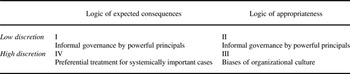
Putting the two dimensions together produces a typological mapping of sources of bias in decision making at the IMF. When the discretion accorded to the IMF's decision makers is low (quadrants I and II in Table 1), the powerful member states take temporary control of the institution, primarily through informal avenues (for example, lobbying), to shape borrowing countries' terms of treatment.Footnote 38 If many observations lie in either of the top two quadrants one would expect to see negative correlations between measures of the interests of principals and measures of the toughness of IMF treatment.Footnote 39
Four varieties of biased decision making at the IMF

In the decision making exemplified by quadrants III and IV in Table 1, IMF officials have significant leeway.Footnote 40 If most observations lie in the bottom left-hand box, preferential treatment would be limited to cases for which special treatment maximizes the institution's expected payoff. These cases may be systemically important countries in crisis (who require especially large liquidity infusions, regardless of their level of compliance).Footnote 41 When observations fall in quadrant III, the IMF's culture drives favoritism. One implication is that the IMF rewards policy teams that share the institution's economic beliefs. The statistical analysis demonstrates that a good amount of the variation in IMF treatment can be explained by the degree of ideational match between the IMF and the policy team in the borrowing country.
Why Shared Beliefs Matter
The IMF's ability to achieve its goals in borrowing countries is not simply a matter of correctly diagnosing the problems and convincing policy-makers to take steps to correct the distortions. The IMF's officials have to contend with unpredictable economic and—in particular—political dynamics that can drive programs off course. When the IMF is asked by policy-makers in member countries to make its resources available in exchange for policy changes, the prospective borrower is typically experiencing severe economic distress. In unstable (and frequently opaque) situations the IMF's officials face some difficult questions: Will the institution's resources be used prudently? Will the reforms be sustainable? Will the program succeed? Answering these questions forces the IMF's staff and management to wade into murky political waters.
Evidence for uncertainty confronting the IMF comes from an internal staff review of the implementation of structural adjustment programs.Footnote 42 Programs were interrupted because of noncompliance in twenty-eight out of thirty-six developing countries that signed concessional loans between 1986 and 1994. Less than a quarter of the arrangements signed during the period were completed without significant deviations.Footnote 43
If the IMF could compute the risk that its programs will fail in different settings with a reasonably high degree of accuracy, then its decisions could be made purely on the basis of rational calculation. But the ability of the institution's staff and management to calculate the prospects for program success is limited, due in large part to the unpredictability of the processes that shape economic policy-making. The IMF has not developed a way to systematically assess the prospects for programs in varying political and institutional environments among borrowing countries.Footnote 44 Claudio Loser, who began his career at the IMF in 1972 and directed the Western Hemisphere Department from 1994 to 2002, acknowledges that at the IMF “all decision analysis occurs in uncertain contexts.”Footnote 45
Uncertainty notwithstanding, IMF officials have to make choices about the best use of the institution's policy tools. The objective probability that a lending program will succeed or fail is unknown, but IMF decision makers have subjective beliefs about that likelihood. Policy-makers in the borrowing country also have prior beliefs about the probability that the IMF's proposed arrangement will succeed or fail. Different economic ideas may drive the priors of the IMF and the borrowing government far apart.Footnote 46 Sometimes prior beliefs diverge because the policy teamFootnote 47 is composed of noneconomists: “Fund staff are often frustrated because non-experts do not see the wisdom of their advice. They believe that people would be more willing to accept Fund advice if they understood the economic logic undergirding these stabilization programs.”Footnote 48 There is evidence that the similarity of professional economists' beliefs depends on where they were trained.Footnote 49 Policy-makers and the public in the developing world often express skepticism, if not outright hostility, toward the neoliberal economic ideas held by IMF officials.Footnote 50
Van den Steen's baseline model of the dynamics of firm-level project management can illustrate how shared beliefs affect the IMF-borrower relationship. I use some simple elements of the model in this study to give more structure to the argument.Footnote 51 Policy action ρ L (in this case, adopting the package of policies in a typical conditional lending arrangement) is assumed to offer some payoff Z > 0 if it succeeds and 0 if it fails. The probability of success is unknown (ρ L ∈ [0,1]) but both sides have priors about that probability. The sides have different expected values for ρ L based on their economic beliefs (denoted by r L,i for the IMF and r L,g for the government).
Van den Steen's model provides a very straightforward way of thinking about belief similarity: it is simply the distance between the means of the beliefs of i (the IMF) and g (the borrower):
 $${\delta _{i\comma g}} = \vert {r_{L\comma i}} - {r_{L\comma g}}\vert.$$
Belief dissimilarity is increasing in δ i,g . As the measure of belief dissimilarity approaches 1, the probability that the two sides would follow the same policies approaches 0—in this situation, the IMF and the borrowing government are in open disagreement.
The implications from Van den Steen's model can be extended to the issue of conditional lending. His model suggests that managers delegate more important decisions to employees who share the managers' beliefs and expend less effort to monitor like-minded employees.Footnote 52 Recall that limiting access and increasing the scope of conditionality are ways of constraining a borrower's policy discretion in order to safeguard the institution's resources. If the IMF's staff members think that the policy team responsible for carrying out the terms of the loan can be trusted to do the right thing (if δ i,g is small), then it will lend more freely and attach fewer conditions to the loan. The IMF will also devote fewer resources to monitoring and enforcing conditions when dealing with teams of like-minded policy-makers.
Readers who interpret the interaction between the IMF and its borrowers as an agency problem might reasonably ask how my explanation differs from conventional principal-agent (PA) models. While my approach focuses on beliefs in the presence of uncertainty, PA focuses on the alignment of the interests of the principal and the agent. Conceptually, beliefs and interests are distinct. The origins of interests are typically posited to lie in material payoffs; for example, a government might resist conditions that threaten politically important groups that prefer the (economically inefficient) status quo. A central contention of behavioral decision theory, by contrast, is that the origin of beliefs lies in heuristics, stories, and mental models.Footnote 53 The approach here centers on the degree to which the actors genuinely agree or disagree rather than the conflicts of interest that characterize PA-type models.Footnote 54 Conceptual issues aside, some of this article's results are hard to explain with the PA approach (an issue discussed in greater detail soon).
Evidence for the IMF's Neoliberal Culture
In order to test the argument, one needs a way to measure the distance between the beliefs of the policy team and the IMF. As I noted, many observers assert the IMF's culture is defined by a widely shared set of neoliberal economic beliefs. The theoretical core of neoliberalism is a revived version of classical liberal economics. Three assumptions are widely shared within the consensus, namely that: the market is the most efficient mechanism for allocating scarce resources; free exchange of goods across borders is welfare improving; and market actors have rational beliefs.Footnote 55 Three policy recommendations flow from these assumptions: governments should, in general, pursue fiscal discipline; a country's economic orientation should be outward; and countries should rely on markets for the allocation of goods and resources and for the setting of prices.Footnote 56
Ideational consensus at the IMF is driven by the institution's operational culture and recruitment practices. The IMF looks like a Weberian bureaucracy: individual and institutional goals are closely aligned, and authority relationships are rigidly hierarchical.Footnote 57 The pressure to conform is intense; as Rogoff, former head economist at the IMF, observes, “fundamentally most people in the Fund believe in markets and market-based solutions to problems.”Footnote 58 Many of the institution's top officials are drawn from a handful of highly ranked American economics departments that serve as incubators for neoliberal ideas. Consider the view from Raghuram Rajan, economic counselor and head of the IMF's research department from 2003 to 2006:
Many of these multilateral organisations are dominated by US trained economists, and certainly when I was at the Fund I heard again and again countries like France saying there's a French view of things, why does it have to only be the US view from economists, no doubt from all over the world, but trained in the US?Footnote 59
To indirectly measure the homogeneity of beliefs at the institution, I obtained biographical data from the IMF's archives on 983 appointments to top-level positions between 1980 and 2000.Footnote 60 The data reveal that the profile of senior officials is remarkably similar for an institution that counts 188 countries as members. Nearly half (47 percent) of the appointees in the data set received a graduate degree from a highly ranked American economics department.Footnote 61 The degree of similarity is further illustrated by the fact that a relatively small number of universities supplied the vast majority of the senior American-educated economists at the IMF.Footnote 62
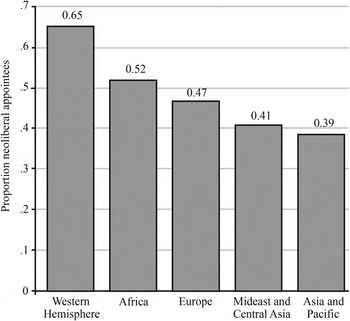
These data obscure the degree of variation between the institution's departments. The five regional departments are primarily responsible for loan negotiations with member states. Figure 2 displays the proportion of top-level appointees in each regional department that received a graduate degree in economics from a top-thirty ranked American university.
Proportion of neoliberal appointees by area department (1980–2000)

In two regional departments—the Western Hemisphere and Africa—the majority of top officials were trained in the economics departments that were most likely to transmit neoliberal economic ideas. Countries that lie within the purview of the two regional departments were also the locus of IMF activity in the years between 1980 and 2000: 71 percent of the conditional loans doled out during this period went to a country in one of the two regions.
Combining the evidence of the IMF's ideational culture with the arguments about how shared beliefs influence delegation and monitoring yields three testable hypotheses. I expect to find that as the proportion of neoliberals in the borrowing government increases:
-
1. The relative size of loans will increase.
-
2. The number of binding conditions in programs will decrease.
-
3. The IMF will be more likely to issue waivers for noncompliance.
Data and Methods
Until recently researchers could not systematically test competing explanations for variation in IMF treatment because loan documents were confidential. Taking advantage of the opening of the IMF's archives, I collected documents that outline the terms of agreements, including the size of the loan, the phasing of disbursements, binding and nonbinding conditions, and policy commitments and goals set out by the country's economic authorities.Footnote 63 The data set consists of the terms of 486 separate agreements signed between 1980 and 2000.Footnote 64
I use an imperfect but defensible measure of the extent of conditionality: I count the number of binding conditions included in each program.Footnote 65 I measure the second aspect of IMF treatment, the generosity of its funding packages, as the size of the loan as a percentage of the country's quota. Because these data are skewed to the right by some extremely large loans, I use the natural log of loan size/quota in the statistical analysis. The loan size regressions include data from 1984 to 2000.Footnote 66 Many programs from 1980–83 exceeded the 300 percent of quota cap for the simple reason that quota increases had failed to keep pace with borrowers' financing needs.Footnote 67 The quota revisions came into effect on 30 November 1983.
To measure enforcement, I gathered the decisions by the IMF's Executive Board to approve waivers for noncompliance between 1980 and 1997.Footnote 68 The measure of enforcement is a dichotomous variable that takes a value of 1 when a waiver is approved by the Executive Board, and 0 during other years when a program is active and a waiver has not been issued.
In order to test my argument against the alternatives, it is necessary to develop a variable that captures the economic ideas held by policy-makers. The strategy adopted here focuses on experiences that are likely to transmit neoliberal economic beliefs to individual economic policy-makers. Two socializing experiences are regarded as particularly important transmission mechanisms.
The first is the educational background of policy-makers. A number of researchers provide evidence that graduate training in economics “is a transformative experience for doctoral students that creates strong professional identities.”Footnote 69 It is widely recognized that mainstream American economics departments shaped the neoliberal consensus. Consequently, I code policy-makers as neoliberal if they earned a master's degree or above from a highly ranked American economics department.Footnote 70
Policy-makers who have sustained experience within the IMF and the World Bank are also coded as holding neoliberal beliefs.Footnote 71 While neoliberal economists are a less dominant presence within the World Bank, owing largely to the Bank's more expansive mandate in developing countries, it too remains a center for neoliberal thinking.Footnote 72
The data collection effort resulted in a data set consisting of the entry and exit dates and biographical details for more than 2,000 policy-makers in ninety countries observed between 1980 and 2000.Footnote 73
Testing the first observable implication of the argument requires a measure of the relative influence of neoliberal policy-makers in developing countries. The variable I create (referred to hereafter as proportion neoliberal) is an index that attempts to capture the ideational coherence of the policy team:
 $$\matrix{{\rm PROPORTION}\cr {\rm NEOLIBERAL} }= \displaystyle{{Number \, \, of \, \, neoliberals \, \, in \, \, top \, \, policy{\rm -}making \, \, positions} \over {Number \, \, of \, \, top \, \, economic \, \, policy{\rm -}making \, \, positions}}$$
The Letter of Intent that specifies the terms of IMF agreements is signed by each country's top-ranking economic officials; I used these documents, recovered from the IMF's archives, to identify the important policy-makers for each country. The policy team thus consists of the officials who sign the IMF agreements plus the head of government. proportion neoliberal ranges in value between 0 (no neoliberals in important economic policy positions) and 1 (a fully unified policy team in which neoliberal economists occupy each of the top policy positions).Footnote 74 The analysis includes a number of other covariates.
Technocratic variables
If technocratic considerations dominate the design of IMF programs, treatment by the IMF should be proportional to the depth of the economic problems facing the borrower. Two indicators measure the severity of the external economic constraints: international reserves as a percentage of external debt and debt as a percent of gross national income. I also include the growth rate of gross domestic product (GDP) per capita and the natural log of GDP.
Perhaps neoliberal officials are more likely to be observed in countries that have pursued market liberalization. Failure to control for the degree of economic reform would then overstate the impact of ideational proximity. I take this possibility seriously and try to account for the problem by including several different measures of policy liberalization alongside proportion neoliberal. In the model reported in this article I rely on a dichotomous measure of trade liberalization.Footnote 75 The supplementary appendix reports results that include measures of capital account openness, financial market liberalization, and product market liberalization. The main results are unaffected by the inclusion of different indicators of policy liberalization.
Several other indicators of economic conditions are included in the analysis. Previous research has linked compliance with binding conditions to inflation and government consumption; consequently, these measures are included in the models of waivers.Footnote 76
Intra-institutional variables
Intra-organizational politics and routines are expected to influence the behavior of the IMF. Barnett and Finnemore suggest that the expansion of conditionality is a consequence of the IMF's progressive elaboration of the monetary approach to balance of payments crises “to incorporate more and more aspects of domestic life into its stabilization programs.”Footnote 77 Consequently I include a counter variable that starts at 0 in 1980.Footnote 78
Two additional variables account for bureaucratic aggrandizement.Footnote 79 As global financial conditions worsen, the interest rate subsidy provided by the IMF (since interest on its loans is for most borrowers below market rates) becomes more attractive, enabling the staff to increase both lending and conditionality. The IMF should be tougher in enforcing conditions when alternative sources of funding for borrowers are scarce. As a measure of global financial conditions I include the annual nominal US Treasury bill rate. I also include a measure of the total annual use of IMF credit and administrative resources as a percent of the total quota of the IMF provided by the institution's members. This is an indicator of the general demand for IMF resources and should be positively correlated with conditionality and negatively related to the amount of funding disbursed.Footnote 80
Extra-institutional variables
I use two measures to account for a borrower's strategic importance to the most powerful influential member of the IMF, the United States. First, Stone argues that political significance is indicated by the flows of foreign aid.Footnote 81 I include a variable that records annual (logged) American military aid and grants.Footnote 82 Dreher and Jensen suggest that voting in the United Nations General Assembly (UNGA) is a better variable to measure the effect of geopolitical interests on the IMF's behavior.Footnote 83 The similarity of voting profiles in the UNGA is used as an indicator of the closeness of a borrower and powerful state in a number of studies of the IMF.Footnote 84 The measure I use captures the similarity of a borrower's and the US's voting decisions on UNGA resolutions. The variable (us affinity) ranges from -1 to 1, with higher values indicating closer relations.Footnote 85 If the United States intervenes in the IMF's lending behavior, one should observe that friendly, politically influential countries receive bigger loans with fewer conditions and are more frequent recipients of waivers.
To capture the impact of financial interests on IMF treatment, I create a dichotomous variable that is coded positively when a Paris Club sovereign debt restructuring agreement was reached in the six months preceding or following the initiation of an IMF program.Footnote 86 I expect that these are periods in which creditors are both more interested in the content of IMF programs and better organized than usual.Footnote 87 Many, but not most, loans are accompanied by Paris Club agreements.Footnote 88
Domestic institutional variables
Several domestic political variables aside from the presence of neoliberals might influence IMF treatment. The literature on the economic effects of the electoral cycle suggests that governments are more prone to adopt irresponsible policies in the period preceding elections. An internal review by the IMF staff identified pre-election dynamics as an important cause of deviations from binding conditions in at least six major programs in the 1980s and 1990s.Footnote 89 If this is the case, the IMF should be tougher on countries before elections.Footnote 90 On the other hand, in the “honeymoon” period following an election the IMF might be more lenient on the new government. To measure the electoral cycle, I used the World Bank's Database of Political Institutions (DPI) to gather the dates of elections in countries in the sample. Since political business cycles should be present in competitive elections only, I included elections with multiple candidates/parties only (denoted by a score of 5 or above in the DPI's electoral competitiveness index). Two dichotomous variables were generated from this process: an indicator that takes a value of 1 if a legislative or executive election is scheduled in the next six months (pre-election), and an indicator for elections that occurred in the previous six months (postelection).Footnote 91 In the model of waivers the election indicator takes a value of 1 if there was a competitive election in year t.
Partisanship may influence the design of programs. Some accuse the IMF of conservative bias in its lending behavior.Footnote 92 To measure the effect of partisan dynamics, I include an indicator of left-wing governments.Footnote 93 The effects of three other domestic institutional variables are examined. Vreeland argues that executives might seek to bring in the IMF when there are many veto players that can prevent policy change; on the other hand, the IMF might be tougher with countries with many veto players because ambitious reforms are less likely to be carried out in these cases.Footnote 94
The effect of regime type on IMF treatment is controversial. Vreeland suggests that the IMF might prefer negotiations with dictatorships, which can more readily commit to and carry out tough conditions.Footnote 95 On the other hand, the “democratic commitment” literature emphasizes that democracies can more credibly commit to policies, which suggests that the IMF would be more generous in its treatment of democratic regimes.Footnote 96 Regime type is measured via the Polity2 score.Footnote 97 To account for the possibility that the IMF is more likely to issue a waiver for countries experiencing political instability, I include a variable (instability) that equals 1 if the Polity2 regime type indicator changes (in either direction) by at least three points during a three-year period.Footnote 98
I use several estimation procedures because of the different properties of the data on IMF treatment. For the total number of binding conditions, I specify Poisson models with robust standard errors clustered by country. To test the determinants of the size of loans, I estimate Prais-Winsten models with panel-corrected standard errors and an AR(1) correction.Footnote 99 The models do not include country or year fixed effects.Footnote 100 Finally, when the dependent variable measures whether a country under an IMF program receives a waiver I estimate logit models with robust standard errors clustered by country.Footnote 101 Most of the explanatory variables are lagged by one year to reduce simultaneity bias.Footnote 102
Results
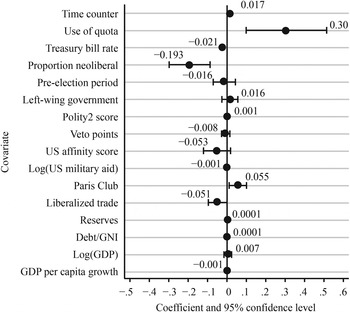
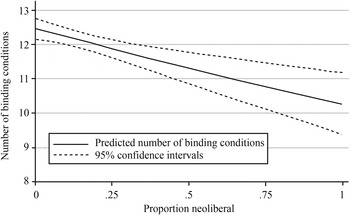
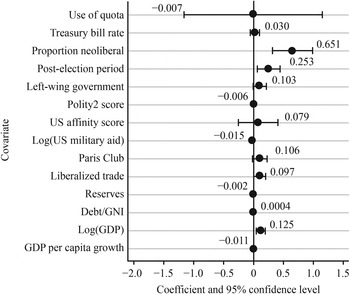
Coefficients and confidence intervals from the conditionality regression are reported in Figure 3 (N = 436). The results confirm that policy teams staffed with neoliberal officials get better treatment: controlling for a range of different explanations, the proportion neoliberal variable is negative and highly significant. Figure 4 provides a substantive interpretation of the variable's impact on IMF conditionality based on the results reported in Figure 3. The figure shows the predicted number of conditions in a program when the explanatory variables are held constant and the proportion neoliberal measure is allowed to vary.Footnote 103
Covariates of number of binding conditions in IMF agreements (1980–2000)

Predicted number of binding conditions as proportion neoliberal changes

As the proportion of the government occupied by neoliberals incrementally increases the predicted number of conditions decreases. Moving from a government with no neoliberals to a unified neoliberal government shaves approximately two conditions off lending programs.
Several other factors influence the extent of conditionality included in the loans in my data set. The IMF becomes tougher when its resources are in demand; increasing the value of the total use of IMF resources from its minimum to maximum value leads to slightly more than one additional condition. For each five-year period that passes, another condition is added to the typical agreement. Contrary to expectations, a four-point increase in the nominal Treasury bill rate leads to one less condition per program, on average. There is little evidence to suggest that measures of domestic political conditions,Footnote 104 the interests of powerful actors, or systemic importance (indicated by logged GDP) are systematically correlated with conditionality.
Results from the loan size regression are given in Figure 5 (N = 375). They provide additional evidence to support the argument that the IMF is biased in favor of governments with neoliberal economic policy-makers. The substantive relationship between loan size and proportion neoliberal is large: a one standard deviation increase in the proportion neoliberal variable is associated with a 12 percent increase in relative loan size.Footnote 105
Covariates of relative size of IMF loans (1984–2000)

Other patterns are revealed in the loan size regression. Economic crises in large countries can destabilize the global economic system, and the findings show that the IMF takes the threat seriously by consistently giving larger loans to bigger countries.Footnote 106 The IMF is sensitive to borrowers' financing requirements: the reserves covariate is negatively signed and significant (p = 0.007); the point estimate suggests that a one standard deviation increase in the level of reserves is associated with a 6 percent decline in the average loan.Footnote 107 Political factors also matter. Borrowers in the postelection “honeymoon” period are rewarded with loans that are 25 log points, or 29 percent, larger on average.
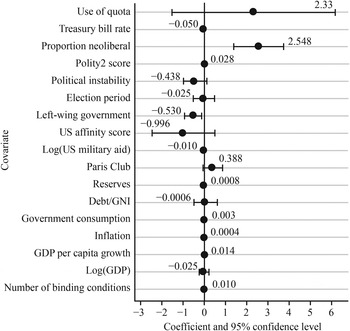
Figure 6 reports the results of a logistic regression when the dependent variable is the issuance of a waiver that allows a country to continue its program despite missing one or more binding conditions (N = 682). Because the waivers data set includes not just the year in which a program was signed but all years in which a program is active, I measure proportion neoliberal annually.Footnote 108 Only a few variables are statistically significant determinants of waivers.Footnote 109 Countries that are more democratic (indicated by higher Polity2 scores) and have higher consumer price inflation are more likely to secure waivers, while fewer waivers are given to left-wing governments.Footnote 110
Covariates of waivers (1980–1997)

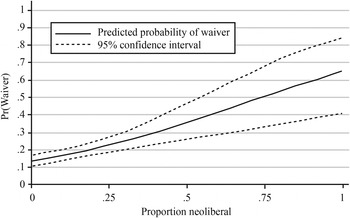
The most powerful influence on the distribution of waivers is the presence of neoliberal economic policy-makers in the borrowing government. As the proportion of the economic policy team occupied by neoliberals increases, countries under active lending programs become increasingly likely to receive waivers. Figure 7 shows the substantive impact of changing proportions of neoliberals in government on the predicted probability that waivers for noncompliance with program dictates will be issued.Footnote 111 The figure indicates the dramatic effect of changes in the proportion neoliberal measure on the likelihood that the IMF will overlook noncompliance by a borrowing government: unified neoliberal policy teams are approximately 50 percent more likely to receive a waiver than economic policy teams with no neoliberal officials.
Predicted probability of receiving a waiver as proportion neoliberal varies

The results are consistent with arguments advanced in this article. The measure of enforcement, however, is imperfect. Ideally, one could assemble a sample consisting of borrowers that sought and received a waiver to compare with a sample of borrowers that were denied a waiver. Countries under IMF programs that had no need for a waiver (and thus did not receive one) could be omitted from the analysis. The problem is that one observes the staff's decision to recommend a waiver only—and the Executive Board always approves the staff's recommendation, even when discussion of the proposal is contentious.Footnote 112 The staff members are given the discretion to recommend a waiver, and one does not observe cases in which the staff privately considered and ultimately rejected a borrower's case for a waiver.
Given the shortcoming of the dichotomous indicator for waivers, I examined one additional measure of enforcement's stringency: the number of waivers granted by the Executive Board. Instead of focusing on whether a country under an IMF program did or did not receive a waiver, I ask whether, conditional on the Board's decision to grant a waiver, the ideational proximity of the team in the borrowing country and the IMF (operationalized by the proportion neoliberal variable) is associated with the number of waivers granted. The average number of waivers approved in an Executive Board decision is two; the variable ranges from a minimum of one to a maximum of seven. I regress the number of waivers on the same set of covariates listed in Figure 6; following Stone I estimate a negative binomial count model.Footnote 113 The results (N = 136) show that, after accounting for the impact of other covariates, the proportion neoliberal measure is positively correlated with the number of waivers granted for noncomplying countries, though the substantive impact of the variable on the number of waivers is relatively small.Footnote 114 These findings, combined with the rest of the results I described, are strong evidence that treatment improves as the ideational proximity of the IMF and the policy team in the borrowing country narrows.
Alternative Explanations
The distance between the economic beliefs of the IMF and the policy team drives the argument: when the gap is large, the IMF is more likely to limit the borrower's policy discretion by reducing access to funds, adding conditions, and punishing noncompliance. The proportion neoliberal variable is a way to indirectly measure the beliefs of the policy team. A different interpretation would treat the presence of neoliberals not as an indicator of beliefs but rather as a credible signal of the borrower's type.
Conditional lending does involve an adverse selection problem. Consider a simple distinction between two borrowers whose objectives differ: a liberalizer that will stick with the strictures of the program and a “redistributive” government that survives by giving rents to social groups and will not comply with the conditions after it has accessed the initial tranche of the loan. It is difficult for the IMF to discover the true intentions of governments because “foreign assistance may well provide a motive for the ‘redistributive’ government to mimic the ‘liberaliser’ for a while . . . by skewing the incentives of the ‘redistributive’ government, it makes it more difficult for the ‘liberalising’ government to reveal its true type.”Footnote 115
Perhaps the proportion neoliberal variable is actually an indicator for a credible signal that distinguishes the government's true type. There are two problems with this interpretation. First, the credibility of a signal is linked to its costliness.Footnote 116 Appointing a neoliberal policy-maker is not very costly, because the executive can always engineer the official's replacement. Finance ministers and central bank governors typically do not survive in office for very long in developing countries, a tendency that gets amplified during economic crises.Footnote 117
Second, if neoliberal policy-makers are ex ante signaling devices that help the IMF mitigate uncertainty associated with the government's intentions, then one should observe that the likelihood of obtaining a waiver decreases as the proportion of neoliberals in government increases.Footnote 118 The logic follows Tomz's discussion of sovereign lending: borrowers that are reputed to be “stalwarts” (unlikely cases for debt repudiation) will be punished by investors for failure to repay regardless of the circumstances under which noncompliance occurred.Footnote 119 One would expect to see the same kind of updating by the IMF: neoliberal policy teams that fail to meet specified policy targets communicate information to the IMF's staff and management that the borrower is not trustworthy.
Another explanation for the findings would emphasize the relationship between education and competence.Footnote 120 The socializing experiences that, in my argument, transmit neoliberal economic ideas to policy-makers also confer a bundle of other attributes. Along with economic ideas, economists with advanced training from highly ranked American economics departments may have technical skills or innate abilities that make them more “competent” economic officials. There is no need to refer to the ideas held by IMF staff members if all rational individuals perceive neoliberals to be better equipped to carry out stabilization and reform programs.
I cannot definitively claim that beliefs dominate competence because I do not have a ready identification strategy to separate the independent effects of each. I leave that task for future research. However, the evidence here undermines the claim that neoliberals are more competent policy-makers. Governments with neoliberals receive, on average, larger loans with fewer conditions attached. Highly competent policy teams should find it a cinch to successfully complete such programs. Yet one of the strongest findings in the article is that neoliberals are much more likely to obtain waivers in order to continue to draw on the IMF's resources despite noncompliance.
Conclusion
The IMF plays a key role in the global economy. Because capital flows are procyclical, low- and middle-income countries suffering from payments problems frequently find that the IMF is their only economic lifeline. Since 2008 a handful of rich democracies in Western Europe have learned that lesson as well. The Great Recession of 2007–2010 has for the foreseeable future destroyed the possibility that rescues coordinated by rich and powerful states will be sufficient to quell the turmoil.
Understanding how the IMF chooses to deploy its policy tools, then, is an important issue, both for theories of IO behavior and for practical policy analysis. I have outlined several possible sources of bias in IMF lending and linked uncertainty and beliefs to decision making. The theory suggests that when the economic beliefs of a policy team are close to the beliefs of the IMF, loans are larger, conditionality is weaker, and enforcement is less rigid. In other words, policy teams composed of fellow travelers receive special treatment by the IMF. The evidence from analysis of a large number of IMF lending arrangements strongly supports the argument.
Is the IMF's inconsistent behavior to blame for some of its more spectacular failures?Footnote 121 In January 2002, several weeks after the IMF refused to disburse a tranche because of pervasive noncompliance, the interim Argentine president announced a moratorium on external debt repayment to a room full of cheering legislators. Between 1991 and 2001, the Argentines signed five separate agreements with the IMF. Conditionality was light; only one of the five agreements (March 1992) included binding structural conditions. As the IEO's postmortem report noted, “even though the annual deficit targets were missed every year from 1994, financing arrangements with Argentina were maintained by repeatedly granting waivers.”Footnote 122 The decade marked a remarkable consolidation of neoliberal control over policy-making in Argentina: every economy minister and central banker between February 1991 and December 2001 held a PhD from a top-ranked American economics department.Footnote 123 The evidence of generous treatment during a period of neoliberal control is consistent with the argument and evidence. And, to the extent that the Argentine crisis was driven by unsustainable fiscal policies and underlying structural problems (for example, labor market inflexibility) that eroded confidence in the Convertibilidad system, the IMF's relative leniency was a grave mistake.Footnote 124 Reflecting on the Argentine crisis, the former head of the IMF's Western Hemisphere department accepted that the IMF had been too permissive: “the Argentine political class thought that the IMF was always giving them a new chance, no matter what they did. So they kicked the problem down the line. The behavior of the Fund ratified this perception.”Footnote 125
Efforts to improve the effectiveness and legitimacy of the IMF focus mainly on its financial resources and the distribution of voting rights. While it is easy to find critics who bemoan the dominance of neoliberal economists at the IMF,Footnote 126 efforts to change recruitment patterns have made little headway. This article's evidence indicates that the beliefs of the staff and management have important consequences for the institution's behavior.
Supplementary material
Replication data are available at http://dx.doi.org/10.1017/S0020818313000477.