Introduction
Ratoon rice is grown from the seedlings of buds that remain at nodes of rice stubble following the harvest of the main rice crop (Xu et al., Reference Xu, Zhang, Zhou, Guo, Zhu, Liu, Xiong and Jiang2021). Compared with double-season rice and single-season rice (the dominant rice systems in central China, Nie and Peng, Reference Nie, Peng, Chauhan, Jabran and Mahajan2017), ratoon rice is effectively balanced by the high annual rice grain yield and the high profitability (low labor requirements). In recent years, the farmers planted the ratoon rice spontaneously without promotion, and there is more than 1 million hm2 of ratoon rice cropping in southern China (Wang et al., Reference Wang, Huang and Peng2021).
Cutting time and stubble height are two important factors affecting the rice yield and quality of the ratoon crop. In Southern China, harvesting the main crop when 90% of rice grains ripened aids the elongation and emergence of ratooning buds (Xiong et al., Reference Xiong, Ran, Xu and Hong2000), while in the Central China region, it is better to harvest when 95% of grains are ripened (Miao, Reference Miao1996). Jones (Reference Jones1993) stated that a higher rice yield of ratoon crop was obtained with a stubble height of 20–30 cm. Daliri et al. (Reference Daliri, Eftekhari and Mobasser2009) observed significant differences in ratoon crop yield among different harvesting times and stubble-cutting heights of the main crop, and the highest rice yield of the ratoon crop was found at a stubble height of 40 cm. However, ratooning buds died after the full-heading stage of main crop, and bud-promoting fertilizers could effectively increase the survival rate of the ratooning buds (Xu et al., Reference Xu, Xiong, Zhao and Hong2000). Further information is needed to explore the combined impact of the cutting time and cutting height on rice grain yield of the ratoon crop, especially the cutting time after the full-heading stage of main crop.
In Hunan Province, the cutting time and stubble height in the ratoon rice production system are about 30 days after the flowering stage of the main crop and 30 cm height, the annual grain yield is about 12–15 Mg·hm−2, the ratio of the grain yield between the main crop and ratoon crop is 7:3 or 8:2, consequently, and the rice yield of the ratoon crop is about 2.4–4.5 Mg·hm−2. Although ratoon rice attains a higher annual grain yield and net economic return than middle-season rice, poor rice quality (high temperature during the filling stage) of the main crop and relatively low grain yield of the ratoon crop have greatly limited rice producers’ income. Novel ratoon rice cropping with the main crop as forage and the ratoon crop as food was an effective way to improve rice producers’ income, and it should be noted that this differs from the development of ratoon crop as forage, as reported by Dong et al. (Reference Dong, Xu, Ding, Gu, Zhang and Sun2020). It altered stubble character (e.g., stubble biomass and its nitrogen content) via cutting time and cutting height improvement in the novel ratoon rice cropping. Studies have shown that the dry weight of stem sheaths in the late growth period of the main crop is positively correlated with the regenerative capacity and yield of the regenerative season (Chen et al., 2018; Xu et al., Reference Chen, He, Wang, Peng, Huang, Cui and Nie1998). In addition, the nutrient storage in rice straw is positively correlated with the regenerative capacity (Santos et al., Reference Santos, Fageria and Prabhu2003). Carbohydrates and nitrogen are the main components stored in straw, and the ratio of carbohydrates (C) to nitrogen (N) in straw is closely related to the regenerative capacity of rice in the regenerative season (Vergara et al., Reference Vergara, Lopez and Chauhan1988). It has been reported that the nitrogen content in main crop straw is negatively correlated with the regenerative capacity of the regenerative season (Vergara et al., Reference Vergara, Lopez and Chauhan1988), while the nonstructural carbohydrates and dry weight of rice stalks are positively correlated with the regenerative capacity (Huang et al., Reference Huang, Tu, Jiang, Qin and Huang2009).
For increasing rice yield of the ratoon crop, a field experiment was carried out in 2018–2019 and the combined effects of the cutting time and cutting height on ratooning ability and rice grain yield of the ratoon crop were investigated. The objective of the present work was to test the hypothesis that modification of cutting time and cutting height during main crop harvesting can improve ratooning ability and rice yield of the ratoon crop.
Materials and Methods
Ratoon rice planting
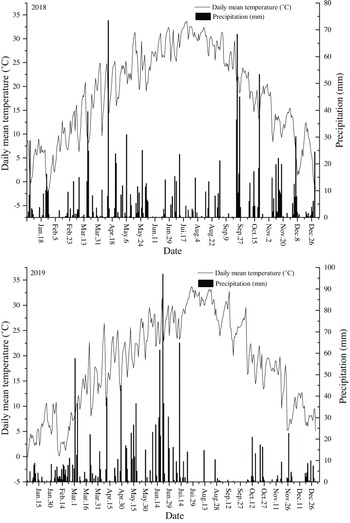
Ratoon rice cropping was established in Yiyang City, Hunan Province (29°08′N, 112°26′ E, 28 m a.s.l.) in 2018–2019. The soil at the site was tidal soil with a pH of 7.52 in 2018 and 7.57 in 2019. Additionally, the soil contained approximately 4.84% and 4.78% organic matter in 2018 and 2019, respectively. Climate condition was characterized by annual average sunshine time of 1643.3 h, annual average temperature of 16.9°C – the coldest month (January) has an average temperature of 4.3°C and the hottest month (July) an average temperature of 29.1°C – frost-free period of 264 d, accumulated temperature (≥10°C) of 5240°C, and an average rainfall of 1240.8 mm, concentrating from May to September. Precipitation and daily mean temperature are shown in Figure 1. The rice cultivars were Xiangliangyou 900 (XLY900, Indica hybrid rice) and Yongyou4149 (YY4149, Indica/japonica hybrid rice), which were widely planted in the Hunan Province. The characteristics of these rice cultivars were available on the China rice data center (www.ricedata.cn).
Daily mean air temperature and precipitation near the field experimental site in 2018 and 2019. Climate data comes from the Bureau of Meteorology’s local observatory.

Sowing was done on March 29th, and the seed quantity was 22.5 kg hm−2. At a seedling age of 30 days, machine transplanting was performed (on April 29th). The nitrogen (N) application rate was 345 kgNhm−2 (195 kg N hm−2 for the main crop and 150 kg N hm−2 for the ratoon crop), in accordance with the local high-yield and high-quality ratooning rice cultivation system. The P2O5 and K2O application rates were 90 and 225 kghm−2, respectively.
Beginning at the flowering stage of the main crop, three cutting times (10, 20, and 30 days after the flowering stage) were tested. Three cutting heights (Figure 2, stubble of 10, 20, and 30 cm) were used per cutting time, respectively. There were three replications with an area of 25 m2 for each plot. During the main crop, pesticides including abamectin and tricyclazole were sprayed 2–3 times, including those used to prevent rice plant hopper and damage from rice borers, and also herbicides for controlling barnyard grass; fungicides, including validamycin and tebuconazole, were used for sheath blight control. Other cultivation measures followed the local high-yield and high-quality ratooning rice cultivation system (Wang et al., Reference Wang, Zheng, Chen, Zou, Luo and Tang2023).
Schematic diagram in the experiment.

Growth period
Dates of sowing, flowering stage in the main crop, cutting time, flowering stage, and mature stages in the ratoon crop were recorded accurately.
Stubble character
At 10, 20, and 30 days after the flowering stage of the ratoon crop, ten hills were sampled and stubble biomass was determined in different stubble heights (10, 20, and 30 cm), excluding the three border plants.
Maximum tillering in the ratoon season
Excluding the three border plants, ten hills were labeled in each plot to count tillers at fixed intervals from 5 to 40 days, and recorded the maximum number of tillers in the different experimental plots.
Biomass per hills and harvest index
In the mature stage of the ratoon crop, biomass per hill (grain and straw) was determined for 12 hills, and the harvest index was calculated as the ratio of the grain weight and the total (grain + straw) weight.
Yield and its components
In the mature stage of the ratoon crop, yield components were determined for 12 hills, including spikelet panicle–1, filling ratio, and grain weight. Finally, grain yield was determined in a selected area (5 m2), and the effective number of panicles per m2 was determined for 20 hills.
Data analysis
The tillers-to-stubble ratio (TSR) and panicles-to-stubble ratio (PSR) were calculated as the ratio of maximum tillers and panicles to stubble of main rice. Means were calculated and a correlation analysis was performed using Statistix 8.0 and Microsoft Excel 2017 software. We performed a one-way analysis of variance and the least squares difference test was used to check statistically significant differences among cutting times and cutting heights.
Ethics approval
Experimental research and field studies on plants, including the collection of plant material, comply with relevant institutional, national, and international guidelines and legislation. We had appropriate permissions/licenses to perform the experiment in the study area.
Results
Growth period of the ratoon season
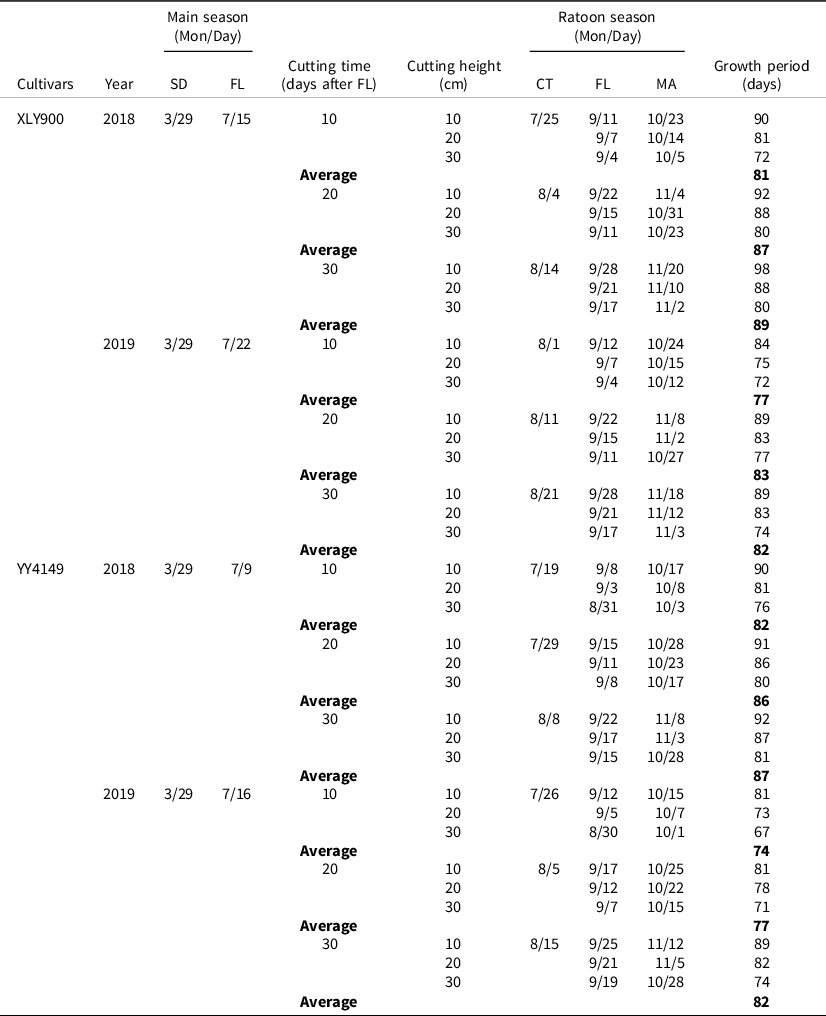
Early cutting time shortened the growth period, and the minimum growth period was found at 10 days after the flowering stage of the main crop (Table 1). Compared with 30 days after the flowering stage of the main crop, the growth period at 10 days after the flowering stage was shortened by 7 days, and then the growth period was shortened by 3.5 days per 10 days ahead of the cutting time. The growth period was delayed by reducing the stubble heights. Compared with 30 cm stubble height, the growth period at 10 cm stubble height was prolonged by 14.5 days for XLY900 and 13.5 days for YY4149. Overall, the growth period was prolonged by 7 days per 10 cm stubble height decrease.
Growth period of the ratoon season with different cutting times and heights in XLY900 (Xiangliangyou900) and YY4149 (Yongyou4149) in 2018–2019

SD, sowing date; FL, flowering date; MA, mature date.
Stubble characteristics
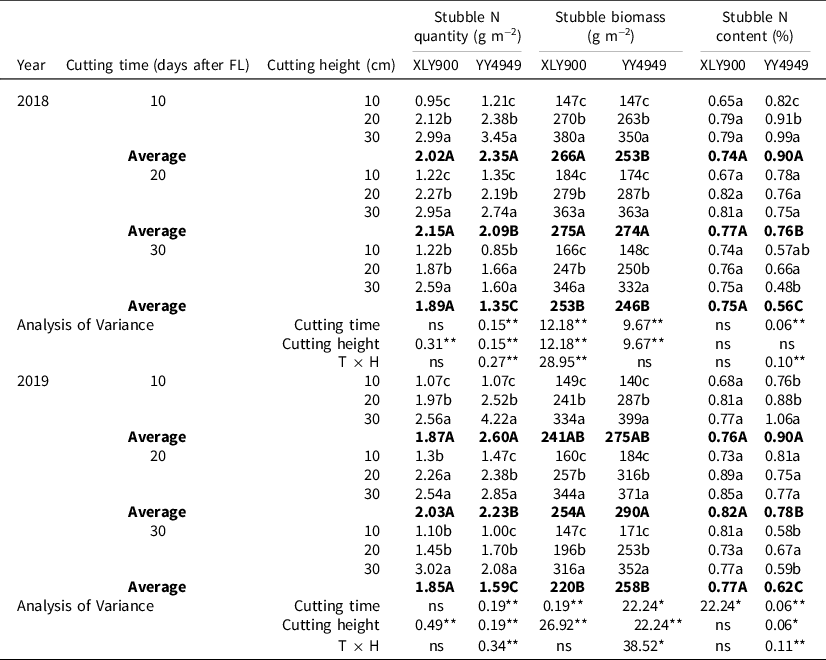
Maximum stubble biomass among cutting times treatments was found for 20 days after the flowering stage of the main crop, and significant differences (p < 0.05) were observed between 20 and 30 days after the flowering stage of the main crop (Table 2). The biomass of stubble increases as the cutting height increases, and there is a significant difference among various stubble heights (p < 0.05). Variation in stubble N content was observed between cultivars. YY4149 (Yongyou4149) stubble nitrogen content decreased significantly with increasing cutting times (Table 2), while non-significant differences among the treatments were found for XLY900 (Table 2). In YY4149, the highest stubble N quantity was determined at 10 days after flowering stage of the main season and 30 cm stubble height (Table 2).
Stubble character difference with different cutting times and heights in XLY900 (Xiangliangyou900) and YY4149 (Yongyou4149) in 2018–2019

*, **, significance at 0.05 and 0.01 level, respectively.
FL, flowering date; ns, no significance.
Ratooning ability
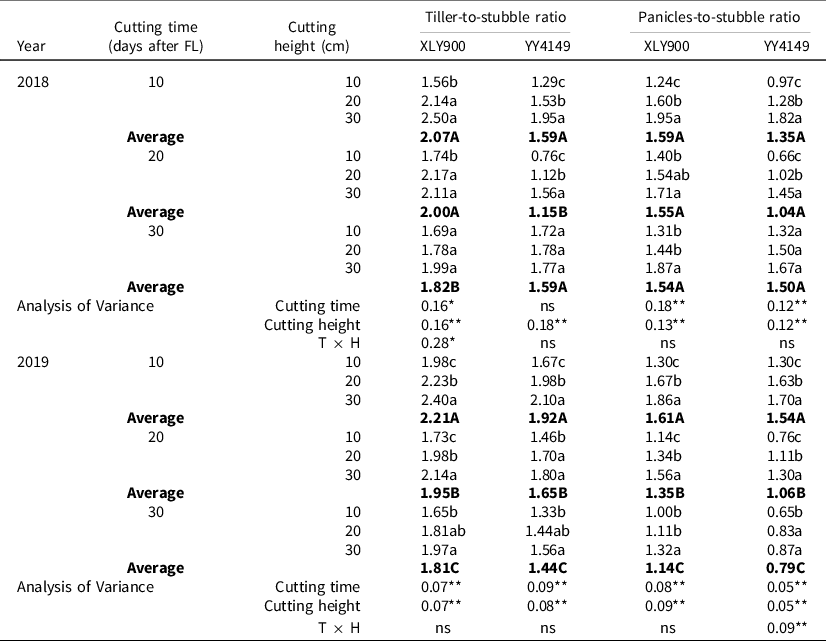
The maximum TSR was observed 10 days after the flowering stage and 30 cm stubble height, and there was significant difference among the treatments of T and H in 2019 (Table 3). The PSR showed a similar trend as the TSR, and there was significantly difference among the treatments of T and H in 2019 (Table 3).
Regeneration ability difference among different cutting times and heights in XLY900 (Xiangliangyou900) and YY4149 (Yongyou4149) in 2018–2019

*, **, significance at 0.05 and 0.01 level, respectively.
FL, flowering date; ns, no significance.
Biomass per hill and harvest index
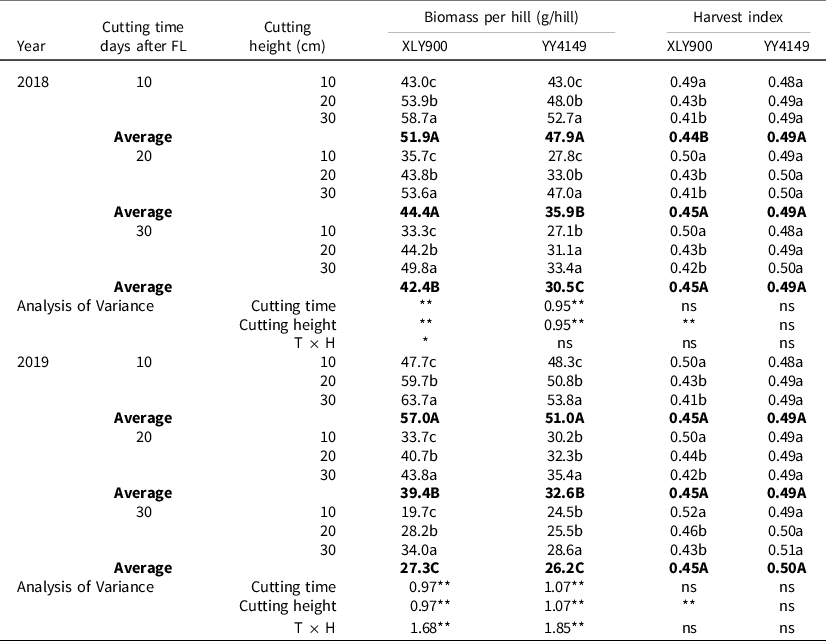
Biomass per hill was decreased with the delay of cutting times and increased when the cutting height increased. The maximum biomass per hill was observed 10 days after the flowering stage of the main crop and 30 cm stubble height, and there was a significant effect of cutting time and cutting height (Table 4). In XLY900, the maximum harvest index was observed at 10 cm stubble height and was significantly higher than that of the other stubble heights.
Biomass per hill and harvest index among different treatments in XLY900 (Xiangliangyou900) and YY4149 (Yongyou4149) in 2018–2019

*, **, significance at 0.05 and 0.01 level, respectively.
FL, flowering date; ns, no significance.
Yield and its components
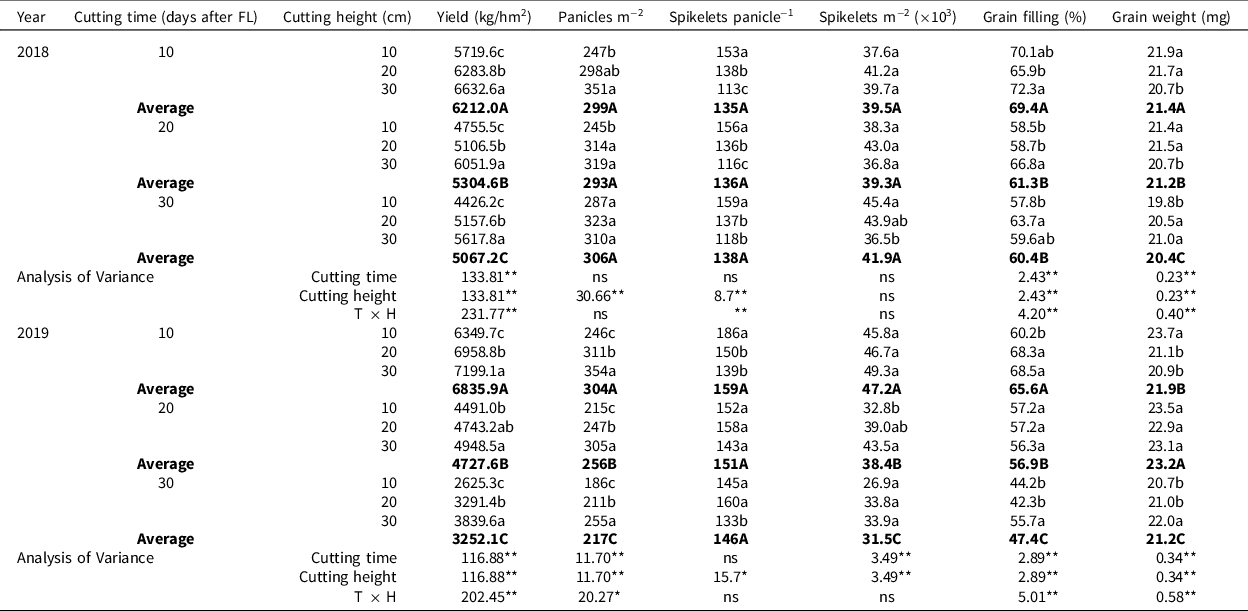
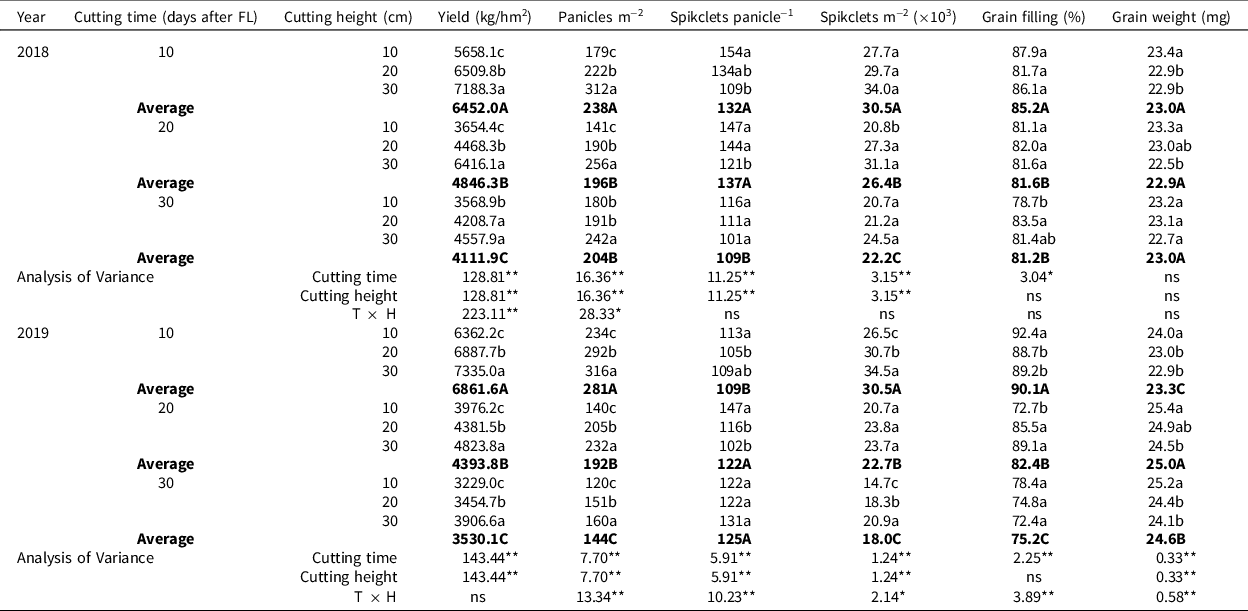
The highest rice yield of the ratoon crop was obtained with cutting 10 days after flowering stage of the main crop at a stubble height of 30 cm, reaching 6916 kg·hm−2 for XLY900 and 7262 kg·hm−2 for YY4149, on average of both growth seasons (Table 5). Spikelets per m2 is the product of panicle per m2 and spikelets per panicle. From yield components, spikelets per m2 of YY4149 and XLY900 with cutting 10 days after the flowering stage of the main crop was significantly higher than other treatments in 2019. The maximum grain filling at 10 days after the flowering stage of the main crop was, on average, 67.5% for XLY900 and 87.7% for YY4149, and significantly higher than that of 30 days after the flowering stage of the main crop. Compared with 30 days after the flowering stage of the main crop, early cutting time increased grain weight of XLY900.
Yield and its components among different treatments in XLY900 (Xiangliangyou900) in 2018–2019

*, **, significance at 0.05 and 0.01 level, respectively.
FL, flowering date; ns, no significance.
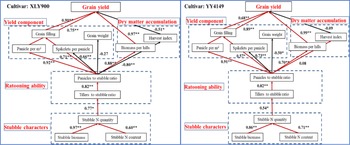
There was a significant and positive correlation between stubble N quantity, stubble biomass, and stubble N content (Figure 3). A significant positive correlation was observed between stubble N amount and TSR (r 2 = 0.77 in XLY900, and 0.54 in YY4149). Consequently, a significant positive relation was found between PSR and TSR (r 2 = 0.82 in XLY900, and 0.82 in YY4149). Panicle per m2 and grain filling increased significantly with increasing PSR, while there was significant negative correlation between spikelets-per-panicle and panicle-per-stubble ratio (r 2 = −0.66 in XLY900, and 0.73 in YY4149), and negative correlation between grain weight and panicle-per-stubble ratio (r 2 = −0.27 in XLY900, and −0.50 in YY4149). Therefore, high rice yield of the ratoon crop was mainly depended on panicle per m2 (r 2 = 0.75 in XLY900, and 0.89 in YY4149, p < 0.01) and grain filling (r 2 = 0.90 in XLY900, and 0.68 in YY4149). Biomass per hill was increased with increasing PSR (r 2 = 0.88 in XLY900, and 0.70 in YY4149). However, a significant negative correlation was observed between panicle-per-stubble ratio and harvest index (r 2 = −0.80) for XLY900, and there was a significant and negative relation between rice yield of the ratoon crop and harvest index (r 2 = −0.51). So, high rice yield of the ratoon crop depended on biomass per hill too (r 2 = 0.99 in XLY900, and 0.97 in YY4149).
Correlations of yield and its components, dry matter accumulations, ratooning ability, and stubble characters.

Yield and its components among different treatments in YY4149 (Yongyou4149) in 2018–2019

*, **, significance at 0.05 and 0.01 level, respectively.
FL, flowering date; ns, no significance.
Discussion
Our study demonstrated that rice yield of the ratoon crop was increased significantly with early cutting time and increasing cutting height, with the highest rice yield of the ratoon crop obtained after cutting 10 days after flowering stage of the main crop and a stubble height of 30 cm. The number of surviving buds was significantly and negatively correlated to the days after full-heading stage (Xu et al., Reference Xu, Zhang, Zhou, Guo, Zhu, Liu, Xiong and Jiang2021). Consequently, advancing the cutting time from 30 to 10 days after the flowering stage of the main crop resulted in improved total spikelet number and aboveground biomass, and then increased ratoon rice grain yield. Huang et al. (Reference Huang, Tu, Jiang, Qin and Huang2009) and Harrell et al. (Reference Harrell, Bond and Blanche2009) observed an increase in the growing point of axillary buds and the grain yield of ratoon crop with an increase in stubble height from 20 to 40 cm, and the grain yield of ratoon crop due to an increase in the spikelet number per m2 (more spikelets per panicle). In our study, high rice yield of the ratoon crop was mainly depended on panicle per m2 and grain filling, rather than spikelets per panicle (Figure 1). An alternative explanation would be the environmental conditions in the experimental site. Ratoon rice can be cultivated in regions where double-season rice (early-season rice and late-season rice) is grown, and the ripening stage of ratoon rice is similar to that of late-season rice. Huang et al. (Reference Huang, Chen, Cao and Zou2018) stated that delayed transplanting reduces spikelet filling, grain weight, and grain yield due to low-temperature stress at anthesis in machine-transplanted late-season rice. Our data indicated that the growth period of ratoon rice was shortened with increasing cutting height, which was beneficial for avoiding low-temperature stress and increasing accumulated temperature during ratoon rice season (Table 1). Different cutting times and cutting heights had a more significant effect on grain filling and panicle per m2 than on spikelets per panicle, however, there were differences among the cultivars (Figure 3). Herein, cutting times and cutting heights changed stubble characteristics, which in turn affected the ratooning ability and then the rice yield of the ratoon crop. Our data indicated that the highest rice yield of the ratoon crop was determined after cutting 10 days after flowering stage of the main crop and a stubble height of 30 cm (Table 5). Previous studies stated that the stem-sheath dry weight is an important indicator for measuring the ratooning ability of hybrid rice and was used to establish a regression equation to predict ratooning ability (Ren et al., Reference Ren, Jiang, Wang, Li, Zhang and Lu2006; Xu et al., Reference Xu, Zhang, Zhou, Guo, Zhu, Liu, Xiong and Jiang2021). Early cutting time limited biomass accumulation in the stubble (Table 4) because biomass stored (non-structure carbohydrate) in the stem sheath and photosynthate were mainly allocated to the panicles of main rice at the early stage of grain-filling. Xu and Xiong (Reference Xu and Xiong2000) reported that stem assimilates stimulated the bud emergence and growth when there was a higher leaf-grain ratio at the full-heading stage. Our results demonstrated that the biomass of the rice stubble was increased when the stubble height was increased from 10 to 30 cm (Table 4). Again, the highest biomass of the rice stubble in the cultivars YY4149 and XLY900 was observed after cutting 10 days after flowering stage of the main crop and a stubble height of 30 cm. The axillary buds of high nodes were more dependent on the dry matter stored in the stem and sheath than those of low nodes (Zhang et al., Reference Zhang, Xiong, Wang, Liu, Chen, Wu and Yan2000). Besides, nitrogen distribution in rice stubble is essential for germinating axillary buds into seedlings (Qin and Tu, Reference Qin and Tu2004; Xu et al., Reference Xu, Zhang, Zhou, Guo, Zhu, Liu, Xiong and Jiang2021). Due to the decline in root function during the grain-filling stage of rice, the efficiency of nitrogen absorption and utilization is often low (Xu et al., Reference Xu, Xiong, Zhao and Hong2000). Ma et al. (Reference Ma, Wang, Sun and Ren1992) found that the main source of nitrogen in the regenerating tillers was the transfer of nitrogen from rice stubble, and the nitrogen contribution of the main crop bud-promoting fertilizer was small. Lin et al. (Reference Lin, Chen, Zhang, Xu, Tu, Fang and Ren2015) found that the export percentage and apparent conversion rate of nitrogen from the stem and sheaths of the main crop to the ratoon crop were 37%–49% and 29%–54%, respectively. Interestingly, our data revealed that early cutting time increased stubble nitrogen amount, mainly for YY4149. Previous research reported that nitrogen translocation of the stem/sheath in the indica-japonica hybrid rice was significantly higher than that of the japonica inbred rice and the indica hybrid rice (Li et al., Reference Li, Zhang, Ma, Yang, Li, Wei, Dai, Huo and Xu2012; Li et al., Reference Li, Wei, Xu, Wang, Xu, Zhang, Dai, Huo, Wei and Guo2016). Based on this, it is speculated that the reason why early harvesting and increasing stubble height treatment increased the nitrogen accumulation in regenerating season rice is the high nitrogen content of rice stubble and the high nitrogen transfer efficiency of rice stubble. In addition, the difference in root vitality may also be one of the reasons for the difference in nitrogen accumulation. However, the difference in root vitality of regenerating season rice under different harvesting times and stubble heights is still unclear. Additionally, the impact of increased nitrogen content in regenerating season rice on photosynthetic assimilation efficiency and material transport metabolism requires further investigation.
Conclusively, our results confirmed that higher cutting height increases stubble biomass and its nitrogen amount when the cutting time of the main crop is advanced. Our results revealed a significant positive correlation between stubble N amount and TSR, and also between PSR and TSR (Table 3). As ratooning buds die after the full-heading stage of main crop, applying bud-promoting fertilizer to supplement the growth of the ratooning buds can effectively increase the survival rate of the ratooning buds[8]. These results suggest that time of application and doses of bud-promoting fertilizer depend on the nitrogen amount and its distribution in rice stubble. In the cultivar YY4149, the application time and doses of bud-promoting fertilizer would be advanced.
Conclusions
Cutting time and stubble height are two important factors affecting the rice yield of the ratoon crop. This study demonstrates that rice yield of the ratoon crop increased significantly with early cutting time after the flowering stage of the main crop and with increasing cutting height. The highest rice yield of the ratoon crop was found with cutting 10 days after flowering stage of the main crop and a stubble height of 30 cm, with XLY900 and YY4149 yielding (on average) 6916 and 7262 kg·hm−2, respectively. Stubble nitrogen amount (the product of stubble biomass and stubble nitrogen contents) was the effective index for improving ratooning ability, and then increasing ratoon rice grain yield. Therefore, novel ratoon rice cropping is an effective means to ensure both forage and grain security. With sufficient high-quality unprocessed grain, one can increase forage yield by delaying cutting time and reducing cutting height.
Acknowledgements
Authors gratefully acknowledge the help of anonymous reviewers for improving this article.
Author contributions
Q.Y. and H.B. conceived and designed the experiments; Y.W. and H.B. performed the experiments and wrote the manuscripts; and Y.W., H.B., and W.Q. analyzed the data, and contributed reagents/materials/analysis tools. All authors have read and agreed to the published version of the manuscript.
Financial support
The study was financially supported by the Earmarked Fund for China Agriculture Research System (No. CARS-01-27), funds from the Ministry of Agriculture & Rural Affairs; and the Major Science and Technology Project of Water Conservancy in Hunan Province (XSKJ2022068-29).
Competing interests
The authors declare no conflict of interest.