In May 1851, the Great Exhibition opened in London. By the time it closed its doors five months later, British designers and educators were already taking stock of its accomplishments and failures. It had been a grandiose display of British industry and imperial possessions that was visited by nearly one-fifth of the British public and put on display Britain's global empire for an international audience to see. At the same time, it had confirmed what some British artists and designers already knew: the design of British manufactures did not appeal to a public that preferred French designs. The solution suggested by the exhibition's chief organizer, Henry Cole, was to reform the British system of drawing education. On the South Kensington corner of the exhibition grounds in Hyde Park, Cole founded a school of drawing. Its method of drawing education, known as the South Kensington method, taught linear drawings based on geometric designs as opposed to human figures or landscapes. The geometric drawings of the South Kensington School were such a success that they came to dominate drawing education curricula until the first half of the twentieth century, not only in Britain but across the world. The story of the global spread of geometric drawing in France, the United States, Canada, Brazil, Australia, Japan, and elsewhere has been told in numerous books and articles. It is the story of drawing education put to the service of industrial capitalism in the age of imperialism.Footnote 1
What has not been told is the way in which non-Western societies that adopted the South Kensington method of drawing education transformed it from a functional skill that supported industrial capitalism to an artistic practice for forging a national essence. It is not that non-Western societies like Japan and Egypt did not continue to value skills that could improve industrial production. It is only that, in addition to their economic concerns about the success of industry, they faced a crisis of subjectivity that British educators did not. British, and for that matter French educators may have been concerned with cultivating a national culture of design. British writers frequently referred to France as the queen of design, while French educators could be heard fretting about what institutional structure would best foster the next genius of French drawing.Footnote 2 Competition was inherent in the Franco-British relationship, but among the global powers there was never any doubt that France and Great Britain were fully independent, “responsible,” and “civilized” members of the international system.
Japan and Egypt, on the other hand, were engaged in a struggle for their independence. British rule over Egypt justified itself by claiming that Egyptians were not ready to govern themselves. The unequal treaties similarly implied that Japanese laws could not be trusted to try the citizens of Western nations.Footnote 3 In such colonial and proto-colonial contexts, the independence of non-Western states depended on their ability not only to define themselves as equally modern and civilized as Western imperial powers, but also to portray themselves as having a unique essence that authorized them to exist as autonomous entities. Much like a people without history, a people without art lost some of their right to agency.Footnote 4 For Japanese modernizers, writes the art historian Chelsea Foxwell, the reframing of existing practices like the tea ceremony or calligraphy as art was an “outward-directed and anxiety-ridden process.”Footnote 5 It was aimed at Westerners and fraught with concern because a nation without art lost an important part of what made it distinct. For a non-Western society, the lack of a national art was also a lost opportunity to open another front in the struggle to revise its subaltern status. Art was important for nations like Japan and Egypt because by escaping the linear narrative of progress that made Europe's technological superiority indicative of its civilizational superiority, it could become a source of cultural capital.Footnote 6 So when Japanese and Egyptian educators replaced their mimetic embrace of modern Western drawing education with a national art education, they took on a new project. In addition to preparing workers for a modern industrial society, they began to establish a national culture that could claim a place in a world of cultural nations.
Art also had a second role. Not only did it help modern nations gain legitimacy as subjects of history, but it helped make them seductive objects of attraction. In Europe, Friedrich Schiller saw aesthetics as responsible for creating cultural community in the face of a cold technological modernity.Footnote 7 The interplay between technology and culture was even more important in Asia and Africa. “The greater one's success in imitating Western skills in the material domain,” writes Partha Chatterjee, the more anticolonial nationalisms stressed “the need to preserve the distinctiveness of one's culture.”Footnote 8 We can see echoes of this duality in the popularity of Japan's Meiji-era slogan advocating a “Japanese spirit with a Western technique” (wakon yōsai) as well as in a cotemporaneous Arabic discourse that differentiated between “the spiritual and the material” (al-rū ḥi wa al-mālī). Among those tasked with preserving the distinctiveness of the national culture, artists were prominent. In some cases they represented the national essence in the subject of their artwork, as in the famous statue by the sculptor Mahmud Mukhtar of an Egyptian peasant woman next to the sphinx, a symbol of ancient Egypt, or Raji Varma's paintings of scenes from Hindi mythology. In other cases, they represented the nation in the style of their artwork, as in the school of Japanese-style painting (nihonga) that was created in opposition to Western-style painting (yōga). Art was a key practice entrusted with making the nation attractive.Footnote 9
In this way, art helped to forge the nation into both a subject of history and an object of attraction. In some ways this article discusses the role of art in representing the nation, a topic that has sometimes been addressed by historians of art. My focus, however, is not on the art of professional artists but on the art education of primary school children. The advantage of focusing on the rise of art education in primary schools is twofold. First, it allows a more systematic global comparison of Japan, Egypt, and Great Britain that is made possible by the global similarity in educational materials. Most modern public schools produce similar archives, namely curricula that tell teachers what to teach, teaching manuals that tell them how to teach it, and textbooks that help them teach each subject.Footnote 10 The transculturation of these texts from one society to another makes it possible to trace the global rise and decline of certain methods, like the South Kensington method of drawing education, more systematically than would texts or images produced by professional artists. The second advantage of focusing on art education is that whereas professional artists always claim to be producing art, primary schools have not always claimed to teach art. Drawing education was a functional technique before it became an art. Tracing its transformation from the former to the latter is central to tracing the rise of aesthetics as a means of making the nation into a subject of history and an object of attraction. The first part of this paper discusses the mimetic moment in the 1870s and 1880s that saw the global spread of the South Kensington method of drawing education. The second and third parts are about the introduction of national art in Japanese and Egyptian schools that brought this mimetic moment to an end. This is when drawing education began to serve as a vehicle for breathing life into the national body in order to make it both a subject of history for an international audience and an object of attraction for a national audience.
DRAWING AND THE MIMESIS OF WESTERN TECHNIQUES
Until the latter half of the nineteenth century, schools in Japan and Egypt did not teach children to draw. Like most early modern schools, terakoya schools in Japan and kuttāb schools in Egypt usually grounded children in the three Rs—writing, reading, and occasionally arithmetic—and left other subjects outside of the framework of the school.Footnote 11 The modern schools that were established in Japan and Egypt in late 1860s and early 1870s broke from this pattern. Modeled on modern Western schools, they taught drawing education according to the South Kensington method. This method was first introduced into British public schools in 1853 and soon became a global phenomenon. It spread to Massachusetts in the 1870s, where the Headmaster of the Leeds School of Art Walter Smith became State Director of Art Education and Principal of the New England School of Fine Arts; to the province of Ontario in Canada in the 1880s, where Smith and others argued that the South Kensington system could increase Canada's exports of manufactured goods; to South Australia in the 1890s, where an alliance of educators, manufacturers, and artists contributed to making the South Kensington system a compulsory part of the school curriculum; and to Brazil, where the deep impression made by Smith's exhibit of children's drawings from Massachusetts at the Centennial Exhibition of 1876 encouraged Brazilian educators to adopt his methods as a more popular and practical alternative to the elitist influence of the fine arts on drawing education in primary and secondary schools. In this way, the linear and geometric drawings of the South Kensington method came on the heels of the global spread of industrial capitalism, feeding its demand for better-designed manufactured goods.Footnote 12
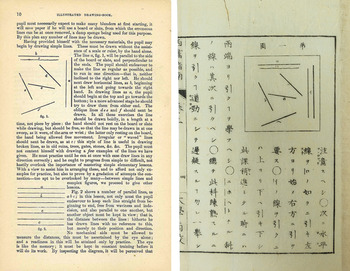
It is not surprising that the first Western drawing textbook translated into Japanese was influenced by the South Kensington method. In 1875 Kawakami Kan,Footnote 13 a leading expert of Western-style painting at the former Institute for the Study of Barbarian Books (bansho shirabesho), translated the British manual The Illustrated Drawing Book by Robert Scott Burn. This manual was published by the Japanese Ministry of Education as a Seiga shinan (“Guide to Western drawing”) and used to train drawing teachers in the newly established national school system.Footnote 14 Kaneko Kazuo has shown that compared to the South Kensington drawing manuals, which focused exclusively on geometric and linear drawing techniques, Burn's manual took the leeway to include landscapes, still life paintings, and drawings of the human body. In this sense, Burn's manual cannot unambiguously be referred to as a Western, European, or even a British manual, but it was a popular and eclectic version of the manuals that were used in British schools.Footnote 15 Like other manuals from this period, however, it was structured by the conventions of geometry. Children began by drawing straight lines, the foundation of the South Kensington method (see figures 1 and 2).Footnote 16 They then moved on to drawing the human body or landscapes. Even then, however, the manual superimposed straight lines onto the human face to show its proportions and diagonal lines onto the landscape to show a one-point perspective in which remote objects vanished into the distance. This obsession with straight lines, which was characteristic of the South Kensington School, was not only translated into Kawakami's manual; it was adopted by Japanese bureaucrats and educators when they began to author their own textbooks. In one typical textbook, published by the Japanese Ministry of Education in 1878, the first dozen images are all encased in straight lines in order to show proportions and perspective.Footnote 17 Although born in Britain, the South Kensington method and its rectilinear geometric conventions had made their way into the classrooms of modern Japan.
The teaching manual on the left, The Illustrated Drawing Book, is a popular British drawing manual from 1852. Its translation on the right, Seiga shinan (Guide to Western drawing), was published by the Japanese Ministry of Education in 1871. It was the first drawing manual intended for modern Japanese schools. The influence of the South Kensington Method of drawing education is visible in these and most other drawing manuals from this period, whether in Europe, the Americas, Egypt, Japan, or Australia. They usually began by teaching children to draw straight lines, which were fundamental to the geometric shapes and linear drawings that followed. The objective was not to teach children art but to prepare them for modern professions like industrial design, urban planning, engineering, and medicine. Robert Scott Burn, The Illustrated Drawing-Book (London: Ward, Lock, and Tyler, [1853]) (Harvard Fine Arts Library collection), 10; Kawakami Kan, Seiga shinan (Tokyo: Monbushō, 1875), 4 (National Diet Library collection).

The British South Kensington method of drawing education also became the model in France. The first half of the nineteenth century had seen French educators divided between advocates of teaching the human figure and advocates of teaching geometry.Footnote 18 The victors of this debate were the advocates of geometric drawing. Starting with the Great Exhibition in London, a cacophony of voices began to argue that the decline in France's industrial exports was due to the decline in the prestige of its decorative arts. A report to the French government alleged that at the opening of the Berlin museum of decorative arts the German crown prince had declared that improving the decorative arts would enable Germany, which had defeated France militarily in 1870, to defeat it “on the battlefield of commerce and industry.”Footnote 19 In order to improve the level of industrial design, French teaching manuals adopted geometric drawing much like Great Britain. One such textbook was the 1869 French primary school teaching manual by Jean Carot, La clef du dessin (The key of drawing). Its first shape consisted of “straight lines, horizontal and parallel.”Footnote 20 This was followed by various geometric shapes and eventually by geometric ornaments. When in the late 1860s the Egyptian government created a school system to train a small cadre of government bureaucrats, it used these French drawing textbooks. An 1888 curriculum prescribed the “Carot method” for government primary (ibtidā’iyya) schools, almost certainly referring to the above-mentioned work.Footnote 21 In this way, Japanese and Egyptian manuals that were modeled on British and French manuals, respectively, came to share in the same global paradigm that had originated in Europe and, as a consequence, resembled each other without ever having enjoyed direct contact with one another.
Advocates of the South Kensington method agreed that drawing was not an art but a functional skill. In an address to the Council of Arts and Manufactures of Quebec, Walter Smith told his audience that drawing “is not art, any more than the process of reading and writing are literature.”Footnote 22 Half a world away he was echoed by Ḥasan Tawfīq, a leading Egyptian Arabist and educator. Tawfīq had graduated from Egypt's most prestigious institutions, its oldest university, al-Azhar, and its leading modern teachers’ college, Dār al-‘ulūm, then spent most of his career teaching Arabic at the School of Oriental Studies in Berlin and the University of Cambridge. In Arabic language writings intended for Egyptian teacher's colleges, like this pedagogical guide published in 1892, he conveyed to Egyptian audiences what was standard knowledge among European educators. “The intention of drawing education in primary schools,” he wrote, “is not to make [children] into artists.”Footnote 23 Almost without exception, modern educators everywhere repeated that drawing was primarily useful for improving industrial design, although it could also be useful for fostering other professions. The Japanese educator Ima'izumi Gen'ichirō enumerated some of these when he wrote that drawing was beneficial for “farmers, merchants, doctors of Western medicine, and natural scientists.”Footnote 24 And the French painter and writer André Albrespy added that drawing was helpful for prosecuting war, since it helped citizen soldiers improve their aim.Footnote 25 Drawing was part of not only primary education but also secondary education. For example, late nineteenth-century Egyptian railroad employees who were about to be sent abroad for further training spent three hours of a fourteen-hour examination on drawing.Footnote 26 In a world structured by capitalism and imperial competition, both colonizers and colonized taught drawing not as an art but as a functional technique that prepared children and young adults for modern professions.
FROM WESTERN TECHNIQUE TO NATIONAL ART
By the turn of the century the South Kensington method was under siege. British opponents of industrialism like John Ruskin had long opposed its focus on teaching drawing as a preparation for industrial design. Ruskin's pupil Ebenezer Cooke was transitioning the South Kensington School toward a method of drawing education that encouraged children to express themselves more freely.Footnote 27 Although the South Kensington method did not completely disappear from British schools until the 1930s, a global revolt against geometric drawing education was already underway.Footnote 28 At the London exhibition of 1908, representatives from twenty-two countries assembled at the museum of the South Kensington School itself, which was partaking in the critique of its own nineteenth-century pedagogic practice. The most influential exhibit was by the school of the Viennese educator Franz Cizek, whose pedagogic method consisted of giving children complete artistic freedom. The striking images that his pupils drew made a deep impression on many of the participants, who for the first time discovered an intrinsic value to children's art. Freehand drawing education, as this new school of drawing education was known, was adopted by the French national curriculum of 1909, became the dominant method of drawing education in Japan from about 1918, and became the norm in Egypt a few decades later. Instead of textbooks that began with straight lines and geometrical shapes, freehand drawing education asked children to express themselves creatively, subjectively, and beautifully.Footnote 29
This article, however, is not about the freehand drawing education movement but about a largely overlooked trend that preceded it by several years. More than a decade before freehand drawing education became popular in Europe, in an age when Cizek was still largely unknown and the geometric drawing education of the South Kensington School was still dominant, Japanese and Egyptian educators began teaching children genres of drawing that did not exist in European schools. These should not be confused with freehand drawing education. Not only did they come earlier, starting in 1888 in Japan and 1894 in Egypt, but their styles were different from the freehand drawing education that came later. They did not oppose the copying of models, use colors, or seek personal expression and creativity. Instead, they taught brush drawing in Japan and “Arab art” in Egypt, two styles of drawing that were absent from European schools. In this sense, these movements were not global but rooted in local techniques and practices. Despite their national particularity, however, they participated in a common project that used art to create a national culture.
Looking at educational sources from primary schools, it is possible to identify the moment when artistic intent became important to drawing education in modern schools.Footnote 30 In Japan, the beginning of brush drawing education in modern schools can be dated to 1888, when the first Japanese drawing textbook that used the brush instead of the pencil was published.Footnote 31 In the world of Japanese drawing education, this was a momentous event. Since the beginning of modern schools in 1872, the pencil had reigned supreme. It was one of the instruments of writing and drawing in the West and, like other instruments of Western civilization, was adopted as the new standard of modern Japan. Yet even in 1873, as Japanese artisans were learning to make their first pencils, a Japanese delegation attending the Vienna International Exhibition discovered, to its great surprise, that Japan's brush paintings and calligraphies elicited considerable interest from Western audiences. At the very moment when the pencil was being introduced into Japan's first modern primary schools, its relationship to the brush was already being refashioned. The pencil was becoming an emblem of the modern West, an instrument of the power and wealth to which Japan aspired. The brush was being recast from the standard instrument of writing and painting of early modern East Asia to an instrument that came to represent Japanese aesthetics and consequently Japan itself. In this way the relationship between the pencil and the brush came to mediate the relationship between the West and Japan. The West provided the instruments for an efficient and functional modernity, while Japan's past provided its aesthetic essence.Footnote 32
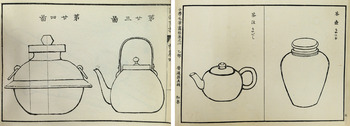
This was the context in 1888, when the first textbook for brush drawing, the Shōgaku mōhitsu gajō (The primary school brush drawing book), was published. It marked the beginning of a debate that would rage for the next fifteen years, pitting advocates of the brush (mōhitsu) against advocates of the pencil or, more precisely, the “hard tip” (kōhitsu), which usually referred to the pencil but sometimes also to the pen. During this period the brush was as popular as if not more popular than the pencil. One study of 244 textbooks estimated that from 1893 to 1903 the brush was the primary instrument of drawing education for 62 percent of drawing textbooks.Footnote 33 Although they were concerned with artistic beauty, textbooks advocating the brush did not forego the functional objective of drawing education. They still sought to prepare children for careers like engineering and architecture. In fact, textbooks that advocated brush drawings and pencil drawings did not show any significant difference in the object of the drawings.Footnote 34 It was still dominated by geometric shapes in the early years and linear drawings thereafter (figures 3 and 4). In this sense, the influence of the South Kensington School of drawing education remained. Advocates of the brush only believed that in addition to teaching children functional skills, schools should also educate their artistic faculties.
Two images from primary school textbooks published in 1888. The textbook on the left, the Shogaku zuga kaitei (Primary school drawing guide), uses the pencil, while that on the right, the Shōgaku mōhitsu gajō (Primary school brush drawing book), is the first textbook to use the brush. Although textbooks for both the pencil and the brush taught children to draw similar objects, the pencil was assigned a different role from the brush. The pencil's even and precise line was associated with the practical world of Western techniques while the brush's varied thickness and deeper blacks were understood as a specifically Japanese form of artistic expression. Late nineteenth-century Japanese educators split on whether primary schools should teach children the functionality of the pencil or the beauty of the brush. Ichihashi Sutegorō, Shōgaku zuga kaitei (Fukui: Hirasawa Junsuke, 1888), 4:20; Kose Shōseki, Shōgaku mōhitsu gajō (Kyoto: Fukui Shōbōdō, 1888), 2:5; both volumes are in the National Diet Library.

The brush was almost always seen as offering more artistic possibilities than the pencil. Where the pencil was practical, the brush was beautiful. A 1903 teaching manual published by the primary school attached to the Takada Teachers’ College of Niigata Prefecture, for example, noted: “The pencil coincides with the practical progress of architecture or of machines. [It is] often useful for the development of geometric, or in other words mechanical, drawing methods … [but] according to national custom [the brush] is more adept at eliciting a sense of beauty in drawings.”Footnote 35 Such a division of labor between the mechanical and practical properties of the pencil on the one hand and the national and artistic nature of the brush on the other was widespread. It can be seen in a primary school teaching manual from around the same time, authored by two high-ranking educators in Tochigi prefectures, Suzuki Kōai, the principal of the Tochigi Prefecture Teacher's College, and Sugita Katsutarō, the principal of the primary school affiliated to the Tochigi Prefecture Teacher's College. For teaching children a beautiful calligraphy in language class, they argued, the advantages of the brush were many, “but for making precise scientific drawings the pencil has its benefits.” In the overwhelming majority of teaching manuals from this period, the brush had a monopoly on artistic representation.Footnote 36
There is no doubt that the parameters of this discussion are specific to the world of education. In the world of art, Japanese practitioners of Western-style painting sometimes used the pencil as an instrument for making art works and were well aware of its artistic potential. This was not the case in literature on primary school drawing education. Teachers at the top of Japan's educational apparatus like Murata Uichirō, a teacher at Japan's most elite teacher's training college, the Higher Teacher's College, explicitly recognized the artistic role of the pencil in Western-style painting. Like others, however, Murata concluded that the dichotomy between the brush and the pencil remained anchored, if not in his own mind then in popular discourse. Even though pencils had both functional and artistic purposes, “in the eyes of Japanese people,” he wrote, “pencil drawings occupy a scientific function, while brush drawings have an artistic function.”Footnote 37 This division of labor between the functionality of the pencil and the aesthetics of the brush was shared by both advocates of the pencil and advocates the brush. What they disagreed about was whether functionality or beauty should be privileged in primary school drawing classes. The pencil was modern in its functionality. The brush was most suited for fostering “national customs” but less precise and useful for functional drawings. The question was whether the brush's Japanese aesthetics justified its replacement of the more functional pencil. Choosing the brush over the pencil not only foregrounded aesthetic concerns but went against some of the functional objectives of the South Kensington School, which had until then been the model for drawing education in Japan.Footnote 38
Egypt experienced a similar departure from the industrial concerns of the South Kensington School of drawing education. If in Japan the brush was draped in the mantel of Japanese “national customs,” in Egypt it was a style of geometric ornaments that became the symbol of the Egyptian nation. Like in Japan, primary school drawing curricula in late nineteenth-century Egyptian schools largely consisted of drawing lines, geometric shapes, and linear drawings. The 1892 curriculum for the first three grades of government primary schools, for example, instructed pupils to draw straight lines and divide them into parts, draw angles, and draw patterns by first tracing a circle with a specific circumference and then surrounding it with geometric shapes and flower or star patterns.Footnote 39 This type of drawing largely reproduced methods that were common in French schools and which the British South Kensington School had made globally popular. Yet in the case of Egypt, they may have been more than a mimicry of European drawing methods. In the Arab and Islamic worlds geometry had a long history that predated the nineteenth-century adoption of European drawing education curricula. It was at the center of Islamic art and of its fountains, mosques, and illuminated manuscripts. Orientalist scholarship even named some geometric motifs after the Arab world, referring to them as “arabesque.”Footnote 40 As a consequence, when the curriculum for modern schools was first drawn up in 1870s Egypt, its creators had two reasons to teach straight lines and geometric shapes in drawing class. In an early twentieth-century teaching manual, for example, the director of education of Egypt's Baḥriya governorate, ‘Ali ‘Umar, encouraged geometry by citing not contemporary European scholarship but a passage from the famed fourteenth-century Arab scholar Ibn Khaldūn:
Geometry enlightens the intellect and sets one's mind right.… It is hardly possible for errors to enter into geometrical reasoning, because it is well arranged and orderly. Thus, the mind that constantly applies itself to geometry is not likely to fall into error. In this convenient way, the person who knows geometry acquires intelligence. It has been assumed that the following statement was written upon Plato's door: ‘no one who is not a geometrician may enter our house.’ Our teachers used to say that one's application to geometry does to the mind what soap does to a garment. It washes off stains and cleanses it of grease and dirt.Footnote 41
Geometric drawing was not only a European method for preparing children for modern professions that required linear drawing. In the Egyptian context it was also an artistic idiom with deep roots in the Arab-Islamic sciences and arts.
Since geometric drawings were both a modern European method of drawing education and an indigenous practice that predated the influence of modern European methods of drawing education, it is not possible to trace the rise of an indigenous form of drawing like in Japan, where the brush was unmistakably associated with indigenous traditions. The rise of a concern for an indigenous artistic tradition can, however, be seen in a discursive shift that occurs in the drawing section of official Egyptian government curricula starting in 1894. That year, the word “art” first appears in these curricula. It does not appear alone, though, but is preceded by an ethno-regional qualifier. The French language curriculum speaks of the need to inculcate in pupils an adequate notion of the “art of their country” (l'art de leur pays). This link between art and the nation was not incidental. The 1898 curriculum, also in French, spoke of the need for teachers to teach “motifs of Arab art” (motifs d'art arabe). The 1901 curriculum, this time in an Arabic version, instructed students to draw “Arab forms” (ashkāl ‘arabiyya), while the 1907 curriculum spoke of “Arab patterns” (nuqūsh ‘arabiyya) in the Arabic version and “Arabesque designs” in the English version. The word “art” can here be seen entering drawing curricula at the same time as the ethno-regional concept of Arabism, which was used to signify Egypt's indigenous culture. While in Japan the brush represented the artistic expression of the Japanese nation, Arab art represented the artistic expression of the Egyptian nation. In both cases, the nation needed art in order to become manifest, both on an international stage and for its own population.Footnote 42
THE MUTUAL CONSTRUCTION OF ART OBJECTS AND NATIONAL SUBJECTS
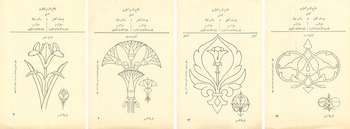
The construction of an indigenous national essence is inherent to modern nationalisms, whether in Japan, Egypt, Europe, or elsewhere. As such, it is not surprising that the concepts of the Japanese brush and of Arab design were both developed in dialogue with Western typologies of art. Before the nineteenth century, artistic styles in the Arab world and East Asia were usually classified according to the dynasty under which they developed, the region from which they originated, or the religious narrative that they recollected. Yet, with the adoption of European categories of knowledge, art began to be categorized according to ethno-regional criteria. A good example is a set of pedagogical drawing cards printed by two of the era's leading Egyptian artists, Yūsuf Kāmil and Rāghib ‘Ayyād, both of whom began their careers as drawing teachers. Produced sometime between 1911 and 1925, these cards were divided into four categories: natural design (namūdhaj ṭabī‘ī), Egyptian design (namūdhaj miṣrī), Arab design (namūdhaj ‘arabī), and Western design (namūdhaj ifranjī) (figures 5–8).Footnote 43 Their categories mirrored the categories of world art in works by well-known European experts of ornament such as the British architect and designer Owen Jones, whose 1856 The Grammar of Ornament was the first systematic attempt to generate a language of ornament that could serve the modern industrial project.Footnote 44 To this end, it divided ornaments into nineteen styles that included “[ancient] Egyptian ornament,” “Arabian ornament,” and “leaves and flowers from nature.” Although Jones’ Grammar of Ornament was, like the drawing education of the South Kensington School, intended to improve the quality of British designs, the cards by Kāmil and ‘Ayyād were less a survey of world art than an exhibition of the art of the Egyptian nation.Footnote 45
Sample from a set of some twenty-five educational drawing cards from the 1910s or early 1920s by the Egyptian artists Yūsuf Kāmil and Rāghib ‘Ayyād. The cards are classified into four categories: From left to right, natural design (namūdhaj ṭabī‘ī), Egyptian design (namūdhaj miṣrī), Arab design (namūdhaj ‘arabī), and Western design (namūdhaj ifranjī). This ethno-regional classificatory scheme is typical of British works like Owen Jones’ The Grammar of Ornament, but unlike Jones’ work these cards did not attempt to survey the world's artistic heritage in order to improve industrial designs, but rather sought to articulate an Egyptian national art in relation to Western categories of art. Yūsuf Kāmil and Rāghib ‘Ayyād, “Namādhij al-rasm al-naḍharī” [Models of freehand drawing] (Ilhāmiyya Industrial School Press, n.d.), cards 3, 5, 13, 23.

Missing from Jones’ Grammar of Ornament was Japan. It was left out of Jones’ encyclopedic work along with other forgotten regions like Africa, whose ornaments were largely unknown in British art schools and museums. It was only with the 1862 International Exposition in London that Japanese objects were discovered by British designers. One of them was Christopher Dresser, a student of Owen Jones, whose 1873 Principles of Decorative Design came to include the Japanese arts. Just like Jones’ work from two decades earlier, Dresser's objective was to create a global typology of ornaments that could help to educate “those who seek a knowledge of ornament as applied to our [English] industrial manufactures.”Footnote 46 Within a few years of its publication, a wave of interest in the Japanese arts known as Japonisme swept Europe and North America and Dresser was soon aboard a ship to Japan. The product of his visit was a work specifically on Japanese ornament entitled Japan: Its Architecture, Art, and Art Manufactures.Footnote 47 Like other Orientalist works, Dresser's volume contributed to giving Japan an artistic presence in Europe. From that point onward Japan would rarely be excluded from Western surveys of world ornament or world art, where it found a place within the pantheon of autonomous national cultures.
Art did not just help people living outside of the West to gain subjectivity in the eyes of Western societies. It also helped construct the nation as an independent and attractive subject of history in the eyes of its own domestic audiences. In this respect, the late 1880s in Japan and the 1890s in Egypt were important to the construction of a national subject. In Japan, this period saw a new generation awaken from two decades of restless importation of Western instruments, practices, and institutions to find itself beset by the agonies of cultural alienation. This was a time when what Kenneth Pyle called “the new generation in Meiji Japan” sought to restore Japan's cultural autonomy.Footnote 48 Julia Thomas writes that, by the 1890s, “Japanese culture could begin to love nature without having to look outside itself.”Footnote 49 This concern for a national culture could also be seen in the visual arts. In 1887 Okakura Kakuzō, one of this era's leading art critics, began his career by embracing the ideas of Dresser and, more famously, the American art historian Ernest Fenollosa. He established the Tokyo School of Fine Arts, which at its inception was focused on Japanese-style painting, by which he meant a style of painting that traced its genealogy back to premodern Japanese art. Scholars have debated whether the introduction of brush painting in primary schools was directly attributable to Okakura, but whether this was the case or not, the dichotomy between Japanese-style painting and Western-style painting is generally recognized as the precursor to the dichotomy between the brush and the pencil in primary school education.Footnote 50 Both participated in the artistic construction of the more independent Japanese national subject that gained traction in the late 1880s.Footnote 51
In Egypt, the construction of a national subject came later and was slower. In the 1890s Egyptians were just beginning to imagine Egypt as an independent subject of history. This entailed shedding their attachment to Ottoman culture and to the Ottoman Turkish language in favor of the Arab world and the Arabic language. As Yoav Di-Capua notes in his study of Egyptian historiography, this was the moment when Egyptian elites began “to mold this object called ‘Egypt,’” at least in its modern conception.Footnote 52 They did this not only through the introduction of the discipline of history, but through anthropology and other social sciences. Omnia El Shakry describes how Egyptian social scientists worked to replace the Orientalist assumption of a radical difference between Europe and its colonial others with a collective national subject that was analogous to the European one but still possessed a unique essence.Footnote 53 This subject found a visual expression in the references to Arab art in primary school curricula from the 1890s and was illustrated in the drawing cards by Kāmil and ‘Ayyād. It imagined Egypt as a national culture in a world of cultural nations.
The foundations of this modern national culture stood on several pillars. They included history, language, and art. Together, these and other fields made a collective claim to the uniqueness of each national polity. The way in which language contributed to the imagination of the nation is central to Benedict Anderson's study of nationalism, while the role of historical narratives in creating the nation as a new sovereign subject is the topic of Prasenjit Duara's Rescuing History from the Nation.Footnote 54 Like national languages and national histories, national forms of art are particular in a global manner. They serve to construct the nation as a unique subject, yet they can only exist in the company of other parallel constructions of the nation. As Arjun Appadurai notes, “Indian cuisine” could not exist outside of a world made of French, Italian, and other national cuisines.Footnote 55 Whether through language, history, cuisine, art, or otherwise, the modern world was imagined as made up of ethno-regional components. The introduction of national art in schools can be seen as participating in the construction of the Japanese and Egyptian components of this world.
The introduction of art education in Japanese and Egyptian schools cannot, however, be reduced to the international concerns of Japanese and Egyptian elites. Although the introduction of art education in primary schools occurred in the global context described in this section, it was largely aimed at a domestic audience of primary school children. We do not know whether these children internalized the national forms of art that the curricula, teaching manuals, and textbooks assign them. Children leave few documents for the historian to consider and even when they do, these rarely find their way into archival repositories. If we understand aesthetics as an object of attraction that makes a “promise of happiness,” to use the words of Alexander Nehamas, then drawing education as art education, namely as an aesthetic practice, was dealing in a currency other than shared language communities or historical narratives.Footnote 56 It was not, like language, concerned with creating a shared discursive space, or like history, with building a shared narrative. Drawing education as an aesthetic practice was concerned with using art to make the nation into a seed of pleasure and in planting this seed into children's bodies. The repeated reference to “art” and “beauty” in Japanese and Egyptian curricula and teaching manuals reflects this desire to appeal to children's tastes, namely to attract children toward the object of the drawings, which was the national subject.
CONCLUSION
I began this paper by describing the foundation of the South Kensington School of drawing education and the global adoption of its methods. At first, the paper's structure seems to replicate what Dipesh Chakrabarty critiqued as a “first in Europe, then elsewhere” narrative of world history, wherein concepts and practices originating in Europe are then adopted elsewhere.Footnote 57 If this study spanned the period from the early 1870s to the late 1880s, and even if it avoided historicist assumptions, it would still be difficult to ignore a Japanese and Egyptian literature on drawing education that was largely modeled on the British South Kensington School. During this time, after all, the first drawing manual for modern Japanese schools was entitled “Guide to Western drawing,” while Egyptian curricula recommended that primary school teachers learn to teach drawing by reading French and English drawing manuals in the original. If we expand the temporal span to include what came before the 1870s, however, we notice that the Japanese and Egyptian mimesis of European drawing manuals, and of many other aspects of Western societies, was a rare moment. It followed centuries if not millenniums that saw the inhabitants of what became Japan and Egypt cultivate a variety of methods for educating children and for practicing the visual arts with only occasional and ancillary engagement with European methods. Expanding the span beyond the 1880s shows that Japanese and Egyptian educators transformed European methods by infusing them with alternative practices, which were cast as national forms of art. As far as drawing education in primary schools was concerned, the mimetic moment had lasted less than two decades.
It is tempting to see the Japanese and Egyptian transformation of the South Kensington method of drawing education in the late 1880s and 1890s as an example of non-Western subjects subverting European practices. Yet as recent scholarship, starting with Lydia Liu, has suggested, the history of non-Western societies cannot be reduced to one of resistance.Footnote 58 Japanese and Egyptian educators were not concerned with resistance but with creation. In this article, their creation consists of using primary school drawing education to help construct an autonomous national culture. The very concept of a national culture, of course, participated in the late nineteenth-century global order described in the previous section, which was grounded in a culturally autonomous national subject modeled on the West. Yet as that section made clear, the construction of a national subject cannot be reduced to an act of mimesis. Educators used art to create both a national subject that was analogous to other national subjects and a subject that was sufficiently charismatic to become an object of allegiance and attraction.
This double nature of the nation, as both subject and object, is essential to understanding the end of the mimetic moment. As a subject of history, the nation's raison d’être was defined in inter-subjective terms. The Japanese and Egyptian nations had to define themselves as national subjects within a world made of national subjects whose existence justified their existence. The justification for the nation as a subject was external. It could only exist within an international system made of national subjects. As an object, however, the nation had to be made into a magnetic nucleus of attraction for its population. For the nation to become a core of attraction that could bring together a national community it had to be made beautiful. If it was not, then it could lose its ability to harness the allegiance of the national community, leaving its members vulnerable to seduction by other objects of attraction. Thomas Macaulay glimpsed such an outcome when in his 1835 “Minute on Indian Education” he suggested that the ultimate supporters of British power in India would be an Indian elite, which was “English in tastes, in opinions, in morals and in intellect.”Footnote 59 Taken to its logical extreme, such an elite would not have mourned the disappearance of India as an autonomous national subject because the object that enchanted it, attracted it, and gave it pleasure was English. If newly minted modern nations like Japan and Egypt were to survive, they too had to become attractive. To do so, the mimetic adoption of universal industrial drawing methods had to make space for an education that taught a national art.