Operatic reception histories based on press sources still arguably undervalue audience preparation in comparison with critical response. Such practice has its immediate logic, not least because on a pragmatic level it offers an answer to the conundrum of where – within the interlocking cycles of reception as artistic influence, as practice and as documented response – the historian should start. In addition, much preview material is simply hype issued by interested parties. Nevertheless, whether our primary focus is a work, an event, or a set of cultural norms, we ignore preview and preparatory material at our peril, and although many works reach the operatic stage without a great deal of noise, those works that are long-fought or carefully orchestrated are documentary building sites of cultural expectation that can, in due course, become cultural memory. Where abandoned or radically revised projects are concerned, previews can reveal the reasons behind curious trajectories, which might otherwise slip under the radar; they can offer a valuable and cumulative corrective to the temptations of writing history with hindsight; and the terms of reference of their hype can be immensely instructive. Moreover, where reception history involves diachronic analyses and studies of geographical and cultural displacement – which is currently more often than not – the nature of preview or preparatory material broadens accordingly. In studies of the later lives, or afterlives, of repertories, its transformation into a more rounded type of cultural history is all but inevitable, and indeed intellectually necessary.
To write about Lohengrin in 1890s France is to beg the question of forty-odd years of history preceding a sudden and dramatic flurry of activity. It also invites musicological reconsideration of the composer's volatile reception there. Appropriately enough given Wagner's lifelong difficulties in Paris, French reception of his staged operas opens with a flop followed by a cancellation and then political complication. July 1855 saw four performances of Tannhäuser at the Grand Théâtre in Strasbourg, given in the original language by a German touring company that also planned to bring France its first Lohengrin. The cultural importance of both productions as French premieres was central to the sales pitch of Ferdinand Roeder, the opera company's manager, but ticket receipts for the season overall were low (the performances clashed with an exodus to Paris for the Exposition Universelle): Lohengrin did not make it to the stage.Footnote 1 Thereafter, in the most literal of senses, the opera arrived in Strasbourg too late to be French: by the time it was staged by the resident company, on 20 November 1874, Strasbourg was four years beyond France's defeat by Prussia. The town, its municipal opera, and its first Lohengrin were German, and in line with Strasbourg's underexposure in Paris-based criticism on account of its being a ‘lost’ regional capital, none of the leading musical weeklies in Paris covered it.
The standard history of Wagner stagings in France has hitherto meant the Parisian Tannhäuser scandal of 1861 followed by Rienzi at the Théâtre-Lyrique in 1869. Wagner then takes the humiliating defeat of the French to Prussia in 1870, the ensuing siege and civil war in Paris, and the French loss of Alsace-Lorraine, as cues for literary revenge on France's failure to recognise his value: an ode on the failings of the French army is accompanied by the infamous Eine Kapitulation, a playlet cast as a libretto for a quasi-Offenbachian operetta subjecting everything Parisian to spoof and ridicule.Footnote 2 Paris is not amused, and the resulting political impasse over performances of Wagner, chief artistic insulter of the French nation, is catastrophic. A history of audience rioting over concert extracts at Jules Pasdeloup's Concerts Populaires in the 1870s ensures that despite there being appreciative audiences for entire acts of Wagner's operas at Charles Lamoureux's concerts by the early 1880s, attempts to mount full productions during the same period have to be abandoned amid fears of unrest if a whole work is presented on a publicly funded stage.Footnote 3 A committee begins fundraising in late 1885 to stop projected Wagner performances, and revanchist Juliette Adam writes a much-cited letter to Le Figaro denouncing the Opéra-Comique manager Léon Carvalho's forthcoming Lohengrin as unpatriotic.Footnote 4 The pseudo-patriotic riots organised to disrupt Lamoureux's production of the opera at the privately funded Eden-Théâtre in 1887 seem to prove the case that it cannot safely be staged in Paris. Lamoureux abandons performances after the first night, following discussion with the Ministre de l'Intérieur, and the work is effectively banned until 16 September 1891, when street riots outside the Opéra are quashed by rather more determined government action to protect the first performances of Lohengrin on a French national stage. They open the way for a period of belated Wagnerian dominance in Paris.
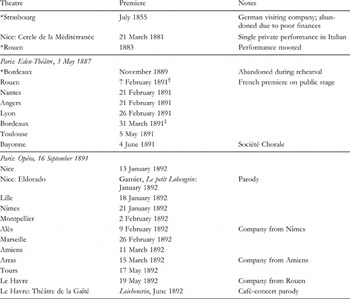
This centralist narrative illustrates that the French knew they had to catch up with the rest of Europe, but beyond the briefest of allusions or listings of performances, it does not relate how.Footnote 5 That ‘how’ is strikingly decentralist (Table 1). It begins with a private performance of Lohengrin, in Italian, in Nice in 1881, followed by a project for Rouen mooted in November 1883Footnote 6 and a venture that nearly succeeds, in Bordeaux in 1889. There is decisive but ultimately damaging intervention from Angers in 1886 when comte Louis de Romain tries to galvanise support for the Carvalho project at the Opéra-Comique.Footnote 7 Then, between February and June 1891 come the French premieres, using the libretto as translated by Charles Nuitter: Rouen, Nantes, Angers, Lyon, Bordeaux, Toulouse and Bayonne.Footnote 8 All seven of them before Paris, all seven of them without attendant violence, all seven of them on publicly funded stages. This was what Catulle Mendès memorably (and quotably) called Lohengrin's ‘tour de France’.Footnote 9 After Paris the tour continues to the end of the season: Lohengrin revivals in Lyon in November 1891 and January 1892, and in Toulouse in December 1891; then first public performances for Nice, Lille, Nîmes, Montpellier, Alès, Marseille, Amiens, Arras, Tours, Le Havre, with resident companies now beginning to take the opera to smaller centres.
Lohengrin in the French Regions to June 1892*

* Entries with an asterisk were projected or abandoned. Entries in italic illustrate how the two Paris productions intersect with regional provision. All regional performances are at the municipal theatre except where indicated.
† Pierre Duchesne gives a series of dates for regional premieres before Paris. Unfortunately almost all are wrong. Pierre Duchesne, Lohengrin à Lille: Légende, livret, partition (Lille, 1892), 32.
‡ Kahane and Wild give an erroneous date of 13 September. Kahane and Wild, Wagner et la France, 165.
Each successful premiere acted as prelude to the next, creating a cumulative cycle of confidence and appreciation such that by the time Lohengrin arrived in Lille in early 1892, history was reinventing itself nicely: according to ‘Zedde’ in a preview for Le Réveil du Nord, despite the Parisian riots of 1887 the regions ‘had no hesitation’ [n'hésitèrent pas] in staging it.Footnote 10 By the following February, a year after its Rouen début it was, according to Le Sémaphore de Marseille critic Ch.-Ed. Michel, a work ‘destined to become classic and popular in equal measure’ [destiné à devenir classique et populaire à égal titre].Footnote 11 There was no hollow ring to regional correspondents' claims of success after success. Lohengrin had a regenerative impact on metropolitan operatic culture. As was widely predicted, Wagner's novelty attracted the high-spend sector back into the theatre, making performance runs profitable: Lohengrin could and did rescue theatre company finances. Suddenly, advance ticket purchase was essential, repeat attendance common, and the black market for tickets a council headache.Footnote 12 By public demand Lohengrin was given matinées, half-price ‘popular’ performances, and slots on regular days of the week. It dominated opera schedules: Marseille gave it thirteen times in a single month. Financial dependability made it ideal repertoire for benefits and charity galas, and it soon displaced familiar works by Meyerbeer or Verdi to close opera seasons in grand fashion. Finally, it created its own afterlife, inspiring parodies in Nice and Le Havre and doubtless elsewhere.
While regional preparations were in full swing, the Paris situation was one of tension and brinkmanship caused by the fact that in respect of Wagner alone, Paris could not perform its usual centralising function. A stealth attack was the best the capital could manage, possibly mirroring a similar but failed attempt of February 1886 at the Opéra-Comique, but now overshadowed by the public-order ban of 1887. On 30 October 1890, having advertised Acts 3 and 4 of Ambroise Thomas's Hamlet in a gala benefit for the actor Dumaine, and having listed a duet from Lohengrin on the programme sheet itself, the Opéra's directors instead slipped in the whole of Act III, fully staged.Footnote 13 It seems to have been Rose Caron's idea, and done for ostensibly musical reasons,Footnote 14 but this ambush of an aesthetically and politically neutral public with a substantial portion of a supposedly inflammatory work proved how popular it was likely to be.Footnote 15 Emmanuel Arène, parliamentary député for Corsica, wrote that it was tantamount to getting Lohengrin onstage ‘via the servants' entrance’ [par l'escalier de service]; the Paris correspondent for the New York Times called it a ‘quiet revolution’.Footnote 16
Revolution, though, was precisely what the capital could not deliver, and as news of regional preparations grew, levels of journalistic scorn increased. The ideal was not for Paris to centralise everything, wrote Alfred Ernst, a future Wagner translator, ‘but the way things are going, Wagner's work will be performed at the Grand-Theâtre in Bourg-en-Bresse or at the Opéra-National of Castelnaudary before it reaches one of our Paris opera houses!’Footnote 17 In January 1891, Louis de Fourcaud, a co-founder of La Revue wagnérienne, contributed a much-cited encouragement to regional initiative which made the front page of Le Gaulois. Paris, he wrote, had a Wagner problem, but thankfully the regions did not.Footnote 18 Elsewhere, headlines such as ‘Paris behind the curve’ [Paris en retard] did nothing to help the capital's reputation,Footnote 19 and neither did pleas such as that in Le Temps: ‘let Paris at least follow the example of the major French towns, since it has not hitherto been permitted to give them the lead!’Footnote 20 Meanwhile the Paris papers – musical and otherwise – were raving about Siegfried, whose French-language premiere took place at the Théâtre de la Monnaie in Brussels on 12 January. There was, in other words, considerable pressure for Wagner to be mounted on a public stage in Paris, pressure stoked by a combination of despair and relief that the regions were racing ahead.
In Paris, the regions were a stick with which to beat the authorities and establishment alike. Their very specific function in 1891–2 was to purge Wagner of the poison that rendered him unperformable at the Opéra and to transform his reputation from pariah to universal genius. And they delivered: by the end of April 1891 – one month after the Bordeaux premiere – Ritt and Gailhard were able to begin formal negotiation with Adolphe von Gross, Cosima's secretary in Bayreuth, about a contract for Lohengrin at the Palais Garnier.Footnote 21 The riots of the following September indicated, of course, that purgation was a process rather than an event. Nevertheless, it was in essence the first wave of regional performances that released Lohengrin from its curse, as three prominently placed sentences within Le Moniteur universel's report on the third Paris Opéra performance reveal:
[Opening] The battle is completely won.
[End of first section] We shall not be the laughing-stock of Europe.
[Close] The demonstration is dead, truly dead.
(La bataille est complètement gagnée.… Nous ne serons pas la risée de l'Europe.… La manifestation est morte, bien morte.)Footnote 22
That there was a race to mount Lohengrin in metropolitan France says much about the disjunction between the regions and Paris at the beginning of 1891. Nevertheless, the polarisation was not complete, and certainly not as clear-cut as de Fourcaud suggested. In response to a press and poster campaign run by Le Réveil de l'Eure, Rouen, which won the Lohengrin race by a little over two weeks, instituted anti-riot measures for the first night.Footnote 23 The Bordeaux town council, too, installed prison wagons outside the theatre.Footnote 24 In Lyon they feared invasion by workers from the famously volatile Croix-Rousse district.Footnote 25 Articles leading up to all the premieres before Paris 1891 included hopeful predictions (i.e. pleas) that the public – whether inside or outside the theatre – would display a maturity distancing them from Parisian skirmishes. In light of the September rioting in Paris, Lille – with the major industrial centre of Roubaix on its doorstep – did the same, although with more confidence.Footnote 26 Previews and other forms of advance notice reveal two major strands of argument among attempts to ensure that Wagner made it safely and fruitfully onto regional stages. The first was political; the second was aesthetic, music-historical and didactic.
Politics
In November 1889, with rehearsals for a mid-January premiere in progress, the opera company at Bordeaux voted decisively to abandon Lohengrin because of threats of violence along the lines of 1887.Footnote 27 The decision came as a shock in light of the confidence with which Wagnerians had presented the Bordeaux initiative as decentralist history in the making. Regional pride was at stake. Prompting expressions of dismay in both La Gironde and Le Nouvelliste de Bordeaux, opera-house director Tancrède Gravière's action rekindled urgent questions. An unsigned commentator in La Gironde protested at the conflation of art and politics, and suggested the decision was an over-reaction: the Grand-Théâtre's public had already listened perfectly calmly [paisiblement] to extracts from a work that ‘excellent’ Frenchmen had designated the product of genius.Footnote 28 In Le Nouvelliste de Bordeaux, drama critic Georges Duprat was more concerned about the reputational damage to Bordeaux of press coverage of the U-turn.Footnote 29 Such reminders of the vulnerability of Lohengrin to political hijack probably help explain why explicit references to threatening behaviour, as for instance in Lyon and in Nantes, tended thereafter to surface only after a premiere was safely over.Footnote 30 It allegedly took the latter town's most vocal Wagnerian resident, the twenty-something critic Étienne Destranges, three years to persuade a municipal opera manager to programme the opera. By 1890 he expected Nantes to be the trailblazer and to win the Lohengrin race, which perhaps explains an especially pronounced determination to neutralise all the old political arguments. On his home ground of Nantes-Lyrique, he wrote extensively on the subject of Wagner and politics, especially in a cluster of articles during the late summer and autumn of 1890, which earned him a long letter of encouragement from fellow Wagnerian Maurice Kufferath in Brussels.Footnote 31 Here, in respectively complicit, feisty and again complicit dialogue with ‘Intérim’, Albert Gassorah and Hugues Rebell of Nantes mondain, we find over a dozen direct and indirect political arguments relevant to Wagner stagings.Footnote 32 Many of them would have been familiar to Parisians who had followed the fate of Lohengrin in Paris between 1885 and 1887 via the capital's press.Footnote 33 Now with added local elements, they became ubiquitous in regional preview material:
• One must separate art and politics. (Art belongs to everyone, and not to a particular nation; it is not unpatriotic to call for Wagner performances.)
• One must separate the art from the man. (A reference mainly to Wagner's anti-French writings and attitudes.)
• Time heals grievances. (The composer's death is a material fact.)
• Eine Kapitulation has been mistranslated, misinterpreted, and overblown in importance.
• The music must be judged by experience, not via prejudice, and concert extracts are insufficient to form a secure view.
• Other countries have no Wagner problem.
• There is municipal pride at stake in displaying a civilised impartiality. (A decentralist argument aimed at the failings of Paris.)
• The Parisian riots of 1887 were expedient, not patriotic.
• The 1887 riots brought national shame on France.
• Ignorance of the music is itself a national disgrace given its international renown.
• One can call for performances without being a ‘Wagnerian’. (Suggesting concomitantly that one can call for them without being unpatriotic, whether one is Wagnerian or not.)
• Rejecting Lohengrin will undermine more general repertoire renewal. (And therefore France's reputation at the forefront of opera performance.)
• Wagner's dramas have roots in French culture. (Lohengrin, Parsifal, Tristan)
• Wagner hated the French no more than certain other artists whom the French admire. (References were to Mozart, Weber, Mendelssohn.)
• Outlawing all artists who had insulted the French would have a ridiculous impact on repertoire.
• Continuing hostility plays into the hands of radicals.
That most of these arguments admit counter-claims has ensured the debate's longevity; but in 1891, whether critics presented the events of previous decades as almost too familiar to need elaboration,Footnote 34 or laid out Wagner's anti-French sins in minute detail in an attempt to have them laid aside permanently,Footnote 35 all those involved in the first wave of Lohengrin stagings had to pass through this particular gateway. Even in Angers, where the main impetus for the premiere was well known to be neither decentralist nor aesthetic, but financial; and even in a journal such as Les Échos de l'Anjou, which was aimed primarily at women, these arguments were unavoidable. Indirectly related journalism, too, was harnessed to the politics of the Wagnerian operatic cause. When the Association Artistique d'Angers, the orchestra that provided the town's Concerts Populaires and which would play for its Lohengrin, programmed the finale of Lohengrin Act I and the prelude to Act III in a special concert to help the ailing opera company, reviewers at Les Échos, L'Union de l'Ouest and Le Petit Courrier cast the event as the opera's pre-premiere and as a successful test of the public's capacity both to appreciate art and to separate it from politics.Footnote 36
In the bid to make Wagner normal, perhaps the strongest argument, because demonstrable, rested on the fact that in 1887 his opera had been held to ransom by a tiny minority of anarchists who appealed to the sanctity of art and patriotism while having precious little investment in either. For if the ‘anti-French’ slur could be removed from Wagner discourse, the process of rebuilding his reputation could begin. Perhaps more effective, however, was the decentralist argument, since it appealed beyond the matter of Wagner, and even beyond music, to more topical sentiments of local pride and competitiveness. Positive and negative considerations were both in play. No one wanted to have to report a failed, disrupted or abandoned municipal premiere to a Paris journal such as Le Monde artiste or Le Progrès artistique, where regional correspondence was a major feature. In addition, for Wagnerians, a single disrupted performance had the potential to bring several years' worth of evangelical momentum to a halt, since towns still preparing their productions were more likely to take fright than to continue the experiment. And since those writing the vast majority of the first wave of previews were pro-Wagner, exaggeration and spin abounded in an attempt to channel public energy appropriately and to make each town's premiere appear more of a bi-lateral competition with Paris than a race against regional rivals. Direct preview material in Angers, for instance, encouraged excitement via hype that managed never to mention the simultaneous performance at Nantes (and Destranges, already a noted Wagner authority, was quoted from the long preview he published in Angers-Artiste rather than from any of his home-town publications).Footnote 37
Lyon, whose decentralist tendencies were well developed even in the 1830s, was more strategic. The first instalment of a long preview article by Bayreuth attendee Joseph Tardy was published in Le Salut public a fortnight before the town premiere. For Tardy, in a short section titled ‘Lohengrin en France’, the production allowed glimpses of a return to a better status quo:
If the old French provinces, once so lively, so intellectual, so independent, remain depressed under the Republican-Caesarian yoke of Byzantine centralisation, we can at least note that in the realm of the arts there are some welcome symptoms of revolt against provincial monotony […] Having proclaimed in France the name of Reyer and the renown of Sigurd, Lyon is going to send astonished Parisians the posters for Lohengrin. […]
The swan fled when faced with the clamour of the Eden; it is returning to the banks of the Rhône.Footnote 38
Tardy could not fail to mention 1887, but he did so obliquely; his main focus was the innovative precedent-setting of Lyonnais opera managements. Mention of Sigurd was shrewd, creating by association the illusion of a Wagnerian link or trajectory in Lyon – something that would indeed come about, but only after the extraordinary success of this first production. Finally, Tardy's sins of omission are important elements in the project to bring Wagner into the French repertoire via decentralist appeals. Lyon had to look like a beacon of civilisation – a cultural capital in and of itself.Footnote 39 And while critics in towns further down the line mentioned the opera's cumulative success as a way of enhancing the prospect of their own local triumph, until his closing sentence Tardy mentioned neither the recent Lohengrin performance at Rouen nor the preparations elsewhere, and he never admitted that the world premiere of Ernest Reyer's Sigurd had been given in Brussels, with Lyon mounting the French premiere only the following year – nearly twenty years after the work was finished.
As it happened, Paris offered Wagner's regional supporters an unexpected, and related, gift in respect of both the patriotic and the decentralist arguments – one that in the context of this article provides a useful prompt about following the newspaper stories that run parallel to one's own current obsession. Preparations for the February 1891 performances of Lohengrin coincided with the ‘Thermidor affair’, and news of both often inhabited the same page. The latter provided an uncanny echo of 1887: written by the playwright whose sensationalist realism spawned Puccini's Tosca, it, too, was a stage work hijacked for political purposes and banned in knee-jerk fashion by the government. Victorien Sardou's play about the darkest phase of the French Revolution had premiered on Saturday, 24 January, on the hallowed (and nationally subsidised) stage of the Comédie-Française. Nonetheless, after a successful first night it was disrupted at its second performance by radical Republicans who claimed that its critique of Robespierre and of the Terror entailed a rejection of the Revolution and thus of Republicanism itself. Ministre de l'Intérieur Ernest Constans immediately took the play off the stage and the government and Chambre des Députés were pitched into debate about two things: whether a true Republican should accept the Terror as a legitimate part of the Revolution, and how to maintain public order while preserving appropriate freedom of expression within the theatrical industry.Footnote 40 Regional newspapers thus present a double trajectory in which the Sardou scandal reads as a salutary reminder of Lohengrin 1887, a warning to town councils that maintaining public order is paramount, and a decentralist appeal to anti-Wagnerian ticket-holders that in a context of extreme sensitivity the consequences of audience disruption could undermine their town's standing via a repeat of Parisian dystopia.
One might argue, of course, that readers of the mainstream press, whether Catholic, Republican or independent, would not be the most useful audience at which to aim such comparisons or arguments, the radical socialist press being more important. But the two went hand in hand. Misinterpretation or hijack of aesthetically motivated protest, whether inside or outside the theatre, was as potentially damaging as politically motivated action because it had the capacity to bring the same result. Even in the 1890s, and despite iterated campaigns to prevent it, regional opera audiences across France preserved their reputation for rowdy behaviour when confronted with unacceptable performances (the traditional débuts season for new singers, for instance). Even inside the theatre, nothing could be taken for granted. Outside it, however, there is evidence of waning support for the expedient hitching of ‘patriotic’ protest to Wagner performance. Whereas the Rouen radicals were supported by Le Réveil de l'Eure in the run-up to the town premiere, when Gaston Lafargue-Decazes started to argue in Bordeaux's La Question sociale that the opera-house director Gravière was trying to wipe out the memory of 1870 in a triumph for ‘Les Prussiens-Bordelais’, the editor explicitly distanced the paper from his ‘patriotic views’ [sentiments patriotiques].Footnote 41
Rebranding
Once the ‘unpatriotic’ dragon had been metaphorically slain, amid the appeals to local pride Wagner's regional supporters had another job to do: to argue for the artistic worth of the operas in general, and of Lohengrin in the first instance. To rely on Wagner's pan-European reputation would have been to underestimate how urgently its apparent hyperbole required explanation, and it is to this desideratum that we owe the extraordinary amount of critical material that constitutes an 1890s relaunch of Wagner the opera composer (as opposed to the composer of operatic concert extracts or the literary hero of the previous decade's La Revue wagnérienne) in France.
When, in a somewhat peevish tone, the editor of a Paris journal representing the financial interests of French musicians noted that never in a century had a native composer been so fêted, he doubtless had such Wagnerian writings in mind – although they were only just beginning.Footnote 42 The classic format for the critique of opera premieres in newspapers and major journals alike was that of the review-feuilleton (libretto, music, performance) expanded into up to four article-size instalments that also took in aspects of legend, Wagner's musical biography, his international performance history and his stormy relationship with Paris.Footnote 43 The result was comparable to that of the mid-century publishing-house journal selling its latest major opera with a multi-instalment essay aimed at sustaining interest beyond the premiere and encouraging the purchase of scores and sheet music. Three related features in 1891–2 are distinctive, however, in the regional press: although interested parties wrote a great deal, regional Wagner criticism played no role in music-publisher advertising;Footnote 44 an emphasis on previewing placed the centre of gravity earlier than in Paris; and the preferred medium was dailies, not specialist weeklies (of which there were fewer in any case than in Paris). These exceptional circumstances worked to the benefit of Lohengrin, not least because the density of quick-fire preview articles, intermingled with reports of rehearsals, upbeat box-office news and other Wagneriana, ensured it was a must-see event. The techniques employed sometimes challenged the serious traditions of front-page daily news, an extreme example being a detailed description of how the ‘closed’ dress rehearsal in Nantes was progressively gatecrashed by enthusiasts bribing the porter, until the hall contained a respectable audience, including (patriotic) soldiers.Footnote 45 As with material focusing on politics, we witness early saturation followed by relaxation towards normality. The productivity of critics resident in the first wave of towns left Rouen, Nantes, Angers and Lyon awash with Wagner articles in January and February 1891; in May, Toulouse printed not a single preview as far as I can tell. In between, Bordeaux's august daily La Gironde showed a combination of normality and caution. The opera failed to disrupt the customary sequence of fortnightly feuilletons: it was reviewed from 1 April, but not previewed. The paper had, however, already published an extended and impassioned plea for political calm (10 March).
The second wave of regional premieres in early 1892 saw Lille revive the review-feuilleton traditions of a year before, and thereafter towns with an especially rich press base, such as Tours, yielded high aggregate numbers of articles on their local performances; but where Lohengrin was concerned, progressively the extended preview gave way to the single review-article or feuilleton of traditional regional practice. In the process, however, a new and quasi-didactic phenomenon had been created within French critical discourse: the handbook-cum-souvenir programme containing essays to be read before the performance, or afterwards, or both.Footnote 46
What did audiences read in them? Very little recent writing from Paris, for one thing. The Wagnerian symbolists of Paris are absent, and Baudelaire nearly so.Footnote 47 By contrast, in the pragmatics of audience reassurance there is a sense that the anti-Wagnerian music critics of the 1850s and 1860s, headed by François-Joseph Fétis, remain a reference point. Lohengrin, these critics stressed, was transitional in the best sense: original but free of system. Although it contained leitmotifs, this Romantic opera did not display Wagner's reforms at their starkest,Footnote 48 and in any case French audiences had already experienced and accepted the next generation of works from Wagner's followers.Footnote 49 A critical balance had to be struck given that French audiences had experienced their music history in reverse: there was nothing stylistic to fear, but the work needed to be appreciated for the revolutionary germ it contained.Footnote 50 Moreover, the work could be linked with the French because of its source material (in Lille it appeared positively local),Footnote 51 and it showed close attention to the realisation of drama through music, as the best French opera scores had always done. As Paul Delesques put it for his readers in Rouen:
Lohengrin, a work of Wagner's maturity, is certainly at once the most effective and the most accessible of all his output. Its fusion of music and poetry is complete, and the work's particular character is that of charm.Footnote 52
Finally, in terms of ecstatic musical description, few writers could resist references to the vaporous opening prelude and the prelude to Act III [Marche des Fiançailles], the Act III love/crisis scene, or the final farewell. Within the score it was not always Wagner's most direct and familiar music that drew regional critics' praise (the Wedding Chorus would have been an obvious example), but the scenes of intimacy, energy, passion and mysticism – which served to colour the whole.Footnote 53 Delesques's two descriptors – charm and accessibility – became the work's bywords, alongside ‘intensity’. For Lohengrin, wrote regional Wagnerians, was a transporting and seductive music against which listener resistance was futile: ‘it cradles and inflames’ [elle berce et elle enivre], wrote ‘L. P.’ in Nantes; ‘it opens the door to starlit dreams, to unknown and desired ecstasies’.Footnote 54 Regional publics took little persuading to try it, whole, for the first time.
France's Lohengrin performances of 1891–2 did not take place entirely without incident. There was some whistling in Lyon and a stink bomb in Lille, but police dealt swiftly with both, and not a single performance was curtailed by political protest. Of street violence there was none. Critics in the mainstream press complimented their audiences and the wider public,Footnote 55 and sceptics among them showed no appetite for recrimination on political grounds. Reading the succession of reports from regional correspondents in Paris's Le Monde artiste is like listening to a long collective sigh of relief. At first, public order tops the reporting agenda, along with claims of success (Rouen, Nantes and Lyon); for Bordeaux, public order is not mentioned; for Toulouse, it is mentioned as an afterthought. Thereafter the tone changes such that correspondents from smaller towns doing Lohengrin in 1892 seem most concerned with reassuring Paris readers that their residents, too, can appreciate a masterwork (Amiens, Le Havre, Tours).Footnote 56 In addition, the longer-term effects of these initial performances in the winter and spring of 1891 bear out the proposition that during the course of 1891–2 Wagner became normal in regional milieux.
With the exception of Lille, preview journalism dating from the second wave of regional performances shows different characteristics and patterns from those of the first. It loses its political urgency, returns to the traditional language of operatic publicity, and begins to assume new levels of prior knowledge. For Amiens, Le Progrès de la Somme simply recounted the libretto a week in advance, and on the day of the premiere opined that everyone would realise how important the event was within the season; its Catholic counterpart L'Écho rehearsed the politics as being well in the past and recalled the regional triumph at Rouen, which people from Amiens had attended.Footnote 57 In Nice, L'Éclaireur printed an account of the Lohengrin legend on 14 December 1891 that left readers to use their knowledge of the Wagner libretto to comprehend the distance between the two accounts, while on 13 January, the day of the premiere, the journal provided a preview of the next new opera, Mascagni's Cavalleria rusticana, when one would have expected a libretto or music analysis of Lohengrin. In Le Petit Niçois, a seemingly classic series of four preview articles by the Prince de Valori is in fact an attack on Wagner's self-promotion, his self-appointed martyrdom and his lack of truly revolutionary musical credentials.Footnote 58 Here, making him normal becomes an exercise in cutting him down to size on aesthetic grounds and ends not with a review of the opera, but with a paean to Sophie Cruvelli, who had premiered the role of Elsa in Nice's Italian-language performance of 1881.Footnote 59 But the absence of nationalist arguments is striking, especially given that De Valori was a regular contributor to Adam's revanchist La Nouvelle Revue.
As this example might suggest, signs of normality in Wagner reception turn up as much in forms of critique as in encomia. They also exist on stage in the form of double-bills which seem improbable and perhaps inappropriate from a twenty-first-century perspective, but which in French regional contexts indicated assimilation: Lohengrin partnered by Offenbach's Madame l'Archiduc (Angers, March 1891 – replacing La Favorite due to singer illness); Lohengrin preceded by a one-act play (the Amiens premiere, March 1892); Le Vaisseau fantôme followed by a one-act homage to local chansonnier Alexandre Desrousseaux, who had died the previous year (Lille, March 1893). In published writings on Lohengrin, adverse criticism of Wagner's libretto and music begins to appear in preview essays, indicating a move away from the evangelism of interested parties.Footnote 60 It also appears, with studied calm, in reviews: to express boredom or distaste, whether individual or collective, becomes apolitical and non-inflammatory.Footnote 61 Finally, Wagner critique – reflecting the existence of stage parody – starts to develop a sense of humour. The cult that Destranges and Théâtre-Graslin director Jules Melou, dit Morvand, had created in Nantes was lampooned in 1893 via two pages of unremitting biblical travesty that began: ‘In those days, Wagner was walking with his disciples by the banks of the river Loire’ [En ce temps-là, Wagner se promenait avec ses disciples sur les bords du fleuve de Loire].Footnote 62 And, in a more troubling vein, Wagner began to be appropriated for the purpose of anti-Semitic attacks presented as in-jokes. The radical Catholic La Semaine de Bayonne constructed its Lohengrin review as a playlet set in different parts of the theatre during the performance and ending by heaping derision on a supposedly Jewish/Republican council;Footnote 63 a year later, in Lille, the pathologically xenophobic Le Lillois, which had been waging war on the hire of Belgian musicians at the municipal-funded opera, welcomed Wagner's Le Vaisseau fantôme on the basis that his anti-Semitism more than made up for his nationalism, especially since his anti-French musical opinions were predicated on the misapprehension that Meyerbeer, Halévy and Offenbach constituted French music.Footnote 64 It was supposed to be knowing, self-deprecatory and witty.
Conclusion
It is tempting to read the evidence from the regions as a decentralist victory of shaming Paris into accepting and presenting Wagner. But the subversive Act III of October 1890 at the Opéra suggests rather an interpretation in which the capital wants, and waits, to be cured. Paris needed the regions as a testing ground to prove that Wagner and riots were not indissolubly linked; to depoliticise him and then to re-aestheticise him in print commentary; to render him normal, universal and, in that long French tradition, assimilable; and to demonstrate the determination of the French public to support, if only out of curiosity, a body of work whose absence from French national stages was becoming an international artistic embarrassment. The regions could oblige in part because of the very centralisation so many of them despised: Parisian weakness in the specific area of Wagner staging gave leverage to topical arguments about competition, autonomy and levels of civility – arguments which Paris itself could not access. And despite the September riots of 1891 at the Opéra they could congratulate themselves on having demonstrated beyond all doubt that the Wagner problem was no longer one of national conscience, and did not justify continued silence.
Proving that point required special journalistic measures aimed at allaying the fears of metropolitan audiences, educating them in arguments that could counter the reflexes of post-1870 nationalist aggression, encouraging collective responsibility for local success, and relaunching a composer who was familiar from concert extracts but whose aesthetic demands in the opera house needed patient explanation. The vast majority of such debate needed to take place before the first night, since although every premiere arguably marks a work's point of maximum vulnerability, failure for Lohengrin in France – yet again – would have spelled near-permanent national humiliation. Few can have doubted in objective terms that there was money to be made from the opera, but the political stumbling block of the premiere had to be negotiated first, and no one knew what would happen. That is why, just as Lohengrin's ‘tour de France’ was a necessary prelude to Parisian Wagnerism at the fin de siècle, so, for those studying either ‘Wagner in France’ or, more often, ‘Wagner in Paris’, are its broad narratives of audience behaviour-management in the regions (and the organisation of audience ambush in Paris) an essential component of reception history. In respect of both overt and covert phenomena, then, we might usefully appropriate a bon mot cited by Noël Desjoyaux in a preview essay for Lohengrin at Rouen: ‘theatre is the art of preparation’.Footnote 65