Adolescence is considered to be a crucial formative period in which several normative developmental tasks have to be addressed. A key developmental task on the road to adulthood is the formation of a personalised identity. Adolescents have to address the self-defining question: “Who am I and where do I want to go with my life?” Abundant research has shown that the ways in which this question is tackled have important implications for daily functioning.Reference Kroger and Marcia1 Adolescents who keep on postponing identity-related decisions or keep on worrying where their lives should lead them experience various psychosocial difficulties, such as increased levels of depressive symptoms and lowered self-esteem. Adolescents who purposefully explore various future possibilities and succeed in committing to certain life decisions were found to be the most resilient individuals.Reference Luyckx, Schwartz, Goossens, Beyers and Missotten2
Research on the identity formation process in adolescents afflicted with severe medical or chronic conditions is virtually non-existent.Reference Luyckx, Seiffge-Krenke and Schwartz3 Congenital cardiac disease, comprising a wide spectrum of simple, moderate, and complex structural cardiac lesions, is the most common birth defect, with approximately eight in 1000 births being affected.Reference Hoffman and Kaplan4 Owing to advances in paediatric cardiology and cardiac surgery, the life expectancy of children with congenital cardiac disease has increased substantially over the past decades. However, congenital cardiac disease is characterised by many medical, psychosocial, educational, and behavioural challenges.Reference Moons, De Geest and Budts5, Reference Moons, Van Deyk and Marquet6 Hence, it can be considered as a chronic disorder. Owing to the increased survival rates of these patients, more attention is being paid to quality of life and psychological and cognitive functioning.Reference Karsdorp, Everaerd, Kindt and Mulder7, Reference Moons, Van Deyk and De Bleser8 However, to date, no research has investigated how adolescents with congenital cardiac disease tackle normative developmental tasks, such as identity formation. Nonetheless, this is an essential element in transitional care for adolescents with chronic medical conditions.Reference Luyckx, Seiffge-Krenke and Schwartz3
Identity formation is typically measured using key dimensions of exploration and commitment as outlined in the identity status paradigm.Reference Kroger and Marcia1 Luyckx et alReference Luyckx, Schwartz and Berzonsky9 distinguished five interrelated identity dimensions. Commitment making refers to the degree to which individuals make choices about their future and possible life alternatives, for example, deciding to become a lawyer; identification with commitment refers to the degree to which they feel certain about the choices made. Further, three exploration dimensions were distinguished. Exploration in breadth assesses the extent to which adolescents purposefully explore different alternatives before making choices. Ruminative exploration indicates the degree to which individuals keep on worrying about the future and experience difficulty arriving at firm commitments. Exploration in depth entails an in-depth evaluation of one's commitments to assess how well they fit into one's self, for example, is becoming a lawyer something that really suits me?
Instead of studying these identity dimensions in isolation, identifying different combinations of these dimensions – called identity statuses – is more informative.Reference Kroger and Marcia1 The achievement and foreclosure statuses are defined by having firm identity commitments combined with low scores on ruminative exploration, that is, individuals in these statuses do not excessively worry about their future. In contrast to achieved individuals having an open, exploratory outlook on life – for example, thoroughly exploring various college majors before committing to law studies – foreclosed individuals made identity commitments without much prior exploration – for example, deciding to become a lawyer because one's father is a lawyer. The remaining statuses consist of individuals characterised by relatively weak identity commitments. Individuals in the moratorium status are currently uncommitted but launch themselves in the exploration process and seek out various identity alternatives. This status is often accompanied by high scores on ruminative exploration and elevated scores on distress, indicative of the inherent uncertainty and in-crisis position of these individuals. Finally, individuals in the diffusion statuses also score low on commitment but, as opposed to the moratorium individuals, they do not engage themselves in a purposeful exploration process. In contrast to carefree diffusion individuals rather seeming to enjoy this uncommitted state and, hence, scoring low on ruminative exploration, diffused diffusion individuals continuously worry where their lives would lead them and, hence, score high on ruminative exploration, leading to elevated levels of distress.
The aim of this study was to apply these identity statuses to the study of congenital cardiac disease by addressing three main research questions:
• To what extent do adolescents with congenital cardiac disease succeed in forming a personal identity and do they differ from their peers in addressing this developmental task?
• How is identity formation related to various demographic and clinical parameters in adolescents with congenital cardiac disease? For instance, are adolescents with a more complex congenital cardiac disease more likely to be identity diffused due to the possible impact the disease might have on their daily lives?
• How is identity formation related to outcome variables, such as quality of life, perceived health status, depressive symptoms, and loneliness in these adolescents? We expected that adolescents with congenital cardiac disease who succeeded in making strong identity commitments would display better psychosocial functioning as compared with those adolescents characterised by identity diffusion and worry about the future.
Materials and methods
Study population
As part of the Information technology Devices and Education programme for Transitioning Adolescents with Congenital Heart disease project, we conducted a study on normative developmental tasks in adolescents with congenital cardiac disease. Eligible patients were selected from the database of paediatric and congenital cardiology of the University Hospitals Leuven (Belgium). Patients could be included if they met the following criteria: confirmed congenital cardiac disease, defined as structural abnormalities of the heart or intrathoracic great vessels that are actually or potentially of functional significance;Reference Mitchell, Korones and Berendes10 aged 14–18 years; last cardiac consult at our tertiary care centre 5 or less years ago; able to read and write Dutch; and valid contact details available in the clinical database or the hospital information system. Of the 33,895 individuals included in the database on 2 September, 2009, 503 patients met the inclusion criteria, of which 429 participated in the study with a response rate of 85.3%.
A control group, comprising healthy peers, was established. They were recruited at secondary schools in the region of Leuven (Belgium). Matching was performed based on gender and age distribution, resulting in 94.0% of patients matched with a control subject (n = 403).
Procedure
Eligible patients received a set of questionnaires by mail addressing different aspects of developmental tasks in adolescence, accompanied by an information letter, an informed consent form, and a pre-stamped and addressed envelope. The informed consent form was to be signed by both parents and patients. Patients were asked to complete the set of questionnaires themselves and return them within 2 weeks. Completion of the entire set of questionnaires took approximately 60 minutes.
To obtain the highest response rate as possible, study patients received a movie ticket as an incentive for participation. Furthermore, a modified version of Dillman's procedureReference Dillman11 was used to avoid non-response, such as all eligible patients (n = 503) received the questionnaires and accompanying documents by mail; non-responders (n = 265) received a first reminder by mail 4 weeks after the first mailing; patients who still did not respond (n = 134) received a new set of questionnaires printed out on coloured paper accompanied by a personalised second reminder; and the remaining non-responders (n = 88) were systematically contacted over telephone. Data were collected from November, 2009 to April, 2010.
The proposed study protocol was approved by the Institutional Review Board of the University Hospitals Leuven, Belgium. This study was conducted in accordance with ethical standards, as described in the 2002 Declaration of Helsinki.
Measures
Demographic and clinical data
Demographic and clinical data were obtained from the patients’ medical records. The primary cardiac defect of patients was categorised using a modified version of the hierarchy of cardiac defects developed by the CONgenital COR Vitia project.Reference Vander Velde, Vriend, Mannens, Uiterwaal, Brand and Mulder12 The modifications are detailed elsewhere.Reference Moons, Sluysmans and De Wolf13 Furthermore, based on Task Force 1 of the 32nd Bethesda conference, the complexity of patients’ cardiac lesions was determined as mild, moderate, or complex.Reference Warnes, Liberthson and Danielson14
Identity formation
Identity formation with respect to future-related possibilities and life plans was assessed using the Dimensions of Identity Development Scale,Reference Luyckx, Schwartz and Berzonsky9 a valid and reliable measure in community and clinical samples.Reference Hoffman and Kaplan4 Patients responded to each item – five items for each dimension – using a 5-point Likert-type rating scale ranging from 1 (strongly disagree) to 5 (strongly agree). Sample items read: “I have decided on the direction I want to follow in my life” (commitment making); “I sense that the direction I want to take in my life will really suit me” (identification with commitment); “I regularly think over a number of different plans for the future” (exploration in breadth); “I regularly talk with other people about the plans for the future I have made for myself” (exploration in depth); and “It is hard for me to stop thinking about the direction I want to follow in my life” (ruminative exploration). Cronbach's alphas ranged from 0.85 to 0.94 in the patient sample and from 0.82 to 0.92 in the control sample.
Depressive symptoms and loneliness
This study focused on both intra-personal, that is, depressive symptoms, and inter-personal psychosocial outcomes, that is, loneliness, defined as the negative emotional response to a discrepancy between the desired and achieved quality of one's social network.Reference Peplau and Perlman15 Depressive symptoms were measured with the widely used 20-item Center for Epidemiologic Studies Depression Scale.Reference Bouma, Ranchor and Sanderman16 Each item asks patients how often they had experienced symptoms of depression during the past week. Items were scored on a 4-point Likert-type rating scale, ranging from 0 (seldom) to 3 (most of the time or always). A sample item reads: “During the last week, I felt depressed”. Cronbach's alpha in the patient sample was 0.89. Loneliness was assessed with the brief, widely used eight-item version of the UCLA Loneliness Scale.Reference Roberts, Lewinsohn and Seeley17 Patients responded to each item using a 5-point scale ranging from 1 (strongly disagree) to 5 (strongly agree). A sample item reads: “I feel isolated from others”. Cronbach's alpha in the patient sample was 0.81.
Quality of life
Quality of life is defined as the degree of overall life satisfaction that is positively or negatively influenced by individuals’ perceptions of certain aspects of life important to them, both related and unrelated to health.Reference Moons, Van Deyk and Marquet6 This definition was based on a thorough conceptual ground, which indicated that quality of life is most appropriately defined in terms of life satisfaction.Reference Moons, Budts and De Geest18 Hence, we measured quality of life using a Linear Analogue Scale, which is a vertically oriented 10-centimetre line, graded with indicators ranging from 0 (worst imaginable quality of life) to 100 (best imaginable quality of life). Patients were asked to rate their overall quality of life by marking a point on this scale. The psychometric properties of the Linear Analogue Scale for patients with congenital cardiac disease are detailed elsewhere, showing that the Linear Analogue Scale is valid and reliable for this purpose.Reference Moons, Van Deyk and De Bleser8
Perceived health status
To assess perceived health status, we used the self-report version for adolescents aged 13–18 years of the Pediatric Quality of Life Inventory. Despite the Pediatric Quality of Life Inventory being initially developed to measure health-related quality of life, it is believed to more likely express perceived health status. Very often, the term quality of life is used when researchers are actually referring to health status or functional abilities of the patients.Reference Moons19 Both the generic and cardiac modules were applied. The Pediatric Quality of Life Inventory 4.0™ (Lyon, France) generic core scales consist of four subscales, measuring physical (8 items), emotional (5 items), social (5 items), and school functioning (5 items) problems. We used three subscales of the Pediatric Quality of Life Inventory 3.0™ cardiac module in this study: treatment anxiety (4 items), cognitive problems (5 items), and experienced problems in communicating with clinicians (3 items).Reference Uzark, Jones, Burwinkle and Varni20, Reference Varni, Seid and Murtin21 Patients had to indicate the degree to which they experienced problems during the past month using a 5-point scale ranging from 0 (never) to 4 (almost always). Cronbach's alphas in the patient sample ranged from 0.76 to 0.90.
Statistical analyses
Our primary analysis was cluster analysis that aims at discovering classifications within complex data sets based on multivariate observations. Its purpose is to group patients into relatively homogeneous clusters in such a way that patients within one cluster have more in common than they do with patients assigned to other clusters. Cluster analysis on the five identity dimensions was conducted using a two-step procedure.Reference Gore22 Before conducting the analysis, two multivariate outliers, that is, individuals with high Mahalanobis distance values in the patient sample and three multivariate outliers in the control sample were removed. In line with previous research, four- to six-cluster solutions were evaluated in terms of substantive interpretability, parsimony, and explanatory power. Initially, a hierarchical cluster analysis was carried out using Ward's method based on squared Euclidean distances. Then, these initial cluster centres were used as non-random starting points in an iterative kappa-means clustering procedure. To examine the stability of the obtained cluster solution across the patient and control samples, a cross-validation procedure was used in which patients of each sample were assigned to new clusters on the basis of the Euclidean distances to the cluster centres of the other sample. These new clusters were compared with the original cluster solution by means of Cohen's kappa. The two resulting kappas were averaged. An agreement of at least 0.60 is considered acceptable.Reference Breckenridge23
Results
Study participants
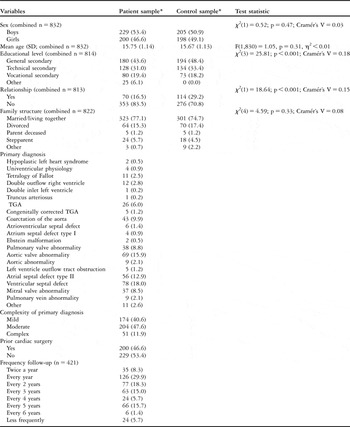
Table 1 presents demographic and clinical information for the patient and control sample. No significant differences were obtained between both samples on sex, mean age, educational level (see note at the bottom of Table 1), and family structure. With respect to the significant difference observed between both samples on romantic relationship, more adolescents of the control sample were involved in a relationship when compared to the patient sample.
Demographic and clinical characteristics of patients.

TGA = Transposition of great arteries
*Data are presented as numbers and percentages (within parentheses) except for age
With respect to educational level, standardised residuals indicated that the patient and control samples differed only on the category “Other”. With respect to the other three categories, there were no differences between both samples
Cluster analysis
Cluster analysis on the five identity dimensions resulted in a solution with five clusters, explaining between 56% and 63% of the variance in the identity dimensions in the patient sample and between 52% and 61% of the variance in the control sample. The averaged kappa was 0.77, attesting to the stability of the five-cluster solution across samples.
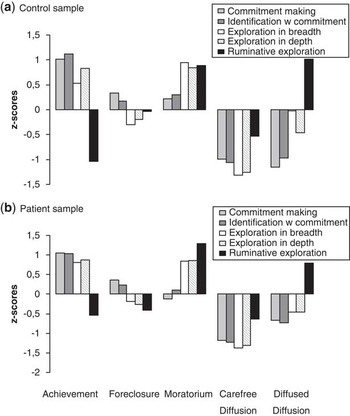
Figure 1 presents the final five-cluster solution for the control and patient samples. The y axis represents z scores. Analogous to Cohen'sReference Cohen24 d, 0.2 standard deviation is a small effect, 0.5 standard deviation is a medium or moderate effect, and 0.8 standard deviation is a large effect.
Final cluster solution in the control (a) and patient (b) samples; y axis represents z scores for the identity dimensions.

• Achievement status: high scores on the commitment dimensions, exploration in breadth, and exploration in depth, and low scores on ruminative exploration.
• Foreclosure status: moderately high scores on commitment and moderately low scores on exploration.
• Moratorium status: intermediate to moderately high scores on commitment, and high scores on exploration.
• Carefree diffusion status: low scores on all identity dimensions.
• Diffused diffusion status: low scores on all identity dimensions except for a high score on ruminative exploration.
Additional analyses on the combined sample indicated that patients and controls tended to be distributed differently among these five statuses (χ 2(4) = 15.30; p = 0.004; Cramér's V = 0.14). Standardised residuals in the chi-square analysisReference Haberman25 indicated that, whereas patients and controls tended to be evenly distributed in the achievement (23.76% versus 21.99%, respectively) and foreclosure (32.24% versus 29.41%) statuses, patients were somewhat underrepresented in the moratorium (15.53% versus 20.20%) and diffused diffusion (12.00% versus 18.41%) statuses and were overrepresented in the carefree diffusion status (16.47% versus 9.97%).
External correlates of identity statuses in patients
Demographic and clinical variables
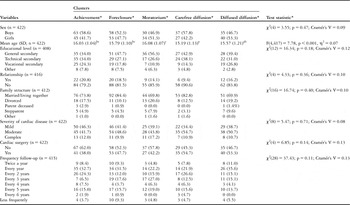
As demonstrated in Table 2, there were no significant status differences on sex, educational level, family structure, having a romantic relationship, complexity of coronary heart disease, whether adolescents received surgery in the past or not, and frequency of follow-up. With respect to mean age, individuals in the foreclosure and achievement and especially moratorium statuses were somewhat older, whereas individuals in the diffused diffusion and especially carefree diffusion statuses were somewhat younger.
Demographic and clinical characteristics for the five clusters in the patient sample.

*Data are presented as numbers and percentages (within parentheses) except for age
For mean age, cluster means differ if they have different superscripts
Quality of life, perceived health status, depressive symptoms, and loneliness
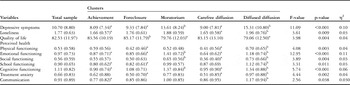
A multivariate one-way analysis of variance was conducted with status membership as an independent variable and depressive symptoms, loneliness, quality of life, and the different perceived health status scales as dependent variables. Significant multivariate cluster differences emerged, Wilks’ λ = 0.75, F(40,1476) = 2.94, p < 0.001, η2 = 0.07. Follow-up univariate analyses and post hoc cluster comparisons using Tukey's Honestly Significant Difference tests are shown in Table 3.
Univariate ANOVA and post hoc cluster comparisons based upon Tukey HSD tests for the five clusters in the patient sample.

ANOVA = analysis of variance; HSD = honestly significant difference
Data are presented as mean and standard deviations (in parentheses). Cluster means differ if they have different superscripts. A mean without a superscript is not significantly different from any other mean
• Depressive symptoms: the achievement, foreclosure, and carefree diffusion statuses scored lowest, and the moratorium and diffused diffusion statuses scored highest.
• Loneliness: the achievement and carefree diffusion statuses scored lowest and the diffused diffusion status scored highest.
• Quality of life: the diffused diffusion and moratorium statuses scored lowest and the foreclosure status scored highest.
• Physical functioning: the diffused diffusion status reported the most problems, and the foreclosure and carefree diffusion statuses reported the least problems.
• Emotional functioning: the foreclosure, carefree diffusion, and achievement statuses reported the least problems, and the moratorium and diffused diffusion statuses reported the most problems.
• Social functioning: the carefree diffusion status reported the least problems, and the moratorium and diffused diffusion statuses reported the most problems.
• School functioning: the achievement and foreclosure statuses reported the least problems and the diffused diffusion status reported the most problems.
• Cognitive functioning: the achievement and carefree diffusion statuses reported the least problems, and the moratorium and diffused diffusion statuses reported the most problems.
• Treatment anxiety: the foreclosure and carefree diffusion statuses reported the least problems and the diffused diffusion status reported the most problems.
• Communication: the achievement status reported the least problems and the diffused diffusion status reported the most problems.
Discussion
This study expanded our knowledge base on congenital cardiac disease in adolescents by investigating, for the first time, the important task of identity formation in these patients. There were three sets of findings that proved to be clinically important: first, although some minor differences existed, adolescents with congenital cardiac disease tackled identity issues in a way similar to what their peers did, testifying to the resilience these patients display; second, and much in line with previous research on psychosocial functioning in patients with congenital cardiac disease,Reference Moons, Van Deyk and Marquet6, Reference Nio26 the way in which adolescents addressed identity issues seemed to be rather unrelated to several demographic and disease characteristics, such as complexity of congenital cardiac disease; third, patients’ identity formation was substantially related to depressive symptoms, loneliness, quality of life, and perceived health status. Patients with low identity commitments combined with high degrees of worry about the future, that is, the diffused diffusion status especially showed the highest distress and the lowest quality of life and perceived health.
The highly similar identity statuses found in the patient and control samples suggested normalcy, rather than deviance, in identity formation for adolescents with congenital cardiac disease. Further, membership in the different identity statuses seemed to be unrelated to complexity of the disease, whether or not patients had surgery in the past, and the frequency of follow-up. Apparently, more complex diagnoses requiring cardiac surgery seemed to be unrelated to a more problematic identity formation process. Hence, although growing up with a congenital cardiac defect constitutes a big challenge, these patients were in general as agentic and competent as their peers in addressing the normative developmental task of identity formation. Patients were even somewhat underrepresented in the identity statuses characterised by high scores on ruminative exploration. Future research should focus on possible antecedents of identity formation in adolescents with congenital cardiac disease, such as experienced parenting or the degree to which one has developed a sense of coherence.Reference Nio26, Reference Moons and Norekval27
The similar identity statuses identified in controls and patients did not preclude some patients from being at risk for a problematic identity formation process: over 10% of the sample belonged to the diffused diffusion status, being the most problematic status characterised by a lack of steady identity commitments and high scores on rumination and worry about the future. These findings suggest that integrating developmental frameworks into clinical efforts could prove fruitful in dealing with adolescents with congenital cardiac disease. During follow-up contacts, clinicians could be sensitive towards certain signs that identity formation might be problematic for adolescent patients. If an adolescent does not appear to be able to make steady identity commitments but instead worries about where his or her life is heading, then this adolescent could experience substantial problems in transitioning to adulthood. As compared to achieved and foreclosed patients – both characterised by moderate-to-strong identity commitments and lowered scores on ruminative exploration – patients in the diffused diffusion status indeed scored higher on depressive symptoms, loneliness, emotional and cognitive problems, and experienced more academic problems. Further, not only did these adolescents score worse on these relatively generic outcome measures, but also they experienced the most treatment anxiety and reported the most problems in communicating with clinicians, suggesting that adolescents in the diffused diffusion status may be particularly at risk of being lost to follow-up. These latter findings are very important given that, depending on the study, 21–76% of patients are lost to follow-up by the time they reach adulthoodReference Goossens, Stephani and Hilderson28 and, hence, do not receive proper lifetime care, which is associated with significant morbidity.Reference Yeung, Kay, Roosevelt, Brandon and Yetman29 Consequently, future studies should directly assess the extent to which identity formation processes potentially influence adherence to the prescribed follow-up schedule.
Methodological limitations and future suggestions
Cluster analysis is an empirically driven approach and, as such, the outcomes are contingent upon measure and sample characteristics, necessitating independent replications. However, our cluster solution was obtained in a large sample of patients with a wide diversity of congenital cardiac defects and mirrored the clusters identified in the control sample and other populations, such as high-school students, college students, and young adults with type 1 diabetes3. Future research should also investigate similar research questions using a longitudinal design. Owing to our cross-sectional design, we were unable to determine the degree to which our identity typology actually influenced – or was influenced by – the different external variables assessed. Such longitudinal research would also allow for the charting of developmental trajectories of identity and quality of life across time and for investigating how such trajectories influence one another. This study focused solely on psychosocial distress, quality of life, and perceived health as external correlates of identity formation. Other important variables that need to be studied in tandem with identity formation are health behaviour and disease knowledge, two sets of constructs with specific relevance towards patients with congenital cardiac disease.Reference Moons, De Volder and Budts30, Reference Reid, Webb, McCrindle, Irvine and Siu31 Finally, future studies should also look at the family context and investigate how the experienced parenting climate at home and parental levels of anxiety relate to and possibly influence illness adaptation and identity processes in adolescents with congenital cardiac disease.Reference Mussatto32, Reference Ong, Nolan, Irvine and Kovacs33
Conclusion
Most adolescents with congenital cardiac disease seemed to tackle the identity formation process in a way similar to what their peers did. The vast majority of them were showing identity formation patterns well within the realm of average and typical. Individuals with a strong sense of identity displayed optimal outcomes in terms of quality of life, perceived health, and psychosocial functioning. However, individuals with a diffused identity scored highest on depressive symptoms and loneliness, and lowest on quality of life. In addition, they scored highest on treatment anxiety and communication problems, indicating the need to provide tailored care for such diffused adolescents with congenital cardiac disease on the winding road to adulthood.
Acknowledgement
The authors gratefully thank Sonia Rens, Alessandra Loiacono, Julie Maes, and Eva Stroobants for their assistance in data collection and data management.