1. Introduction
R. Murray Schafer’s work is not readily associated with utopian reflections on the post-industrial world, yet this is what we find in his concept of the tone of prime unity (TOPU). Schafer describes the TOPU as a persistent tonal centre grounding and potentially unifying an international community of listening subjects (Schafer Reference Schafer1994: 99). What makes this community international is its delimitation according to the presence of a pervasive ambient hum emitted by electrical devices. In North America this tone has a fundamental frequency of 60 Hz, whereas in Europe, Australia and most of Africa and Asia it is 50 Hz. This tone is considered to ground an international community in the sense that it informs an acoustic unconscious, determining the frequency to which individuals will habitually tend:
In the Indian anahata and in the Western Music of the Spheres, man has constantly sought some prime unity, some central sound against which all other vibrations may be measured … It is, however, only in the electronic age that international tonal centers have been achieved; in countries operating on an alternating current of 60 cycles, it is this sound which now provides the resonant frequency, for it will be heard (together with its harmonics) in the operation of all electrical devices from lights and amplifiers and generators. (Schafer Reference Schafer1994: 98–9)
It is in workshop exercises that Schafer claims to have discovered the TOPU and the extent to which it has impressed itself upon the acoustic unconscious of an international community of listening subjects:
In ear training exercises I have discovered that students find B natural much the easiest pitch to retain and to recall spontaneously. Also during meditation exercises, after the whole body has been relaxed and students are asked to sing the tone of ‘prime unity’ – the tone which seems to arise naturally from the center of their being – B natural is more frequent than any other. I have also experimented with this in Europe where the resonant electrical frequency of 50 cycles is approximately G sharp. (Schafer Reference Schafer1994: 99)Footnote 1
One might assume that the ubiquity of this electrical hum which gives it a certain equivalence to broadcast signal and its consequent raising of the ambient noise-floor – contributing to a ‘lo-fi’ soundscape (Schafer Reference Schafer1994: 17) – of urban and domestic environments would result in Schafer levelling the charge of imperialism at such phenomena. Schafer identifies acoustic imperialism in the wanton use of loudspeakers: ‘when sound power is sufficient to create a large acoustic profile, we may speak of it … as imperialistic. For instance, a man with a loudspeaker is more imperialistic than one without because he can dominate more acoustic space’ (Schafer Reference Schafer1994: 77). Clearly the difference here concerns amplitude and intention: the amplitude of this electrical hum is usually low, easily tuned out and ignored, an accidental byproduct or background noise. But while the acoustic profile of this hum is low, its capacity to dominate acoustic space is accordingly all the more pervasive due to the subtle and potentially normalising influence it exercises.
Schafer’s project has never excluded industrial sounds but favoured those that are consciously designed rather than unconsciously or accidentally produced. An accidental byproduct of industrialisation, the discordance that the TOPU introduces into Schafer’s project can be explained through recourse to correspondence between Schafer and Marshall McLuhan regarding the concept of acoustic space. For McLuhan, acoustic space was a metaphor for the decentralisation and affective re-orientation that innovations in electrical media forced upon culture at large, whereas Schafer’s concern for acoustic space remained fixed on the actually rather than metaphorically acoustical. The TOPU presents a quilting point linking McLuhan’s concept of acoustic space with Schafer’s concept of acoustic communities.Footnote 2 This connection helps to explain the anomalous utopianism Schafer attaches to this electroacoustic tone while not entirely resolving the discordance it introduces into Schafer’s wider project.
The TOPU is of particular interest for three main reasons: 1) through its optimistic consideration of the accidental acoustic emissions of electrical devices it problematises the bucolic naturalism too readily associated with Schafer; 2) this speculative optimism extends to a peculiar, fleeting utopianism within Schafer’s project, describing the sonorous conditions for a global community of listening subjects; 3) it supposes a theory of sonorous influence built upon the unconscious reception or passive synthesis of sound. The order of these points is important as it is (1) the abandonment of the bucolic that (2) makes possible the utopian thought of an ‘acoustic community’ grounded in the persistence of electromagnetic or ‘aelectrosonic’ (Kahn Reference Kahn2011) emissions which (3) requires a theory of sonorous influence to account for how this community is formed and the role that sound plays in its formation.Footnote 3 Beyond the concept of ‘keynotes’ Schafer does not explicitly outline a theory of sonorous influence or interpellation and so it is one aim of this article to outline such a theory. These three points provide the structure for this article and will be discussed in turn before closing with a discussion of the continued significance of Schafer’s TOPU through reference to contemporary artistic practice.
2. Synthetic Nature
Schafer’s aesthetics are readily associated with a preference for the acoustic over the amplified, the pastoral over the urban, the given over the synthetic, the local and specific over the general and abstract. Given the ethics, aesthetics and metaphysics that drive his broader project of negotiating a return to a natural equilibrium through a (re)tuning of the world, the TOPU introduces significant discordance into Schafer’s project. A synthetic byproduct of industrialisation rather than a ‘natural’ or given event, the global ubiquity of the TOPU renders it generic rather than specific. The TOPU is in many ways counter to the apparently defining characteristics of Schafer’s project.
Schafer’s considerations of the TOPU appear in The Soundscape (Schafer Reference Schafer1994) amidst a chapter on the electric revolution which on the whole remains critical of the impact electrical technology has had upon a perceived natural order or equilibrium of the world. Yet despite this scepticism regarding the long-term impacts of technological developments it is here that we find the broadest consideration of what Schafer refers to as an ‘acoustic community’, a breadth that is made possible only by the increasing ubiquity of electrical networks and appliances. This ubiquity leads to electroacoustical emissions being buried deep within our ‘sonic unconscious’ (Cox Reference Cox2009: 22). A similar claim is made by Schafer insofar as the TOPU constitutes one of the keynote sounds of the modern, globalised urban environment. Keynote sounds provide a ‘background against which other sounds are perceived … Often keynote sounds are not consciously perceived, but they act as conditioning agents in the perception of other sound signals’ (Schafer Reference Schafer1994: 272). As keynote or background noise, the TOPU constitutes an unconscious conditioning agent, its ubiquity making possible a subtle but powerful conditioning of listening subjects. This conditioning is, according to Schafer, so successful that the TOPU ‘seems to arise naturally from the center of [our] being’ (Schafer Reference Schafer1994: 99).
It is significant that Schafer should identify this tone, originating within urban infrastructure and the electric revolution, with the natural centre of our being. We might, following the most wildly metaphysical aspects of the concluding chapter of The Soundscape, expect Schafer to identify the natural tonal centre of our being with some kind of cosmic fundamental which binds us into the harmony of the spheres, yet here we find a conflation of the natural and the ‘electric’, a tonal centre no longer grounded in naturally given sounds or ‘keynotes’, but in a tonal centre that is produced. This conflation results in a synthetic conception of the natural. The connection between Schafer’s TOPU and the urban infrastructure that produces and sustains it creates a resonance between Schafer and the contemporaneous work of Henri Lefebvre for whom sound held an important role in the (rhythm)analysis and understanding of urban environments (Lefebvre Reference Lefebvre1996: 219–40). Schafer’s emphasis on the production of a new natural tonal centre amidst his broader concerns regarding the degradation of nature or terrestrial ecology resonates with Lefebvre’s comments on the necessity of recreating nature after its ‘ravaging’:
In the process of being mastered, nature was ravaged and threatened with annihilation, which in turn threatened the human realm which, although still bound to nature, caused its annihilation. From this came the necessity of a strategy of intervention … We must anticipate a time when we will have to recreate nature. To produce particular objects will no longer be sufficient; we will have to reproduce what was the basic condition for production, namely, nature. (Lefebvre Reference Lefebvre2009: 173)
For Lefebvre the reproduction of nature describes the principal project of urban planning: the management of ‘new scarcities’, including ‘water, air, light and space’ (Lefebvre Reference Lefebvre2009: 174). Schafer’s TOPU describes the acoustic residue of this infrastructural reproduction of nature. The reproduction of ‘nature’ – for example, water filtration, air conditioning, lighting attuned to circadian rhythms, park land – through urban planning and technological infrastructure thereby results in the production of a new ‘natural’ tonal centre in the listening subject, an acoustical intervention concomitant with that advocated at the level of infrastructure by Lefebvre. Yet this new tonal centre does not simply replace an existing natural given; for Schafer what is new about the TOPU is its international reach. While Schafer’s work as an acoustic ecologist provides many accounts of keynote sounds active in the determination of community identity (Soundscapes of Canada radio series, Five Village Soundscapes (Schafer Reference Schafer1977), etc.) it is ‘only in the electronic age that international tonal centres have been achieved’ (Schafer Reference Schafer1994: 98). With the TOPU, Schafer’s consideration of the conditioning agency of keynote sounds moves from the determination of local identities to potentially global communities. The TOPU would, through its participation in the city as influential apparatus, be involved in the production of a global subjectivity, an acoustically structured and acoustic-ecologically attentive community, thus providing one possible conclusion to Schafer’s utopian project of soundscape design. The TOPU’s concomitance with the project of ‘utopian soundscape’ design resides in the establishment of a unified global community of listening subjects and an apparent levelling of cultural hierarchies (Schafer Reference Schafer1994: 244). Its discordance with Schafer’s goal arises where the ubiquity of this new fundamental results in a homogenised image of a global acoustic unconscious. Furthermore, the TOPU’s status as an accidental byproduct of industrialisation contradicts Schafer’s assertion that the soundscape should not be an ‘accidental byproduct of society’ but rather a ‘deliberate construction’ (Schafer Reference Schafer1994: 237). Yet despite these issues, Schafer’s writing on the TOPU retains its utopian potential.
3. Electricity and Acoustic Space
What does it mean to describe a community as acoustically structured? Answering this question requires that we first outline a concept of acoustic space, as the structure of an acoustic community is that of acoustic space. Marshall McLuhan’s concept of acoustic space was underpinned by his thinking on electrical devices and networks, and particularly their impact upon and restructuring of culture, thought and the senses. An understanding of McLuhan’s concept of acoustic space and its reliance upon electronic media provides us with an analogous framework for understanding the TOPU and its role in the instantiation of international acoustic communities. McLuhan’s use of the term ‘acoustic’ was largely metaphorical, a means of creating an intuitive sense of the speed and spatial organisation of electric media that simultaneously distanced it from the ‘visual’ order of typography:
Electric speed is approximately the speed of light, and this constitutes an information environment that has basically an acoustic structure. At the speed of light, information is simultaneous from all directions and this is the structure of the act of hearing, i.e. the message or effect of electric information is acoustic. (McLuhan Reference McLuhan1987: 466)
Here we see that the effects of electrical media that McLuhan was primarily concerned with are described as being like an acoustic as opposed to a visual (linear) perception of space, rather than having specific concern for the acoustic as such. While McLuhan’s interest in the acoustic was limited to metaphor, he described at length the differences between auditory and visual cultures.Footnote 4 McLuhan’s concept of acoustic space helps clarify Schafer’s less developed notion of the TOPU; both are underpinned by the properties of electrical media, infrastructure and devices; through their distributed and decentred spatial organisation instantiated on a global scale they influence and inform the structure and behaviour of a globalised culture. For McLuhan this entailed a return to a tribal order lost with the instantiation of typography and its linear spatiotemporal order. For Schafer the impact of the electrical and specifically its acoustical residue made it possible to extend the concept of the (non-metaphorical) acoustic community from something describing the formation of specific local identities to a description of the conditions of a global community; it provided an opportunity for a shift in discourse from the specific and local to the general and global.
We can see further examples of a shared agenda for the formation of a new global community according to the topography of metaphorical (McLuhan) and non-metaphorical (Schafer) concepts of acoustic space if we consider McLuhan’s thoughts on the reinstantiation of common sense, lost through the privileging of the visual as a consequence of typographical media’s dominance. McLuhan’s ‘common sense’ entailed the harmony and tuning of the senses, producing a balanced image of the world and a (re)tuned subject. This subject was to be tuned through immersion in the electroacoustic space of global electronic media – according to the distributive and informational structure of mediums rather than media-as-cultural-technique. The ubiquity of electronic media would eventually resolve itself through the production of a subject-model that would be globally applicable. This tuning of a global subjectivity via the proliferation of electrical media parallels Schafer’s interest in the tuning of the listening subject via the proliferation of the TOPU, itself the actual yet accidental acoustic residue of what McLuhan described metaphorically as acoustic space.
For Schafer an acoustic community is a community whose identity is determined to a large extent by acoustical events. Although McLuhan did not make use of the term ‘acoustic community’ as Schafer did, we might construct a McLuhanist concept of an acoustic community nonetheless: a decentralised community that communicates and exchanges information in a non-linear and near instantaneous fashion via the affordances of electronic media. The concept of an acoustic community constructed according to McLuhan’s metaphorical use of the term ‘acoustic’ refers less to any particular importance of sound than to the structuring and ordering of space in a way that was roughly analogical to what McLuhan took to be the basic characteristics of aural perception, specifically hearing:
Auditory space … is usually defined as a ‘field of simultaneous relations without center or periphery.’ That is, auditory space contains nothing and is contained in nothing. It is quite unvisualisable, and, therefore, to the merely print-oriented man, it is ‘unintelligible’. (McLuhan Reference McLuhan2006: 49)
Acoustic space and auditory space were used by McLuhan interchangeably, yet the latter is more precise as it makes explicit the fact that McLuhan is grounding his metaphor in a simplistic understanding of auditory experience rather than through specific recourse to acoustics. A McLuhanist acoustic community is arranged according to the topography of acoustic space as outlined above, rather than the linear and centralised order of ‘visual’ or typographical space. This acoustic space is itself only acoustic in a metaphorical sense and made possible through the affordances of electrical media and infrastructure. The TOPU connects Schafer’s interest in actual acoustics with McLuhan’s more expansive concept of acoustic space, thereby explaining Schafer’s peculiar optimism for the accidental humming of electrical appliances and the utopian speculation on the potential of such a tone to perform a retuning of the world. As a ubiquitous electroacoustic phenomenon the TOPU presents Schafer with the opportunity of aligning the soundscape with ‘McLuhan’s claim that electricity unites men [sic] together again’ (Schafer Reference Schafer1994: 118). The TOPU, through its connection to McLuhan’s concept of acoustic space makes a contribution to the formation of an acoustic community within an acoustically structured ‘global village’ without centres or margins, a global spatial order structured according to the plasticity of ‘acoustic space’:
We are living in an acoustic age for the first time in centuries, and by that I mean that the electric environment is simultaneous. Hearing is structured by the experience of picking up information from all directions at once … At this moment, the entire planet exists in that form of an instant but discontinuous co-presence of everything. (McLuhan Reference McLuhan1987: 507–8)
What the TOPU – and the link it makes possible with McLuhan’s electrically informed concept of acoustic space – reaffirms is that Schafer’s criticism of industrial and post-industrial soundscapes cannot be strictly reduced to a preference for bucolic aesthetics, as we find in his work studies and appreciation of train whistles, boat horns and other post-industrial sounds. If we were to attempt a reduction or simplification of Schafer’s argument and criticism of post-industrial soundscapes, it would be dynamic range rather than audible quality that emerged as an overarching concern, an argument for the preservation of expressive acoustic communication rather than a pre-industrial aesthetics. What binds these elements together is that industrial reduction of dynamic range has, in Schafer’s studies, entailed a machinic aesthetics implicated in the hegemonic domination of acoustic space and communication. Accordingly, Schafer’s concerns for the proliferation of unchecked, accidental noise and a loss of dynamic range has an ideological dimension. In the Soundscapes of Canada radio series we find the cultural association of noise with progress, specifically industrial, technological progress, subject to critique via some skilful sound editing and juxtaposition. What Schafer et al. are critical of here are the ideological implications of noise, that noise should come to serve as a tool for promoting ever greater industrial development or ‘progress’. That the TOPU is to be found in appliances indicative of a certain industrialised modernity and automation of labour, as well as allowing for a degree of control, autonomy or reproduction of natural conditions (refrigeration, extension of daylight, etc.), decentres any bucolic sense of the natural. The TOPU also performs an ideological function and what will be described in the following section as an ‘unsound’ interpellation via the receptivity and passive synthesis of hearing.
4. Acoustic Influence
The class of keynote sounds to which the TOPU belongs dominate acoustic space in a manner that is more subtle and potentially insidious than the ‘imperialistic’ use of loudspeakers that Schafer criticises (Schafer Reference Schafer1994: 77). Where volume and intensity allows the loudspeaker to dominate acoustic space, it is the constancy and subtlety of the keynote sound, its status as a kind of background noise conditioning auditory habits, that allows it to exercise greater dominance. This dominance is not attained via a sudden imposition, or disruption that could be clearly identified and conceptually contained, but via a subtlety and constancy that results in its acceptance as given, obvious or natural. The subtlety and ubiquity of keynote sounds results in them often being tuned out by the listener who instead directs attention to foreground signals.Footnote 5 For Schafer the TOPU determines the terrain within which one is conditioned and individuated as a listening subject, yet the scale and ubiquity of this tone renders this model of a listening subject generic and global rather than specific to an individual locality. Despite its lesser intensity, the space dominated by the TOPU is far greater than that of the loudspeaker – enforcing an international tonal centre – yet still it escapes the charge of imperialism that Schafer levels at the latter. While the acoustic profile of the TOPU is low, its capacity to dominate acoustic space is accordingly all the more powerful. The low profile and ubiquity of the tone causes it to be tuned out, set apart from the intentionality of listening as a conscious and cultural technique. Where attention is turned away from this tone it is permitted unfettered access to an acoustic unconscious, to the determination of habitual tonal centres through a passive synthesis.
One of the three syntheses of time outlined by Gilles Deleuze in Difference and Repetition, passive synthesis describes the formation of both a past and a present for the individual: a past in the sense that the passive synthesis of continuous stimuli by the organism forms a reservoir of experiences which inform the development of habits; a present in the sense of a lived yet pre-conceptual affectivity. It is this passive synthesis that, for Deleuze, forms the foundations of the individual or the transcendental conditions of the self. For Deleuze this passive synthesis is positioned below or before that of active, conceptual synthesis, and it is this primary ‘domain of passive syntheses which constitute us’ (Deleuze Reference Deleuze2004: 100). The active syntheses are conceptual in nature, entailing reflection, recognition and understanding and therefore are more closely aligned with cultural techniques of listening. Hearing is aligned with passive synthesis as it is considered anterior to the critical selectivity that is characteristic of listening as a learnt, culturally determined technique. Hearing describes a natural capacity for resonance, a capacity that is organically produced rather than subjectively trained and refined. While the strict division of hearing and listening is undoubtedly crude insofar as the organism can be said to have refined or tuned its capacity for hearing as the listening subject continues to refine and tune its capacity for critical listening, what is reflected upon in the critical action of listening is that which is produced and passed to the conscious, intentional act of listening by hearing as a passive but no less synthetic process of production. As the immanent conditions of subjective listening, the passive syntheses of hearing constitute the transcendental conditions of listening. While a distinction between hearing and listening is posited, this is to clarify distinctive stages of a continuum of refinement, tuning and selection. This description of hearing in terms of a passive synthesis should not suggest inertia but rather the unconscious productivity of the auditory system, rather than reducing it to a merely receptive and inert substrate registering impressions from without in the manner that sand records the movements of the waves. It is at the level of passive synthesis that Schafer’s concept of the TOPU operates.
Through the TOPU Schafer identifies how individual subjectivity is re-inserted into a newly synthesised international community addressed according to generic traits and unconscious habits rather than active or conceptual syntheses through which one might actively choose to identify with a specific community or sub-culture. In contrast to a community built upon the active and conceptual construction of identities, the TOPU forces collectivity via affective capacities and unconscious conditioning. Here we see how Schafer’s tone is one of unity: through its global proliferation it counts all resonating bodies within its reach as one, thereby fulfilling a certain utopian project of producing a new keynote for all of humanity. Despite this utopian orientation we should consider the extent to which, through its forceful imposition, the unconscious conditioning that the TOPU performs operates through the ‘acoustic violence of vibration’ (Goodman Reference Goodman2010: xiv), exploiting affective and physiological capacity without seeking consent or invitation. In contrast to the immediately shocking and traumatic instances of acoustic violence identified by Steve Goodman in his studies of Sonic Warfare (Goodman Reference Goodman2010), this violence appears banal and quotidian rather than immediately shocking, exercised through subtle force and gestures whose diminutive profile is compensated through frequency and repetition. As the acoustical residue of electrical infrastructure, there is a side to the TOPU diverging from Schafer’s utopian speculations. Approached critically, the TOPU can be understood as entailing both repressive and ideological determination. Through the forceful and affective imposition of a singular tonal centre upon an international community, the TOPU could be understood to entail a broad repressive character, while its subsequent utopian interpretation entails ideological implication comparable to the association of construction noise and progress that Truax and Schafer identified in the Soundscapes of Canada.Footnote 6
The instances of acoustic violence identified by Goodman have a clear connection to what Louis Althusser called the ‘repressive state apparatus’, comprising the military, police, prisons and so on (Althusser Reference Althusser2014: 243). This connection has been extensively explored by the artist Mark Bain, whose work is often concerned with weaponisation of sound and the ‘psychosonic modulation of public space’ (Bain Reference Bain2005). While Bain’s exploration of these themes engages the explicitly repressive, the force exerted upon listening subjects by the TOPU has a more subtle and ambiguous character, slipping between the repressive and ideological. While the presence of Public Address or PA systems in many urban centres provides a connection between acoustic infrastructure and state apparatus, it is not only the content played through these systems – ‘hailing’ subjects through speech, announcements and ‘muzak’ intentionally designed to condition space and influence behaviour therein – but the infrastructural systems themselves that exert a subtle influence through their electroacoustical residue.Footnote 7 The influence exerted by the infrastructure itself is distinct from the explicitly ideological character of announcements seeking to mobilise the public in identifying anything ‘different’, suspicious or out of the ordinary that when coupled with the activation of fear engenders hostility and suspicion of the different and other. Nonetheless the humming of infrastructure and appliances may become implicated in the exercise of ideology, understood as a ‘system of … ideas and representations which dominate the mind’ (Althusser Reference Althusser2014: 253), wherein its fundamental frequency is identified as occupying the natural core of one’s being. It is the tuning out of this ubiquitous tone that allows it to take hold at the ‘centre of one’s being’, seemingly arising spontaneously and immediately from a natural disposition. Through a dropping of audile defences the TOPU is accepted as a grounding force by the listening subject. Through appearing to be a ‘natural’ tonal centre the TOPU attains an obviousness and transparency that solicits little theoretical elaboration: it is simply natural, obvious or without reason that one should tend towards this frequency as a tonal centre. The passivity of these terms reflects the apparent givenness of ideological assumptions and assertions.
The ear training exercises wherein Schafer identified the TOPU required participants to sing the note which came to them spontaneously, without forethought or conceptual interference. Schafer describes how B natural or G sharp would emerge from the groups who would identify or recognise this tone as a ‘natural’ centre. It is through the recognition of this tone as grounding one’s auditory habits that one is inserted into an acoustic community, the recognition of a common tonal centre and the immediate, subjective recognition that ‘yes, that is the tone which comes to me spontaneously, naturally’, identifying a resonant core.
The concept of ‘unsound’ is developed by Goodman to identify the ‘not yet audible … the fuzzy periphery of auditory perception where sound is inaudible but still produces neuroaffects or physiological resonances’ (Goodman Reference Goodman2010: 198). This inaudible periphery is defined as such by two intersecting limits, one being the physiological limits of audition and the other the subjective limits of attention. A sound may be inaudible due to its frequency or amplitude, but also due to the subjective act of tuning it out, of directing attention elsewhere. Through its low-profile ubiquity, the TOPU constitutes an example of unsound defined according to the latter limit imposed through subjective attention: low amplitude and ubiquity deflects intentionality. An agent of acoustic conditioning residing at the ‘fuzzy periphery of auditory perception’, the TOPU can be understood to perform an ‘unsound’ interpellation (Goodman Reference Goodman2010: 264). Where Althusser’s famous example of interpellation describes a process of subjectification through speech and language, an unsound interpellation addresses subjects not through language or voice but through an affective force that informs auditory habits and assumptions regarding the natural. It is through this unsound influence that the TOPU becomes embedded at the ‘natural’ centre of the listening subject. Where one recognises a shared and ‘natural’ tonal centre, one recognises oneself to be part of a particular acoustic community. This moment of recognition is essential to the ideological interpellation that may bind one into a globalised urban identity and community.
5. Artistic Resonances
The discordance introduced when aligning the natural with the electrical in Schafer’s speculations on the TOPU can be countered through recourse to artistic interest in electromagnetism and natural radio, where electricity has long been central to artistic engagements with ideas of the natural (see Kahn Reference Kahn2011, Reference Kahn2013). In contrast to the artistic and experimental practices ascertaining that ‘radio was heard before it was invented, and radio, before it was heard’ (Kahn Reference Kahn2013: 2), the electrical signals that concern Schafer’s TOPU operate at what Kahn calls ‘earth magnitudes’ or planetary scale, yet are the product of human rather than atmospheric or solar events. The TOPU could be considered an ‘aelectrosonic’ event (Kahn Reference Kahn2013: 6–7) yet this particular signal is produced rather than found, synthetic rather than given. While the source of aelectrosonic phenomena described by Kahn are natural events that largely act independently of human activities – natural radio, lightning strikes, whistlers, etc. – the electrical signals underpinning Schafer’s TOPU entail the synthetic reproduction of a natural tonal centre through human actions.Footnote 8
Precursory engagements with what Schafer would later call the TOPU can be found in the compositions of La Monte Young, which attest to the auditory influence of electrical infrastructures. Young claims that the ‘dream chord’ central to a number of compositions was impressed upon him through extended periods of listening to the electroacoustic residue of power plants, transformers and other elements of electrical infrastructure:
One of [Young’s] favourite pastimes as a young boy was listening to the harmonics created by the humming of the transformer from the power plant near the Conoco station his grandfather ran in Montpelier, as well as ‘a favourite telephone pole I used to like to stand by in Bern … The Second Dream contains only four tones of a ‘dream chord,’ expressed harmonically as 18/17/16/12. ‘These pitches,’ Young notes, ‘may be isolated in the harmonic structures of the sounds of power plants and telephone poles’. (Strickland Reference Strickland2000: 154–5)
A key difference here is that Young is described as actively seeking out and critically attending to the drones of electrical infrastructure rather than absorbing them unconsciously as a background noise via subliminal influence. Young’s audile attention to the electroacoustic residue of infrastructure and its subsequent implementation in his compositional practice describes an active synthesis distinct from the passive synthesis described above.
The TOPU as described by Schafer remains a form of background noise that unconsciously influences listening subjects through passive synthesis, yet in contemporary art, phonography and acoustic ecology practice we find the presence of such signals foregrounded, making them the objects of conscious attention and therefore active synthesis. Induction receivers or telephone pickups are increasingly common in field-recorders’ toolkits, allowing them to record signals of electrical origin in addition to acoustic signals. A famous example of this foregrounding is found in Christina Kubisch’s Electrical Walks (2004–), which use specially modified headphones to render specific bandwidths of the electromagnetic field audible. Through their sensitivity and amplification of the electromagnetic emissions of everyday appliances, Kubisch’s ongoing series of walks allows participants to trace the contours and varying intensities of what Schafer labelled the TOPU. As a source of amplification and means of directing attention towards the fluctuations of this tone that, as background noise, are ordinarily tuned out of everyday listening Kubisch’s headphones attune listeners to the physicality and ubiquity of this ordinarily imperceptible medium that envelopes and transpierces us.
5.1. Hummingbird Clock
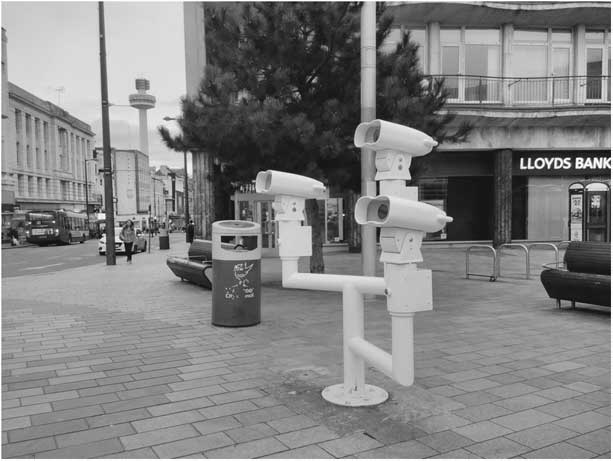
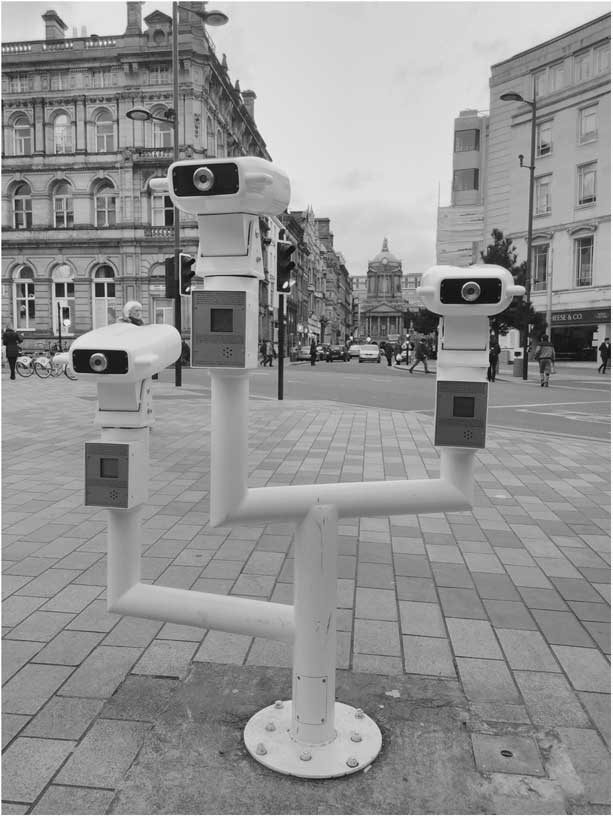
The physical signal that Schafer labelled the TOPU is a signal of global reach that can be identified in many audiovisual recordings and transmissions. The presence of this tone or hum in recordings and transmissions permits its use in forensic activities that seek to identify the true timing and potential doctoring of recorded events and evidence. Lawrence Abu Hamdan’s Hummingbird Clock (2016; Figures 1 and 2) monitors fluctuations in the ubiquitous humming of electrical currents that run through all devices and appliances, a humming that is faintly audible in many recordings made outside of carefully controlled environments such as recording studios. By recording fluctuations in this ubiquitous tone comparisons can be made between a database of fluctuations and those evident in individual recordings and transmissions. A false claim on the timing of a recorded event becomes evident through divergences in the fluctuations of the tone stored in a database and those evident in the individual recording. Where the fluctuations in frequency do not align, events cannot have taken place simultaneously and doctoring has occurred.
Lawrence Abu Hamdan’s Hummingbird Clock, front.

Lawrence Abu Hamdan’s Hummingbird Clock (rear) pointed towards the clock face atop Liverpool Town Hall.
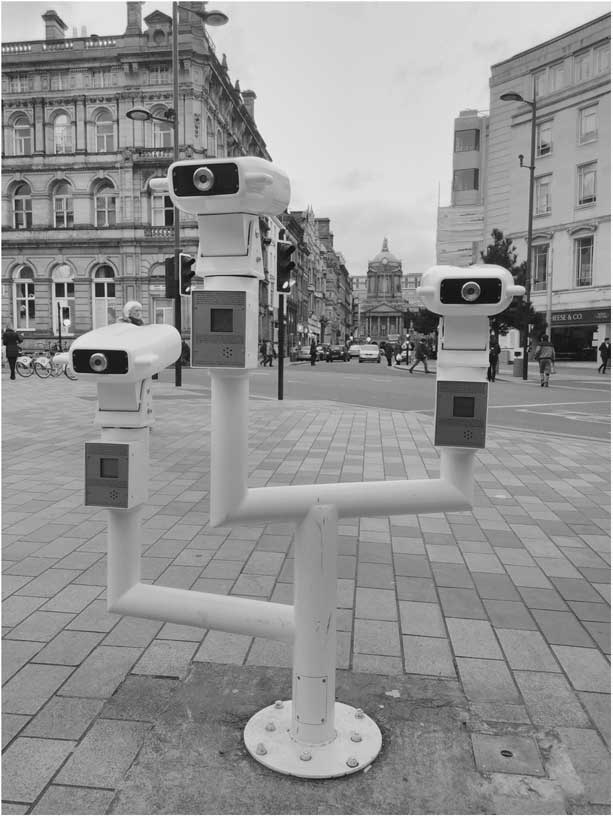
Abu Hamdan’s Hummingbird Clock shows how, running in parallel to Schafer’s utopian speculations, this accidental residue of electrical infrastructure can become implicated in the state apparatus, and so its unifying utopian potential cannot be considered inherent, but something that must be engendered through a development of cultural techniques, analysis and understanding. The Hummingbird Clock takes steps towards a political implementation of Schafer’s more metaphysical utopianism by placing the TOPU under forensic scrutiny. While the tone is ubiquitous, understanding and analysis of its micro-sonic fluctuations is not. Where forensic scrutiny of this tone has historically been a technique used by the state to ascertain the veracity of audiovisual recordings, Abu Hamdan’s works seeks to make this technique available to the public. Where analytical techniques and understanding are made public, the tone is no longer just a source of affective unity unconsciously instilled and manifest in the auditory habits of an international community, but a common resource that can be drawn upon by activists within this community in holding states to account.
5.2. Scrying
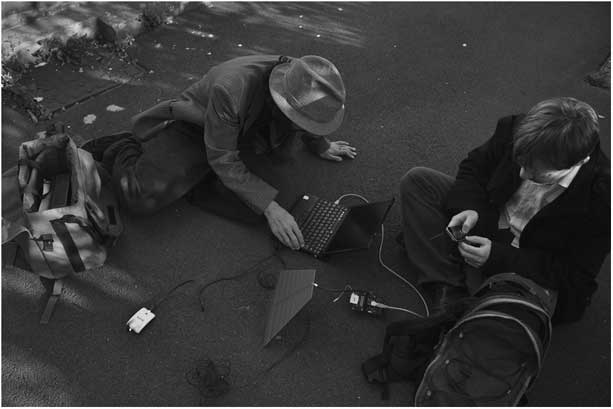
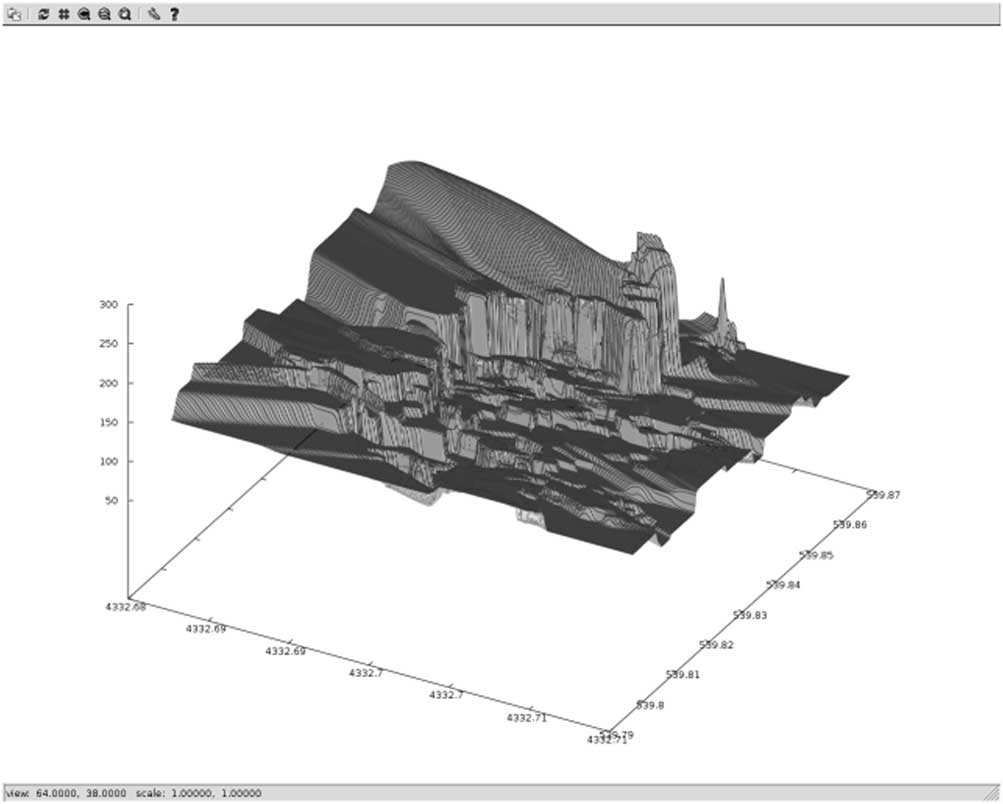
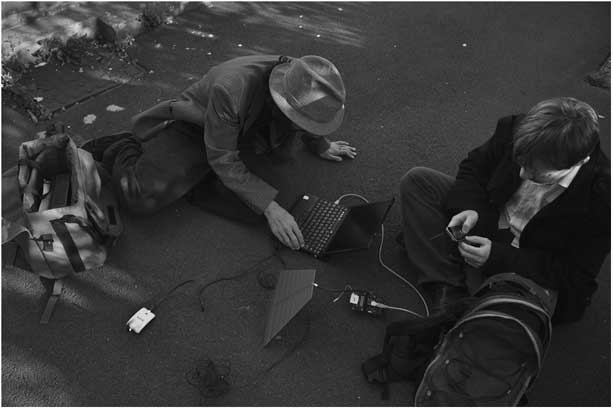
Martin Howse’s ‘psychogeophysical’ practice uses a variety of modified and self-developed techniques for recording, monitoring and analysing a range of otherwise imperceptible fields, signals and impressions found in the world around us (Figure 3). The various ‘scrying’ projects in which Howse was engaged for a number of years involved monitoring and mapping the electromagnetic fields permeating the built environment.Footnote 9 Scrying refers to the esoteric practice of gazing into water or crystal balls in order to reveal past or future events; through the use of crystal or liquid media the viewer sees through to another domain. The devices Howse built for the purpose of scrying allow for the recording of electromagnetic signals and the combination of these recorded signals with GPS coordinates so that a map of electromagnetic fields can be created (Figure 4). The contours of this field, often mapped out while undertaking dérive or drifting throughout a city, supplement yet often diverge greatly from the visible contours of the city as it is seen and otherwise sensed in everyday engagement.Footnote 10 Significantly there is no immediate sonification of these fields whilst the artist – frequently accompanied by workshop participants – drifts throughout a city making recordings. It is not only the contours and intensity of the fields, and less so their audible qualities, that interests Howse, but their unconscious influence upon the mind.
Scrying hardware being used by Martin Howse and a workshop participant.
A plot of the data gathered using scrying hardware. The plot shows EM field intensity against GPS coordinates. Image: Martin Howse, used with permission.

An unlikely juncture between Schaferian soundscape practice and the scrying activities of Howse is found where we consider the influence of both Schafer’s TOPU and the electromagnetic fields interrogated by Howse. For Schafer the class of keynote sounds to which the TOPU belongs are considered conditioning agents determining the acoustic unconscious and perceived natural tonal centre of listening subjects. The issue of conditioning and influence is also of key importance to Howse’s scrying activities which sought not only to reveal an otherwise imperceptible electromagnetic terrain – as in the work of Kubisch or Hinterding – but also to speculate upon the influence that this field might have upon the mind and behaviours of those subjects through which it passes. Howse’s scrying activities, as well as an act of seeing through to an otherwise imperceptible domain, were part of an ongoing search for sites of ‘execution’: the physical locations and substrates wherein a symbolic process is initiated. This site of execution that Howse’s activities sought out supposed a juncture between earth, matter and mind, a point at which field and thought intersect, the former being a conditioning agent influencing the latter. Howse’s scrying thereby posits an immanent relationship between material and mental phenomena. Where Howse’s practice and attention to these influential physical fields extends beyond that of Schafer is not only in the bandwidth of frequencies observed, the means of access – technologically mediated rather than intuitive, immediate or embodied – but also in the recognition of this field as an element of nature and not only as the accidental byproduct of industrial development. Howse’s engagement with the electromagnetic field identifies a point where the natural is entangled with the constructed and synthetic, the domains of natural radio and electromagnetic fields becoming confused with wireless communication devices and the residue of electrical infrastructure (Figure 4). The electromagnetic field understood to be an influential environmental agent is recognised in Howse’s work to be a product of both human and inhuman processes. Positing a number of junctures within a broadly materialist plane of immanence, Howse’s scrying activities identify a meeting of both matter and mind, as well as the synthetic and the natural.
6. Conclusion
Schafer’s concept of nature is one of harmonic equilibrium, a metaphysics built upon the model of the music of the spheres. The tuning of the world and its soundscape is, for Schafer, principally a divine act terrestrially manifest as a hi-fidelity soundscape preserving the given form and sounds of a typically if not exclusively bucolic image of nature. Schafer’s speculations on the TOPU, however brief, presents a break with this theological concept of harmony and equilibrium, replacing it with a synthetic concept of nature that extends to the centre of the listening subject. The TOPU as a synthetic fundamental presents an opportunity to excise the theological metaphysics at the core of Schafer’s project, replacing it with a synthetic and materialist core asserting ontological immanence. Subject to the TOPU, the fundamental according to which humanity comes to be tuned is no longer the eternal yet silent sound of the harmony of the spheres that we find in the final chapter of The Soundscape, but a synthetic fundamental of humanity’s own production.
Schafer’s writing on the TOPU presents fleeting speculations on a techno-utopia wherein a global community is forged atop a newly synthesised sense of the natural. In these speculations we find a glimpse of an acoustic-ecological, soundscape practice that is sensitive to positive and utopian aspects of the synthetic, not just a bucolic conservatism and hostility towards the post-industrial. Yet where the concept of the TOPU presents opportunities for rethinking and realigning Schafer’s project with contemporary artistic practice, the issue of normalisation persists, as this new and synthetic fundamental becomes a measure against which other oscillations are measured, a new kind of acoustic dominance and ‘imperialism’. The ubiquity of this tone and its potentially insidious influence, whilst presented as a utopian potential for global unity also presents the threat of global normalisation, domination and the homogenisation of the acoustic unconscious.
Taken as an instance of a keynote sound, Schafer’s concept of the TOPU indicates how the design of soundscapes is simultaneously the design of our auditory unconscious, and so this should not be left to chance, becoming a residual by-product of infrastructure and engineering, but an active processes wherein the synthetic reinvention of natural tonal centres is recognised as being a design and reinvention of ourselves as listening subjects. Beyond a bucolic aesthetics informing a hostility towards the post-industrial, it is through conscious investment in sound design, and an acknowledgement that the boundary between environment, city and subject is porous, that we should pursue utopian soundscape practices.
Acknowledgements
The ideas discussed herein were initially developed during an artistic workshop I delivered at La Cambre for the 2013 Tuned City Festival. The workshop involved discussion of the ideas presented herein, sound walks, field recording exercises and the fabrication of instruments for recording electromagnetic signals. My thanks to the workshop participants and Tuned City team for their support.