Introduction
Chronic pain is a common condition in older people, affecting more than 50% of elderly adults living in community settings and over 80% of NH residents (Zanocchi et al., Reference Zanocchi2008). Pain interferes in the everyday functioning of elderly people, both in NH care contexts and community settings (Zanocchi et al., Reference Zanocchi2008), and has been related to depressive symptomatology in several pain conditions (Lapane et al., Reference Lapane, Quilliam and Chow2012), including osteoarthritis (OA) (Hawker et al., Reference Hawker2011). Furthermore, depression is a significant problem in older people, in both community-dwellers and long-term care home residents (Dow et al., Reference Dow, Lin, Tinney, Haralambous and Ames2011).
Although it is possible that depression influences pain severity (Kroenke et al., Reference Kroenke, Wu, Matthew, Krens, Damush and Tu2011), there is an emerging consensus that chronic pain is more likely to lead to depressive symptomatology than vice versa (Campbell et al., Reference Campbell, Clauw and Keefe2003), which is confirmed in longitudinal studies with community-dwelling elderly patients, including those with OA (Geerlings et al., Reference Geerlings, Twisk, Beekman, Deeg and Van Tilburg2002; Hawker et al., Reference Hawker2011). The reasons for the relationship between pain and symptoms of depression are not completely clear. Several studies focus on the role of different variables in this relation. As activity restriction and functional limitation appear to be important risks factors in the development of depression in older people, both for those in NH (Vankova et al., Reference Vankova, Holmerova, Andel, Veleta and Janeckova2008) and community-dwellers (Hawker et al., Reference Hawker2011), this variable have been among the most widely studied. Nevertheless, the nature of their role and the differences in the relationship by context (NH or community) remain unclear.
As regards elderly adults with chronic pain in community settings, a recent longitudinal study found that pain interference in activity at baseline was a risk factor for developing depressive symptomatology at follow-up (Arola et al., Reference Arola, Nicholls, Mallen and Thomas2010). In a correlational work carried out by Williamson and Schulz (Reference Williamson and Schulz1992), activity restriction mediated the relationship between pain and symptoms of depression, and accounted for differences in pain intensity between non-depressed people and those at risk for developing depression. In older adults with OA, a recent longitudinal study revealed that pain strongly predicts future disability, which in turn predicts future-depressed mood, but the results from other longitudinal studies do not support the hypothesis that the relationship between pain and symptoms of depression is mediated by disability (Geerlings et al., Reference Geerlings, Twisk, Beekman, Deeg and Van Tilburg2002). Other studies, though supporting the influence of both pain and functional interference in depressive symptomatology, do not test any moderation or mediation hypotheses.
In institutionalized samples, there are scarce data analyzing the influence of activity restriction on the relationship between pain and symptoms of depression. In a correlational study, Parmelee et al. (Reference Parmelee, Katz and Lawton1991) found that those classified as people with major depressive symptoms, following DSM-IIIR criteria, reported more pain intensity, and people with greater pain intensity had more symptoms of depression. Although functional disability correlated with pain intensity, this correlation did not account for the observed association between pain and depressive symptomatology. Other works found direct associations between pain intensity, depressive symptomatology, and activity restriction in NH, but they did not test any mediation or moderation hypotheses (Vankova et al., Reference Vankova, Holmerova, Andel, Veleta and Janeckova2008; Hoover et al., Reference Hoover2010).
In sum, while several studies seem to support a mediator role of activity restriction in the relationship between pain and depression in older people with chronic pain (Williamson and Schulz, Reference Williamson and Schulz1992; Hawker et al., Reference Hawker2011), others do not support this role (Geerlings et al., Reference Geerlings, Twisk, Beekman, Deeg and Van Tilburg2002) or do not test it. The inconsistences in the literature may result from the different instruments used to measure depressive symptomatology. A remaining question is whether this role might vary across contexts (e.g. community and NH). In community settings, the results of two of the three studies reviewed that test the mediation hypothesis support a mediation role (Williamson and Schulz, Reference Williamson and Schulz1992; Hawker et al., Reference Hawker2011), but in NH no studies, to our knowledge, have specifically analyzed this role. Regarding a possible moderator effect of activity restriction on the relationship between pain and symptoms of depression, the scarcity of studies means that we cannot draw any firm conclusions. Where this effect has been tested, it has been found in community settings (Williamson and Schulz, Reference Williamson and Schulz1992) but not in institutionalized samples (Parmelee et al., Reference Parmelee, Katz and Lawton1991). Again, on comparing results, it is necessary to consider the different measures applied and the different contexts of study.
Clarifying the relationship between pain, activity restriction, and depression is essential with a view to launching initiatives aimed at preventing and reducing depressive symptomatology in older people with chronic pain. If there was a moderated relation, activity restriction (moderator) would change the relationship between pain intensity (an independent variable) and the level of depressive symptomatology (criterion). If the moderated role of activity restriction was supported by research, it would be possible to identify people at risk of developing depressive symptoms and to implement programs for cushioning the impact of pain in psychological distress. Furthermore, if the relationship between pain and depression was mediated by activity restriction, pain intensity would influence the level of activity restriction, which in turn would modify the level of depressive symptomatology. If activity restriction was found to play a comprehensive mediating role, one way to diminish depressive symptomatology would be to improve functionality rather than reduce pain intensity (maintaining good performance in daily activities regardless of pain). As previous work has shown, it is possible to improve functionality without modifying pain intensity (McCracken et al., Reference McCracken, MacKichan and Eccleston2007), and since many studies have failed to reduce pain intensity after cognitive-behavioral interventions (Williams et al., Reference Williams, Eccleston and Morley2012), initiatives designed to maintain good performance in daily activities regardless of pain would be very helpful for improving psychological well-being. In addition, as the relationship between psychological and functional factors could be affected by context, it would be necessary to test differences in this way, analyzing whether a possible-mediated relationship would be the same in the NH and community contexts.
The objective of this work was to test the potential role of activity restriction as a moderator and mediator in the pain-depression relationship, in both community and nursing home-dwelling older adults with pain related to OA, analyzing the differences between the samples using a multi-group approach. To achieve this goal, a cross-sectional study was carried out, measuring pain intensity, the level of activity restriction due to pain, and depressive symptomatology at the same time.
Method
Participants and procedure
Two-hundred-and-eight older adults with musculoskeletal pain participated in the study, 102 residing in nursing homes (NH) and 106 living in the community. The community-dwelling sample was recruited through doctors and nurses working at health centers in the Autonomous Region of Madrid, and the doctor who usually attended the potential participant checked that they met the inclusion criteria. The NH sample was recruited from several public and private institutions in the Autonomous Region of Madrid through the doctor responsible for them, who checked the inclusion criteria. Inclusion criteria were as follows: to be 65 years old or more; to have no oncological or organic-brain illness; to be free of any degree of sensory impairment that would hinder participation in the study (good visual and hearing ability were required); to have no serious illness involving functional impairment other than musculoskeletal problems (e.g. paralysis of any extremity); and to have no serious chronic illness other than musculoskeletal problems, with the exception of hypertension or type 2 diabetes (due to high incidence); and to have no cognitive impairment. Mental status was assessed using the Spanish adaptation of the Mini-Mental State Examination (MMSE; Folstein et al., Reference Folstein, Folstein and McHugh1975; Lobo et al., Reference Lobo, Ezquerra, Gómez-Burgada, Sala and Seva-Díaz1979), excluding people with a score of less than 24. It should be taken into account that in Spain, there is great variability in the care needs and medical status of people living in nursing homes. In the present study, we recruited older people with relatively good health status, so that our participants in NH were quite similar to community-dwelling people as regards health problems (people who can no longer manage at home for various reasons but do not need 24-hour nursing care). To measure comorbidity, we used the Charlson Comorbidity Index (Charlson et al., Reference Charlson, Pompei, Ales and MacKenzie1987), excluding people with an index higher than 1 (without including age score) or who had diseases other than uncomplicated diabetes mellitus and/or peptic ulcer. Participation was voluntary. Approval for the study was granted by the Research Ethics Committee at the Rey Juan Carlos University of Madrid (Spain). First of all, the research team had a meeting with the potential participants to explain the purpose of study. If they agreed to take part, they filled out an informed consent document and a personal interview was arranged for each participant. Of the 231 people contacted, 20 declined to take part in the study. Of the 211 who agreed to take part, two left the study due to hospitalization and one because of death, so that the final sample numbered 208. It should be noted that at the time the study was carried out, no participant was receiving or had ever received any type of cognitive-behavioral therapy for managing either their pain or their depressive symptomatology.
Measures
Depression
Depressive symptomatology was measured with the Geriatric Depression Scale (GDS, Brink et al., Reference Brink, Yesavage, Lum, Heersema, Adey and Rose1982), adapted by Montorio and Izal for Spanish population (Montorio and Izal, Reference Montorio and Izal1996). A cut-point of 14 was used, which has an 80% sensitivity rate and a 100% specificity rate (Yesavage et al., Reference Yesavage1983). The internal consistency coefficient (Cronbach's α) for the Spanish version is 0.94, and it has good concurrent validity (Montorio and Izal, Reference Montorio and Izal1996).
Pain intensity
Intensity was measured with a composite measure involving four dimensions (current, worst, least, and average pain), which have emerged as appropriate in small samples, where maximum reliability is required (Jensen et al., Reference Jensen, Turner, Romano and Fisher1999). We used an 11-point box scale (0 to 10) with color gradation (different shades of red) to measure each item. Box scales, given that they combine numerical scales and visual analogue scales, are highly appropriate for measuring pain in the elderly, and are recommended in the Consensus Statement on the assessment of pain in older persons (Hadjistavropoulos et al., Reference Hadjistavropoulos2007). Cronbach's α for this index was 0.91.
Activity restriction
The level of activity restriction due to pain was measured with the Activity Restriction Scale, a scale successfully applied in previous research on older adults experiencing chronic pain (López-López et al., Reference López-López, Montorio, Izal, González and Alonso2010). Factor analysis revealed a single factor, permitting the use of a total global score. This scale evaluates pain interference in several daily activities or areas of functioning: individual household activities, leisure, family relationships, social activity, sexual activity, self-care, and basic movement (upper and lower extremities). Each area of activity was assessed using a box scale with 11 points, from 0 to 10, where the participant had to indicate the degree to which pain interfered with the activity. The Cronbach's α was 0.82.
Statistical analyses
Preliminary analyses
Initially, univariate outliers were examined according to Tabachnick and Fidell's (Reference Tabachnick and Fidell1996) criteria, considering as potential outliers cases with standardized scores above 3.29 (p < 0.001). Multivariate outliers for depression, pain intensity, and activity restriction were tested using Mahalanobis distance at a probability level of 0.001, so that a case was removed if the Mahalanobis distance was greater than 16.3, the critical value of χ 2 for p < 0.001 (Tabachnick and Fidell, Reference Tabachnick and Fidell1996). The distribution of the variables was tested for each sample with the Kolmogorov-Smirnov test for normality. In order to test whether there were differences between the community and NH samples in sociodemographic variables and in depression, pain intensity and activity restriction, Student t-test analyses, and Chi-square tests were carried out. In addition, ANCOVAs were performed to check whether the sociodemographic variables were influencing the results.
Data analyses to examine direct associations
First of all, we examined direct associations between pain, activity restriction, and symptoms of depression, with separate analyses for older adults living in NH and in the community. We first explored the relationship between the study variables by carrying out an analysis of Pearson correlations. Second, we compared participants without symptoms of depression and those with depressive symptomatology (above the cut-off point for depression on the GDS) using the Student t-test. These analyses were carried out using IBM SPSS Statistics 19.0. We used a significance level of 0.05 and a confidence interval of 95%.
Data analyses to test the potential role of activity restriction as a moderator
In a second stage of data analysis, we conducted analyses to test the potential role of activity restriction as a moderator in each sample separately. The moderator effect occurs when the moderator variable (a second independent variable) changes the relationship between another independent variable and the criterion. As activity restriction was measured at the same time as pain intensity, we treated this variable as a confounding variable of the effect of pain intensity on depressive symptomatology. Using the moderation analyses approach, we can test whether the association between pain intensity and depressive symptomatology is distorted by the presence of activity restriction, observing if the slope of the relationship between pain intensity and depressive symptomatology varies according to the level of activity restriction (Edwards and Lambert, Reference Edwards and Lambert2007). We carried out two hierarchical regression analyses following Aiken and West's (Reference Aiken and West1991) recommendations, one for community-dwellers and one for people living in NH. The initial variable and the moderator were previously centered in order to reduce multicollinearity. Then, in a first step, we introduced the sociodemographic characteristics and the time since onset of pain so as to control their influence on the results. In a second step, we introduced pain intensity scores and interference scores, and in a third step, these variables and a new variable resulting from the interaction of the two (Intensity × Activity Restriction), observing whether the change in R 2 was significant. In the case of the interaction being significant, we carried out post-hoc probing of significant moderator effect. In this analysis, the simple slope of one independent variable (here, intensity of pain) at the specific values of the other independent variable (the moderator; here activity restriction) is examined. To perform post-hoc probing of significant moderator effects, we followed the methodology recommended by Holmbeck (Reference Holmbeck2002) for participants with high activity restriction (+ 1 SD) versus low activity restriction (– 1 SD) in order to determine the nature of the relationship between pain intensity and depression.
Data analyses to test the potential role of activity restriction as a mediator and the potential role of the context as a moderator
In a third stage of data analyses, we tested the hypothesis that the relationship between pain intensity and depression was potentially mediated by activity restriction and, in addition, that the power of the mediation was potentially moderated by the residence context (community or NH). In order to test these hypotheses, we using the moderated-mediation analyses approach. Followed Hayes's (Reference Hayes2009) recommendations, we first carried out analyses to test the mediation model with each sample separately, to find out whether the mediation hypothesis holds in each model individually. To perform these analyses, we used structural equation modeling by AMOS 17.0, applying a bootstrapping method, which has proved to have the highest power and best type I error control (Hayes, Reference Hayes2009) and constitutes a good alternative to the causal steps approach popularized by Baron and Kenny (Reference Baron and Kenny1986), which has been criticized on multiple grounds (Mackinnon et al., Reference MacKinnon, Lockwood, Hoffman, West and Sheets2002; Fritz and MacKinnon, Reference Fritz and MacKinnon2007). Bootstrapping generates an empirical representation of the sampling distribution of the indirect effect. The obtained sample is treated as a representation of the population, and repeatedly resampled during analysis, imitating the original sampling process. Once the resampling is complete, paths a (independent variable to mediator) and b (mediator to dependent variable) are estimated, and the product of the path coefficients recorded. This process is repeated k times (at least 1,000), allowing k estimates of the indirect effect. Using the k estimates, a ci% confidence interval is generated, achieved by sorting the k values of ab. If zero is not between the lower and upper bound, then we can conclude that the indirect effect is not zero with ci% confidence. This is conceptually equivalent to rejecting the null hypothesis that the true indirect effect is zero at the 100 – ci% level of significance. Once we had tested the role of activity restriction as a potential mediator in each sample, we could test whether the mediating process was significantly different between older people living in the community and in NH. In other words, if place of living acts as a potential moderator that places constraints on how the mediation process can function. To test this moderated mediation hypothesis, we tested a single model for both samples (community and NH) using multi-group analysis with AMOS 17.0. Estimation was carried out in the two samples simultaneously, allowing reduction of the standard error estimates of the parameters and reducing the confidence interval in the estimation of the parameters. Once the estimation had been made, we tested whether the indirect effects of pain on depression obtained were significantly different across the models, and analyzed the critical ratios for differences between parameters, seeking absolute values above 1.96 (z critical value for 0.05 significance level). Testing the equality of path b across the models constitutes a test of moderated mediation (Baron and Kenny, Reference Baron and Kenny1986; Williams and MacKinnon, Reference Williams and MacKinnon2008)
Results
Preliminary analyses
Following the criteria previously defined, no univariate outliers were found, but we did find one multivariate outlier (Mahalanobis distance = 16.4). Thus, one participant from the community-dwelling sample was removed from the analysis.
Most participants were women (community: 84.85, NH: 84.3%). For community-dwelling people, the average age was 68.7 years (SD = 8.1, range 65–89), and for NH residents it was 82.5 (SD = 7.1, range 65–96). Average time elapsed since onset of the disease was 19.3 years in the NH (SD = 13.65; max.: 60, min.: 1) and 14.9 years (SD = 9.3; max.: 40, min.: 1) for those living in the community. As for pain location, the number of places a participant felt pain ranged from 1 to 13. The majority of participants (community: 77.1%, NH: 71.6%) experienced pain in between 1 and 5 places. The knees (community: 55.6%, NH: 68%) and the lumbar region (community: 50%, NH: 54%) were the most common locations, followed by the hands (community: 40.7%, NH: 28%) and the hips (community: 13%, NH: 24%). Most participants had completed primary education (community: 70.1%, NH: 73.5%), a small percentage had completed secondary education (community: 7.2%, NH: 9.8%) or gone on to higher education (community: 6.2%, NH: 5.9%), and the other participants were all literate, showing the ability to read and write and to think critically about the texts, even if they had not had a full basic education (community: 16.5%, NH: 8.8%). Table 1 shows the means and SDs for the variables assessed in both samples. Significant differences were found for age (t = –13.241, p < 0.0001) and years since onset of the pain problem (t = –2.702, p = 0.01), both being higher in NH. For the time since onset of pain, significant differences disappeared when age was controlled in an ANCOVA test (F = 0.796, p = 0.37). No differences were found for gender or educational level. No differences were found in depression (F = 0.336, p = 0.74), pain intensity (F = 0.049, p = 0.82) or activity restriction (F = –0.939, p = 0.35).
Correlations, means, SDs, and ranges of assessed variables

Note: acommunity, bnursing homes, *p < 0.05, **p < 0.01.
Direct associations
Correlations among pain intensity, level of depressive symptomatology, and activity restriction in daily activities for each sample are shown in Table 1. All variables were significantly correlated (p < 0.001) in both samples. The results of a student t-test, using the level of symptomatology dichotomized in two levels, showed significant differences for all measures, in both NH and community-dwelling older adults. All variables yielded higher scores in people with depressive symptomatology (all p < 0.0001).
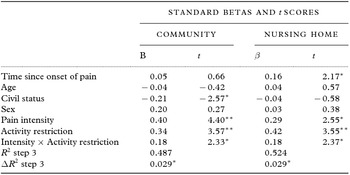
Testing the potential role of activity restriction as a moderator
Our data support the potential role of activity restriction as a moderator in both samples. Table 2 shows the results of the last step of moderation analysis for both samples. In the community sample, the independent effect of both pain intensity and activity restriction on depression was significant at a probability level of 0.001. The increment in R 2 (ΔR 2 = 0.030, ΔF = 5.421, p = 0.02) when we introduced into the equation the effect of the interaction between pain intensity and activity restriction on the criterion variable (depression) was significant at the 0.05 level, so that the data support the moderation hypothesis (β = 0.179, t = 2.328, p = 0.02). The results of post-hoc probing of significant moderator effects (Figure 1a) indicated that when pain interference in activity (activity restriction) was high, there was a significant and positive relationship (β = 0.916, t = 3.830, p < 0.0001). Specifically, as pain intensity increases the depressive symptomatology increases. However, when activity restriction was low the relationship between pain intensity and depression was not significant (β = –0.12, t = –0.57, p = 0.57).
Moderation analysis of the effect of activity restriction in the relationship between pain intensity and level of depressive symptomatology

Note: *p < 0.05, **p < 0.01.
(a) Estimated relationship between pain intensity and depression in participants with low (− 1 SD) versus high (+ 1 SD) activity restriction in community-dwelling older adults. (b) Estimated relationship between pain intensity and depression in participants with low (− 1 SD) versus high (+ 1 SD) activity restriction in nursing home residents.

In the NH sample, there was a significant change in R 2 at the 0.05 level, (ΔR 2 = 0.029, ΔF = 5.617, p = 0.02), indicating a significant moderator effect (β = 0.18, t = 2.37, p = 0.02). Post-hoc analysis (Figure 1b) shows that when activity restriction was high, there was a significant and positive relationship (β = 0.849, t = 2.928, p = 0.004). Specifically, as pain intensity increases, the depressive symptomatology increases. However, when activity restriction was low, the relationship between pain intensity and depression was not significant (β = –0.275, t = –0.185, p = 0.239).
Testing the potential role of activity restriction as a mediator, and the potential role of the context as a moderator, moderated mediation approach
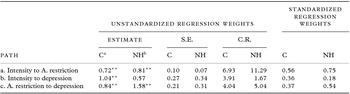
The analyses carried out for testing the mediation model with each sample separately showed that the indirect effect was significant in both samples, showed that activity restriction is a potential mediator between pain and symptoms of depression. Table 3 shows the standardized and unstandardized regression weights, standard errors, critical ratios, and significance for each sample. The standardized indirect effect was 0.207 (Bootstrap S.E. = 0.056, two-tailed significance of indirect effect by bias-corrected percentile method: p = 0.001) for the model tested in the community sample and 0.407 (Bootstrap S.E. = 0.089, p = 0.001) for the NH sample. Additionally, observing the significance of the regression weights (see Table 3), it seems that for NH residents there is perfect mediation, as the regression weight for intensity to depression is non-significant, and for the community-dwelling elderly there is partial mediation.
Mediation analyses in community and nursing home samples: Unstandardized and standardized regression weights

Note: acommunity, bnursing homes, *p < 0.0001.
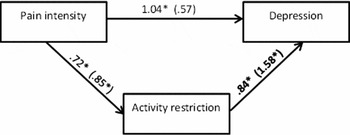
Once the potential mediation role of activity restriction was supported in each sample separately, multi-group analysis allowed us to test whether the mediation process was significantly different between community and NH. The indirect effects of pain on depression (community = 0.606, NH = 1.291) obtained were significantly different across the models, and analyses of the critical ratios showed that path b, between activity restriction (mediator) and depression, was different across models (C.R. = 1.976), which is indicative of moderated mediation (Williams and McKinnon, Reference Williams and MacKinnon2008). Paths a (C.R. = 1.976) and c (C.R. = 1.976) were equal across models. Figure 2 shows the parameters obtained for the two samples in the multi-group analysis.
Tested path model of the relationships between pain intensity, activity restriction, and depression. Unstandardized regression weights are showed; those in parentheses are from nursing homes, those in bold are different between samples. Significant regression weights are marked with * (all p < 0.0001).

Discussion and conclusions
Taken together, our results support the role of activity restriction as a risk factor in the development of depression in older people with chronic pain, living both in NH (Jongenelis et al., Reference Jongenelis, Pot, Eisses, Beekman, Kluiter and Ribbe2004; Vankova et al., Reference Vankova, Holmerova, Andel, Veleta and Janeckova2008) and in the community (Arola et al., Reference Arola, Nicholls, Mallen and Thomas2010; Hawker et al., Reference Hawker2011). Considering the direct associations, depressed people show greater activity restriction than non-depressed people, both in the community and in NH. Moreover, pain intensity is also higher for people with depressive symptomatology in both samples.
Having found support for the relevance of pain and activity restriction in depressive symptomatology, a remaining question concerns the nature of the relation. The moderation analyses revealed that when pain shows little interference in the performance of daily routine activity, it seems that pain intensity is unrelated to mood, and specifically, depressive symptomatology. However, when pain does interfere in everyday activities, the experience of being in pain is a good predictor of depressive symptoms. Although the significance of the increment in R 2 indicates a moderator effect, caution is needed in the interpretation of these findings, due to the low percentage of variance of depressive symptomatology (3%) explained by the interaction. Thus, the importance of the main effects should not be ignored. Older people unable to maintain an acceptable level of activity regardless of pain could be at major risk of depressive symptomatology. Consequently, programs for cushioning the impact of pain in psychological distress should be given preference for these individuals. As it is possible to improve performance of daily activity without modifying pain intensity (McCracken et al., Reference McCracken, MacKichan and Eccleston2007), these programs should include training in coping skills that allow people to improve their level of functioning regardless of pain.
These results are congruent with those presented by Williamson and Schulz (Reference Williamson and Schulz1992), and go beyond those reported by Parmelee et al. (Reference Parmelee, Katz and Lawton1991), who failed to find evidence for the moderator role of functional disability in institutionalized people. However, some caution is warranted in making comparisons between these studies. First, whereas these two studies included individuals with and without chronic pain, we only included people with chronic pain. Second, Williamson and Schulz evaluated interference in many activities that may be important to community-dwellers but irrelevant to those living in NH. Third, Parmelee et al. (Reference Parmelee, Katz and Lawton1991) included only those individuals that met DSM-III-R criteria for major depression, whereas we included individuals with and without depressive symptomatology, as did Williamson and Schulz (Reference Williamson and Schulz1992). Finally, the instrument used to evaluate depressive symptomatology differed across studies.
Regarding the analysis carried out to test the potential mediation role of activity restriction, this role is found in both NH and community-dwelling older adults. Furthermore, there is a moderated mediation relationship. Surprisingly, the strength of the mediation was higher in NH. If we take account only the results in non-institutionalized people, our data are congruent with previous research that supports this mediation role in older people living in the community, for both elders with OA (Hawker et al., Reference Hawker2011) and the general elderly population (Williamson and Schulz, Reference Williamson and Schulz1992). In contrast, if we consider the moderated mediation analyses, our results are at odds with those of authors who suggested that functional interference played a much more important role in the pain-depression relationship in older people living in the community than in those living in NH (Williamson and Schulz, Reference Williamson and Schulz1992). Williamson and Schulz (Reference Williamson and Schulz1992) maintained that, since community-dwellers have more responsibility over their activities than people residing in nursing homes, difficulties for doing everyday activities would affect their emotional well-being to a greater extent. Previous research seemed to support this idea: whereas the moderator and mediator role of activity restriction has been supported by several previous studies with community-dwelling people, the only study that tested a specific role of this variable in NH found that activity restriction did not affect the pain-depression relationship. Nevertheless, our results do not appear to support this. On the contrary, they suggest that in community-dwellers the weight of activity restriction in the pain-depression relationship is lower. One of the factors that might explain this pattern of results is that the NH and community samples differed significantly in age, those people living in NH being older than those living in the community. Since previous research has shown that age is related to changes in the pain experience (Corran et al., Reference Corran, Gibson, Farrell and Helme1994; Benbow et al., Reference Benbow, Cossins and Bowsher1995; Turk et al., Reference Turk, Okifuji and Scharff1995; Cook et al., Reference Cook, Brawer and Vowles2006; Edwards, Reference Edwards2006), age should be considered as a potential reason for the observed results. Previous works showed that the relationship between disability and depression is stronger for young or middle-aged people than for older people (Cook et al., Reference Cook, Brawer and Vowles2006, Edwards, Reference Edwards2006; Lewandowski et al., Reference Lewandowski, Palermo and Peterson2006), and the restriction of routine activities due to pain may be more emotionally distressing to individuals under 65 than to those aged 65 or over (Turk et al., Reference Turk, Okifuji and Scharff1995; Williamson and Schulz, Reference Williamson and Schulz1995). In addition, the strength of the direct relation between pain and depression is higher for older people (Cook et al., Reference Cook, Brawer and Vowles2006; Lewandowski et al., Reference Lewandowski, Palermo and Peterson2006). Taking into account these studies, one might expect the mediating role of activity restriction to be weaker in NH, where people are older than community-dwellers. In contrast, though, our own data showed greater weight of activity restriction in the pain-depression relationship for people living in NH, so that explaining the results through the age differences in the samples is somewhat controversial. In our view, assumptions from the self-determination theory (Deci and Ryan, Reference Deci and Ryan2000) and the motivational model proposed by Skinner and Edge (Reference Skinner, Edge, Deci and Ryan2002) can help us to understand this pattern of results. These theories assume that humans have three basic psychological needs: relatedness, competence, and autonomy. The way in which pain and activity restriction due to pain restrict autonomy can help to explain the differential weight of activity restriction in depression between community-dwellers and NH residents.
Autonomy refers to the need to express one's genuine desires and preferences, to act according to these desires and goals, and to experience oneself as the source of one's own behaviors (Skinner and Edge, Reference Skinner, Edge, Deci and Ryan2002). Chronic illness, pain, and related activity restriction could be important threats to autonomy (Skinner and Edge, Reference Skinner, Edge, Deci and Ryan2002). In such cases, people with an autonomy-oriented behavior initiate mechanisms such as accommodation, acceptance and negotiation, reorienting their goals, selecting and optimizing the activities they can do and modifying the way in which routines are developed. To do so requires a context that permits these processes (Deci and Ryan, Reference Deci and Ryan2000). If the context is coercive, it reduces opportunities for autonomous action, and facilitates opposition and perseveration (Skinner and Edge, Reference Skinner, Edge, Deci and Ryan2002). Social contexts can be coercive if they are characterized by excessive rules, or if they are overprotective, extremely directive or intrusively helpful (Skinner and Edge, Reference Skinner, Edge, Deci and Ryan2002). In fact, the majority of NH could be considered as coercive contexts, even when their rules and overprotective style are well-intentioned. Studies have shown that healthcare staff have a tendency to “do it for” residents as regards daily life activities (Brown et al., Reference Brown, McWilliam and Ward-Griffin2006), and many elderly people living in long-term institutions have problems with changing or adapting their daily routine activities (Anderson et al., Reference Anderson, Pettersson and Sindenvall2007). This pattern of care leads to a reduction in autonomy and sense of self-determination in many older people (Anderson et al., Reference Anderson, Pettersson and Sindenvall2007; Welford et al., Reference Welford, Murphy, Wallace and Casey2010), and the evidence suggests that level of perceived autonomy is often eroded in people in long-stay care (Barkay and Tabak, Reference Barkay and Tabak2002; Randers and Mattiasson, Reference Randers and Mattiasson2004).
Bearing this in mind, we could hypothesize that when older people suffer pain, and pain leads to activity restriction, the living context (NH or the community) could be crucial for the subsequent emotional consequences. The community context would favor an accommodation process, which allows the emergence of new goals and facilitates negotiation about new ways of developing routine activities. The NH context tends to react to dependency by providing individuals with activities, often in a rigid and imposed fashion (for example, an individual who is in a wheelchair cannot decide when or where to go, or how long he/she can sit at the dining table). Thus, for people disabled by pain, NH may cover the basic need for competence through increased predictability, even contingency, but would crush their autonomy, since it tends to produce particular outcomes often at odds with the individual's genuine preferences and desires. Moreover, this coercive setting promotes opposition and perseveration in response to pain and loss of functional independence, which prevent refocusing and/or relinquishing of goals, and are associated with rumination, intrusive thoughts and feelings of self-blame (Skinner and Edge, Reference Skinner, Edge, Deci and Ryan2002).
The explanatory hypotheses dealt with in the present work are centered on analyses of the relationship between pain and depressive symptomatology in a unidirectional way, under the assumption, supported by previous research, that chronic pain is likely to lead to depressive symptomatology (Geerlings et al., Reference Geerlings, Twisk, Beekman, Deeg and Van Tilburg2002; Campbell et al., Reference Campbell, Clauw and Keefe2003; Hawker et al., Reference Hawker2011). However, the relationship between pain and depression in the opposite direction has also been supported in other work (Kroenke et al., Reference Kroenke, Wu, Matthew, Krens, Damush and Tu2011); therefore, one must consider that increased symptoms of depression might lead to greater activity restriction and higher pain intensity, and the possibility of a bidirectional relationship.
In conclusion, we hypothesize that lower perceived autonomy in NH residents, even with equal levels of activity restriction, can explain the stronger relation between activity restriction and depression found in this population. The evidence suggests that perceived autonomy is important to good quality of life in older people, both in the community and in residential care (Barkay and Tabak, Reference Barkay and Tabak2002). Indeed, sense of autonomy creates a buffer that protects against the negative consequences of stress. Furthermore, non-autonomous orientation creates an amplifying effect (Skinner and Edge, Reference Skinner, Edge, Deci and Ryan2002). When events are objectively coercive (for example, when pain threatens autonomy) and really involve pressure on an individual's actions, people with a higher sense of autonomy perceive such events as less coercive. In this situation, the NH context would promote a perseverative style and opposition responses and reduce opportunities for autonomous actions. As a lack of perceived autonomy and the maintenance of a perseverative style constitute risk factors for depression and hopelessness (Nolen-Hoeksma, Reference Nolen-Hoeksma, Heckhausen and Dweck1998; Brandtstädter, Reference Brandtstädter1999), pain-related activity restriction in older people may bring a higher risk of depression if they live in a NH than if they live in the community. As has been mentioned, the possibility should also be considered that it is depressive symptomatology that leads to more interference and greater intensity of pain. The explanation based on self-determination theory may be only suitable if we consider that pain leads to activity restriction, leading in turn to depression.
As regards the clinical implications of the data, interventions to reduce and prevent depressive symptomatology in this population must be designed to reduce pain interference, rather than focusing only on reducing the intensity of the pain. This would apply particularly to NH settings, where there was no significant direct relationship between pain and depression. This way of improving psychological well-being would be especially helpful, considering that many studies have failed to reduce pain intensity after cognitive-behavioral interventions (Williams et al., Reference Williams, Eccleston and Morley2012). Training in cognitive and behavioral skills associated with lesser pain interference in older people with chronic pain, even in people with equal levels of pain intensity or radiological deterioration (Izal et al., Reference Izal, López, Montorio and González2010), could yield a reduction in depressive symptomatology. In addition, it would be possible to reduce depressive symptoms without modifying pain intensity using techniques such as Acceptance and Commitment Therapy, as has been shown in other populations (McCracken et al., Reference McCracken, MacKichan and Eccleston2007). Finally, if our hypotheses are correct, increasing perceived autonomy could reduce depression in older people with chronic pain. Providing the opportunity to decide and choose for oneself can raise perceived autonomy in institutionalized older adults, even when they are dependent on others in activities of daily living (Anderson et al., Reference Anderson, Pettersson and Sindenvall2007; Welford et al., Reference Welford, Murphy, Wallace and Casey2010).
Some limitations of the present study should be considered. Taking into account the correlational nature of the analyses, we were only able to test the potential role of activity restriction as moderator or mediator, but further longitudinal studies are needed for confirmation. No causal relationships can be established. Nevertheless, we could suggest causal hypotheses that should be tested in future research through prospective studies. Regarding the participants, this was a convenience sample, rather than a random one, and sample size was relatively small. Furthermore, all participants suffered from pain due to OA, which could constitute a limitation for the generalization of our findings with regard to other types of chronic pain. An important issue to take into account is that, although NH and community participants were similar in gender and educational level, participants in the NH sample were older. Moderation analysis was carried out controlling for age, but in any case the results of the moderated mediation analyses should be treated with caution, since, although we focused on the role of context, the differences in age could partly explain the results. Taking into account previous research, the fact that the strong role of activity restriction has been found in NH, where people are older, makes unlikely an interpretation of the differences based on age; even so, age differences as a potential reason for the results might be considered as an alternative explanation. In addition, moderator effects may be with caution, due to the small amount of variance explained. Finally, we measured depressive symptomatology, but not the presence of major depression. Future research is needed to test whether the results would be the same in relation to major depression. Despite these limitations, the findings of the present study provide additional evidence of the importance of activity restriction for depressive symptomatology, and address the question of a differential role depending on the context – NH or the community; moreover, the comparison between these populations is all the more reliable for the fact that people from the two contexts were assessed simultaneously, and with the same instruments.
Conflict of interests
None.
Description of authors’ roles
A. López-López designed the study, performed the data analyses, and wrote the paper. M. Alonso-Fernández assisted with the study design and supervised and assisted the data collection. J.L. González helped with the design and data analyses and assisted with writing the paper. N. Ciudad and B. Matías collected the data and assisted with preparation and analyses of the data. All authors approved the final draft for submission.
Acknowledgments
This study was supported by a grant from the MAPFRE Foundation, Beca Primitivo de Vega-2010. We thank the Geriatros S.A.U. group and the Regional Service for Social Well-Being (S.R.B.S.) of the Madrid Autonomous Region (Comunidad de Madrid), which provided us with the necessary clinical data and access to their nursing homes. Neither the MAPFRE Foundation nor Geriatros S.A.U. or S.R.B.S. was involved in the design, methods, recruitment, data collection, analysis or writing.