Introduction
There continue to be large gaps in our understanding of why some people live in conditions so filthy and cluttered that they attract the label of severe domestic squalor (Snowdon et al., Reference Snowdon, Shah and Halliday2007). Such conditions put the individual at risk and cause considerable concern to neighbors, the local community and visiting professionals. While almost certainly a syndrome of heterogeneous etiology, studies to date have come to very different conclusions, probably as a result of varied selection criteria. For instance, Macmillan and Shaw (Reference Macmillan and Shaw1966) found a mental disorder in 53% of people found living in squalor. Clark et al. (Reference Clark, Mankikar and Gray1975) studied a group of 30 patients admitted to hospital with extreme self-neglect, including hoarding of rubbish, in whom physical illnesses were very common and mortality high. The authors postulated that the syndrome might be a reaction to late life stress in certain types of personality. Similarly, Post (Reference Post1982) postulated that “senile reclusiveness” might be the end stage of a personality disorder. An urban Irish study also reported a high rate of medical diagnoses (Wrigley and Cooney, Reference Wrigley and Cooney1992); half the group were found to have cognitive impairment and 45% received a diagnosis of dementia, 10% a diagnosis of alcohol dependence, and 10% a diagnosis of schizophrenia. More recently, Halliday et al. (Reference Halliday, Banerjee, Philpot and Macdonald2000) undertook a cross-sectional study of clients referred to a specialist cleaning service. Seventy percent of individuals were identified as having a mental disorder, and again a variety of disorders were identified: 16% had dementia, 21% had a psychotic disorder, and 22% had an alcohol-induced disorder either as a separate or co-morbid diagnosis.
In an editorial, Orrell and Sahakian (Reference Orrell and Sahakian1991) speculated that significant frontal cognitive deficits might be the common denominator in senile squalor, and a number of single-case studies have supported the association between late life squalor and frontotemporal dementia (Orrell et al., Reference Orrell, Sahakian and Bergmann1989). In order to explore the association between frontal executive deficits and squalor, Lebert (Reference Lebert2005) reviewed 30 patients with a diagnosis of frontotemporal dementia, and found that 36% met criteria for Diogenes syndrome, while 50% showed pathological hoarding. Lebert speculated that functional deficits associated with frontal pathology might underpin the picture of senile squalor. For example, apathy might reduce the inclination to wash; the inability to sequence complex tasks could explain the reduction in complex personal tasks, and a reduction in ability to recognize the emotion of disgust could contribute to the ability to tolerate dirt. A recent study of self-neglecting adults referred to an adult protection service also suggested an association between self-neglect and impaired executive function (Schillerstrom et al., Reference Schillerstrom, Salazar, Regwan, Bonugli and Royall2009), as did a single-case study of a 49-year-old woman living in squalor who had who sustained orbito-frontal damage following a burst aneurysm (Funayama et al., Reference Funayama, Mimura, Koshibe and Kato2010). To our knowledge the role of disgust appreciation has not been studied, but may well be pertinent particularly as patients with frontotemporal dementia appear impaired on tests involving implicit judgment of disgust-inducing stimuli (Bedoin et al., Reference Bedoin, Thomas-Anterion, Dorey and Lebert2009). Individuals found living in squalor are apparently oblivious to their environment and do not appear to see that others respond with disgust. The ability to recognize and respond to disgust depends upon the function of the insula and basal ganglia (Adolphs et al., Reference Adolphs, Damasio and Tranel2002). In addition, deficits of so-called “theory of mind”, the capacity to understand what another individual is thinking or feeling, which is underpinned by the frontal lobes (Gregory et al., Reference Gregory2002), may also contribute to the individual's ability to tolerate others’ disapproval of their living conditions.
We hypothesized that, regardless of diagnosis, people found living in squalor may share common deficits. More specifically, impairment of executive function, abnormalities in the appreciation of disgust, or deficits in theory of mind may be key underlying cognitive deficits. Furthermore, in an attempt to explore the mechanisms underpinning how individuals could tolerate living in an environment which others perceive with disgust, we devised a novel test to assess whether the subjects’ assessment of their own environment was at odds with their assessment of pictures of other individuals’ squalid and cluttered environments.
Methods
All patients seen in the study were referred to the psychogeriatric service of the Eastern Sector of the Central Sydney Area Health Service after being found in squalid living conditions. Of ten consecutive patients referred between August 2002 and March 2003, all ten agreed to participate but three had marked cognitive impairment (Mini-mental State Examination (MMSE) score <10) and the other was unable to cooperate such that data from six patients was complete enough to include in the analyses. The diagnosis was recorded at the time of assessment but did not influence whether or not the person was included in the study. The study was approved by the Ethics Committee of the Central Sydney Area Health Service. The battery of tests and assessments were undertaken usually over several sessions.
Basic demographics and assessment of living conditions
Patient's age, marital status, type of housing and diagnosis were recorded.
Neuropsychological test battery
General neuropsychological tests administered were the MMSE (Folstein et al., Reference Folstein, Folstein and McHugh1975) and the National Adult Reading Test (Nelson and O'Connell, Reference Nelson and O'Connell1978) as an estimate of premorbid IQ. Tests of memory included the Weschler Memory Scale Logical Memory 1 & 2, Visual Memory Test (WAIS-R) (Wechsler, Reference Wechsler1987), using the average of I and II delayed score.
Executive function
Tests of frontal executive function included Digit Span (forwards and backwards), the Controlled Oral Word Association test, i.e. verbal fluency for category and letters, and the Brixton Tests of spatial anticipation and planning (Burgess and Shallice, Reference Burgess and Shallice1997), which measures the ability to detect rules in sequences of stimuli and concept formation. It comprises 56 nearly identical cards printed with ten (5 rows of 2) circles, one of each being colored while the others are white. The position of the colored circle moves around according to a set of rules unknown by the subject, who is asked to predict where the next colored circle will appear.
Assessment of theory of mind
To assess theory of mind we used the Faux-pas Test (Stone et al., Reference Stone, Baron-Cohen and Knight1998; Gregory et al., Reference Gregory2002), an assessment of an individual's ability to recognize that someone has said something unintentionally that they should not have said, either because it is meant to be confidential or is hurtful. In this test the subject is read 20 stories, which may or may not contain a social faux pas; the individual is then asked a number of questions about the situation, in particular to identify whether a faux-pas has occurred.
Detection of emotion and disgust
Detection of emotions was assessed using a modified version of the Ekman Faces Test (Ekman and Friesen, Reference Ekman and Friesen1976). Photos of faces expressing one of six emotions are shown randomly to the subject, who is then asked to identify the emotion from a choice of six descriptors (happiness, surprise, fear, sadness, disgust and anger) displayed beneath each face. A total of 24 faces were shown (four of each emotion) to each subject.
Living Conditions Rating Scale, insight and awareness
Cleanliness of patients’ accommodation was scored using the interior scale of the Living Conditions Rating Scale (LCRS). This consists of 13 items measuring cleanliness of the walls, floors/carpets, furniture, kitchen, and bathroom/toilet, as well as accessibility, odor, lighting, food condition, disposal of excreta, hoarding, clutter, and numbers of vermin. Items are rated from zero (acceptable) to 3 (markedly unclean, unhygienic or inaccessible), using operationally defined criteria, the maximum score being 39. Reliability (correlation 0.89 between researchers’ total scores on this scale) and validity were demonstrated during development of the Environmental Cleanliness and Clutter Scale (Halliday and Snowdon, Reference Halliday and Snowdon2009). In their London study of people whose dwellings were deemed to need heavy duty cleaning, Halliday et al. (Reference Halliday, Banerjee, Philpot and Macdonald2000) reported a mean LCRS interior scale score of 17 (SD 6, range 6–34).
To assess insight we used two tasks. In the first (Halliday et al., Reference Halliday, Banerjee, Philpot and Macdonald2000), individuals were asked to assess their own accommodation across three domains; The first domain requires the subject to describe their own accommodation in terms of its cleanliness (forced choice categories 1–4 from very clean (1) to very untidy or dirty (4); the second domain requires the subject to describe their level of concern about the state of the accommodation (forced choice categories, 1–4) from very concerned to not at all concerned; and the third domain asks how the individual believes his or her accommodation compares to other older peoples’ accommodation (again four forced choice categories, 1–4) from definitely less clean to no less clean). The second part of the test was newly devised. Subjects were shown a series of photographs from newspapers of unclean living conditions, and were asked to describe (1) what they saw in the picture, with their responses recorded to indicate whether they mention clutter, neglect and dirt, and how extreme they feel this is, and (2) whether they would feel concerned about another individual living in the home represented in the picture (from very concerned to not at all concerned).
Statistical analysis
Given the relatively small number of subjects we took a multi-patient single-case approach and compared each subject's performance with that of controls using a Z-score approach. For the standardized neuropsychological tests we applied a threshold of two or more standard deviations below that of age appropriate controls, and dichotomized performance as normal or impaired. For the Brixton, scores in the poor, abnormal or impaired categories were considered as impaired. For the experimental tasks, i.e. assessing theory of mind and detection of emotions, we used scores from previously published studies involving frontotemporal dementia subjects and age matched controls (Gregory et al., Reference Gregory2002; Lough et al., Reference Lough, Kipps, Treise, Watson, Blair and Hodges2006; Kipps et al., Reference Kipps, Nestor, Acosta-Cabronero, Arnold and Hodges2009)
Results
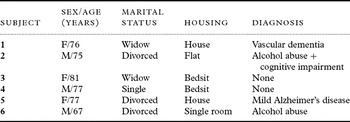
The six subjects were aged from 67 to 81years. All patients lived alone, regardless of type of housing, and had a variety of diagnoses (Table 1). In two cases no definitive diagnosis could be made at presentation.
Basic demographics of the patient group

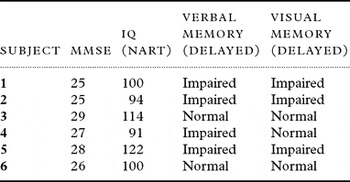
As shown in Table 2, all six who participated had MMSE scores above 24. IQ scores predicted from the NART ranged from 91 to 122. For delayed recall of verbal information (logical memory), four of the six subjects were impaired; two recalled no information, and two recalled fragments only. Delayed recall of visual material showed three of the subjects falling within the normal range. Considering verbal and visual memory together, three of the six subjects can be considered amnesic, whilst two performed normally in both modalities; the remaining patient showed discordance across modalities.
General psychological tests (Mini-mental State Examination and full scale IQ derived from the National Adult Reading Test) and tests of memory. Dichotomized performance as normal or impaired using a threshold of two or more standard deviations below that of age appropriate controls.

Executive function
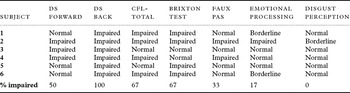
Although forward digit span fell within the normal range for three subjects (Table 3), the reverse digit span was impaired in all six subjects (three or less). Verbal fluency (for letters CFL) fell in the impaired range for four of the six subjects. On the Brixton test of spatial anticipation four subjects were clearly abnormal. Considering together the three tests of frontal executive function (digit span forwards and backwards, CFL and the Brixton), it is notable that no subject performed normally on all three tests: two were impaired on all tasks, and three subjects showed impairment on two of the three tasks.
Test of frontal executive functioning: digit span (DS) forwards and backwards, Controlled Oral Word Association (for letters CFL), Brixton test and Faux Pas test), emotional processing and disgust perception. Scores dichotomized to normal or impaired (and for emotional processing normal impaired or borderline) – using two standard deviations below that of age matched controls.

Theory of mind
Surprisingly, on the detection of social faux pas, only two of the patients’ performance fell in the clearly impaired range. In all subjects their performance was statistically better than chance and the four subjects with normal performance actually scored within one standard deviation of the control group (Gregory et al., Reference Gregory2002).
Emotional processing and perception of disgust
On the modified Ekman's face emotion task, one subject was grossly impaired, obtaining a score that was no better than chance, three fell clearly within the normal range and two were borderline – falling just at the very lower limit of the normal range. It is notable that (with the exception of the extremely impaired subject No. 2 who scored 3 out of 4), all obtained full scores on the disgust face.
Summary of neuropsychological results
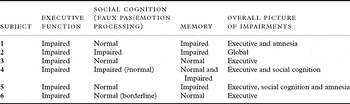
In Table 4 we have attempted to summarize the overall performance of our subjects in the three domains, i.e. executive function, social cognition (which incorporates faux pas and facial emotion recognition) and episodic memory. Subject No. 2 showed global deficits across all three domains, while Subject No. 3 was normal. The other four subjects showed different combinations but with a predominance of executive impairments. Expressed in a different way, overall six were considered to show executive deficits, three memory impairment and only two showed a break-down in social cognition.
Summary of neuropsychological results

Insight and awareness
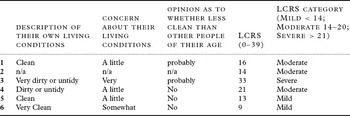
Table 5 summarizes the results of the subjects’ own assessment of their living conditions. Subject No. 2 was unwilling to participate in this part of the study. There was considerable variation in the individuals’ insight and awareness into their own living conditions, with responses varying from “very clean” to “very dirty”. This did not appear to relate to overall neuropsychological function, or disgust scores. All five subjects recognized and commented appropriately on the newspaper photos using appropriate terms to highlight the unclean and squalid state depicted. Similarly, all subjects were able to suggest the topic of the newspaper article and four of the five subjects were “very concerned” about any person living in such conditions. Subject No. 5 however was not at all concerned about a person inhabiting the environment depicted.
Subjects’ assessment of their own living conditions, and Living Conditions Rating Scale (LCRS) scores.

Discussion
In keeping with our primary hypothesis, all six elderly patients found living in squalor had significant deficits involving frontally based cognitive abilities, although these occurred largely in the context of more diffuse impairment notably including episodic memory. Somewhat surprisingly, the appreciation of disgust was not impaired except in one of the patients. Patients showed variable insight into their own living conditions, which did not appear to relate to neuropsychological assessment. Five patients were able to identify and comment appropriately on squalid conditions depicted in photographs from a newspaper, and were able to suggest the likely topic of the accompanying newspaper article. Four of these patients showed concern at the idea of living in such conditions.
It has previously been postulated that impaired frontal executive function might be a common denominator underpinning this clinical problem, regardless of diagnosis (Orrell and Sahakian, Reference Orrell and Sahakian1991). This hypothesis was explored in a recent study of adults with self-neglect referred to an adult protective service in the U.S.A. Compared to general geriatric psychiatry outpatients, those with self-neglect did poorly on the CLOX test of executive dysfunction (Schillerstrom et al., Reference Schillerstrom, Salazar, Regwan, Bonugli and Royall2009). Patients with frontotemporal dementia who have a high rate of self-neglect and squalor also show deficits on tests of frontal executive function (Lebert, Reference Lebert2005). Our study confirms that frontal dysfunction is indeed ubiquitous in this group. Of the tasks employed, reverse digit span (a test of auditory verbal working memory) was the most sensitive, being abnormal in all six, while verbal fluency (generating words beginning with CFL) and the Brixton test of spatial anticipation revealed deficits in four of the six subjects. It is of interest that a recent study of subjects with definite FTD showed that digits reversed and verbal fluency were among the most sensitive tasks for the detection of pathology even in the early stages of the disease (Hornberger et al., Reference Hornberger, Piguet, Kipps and Hodges2008). Performance on both of these tasks is strongly linked to dorso-lateral rather than orbito-frontal function (Stone et al., Reference Stone, Baron-Cohen and Knight1998), which is relevant when we come to consider (below) the potential etiology of their frontal dysfunction.
In comparison to their performance on more traditional tests of frontal function, the six patients performed surprisingly well on the detection of social faux pas. The ability to detect these violations of social etiquette is considered a component of theory of mind. Theory of mind is a key component of social cognition that in normal individuals develops in late childhood. It is defective in individuals with autism and Asperger's spectrum syndrome (Baron-Cohen et al., Reference Baron-Cohen, Leslie and Frith1985) and has been shown to break down in patients with orbito-mesial frontal pathology (Stone et al., Reference Stone, Baron-Cohen and Knight1998). It was included in the current battery as prior studies in patients with behavioral variant FTD, who present with decline in self-care and show early impairment in activities of daily living (Mioshi et al., Reference Mioshi, Kipps, Dawson, Mitchell, Graham and Hodges2007), show consistent impairment on the Faux Pas test (Gregory et al., Reference Gregory2002; Torralva et al., Reference Torralva2007). Performance on the Ekman test which involved the detection of emotions, including disgust, was also relatively normal with only one patient showing a clear-cut impairment. The evidence from both lesion and functional imaging studies suggests that the recognition of basic emotion depends on a discrete network of brain structures involving the amygdala, orbito-frontal, temporal cortices and the insula cortices with a strong right-sided emphasis and that, within this circuit, the perception of disgust relies on the insula and basal ganglia (Adolphs et al., Reference Adolphs, Damasio and Tranel2002). It may be that the test used was insufficiently sensitive to pick up abnormalities in this aspect of emotional processing, although it has been shown that patients with early FTD show consistent deficits on the same task (Kipps et al., Reference Kipps, Nestor, Acosta-Cabronero, Arnold and Hodges2009) and one recent study went as far as proposing the Ekman 60 Faces Test as a diagnostic test for FTD (Diehl-Schmid et al., Reference Diehl-Schmid, Pohl, Ruprecht, Wagenpfeil, Foerstl and Kurz2007).
Because very unclean and squalid living conditions are so striking to relatives, health care providers, social services and neighbors, it might be presumed that the occupant is at least equally aware. Few studies though have attempted to examine systematically the attitude of people living in squalor to their living conditions. In this study we utilized the same test that was used in the assessment of 81 clients of a local authority special cleaning service (Halliday et al., Reference Halliday, Banerjee, Philpot and Macdonald2000). Like the previous study, a significant number of subjects reported that their home was clean or very clean. Only one subject reported being very concerned. In addition to this assessment of insight, all of the subjects were able to identify severely unclean or cluttered living conditions in newspaper photographs. This suggests that our subjects had the capacity to recognize unclean living conditions, and that this may be a problem for others. This dichotomy between appreciation of squalor in photos and concern for others and the reduced concern and insight into their own squalor is interesting and requires further study.
Turning to the potential etiology of the frontal dysfunction, in keeping with prior clinical studies, the etiology of senile squalor syndrome is heterogeneous with no single underlying diagnosis (Macmillan and Shaw, Reference Macmillan and Shaw1966; Clark et al., Reference Clark, Mankikar and Gray1975; Post, Reference Post1982; Wrigley and Cooney, Reference Wrigley and Cooney1992; Halliday et al., Reference Halliday, Banerjee, Philpot and Macdonald2000). One of our patients had a vascular etiology while two had a long-term history of significant alcohol abuse which is likely to have contributed to their frontal dysfunction. One of the others was regarded as suffering from early Alzheimer's disease (AD). It is possible that a number of the patients had frontotemporal dementia but the absence of collaborative informant histories and follow-up information hampers our ability to be certain. Central to current diagnostic criteria for the behavioral variant of frontotemporal dementia is an informant account of a progressive decline in social cognition, behavior and personality and the absence of other potential causes for frontal dysfunction (Rascovsky et al., Reference Rascovsky2007), but such evidence was missing in our cases, all of whom lived alone and were reclusive with little social contact. It is well established that the primary sites of pathology in FTD are the mesial and orbital regions of the frontal lobes (Rosen et al., Reference Rosen2002; Kril et al., Reference Kril, Macdonald, Patel, Png and Halliday2005). The fact, therefore, that our patients exhibited impairment of tests traditionally regarded as sensitive to dorsolateral, rather than orbitomesial, pathology speaks against the likelihood of frontotemporal dementia. Another piece of evidence is the finding of very significant impairment of episodic memory in all but one of our patients, which was often in the highly amnesic range, with zero recall of new information after a delay. Such impairment is much more suggestive of early AD. Moreover, the pattern of executive dysfunction is also compatible with AD which is frequently accompanied by dorsolateral prefrontal as well as the well-known medial temporal pathology (Perry and Hodges Reference Perry and Hodges1999; Pike et al., Reference Pike2007).
Our finding of significant frontal executive deficits may also aid the management of these individuals who present a burden on resources in the community. It is likely that a reduction in motivation, planning, goal setting and decision-making play a key role in the genesis and maintenance of squalor and should be taken into account by the management team. The lack of appreciation of their own squalid living conditions in some individuals, yet their ability to appreciate squalor in photographs is intriguing and requires novel ways of studying this aspect in the future.
The present study has a number of shortcomings. Although all ten of a consecutive series of referred patients agreed to involvement in the study, only six were able to cooperate well enough for their results to be included in our analyses. Future studies should perhaps include a wider range of more recently designed tests sensitive to frontotemporal dysfunction as well as long-term follow-up to obtain a clearer view of the outcome and etiogy in such cases.
Conflict of interest
None.
Description of authors’ roles
C. Gregory collected the data, was involved with the study design and wrote the paper. G. Halliday collected the data and assisted in data analysis. J. Hodges advised on the study design and data analysis and assisted in writing the paper. J. Snowdon initiated the study, supervised data collection and assisted in paper writing.
Acknowledgments
We thank Sarah Homewood for secretarial assistance. J. R. Hodges is supported by an Australian Research Council Federation Fellowship FF0776229.