Introduction
Cacti are important elements in the New World flora for many reasons. They are almost exclusively native to the Americas (Anderson, Reference Anderson2001), making an important contribution to species richness and endemisms in many regions (López, Reference López2003; Ortega-Baes and Godínez-Alvarez, Reference Ortega-Baes and Godínez-Alvarez2006; Giorgis et al., Reference Giorgis, Cingolani, Chiarini, Chiapella, Barboza, Espinar, Morero, Gurvich, Tecco, Subils and Cabido2011). The mountains of north-western Argentina and Bolivia are one of the three main areas of highest cactus diversity, together with Mexico and north-eastern Brazil (Ortega-Baes and Godínez-Alvarez, Reference Ortega-Baes and Godínez-Alvarez2006). In central Argentina, the Córdoba Mountains are the southernmost portion of the mountains of north-western Argentina and Bolivia. However, few studies here have analysed basic aspects of cactus biology, such as regenerative traits (Gurvich et al., Reference Gurvich, Funes, Giorgis and Demaio2008).
One of the most important topics in plant community ecology is the relationship among plant traits (Díaz et al., Reference Díaz, Hodgson, Thompson, Cabido, Cornelissen, Jalili, Montserrat-Martí, Grime, Zarrinkamar, Asri, Band, Basconcelo, Castro-Díez, Funes, Hamzehee, Khoshnevi, Pérez-Harguindeguy, Pérez-Rontomé, Shirvany, Vendramini, Yazdani, Abbas-Azimi, Bogaard, Boustani, Charles, Dehghan, de Torres-Espuny, Falczuk, Guerrero-Campo, Hynd, Jones, Kowsary, Kazemi-Saeed, Maestro-Martínez, Romo-Díez, Shaw, Siavash, Villar-Salvador and Zak2004; Grime and Pierce, Reference Grime and Pierce2012). Seed mass has been indicated as one of the most important functional traits in plants (Lönnberg and Eriksson, Reference Lönnberg and Eriksson2013), being one of the principal traits influencing the early phases of a plant's life cycle (Fenner and Thompson, Reference Fenner and Thompson2005). In addition, seed mass has been shown to be correlated with several seed or seedling traits, such as dispersal mode (Leishman et al., Reference Leishman, Wright, Moles, Westoby and Fenner2000), seed moisture content (Sautu et al., Reference Sautu, Baskin, Baskin and Condit2006), the capacity to form soil seed banks (Thompson et al., Reference Thompson, Band and Hodgson1993; Funes et al., Reference Funes, Basconcelo, Díaz and Cabido1999), seedling size (Seiwa and Kikuzawa, Reference Seiwa and Kikuzawa1996), and seedling relative growth rate (Shipley and Peters, Reference Shipley and Peters1990). However, the relationship between seed mass and germination attributes, such as total germination, response to light and time to germination, are still unclear, particularly in Cactaceae.
It has been proposed that seed mass may be related to seed germination percentage. However, studies considering this relationship have found different results. Some studies indicated a direct relationship (Galíndez et al., Reference Galíndez, Ortega-Baes, Daws, Sühring, Scopel and Pritchard2009), others reported an inverse one (Bu et al., Reference Bu, Chen, Xu, Liu, Wen and Du2007; Wang et al., Reference Wang, Baskin, Cui and Du2009), whereas most studies found no relationship between seed mass and germination traits (Shipley and Parent, Reference Shipley and Parent1991; Morgan, Reference Morgan1998; Sautu et al., Reference Sautu, Baskin, Baskin and Condit2006; Liu et al., Reference Liu, Yan, Li, Ma and Ling2007). In Cactaceae, a study considering 54 species did not find a relationship between seed mass and total seed germination (Rojas Aréchiga et al., Reference Rojas-Aréchiga, Mandujano and Golubov2012).
Germination response to light was proposed as one of the most important signals in a plant's life cycle (Pons, Reference Pons and Fenner2000). For example, it has been proposed that species forming persistent seed banks would be positively photoblastic in order to avoid germinating under the soil (Fenner and Thompson, Reference Fenner and Thompson2005); moreover, pioneer tree species of tropical forests depend on an open gap to emerge (Baskin and Baskin, Reference Baskin and Baskin1998). The effect of light on germination has been well studied in cactus species (Flores et al., Reference Flores, Jurado, Chapa-Vargas, Ceroni-Stuva, Dávila-Aranda, Galíndez, Gurvich, León-Lobos, Ordóñez, Ortega-Baes, Ramírez-Bullón, Sandoval, Seal, Ullian and Pritchard2011). Species can be either light dependent (positively photoblastic) or show no light requirement for germination (Rojas-Aréchiga et al., Reference Rojas-Aréchiga, Orozco-Segovia and Vázquez-Yánes1997; Rojas-Aréchiga and Vázquez-Yañes, Reference Rojas-Aréchiga and Vázquez-Yañes2000; Flores et al., Reference Flores, Jurado and Arredondo2006); the latter phenomenon (negative photoblasticity) seems to be a non-existing response in cactus species (Guerrero et al., Reference Guerrero, Alves-Burgos, Peña-Gómez and Bustamante2011). In a study of 136 cactus species from different countries, Flores et al. (Reference Flores, Jurado, Chapa-Vargas, Ceroni-Stuva, Dávila-Aranda, Galíndez, Gurvich, León-Lobos, Ordóñez, Ortega-Baes, Ramírez-Bullón, Sandoval, Seal, Ullian and Pritchard2011) found that seed mass was related to light dependence. They found that heavier-seeded species are more indifferent to light than lighter ones. However, Rojas-Aréchiga et al. (Reference Rojas-Aréchiga, Mandujano and Golubov2012) found no relationship between seed mass and light dependence in 54 cactus species from the tribe Cacteae.
Time to germination is crucial for seed survival and seedling establishment. Norden et al. (Reference Norden, Daws, Antoine, Gonzalez, Garwood and Chave2009) proposed that large-seeded species would have the fastest germination rate, since they are more likely to undergo high post-dispersal seed predation. In addition, small-seeded species that are generally highly persistent in the soil seed bank showed a delay in seed germination until proper germination conditions occur. Empirical data, however, are contradictory; for example, Norden et al. (Reference Norden, Daws, Antoine, Gonzalez, Garwood and Chave2009) observed a positive relationship between time to germination and seed mass for tree tropical tree species, whereas Sautu et al. (Reference Sautu, Baskin, Baskin and Condit2006) found no relationship. Cactus species generally germinate quickly (Álvarez-Aguirre and Montaña, Reference Álvarez-Aguirre and Montaña1997; Bárcenas-Argüello et al., Reference Bárcenas-Argüello, Lauro López-Mata, Terrazas and García-Moya2013). However, the relationship between time to visible germination and seed mass has been poorly analysed. In a study involving six columnar cactus species, Loza-Cornejo et al. (Reference Loza-Cornejo, López-Mata and Terrazas2008) found a positive relationship between seed mass and germination velocity.
The traits seedling size and shape might also be strongly dependent on seed mass. Heavier seeds may produce bigger seedlings, which in turn could affect their establishment (Moles and Leishman, Reference Moles, Leishman, Leck, Parker and Simpson2008). In addition, seedling shape might be involved in the ability of the cactus to capture light or in dealing with temperature variations; therefore, this could be a key trait for seedling survival. To our knowledge, no previous study has analysed this relationship. Considering seedling characteristics, only Bowers and Pierson (Reference Bowers and Pierson2001) analysed the relationship between seedling traits and seed mass for North American cactus species. They compared seedling survival in two species with contrasting seed mass, Carnegiea gigantea and Ferocactus wislizeni with light and heavy seeds, respectively. They found that seed mass was positively related to seedling size and, therefore, to survival.
The Córdoba Mountains area is an important centre of cactus diversity in Argentina, both in the number of species (31) and in the presence of endemic ones (10) (Gurvich et al., Reference Gurvich, Demaio and Giorgis2006; Giorgis et al., Reference Giorgis, Cingolani, Chiarini, Chiapella, Barboza, Espinar, Morero, Gurvich, Tecco, Subils and Cabido2011). However, different aspects of their biology, particularly reproductive biology, have not been fully addressed (Gurvich et al., Reference Gurvich, Funes, Giorgis and Demaio2008). In the present study we investigated the relationship between seed mass and total germination percentage, response to light, mean time to germination, and seedling size and shape in 17 cactus species from mountain grasslands and xerophytic woodlands of central Argentina. Particularly, we hypothesized that seed mass will be positively related to total germination, mean germination time and seedling size. We also expect a negative relationship between seed mass and relative light germination (RLG).
Materials and methods
Study area and species selection
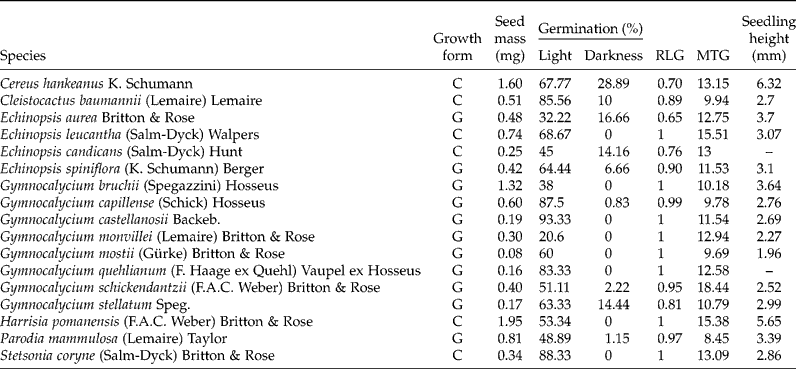
We studied 17 cactus species from the Cactoideae subfamily occurring in the north-western region of Córdoba province in central Argentina (see Table 1). Two main ecosystems are present in the study area, grasslands and xerophytic woodlands. Grasslands occur mainly above 1000 m asl, whereas below this altitude woodlands dominate the landscape (Giorgis et al., Reference Giorgis, Cingolani, Chiarini, Chiapella, Barboza, Espinar, Morero, Gurvich, Tecco, Subils and Cabido2011). We selected species based on their taxonomy, attempting to include species from all genera present in the area as well as globose and columnar ones, the two most common growth forms.
Growth form (C=columnar and G=globose), seed mass (mg), percentage of seed germination, relative light germination (RLG), mean germination time (MGT) and seedling height (mm) for cactus species from Córdoba (Argentina)

Experiments performed and variables measured
We collected mature fruits from at least ten individuals per species. Seeds were air-dried and stored in the laboratory at ambient conditions until the start of the experiments. We estimated seed mass by determining the weight of 50 dry seeds per species with a precision balance (0.1 mg). When seed mass was very low, we weighed a pool of ten seeds. We tested seed germination of the 17 species in a germination chamber under controlled light conditions (12/12 h daily photoperiod of about 38 μmol m− 2s− 1 cool white fluorescent light tubes). Darkness treatment consisted of dishes wrapped in a layer of aluminium foil. All samples were exposed to a 12/12 h alternating temperature regime of 25/15°C. This temperature regime is optimal for germination of different species (including cacti) in the study area (Gurvich et al., Reference Gurvich, Funes, Giorgis and Demaio2008; Funes et al., Reference Funes, Díaz and Venier2009). We used three replicates per treatment. Each replicate consisted of 30 seeds placed on filter paper in 9-cm diameter Petri dishes and moistened with distilled water, for 30 d; for the species Echinopsis candicans, Gymnocalycium capillense, G. mostii and Stetsonia coryne, 40 seeds were used. We checked germination of seeds incubated in the darkness at the end of each experiment. Protrusion of the radicle was the criterion for seed germination.
For 15 species we also measured seedling size (i.e., height and width), shape and volume (Table 1). Seeds of those species were germinated in plastic pots in the greenhouse; 3 weeks after germination we measured seedling height and width of seven seedlings per species with a digital caliper. With these data we calculated a shape index (height/width ratio), with a value of 1 indicating spherical seedlings (typical of globose cacti) and a value departing from 1 indicating that seedlings become cylindrical (typical of columnar cacti). For spherical species, we calculated volume as: (4π.r 3)/3, where r is the radius. For cylindrical species, volume was calculated as: π.r 2.h, where h stands for height.
Data analysis
We calculated total percentage of seed germination, relative light germination (RLG; see Milberg et al., Reference Milberg, Andersson and Thompson2000) and mean germination time (MGT; see Thapliyal and Phartyal, Reference Thapliyal and Phartyal2005). Since the dark treatment produced little or no germination (see Table 1), we estimated MGT only for seeds exposed to light. For RLG, we classified species as negatively photoblastic (RLG value 0–0.25), indifferent (0.25–0.75) and positively photoblastic (0.75–1). We analysed the relationship between seed mass and percentage of seed germination, RLG, MGT and the different measures of seedling size (height, width and volume) by calculating the Pearson correlation coefficient. Confidence intervals for the correlation coefficient were obtained by bootstrapping (Manly, Reference Manly2006). We generated 9999 bootstrap samples. Correlation coefficients estimated after each bootstrap were used to obtain a frequency distribution. A correlation coefficient was considered significant if the bias-corrected and accelerated percentile interval (BCa) did not include zero (Moré et al., Reference Moré, Amorim, Benitez-Vieryra, Medina, Sazima and Cocucci2012). We used the boot package (Canty and Ripley, Reference Canty and Ripley2011) of R software vs. 2.15.0 (R Development Core Team, 2012) to perform the bootstrapping and estimate the 90, 95, 99 and 99.9% confidence intervals. We report the correlation coefficient ± the standard deviation of the simulated values.
Results
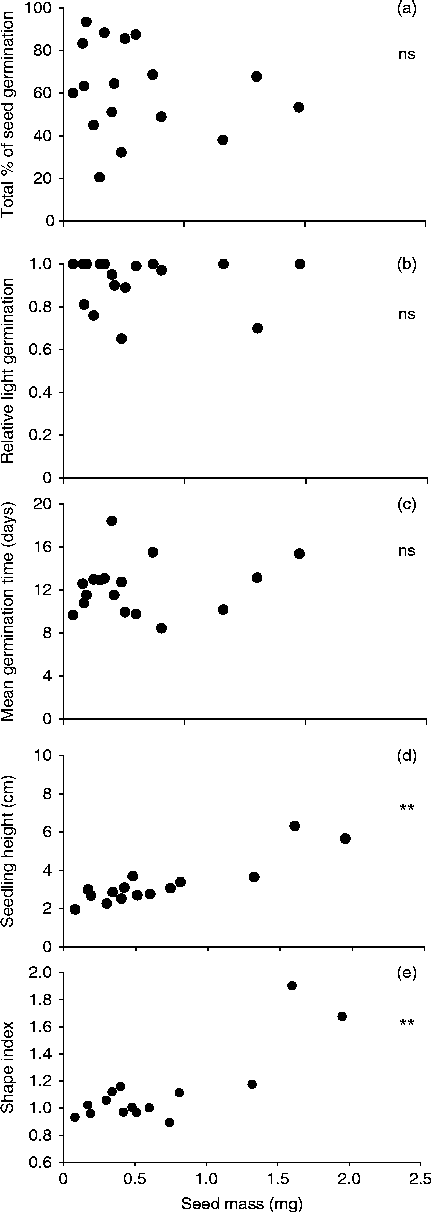
Seed mass ranged from 0.08 (G. mostii) to 1.95 mg (Harrisia pomanensis) (Table 1). Seed mass and final germination percentage were not significantly related under light conditions (r= − 0.17 ± 0.18, P ≥ 0.1; Fig. 1a). Seed mass and RLG were not related (r= − 0.05 ± 0.29, P ≥ 0.1; Fig. 1b). Only two species (Echinopsis aurea and Cereus hankeanus) were classified as light indifferent, with the remaining species being positively photoblastic (Table 1). Eight species did not germinate in the darkness, whereas in this treatment the maximum germination achieved was 28.89% in C. hankeanus (Table 1). Seed mass and MGT were not significantly related either (r= 0.17 ± 0.24, P ≥ 0.1; Fig. 1c). All species started to germinate before the fifth day of the experiment.
Relationships between seed mass and (a) total percentage of seed germination; (b) relative light germination (RLG); (c) mean germination time (MGT, days); (d) seedling height (mm); and (e) shape index in cacti species from central Argentina. **, P ≤ 0.001; ns, non-significant; Pearson correlations.

Seedling width, height and volume were positively related to seed mass, with height being the measure that best correlated with seed mass (r= 0.89 ± 0.10 P≤ 0.001; Fig. 1d). In addition, seedling shape was also related to seed mass (r= 0.83 ± 0.19 P ≤ 0.05; Fig. 1e). We found that 13 of the 15 species presented a shape index close to 1 (Fig. 1e), indicating that they are ‘globose’ seedlings. The other two species, C. hankeanus and H. pomanensis, presented values of 1.5 and 1.9, respectively, indicating that they are ‘columnar seedlings’. Interestingly, all globose species (as adults) presented globose seedlings, but not all columnar species presented columnar seedlings. Particularly, seedlings of Cleistocactus baumannii, Echinopsis leucantha and S. coryne were globose.
Discussion
For cactus species from central Argentina, seed mass was not related to the total germination percentage. These results are in agreement with some studies performed in different plant species from wetlands, dry grasslands and forests (e.g., Shipley and Parent, Reference Shipley and Parent1991; Morgan, Reference Morgan1998; Chen et al., Reference Chen, Peng, Zhang and Zhao2002; Sautu et al., Reference Sautu, Baskin, Baskin and Condit2006; Liu et al., Reference Liu, Yan, Li, Ma and Ling2007). However, other studies also conducted in those ecosystems showed a significant relationship (positive and/or negative) between seed mass and total germination (e.g. Milberg et al., Reference Milberg, Andersson and Thompson2000; Bu et al., Reference Bu, Chen, Xu, Liu, Wen and Du2007; Galíndez et al., Reference Galíndez, Ortega-Baes, Daws, Sühring, Scopel and Pritchard2009; Wang et al., Reference Wang, Baskin, Cui and Du2009). In agreement with the results found by Rojas Aréchiga et al. (Reference Rojas-Aréchiga, Mandujano and Golubov2012) in cactus species, our results suggest that total percentage of seed germination could be related to factors other than seed mass (Paz et al., Reference Paz, Mazer and Martinez-Ramos1999; Wang et al., Reference Wang, Baskin, Cui and Du2009).
We found no relationship between RLG and seed mass. Germination of almost all species was found to be light dependent, which is in agreement with previous studies in cactus species (Flores et al., Reference Flores, Jurado and Arredondo2006; Gurvich et al., Reference Gurvich, Funes, Giorgis and Demaio2008; Ortega-Baes et al., Reference Ortega-Baes, Aparicio González, Galíndez, del Fueyo, Sühring and Rojas-Aréchiga2010; Guerrero et al., Reference Guerrero, Alves-Burgos, Peña-Gómez and Bustamante2011; Rojas-Aréchiga et al., Reference Rojas-Aréchiga, Mandujano and Golubov2012). By contrast, Flores et al. (Reference Flores, Jurado, Chapa-Vargas, Ceroni-Stuva, Dávila-Aranda, Galíndez, Gurvich, León-Lobos, Ordóñez, Ortega-Baes, Ramírez-Bullón, Sandoval, Seal, Ullian and Pritchard2011) found a weak negative but significant relationship between seed mass and RLG; this difference may be due to the broader seed mass range used in that work (0.046–16 mg) than the range we used (0.087–1.958 mg).
MGT for all species ranged between 8.45 and 18.44 d; these values are similar to those reported for four taxa of the genus Arthrocereus (Cactaceae) from south-eastern Brazil (Cheib and García, Reference Cheib and García2012) and from previous studies in the present area (Gurvich et al., Reference Gurvich, Funes, Giorgis and Demaio2008). In addition, these values are common for plants, even among contrasting growth forms (Norden et al., Reference Norden, Daws, Antoine, Gonzalez, Garwood and Chave2009). Theoretical models predict that large-seeded species would germinate more rapidly than small ones. In this study seed mass was not related to MGT. All species germinated relatively quickly, independently of their mass, showing/suggesting that they do not have any type of dormancy, and that seed mass is not an important selection force that affects germination velocity.
Our results show that seed mass was only related to seedling size and shape. As expected, heavier-seeded species may produce bigger seedlings. This result is in accordance with previous studies that found a positive relationship between seed mass and seedling size for plants of other families (Leishman et al., Reference Leishman, Wright, Moles, Westoby and Fenner2000). A large seed mass may provide large seed reserves, which may guarantee large seedling size and high tolerance to any stress factors (e.g. drought, shade; Leishman et al., Reference Leishman, Wright, Moles, Westoby and Fenner2000; Bowers and Pierson, Reference Bowers and Pierson2001; Baraloto et al., Reference Baraloto, Forget and Goldberg2005). We found a positive relationship between seed mass and shape index. Heavy seeds produce ‘columnar seedlings’. In our study, all globose species presented globose seedlings, but not all columnar species presented columnar seedlings. Particularly, seedlings of E. leucantha, S. coryne and C. baumannii, all columnar species, have globose seedlings. Columnar seedlings would be better competitors for light, but globose seedlings would be more resistant to temperature variations due to their lower surface/volume ratio. To our knowledge, no study has analysed seed mass in relation to seedling shape.
In conclusion, theory suggests that seed mass is a key variable for predicting patterns of plant regeneration (Leishman et al., Reference Leishman, Wright, Moles, Westoby and Fenner2000; Daws et al., Reference Daws, Crabtree, Dalling, Mullins and Burslem2008). Apparently, this pattern is most evident at the species level (van Mölken et al., Reference van Mölken, Jorritsma-Wienk, van Hoek and de Kroon2005). In Cactaceae the available data do not allow us to establish a general pattern in the relationship between seed mass and germination characteristics. In addition, the germination response observed could be a species-specific trait independent of seed mass. On the other hand, our results suggest that seed mass would directly affect seedling establishment, which is a key demographic process in cacti (Bowers and Pierson, Reference Bowers and Pierson2001; Rojas-Sandoval and Meléndez-Ackerman, Reference Rojas-Sandoval and Meléndez-Ackerman2013). Our study also provides essential data about the regenerative biology of some species of this interesting plant group.
Acknowledgements
Jorgelina Brasca assisted with the English version of the manuscript. Comments of two anonymous referees greatly improved the quality of this work.
Financial support
This work was supported by grants from CONICET (PIP 1286 and 1458) and the Research Committee of the Cactus and Succulent Society of America. D.E.G., G.F. and A.F. are researchers at CONICET.
Conflicts of interest
None.