Implications
Information on the use of immunocastration in male lambs is limited, and thus results from this study contribute to the formulation of immunocastration vaccination protocols in lambs to enable its commercial application. Immunocastration using either a 4 or 6-week interval between second vaccination and slaughter is successful in decreasing testes size in pubertal ram lambs, without influencing their growth rate. Immunocastration is a suitable alternative to both physical castration and intact ram production to improve animal welfare during finishing.
Introduction
In lamb meat producing enterprises, physical castration is used to minimise the incidence of male behaviours (Pinckard et al., Reference Pinckard, Stellflug and Stormshak2000) while aiding in carcass fattening improvement of meat quality (Sales, Reference Sales2014). Physical castration of lambs is performed shortly after birth using an elastrator ring placed at the top of the scrotum (Baird and Wolfe, Reference Baird and Wolfe1998) while closed-crushing with an emasculator (Burdizzo) is the preferred method of castration in older rams (Melches et al., Reference Melches, Mellema, Doherr, Wechsler and Steiner2007). However, negative effects of these two methods include infection and chronic pain when rubber rings are used, and high levels of acute stress when the Burdizzo technique is used (Melches et al., Reference Melches, Mellema, Doherr, Wechsler and Steiner2007). Furthermore, the efficacy rate of the Burdizzo castration technique is questionable (Hosie et al., Reference Hosie, Carruthers and Shepard1992). According to Melches et al. (Reference Melches, Mellema, Doherr, Wechsler and Steiner2007), anaesthesia and analgesics do not fully eliminate the pain response to castration, and thus methods for improving the welfare of castrated male lambs are required, such as immunocastration.
Effective immunocastration relies on the administration of at least two doses of the vaccine which contains gonadotropin-releasing hormone (GnRH) conjugated to a foreign protein. Immunocastration is successful in suppressing testosterone production and testis growth using intervals of two, three and four weeks between first and second immunocastration vaccination doses in Dohne Merino lambs, without negatively influencing growth and slaughter performance (Needham et al., Reference Needham, Lambrechts and Hoffman2016; Needham et al., Reference Needham, Lambrechts and Hoffman2019). Despite the flexibility of the inter-vaccination period, extending the interval between second vaccination and slaughter may have a greater effect on the performance of immunocastrated lambs.
Further research is required into the behaviour of immunocastrated ram lambs as previous studies have focussed predominantly on sexual behaviours (Kiyma et al., Reference Kiyma, Adams, Hess, Riley, Murdoch and Moss2000; Parthasarathy et al., Reference Parthasarathy, Price, Orihuela, Dally and Adams2002) and not the time budget of normal behaviours compared with pain or stress behaviours. To the best of our knowledge, no study has yet compared the performance, together with stress and pain responses, of immunocastration in male lambs with closed-crushing or Burdizzo castration to date. Thus, this study aimed to quantify the growth, testis development and stress responses of lambs to both immunocastration and Burdizzo-castration, the null hypothesis being that extending the slaughter interval of immunocastrates is ineffective in continued testis development suppression and does not affect growth in post-weaning castrated ram lambs.
Materials and methods
The study was conducted at the Welgevallen Sheep Research Section of Stellenbosch University within the coastal Western Cape Province of South Africa, which is characterised by a Mediterranean climate. The study was performed from late winter (daylength ~10 to 11 h) to early spring (daylength ~11 to 13 h) with a typical average daytime temperature of 18°C during this period. The total duration of the study was 57 days.
Animals, feeding and experimental design
A total of 40 Dohne Merino (dual-purpose; medium maturity type) ram lambs (~6.5 months of age) were stratified into four weight groups according to initial weight and then randomly allocated to one of four treatment groups, with 10 animals per treatment group. The mean (±SD) initial weights for the treatments were 45.6±3.78 kg for ICS6, 45.9±4.42 kg for ICS4, 44.0±3.11 kg for B and 45.9±3.48 kg for R. Treatments included a group of immunocastrated lambs, receiving their second vaccination 4 weeks before slaughter (ICS4); a second group of lambs receiving their second immunocastration vaccination 6 weeks before slaughter (ICS6); a Burdizzo-castrated group (B) and an intact male/ram group (R, control). The lambs grazed as a single flock on kikuyu pasture during the day (ad libitum) and had ad libitum access to water, for 57 days. From 16:00 to 8:00 hours daily, the lambs were housed indoors as a single flock on wooden slatted floors to avoid livestock theft, with lucerne (ad libitum) and a commercial grower maize/soybean meal-based feed provided at 500 g per lamb per day (Supplementary Table S1). Feed intake and conversion efficiency was not determined but live weight was monitored weekly. Animals were only separated into treatment groups during the behavioural observation periods.
Immunocastration vaccination and physical castration protocols
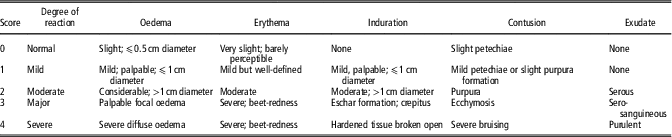
Immunocastration was performed using two doses (2 ml each) of a vaccine containing a synthetic GnRH analogue conjugated to a carrier protein (diphtheria toxoid) in a diethylaminoethyl-dextranthiomersal adjuvant (Improvac®; Reg. no. G3643, Act 36/1947; Zoetis Animal Health, Sandton, South Africa) per ram (Table 1). The ICS6 lambs were vaccinated on day 1 (D1) and D15 of the trial, while the ICS4 lambs were injected on D15 and D29. Before vaccine administration, a 10×10 cm area on each shoulder blade was trimmed free of wool to allow for the scoring of any injection site reactions and this area of skin was disinfected (70% ethanol) before injection. Each 2 ml vaccine dose was administered in 0.5 ml ‘sub-doses’ at one of the four corners of the wool-free square to ensure dispersal of the vaccine. The primary vaccination was given on the left shoulder and the secondary vaccination on the right shoulder using a sterile disposable 1.27 cm 20-gauge needle per animal. Intact controls received no placebo vaccination. The injection site reaction of only the immunocastrates was scored following the schedule in Table 1 and according to parameters specified in Table 2. The baseline values of these parameters were measured on D1 for ICS6, and D15 for ICS4.
The timeline of activities throughout the growth trial of immunocastrated, Burdizzo-castrated and intact Dohne Merino lambs. The day of immunocastration vaccination, timing of Burdizzo castration are indicated as well as the subsequent measurements of reactions, temperatures, BW and blood collection

XB = baseline values for parameters.
C = control rams also sampled for this parameter at the specified time points.
* Measurements performed on all treatment groups, including controls.
1 ICS6 = lambs receiving second vaccination 6 weeks before slaughter.
2 ICS4 = lambs receiving second vaccination 4 weeks before slaughter.
The immunocastration injection site scoring system used to describe the reaction to vaccination after primary and secondary injection administration in Dohne Merino ram lambs

The physical castration treatment group were castrated using closed-crushing on D2 of the trial. The non-steroidal anti-inflammatory drug Metacam® has been successful in reducing abnormal behaviours in knife-castrated lambs at 7 to 10 weeks of age (Small et al., Reference Small, Belson, Holm and Colditz2014) and thus, before castration, each lamb was injected with Metacam® (20 mg Meloxicam/ml) at a dose of 0.25 ml per kg body weight. Lambs were placed in a recumbent position and a Burdizzo clamp was applied to each scrotal neck for 30 s, with the second application approximately 0.5 cm below the first application. The scrotal area was then sprayed with Necrospray (Bayer© Animal Health) and SuponaTM (ZoetisTM Animal Health). During the Burdizzo castration procedure, the immediate reaction of each lamb was categorised as: no response (score = 0), moderate response with wriggling (score = 1) or severe response with kicking, struggling and vocalisation (score = 2). Subsequently, three doses of Metacam® were administered to the Burdizzo-castrated group at three-day intervals.
Assessment of bodyweight, temperature and scrotal circumference for all lambs
All lambs were weighed weekly using a livestock scale (Model SI2963, Scales Incorporated, South Africa, accurate to 200 g). On the days specified in Table 1, maximum scrotal circumference was measured using a flexible tape measure around the widest axis of both testes. Scrotal surface temperature was determined by parting the wool of the left testis and placing the infrared thermometer (Alla France, accuracy: ±2%) flush with the skin. The skin surface temperature of the injection site was measured on the bare shoulder area and rectal temperature was measured using a veterinary thermometer (Kruuse, Denmark, range: 32°C to 44°C, accuracy: ±0.10°C).
Recording of pain behavioural responses
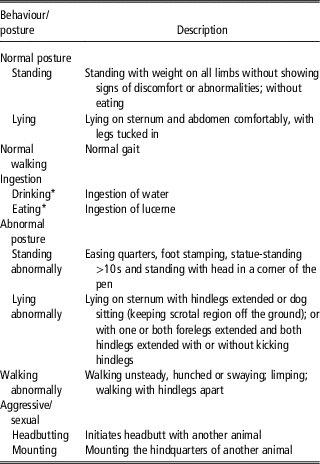
After the routine scrotal measurements, the Burdizzo-castrated lambs were assessed for their pain responses to testes palpation, avoiding the tissue area to which the clamp was applied (Table 1). Responses to palpation were scored as either: no response (score = 0), moderate response of wincing and wriggling (score = 1) or severe response of struggling and attempting to escape (score = 2). A walking score was given to all the animals to assess pain in the forequarter from the immunocastration injection and in the hindquarter from Burdizzo-castration, according to the schedule in Table 1. Lambs were categorised into normal walking gait (score = 0), slight stiffness in gait (score = 1), clear limp or compensation (score = 2) or reluctant to place any weight on limb(s) (score = 3).
Behavioural recordings were made on the day of Burdizzo castration, where the lambs were separated into their respective treatment groups and placed into one of four, square pens (20 m2 each) and observed for 10 min every hour, for 5 h (11:00 to 16:00 hours) to establish the short-term behavioural response. Lucerne and water were available ad libitum throughout the observation periods. Animals were also separated into groups for one 10-min observation period on D3, D5 and D8 at 11:00 hour for the first week of the trial (medium-term behavioural response), followed by weekly measurement (long-term behavioural responses; Table 1). Observations were recorded from outside of the pens, without disturbing the activities of the lambs. The behavioural recordings were performed using a modified version of the ethogram which Melches et al. (Reference Melches, Mellema, Doherr, Wechsler and Steiner2007) used to assess pain responses of three physical castration techniques (Table 3). During the 10-min period, a group-scan technique was followed where the number of animals exhibiting a certain posture per treatment was recorded every 2 min. The number of occurrences of a certain behaviour/posture within each 10-min observation period was totalled and expressed as a percentage of the total behavioural parameters recorded within that group for the session to establish the time activity budget of that behaviour/posture. The intact ram group was used as a control to which the postures of the castrated treatments were compared, as done by Molony et al. (Reference Molony, Kent and McKendrick2002).
Description of the various behavioural/postural observations recorded during the 57-day growth trial of immunocastrated, Burdizzo-castrated and intact Dohne Merino ram lambs, as adapted from Melches et al. (Reference Melches, Mellema, Doherr, Wechsler and Steiner2007). Each behaviour/posture index has been defined for the specific activity that was assessed and counted

* Standing normally or abnormally while eating or drinking was not recorded separately.
Blood collection and determination of serum cortisol concentrations
Blood samples were collected more frequently after vaccination and physical castration, followed thereafter by weekly sampling (Table 1) during the trial period from late winter (daylength 10 to 11 h) to early spring (daylength 11 to 13 h). The ICS6 animals were sampled on D1 (before primary vaccination), 3, 5, 8, 15 (before secondary vaccination), 17, 19, 22, 29, 36, 43, 50; ICS4 on D1, 8, 15 (before primary vaccination), 17, 19, 22, 29 (before secondary vaccination), 31, 33, 36, 43, 50; B on D1 (day before castration), 3, 5, 8, 15, 29, 36, 43, 50; and R on D1, 3, 5, 8, 15, 17, 19, 22, 29, 31, 33, 36, 43, 50 (Table 1). These time points were chosen to coincide with the application of the various treatments (castration or injection) to monitor the serum cortisol levels more closely after a procedure. Blood sampling was performed strictly before any other measurement at 9:00 hour, from the jugular vein into 6 ml Z Serum Clot Activator Vacuettes®. As half of the lambs per treatment (n = 5) were used to collect semen samples for a separate study that formed Part II of this manuscript series, they were omitted from serum cortisol determination. Baseline serum cortisol concentrations were determined for ICS6 and B on D1 of the trial, as this blood withdrawal was the first activity to be performed with the lambs. All ICS6 lambs received their primary vaccination within approximately 1 h after this initial baseline blood sampling, while the B animals were castrated the following day. The ICS4 lambs received their first vaccination on D15 and thus their subsequent cortisol concentrations were compared to the blood sample taken that morning, before any other measurement on the lambs. Serum cortisol extraction was achieved using the liquid-liquid extraction protocol described in detail within Supplementary Material S1. Further details regarding accuracy, precision, limits of detection and quantification of the methodology used may be found within Quanson et al. (Reference Quanson, Stander, Pretorius, Jenkinson, Taylor and Storbeck2016). Analyses of the extracted serum samples was performed with ultra-performance convergence chromatography tandem mass spectrometry (UPC2-MS/MS) using an Acquity UPC2 system fitted with an Acquity UPC2 BEH 2-EP (3 × 100 mm; 1.7 µm) column (Waters Corporation, USA) as described by Quanson et al. (Reference Quanson, Stander, Pretorius, Jenkinson, Taylor and Storbeck2016). The internal standard used was cortisol-9, 11, 12, 12-d4 at 15 ng per sample and a standard curve was established using cortisol-9, 11, 12, 12-d4 (y = 0.0414x + 0.0154) with an R 2 of 0.9997. All samples were run within one continuous batch.
Statistical analysis
The data were analysed using STATISTICA 13 (StatSoft Inc.). Normality of residuals and homogeneity of variances was ensured before further analysis. The continuous data collected over time (BW, temperatures, scrotal circumference and serum cortisol concentrations) were assessed using the variance estimation, precision and comparison (VEPAC) procedure following a mixed-model repeated-measure ANOVA approach. Within the model, Animal, Treatment and Day were used as grouping variables and specified further into fixed (Treatment, Day and the interaction effect of Treatment × Day) and random effects (Animal nested in Treatment). Fisher’s LSD was the chosen post-hoc test to compare treatment means and significant differences are reported at 5% and less. Owing to the high number of ‘0’ or ‘normal’ recordings for walking, injection site and palpation scores over the study period, statistical analyses were not performed for these parameters. Furthermore, the behavioural recordings were performed per pen (n = 1) and thus only descriptive statistics were used to describe the preliminary effects of castration on the short-term, medium-term and long-term postures. Little change was seen over the 5-h collection time for the short-term period, and thus observations were pooled and compared to the medium- and long-term periods.
Results
Bodyweight, scrotal circumference and testis temperature
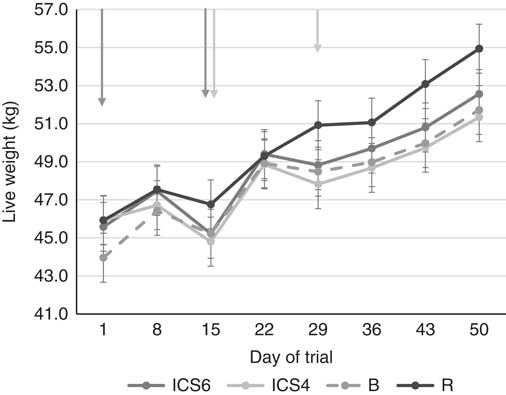
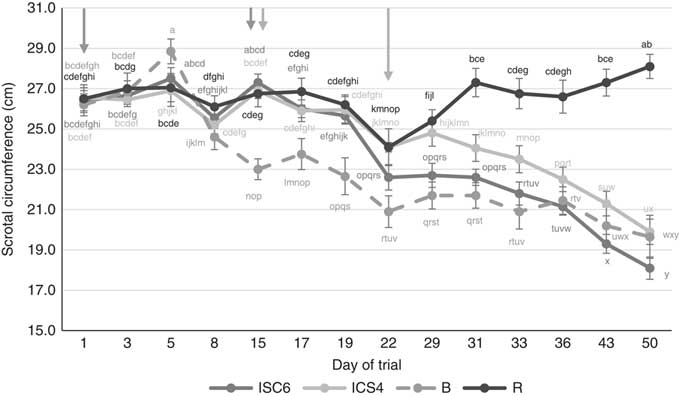
No treatment differences were observed for live weight over the trial period (Figure 1) and treatments reached an average slaughter live weight of 52.6±4.73 kg. The mean calculated average daily gains (ADGs) (±SD) for the treatments over the entire study were 514±61.5 g/day for ICS6, 636±76.1 g/day for ICS4, 495±59.3 g/day for B and 551±65.9 g/day for R lambs. No differences were seen for scrotal circumference between treatments until D5 (Figure 2). The Burdizzo-castrated lambs had larger scrotal circumferences compared to ICS4 lambs (P⩽0.05) and R lambs (P⩽0.05), due to swelling after the castration procedure which occurred on D2. By D15, the swelling had subsided, and B lambs had smaller scrotal circumferences than all other treatments until D22. The scrotal swelling in B lambs did not increase the scrotal surface temperature compared with the other treatments and thus no treatment differences were seen for scrotal surface temperature over the trial period (28.0±2.50°C; Supplementary Figure S1).
Live weights (kg) for Dohne Merino ram lambs immunocastrated with either a six (ICS6; n = 10) or four-week (ICS4; n = 10) interval between second vaccination administration and slaughter in comparison to both physically castrated (B; n = 10) or intact (R; n = 10) lambs. Arrows indicate primary and secondary vaccinations. Error bars indicate SEM.

Scrotal circumference of lambs Burdizzo-castrated on day 2 (B; n = 10) and intact rams (R; n = 10) compared with lambs immunocastrated with either six (ICS6; n = 10) or four (ICS4; n = 10) weeks intervals between second vaccination and slaughter. Vaccination administration is indicated by arrows. Vertical bars denote SEM. Means with different superscripts indicate significant differences both within and between treatments (P⩽0.05).

The scrotal circumference of ICS6 decreased (P⩽0.001) from D5 to D8, one week after primary vaccination (Figure 2). However, the scrotal circumference of ICS6 lambs did not decrease further until after the second vaccination. Within a week after the second vaccination, ICS6 had decreased (P⩽0.001) scrotal circumferences (D22). From D29, ICS6 lambs had scrotal circumferences equivalent to B lambs and smaller than both ICS4 (P⩽0.05) and R (P⩽0.01) lambs. Similarly, from D22 ICS4 lambs experienced a decrease (P⩽0.01) in scrotal circumference within a week after primary vaccination. The ICS4 lambs had scrotal circumferences significantly smaller than R from D31 (P⩽0.001), within the week after secondary vaccination. The scrotal circumference of ICS4 lambs continued to decrease until all castration treatments no longer differ from one another at D36.
Reaction to immunocastration vaccination
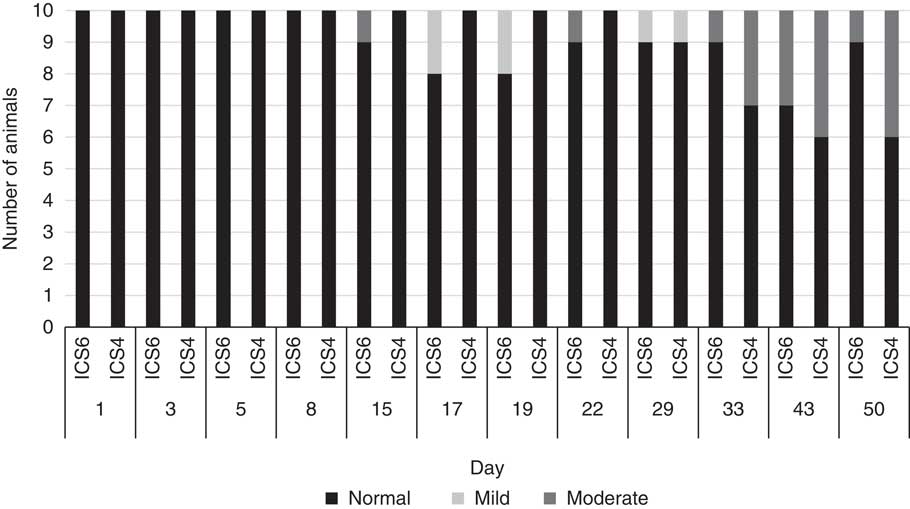
The primary vaccinations for both ICS4 and ICS6 lambs elicited normal injection site reactions with no influence on the walking score for the first week after injection (Figure 3). However, 2 weeks after primary vaccination, one ICS4 and two ICS6 lambs had hardening of the tissue (induration) at the injection site (score = 2). Two days after the secondary vaccination of ICS6 lambs, two lambs had mild reactions to the vaccine with slight bruising or contusion (score = 1) and three ICS6 animals showed stiffness in their gait (score = 1). Four days after secondary vaccination, the mild injection site reaction recorded on D3 showed tissue hardening. One animal from the ICS6 group had tissue hardening at the injection site for the duration of the growth period, with some tissue hardening in other animals occurring later in the trial.
The number of Dohne Merino ram lambs per immunocastration treatment (n = 10) which had normal, mild or moderate reactions to the vaccination. Major and severe scores have been omitted as no animals exhibited either of these degrees of reactions throughout the trial. Vaccination administration occurred on day 1 and day 15 for lambs vaccinated with a pre-slaughter interval of 6 weeks (ICS6) and day 15 and day 29 for lambs vaccinated with a pre-slaughter interval of 4 weeks (ICS4).

Two days after the second vaccination for ICS4 lambs, one lamb had bruising (score = 1) and one had tissue hardening (score = 2). At 4 days after the booster, the number of animals with hardened tissue at the injection site increased to three and then to four animals in the following week. These four animals had tissue hardening for the duration of the study, as also noted for the ICS6 treatment. However, the hardening tissue did not crack or pull away from the underlying skin for the duration of the trial and no infections occurred. None of the ICS4 lambs showed any stiffness or soreness in their walking gaits.
The injection site surface temperature fluctuated over time for all the treatments (Supplementary Figure S1); however, little difference was seen between treatments (29.4±2.22°C). The injection site temperature of ICS6 lambs remained stable and lower than that of the other treatments on D1 (29.0±0.83°C; P⩽0.05) and D5 (27.9±1.38°C; P⩽0.001). Following the second vaccination for ICS6 lambs and first vaccination for ICS4 lambs, both immunocastrated treatments had elevated injection site surface temperatures on D17 (ICS6: 33.1±0.84°C; ICS4: 32.9±0.37°C; P⩽0.001) but no differences were seen for rectal temperatures over the trial period (39.3±0.37°C; Supplementary Figure S1). On average, skin surface temperature on the clean sheared shoulder site was 10°C lower than rectal temperature throughout the trial.
Reaction to physical castration
Only one Burdizzo-castrated lamb had a moderate reaction (score = 1) during the castration while the remaining nine lambs did not show any reaction. Palpation of the testes and walking score on day 1 showed no response/abnormalities for baseline values before castration. On the day following the castration procedure (D3), five of the castrated lambs showed no reaction to palpation, four showed a moderate response and one lamb showed a severe response. On D3, seven of B lambs walked with stiffness in gait (score = 1) and three had a normal walking gait. The same frequency of palpation responses was recorded on D5 but eight of lambs were walking stiffly, thus decreasing the number of B lambs with a normal walking score to two. The number of non-reactions to palpation increased to seven on D8 of the trial, with three lambs still showing a moderate response. On D8, seven lambs were walking normally with only three still walking stiffly on their hindlegs. Two weeks after castration (D15), all B lambs showed no response to palpation and had a normal walking gait, which persisted throughout the rest of the trial.
Serum cortisol concentrations and behavioural responses to castration method
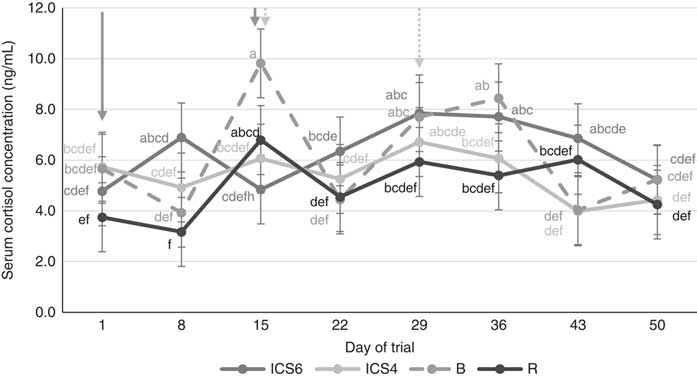
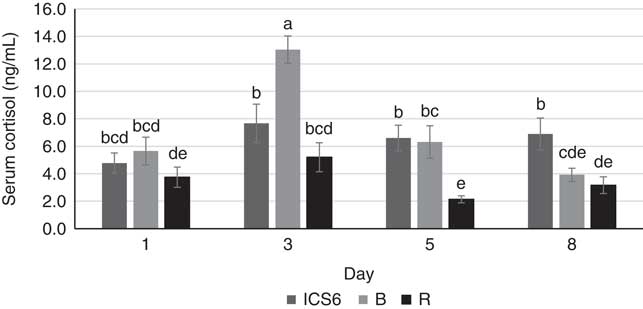
Weekly serum cortisol concentrations [CORT] did not change significantly over the study period for ICS4 and ICS6 lambs (Figure 4), as well as that of the R lambs which showed only one increase in [CORT] from D8 to D15. However, the B lambs had fluctuating [CORT], increasing from D8 to D15 (P⩽0.001), then decreasing from D15 to D22 (P⩽0.001), increasing again from D22 to D29 (P⩽0.05) and finally decreasing from D36 to D43 (P⩽0.01). When the more frequent blood collection period is evaluated from first injection from D1 to D8 (Figure 5), no differences were seen within the ICS6 treatment; however, ICS6 had greater [CORT] than R on D5 (P⩽0.001) and D8 (P⩽0.01). This difference is mostly attributed to the drop in [CORT] experienced by R from D3 to D5 (P⩽0.05). The B lambs had increased [CORT] from D1 to D3 (P⩽0.001), followed by a decrease from D3 to D5 (P⩽0.001), but were only higher than R lambs on D3 (P⩽0.001) and D5 (P⩽0.01). The B lambs had higher [CORT] than ICS6 on D3 (P⩽0.01), and D8 (P⩽0.02). No differences were seen within and between the treatments measured from D15 to D22 (5.5±2.51 ng/ml) and D29 to D36 (6.6±2.73 ng/ml) for [CORT], and thus no figure has been included.
Serum cortisol concentrations (ng/ml) for immunocastrated (IC), Burdizzo-castrated (B; n = 5) and intact Dohne Merino rams (R; n = 5). Arrows indicate the primary and secondary vaccinations for respective treatments. Secondary vaccination intervals include six (ICS6; n = 5) or four (ICS4; n = 5) weeks before slaughter. Vertical bars denote SEM and means with different superscripts indicate significant differences both within and between treatments (P⩽0.05).

The average (±SE) serum cortisol concentrations (ng/ml) of Dohne Merino lambs for the blood sampling periods from day 1 to day 8 for lambs immunocastrated on day 1 and day 15 (ICS6; n = 5), lambs Burdizzo-castrated on day 2 (B; n = 5) and intact rams (R; n = 5). Letters indicate significant differences between means between and within treatments at a significance level of 5%.

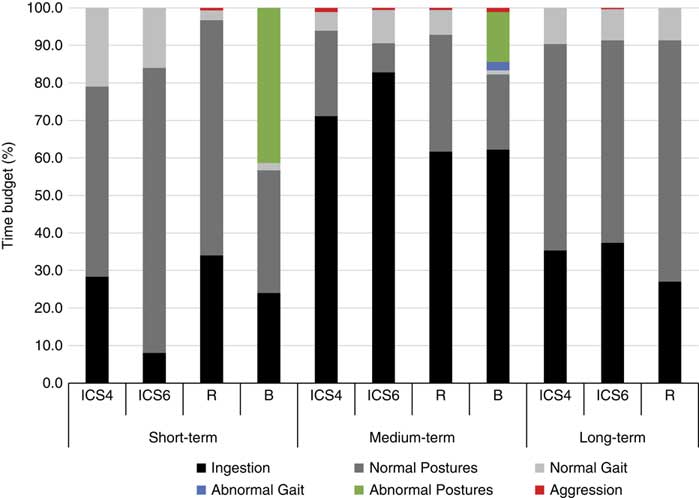
The increase in [CORT] of B lambs coincided with greater percentage of time spent in abnormal postures and less time spent in normal postures during the short-term behavioural assessment (Figure 6). Compared with other treatments, the ICS6 lambs spent less time eating/drinking and more time standing/lying. The ingestive behaviour of all treatments increased from the short- to medium-term periods, resulting in less standing/lying behaviour. The B lambs showed less abnormal postures and were more mobile, but their gait was considered abnormal, in the medium-term compared with the long-term. Over the long-term period, the B animals showed no abnormal postures or gaits and the treatments displayed similar time budgets for ingestion, standing/lying and walking. Minimal aggression was displayed.
Frequency of behaviours and postures observed for lambs immunocastrated at four (ICS4) or six (ICS6) weeks before slaughter, Burdizzo-castrated (B) and intact rams (R) over the short- (day of physical castration; day 2), medium- (first week of study) and long-term (weekly for 8 weeks).

Discussion
Although meta-analysis has indicated that physical castration generally decreases feed efficiency and ADG of ram lambs (Sales, Reference Sales2014), no differences have been found between the growth of lambs castrated lambs and intact rams up to 21 days after the procedure when local anaesthesia is used, despite the use of various castration techniques (surgical, Burdizzo and elastrator ring; Melches et al., Reference Melches, Mellema, Doherr, Wechsler and Steiner2007). As reported by Melches et al. (Reference Melches, Mellema, Doherr, Wechsler and Steiner2007), the lack of differences in growth rate between physically castrated lambs and intact rams in the current study was likely influenced by using pain mitigation. However, the effect of immunocastration on lamb growth rate varies. Ülker et al. (Reference Ülker, Gökdal, Aygüna, Karakus, de Avila and Reeves2003) reported that lambs vaccinated at 10, 14 and 22 weeks of age showed similar rates of gains to physically castrated lambs, with decreased feed efficiency and growth compared to intact rams, slaughtered at approximately 36 weeks of age. However, Ülker et al. (Reference Ülker, Gökdal, Temur, Budağ, Oto, de Avila and Reeves2002) observed no differences in the growth of 18 and 26 weeks old vaccinated Karakas lambs compared with intact rams, also slaughtered at 36 weeks of age. Thus, the age of the lamb at immunocastration and the timing of the vaccination schedule relative to slaughter age may influence the effects on growth rate. However, when shorter varied inter-vaccination periods were investigated in 5.5-month-old Dohne Merino lambs, no differences were reported for growth rates between intact rams and immunocastrated lambs (Needham et al., Reference Needham, Lambrechts and Hoffman2016). Similarly, no growth differences were reported between immunocastrated, physically castrated and intact male lambs for growth rate in the current study, where shorter variations in the second vaccination-to-slaughter periods were investigated. Although the timing of immunocastration relative to lamb age appears to have an influence on their growth rates, the level of nutrition may also influence the sexual differentiation for growth rates and while this has been investigated in pigs (Boler et al., Reference Boler, Kutzler, Meeuwse, King, Campion, McKeith and Killefer2011; Needham et al., Reference Needham, Hoffman and Gous2017), it should be considered in future lamb studies.
Within the present study, administration of the primary vaccination decreased scrotal circumference within a week for both vaccination schedules; however, a further decrease in scrotal size was only realised after second vaccination for both immunocastration treatments, which was similarly noted by Needham et al. (Reference Needham, Lambrechts and Hoffman2016). Thus, immunocastration appears to be effective in suppressing testis growth; however, the effects on androgen production and spermatogenesis needs to be evaluated throughout the growth period to ascertain when the decrease in testis size begins to influence semen quality and sperm parameters.
Minimal adverse reactions were seen within the current study in response to the immunocastration vaccination method, with reactions observed being largely localised tissue hardening, occurring 2 weeks after the primary vaccination but within a week after secondary vaccination. The faster appearance of changes in the tissue surrounding the injection site after second vaccination is likely due to the stronger secondary immune response elicited by the booster vaccination. Hardening of the tissue at the injection site was not unexpected, as this may be a consequence of using an oil-based adjuvant such as the diethylaminoethyl-dextran within the immunocastration vaccine used. The distribution of the immunocastration vaccine over four sites on the shoulder resulted in a decreased incidence of adverse reactions compared with the results reported by Needham et al. (Reference Needham, Lambrechts and Hoffman2016) who injected a single dose into the bare area behind the foreleg. The improvement of the reaction to the vaccine within this study is a result of choosing an injection site free from skin folds where no friction can occur post-administration and little contact would be made between the injection site and the ground when lying down. No swelling occurred at the injection sites and thus no change in skin surface temperature was observed, compared with control rams, and thus the fluctuations for recorded skin surface temperature is likely a result of ambient influences. Despite the possibility of raised body temperatures in lambs after immunization or during wound-healing, the rectal temperature remained stable within the present study.
When the [CORT] is compared within immunocastration treatments with their respective baseline values within the present study, the two vaccination schedules showed no effect on weekly [CORT], nor the [CORT] measured during the more frequent sampling after vaccinations, and thus the mild-to-moderate reaction recorded appears to have minimal effect on physiological stress of the castrated lambs. Therefore, it is not unexpected that vaccination did not affect walking gait or basic behaviour/postures. The effect of immunocastration on physical activity has been investigated in pubertal bulls, showing decreased physical activity in immunised bulls after the second vaccination (Janett et al., Reference Janett, Gerig, Tschuor, Amatayakul-Chantler, Walker, Howard, Bollwein and Thun2012). However, the basic descriptive data showed little difference in the time activity budget for various postures and behaviours of the castration treatments over the long-term period for the current study. For future research building upon the basic description of pain behaviour/postures of immunocastrates, a study with a larger sample size of group-housed immunocastrated lambs should evaluate the social behaviour of these animals. Such behaviours should encompass both aggressive interactions and affiliative interactions, as used to assess behaviours of individual lambs by Teixeira et al. (Reference Teixeira, Miranda-de la Lama, Villarroel, Garcia-Belenguer, Sañudo and Maria2012).
Burdizzo-castrated lambs in the current study showed greater fluctuation in [CORT] over the trial period, with raised concentrations the day after, and two weeks after, the procedure was performed, compared to their baseline measurement. These lambs thus also showed discomfort to testes palpation and during walking on the day after castration, which agrees with Melches et al. (Reference Melches, Mellema, Doherr, Wechsler and Steiner2007) who reported a high incidence of moderate responses to palpation in Burdizzo-castrated lambs despite the use of anaesthesia. Basic description of the pain behaviours and postures of Burdizzo-lambs within the present study on the day of castration showed that just over 40% of their time activity budget was spent in abnormal postures (predominantly abnormal standing), which could negatively influence their performance in an extensive environment that relies on mobility to reach food and water or to remain with their mothers if they are castrated before weaning. Although Melches et al. (Reference Melches, Mellema, Doherr, Wechsler and Steiner2007) reported no differences in the time activity budget of Burdizzo-castrated lambs compared with intact lambs for abnormal postures on the day of castration, they did spend less time eating than intact controls.
The results from the current study indicated raised [CORT] for up to 24 h after the Burdizzo-castration procedure, which contrasts to the results obtained by Melches et al. (Reference Melches, Mellema, Doherr, Wechsler and Steiner2007), who found that Burdizzo-castrated lambs reach baseline serum [CORT] within 6 h after the procedure when lidocaine or bupivacaine anaesthesia was used. Despite this drop in [CORT], these Burdizzo-castrated lambs still showed painful responses to palpation for a mean of 1.3±1.0 days (Melches et al., Reference Melches, Mellema, Doherr, Wechsler and Steiner2007). Within the present study, walking discomfort increased within two days post-castration and so did scrotal circumference, indicating scrotal swelling but no changes in scrotal surface temperature (28.0±2.50°C). Two weeks since the castration procedure used in the present study, testes palpation and walking pain scores indicated that the lambs had healed and recovered; however, it would be expected that without the continued use of pain mitigation, incidences of discomfort and abnormal behaviour may have been greater. Despite the visual assessment of healing in these lambs, [CORT] continued to fluctuate after the scrotal swelling had subsided, possibly indicating physiological stress caused by tissue damage. Furthermore, scrotal tissue hardening and wool-loss on the testes were seen in some of the Burdizzo-castrated animals throughout the study and thus tissue histology needed to be investigated and was done so within the second part of this manuscript series, along with analysis of serum androgen concentrations and changes in semen quality.
Conclusion
Pain and discomfort are evident in Burdizzo-castrated lambs, despite the extended use of pain mitigation, resulting in abnormal postures after the procedure and fluctuating serum cortisol levels indicating physiological stress. Although pain mitigation may have improved the growth performance of Burdizzo-castrated lambs, it is highly unlikely that farmers would consider handling their lambs as intensively for its administration. Immunocastration improved the welfare of castrated lambs as indicated by baseline serum cortisol concentrations and no exhibition of pain behaviours. Although vaccinating subcutaneously in the shoulder area minimised reactions at the injection site, further investigation into an easy and safe injection system that ensures good hygiene practices when immunocastration is carried out on a commercial scale is warranted. Extending the immunocastration vaccination interval between second vaccination and slaughter does not influence BW gain and is effective in disrupting testis growth, and thus this flexible vaccination schedule offers an alternative approach to physical castration, resulting in the improved welfare of castrated lambs, which may be realised in carcass characteristics.
Acknowledgements
The authors acknowledge the Meat Industry Trust and Supporting the Development of International Mobility of Research Staff at CULS Prague (CZ.02.2.69/0.0/0.0/16_027/0008366) for their financial support, Prof Martin Kidd for assistance with the statistical analyses, Jonathan Quanson, Prof Karl Storbeck and Dr Marietjie Stander for their assistance with the laboratory analyses. This research is supported by the South African Research Chairs Initiative (SARChI) and funded by the South African Department of Science and Technology (UID: 84633), as administered by the National Research Foundation (NRF) of South Africa. The financial assistance of the NRF towards this research is hereby acknowledged. Opinions expressed, and conclusions arrived at, are those of the authors and are not necessarily to be attributed to the NRF.
Declaration of interest
Permission to publish the results from this study was obtained from ZoetisTM. The opinions and conclusions regarding this extra-label use of Improvac® are those of the authors and not necessarily attributed to the manufacturer.
Ethics statement
Ethical clearance was obtained from the Research Ethics Committee: Animal Care and Use of Stellenbosch University (SU-ACUD15-00073). Animal husbandry was in accordance with the specifications of the South African National Standards 10386: 2008.
Software and data repository resources
None.
Supplementary materials
To view supplementary material for this article, please visit https://doi.org/10.1017/S1751731118003592