Research investigating the development of sentence processing in children has shown that, although children's and adults' language processing systems are largely qualitatively similar, interesting and theoretically important developmental differences exist. In particular, a body of research suggests that while young children use local cues such as lexical biases for sentence interpretation, they do not appear to incorporate more diffuse cues such as referential scene information into their parse, and they experience difficulty revising initial syntactic analyses.
Trueswell, Sekerina, Hill & Logrip (Reference Trueswell, Sekerina, Hill and Logrip1999) presented five-year-old children and adults with sentences like (1), which contain temporary ambiguity of prepositional phrase (PP) attachment.
(1) Put the frog on the napkin in the box.
The first PP, on the napkin, is temporarily ambiguous between a destination interpretation and a noun modifier interpretation, and is only disambiguated by the sentence final PP in the box. Participants were asked to act out the test sentences using toy props, and their eye-movements to the toys were recorded as they heard the sentence. The referential scene was manipulated. A 2-referent scene contained two frogs, thus providing the appropriate referential conditions to process on the napkin as a restrictive noun modifier. A 1-referent scene contained only one frog, which should lead participants to interpret the temporarily ambiguous as a destination, leading to a garden path effect. The pattern of eye-movements showed that both the adults and the children were garden-pathed by the 1-referent context. In the 2-referent context the adults used the presence of two frogs to create a contrast set for which on the napkin had a restrictive function, and so were not garden-pathed. The children did not use the referential context to process the test sentences; they were garden-pathed equally in the 1-referent and 2-referent conditions.
Trueswell et al. (Reference Trueswell, Sekerina, Hill and Logrip1999) argued that a constraint satisfaction approach to parsing could explain their results (e.g. MacDonald, Pearlmutter & Seidenberg, Reference MacDonald, Pearlmutter and Seidenberg1994; Trueswell & Tanenhaus, Reference Trueswell, Tannenhaus, Clifton, Frazier and Rayner1994), since the sole verb they used in the study, put, always occurs with an NP argument encoding a destination. Therefore, children could be computing upcoming structure on the basis of the statistical information encoded on the verb. However, this is not the only possible interpretation of the data: children's parsing decisions could be argued to be guided by the structurally based processing heuristic Minimal Attachment (MA), a component of the Garden Path model (Frazier, Reference Frazier and Coltheart1987), which predicts that the ambiguous PP is attached to the VP during an initial structural analysis that is blind to semantic content. Either way, the results suggested that once the children had committed to an initial analysis they could not revise it, despite the fact that the second PP (in the box) should provide a strong cue to the need for revision.
Snedeker & Trueswell (Reference Snedeker and Trueswell2004) investigated the role of lexical and referential cues to interpretation by presenting adults and children with structurally simpler, yet fully ambiguous V-NP-with-NP sentences in three verb bias conditions, as in (2)–(4).
(2) Tickle the pig with the fan. (instrument bias)
(3) Feel the frog with the feather. (equi bias)
(4) Choose the cow with the stick. (modifier bias)
The verb biases were derived from a sentence completion experiment. Participants were once again presented with referential scenes where there were either one or two tokens of the object NP (i.e. 1- and 2-referent scenes). Both the adults and the children pursued the interpretation that was consistent with the verb bias, suggesting that they make rapid use of lexical information to make parsing decisions, supporting a constraint satisfaction account. Additionally, although the adults used the referential scene information to resolve the ambiguity in the 2-referent context, the five-year-old children did not use the referential cue in every instance. There were some hints in the data to suggest that the children were aware of the referential ambiguity in the condition where verbs had no strong attachment bias (i.e. equi bias verbs), but overall there was no main effect of referential context (see also Hurewtiz, Brown-Schmidt, Thorpe, Gleitman & Trueswell, Reference Hurewitz, Brown-Schmidt, Thorpe, Gleitman and Trueswell2000).
Whereas the theoretical implications of Trueswell et al.'s (Reference Trueswell, Sekerina, Hill and Logrip1999) data were unclear, Snedeker & Trueswell's (Reference Snedeker and Trueswell2004) results unambiguously showed that children, like adults, make rapid use of lexical information during structure building. The children's diminished ability to use referential information was attributed to the fact that referential information is not as reliable a cue to interpretation as is lexical information. Trueswell & Gleitman (Reference Trueswell, Gleitman, Henderson and Ferreira2004) argued that children attend to the most reliable cues to interpretation, and across developmental time utilize less reliable cues on-line after they have accumulated a sufficient evidential database to support the use of a particular constraint. If children's sentence processing is success-driven, but they have not acquired the full complement of constraints on interpretation, there will be times when their parse fails, a failure from which they will need to recover. As noted previously, Trueswell et al.'s (Reference Trueswell, Sekerina, Hill and Logrip1999) data suggest that children cannot revise their initial commitments. However, the V-NP-PP-PP construction may be too complex for children to revise, either because of the strong lexical bias of put or because the construction exceeded the children's working memory capacity. This raises the question as to whether children are capable of revising parsing commitments over shorter distances than that studied by Trueswell et al. (Reference Trueswell, Sekerina, Hill and Logrip1999) .Footnote 1
The present paper investigated: (a) whether five-year-old children can revise their initial parsing commitments over shorter distances than was investigated by Trueswell et al. (Reference Trueswell, Sekerina, Hill and Logrip1999) ; and (b) whether children are capable of using referential information during this process. This was achieved by presenting children and adults with the V-NP-with-NP sentences like (5).
(5) Cut the cake with the candle.
Sentence (5) pits two cues against each other: (a) a strong verb bias for VP-attachment; and (b) the plausibility of the final NP (the candle) as a potential instrument. Although technically ambiguous, the PP in (5) should be resolved by plausibility information as a noun modifier. The verb bias should initially activate an instrumental analysis of with, yet the implausibility of this analysis at the sentence-final NP should trigger a reanalysis of the sentence. Kidd & Bavin (Reference Kidd and Bavin2005) reported that five-year-old children were able to do so in an off-line task; however, they tested the children using a within-subjects design that may have alerted the children to the possibility of a modifier analysis and they did not record eye-movements. Therefore, we conducted the present study in order to further investigate the effect.
Sentences like (5) were presented in the context of an act-out experiment where there were two cakes (one with a candle and one without), a (toy) knife and another candle (a potential instrument). That is, the sentences were presented in a 2-referent context. The test verbs were instrumental verbs; they encode an action that is usually performed using a prototypical instrument. Thus they favour a VP-attachment analysis of the ambiguous PP. However, the potential instrument had bad thematic fit with the verb, such that the ambiguity should be resolved by this plausibility information with reference to the information contained in the referential scene. Sussman (Reference Sussman2006) showed that adult participants made rapid anticipatory eye-movements to prototypical instruments once they had heard an instrumental verb. For instance, participants looked significantly longer at a pencil when they heard the verb poke than when they heard a non-instrumental verb such as touch. Furthermore, Chambers, Tanenhaus & Magnuson (Reference Chambers, Tanenhaus and Magnuson2004) showed that adults rapidly incorporate the affordances of task relevant objects into their parse of a sentence. Therefore, we hypothesized that the presence of the plausible instrument in the referential scene would rapidly cue adults to the referential ambiguity and lead them to revise their initial parse of the sentence. That is, we predicted that adults would rapidly compute the affordance between the verb and its prototypical instrument (e.g. cut→knife), and would therefore make more looks to the plausible instrument. Upon hearing the implausible instrument (e.g. candle), we hypothesized that they would: (i) be garden-pathed because the verb biases a VP-attachment analysis and hence make increased looks to the implausible instrument; but that (ii) the affordance between the verb and the plausible instrument would aid revision such that they would also make increased looks to the complex NP (the cake that has a candle). Since it is unclear whether five-year-old children regularly revise garden-path sentences, we did not make any specific hypotheses.
METHOD
Participants
Fourteen (N=14) five-year-old children (mean age: 5 ; 7, range: 5 ; 0–5 ; 10) were recruited from a database of volunteer families in the Max Planck Child Study Centre at The University of Manchester. All were native speakers of English and none had any known visual, cognitive or language impairments. Additionally, fourteen adults (N=14) from The University of Manchester community participated. All participants had normal vision. The adults were paid £5 for their time, and the children received a small gift for participating.
Materials and procedure
Six test sentences were constructed using six different verbs; therefore we used a greater range of verbs than those studies that solely tested put. All verbs had a strong VP-attachment bias, as indicated by a sentence completion study conducted with twenty-five undergraduates at The University of Manchester (see Appendix). The verbs are characterized by the fact that they either implicitly encode or occur with an instrument with high probability (for discussion see Koening, Manner & Bievenue, Reference Koening, Mauner and Bienvenue2003; Sussman, Reference Sussman2006). A set of toys served as referents for the NPs in the sentence. There were always two tokens of the direct object NP that were distinguished by the fact that one token could be identified by the prepositional modifier in the test sentence. For instance, for the sentence Cut the cake with the candle, there were two cakes, one with a candle and one without. There were eighteen filler sentences that contained different verbs and different constructions. Crucially, on a subset of the filler trials there were two tokens of toys that were also distinguished by a single attribute, as in the test sentences. This aimed to reduce the possibility that the participants would identify test trials as unique from the fillers.
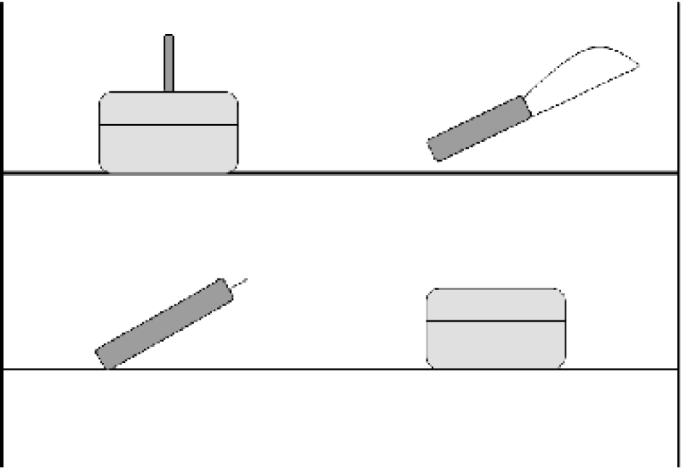
The test and filler sentences were recorded using a minidisc recorder. The sentences were recorded by a native female speaker of standard Northern British English. The sentences were recorded in a neutral prosody to avoid any participants using this cue to interpretation (Snedeker & Trueswell, Reference Snedeker and Trueswell2003; Snedeker & Yuan, Reference Snedeker and Yuan2008). There were four different lists. Participants sat facing a specially constructed rack; two toys were placed on each of the two shelves of the rack equidistant from each other. The linguistic stimuli were played from a minidisc through two speakers that were placed behind the rack (see Figure 1). Participants looked at a fixation cross before the beginning of each trial.
Diagram of experimental set-up for Cut the cake with the candle.

Participants' eye-movements were recorded using an ASL-5000 head mounted eye-tracking system (Applied Science Laboratories, Bedford, MA). The apparatus samples corneal and pupil position of the left eye at a rate of 50 Hz. The output of the scene camera (which included a cursor indicating eye-gaze position) and the spoken instructions were recorded on digital videotape at a rate of 32 frames per second, enabling fine-grained analysis of eye-movements relative to the linguistic stimuli across time.
Coding
There were two dependent measures: (i) participants' eye-movements; and (ii) their off-line interpretations. The participants' eye-movements were coded frame-by-frame using the digital editing program SoundForge (Sony Corp.), which provides simultaneous video and audio channels that show the wave form of the test sentence, thus enabling identification of word boundaries. The data were coded for 500 ms after the sentence offset, which constituted the ‘post-sentence’ region. The off-line responses were taken from the participants' enactment of the sentence on each trial. They were coded as: (i) VP-attachment (instrumental interpretation); (ii) NP-attachment (modifier interpretation); or (iii) Other. For example, for the sentence Cut the cake with the candle, a VP-attachment interpretation involved attempting to cut one of the two cakes using the large candle, and an NP-attachment interpretation involved using the knife to cut the cake that had a candle. Any other action was coded as ‘Other’. Only VP- and NP-attached interpretations were considered valid responses. Ninety-two percent (92%) of the adults' responses were coded as valid; the corresponding statistic for the children was 77%.
RESULTS
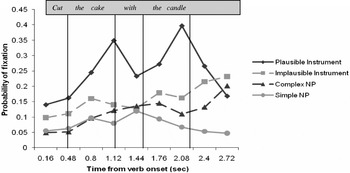
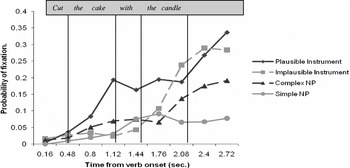
Figure 2a reports the probability of fixating to each toy referent across time for the test sentences for the children; Figure 2b reports the same data for the adult participants.Footnote 2Figures 2a and 2b show that the children and adults processed the test sentences differently. Figure 2a shows that the children made rapid eye-movements to the plausible instrument (i.e. the knife) after the verb, and did so once again at the conclusion of the sentence (i.e. after the candle). In contrast, Figure 2b shows that although the adults looked more to the plausible instrument at the preposition, they directed increased looks to the implausible instrument (i.e. the candle) and the complex NP (i.e. the cake with the candle) at the conclusion of the sentence, suggesting they were entertaining both the VP- and NP-attachment analysis.
Probability of fixations to each referent for the children.

Probability of fixations to each referent over time for the adults.

We report two types of analyses. The first investigates the participants' eye-movements to: (i) the complex NP (the cake with the candle); and (ii) the implausible instrument (i.e. the candle). The children's and adults' looks to these two objects were analyzed across two regions: the sentence-final NP (i.e. the candle) and the post-sentence region. This was because, following our hypotheses, the sentence-final NP should trigger reanalysis, and we should therefore observe an increase in looks to those objects that correspond to each syntactic analysis (VP-attachment=implausible instrument; NP-attachment=complex NP), if reanalysis occurs. In the second analysis we investigated the children's and adults' off-line responses.
The eye-movements to the complex NP were analyzed first. A 2 (group: children vs. adults) by 2 (region: sentence-final NP vs. post-sentence region) repeated measures ANOVA revealed a group by region interaction that was significant by participants but not by items (F 1(1, 26)=6·64, p=0·016, partial ŋ 2=0·204; F 2(1, 10)=3·37, p=0·096, partial ŋ 2=0·252). Post hoc paired sample t-tests showed that the children showed no increase in looks to the complex NP between the two regions (t 1(13)=1·19, p=0·13; t 2(5)=0·44, p=0·34), whereas the adults showed increased looks to the complex NP (t 1(13)=2·45, p=0·016; t 2(5)=3·54, p=0·009).
The eye-movements to the implausible instrument (i.e. the candle) were analyzed next. A 2 (group: children vs. adults) by 2 (region: sentence-final NP vs. post-sentence region) repeated measures ANOVA revealed a significant main effect for group (F 1(1, 26)=8·77, p=0·006, partial ŋ 2=0·252; F 2(1, 10)=88·2, p<0·001, partial ŋ 2=0·898), which was subsumed by a significant group by region interaction (F 1(1, 26)=4·99, p=0·034, partial ŋ 2=0·161; F 2(1, 10)=69·27, p<0·001, partial ŋ 2=0·874). Post hoc paired sample t-tests showed that the children showed no increase in looks to the implausible instrument between the two regions (t 1(13)=0·67, p=0·26; t 2(5)=0·634, p=0·28), whereas the adults showed increased looks (t 1(13)=3·09, p=0·005; t 2(5)=16·53, p<0·001).
Finally, we analyzed the children's and adults' off-line responses. Out of their valid responses, the children made 26% NP-modifier interpretations of the test sentences (i.e. 74% VP-attachment interpretations), whereas the adults interpreted the test sentences in this manner 60% of the time. This difference was significant (t 1(26)=2·69, p=0·012; t 2(10)=4·69, p=0·001). Therefore, whereas the adults entertained both interpretations, as evidenced by their eye-movements, and most often ultimately made the most plausible NP-attachment interpretation, the children seemed not to consider the NP-attachment interpretation, and rarely pursued this interpretation in their off-line responses.
DISCUSSION
The results showed a qualitative difference in how the children and adults analyzed the test sentences. Whereas the adults appeared to consider both interpretations once it became apparent that the sentence was ambiguous, the children did not appear to reanalyze the sentence in the same manner. In particular, whereas the adults showed increased looks to the objects that specified either the VP-attachment (implausible instrument) or the NP-attachment analysis (complex NP), the children did not do so, and instead fixated more on the plausible instrument. Interestingly, the children's looks to the plausible instrument (e.g. the knife) did not trigger the computation of the NP-attachment analysis, despite the fact that they needed to use this instrument in order to interpret the sentence in this manner (as did the adults). Instead, they mostly interpreted the ambiguous PP as VP-attached.
The results from the present research therefore show that, unlike adults, five-year-old children do not appear able to incorporate referential information to revise their initial parsing commitments even over shorter distances than have been previously studied, at least in the case where plausibility might trigger reanalysis. Although the children are influenced by plausibility in the sense that they rapidly processed the affordance between verbs and its instruments, they did not appear to be adept at incorporating plausibility information into their syntactic analysis of a sentence. That is, the conflict between the presence of the plausible instrument in the referential scene and the implausible instrument in the test sentence did not alert them to the possibility that the PP could modify the object NP, as evidenced by the fact that they did not make increased looks to the complex NP. Instead, despite the fact that the children were fixating on the plausible instrument, they pursued an instrumental interpretation of the PP, which entailed using the implausible instrument (i.e. cutting the cake using the candle). It seems that the association between the verb and its instrument triggered an expectation of a VP-attachment analysis, and that the children incorporated the upcoming linguistic material into this analysis, despite the fact there was a more plausible analysis.
In contrast, the adults were able to use this plausibility information to overcome the strong lexical bias for VP-attachment, as evidenced by their increased looks to the implausible instrument and the complex NP, suggesting that they considered both analyses of the sentence. Thus they were able to incorporate plausibility information into their syntactic analysis. As such, it appears that, consistent with Trueswell et al. (Reference Trueswell, Sekerina, Hill and Logrip1999) and Snedeker & Trueswell (Reference Snedeker and Trueswell2004), five-year-old children are more reliant on bottom-up lexical cues to interpretation, whereas adults are capable of integrating top-down information such as plausibility into their parse. It should be noted, however, that the data show that sometimes even adults do not ultimately give this cue priority, as evidenced by the fact that they only made NP-attachment interpretations on 60% of occasions.
There are two broad implications that arise from these data. First, what does children's inability to consider alternative parses mean for the development of sentence processing preferences? Second, how and when might children begin to revise initial interpretations?
If children do not readily revise initial parsing commitments then there will be occasions when their ultimate interpretation is incorrect, leading to communication failure. This suggests that on many occasions children will only get one shot at interpretation, and that they should pursue the parsing strategies that provide the best chance of success. Children could attend to structure, following structural models such as Frazier and colleagues' Garden Path model (Frazier, Reference Frazier and Coltheart1987). With respect to PP-attachment, children would thus predict VP-attachment in every instance by following Minimal Attachment. However, to do so would be inefficient: Kidd & Bavin (Reference Kidd and Bavin2007) reported on a large corpus study that showed that MA only predicts correct interpretation of potentially ambiguous V-NP-with-NP sentences on 54% of occasions. Following the results of Snedeker & Trueswell (Reference Snedeker and Trueswell2004), a better predictor is the lexical bias of the verb. In particular, action verbs bias VP-attachment, whereas stative verbs, such as those that encode psychological states and perceptual and communicative events, bias NP-attachment (see also Kidd & Cameron-Faulkner, Reference Kidd and Cameron-Faulkner2008; Spivey-Knowlton & Sedivy, Reference Spivey-Knowlton and Sedivy1995). Pursuing a syntactic analysis on the basis of this lexical information for these two verb classes would result in a correct interpretation 80–90% of the time. Such consistency between usage patterns and parsing strategies is consistent with constraint-based lexicalist accounts of parsing (MacDonald et al., Reference MacDonald, Pearlmutter and Seidenberg1994).
How does the child's ability to revise initial analyses develop? There are a number of potential mechanisms. One possibility is that increases in processing capacity result in an increased ability to consider multiple analyses on-line. This explanation implicates working memory (WM) capacity, and there are a number of explicit claims in the literature that argue for a direct relationship between WM capacity, broadly defined, and the number of parses that can be entertained (e.g. Caplan & Waters, Reference Caplan and Waters1999; Just & Carpenter, Reference Just and Carpenter1992). Clahsen & Felser (Reference Clahsen and Felser2006) have recently argued that working memory capacity is the only real difference between the child and adult parser. MacDonald & Christiansen (Reference MacDonald and Christiansen2002), however, have criticised such explanations, arguing that the kinds of tasks used to assess WM are in fact indirect measures of language processing, and that differences observed between individuals may reflect differences in exposure to language instead of the magnitude of processing resources available for parsing.
An alternative explanation comes from the literature on cognitive control. Based on a review of neuropsychological and behavioural evidence, Novick, Trueswell & Thompson-Schill (Reference Novick, Trueswell and Thompson-Schill2005) argued that garden-path recovery is mediated by the same mechanisms responsible for cognitive control in other cognitive domains where rapid attentional shifts are required. The neural structures responsible for these behaviours are located in the left inferior frontal gyrus (LIFG), in the pre-frontal cortex (PFC). They argued that since the PFC matures in mid-adolescence, there should be a developmental progression in children's capacity for reanalysis that is attributable to children becoming increasingly able to inhibit dominant analyses in favour of ones that are less preferred. January, Trueswell & Thompson-Schill (Reference January, Trueswell and Thompson-Schill2009) have presented experimented experimental evidence supporting this claim.
The question as to when children develop adult-like reanalysis ability is unresolved. Although Trueswell et al. (Reference Trueswell, Sekerina, Hill and Logrip1999) only reported data for five-year-old children, they anecdotally reported that eight-year-old children processed the temporary ambiguity like adults, suggesting that the capacity for adult-like garden-path recovery develops in the early primary school years. Frederici & Hahne (Reference Frederici, Hahne, Weissenborn and Höhle2001) reported Event Related Potential (ERP) data to suggest that both seven- and eight-year-old children have a reduced capacity for reanalysis when compared to adults. Their data suggested that although children's first parse syntactic processing and lexical–semantic processing were qualitatively similar to the adults, secondary processes involving sentence repair occurred much later than for adults, suggesting they are still not fully automated (and perhaps not ‘on-line’). Future individual differences research that targets the five- to ten-year-old age range is needed to decide between the competing accounts.
APPENDIX
Test sentences (with plausible instrument and VP-attachment preference in brackets)
(1) Chop the tree with the leaves (axe, 84%).
(2) Cut the cake with the candle (knife, 92%).
(3) Poke the dog with the scarf (stick, 92%).
(4) Smash the vase with the flowers (hammer, 92%).
(5) Wash the plate with the fork (sponge, 88%).
(6) Wipe the girl with the hat (cloth, 96%).