Introduction
Biological invasions are one of the five major drivers of human-mediated global environmental changes (IPBES 2019); globalization of trade, travel and tourism has directly or indirectly increased the rate of introductions of species beyond their native distribution ranges (Hulme Reference Hulme2009). Despite some efforts made at sub-national to global governance levels, the rates of species introduction have not slowed (Seebens et al. Reference Seebens, Blackburn, Dyer, Genovesi, Hulme, Jeschke and Pagad2017); alien species introductions are likely to continue at similar or higher rates in the future.
Biological invasions are pervasive, but there is spatial variation in their intensity. Regions with extreme climatic conditions such as the high mountains and poles, and those with low anthropogenic disturbance levels such as protected areas (PAs), are often thought to have low susceptibility to biological invasions. However, such regions with low numbers of alien species are also witnessing a recent increase in the numbers of alien species (Pauchard et al. Reference Pauchard, Kueffer, Dietz, Daehler, Alexander and Edwards2009, Wasowicz et al. Reference Wasowicz, Sennikov, Westergaard, Spellman, Carlson and Gillespie2019, Shackleton et al. Reference Shackleton, Foxcroft, Pyšek, Wood and Richardson2020). Of particular interest are PAs because of their disproportionately high conservation values. While many PAs globally are poorly managed, with unchecked deforestation rates and other environmental degradation (Leberger et al. Reference Leberger, Rosa, Guerra, Wolf and Pereira2020), an overall increase in the threat of invasive alien species in PAs constitutes an extra burden to management authorities (Shackleton et al. Reference Shackleton, Foxcroft, Pyšek, Wood and Richardson2020).
Among six major pathways (sensu Hulme et al. Reference Hulme, Bacher, Kenis, Klotz, Kühn and Minchin2008), the introduction of alien species into PAs may occur by ‘stowaway’ (e.g., by the vehicles used by tourists), ‘corridor’ (e.g., road, trails) and/or ‘unaided’ (e.g., natural dispersal, including rivers). Activities related to tourism often increase alien species’ propagule pressure, resulting in a high abundance and richness of alien species in regions with high tourist activities (Anderson et al. Reference Anderson, Rocliffe, Haddaway and Dunn2015). Proximity to road and human settlements, together with other factors, also significantly affect the occurrence of Invasive alien plant species (IAPS) (Nath et al. Reference Nath, Sinha, Lahkar and Brahma2019). Furthermore, natural landscape structures such as rivers serve as dispersal corridors for alien species between PAs and the surrounding landscape (Foxcroft et al. Reference Foxcroft, Jarosik, Pyšek, Richardson and Rouget2011). Therefore, indirect introduction of alien species deserves a similar level of concern to direct introduction when considering IAPS.
Biological invasions have a wide range of impacts on nature and human welfare. From a biodiversity viewpoint, IAPS in ecosystems alter species composition and reduce species diversity (Davis Reference Davis2011, Pyšek et al. Reference Pyšek, Richardson, Rejmanek, Webster, Williamson and Kirschner2012), thereby threatening global biodiversity (IPBES 2019). Impacts of biological invasions are expected to be similar on absolute terms within and outside PAs (Hulme et al. Reference Hulme, Pyšek, Pergl, Jarošík, Schaffner and Vilà2014), but the relative impacts can be worse in PAs than elsewhere, as these areas preserve key elements of global biodiversity (Foxcroft et al. Reference Foxcroft, Pyšek, Richardson and Genovesi2013). Although more than one-third of the impact studies of invasive alien species worldwide were undertaken within PAs, the majority of these studies have not generated knowledge that is directly useful for managers (Hulme et al. Reference Hulme, Pyšek, Pergl, Jarošík, Schaffner and Vilà2014). The knowledge related to the impacts of biological invasions on populations, species and communities is more important for managers than the impacts on soil or fire, yet only one-third of the impact studies undertaken within PAs have focused on biodiversity and communities (Hulme et al. Reference Hulme, Pyšek, Pergl, Jarošík, Schaffner and Vilà2014). Furthermore, interactions of invasive alien species with ecosystem functions and dynamics are poorly understood, and this knowledge gap is an important impediment to improving invasive species management in PAs (Foxcroft et al. Reference Foxcroft, Pyšek, Richardson, Genovesi and MacFadyen2017). Therefore, additional data on the impacts of IAPS on plant communities within PAs are urgently needed, particularly in understudied regions such as Asia (Hulme et al. Reference Hulme, Pyšek, Pergl, Jarošík, Schaffner and Vilà2014).
The extension and management of PAs constitute Nepal’s most important national strategy for biodiversity conservation (MFSC 2014). Located at the centre of the Himalayan biodiversity hotspot, Nepal has assigned >23% of the country’s total area to PA categories, incorporating diverse ecosystems ranging from subtropical forests in the lowland to Mount Everest in the high Himalaya (DNPWC 2018). The protected areas of Nepal are largely successful in conserving and increasing populations of threatened wildlife such as greater one-horned rhinoceros (Rhinoceros unicornis Linnaeus, 1758) and royal Bengal tiger (Panthera tigris Linnaeus, 1758) (MFSC 2014, DNPWC & DFSC 2018). However, these PAs also face a number of management challenges, and one of these is an increasing number and abundance of IAPS (MFSC 2014, Bhattarai et al. Reference Bhattarai, Wright, Poudel, Aryal, Yadav and Wagle2017). The problem of plant invasions is particularly serious in the PAs located in the southern lowland of the country. For example, core habitats of greater one-horned rhinoceros in Chitwan National Park, a Natural World Heritage site, have been heavily invaded by Mikania micrantha Kunth and other IAPS with negative consequences for foraging behaviour and movements (Murphy et al. Reference Murphy, Subedi, Gnawali, Lamichhane, Upadhyay, Kock and Amin2013). Impacts of IAPS in other PAs, however, have not been examined in detail. Furthermore, except for M. micrantha in Chitwan National Park (Murphy et al. Reference Murphy, Subedi, Gnawali, Lamichhane, Upadhyay, Kock and Amin2013), the spatial distribution patterns of IAPS have not been analysed in any of Nepal’s PAs. Therefore, there is a dearth of data and knowledge related to the impacts of IAPS within PAs to inform management decisions (Shrestha Reference Shrestha, Garkoti, van Bloem, Fule and Semwal2019). In this study, we analysed the spatial extent of IAPS and the impacts of the most widespread IAPS Lantana camara L. on plant species diversity in Bardia National Park (BNP), Nepal. Specifically, this research aimed to: (1) map spatial distribution of IAPS in BNP; (2) identify the environmental factors that govern plant invasions in BNP; and (3) assess the impacts of the most problematic IAPS on plant diversity. The results provide strong grounds for integrating the management of IAPS into the conservation strategies for BNP as well as other PAs of Nepal.
Methods
Study area
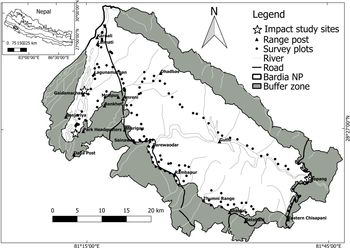
Bardia National Park (BNP) was established in 1988 mainly to protect the royal Bengal tiger and its prey; it is the largest PA in the Tarai region of Nepal, covering 968 km2, and its buffer zone encompasses 507 km2 (DNPWC 2018). It is located in the Bardia district of western lowland Nepal between 28°15.0′–28°35.5′N and 80°10′–81°45′E, with elevations ranging from 150 to 1565 m above sea level (Fig. 1). About two-thirds (69%) of the BNP area is the lowlands of Tarai, and the remaining part (31%) is the Siwalik (DNPWC 2015). Most of the Park and buffer zone are covered by forest (76%), followed by cultivated land (13%), shrub land (4%), grasslands (1%) and water bodies (2%) (DNPWC 2015). The BNP has been recognized as a Tiger Conservation Landscape by the Global Tiger Forum and is part of the Tarai Arc Landscape in western Nepal. The number of tourists visiting the BNP in the fiscal year 2017/2018 was 20 284 (DNPWC 2018).
Location of the survey plots and impact study sites in Bardia National Park (NP), Nepal. Map in inset shows five physiographical regions of Nepal from south to north: Tarai, Siwalik, Middle Mountains, High Mountains and High Himal.

Bardia National Park has a trans-boundary linkage with the Katarniaghat Wildlife Sanctuary in India through the Khata biological corridor and is also linked to Banke National Park towards the east. Monitoring in 2018 detected a total of 87 breeding tigers in BNP and adjoining forest areas, which is the second largest population of tigers in Nepal following Chitwan National Park (DNPWC & DFSC 2018). Bardia National Park also harbours the largest population of the Asian elephant (Elephas maximus Linnaeus, 1758) and the second largest population of greater one-horned rhinoceros and swamp deer in Nepal (DNPWC 2015). The Karnali floodplain located in the western part of the Park and the Babai River valley located in the north-eastern part are considered major wildlife habitat areas (DNPWC & DFSC 2018).
The climate in this area is subtropical monsoon with a rainy season extending from June to early October, with c. 70% of BNP’s total rainfall occurring during June–August, resulting in frequent flooding; the cool dry season extends from October to late February and the hot season extends from March to mid-June. Bardia National Park consists of four main types of forests: lower tropical sal (Shorea robusta Gaertn.), mixed broad-leaved forest, hill sal forest and chir pine (Pinus roxburghi Sarg.) forest (DNPWC 2015). Except for in the chir pine forest, the common tree species in all forest types are S. robusta, Terminalia alata Roth and Buchanania cochinchinensis (Lour.) Almeida.
An increase in the abundance of IAPS such as L. camara and Chromolaena odorata has been recorded in the Park (Thapa & Chapman Reference Thapa and Chapman2010), and Dinerstein (Reference Dinerstein1979) reported the presence of the IAPS Ageratum conyzoides L. and Senna tora (L.) Roxb. in BNP without mentioning their invasive alien nature.
Field data collection
Data were collected from the field for both distribution mapping of IAPS and impact assessment of the most widespread IAPS. In this study, 25 species reported by Shrestha (Reference Shrestha, Jha, Siwakoti and Rajbhandary2016) for Nepal were considered as a reference list of IAPS. These IAPS are either herbs (including herbaceous climbers) or shrubs; none of the alien tree species in Nepal is invasive.
Distribution mapping
Field data were collected during September–November 2018. Distribution mapping of IAPS was conducted by sampling along the roadside and in grids. Along the roadside, 28 plots (10 m × 10 m) were sampled every c. 1 km. The roadside survey covered a section (31 km) of East–West Highway that passes through the Park. In each plot, vegetation type, dominant species, tree canopy cover and cover of IAPS were recorded. For grid sampling, the Park was divided into 900 1-km2 cells, of which 90 were selected randomly for the survey. However, we could sample only 50 grids (c. 55% of the selected grids), and the remaining 40 randomly selected grids were dropped due to non-accessibility and issues related to safety from wildlife. The grids we sampled were located away from the road in natural ecosystems such as forests, shrublands and grasslands. At two diagonal corners of each selected grid, a 10 m × 10 m plot was sampled to record vegetation type, dominant species, fire marks, tree canopy cover and IAPS cover. In the grids, we sampled 100 plots. Spatial distribution patterns of all IAPS were recorded and their cover presented in maps prepared using QGIS 2.18 (https://www.qgis.org).
Impact assessment
Mapping exercises revealed that L. camara was the most widespread and abundant IAPS in the BNP. Therefore, impact assessments of L. camara were performed at two sites in the Karnali River floodplain in the south-western part of the Park and at two sites in the Babai River valley in the north-eastern part of the Park (Fig. 1), which have high levels of L. camara invasion. At each site, 15 pairs of 5 m × 5 m quadrats with (invaded) and without L. camara (non-invaded) were sampled. The invaded and non-invaded quadrat pairs were placed subjectively as close as possible (c. 2 m apart) to reduce possible differences in the plant community before invasion by L. camara. In each quadrat, all vascular plants (herbs, climbers, shrubs and tree seedlings and saplings) including IAPS were enumerated. Cover of each species was estimated visually following Daubenmire’s (Reference Daubenmire1959) method.
Plant identification and categorization
The plant specimens recorded in the quadrats were collected and identified with the help of relevant taxonomic literature (e.g., Chapagain et al. Reference Chapagain, Pandit and Tamang2016, Rajbhandari et al. Reference Rajbhandari, Thapa Magar, Kandel and Khanal2016, Rajbhandari & Rai Reference Rajbhandari and Rai2017). Specimens were also compared with the voucher specimens deposited in National Herbarium and Plant Laboratories (KATH) and Tribhuvan University Central Herbarium (TUCH). Nomenclature follows the Catalogue of Life (http://www.catalogueoflife.org). From the checklist of the identified species (Supplementary Table S1, available online), those included in the ‘Global Register of Introduced and Invasive Species (GRIIS) – Nepal’ were considered as ‘naturalized’ species (Shrestha et al. Reference Shrestha, Budha, Wong and Pagad2018) and the remaining species as ‘native’. The GRIIS database has most recently updated a country-level checklist of naturalized species (Pagad et al. Reference Pagad, Genovesi, Carnevali, Schigel and McGeoch2018). A set of naturalized species included in the list reported by Shrestha (Reference Shrestha, Jha, Siwakoti and Rajbhandary2016) were considered as ‘invasive’ and the remaining species as ‘non-invasive naturalized’.
Data analysis
Distribution maps of individual IAPS were prepared using geographical coordinates recorded during roadside survey, grid sampling and impact assessments. The frequency of each IAPS was calculated as the percentage of total plots where a particular IAPS was present. The mean cover of individual IAPS was calculated as the mean of the mid-value of each Daubenmire cover class (Daubenmire Reference Daubenmire1959). Data collected during roadside and grid sampling were used for the calculation of frequency and cover.
A multivariate analysis was performed to study the effects of various environmental variables on the composition and distribution of IAPS. Using distribution data generated from roadside surveys and grid sampling, ordination was used to identify the major environmental variables governing the occurrence of IAPS in BNP. Species richness (IAPS/100 m2) was considered as a response variable, and tree canopy, fire (yes/no), grazing (yes/no) and distances from the nearest road, river, park range-post and settlement were used as predictor variables. The distances were measured with the help of QGIS software. Initially, de-trended correspondence analysis (DCA) was performed to find the variance in species data, which explained c. 70% of the variance of species composition data. Since the first axis of the DCA had a gradient length of 4.2 SD units (Table S2a), being greater than 2.5 SD units and with an Eigen value >0.5, the data were analysed by direct gradient analysis (i.e., canonical correspondence analysis; CCA) (Table S2b) in R Studio (R Developmental Core Team 2016).
For impact assessment, similarity index, species richness and diversity were calculated. Sorensen similarity between non-invaded and invaded quadrats was calculated using species presence/absence data following Magurran (Reference Magurran2004) and expressed in percentage similarity. Effect of quadrat types (non-invaded and invaded) on species composition was also analysed by CCA. The species richness was defined as the number of species present in a 5 m × 5 m quadrat (Magurran Reference Magurran2004). Lantana camara was excluded from the data on species richness, species composition and species diversity to ensure that the measured effects of L. camara invasion were not due to its presence among dependent variables. Species richness data were normally distributed (Shapiro–Wilk test, p > 0.05), and the invaded and non-invaded quadrats were compared by paired-sample t-tests. Shannon (H’) and Simpson diversity (1 – D) indices were calculated separately for invaded and non-invaded quadrats (Magurran Reference Magurran2004). In these calculations, mean cover of individual species was used to estimate the proportion of the ith species.
Results
Diversity, distribution and abundance
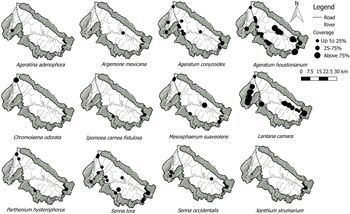
Twelve IAPS in ten genera and six families were recorded from BNP (Table 1). Asteraceae was the most species-rich family with six species. Ageratum houstonianum Mill. (24%) was the most frequent species, followed by L. camara (13%) (Fig. 2 & Table 1). Species such as Ageratina adenophora (Speng.) R. King and H. Rob., Argemone mexicana L., Chromolaena odorata (L.) R. King and H. Rob. and Xanthium strumarium L. were recorded only in single plots (Fig. 2 & Table 1). There was variation in the frequency of species depending on whether the sampling was done along a roadside or in grids. Along the roadside, A. houstonianum had the highest frequency, followed by Mesosphaerum suaveolens (L.) Kuntze, Senna tora (L.) Roxb. and Parthenium hysterophorus L. But in grids, L. camara was the most frequent species, followed by A. houstonianum, A. conyzoides and S. tora. There was also spatial variation in species richness of IAPS, with high richness in plots sampled close to Park headquarters and range-posts (Fig. S1).
Frequency (%) of occurrence in plots and mean cover (%, estimated visually) of invasive alien plant species (IAPS) recorded in Bardia National Park. Sampling was done in plots (28; 10 m × 10 m) located systematically at intervals of 1 km along roadsides as well as in 50 randomly selected 1-km2 grids with two plots (10 m × 10 m) in each grid (total plots: 100). The plots sampled along roadsides and in grids were pooled (n = 128) to calculate combined values. Values in bold represent the two highest values of frequencies and cover.

a Used in Fig. 3.
Distribution and cover of 12 invasive alien plant species reported in Bardia National Park.

Among 12 IAPS present in BNP, L. camara had the highest cover (Fig. 2 & Table 1) and was thus assessed for impact. Other species with high cover were A. houstonianum and M. suaveolens. Similar variation in cover was observed when only grids were considered. However, along the roadside, A. houstonianum had the highest cover, followed by L. camara and C. odorata. Overall, the cover of IAPS was higher along the roadside than in the grids.
Environmental variables and IAPS distribution
Four out of seven of the predictor variables evaluated had significant effects on IAPS distribution (Fig. 3 & Table 2). Species composition was significantly affected by tree canopy, distance from river, distance from settlement and distance from road; each of these variables explained >15% of the variance in species distribution. This suggests that the probability of the occurrence of IAPS was higher closer to roads, settlements and rivers, and lower below the canopies of trees.

Relative importance of environmental variables on determining the species distribution based on canonical correspondence analysis. Total number of sample plots was 128. The significance levels (p-values) were obtained from permutation tests and the statistically significant values are shown in bold.

Impact assessment
Altogether 116 vascular plant species (including L. camara) in 41 families were recorded during sampling of the L. camara-invaded and -non-invaded quadrats (Table S1). Ninety-eight (84%) species were native, ten (9%) were naturalized non-invasive and eight (7%) were IAPS. There were 104 plant species in non-invaded quadrats with 87 native species, ten naturalized non-invasive species and seven invasive species. On the other hand, there were 70 plant species in the invaded quadrats with 58 native species, six naturalized non-invasive and six invasive species. There were 58 species that were common to both non-invaded and invaded quadrats, whereas 11 species were found only in invaded quadrats and 46 species only in non-invaded quadrats (Fig. S2). The Sorensen similarity index between non-invaded and invaded quadrats was only 40%. Low similarity between non-invaded and invaded quadrats was also revealed by the CCA; many species present in non-invaded quadrats were absent in invaded quadrats (Fig. S2).
Species richness in invaded quadrats was less than half of the species richness in non-invaded quadrats (Table 3). The non-invaded quadrats also had higher species richness of native and naturalized non-invasive species than the invaded quadrats. Diversity indices were also higher in non-invaded quadrats than in invaded ones. The Shannon diversity index (H’) values were 3.61 and 3.36 in non-invaded and invaded quadrats, respectively; the Simpson diversity index (1 – D) values were 0.94 and 0.19 in non-invaded and invaded quadrats, respectively.
Mean species richness (no. species/25 m2) and indices of species diversity in non-invaded (n = 60) and invaded (n = 60) quadrats. Species richness values between non-invaded and invaded plots were compared using paired sample t-tests.

Discussion
We showed that the number of IAPS has been increasing in one of the important PAs of Nepal – BNP – and that the evident impacts of the most abundant IAPS – L. camara – on the plant community structure in BNP were substantial. Some IAPS, including the globally prolific and detrimental C. odorata, were at an early stage of invasion with single small satellite populations, providing opportunity for their eradication from BNP. Given the paucity of invasion-related knowledge in the PAs of Nepal and the lack of management interventions, our results have direct implications for the management of IAPS in BNP and other similar PAs in Nepal.
The number of IAPS that we reported in BNP is slightly less than half of the total number of IAPS (26 species) reported in Nepal (Shrestha Reference Shrestha, Garkoti, van Bloem, Fule and Semwal2019). Chaudhary et al. (Reference Chaudhary, Shrestha, Thapa and Siwakoti2020) reported 14 IAPS from Parsa National Park (627.39 km2) in central Nepal, which is smaller than BNP (968 km2), but similar information is lacking for the rest of Nepal’s PAs. Comparing our data with previous studies in the BNP revealed that the number of IAPS present has been continuously increasing. In the present study area, two IAPS (S. tora and A. conyzoides) were reported nearly four decades ago (Dinerstein Reference Dinerstein1979), and an additional four IAPS (Ipomoea carnea subsp. fistulosa, L. camara, C. odorata and A. adenophora) were reported a decade ago (Thapa & Chapman Reference Thapa and Chapman2010). We now report an additional six IAPS, raising the total number of IAPS in BNP to 12. The higher number of IAPS reported in the present study than previously could be attributed to the arrival of new IAPS in BNP and to the differences in sampling methods. Firstly, the number of IAPS has been increasing continuously in Nepal (Shrestha Reference Shrestha, Garkoti, van Bloem, Fule and Semwal2019), and a similar increase can be expected in BNP. Some of the species that are currently frequent (e.g., A. houstonianum, P. hysterophorus) were not reported in the previous studies. In recent decades, these species have been spreading rapidly, invading new areas in Nepal with multiple socio-ecological impacts (Shrestha et al. Reference Shrestha, Pokhrel, Paudel, Poudel, Shabbir and Adkins2019a, Reference Shrestha, Shrestha, Sharma, Thapa-Parajuli, Devkota and Siwakoti2019b). Although PAs are expected to have fewer IAPS than their surroundings (Foxcroft et al. Reference Foxcroft, Pyšek, Richardson and Genovesi2013), the buffering effect of the PAs could have become weak due to continuous pressure from local communities for resource utilization from inside the parks (Brown Reference Brown1997, Thapa & Chapman Reference Thapa and Chapman2010) and the occurrence of human-constructed (e.g., road) and natural dispersal corridors (e.g., rivers). Secondly, in contrast to the previous studies (Dinerstein Reference Dinerstein1979, Thapa & Chapman Reference Thapa and Chapman2010), which were not focused on IAPS, we mapped the spatial distribution of IAPS along their major dispersal corridors (i.e., roads), as well as in randomly selected grids representing various ecosystems, although the entire area of BNP could not be covered. In particular, we could not sample areas close to the northern border of the Park. Further sampling in the areas that we could not cover in the present study may reveal the presence of additional IAPS.
Some of the species were spotted at a single location, suggesting that they are at the initial stage of invasion in BNP. Among them, C. odorata is one of the worst IAPS globally (Lowe et al. Reference Lowe, Browne, Boudjelas and DePoorter2000); it reduces biodiversity, prevents forest regeneration and reduces forage availability to wild animals (Shrestha et al. Reference Shrestha, Shrestha, Sharma, Thapa-Parajuli, Devkota and Siwakoti2019b). The small and isolated ‘satellite’ population of C. odorata spotted near the north-western border of BNP represents the westernmost invasion front of this species in Nepal; it is spreading from east to west (Tiwari et al. Reference Tiwari, Adhikari, Siwakoti and Subedi2005, Paudel Reference Paudel2016). Since the expansion rate of satellite populations of IAPS is faster than that of source populations (Radosevich et al. Reference Radosevich, Stubbs and Ghersa2003), the occurrence of satellite populations of C. odorata and other species in BNP is of great concern for Park management. Eradication or control of newly introduced invasive species before they become widespread is one of the best ways to prevent IAPS invasion (Monaco & Genovesi Reference Monaco and Genovesi2014). Successful control of C. odorata has been reported in Hluhluwe-iMfolozi Park of South Africa through a combination of physical and chemical methods (te Beest et al. Reference te Beest, Howison, Howison, Dew, Poswa, Dumalisile, Cromsigt, Archibald and Owen-Smith2017). Eradication should be possible for the satellite populations that we spotted in BNP, but the eradication option will rapidly disappear within a short timeframe (Wittenberg & Cock Reference Wittenberg and Cock2001). Therefore, as an immediate response, eradication of these small satellite populations of C. odorata and other similar species (A. adenophora, A. mexicana, I. carnea subsp. fistulosa and X. strumarium) will help protect BNP from further invasion and subsequent environmental damage. Since management options for IAPS vary with the extent and intensity of invasion within a geographical region (Grice et al. Reference Grice, Clarkson and Calvert2011), eradication of the above-mentioned species is not a viable option in other regions of Nepal where they are widespread.
The most frequently occurring IAPS in BNP, A. houstonianum, has been reported as the most troublesome IAPS in the agro-ecosystem of central Nepal due to its poisoning effects on livestock (Shrestha et al. Reference Shrestha, Shrestha, Sharma, Thapa-Parajuli, Devkota and Siwakoti2019b). With an increasing abundance of A. houstonianum in BNP, a similar poisoning effect on wild herbivores cannot be ruled out, although this requires further investigation. Another frequently occurring IAPS, which was also the most abundant IAPS in BNP, is L. camara; this is also one of the most globally detrimental IAPS (Lowe et al. Reference Lowe, Browne, Boudjelas and DePoorter2000). Abundances of A. houstonianum and L. camara were high in the Karnali floodplain located in the south-western part of BNP and in the Babai River valley in the north-eastern part of BNP (Fig. 2). Both of these areas are important habitats for the royal Bengal tiger and its prey, as well as the greater one-horned rhinoceros (Dinerstein Reference Dinerstein1979, DNPWC 2015, DNPWC & DFSC 2018). Additional study is required in order to understand the impacts of these IAPS on wildlife in BNP. Management of these widespread species in BNP, such as L. camara and A. houstonianum, among others, requires a combination of physical, chemical and biological control measures (Foxcroft & Freitag-Ronaldson Reference Foxcroft and Freitag-Ronaldson2007). However, a biological control programme has not been initiated in Nepal, although a few biological control agents of P. hysterophorus and A. adenophora from neighbouring countries, where they were released, have spread naturally into Nepal and been established with some impacts (Shrestha Reference Shrestha, Garkoti, van Bloem, Fule and Semwal2019). Among these established biological control agents, Zygogramma bicolorata Pallister is particularly effective in controlling P. hysterophorus in Nepal (Shrestha et al. Reference Shrestha, Pokhrel, Paudel, Poudel, Shabbir and Adkins2019a). Release of laboratory-reared Z. bicolorata could be a sustainable way of controlling P. hysterophorus in BNP and other PAs of Nepal. For other species such as L. camara and A. houstonianum, for which biological control agents are currently not available in Nepal, the available management options include physical methods such as hand pulling and slashing, in combination with the use of carefully selected herbicides in limited areas. These approaches have been effective in controlling C. odorata in Hluhluwe-iMfolozi National Park (te Beest et al. Reference te Beest, Howison, Howison, Dew, Poswa, Dumalisile, Cromsigt, Archibald and Owen-Smith2017) and several other species in Kruger National Park of South Africa (Foxcroft & Freitag-Ronaldson Reference Foxcroft and Freitag-Ronaldson2007).
The occurrence of IAPS in PAs is governed by multiple factors related to human activities, such as tourism, road transportation and other anthropogenic disturbances, as well as natural landscape structures such as rivers (Foxcroft et al. Reference Foxcroft, Jarosik, Pyšek, Richardson and Rouget2011, Anderson et al. Reference Anderson, Rocliffe, Haddaway and Dunn2015, Nath et al. Reference Nath, Sinha, Lahkar and Brahma2019). In BNP, the occurrence of IAPS was significantly related to tree canopy cover and the distance to rivers, settlements and roads. Natural ecosystems such as grasslands without trees often accumulate greater numbers of IAPS than the surrounding forested areas (Siwakoti et al. Reference Siwakoti, Shrestha, Devkota, Shrestha, Bhuju, McLaughlin, Sijapati, Devkota, Shrestha, Ghimire and Neupane2016). Within forest ecosystems, microhabitats with low tree canopy cover such as forest edges and canopy gaps provide environments that are more conducive to the establishment of IAPS than sites with high tree canopy cover (Arellano-Cataldo & Smith-Ramírez Reference Arellano-Cataldo and Smith-Ramírez2016, Khaniya & Shrestha Reference Khaniya and Shrestha2020). Similarly, rivers act as corridors for the dispersal of IAPS; they provide suitable habitat and contain a reservoir of propagules for further invasions (Parendes & Jones Reference Parendes and Jones2000, Levine Reference Levine2001). In some regions, rivers serve as the major conduit for alien species invasions into PAs (Foxcroft & Freitag-Ronaldson Reference Foxcroft and Freitag-Ronaldson2007). Human structures such as roads function as movement corridors and road verges provide suitable habitats for the establishment of IAPS (Christen & Matlack Reference Christen and Matlack2009, Mortensen et al. Reference Mortensen, Rauschert, Nord and Jones2009), especially with low tree canopy cover compared with adjacent forests. Roads have significantly influenced the occurrence of C. odorata and M. micrantha in Manas National Park of India (Nath et al. Reference Nath, Sinha, Lahkar and Brahma2019). Thus, the highway and other roads passing across BNP might have increased propagule pressure, leading to the recent increase in the number of IAPS. Furthermore, proximity of the Park to settlements may increase disturbance and IAPS propagule pressure, leading to greater plant invasions (Rodgers & Parker Reference Rodgers and Parker2003, Simberloff Reference Simberloff2009). These suppositions are supported by our observations that species with single occurrence locations in BNP (suggesting the initial stage of their invasion) were spotted at locations close to the road (C. odorata, X. strumarium), to BNP headquarters (A. adenophora) or to a BNP range-post (A. mexicana). Therefore, the present data and previous studies highlight the need for regular monitoring of open canopy areas, riversides, road verges and park range-post areas inside BNP and the settlements in the surrounding landscape for the presence of new IAPS as part of IAPS risk assessment.
The ecological impacts of the most abundant IAPS of BNP – L. camara – are substantial, as indicated by significant changes in plant species composition and declines in plant species richness and species diversity in the invaded quadrats as compared to the non-invaded quadrats. The results support the finding of a previous community-perception study reporting L. camara as one of the three most problematic IAPS in the natural ecosystems of central Nepal (Shrestha et al. Reference Shrestha, Shrestha, Sharma, Thapa-Parajuli, Devkota and Siwakoti2019b). Modification of the plant community structure and suppression of native plant species growth by L. camara have also been reported in India (Singh et al. Reference Singh, Batish, Dogra, Kaur, Kohli and Negi2014), Africa (Jevon & Shackleton Reference Jevon and Shackleton2015) and Australia (Gooden et al. Reference Gooden, French, Turner and Downey2009). In BNP, L. camara is currently prevalent mainly in the Babai River valley and Karnali floodplain, but it is highly likely that the weed will continue to spread to new areas within BNP and the surrounding landscape because species distribution models have predicted an increase in climatically suitable areas of L. camara in Nepal (Shrestha & Shrestha Reference Shrestha and Shrestha2019) and Asia (Taylor et al. Reference Taylor, Kumar, Reid and Kriticos2012, Priyanka & Joshi Reference Priyanka and Joshi2013). This implies that the intensity as well as the spatial extent of L. camara invasions are likely to increase in BNP, with high-intensity impacts on native plant diversity. Further research evaluating the impacts of L. camara and another frequently occurring species, A. houstonianum, on wildlife habitats and food availability in BNP, which are currently unknown, will be helpful in order to obtain a better understanding of their broader ecological impacts.
Supplementary material
To view supplementary material for this article, please visit https://doi.org/10.1017/S0376892920000223.
Acknowledgements
We are grateful to the Department of National Parks and Wildlife Conservation for issuing permits to carry out this research. We are also indebted to the authority of Bardia National Park, National Trust for Nature Conservation, Bardia Conservation Program and Nepal Army Force for their immense support and help during the field visit. We are thankful to Ashish Prakriti Dhital, Anita Chaudhary and Roshan BC for their assistance in the fieldwork. We are thankful to Lily Jane Clarke (University of Montana, USA) for English-language edits and Lila Nath Sharma (Forest Action Nepal) for comments on the manuscript. The manuscript greatly benefited from critical comments and extensive edits by the editor and reviewers.
Financial support
Funding for this research was provided by WWF Nepal in partnership with CARE Nepal, FECOFUN and NTNC under the Hariyo Ban Program as Students Research Grant to SB.
Conflict of interest
The researchers proclaim no conflicts of interest in the contents of this research.
Ethical standards
Permission to collect data and plant specimens in Bardia National Park was obtained from the Department of National Parks and Wildlife Conservation, Ministry of Forest and Soil Conservation of the Government of Nepal.