INTRODUCTION
Leather artifacts are an undeniable asset to the archaeological record. Evidence from durable leatherworking tools suggests that humans have used leather since Paleolithic times for clothing and shelter (Gilligan Reference Gilligan2010; Rifkin Reference Rifkin2011), developing into the diverse range of objects, including footwear, storage vessels, and decorative accessories seen today. From this extended historical use, researchers can gain insight into human interactions with the environment. However, leather poses a unique challenge for radiocarbon (14C) dating, both in its complex, inhomogeneous matrix and the four stages at which a sample may encounter exogenous carbon—leather manufacture, object use, interment, and conservation.
Leather is collagen-based animal hide that has undergone processing, such as curing and tanning (Phillips Reference Phillips1954). Leather manufacture alters the structure of the skin to stop putrefaction, produce the desired texture for use, and increase resistance to water and wear (Groenman van Waateringe et al. Reference Groenman van Waateringe, Kilian and van Londen1999; Maxwell Reference Maxwell2007). These processes have evolved extensively over time, from early applications of the animals’ own by-products, to tannin-based plant materials, to the refined chemical processes utilized today.
Widely used chemical pretreatment methods aim to extract an endogenous fraction of the sample that is likely to have remained chemically unmodified during interment (de Vries and Barendsen Reference de Vries and Barendsen1954; van Klinken and Hedges Reference van Klinken and Hedges1997). For archaeologically recovered leather, the most accurate age determination relies on the ability to obtain only that carbon which was incorporated into the skin by the living animal or from contemporary organic material used in the initial leather manufacture. All other carbon contributions, including exposure to potentially older substances during manufacture and both older and younger substances during use, interment, and conservation, must be considered contaminants. Pretreatment must then anticipate the numerous opportunities for the incorporation of exogenous carbon.
Of particular concern are non-polar contaminants, such as grease and oil, as these would not be removed by the aqueous solutions of the standard acid-base-acid (ABA) pretreatment for non-carbonate-containing samples. To ensure the removal of these, as well as additives from use and conservation, such as paint, glues and preservatives, leather and other organic samples are typically pretreated with a solvent extraction (Bruhn et al. Reference Bruhn, Duhr, Grootes, Mintrop and Nadeau2001; Brock et al. Reference Brock, Higham, Ditchfield and Bronk Ramsey2010, Reference Brock, Geoghegan, Thomas, Jurkschat and Highman2013; Hajdas et al. Reference Hajdas, Cristi, Bonani and Maurer2014; Dee et al. Reference Dee, Palstra, Aerts-Bijma, Bleeker, de Bruijn, Ghebru, Jansen, Kuitems, Paul, Richie, Spriensma, Scifo, Van Zonneveld, Verstappen-Dumoulin, Wietzes-Land and Meijer2020).
Methods of leather preparation for 14C dating, like bone and other collagen-based non-carbonate materials (Hedges et al. Reference Hedges, Law, Bronk and Housley1989; Brock et al. Reference Brock, Higham, Ditchfield and Bronk Ramsey2010), are typically designed to extract the proteinaceous “collagen” from the bulk sample through gelatinization. For hide materials, gelatinization of the acid-soluble proteins leaves a residual, acid-insoluble fraction. Though it has been suggested that parchment, also derived from animal hide, may not require the additional extraction of collagen following chemical pretreatment (Brock Reference Brock2013).
Also similar to bone samples (Cherkinsky Reference Cherkinsky2009), leather submitted for 14C dating may be variably preserved with many samples that are fragile and highly degraded. Occasionally leather materials will fail to produce sufficient gelatin even for accelerator mass spectrometry (AMS) dating. However, unlike bone, acid-insoluble protein solids from the leather sample remain and typically retain sufficient carbon for analysis. The concern with such analyses then becomes whether the acid-insoluble solids are (1) sufficiently cleaned of exogenous carbons by pretreatment, (2) not adversely influenced by the degradation that destroyed the collagen matrix, and (3) accurately reflect the true age of the animal.
DirectAMS has dated over 45,000 samples by AMS since its inception in 2011. As a commercial laboratory, the focus of DirectAMS is to offer 14C dating services that employ the most advanced published methodologies from the research of many academic laboratories. Despite a reliance on validated methods, DirectAMS does encounter similar challenges in the treatment of rare and complex materials to those laboratories engaged in method development.
This paper examines the suitability of the leather solids, following chemical pretreatment, for 14C dating by examining the similarity of the carbon ratios obtained from the acid-soluble and acid-insoluble material derived from the same bulk leather sample. Agreement between the two fractions supports the hypothesis that the carbon being analyzed is in both cases from the original structure of animal skin and that all exogenous contaminants have been similarly removed.
MATERIALS
Seventeen (n=17) leather samples submitted for 14C analyses by the Utah State University Eastern Prehistoric Museum and the University of Oregon Museum of Natural & Cultural History, were included in this assessment. All the samples originated from the American Southwest. The artifacts varied in composition and preservation as determined by percent collagen yield, and included nine leather shoe components, two headpiece fragments, one portion of decorative fringe, two lengths of cordage, and three unidentified leather panels (see Table 1).
Initial sample masses, artifact type, pretreatment collagen yields, and post pretreatment fraction masses.

All samples survived pretreatment conditions, producing both an acid-soluble and acid-insoluble fraction. The observable quality of the lyophilized gelatin ranged from wispy cream-colored filaments to light brown syrup, and the leather solids ranged from fine powder to identifiable fragments. All samples behaved as expected throughout pretreatment though samples D-AMS 027299 and D-AMS 027302 became wispy and fragile during the initial acid wash.
METHOD
Submitted sample material was initially inspected, and as possible based on the amount of material, representative portions were selected from the areas least affected by visible contaminants, such as ink or paint. Subsamples were then manually cleaned by scraping with a blade to remove any adherent debris or hair and then cut into approximately 3-mm fragments. Samples were initially pretreated with a series of organic solvent washes (Stafford et al. Reference Stafford, Brendel and Duhamel1988; Brock Reference Brock2013; Hajdas et al. Reference Hajdas, Cristi, Bonani and Maurer2014). Each sample was soaked sequentially in n-hexane, acetone and a 1:1 solution of methanol:dichloromethane for 1 hr at room temperature. Samples were rinsed with the preceding and subsequent solvent between each soak. The remaining material was lyophilized and then pretreated with a modified ABA protocol (Longin Reference Longin1971; Hedges et al. Reference Hedges, Law, Bronk and Housley1989). The dry, solvent-rinsed fragments were soaked in 0.5M hydrochloric acid for 30 min at room temperature and rinsed with deionized water to neutrality. Samples were then soaked in 0.1M potassium hydroxide for 30 min at room temperature and again rinsed to neutrality. Samples were then soaked in 0.5M hydrochloric acid for 90 min at 90°C.
At the conclusion of the ABA pretreatment, each sample was expected to produce two fractions: acid-soluble (gelatin) and acid-insoluble (leather solids). Acid-soluble material is comprised primarily of collagen, while the acid-insoluble fraction is assumed to contain ungelatinized protein bound to other compounds. Pretreated material was gelatinized to separate the fractions (Hedges et al. Reference Hedges, Law, Bronk and Housley1989). The acid-soluble supernatant was removed, filtered, and lyophilized prior to combustion and conversion to graphite. The remaining acid-insoluble solids were rinsed with deionized water and lyophilized prior to combustion and conversion to graphite.
Carbon dioxide was produced from the lyophilized fractions by closed-tube combustion with copper oxide. The resulting CO2 was reduced to graphite in the presence of an iron catalyst (Vogel et al. Reference Vogel, Southon, Nelson and Brown1984; Xu et al. Reference Xu, Trumbore, Zheng, Southon, McDuffee, Luttgen and Liu2007). The graphite was then pressed into instrument-specific targets and measured by a 500 kV National Electrostatics Corporation 1.5 SDH Compact Pelletron AMS (Zoppi et al. Reference Zoppi, Crye, Song and Arjomand2007). In the absence of an analytical reference standard appropriate for leather pretreatment, samples were accompanied from combustion through conversion to graphite by 14C-free process blank material (L-Alanine, Sigma, PN=A7627) and IAEA-C7 oxalic acid reference standard (Le Clercq et al. 1988). The sample ratios were normalized to the Oxalic acid standard, HOX II (NIST SRM 4990 C), and corrected for fractionation with d13C as measured by the AMS to determine sample activity in units of percent modern carbon (pMC).
RESULTS AND DISCUSSION
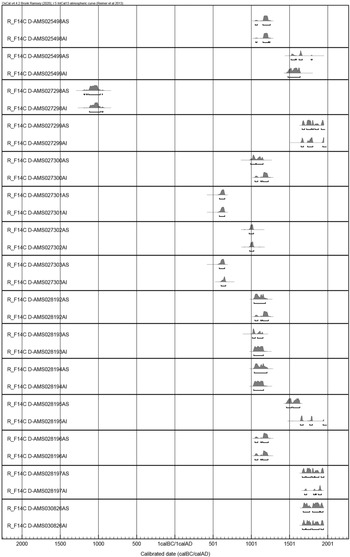
Normalized AMS results were evaluated for each sample by the chi-square test of statistical independence (Scott et al. Reference Scott, Cook and Naysmith2007). Eleven of the 17 samples yielded statistically equivalent pMC results from the acid-soluble and acid-insoluble fractions (see Table 2). Of the six samples that did not, calibration to calendar age using IntCal13 (Reimer et al. Reference Reimer, Bard, Bayliss, Beck, Blackwell, Bronk Ramsey, Buck, Cheng, Edwards, Friedrich, Grootes, Guilderson, Haflidason, Hajdas, Hatté, Heaton, Hogg, Hughen, Kaiser, Kromer, Manning, Niu, Reimer, Richards, Scott, Southon, Turney and van der Plicht2013) with OxCal (Bronk Ramsey Reference Bronk Ramsey2009) version 4.3 resulted in overlapping calibrated age ranges for all but two samples (D-AMS 028195 and D-AMS 034909; see Figures 1 and 2). D-AMS 028195 and D-AMS 034909 were not notably distinct from other samples in the study. Neither exhibited any visible contaminants during portioning nor unusual reactions throughout pretreatment, and both produced collagen with the appearance of light brown, brittle cotton candy.
Chi-square analyses of the paired acid-soluble and acid-insoluble fractions 14C age, and calibrated age ranges (95% probability).

Oxcal v 4.3 (Bronk Ramsey Reference Bronk Ramsey2009) Calibrated ages of paired acid-soluble (AS) and acid-insoluble (AI) leather fractions, cal BC 2000–present.

Oxcal v 4.3 (Bronk Ramsey Reference Bronk Ramsey2009) Calibrated ages of paired acid-soluble (AS) and acid-insoluble (AI) leather fractions, cal BC 12,000–2000.

A paired-samples t-test compares the pMC values for the population of acid-insoluble and acid-soluble fractions. There was no significant difference in the measured pMC for the acid-soluble collagenous material (M=82.51, SD=4.74) and acid-insoluble leather solids (M=82.82, SD=4.67, t(16)=1.965, p=0.07).
As a population, the 14C dates obtained from acid-soluble gelatin and acid-insoluble leather solids derived from the same sample material are not statistically different. Furthermore, there was no observed systematic relationship between the two fractions. However, it is interesting to note that in more than half of the comparisons (n=11), the acid-soluble fraction results in an, albeit insignificantly, older age than the paired acid-insoluble solids. This relationship remains true of the two samples, D-AMS 028195 and D-AMS 034904, that did not have overlap in either the 14C or the calibrated age.
We acknowledge that the data set is small and represents a preliminary effort in the examination of the suitability of leather fractions for 14C dating analyses. Whenever possible, DirectAMS intends to expand on this data set, as well as incorporate stable isotope analyses to further support the appropriateness and similarity between the acid-soluble and acid-insoluble fractions produced by pretreatment. Assessments of the C:N ratio will provide refined quality assessments of the collagen produced during the pretreatment and the skin solids that remain. To determine if acid-insoluble material obtained in the absence of acid-soluble material is not adversely influenced by the degradation that destroyed the collagen matrix and accurately reflects the true age of the animal, an effort to evaluate alternative, associated materials should be made. Samples such as charcoal, short-lived wood, or other organics from similar stratigraphic position or location should be measured in tandem with the leather solids, and potentially with well-preserved paired fractions, to further corroborate the accuracy of their determined 14C ages.
CONCLUSION
This limited data set indicates that both the acid-soluble material and the acid-insoluble solids obtained following the pretreatment of leather may be suitable for 14C dating, and similarly devoid of exogenous carbon resulting from leather manufacture and use, and subsequent interment and conservation efforts. These data also suggest that similar to historical parchment (Brock Reference Brock2013), ABA pretreatment without collagen extraction may result in accurate dates.
In the absence of the ability to compare the resulting age of the acid-insoluble solids when such samples fail to produce the acid-soluble fraction, these results suggest that the acid-insoluble material may be appropriate for analysis. This is especially helpful for samples for which very little material exists and attempts at gelatinization may result in complete sample failure.
ACKNOWLEDGMENTS
We acknowledge the valuable contributions to the work of DirectAMS by J Adler, C Coe, K Cole, J Giacomo, A Jones, T Lacey, J Laugeson, J Niessner, Z Phelps, and AJ Thompson. The following are thanked for their valuable sample contributions: T. Connolly of the University of Oregon Museum of Natural and Cultural History and T Riley of Utah State University Eastern Prehistoric Museum.