INTRODUCTION
Parasites typically depend upon their hosts for shelter, nutrition, and reproduction. Parasites can acquire these needs by 2 alternative strategies: exploitation and cooperation. Parasites exploit hosts to advance their own reproduction at the cost of host fitness. In contrast, mutualists increase their reproductive output by increasing host fitness (Herre, Reference Herre1995; McBride et al. Reference McBride, Greig and Travisano2008). Parasites reduce host fitness and so can also affect that of a host's mutualists (Compton et al. Reference Compton, Rasplus, Ware, Hawkins, Sheehan and 1994; Kerdelhué et al. Reference Kerdelhué, Rossi and Rasplus2000).
A majority of the 750 Ficus species (Moraceae, see Berg, Reference Berg1989) is involved in a species-specific obligate mutualism with its pollinator chalcid wasp (Hymenoptera: Agaonidae), which also strictly depends on its host fig for reproduction. The system forms a remarkable plant–insect obligate mutualism (Ramirez, Reference Ramirez1970; Galil, Reference Galil1977; Wiebes, Reference Wiebes1979). Figs also support a diverse community of non-mutualistic wasps (Compton et al. Reference Compton, Rasplus, Ware, Hawkins, Sheehan and 1994; Kerdelhué et al. Reference Kerdelhué, Rossi and Rasplus2000). Both morphological and molecular data suggest an ancient association between these wasps and their hosts. Despite providing no pollinating services, and so having no apparent benefit to the fig, these non-mutualistic wasps are ubiquitous (West and Herre, Reference West and Herre1994; Kerdelhué and Rasplus, Reference Kerdelhué and Rasplus1996; Jousselin et al. Reference Jousselin, Van Noort, Rasplus and Greeff2006; Marussich and Machado, Reference Marussich and Machado2007). These wasps include gallers, inquilines, kleptoparasites, parasitoids of the pollinators, and parasitoids of other nonpollinating wasp species (Kerdelhué et al. Reference Kerdelhué, Rossi and Rasplus2000; Peng et al. Reference Peng, Yang and Wang2005a, Reference Peng, Yang and Duanb). Up to 32 species have been described in association with a single fig species (Bronstein, Reference Bronstein1999). In every study that has examined the relationships in detail, non-pollinating fig wasps have been found to have a negative impact on pollinator production, and sometimes also on seed production (Compton et al. Reference Compton, Rasplus, Ware, Hawkins, Sheehan and 1994; West and Herre, Reference West and Herre1994; West et al. Reference West, Herre, Windsor and Green1996).
Non-pollinating fig wasps belonging to different families and subfamilies have in some cases exhibited ecological convergence in fig utilization (van Noort and Compton, Reference Van Noort and Compton1996; Rasplus et al. Reference Rasplus, Kerdelhué, Clainche and Mondor1998). Each particular species oviposits at a specific stage of fig maturation (Elias et al. Reference Elias, Menezes and Pereira2008). However, regardless of the time when they oviposit in the fig flowers, all fig wasp species will emerge from the galls in the fig cavity at the same time as the pollinator (Kerdelhué et al. Reference Kerdelhué, Rossi and Rasplus2000; Peng et al. Reference Peng, Yang and Wang2005a). Among non-pollinating fig wasps, all the species of subfamily Epichrysomallinae are gall-makers. They oviposit in very young syconia prior to pollinator arrival, and induce very large galls that protrude in the fig cavity (Kerdelhué et al. Reference Kerdelhué, Rossi and Rasplus2000; Niu et al. Reference Niu, Hu, Huang, Fu and Peng2009). They usually gall the flowers (Galil and Copland, Reference Galil and Copland1981), but also apparently the fig wall (J. Y. Rasplus, unpublished data) or on twigs (Ferrière, Reference Ferrière1929). In Africa, the subfamily Epichrysomallinae is well represented with nearly 40 species. It is also distributed in the Indo-Australasian region, but most species are undescribed (Boucek, Reference Boucek1988). Unlike the pollinators, epichrysomallinae wasps attack the flowers by piercing the outside of the receptacle. During oviposition, epichrysomalline females inject the contents of their acid gland reservoirs in the ovaries, which stimulates parthenogenetic nucellar development to provide food for the offspring (Galil and Copland, Reference Galil and Copland1981).
Sycophilomorpha genus belonging to subfamily Epichrysomallinae is distributed in the Asian continent, and only 1 species (Sycophilomorpha saptapurensis Joseph and Abdurahiman, Reference Joseph and Abdurahiman1969) has been described. The fig host is Ficus bengalensis in India (Joseph and Abdurahiman, Reference Joseph and Abdurahiman1969). Nothing about the biology and ecology of this genus has been reported. Sycophilomorpha sp. was found to parasitize F. altissima at Xishuangbanna, South-western China. Both F. bengalensis and F. altissima belong to Subgenus Urostigma and Section Conosycea, and their pollinators are Eupristina wasps (Priyadarsanan, Reference Priyadarsanan2000). However, F. altissima presents an interesting case for studying factors affecting the stability of the fig–fig pollinator interaction, because of the presence of a cheater – a species congeneric with the pollinator that does not pollinate (Peng et al. Reference Peng, Duan, Yang and Rasplus2008). Hence, in this study we observed the ecology of Sycophilomorpha sp. and investigated its effect on this tripartite interaction.
MATERIALS AND METHODS
Study site
The study was carried out around Menglun town, Xishuangbanna in tropical Southwest China (21°55′N, 101°15′E, at about 555 m asl). Temperature and rainfall data collected for 40 years at Xishuangbanna Forest Ecology Station, less than 3 km from the research area, show that annual temperature averages 21·8°C, with means of 25·7°C in the hottest month (June) and 16·0°C in the coldest month (January). Average annual relative humidity is 85·0% and rainfall is variable, with distinct rainy (May–October) and dry (November–April) seasons.
Study species
Ficus altissima (Subgenus Urostigma, Section Conosycea: Berg and Corner, Reference Berg, Corner, Nooteboom and 2005) is distributed across Asia (Corner, Reference Corner1965). At Xishuangbanna, the species occurs naturally in tropical forest, but is frequently planted in cities, villages or near temples both as an ornamental and as a sacred plant. The twigs renew leaf and initiate syconia simultaneously. Figs are produced in synchronous crops with asynchrony between trees. At the time they release their fig wasps they are yellow and average 14·0 mm in diameter (s.e.=0·99 n=679). Large crops can number many thousands of figs. Ficus altissima is actively pollinated by the agaonid Euptistina altissima, but also supports an undescribed congener (Eupristina sp.) that has reduced pollen pockets and there is no coxal comb. This species has evolved into a cheater that fails to pollinate, it represents 1 of only 2 known cases in which a fig species harbours a species congeneric with the pollinator that has ceased to pollinate (Peng et al. Reference Peng, Duan, Yang and Rasplus2008). In addition to the 2 agaonids, F. altissima also locally supports at least 25 further species of non-pollinating fig wasps (NPFW) belonging to families other than the Agaonidae (Gu et al. Reference Gu, Yang, Zhang, Peng and Song2003). Their detailed biology is largely unknown, but they include ovule gallers and parasitoids. Sycophilomorph sp. is an ovule galler and oviposits prior to pollinator arrival. Males are winged and mating occurs outside of the fig. The mean body size of the Sycophilomorph wasp is 1·96±0·02 (n=7) and it is larger than the pollinator (mean 1·85±0·01 mm, n=96).
Observation of oviposition behaviour
The twigs renewed leaf and initiate syconia simultaneously in F. altissima, and Sycophilomorph sp. is an early ovipositing species. So, once new leaves appeared, the development of the syconia was tracked. When Sycophilomorph sp. was found to oviposit, we took photographs using a Nikon 995 camera to record the oviposition site and posture of the wasp, and opened the fig to record the developmental status of female flowers using a camera installed in a microscope (Olympus SZX12). The figs with Sycophilomorph sp. eggs were tracked on the twigs until the pollinator entry. Figs were also opened to check the galls in the post-pollination phase.
Collection of Sycophilomorpha sp. in natural fig
Seven F. altissima trees were selected to collect figs at the male (wasp releasing) stage. The sampled trees were checked weekly from 13 January 2003 to 6 December 2005. When present, 30 nearly mature D-phase figs that were producing wasps per crop were collected. Each fig was placed individually in a fine-mesh bag (20×20 cm), and the fig wasps were allowed to emerge. All fig wasps, including those remaining inside the figs, were carefully collected and preserved in 70% ethanol. The sexes of Sycophilomorpha sp. were identified and their numbers were counted. During the 3 years, a total of 679 figs were collected from 23 crops.
Statistical analyses
We used binomial models to examine variation in the occurrence of Sycophilomorpha sp. among trees, crops (nested within trees) and months. We also used binomial models to examine the effect of Sycophilomorpha sp. on the occurrence of pollinators, seeds and cheaters. Next, to examine the effect of the presence of Sycophilomorpha sp. on the contents of a fig, we used t-tests to compare fig diameter, the number of female flowers, male flowers, pollinators, seeds and cheaters between figs with and without Sycophilomorpha sp. In the latter tests we selected only those figs that had pollinators, seeds and cheaters, respectively. Finally, we used general linear models, with a negative binomial distribution of the error term, to examine the effect of the number of Sycophilomorpha sp. present on the numbers of pollinators, seeds and cheaters, using only those figs that had Sycophilomorpha sp. and pollinators, seeds and cheaters, respectively. We elected to analyse occurrence and quantitative effects separately because of the large number of zero values (absences) in our dataset. All analyses were performed in R v2.9.2 program.
RESULTS
Oviposition behaviour of Sycophilomorpha sp. in Ficus altissima
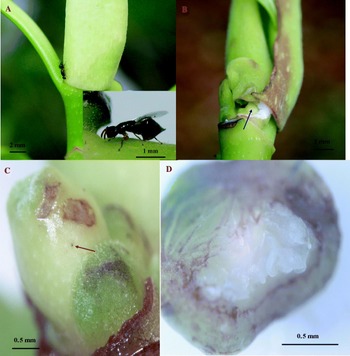
Sycophilomorpha sp. oviposited very early, when the new twigs appeared and the new leaves were still covered by their stipules (Fig. 1A). At this stage the new figs were covered by hood-like involucral bracts (Fig. 1B), and only approximately 1·43 mm in diameter. This is the only reported case of fig wasps ovipositing so early in the development of the syconia. Sycophilomorph sp. oviposited for several hours to 1 day on the same fig. When Sycophilomorph sp. finished ovipositing and left, a small black spot representing the scar left by the ovipositor could be seen on the fig under the microscope (Fig. 1C). Sycophilomorph sp. moved among a small number of figs to oviposit. When oviposited figs were opened, there was no discernible structure to the female flowers (i.e. ovary, style, stigma, pedicel and petal) under the microscope (Fig. 1D). The development of the figs with and without Sycophilomorph wasps was very long. For example, on 21 September 2009 Sycophilomorpha sp. was observed ovipositing on one tree but the pollinators did not enter the figs on the same tree until 10 January 2010 or over 3 months later. Figs with and without Sycophilomorpha sp. developed in synchrony. The galls made by Sycophilomorph had long pedicels and protruded into the fig cavity, but the gall flower had no style or stigma.
Oviposition behaviour of Sycophilomorpha sp. (A) When Sycophilomorpha sp. was ovipositing the fig was still covered by hood-like involucral bracts and the stipule. (B) The blue arrow indicates the position of the hidden fig. (C) The ovipositor pierced the fig wall and left a small black scar (red arrow). (D) The flowers in such young figs had not yet differentiated into ovule, style, and stigma.

Occurrence of Sycophilomorpha sp. in Ficus altissima
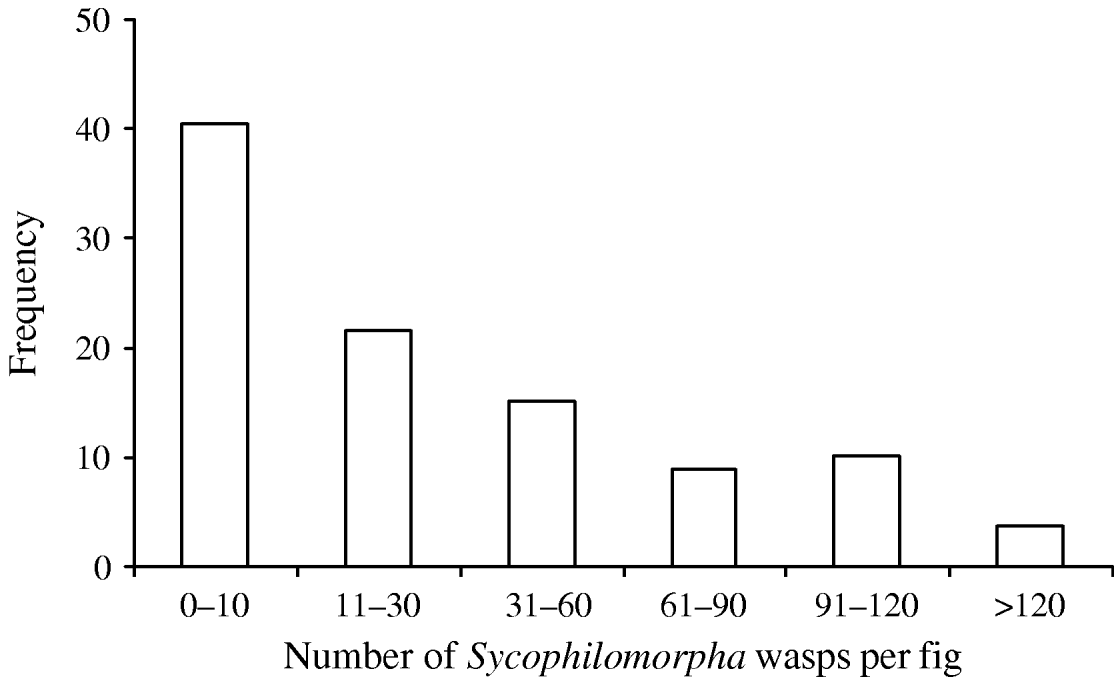
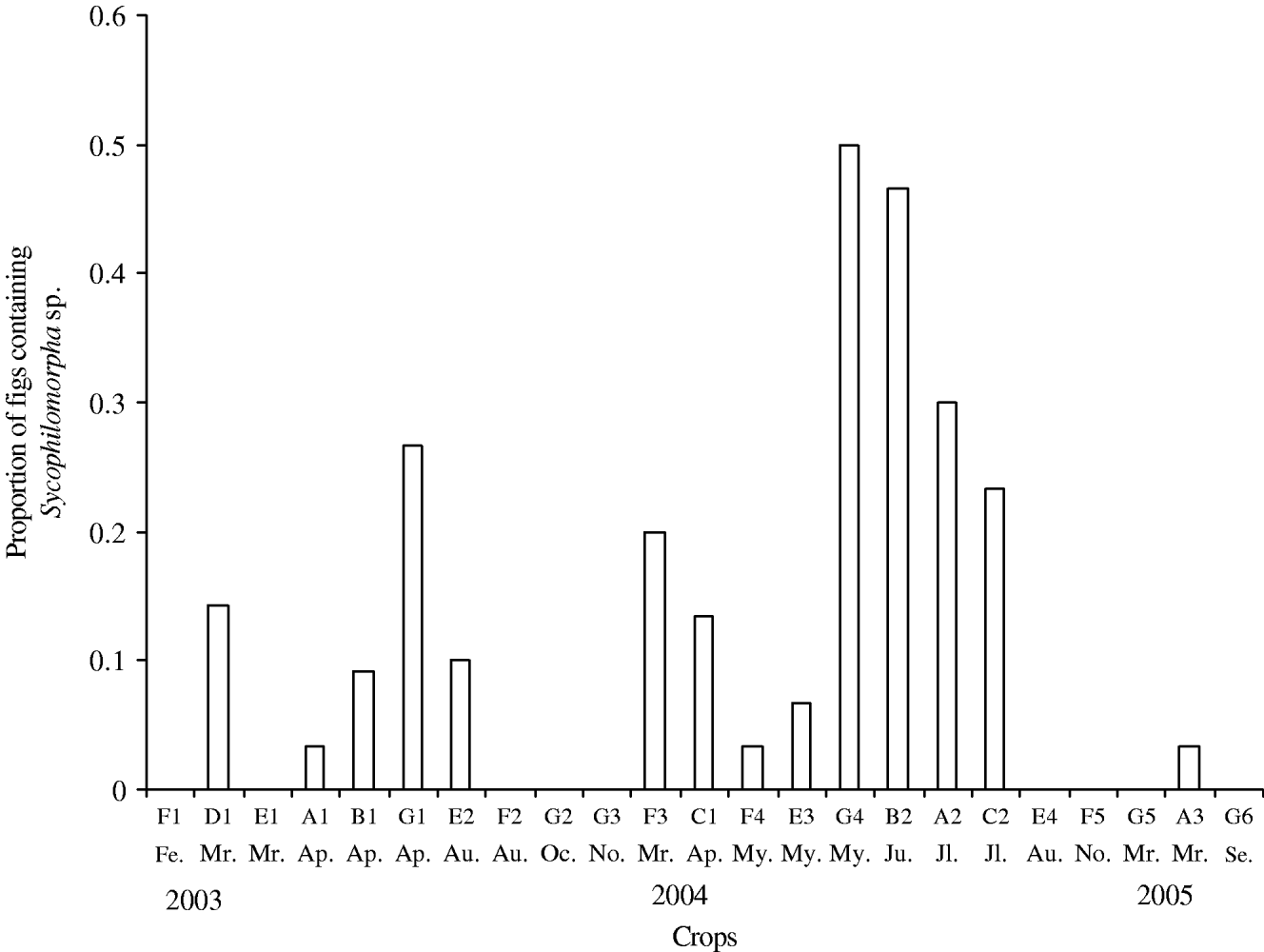
In total, 11·5% of figs were colonized by Sycophilomorpha sp. in F. altissima in Xishuangbanna, and varied from 0 to 50% among 23 crops. A single gall housed 1 Sycophilomorpha wasp. On average, the number of Sycophilomorpha wasps per occupied fig was 35·13±4·58 (s.e., n=79), the range was 1 to 172. By comparison, the average number of agaonid wasps per fig was 163·15±5·11 (s.e., n=312). About 40% of figs colonized produced less than 10 Sycophilamorpha sp. offspring, 45% of the figs produced 10–90 offspring, and 15% of the figs produced more than 90 offspring per fig (Fig. 2). Sycophilomorpha sp. naturally occurred in all 7 sampled trees, but the occurrence of wasps was significantly different among trees (z=3·487, P=0·00049) and crops (z=4·628, P<0·00001). The effect of month on the occurrence of Sycophilomorpha was also significant but was relatively weak (z=−2·079, P<0·05). Sycophilomorpha sp. were observed from March to August and the proportion of figs occupied was higher in 2004 (Fig. 3).
A frequency distribution of the number of Sycophilomorpha wasps per sampled fig.

Occurrence of Sycophilomorpha sp. among sampled crops (arranged chronologically). The uppercase letters represent the different trees and the number the sequential crop number on a particular tree.

The effect of Sycophilomorpha sp. on the fig-fig wasp interaction
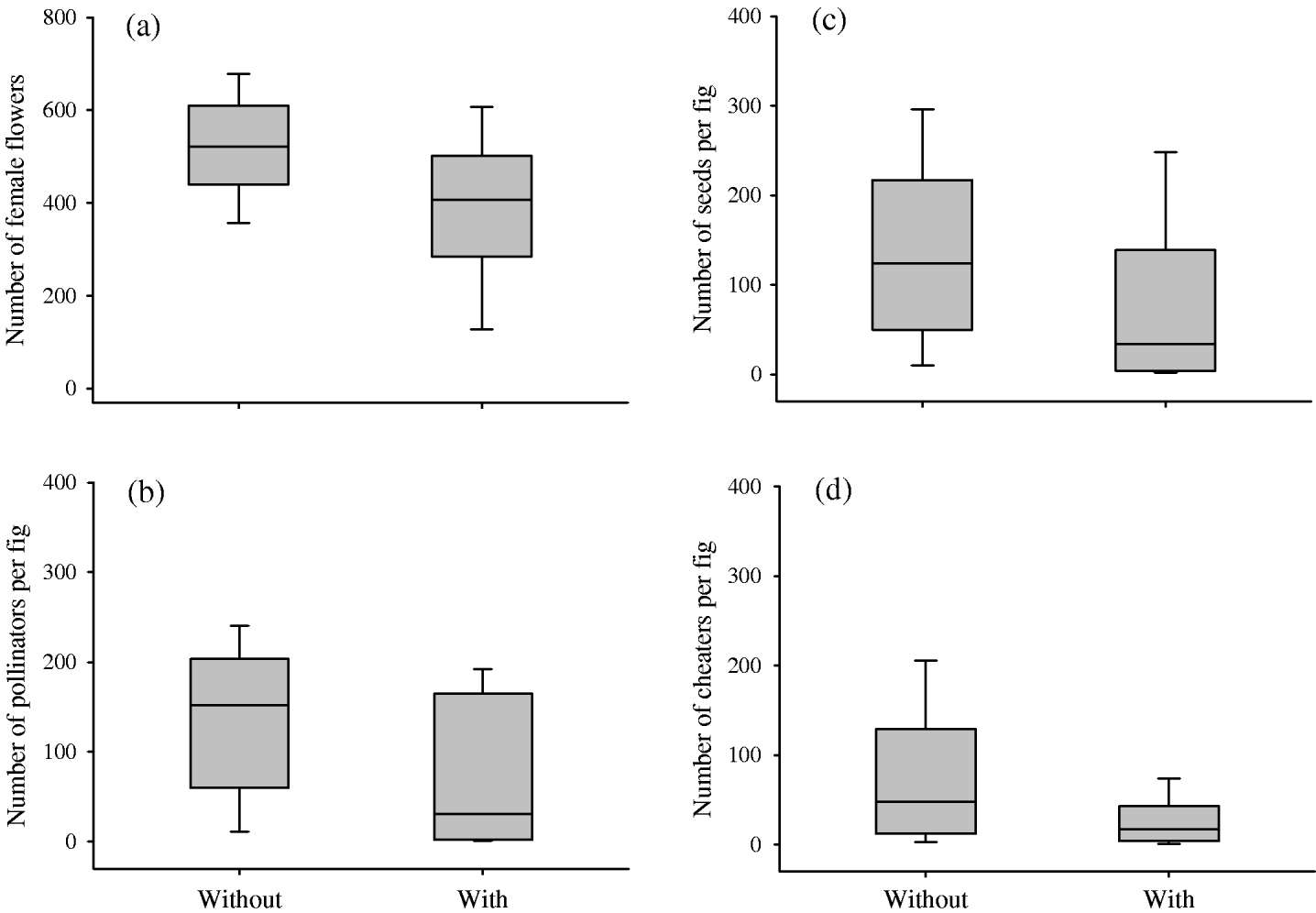
Figs with Sycophilomorpha sp. were small (mean diameter=11·19±0·23, n=50), and had significantly fewer female flowers (t=−6·92, d.f.=91·24, P<0·00001; mean=391·14) than figs without Sycophilomorpha sp. (mean diameter=12·38±0·20, mean number of flowers=520·55) (Fig. 4). Therefore, colonization by Sycophilomorpha sp. reduced fig size and the flower resources available for oviposition.
Comparison of fig contents with and without Sycophilomorpha sp. (without, n=600; with, n=79). (a) number of flowers, (b) the number of pollinators, (c) the number of seeds, and (d) the number of cheaters. The numbers of flowers, pollinators, seeds and cheaters were all significantly reduced in figs with Sycophilomorpha sp. (see text for details).

Sycophilomorpha sp. had a highly significant negative effect on the occurrence of pollinators (z=−8·408, P<0·00001) and seeds (z=−7·170, P<0·00001) after controlling for the effect of cheaters, and on cheaters (z=−8·588, P<0·00001) after controlling for the effect of pollinators. Thus, figs colonized by Sycophilomorpha sp. were less likely to be entered by either a pollinator or cheater.
Figs with Sycophilomorpha sp. had significantly fewer pollinators (t=−3·15, d.f.=15·66, P=0·0061, mean with=72·53, mean without=138·07), seeds (t=−2·73, d.f.=28·61, P=0·011, mean with=84·23, mean without=141·03), and cheaters (t=−5·93. d.f.=29·90, P<0·00001, mean with=26·83, mean without=79·07) (Fig. 4).
However, in figs with both Sycophilomorpha sp. and pollinators, seeds and cheaters, respectively, Sycophilomorpha sp. had a significant effect on the numbers of pollinators (z=−2·54, P=0·0119) but not seeds (z=0·862, P=0·409) or cheaters (z=−1·664, P=0·0962). Thus, while the presence or absence of Sycophilomorpha sp. had a significant effect on seed and cheater production, the abundance of Sycophilomorpha did not.
In summary, Sycophilomorpha sp. had a substantial detrimental effect on the reproductive success of F. altissima and its pollinator. Sycophilomorpha sp. occupied 11·5% of figs. Of these, 64% were not entered by a pollinator or cheater and Sycophilomorpha sp. was able to prevent these unpollinated fruit from being aborted. In the remaining figs colonized by Sycophilamorpha sp. and pollinators or cheaters the production of pollinators, seeds, and cheaters were all approximately half the normal levels. However, in these figs the abundance of Sycophilomorpha sp. only had a significant effect on the abundance of pollinators.
DISCUSSION
Sycophilomorpha wasps oviposited earlier in fig development than is reported for any other non-pollinating fig wasps (Weiblen, Reference Weiblen2002). At this stage, there was no discernible structure to the female flowers. This study also found that the immature phase of fig development is longer than previously reported. Sycophilomorpha wasps also influenced flower development preventing any differentiation into style and stigma.
Most of the non-pollinating fig wasps are rare and rarely abundant in any given fig (Weiblen and Bush, Reference Weiblen and Bush2002). Similarly, Sycophilomorpha sp. only occurred in 8 out of 23 crops and overall colonized 11·5% of sampled figs. However, Sycophilomorpha sp. sometimes laid large clutches in a single fig. More than 50% of the figs colonized by Sycophilomorpha produced more than 10 offspring, and occasionally over 100 offspring. In the figs with Sycophilomorpha sp., 64% of the figs only produced Sycophilomorpha offspring. This indicates that different non-pollinating wasp genera employ different reproductive strategies, despite having an apparently similar ecology in other respects.
Sycophilomorpha sp. naturally occurred in every tree, but the occurrence of wasps varied significantly among trees, crops and months. Over the 2 years of observation Sycophilomorpha sp. occurred from March to August. Our observations indicate that the development of Sycophilomorph wasps can be very slow, approximately 6 months from oviposition in September 2009 to emergence in March 2010. The duration of fig development in Ficus altissima varies widely depending on the season, and is longer in the winter when temperatures reach as low as 10°C at night than in the warm season (Peng et al. Reference Peng, Compton and Yang2010). It is not clear from our relatively short observation window, whether the absence of Sycophilomorpha wasps from September to March is just a stochastic effect of their long development or a strategy to avoid the coldest part of the year.
Non-pollinating parasitoids and gallers are species-rich components of fig wasp assemblages, and have negative impacts on the fig–fig pollinator mutualism through predation of pollinator larvae, through competition with pollinators for seed resources and through use of ovules that might otherwise become seeds (Compton et al. Reference Compton, Rasplus, Ware, Hawkins, Sheehan and 1994; West and Herre, Reference West and Herre1994; West et al. Reference West, Herre, Windsor and Green1996). Moreover, all non-pollinating fig wasps drain energetic resources from the host plant. If gallers oviposit before the pollinator, they may directly compete with the pollinator by reducing the number of ovules available for oviposition or indirectly by inhibiting the ability of the pollinator to lay eggs. In the case of F. altissima, when the pollinator entered a fig that had been colonized by Sycophilomorpha sp. they may have found it difficult to oviposit, because the galls of Sycophilomorpha protrude into the fig cavity. Inhibited movement by the pollinator within the fig cavity could also have a negative impact on seed production through reduced pollen dispersal, as appears to be the case in F. altissima. Sycophilomorpha sp., colonized 11·5% of figs, 64% of these figs did not produce any seeds or pollinators, and in those that were entered by an agaonid, figs with Sycophilomorpha sp. had significantly fewer pollinators, cheaters and seeds.
Through a differential effect on pollinators and cheaters it is possible that Sycophilomorpha sp. could affect the interaction between these competing species, possibly contributing to stable coexistence. However, in comparing the strengths of the effects of Sycophilomorpha sp. on these species, we find limited support for this. Sycophilomorpha sp. had an almost identical effect on both species in terms of the occurrence, which was the most important effect we measured. The presence of Sycophilomorpha sp. did have a stronger effect on the number of cheaters than on the number of pollinators when comparing figs with and without Sycophilomorpha sp. However, the abundance of Sycophilomorpha sp. had a significant effect on pollinator but not cheater abundance. Combined, these figures translate into a reduction in pollinator production of 1·92% and in cheaters of 2·70%. Thus, the percentage difference in the effect on pollinators and cheaters is just 0·78%. Given the high mortality rates of agaonids (approximately 99% died without reproducing), it is doubtful that such a small difference could be important.
Our study has shown that, despite their rarity, Sycophilamorpha sp. have a significant impact on the fig–fig wasp mutualism in F. altissima. Given the ubiquity of non-pollinating fig wasps, many of which are much more abundant than Sycophilomorpha, it is perhaps surprising that the fig–fig wasp mutualism is stable across so many species (approximately 800 spp. globally). A greater appreciation of the effects of non-pollinating wasps would enhance our understanding of the factors that have contributed to the evolutionary success of the fig–fig wasp mutualism.
ACKNOWLEDGEMENTS
We are most grateful to Jean-Yves Rasplus for identifying the fig wasp. We are also thankful to Cong Liu, and Shi-Bo Wu for field assistance. We further thank Zhu-Biao Duan, Dong-Hua Zhou, Zhi-Mei Zhou and Jin-Yuan Zhang for counting the wasps and seeds, and thank Allen Edward Herre and Steve Compton for their useful comments. This study was funded by the Chinese Natural Science Foundation (30670358, 30970439 and 30972294) and Presidential Foundation of the Chinese Academy of Sciences.