In December 2002, a hot public debate was triggered in China when a front-page article in the Beijing Youth Daily reported that recently published official guidelines for history teachers prescribed that Yue Fei (1103–42), one of China's most admired historical heroes, should no longer be called a “national hero” (minzu yingxiong) (Geng Reference Zhensong2002a, Reference Zhensong2002b; Shanghai Star 2003).Footnote 1 According to the Beijing Youth Daily, the problem with referring to Yue Fei as a national hero was that this title did not fit the contemporary official definition of the Chinese nation. The long-held view that Yue Fei had defended China against foreign invasion was no longer acceptable because Yue Fei's enemies, the Jurchens (Nüzhen), are considered today to be members of the Chinese nation (Wang Reference Hongzhi2000, 192). Thus, Yue Fei was disqualified as a national hero because he did not represent the entire Chinese nation as presently defined, but only one subgroup within the nation. As several sources made clear, the major rationale behind the change was a concern for China's “unity of nationalities” (minzu tuanjie), and apprehension that celebrating the legacy of the Han hero, who is known to have killed many of his non-Han enemies, might hurt the feelings of China's ethnic minority people, especially the descendants of the people he fought against.Footnote 2
The report in the Beijing Youth Daily created the impression that the stripping of Yue Fei's status as a national hero was totally new. However, a close examination of history textbooks and other related sources that have been published in China since 1949 reveals that the downgrading of Yue Fei's status actually dates back many years. Yue Fei was labeled a national hero in Chinese history textbooks only until the Cultural Revolution (1966–76). Then, in the few history books that were published toward the end of that period, not only was he not referred to as a national hero, but, in fact, he was severely criticized for being “a general of the landlord class” and for “suppressing peasant rebellions” (BJJB 1975, 131; SZJB 1973, 144–45). In the textbooks that were published after the Cultural Revolution, this class-oriented, revolutionary critique of Yue Fei disappeared, and he was rehabilitated. Nonetheless, in textbooks from that point on, he was never referred to again as a national hero.
In the teaching material of the late 1970s and early 1980s, no explicit prescription that Yue Fei should not be called a national hero was made, and no explanation was given as to why the editors of the postrevolutionary textbooks decided to delete the title in the discussion of Yue Fei. The prescription and the explanation appeared, however, in 1996, six full years before the Beijing Youth Daily published its “news” about Yue Fei. In an official study guide for high school history teachers, a senior editor named Yu Guiyuan prescribed:
Our country has been a multi-national state (duominzu guojia) since antiquity. Strengthening the education for the unity of nationalities … is important for maintaining the stability and unity of the nation … We label as “national heroes” only those outstanding figures, like Qi Jiguang and Zheng Chenggong, who represented the interests of the entire Chinese nation in resisting foreign invasion. As for outstanding figures like Yue Fei and Wen Tianxiang, although we acknowledge their position and the role that they played in resisting ethnic plunder and ethnic oppression, they cannot be referred to as “national heroes.” (Yu Reference Guiyuan, Jiaoyu and Jiaoyusi1996, 116–18)Footnote 3
The significant point about the stripping of Yue Fei of his national hero title, however, is not so much that it actually took place long before the Beijing Youth Daily published its provocative report. Rather, what is more significant is that this change was only the tip of the iceberg of a comprehensive reform of the discourse of ethnicity in Chinese history textbooks that started simultaneously with the launching of Deng Xiaoping's reforms in the late 1970s. Although much has been written about the changes that have taken place in China in the field of historiography since the end of the Maoist era (see, e.g., Bartlett Reference Bartlett2001; Chan Reference Chan1999; Dirlik Reference Dirlik, Dirlik, Bahl and Gran2000; Guo and He Reference Guo and He1999; Liu Reference Liu1981; Sullivan Reference Sullivan and Unger1993; Wang Reference Xuedian2004; Weigelin-Schwiedrzik Reference Weigelin-Schwiedrzik1987; Wright Reference Wright and Unger1993), to date little has been written about this particular reform.
The aim of this article is to analyze the change in the representation of non-Han peoples in Chinese high school history textbooks from 1949 to the present, with a particular focus on the reform that has taken place in this representation since the late 1970s and early 1980s. I will first argue that despite much evidence suggesting that at least during the 1950s, the Communist regime wholeheartedly adopted the notion of China as a multi-ethnic state, as manifested, for example, in the first People's Republic of China (PRC) constitution of 1954 and the “ethnic identification” (minzu shibie) project of the mid-1950s, high school history textbooks during that period and the rest of the Maoist era were still extremely Han-centric and treated non-Han peoples as non-Chinese others.Footnote 4 I will then argue that although the representation of non-Han peoples in history textbooks had begun to change by the mid-1950s, it was only in the beginning of the reform era that a more comprehensive and systematic change in that representation took place. This change was the result of a conscious effort by several powerful editors, who transformed the non-Han peoples in Chinese history from non-Chinese others into an integral part of the Chinese self by changing the content, language, and organization of previous textbooks.
The change in the attitude toward non-Han peoples that is evident in Chinese history textbooks of the last half century is not completely new. More than two thousand years ago, some non-Han peoples who were normally thought of as total others were sometimes represented as kin, an alternative representation that was designed, among other things, to legitimize Chinese expansion and conquest and to advance the assimilation of these peoples (Hinsch Reference Hinsch2004, 81–92, 102–3; see also Di Cosmo Reference Di Cosmo2002, 300). This dual attitude was revived two thousand years later, when China faced the transition from an empire to a modern nation-state. Chinese intellectuals and nationalist leaders living at the end of the nineteenth century and the beginning of the twentieth century clearly had a difficult time choosing between “ethnic/racial nationalism” (Dikötter Reference Dikötter1996; Shen and Chien Reference Shen, Chien, Chien and Fitzgerald2006), that is, a Han-exclusive, monoethnic/racial vision of China and Chinese identity, and a more pluralistic and multi-ethnic “state nationalism” (Chow Reference Chow and Dikötter1997; Duara Reference Duara1995, esp. 33–76; Hon Reference Hon1996; Leibold Reference Leibold2006; Schneider Reference Schneider1971, 258–93; Shen and Chien Reference Shen, Chien, Chien and Fitzgerald2006; Zhang 2002; Zhao Reference Zhao2006, 21–23).
The former was viewed as the best way to unite the majority of the population in China in order to overthrow the Manchu dynasty and to create a modern nation on which to found a modern nation-state (Chow Reference Chow and Dikötter1997). Moreover, many nationalist intellectuals and leaders at that time considered a nation-state composed of one ethnic group or race to be the ideal form of nationalism (Duara Reference Duara1995, 36–37; Gasster Reference Gasster1969, 78–79; Leibold Reference Leibold2006, 190; Zhang 2002, 107). On the other hand, there were those who realized that a multi-ethnic vision of China was necessary in order for the new Chinese nation-state to keep the territory of the Qing, about 60 percent of which was made up of non-Han regions. Inspired by the modern Western concept of citizenship (guomin) and led by the prominent intellectual Liang Qichao, this group of intellectuals and leaders adopted the notion that all people living within the boundaries of the state were citizens who not only were to enjoy rights, liberty, and equality, but also equally belonged to the nation. Indeed, from the turn of the twentieth century on, a growing number of Chinese intellectuals and political leaders started to think of China as a territorial entity, rather than or in addition to being an ethnic/racial or cultural entity, and thus of everyone living within this territory as Chinese (Fitzgerald Reference Fitzgerald and Unger1996, 67–68; Mackerras Reference Mackerras1994, 53; Rhoads Reference Rhoads2000, 291, 294; Shen and Chien Reference Shen, Chien, Chien and Fitzgerald2006; see also Choe Reference Choe2006, 90–92; Chun Reference Chun and Unger1996, 128–29; Shih Reference Shih2002a, 1–5, 22–24; Reference Shih, Goldman and Perry2002b, 234–37). It was in this context that Sun Yat-sen, who originally enthusiastically promoted an ethnic/racial, Han-exclusive vision of the Chinese nation, accepted the more inclusive and pluralistic concept of China as the “Republic of the Five Nationalities” (wuzu gonghe), and started to promote the notion of a “greater Chinese nation” (da Zhonghua minzu) that included not only the Han but also the non-Han peoples inhabiting China (Duara Reference Duara1995, 76, 142; Leibold Reference Leibold2006, 190, 206, 208). Despite these latter developments, the Nationalists were basically against the concept of China as a multi-ethnic state, and thus they adopted a policy of assimilation toward non-Han populations (Dreyer Reference Dreyer1976, 15–41; Mackerras Reference Mackerras1994, 53–78). The multi-ethnic view of China, however, was enthusiastically embraced by the Communists, who assumed power in 1949.
China scholars are well aware that it is widely accepted in China today that to be Chinese does not necessarily mean to be Han. However, much less is known about the process by which the multi-ethnic vision of China and Chinese identity was applied to Chinese historiography, and the process by which this historiography was canonized in China's educational system. The aim of this article is to analyze this process and to examine its implications for China's ethnic minorities and the Chinese state. In this study, I engage in a dialogue not only with scholars of Chinese historiography, but also with scholars who focus in their research on China's ethnic minorities. In the last decade and a half, the latter group has produced an impressive body of literature on representations of non-Han peoples in contemporary Chinese culture and demonstrated that these representations often tend to overemphasize their otherness (Baranovitch Reference Baranovitch2001, Reference Baranovitch2003; Clark Reference Clark1987; Gladney Reference Gladney1994b, Reference Gladney1995; Louie Reference Louie1992; Schein Reference Schein1997). In arguing that Chinese history textbooks in China display a clear evolution from an exclusivist historiography, in which the non-Han peoples constitute non-Chinese others, to an inclusive, multi-ethnic historiography, in which these peoples are fully incorporated into the Chinese self, this article does not necessarily negate the validity of the aforementioned studies. However, it hopes to place some of the conclusions that appear in these studies in a broader and more accurate framework by demonstrating that in contemporary China, along with representations that stress the otherness of minority peoples, there are also contrasting narratives and representations that stress their belonging to the Chinese self. I propose that in order to gain a better understanding of China's ability to maintain its political unity, we ought to pay more serious attention to these narratives of belonging, rather than focus exclusively on practices of othering.
A Note on Methodology
The bulk of this article is based on a comparison of three history textbooks for senior high schools that were published in China from the early 1950s to the present and represent three different phases in the evolution of the discourse of ethnicity in Chinese history textbooks. In addition, the article also draws on teaching guidelines, study guides, and reference books for history teachers, as well as the writings of scholars and editors who played an active role in inspiring and implementing the reform. Most of the sources chosen for analysis were published by the People's Education Press (Renmin Jiaoyu chubanshe) in Beijing. Given that this press has dominated the writing and publication of history (and other) textbooks since the founding of the PRC, the texts examined in this article not only represent the mainstream in history writing in China, but also constitute some of the most widely read historical texts in the country.
The Textbook of 1951: Non-Han Peoples as “Foreigners” (or Chinese History as the History of the Han People)
Despite the fact that since the late nineteenth century and early twentieth century the notion of China as a multi-ethnic state had started to gain popularity among Chinese intellectuals and political leaders, historiographical writing during the Republican era was dominated by Han-exclusive narratives that perpetuated the ethnic/racial nationalism that led to the overthrow of the Qing Dynasty in 1911. In the earliest history textbooks of the PRC, there is a clear continuity with these narratives, in part because during the early years of the new state, the new educational system used history texts from former Guomindang-controlled areas (Su Reference Shoutong1984, 81). These texts establish a clear dichotomy between the Han people (referred to in earlier periods as “Hua”), an advanced, agricultural people who inhabited the Central Plains, and all the other ethnic groups in the region, who are referred to as backward nomads. The texts use the terms “Han people” (Hanren) and “Chinese people” (Zhongguoren) interchangeably, so that “China” (Zhongguo) and Chinese culture are associated exclusively with the Han, while all the other peoples are referred to as “foreign peoples” (yizu or waizu). The frequent use of the terms “in” or “internal” (nei) and “outside” or “foreign” (wai) to refer to the Han and the non-Han, respectively, reinforces the dichotomy by establishing a clear spatial distinction between us and them. The distinction is further reinforced by the use of the term “invasion” (qinru or qinlüe) to depict the attacks of the non-Han peoples on the Han, a term that presupposes a clear physical boundary. The dominant relations between the Han and their neighbors in the 1951 textbook are usually of conflict. The latter are often referred to as “enemies” (di), and the discussion of their relations with the Han appears under titles such as “The Inter-Ethnic Struggle” (minzu jian de douzheng) or “The Invasion of Foreign Peoples” (waizu de qinru).
The 1951 textbook suggests that China had become a unified nation-state of the Han people already by the time of the Qin dynasty. Indeed, the text implies not only that the Qin unified China politically, but that the unification of the different states “inside China” was also an “ethnic unification” (minzu tongyi) of the Han people. Hence, when the text suggests that the Qin established a “nation-state” (minzu guojia), it makes clear that this state was monoethnic. To establish further the notion that the people who inhabited the territory that came under Qin rule were ethnically homogeneous, the text emphasizes that just before the Qin unification, the non-Han peoples (read non-Chinese) who inhabited this territory, and to whom the text refers as “foreign peoples,” almost became extinct (see QHRZJJBW 1951a, 37).
A similar narrative is also found in the discussion of the first and second millennia ad. The distinction between the Han, who are interchangeably referred to as “Chinese,” and all the other peoples, who are referred to as “foreign peoples,” is used here as an important basis for the organization of the text and the chronological division of Chinese history. There are those periods in Chinese history in which China was ruled by the Chinese themselves, and other periods in which it was ruled by “invading” “foreigners” who came from outside China (QHRZJJBW 1951a, 61, 101). That Chinese history is seen only as the history of the Han people is also evident in the fact that, with the exception of the Yuan and the Qing, non-Han regimes are normally discussed in brief and only in the context of the relationship that the contemporaneous Han regime had with them. Thus, for example, the discussion of the Liao, Xia, and Jin, which the Khitans (Qidan), Tanguts (Dangxiang), and Jurchens established, respectively, appears as part of the chapter on the Northern Song under a subsection entitled “The Foreign Aggression (waihuan) during the Northern Song” (QHRZJJBW 1951b, 2).
The otherness of non-Han peoples is also constructed in the 1951 textbook through extremely negative depictions, in which they appear not just as nomads living a backward life, but also as aggressive and brutal, destructive, and morally inferior. These peoples not only “invade,”Footnote 5 but also “brutally massacre” (cansha or tusha), “take masses of captives” (fulu daliang nannü), “loot” (lüeduo), and “destroy” (pohuai or cuihui). Consistent with this negative representation, the evaluation of the periods in which China was ruled by these “foreign peoples” is also extremely negative. These periods are depicted not only as periods of extreme suffering for the Han (read Chinese) people but also as periods in which China suffered major objective setbacks in all domains. The discussion of the Yuan dynasty is representative:
From the point of view of the Mongols, collecting taxes and slaughtering and plundering (shalüe) were activities that were similar in nature and varied in name only. Therefore, politics was much more corrupt and violent than in any other period. Not only did the declining economy in the regions of northern China continue to be destroyed, but the economy of the south that was in the midst of development [under the Song] also suffered severe destruction (qianglie de cuihui), and sank into stagnation (tingzhi). The ruling of China by the Mongolian people brought incomparable disaster (wubi de zaihai) to Chinese society. (QHRZJJBW 1951b, 153)
Although there are several points of light in the discussion of the Yuan, these are mentioned in passing and very briefly and remain extremely marginal in the comprehensive attack on this “foreign” dynasty.
The History Textbook of 1956: Non-Han Peoples Still as Non-Chinese Others Despite Ambiguities
The textbook of 1956 was the first to be completely produced under the new Communist regime (Su 1984, 83), and as such, it reflects the new emphasis on a Marxist worldview and the notion of China as a multi-ethnic state. The emphasis on China's multi-ethnicity derived in part from Soviet influence and the internationalist ethos of Marxism, and in part from the special relationship that the Communists developed with the non-Han populations prior to 1949 (Dreyer Reference Dreyer1976, 63–92). Another reason for this emphasis may have been the fact that the Communist regime was able to establish de facto Chinese sovereignty in the large non-Han areas that the Nationalists could only claim as part of the republic without being able to turn such claims into a reality. This new political reality required a new approach to non-Han populations, and as a result, in history textbooks from the mid-1950s on, the otherness of non-Han peoples was weakened thanks to several important changes that were introduced in the new texts.
Most importantly, the new textbooks seem to have completed their adaptation to the Marxist paradigm of history, so that class categories and the theme of class struggle started to dominate the historical narrative at the expense of all other categories and themes, including those of ethnicity/nationality and ethnic conflict, which were strongly emphasized in the 1951 textbook.Footnote 6 As part of this change, the new textbooks usually no longer refer to entire ethnic groups as such, but rather to different social classes within those groups. Alternatively, the books may make references to the names of the polities that these groups established or to the governments or the armies of those polities. Thus, in the discussion of the Yuan dynasty, for instance, the 1956 textbook no longer refers to the “Mongols” or the “Mongolian people” (Mengguzu), but rather to the “rulers” or the “ruling class of the Yuan dynasty” (Yuan tongzhizhe, or Yuanchao tongzhi jieji), which according to the text included not only Mongolian aristocrats but also people from other ethnic groups, among them Han landlords. In a similar vein, references are often made in the new textbooks to the “common people of various ethnic groups” (ge zu renmin), and instead of “Han resistance” (Hanzu de fankang) (see QHRZJJBW 1951b, 164), the text refers to multi-ethnic “peasant uprisings” (nongmin qiyi) (Chen et al. Reference Lesu1956, 105–6).
Consistent with this change was the creation of a new narrative, according to which the “oppression” during the Yuan dynasty that was described in detail in the 1951 textbook was not so much “ethnic oppression” (minzu de yapo; QHRZJJBW 1951b, 149) of the Han people by the Mongols, but rather class oppression, in which an ethnically mixed ruling class “oppressed the common people of the various ethnic groups” (zhenya ge zu renmin) (Chen et al. Reference Lesu1956, 102). This crisscrossing of class and ethnicity resulted in the weakening of the mutually exclusive ethnic categories and boundaries that prevailed in the 1951 textbook and blurred the clear-cut distinctions between the Han and the non-Han that were strongly emphasized in it.
Another major change in the new textbooks is that in most cases, the terms “Han” (or Hua) and “Chinese” are not used interchangeably anymore, and non-Han peoples are no longer referred to as “foreigners.” Similarly, the clear-cut spatial dichotomy between the “domestic” (or “internal”) and the “foreign” (or “external”) that was so prevalent in the 1951 textbook whenever references were made to the Han people and their territory as opposed to the non-Han peoples and their territories, respectively, often becomes blurred and ambiguous. Consistent with these changes, Chinese history in the new textbooks is no longer divided, as it was in the 1951 textbook, into periods in which China was ruled by the Han/Chinese themselves and other periods in which it was ruled by non-Han/foreign peoples.
In another related contrast to the 1951 textbook, the textbook of 1956 does not attempt to establish that the Qin unification of China in the third century bce resulted in the establishment of an ethnically homogeneous nation-state of the Han people. The new textbook not only avoids such an assertion, and avoids referring to the Qin as a “nation-state” (minzu guojia), but also chooses instead to acknowledge the existence of various non-Han peoples in Qin territory. Nonetheless, it still attempts to diminish the differences between the Han and the non-Han peoples and to establish that they all shared a common writing system and “more or less the same culture” (Qiu, Chen, and Wang Reference Qiu Hansheng, Chen Lesu and Wang Lu1956, 74).
Along with these changes, the 1956 textbook also tends to soften the extremely negative depictions of non-Han peoples that were found in abundance in the earlier textbook. For example, whereas the 1951 textbook claimed that “when the Mongolian soldiers attacked cities … [they] massacred the people, and kept only the craftsmen alive” (QHRZJJBW 1951b, 163), in the 1956 textbook, the part about the massacre is deleted. Instead, the text reads that “when the Mongolian army attacked a city, they captured and took away the craftsmen and made them work [for them]” (Chen et al. Reference Lesu1956, 103).
Finally, in another striking change, in several cases in the 1956 textbook, non-Han peoples receive more serious attention compared with earlier textbooks. Their history and culture are discussed in more detail, and more names of the polities that they established appear in the table of contents and in the titles of parts and chapters of the book, alongside the names of polities established by the Han. For example, whereas in the 1951 textbook, the Liao, Western Xia, and early Jin were completely absent from the table of contents and were mentioned only briefly in the main text in a section entitled “Foreign Aggression during the Northern Song” (Bei Song waihuan), they now appear in the main title of the relevant part (part 6 in the 1956 textbook) alongside the Song in the following way: “Song, Liao, Xia, Jin, Yuan” (without commas in the original)(Chen et al. Reference Lesu1956, 1). This new representation not only symbolically upgraded the non-Han polities, but also, more importantly, implied that these polities were accepted, at least more than before, as part of Chinese history and not just as external others with whom the Song, as the only Chinese polity, had to deal.
Nonetheless, the Song is clearly still privileged even in this title, as it appears first in the list despite the fact that it was established more than half a century after the Liao (960 and 907, respectively). Moreover, in the title of the first chapter in part 6, there is a clear perpetuation of the earlier distinction between the Han polity and the non-Han polities. In this title, which reads “Northern Song—–The Relations of the Northern Song with the Liao, Xia and Jin” (the hyphen represents a space in the original) (Chen et al. Reference Lesu1956, 1), the Song is set apart graphically by a space from the names of the non-Han polities, all of which are lumped together at the end of the title. This title delivers a contradictory message to the one communicated in the previous title (of part 6). It not only diminishes the importance of the Liao, Western Xia, and Jin, and makes it clear that history is still told from the point of view of the Song, and that the non-Han polities are interesting only as far as their relationship with the Song is concerned, but also positions the former as categorically different from the Song.
The different representations of the Song, Liao, Western Xia, and Jin in the table of contents of the 1956 textbook illustrate the many ambiguities and inconsistencies that prevailed in the treatment of non-Han peoples in history textbooks from the mid-1950s on. However, despite these ambiguities and the blurring of the ethnic divide between the Han and the non-Han, in the final analysis, China and Chineseness are still identified in these texts with the Han, even if less explicitly, whereas the non-Han peoples still constitute the non-Chinese others. Consider, for example, the following sections from the discussion of the Manchu conquest of China in the seventeenth century. These sections illustrate the continuing unequivocal Han subjectivity that dominates the text and the continuing othering of the non-Han peoples:
Shi Kefa died heroically for the country (zhuanglie xunguo) … [He] dedicated his own life to defending the motherland (baowei zuguo). [In this he] demonstrated the noble national moral courage (minzu qijie) and played an inspiring role in the development of the struggle of resistance against the Qing. (Chen et al. Reference Lesu1956, 148)
The Qing army … ordered the shaving of [peoples'] heads … Leaving all the hair on one's head was the practice of the Han people. Shaving the hair from all sides of the head and leaving a pigtail in the middle was the style of the Manchu people. Thus, forcing the shaving of heads actually meant forcing the Han people to obey the rule of the Manchu aristocrats … The people rose up everywhere in revolt against the rule of the Qing army. (Chen et al. Reference Lesu1956, 148)
The peasant army of the southwest resisted the Qing persistently for twenty years … and demonstrated the strong and indomitable will of the Chinese people (Zhongguo renmin) to resist invasion. (Chen et al. Reference Lesu1956, 150)
Although, unlike the 1951 text, the textbook of 1956 avoids referring to the Qing as a “foreign” regime by name, it still represents the Manchu dynasty as such by associating it with “invasion” (third passage), a term suggesting that this regime came from outside China. That the Qing was indeed a foreign dynasty, even though it is not referred to as such explicitly, is further established in the same passage in the statement that “the Chinese people” resisted its invasion. The non-Chinese identity of the Qing is also communicated in the first passage. Shi Kefa was a Han general of the Ming dynasty who fought against the Qing, and in suggesting that he defended “the motherland” rather than the Ming dynasty, the text implies that the Ming was in fact China, whereas the Qing was not. Unlike the 1951 textbook, the 1956 textbook does not refer to the Qing dynasty as the “Qing of the Manchu” (Man Qing; QHRZJJBW 1951b, 235) and does not speak about the “invasion of the Manchu people and the resistance of the Han people” (QHRZJJBW 1951b, 5). Yet, because the text does make clear that the Qing was established and ruled by the Manchus, the latter become, by implication, non-Chinese and strangers to “the motherland,” just like the dynasty that they established.
That Chinese history was still perceived by the editors of the 1956 textbook as the history of the Han people is also implied by the continuing positive representation of the Han and the negative representation of the non-Han. Although the 1956 textbook deleted the most extremely negative elements from its depictions of the non-Han peoples, the latter are still often demonized. In addition to being described as “invaders,” thus suggesting that they were not only outsiders but also aggressors, they continue to be described as brutal savages who kill masses of people, behave “cruelly and ferociously” (canbao), and “pillage” (lulüe) and “destroy.” The Han, on the other hand, are not only referred to repeatedly as “patriots” (aiguo) who “defend the motherland” and have “national moral courage,” but are also depicted as “heroes” (yingxiong) who fight “heroically and bravely” (yingyong) while demonstrating “perseverance” (jianchi), and as those who “sacrifice their lives” (xisheng) to protect “the motherland.”
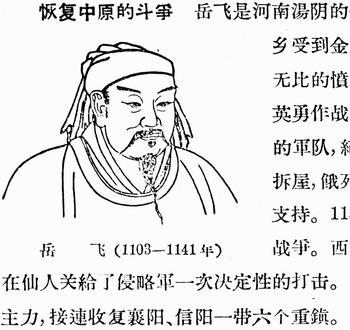
The discussion of the war between the Southern Song and the Jin illustrates the diametrically opposed ways in which the Han and the non-Han are represented. After describing how “in 1129, the Jin army … invaded the south,” how the south “suffered the most severe destruction (ji yanzhong de pohuai) by the Jin army,” and how, as a result, “everywhere people rose up to launch a counterattack against the ferocious enemy (xiong'e de diren)” (Chen et al. Reference Lesu1956, 85), the text proceeds to describe the heroic deeds of Yue Fei. Yue Fei and his struggle of “resistance against the Jin” (kang Jin) are described in no less than one and a half pages, and he is awarded the rare privilege of having his portrait added to the text. The text introduces Yue Fei in the following words: “His hometown suffered cruel destruction (canku pohuai) at the hands of the Jin army, creating in him unparalleled furious resentment” (Chen et al. Reference Lesu1956, 86). It then goes on to describe how Yue Fei fought “heroically” against the Jin (Chen et al. Reference Lesu1956, 86), and after referring to him and two other generals as “patriotic” generals, the discussion ends by labeling Yue Fei a “national hero.”Footnote 7
In the 1956 textbook, as in the text from 1951, the otherness of non-Han peoples also manifests itself in the negative evaluation of the influence that their regimes had on the development of Chinese history. The depiction of the Yuan dynasty is representative of this tendency. As part of the changes mentioned earlier, the 1956 senior high textbook gives more credit to the Mongolian dynasty than its 1951 predecessor. The text mentions, for example, that the Yuan unified China and that it established several important administrative systems and organs. It also suggests that during that period there was “progress” (jinbu) in the handicraft industry, and, in complete contrast to the 1951 text, it also states that commerce “developed” (fada), especially foreign trade via the sea (Chen et al. Reference Lesu1956, 100–4). However, these positive developments are still deemphasized, being mentioned in brief and most often in passing in the context of an overall extremely negative assessment, which is still very similar to the one found in the 1951 textbook. The very first section in the discussion of the Yuan, for example, is entitled “The Oppression of the People by the Yuan Rulers,” a title that already sets the negative tone for the rest of the discussion. This title is followed by frequent references to the “corruption” (tanwu) of the “Yuan rulers,” but more importantly, the discussion suggests several times that during the Yuan reign, Chinese society suffered oppression that was “unprecedented in its cruelty” (kongqian canku), and that economics in general and agriculture in particular suffered “the most severe destruction in [Chinese] history” (wo guo lishi shang shengchan shoudao zui yanzhong pohuai) (see Chen et al. Reference Lesu1956, 105–6, 109, 117–18). Because agriculture has always been one of the most important markers of Chinese identity, as opposed to the nomadic way of life of China's barbaric neighbors, the emphasis on the destruction of agriculture during the Yuan helped establish the otherness of this dynasty.
That the Yuan dynasty was seen as a foreign regime is also implied by the fact that much of the chapter dealing with it is dedicated to positive depictions of Han resistance. While Kublai Khan, the Mongolian founder of the dynasty, is noted only in passing, as the leader of the “enemy” (Chen et al. Reference Lesu1956, 98), without even a mention of the years in which he lived or reigned, Wen Tianxiang, the famous “general of the Southern Song,” by contrast, is discussed in a lengthy paragraph that extols his “patriotism” and “unyielding bravery” (yingyong bu qu). Moreover, like Yue Fei, he is also awarded the privilege of having his portrait added to the text together with a mention of the years in which he lived (Chen et al. Reference Lesu1956, 99). This differential representation suggests that Wen Tianxiang was one of us, while Kublai Khan and the dynasty that he established (the establishment of which is mentioned only in passing) were not Chinese even though they ruled China.
Reforming the Representation of “Minority People” in the History Textbooks of the Post-Mao Era: The Guiding Principles
The textbooks of old China called the Khitan and Jurchens “foreign peoples” and “outside peoples” and called the war that they started with the Song the “invasion of China.” But today's textbooks consider the Khitan and the Jurchens members of the Chinese nation (Zhonghua minzu). The two states of Liao and Jin are two dynasties in the history of China. Therefore the wars between the Liao and Jin and the Song are internal disputes (neibu zhengduan) among ethnic groups who are part of the Chinese nation. They are disputes among several political powers that existed simultaneously inside China's territory.
—Wang Hongzhi, senior editor at People's Education Press (Wang 2000, 192)The reform of the discourse on ethnicity in Chinese history textbooks was a well-planned project that involved the most senior editors at People's Education Press. In addition to writing and editing the textbooks themselves, these editors have also published articles and books describing the rationale for the reform, their intentions and aims, as well as the guiding principles that underpinned their revisions. The writings of the vice general editor of the press, Wang Hongzhi, whom I quote at the beginning of this section, are particularly illuminating. Wang has participated in the editing and writing of many of the textbooks produced since the late 1970s, and also edited parts of the 2003 history textbook that will be discussed in detail later.
Wang traces the origin of many of the new ideas that relate to ethnicity, which she and her colleagues applied in the writing of the new textbooks, to an article written in 1961 by the famous historian Jian Bozan (1898–1968), under whom she studied at Beijing University (Wang 2000, 218). The most basic among these ideas is the notion that China “has been a multi-national state since antiquity (zigu yilai)” (emphasis added). Another related idea is that all the ethnic groups in China are, and have always been, Chinese, despite the fact that each of them is a different nationality:
Our country has been a multi-national state since antiquity. Besides the Han nationality, there are also many other nationalities. As a nationality, each of them is a nationality, but as members of a multi-national state they are all Chinese. Therefore, when we write the history of China, we have to be careful not to separate the history of the people of the Han nationality from the history of all other nationalities. (Jian Reference Bozan1961; cited in fragments in Wang 2000, 219, 223)
In the early 1980s, inspired by Jian's 1961 article, Wang began to develop the ideas discussed in that article and to rearticulate them in her own words:
Our country is historically a multi-national state. All the nationalities have made contributions to the development of the history of the motherland. (Wang 2000, 180)
In Chinese history, besides describing the history of the Han nationality, one should also describe the history of minority nationalities, and show that the history of the motherland was created together by the people of all nationalities. (Wang 2000, 188)
Without the history of minority nationalities, one cannot speak about Chinese history … The teaching of history must include the history of the nationalities; otherwise the students will not be able to learn the true history of China. (Wang 2000, 201)
One major problem that the historians and editors of history textbooks faced in their effort to construct an inclusive, multi-ethnic concept of Chinese history was the question of what exactly constituted China at each given point in history. This question was crucial because it determined which ethnic groups should be included in the historical narrative as part of the national self and which should not. The solution to this problem was offered by another important source of inspiration that Wang and other editors repeatedly cite in their writings, namely, the prominent historian Fan Wenlan (1891/3–1969), who wrote some of the most widely used and influential history books in China after 1949. Explaining why a certain history textbook included a discussion of the Tibetans (Tufan/Tubo) in its chapter on the Tang dynasty, despite the fact that Tibet was not part of Tang territory, Wang cites Fan, who wrote, “The historical territory of China includes both the dynasties of the Central Plains and the states that minorities established independently” (cited in Wang 2000, 224).
This statement is of great importance, and it has been generally understood by the editors of history textbooks and other Chinese historians to mean that historical China should be regarded as everything that existed in the past on the territory that is China today. This point is made clear by Jian Bozan, who wrote, “Do not treat all the nationalities that are not Han as foreign peoples (waiguoren). [We] have to acknowledge that all the ancient nationalities that ever lived and were active within the present-day territory of China (jinri Zhongguo lingtu yinei) were all Chinese, no matter what relations they had at that time with the dynasties of the Central Plains” (Jian Reference Bozan1997, 63). In the late 1970s and early 1980s, the notion that everything that existed in the past on the territory of present-day China should be regarded as Chinese became central to the historical narrative in high school textbooks, thus implying that it became a central component in the contemporary Chinese nation-building project.
This concept of historical China is a typical example of the tendency of nationalist historians to project the present into the past in order to legitimize the state and the nation as they exist today. Like many other nationalist historical narratives, this concept assumed a simplistic, linear continuity and treated China as an ancient entity that had existed almost unchanged from time immemorial (zigu) to the present. It ignored the fact that “China” was and meant different things at different times, and suppressed many uncomfortable historical events and facts that challenged the new narrative. Most importantly, the vision of China as always having been what the PRC is now, territorially and ethnically, ignored the crucial fact that, with a few exceptions, the territorial boundaries of the PRC were based on those established by the Qing empire after its extensive conquests of the mid-eighteenth century. The new vision also ignored the disturbing question of whether the Qing was indeed China. Some Western scholars have suggested recently that the Qing was actually a Manchu empire in which China (defined as the territory occupied predominantly by Chinese speakers) constituted only one component (Elliott Reference Elliott2001, 5; Rawski Reference Rawski1996, 832, 841). It is important to emphasize that this understanding of the Qing and its relationship to China is not new and certainly not confined to contemporary Western scholars. The same understanding was also shared by prominent Chinese revolutionaries in the late nineteenth and early twentieth centuries, some of whom promoted the notion that the territory of the new republic should be confined to China proper, or more specifically, only to the territory of Han-ruled dynasties in China's past. Some also promoted the idea that the alien Manchus should be expelled from China and establish their own nation-state in Manchuria (Rhoads Reference Rhoads2000, 293; Shen and Chien Reference Shen, Chien, Chien and Fitzgerald2006, 57; Zhang 2002). The largest non-Han populations who were incorporated into the Qing empire had similar reservations regarding the equation of the new republic with the Qing. These communities did not consider themselves to be part of Zhongguo (China), and thus after the fall of the Qing sought independence from the new republic (Duara Reference Duara1995, 76, 142; Rawski Reference Rawski1996, 840; Rhoads Reference Rhoads2000, 294).
Another major problematic claim included in the vision of China as always having been what it is in the present is the idea that China has always been a multi-ethnic state. Again, similar to the claim regarding China's territory, this claim ignored the relatively recent origins of the concept of a multi-ethnic state in the Chinese context and the fact that it derived from mid-Qing ideology and policy, being intimately connected to the Qianlong emperor and his particular vision of universal rulership (Crossley Reference Crossley1989, 64–65; Reference Crossley1990, 22, 29; Rawski Reference Rawski1996, 834–35; Rhoads Reference Rhoads2000, 293–94; Zhao Reference Zhao2006).
Ignoring all these uncomfortable historical and historiographical complexities, from the late 1970s and early 1980s on, history textbooks began to discuss all the non-Han ethnic groups that in the past had inhabited the territory that was China at the present as Chinese, and the main effort became to push the links between the Han and the non-Han peoples further and further back in time. The claims that historical China was a reflection of present-day China and that non-Han regions and their native non-Han populations had been “inseparable parts of our [Chinese] motherland since antiquity” were not totally new (see Bovingdon Reference Bovingdon2001, 116; Feuerwerker Reference Feuerwerker and Feuerwerker1968, 24; Schneider Reference Schneider1971, 260). However, it was only from the beginning of the reform era that these claims were fully and systematically incorporated into Chinese history textbooks as part of a new, coherent, multi-ethnic master narrative of Chinese history.
As part of the effort to incorporate non-Han peoples and their histories into the Chinese self and its history, Wang Hongzhi and her colleagues at People's Education Press adopted another central idea of Fan Wenlan, namely, that wars fought in the past between the different peoples that inhabited the territory that was now China were like “a quarrel between brothers, and a scuffle in the family” (xiongdi xiqiang jiali dajia). Fan's metaphor not only affirmed that non-Han peoples were insiders, or part of China's “big family of many nationalities” (duominzu de jiating), but also had the effect of belittling these historical conflicts. Indeed, in the reform era, it became a major principle in the writing of history textbooks to deemphasize conflicts between the Han and the non-Han and instead to emphasize cooperation, peace, and merging.
Fan Wenlan's metaphor also made the interethnic conflicts between the Han and the non-Han categorically different from conflicts that the Han had with those who were not members of the “family.” This new distinction became the basis for an important change in the terminology of the textbooks of the reform period. From this point on, the word “invade” was strictly avoided when references were made to the military attacks that the non-Han peoples launched against the Han. Given that the term suggests two distinct entities and an outsider who is entering a territory not of its own, and that using it would imply that the non-Han peoples were foreigners, the term was avoided in order not to subvert the notion that the Han and the non-Han belonged to the same “family.” This rationale is explained in detail in the following paragraph by another senior editor at People's Education Press, named Zang Rong:
We ought to pay special attention to making a clear-cut distinction between the wars among the various nationalities in the history of our country and the wars in which the various nationalities of our country jointly fought against foreign invasion. The former is an internal matter among the various nationalities in our country, exactly as comrade Fan Wenlan said in those years: “a quarrel between brothers, a scuffle in the family” … [I]n defining and narrating [the former] one absolutely cannot use the words “invade” and “resist invasion.” The latter is a matter in which the people of the various nationalities in our country resisted a foreign invading power, and is essentially different from the internal struggles among the various nationalities within our country. (Zang Reference Rong, Jiaowei and Jiaoyusi1992, 76)
Another important principle that guided the construction of the new discourse on ethnicity was the “principle of equality” (Wang 2000, 206). Wang suggests that the new textbooks avoid the tendency, found in earlier textbooks, to narrate history exclusively from the point of view of the Han while ignoring the perspective of the non-Han peoples (Wang 2000, 180–81, 188–90, 206–9, 231–32). She also observes that the new textbooks pay more attention to the history of non-Han peoples, their heroes, and their contributions to Chinese history:
In the history teaching of old China, the majority of the patriots and national heroes were of the Han people and there were very few or almost no minority ones. This kind of patriotic education is not complete. The patriotic education that we want to practice today with students is that which would make them love wholeheartedly the unified, multi-national, socialist motherland. In order to reach this goal, [we] have to speak about the history of the nationalities. By speaking about the brilliant history of the various nationalities, their heroes and inventions, and by speaking about the contribution that the various nationalities made in every regard to the creation of the great motherland, [we] make the students understand that the unified, multi-national, flourishing motherland of today did not come easily. Thereby, they will love the motherland even more deeply. (Wang 2000, 202)
Considering that no new factual data are presented in the new textbooks or in the articles of the editors who produced them to justify any of the revisions, it becomes clear that it was ideology that constituted the major driving force behind the reform. Indeed, articles written by the editors of People's Education Press together with teaching guidelines and other related material, all make clear that the main aim in producing the new discourse on ethnicity in the history textbooks was to foster “unity among the nationalities” and a sense of belonging and loyalty to the Chinese state among China's minority nationalities.
The History Textbook of 2003: Making the Non-Han Peoples Part of the Chinese Self (or Toward a Unified, Multi-Ethnic Chinese Historiography)
The textbook of 2003 represents the most recent stage in the ongoing reform of history textbooks. In this textbook, ethnicity constitutes one of the major themes, as evidenced by the prominence of the term minzu in its table of contents; the term appears in the titles of three out of the six chapters that make up the book. This new emphasis on ethnicity replaced the focus on class struggle and peasant rebellions that was found in the history textbooks of the Maoist era.
The discussion of ethnicity in the 2003 textbook is centered around two main motifs: the notion of “ethnic merging” (minzu ronghe), and the concept of China as a “multi-ethnic/multi-national state” (duominzu guojia). The “ethnic merging” motif appears right at the beginning in chapter 1, thus communicating the notion that different peoples have always existed in China, and that “ethnic merging” began in the earliest periods of Chinese history. The abstract that precedes chapter 2 states that “the Qin and the Han dynasties … were … the period in which a foundation was laid for a unified, multi-ethnic state” (RJCL 2003, 25). This statement stands in total opposition to the discussion of the Qin dynasty in the 1951 textbook, which suggested that the Qin established an ethnically homogeneous “nation-state” (minzu guojia, as opposed to duominzu guojia) of the Hua/Han people.
Another striking feature in the 2003 textbook is a renewed emphasis on the inside–outside (nei and wai) dichotomy that was so important in the 1951 textbook, but was weakened in later textbooks of the Maoist era. This dichotomy, however, is now completely redefined, and it immediately becomes clear that the outsiders in the 2003 textbook are very different from those in the textbook of 1951. With the exception of one chapter, each chapter in the 2003 textbook is divided into seven or eight sections. In four out of the six chapters, the theme of ethnicity is discussed in the fifth or sixth section under titles such as “ethnic relations” (minzu guanxi) or “the development of a unified multi-ethnic state” (tongyi duominzu guojia de fazhan). Following this section, the next section in each chapter discusses China's “foreign relations” or “foreign contacts” (duiwai guanxi, duiwai jiaoliu, or duiwai jiaowang) during the same period. This organization implies that all the peoples and polities discussed in the previous section are insiders, or in other words, Chinese. In sharp contrast to the 1951 textbook, in which the Xiongnu, Sienpi (Xianbei), Tibetans, Uyghurs (Huihe/Huihu), Khitans, Jurchens, Mongols, and Manchus, to name only the most prominent ethnic groups, were all considered and labeled “outsiders,” these peoples are now discussed in the section that deals with ethnic relations within China, and thus they have become insiders. The only outsiders in the 2003 textbook are Japanese, Russians, and other Westerners, and other peoples who did not live in what is today Chinese territory.
The new discourse on ethnicity manifests itself throughout the 2003 textbook. Let us consider, for example, chapter 5, which is titled “The Further Strengthening of Ethnic Merging and the Continuing Development of the Feudalist Economy—The Five Dynasties, Liao, Song, Xia, Jin, and Yuan.” The abstract of this chapter reads as follows:
In our country, the period between the tenth century and the mid-fourteenth century was the period of the Five Dynasties, the Liao, the Song, the Xia, the Jin, and the Yuan … the two Song regimes, which relied mainly on the Han people, and the Yuan Dynasty, which the Mongolian people established, strengthened the centralized authority further. The regimes of the Khitan, Tanguts, Jurchens, and other minority peoples (shaoshu minzu) existed one after another simultaneously with the two Songs. Although wars were frequent for some time during that period, the exchange in politics, economics, and culture among the various ethnic groups was intense. The various regimes of the ethnic minorities were influenced to one degree or another by the advanced economy and culture of the Han people … The various ethnic groups took a step further in their merging. (RJCL 2003, 97)
This abstract illustrates vividly how in the 2003 textbook all those ethnic groups that in 1951 were labeled “foreigners” and were still treated as such in 1956, albeit without being explicitly referred to as “foreigners” anymore, are now fully incorporated into the Chinese self and are treated as completely Chinese. The incorporation manifests itself in the fact that these ethnic groups are referred to as “minority peoples,” a term that helps establish the idea that they were always an integral, even if only a small part, of a large Chinese whole. This approach is also evident in the fact that the regimes that these groups established are discussed together and on an equal level with those established by the Han. In sharp contrast to the Han-centric representation of non-Han regimes in the 1956 textbook, in which the Song was set apart graphically by a space from the non-Han polities to suggest that it was categorically different, and was listed first in the list of the names of the polities despite the fact that it was established after the Liao, it is now not only listed together with the non-Han regimes, but also appears second in the list after the Liao in accordance with the chronological order in which the two polities were established.
Consistent with this new inclusive and less Han-centric approach, although the abstract still insists on the superiority of the Han, it nevertheless suggests that the non-Han peoples contributed to the development of Chinese history. Thus, the strengthening of a centralized authority is attributed to both the two Songs and the Yuan. This acknowledgment of the contribution of non-Han peoples contrasts with the strikingly negative value judgment of these peoples in textbooks from the Maoist era.
The abstract of chapter 5 also illustrates the centrality of the concept of “ethnic merging.” In history textbooks published during the reform era, the term “merging” (ronghe) replaces all other terms with close meanings that were used in earlier textbooks, such as “assimilation” (tonghua) or “Hanization” (Hanhua). Clearly, this term was found to be a better fit with the new historical narrative because it communicates the idea that China and Chinese culture have developed through a constant mixture of different ethnic cultures, in which all peoples contributed to a pluralistic whole, rather than through the swallowing of all ethnic cultures by the culture of the Han.
In addition, in accordance with the new principle that non-Han peoples should be represented as part of the “family,” the 2003 textbook completely avoids using the term “invade” when discussing the military actions of these peoples in their wars against the Han. The following paragraph, describing the war between the Northern Song and the Liao, is representative of the new discourse:
After the Northern Song stopped its northern expedition, the rulers of the Liao constantly sent troops to go down to the south (nanxia) and threatened the security of the Song. In 1004, the Liao army went on a large scale expedition to the south (nanzheng). (RJCL 2003, 107; emphasis added)
Significantly enough, this paragraph comes after several lines that describe two attacks that the Northern Song launched against the Liao, lines suggesting that the Song was not an innocent victim, and that the Liao was not the only aggressor in the conflict. The relative neutrality that characterizes the description of the conflicts between the Han and their non-Han neighbors is also evident in the deletion of the extremely negative depictions that were used as a matter of course in textbooks from the Maoist era to describe the latter. The non-Han peoples not only cease to be the “invaders,” but with a few exceptions, also cease to be the “brutal” and “cruel” “enemy” who “slaughters,” “plunders” and “destroys” indiscriminately. Similarly, again with a few exceptions, also gone are the many references to the “brave” “resistance” of the Han, their lofty “patriotism,” and their exclusive association with “the motherland.”
The adoption of a more neutral narrative and avoidance of the harsh depictions of the wars between the Han and the non-Han that dominated earlier textbooks were closely associated with the new effort to emphasize a peaceful exchange and cooperation while downplaying conflicts when discussing interethnic relations in Chinese history. After describing in brief the military confrontation between the Northern Song and the Liao, the text continues:
In the beginning of the second year, the two sides reached a peace agreement. Every year the Song gave the Liao “suibi” and the Liao withdrew their troops. The two sides agreed to be brother countries (xiongdi zhi guo) that keep to their own boundaries. In history this was called the Treaty of Chanyuan. After the Treaty of Chanyuan, the Song and the Liao existed side by side. In the course of one century, the two sides basically maintained the peace. The borders of the Song and the Liao were quiet and stable and the trade between the two sides flourished. Envoys came and went constantly. These strengthened the friendly relations between the Khitan people and the Han people and advanced the merging of [the two] nationalities. (RJCL 2003, 107)
This paragraph constitutes a significant change from the 1956 textbook. Although the latter mentioned the “peace treaty” that the Song and Liao signed, the treaty was downplayed and treated negatively, as the discussion implied that it was imposed on the Song. Moreover, the treaty was not referred to by any name, and the text suggested that it was “humiliating” (quru) for the Song, a description that immediately evoked the unequal treaties of the nineteenth century. Consistent with this negative view of the treaty, the description of the situation between the Song and the Liao after the war was mainly technical, consisting of a list of names of places and the objects that were traded between the two sides (see Chen et al. Reference Lesu1956, 73).
In the 2003 textbook, by contrast, the peace treaty is no longer said to be “humiliating,” and this, together with the fact that it is now mentioned by name, present it as a significant treaty that succeeded in bringing about real peace. The new view is communicated even more explicitly in the lengthy, positive description of the relations between the Song and the Liao after the treaty was signed. The statements that the two sides agreed to be “brother countries,” that the borders were “quiet and stable,” and that the trade between the two sides “flourished” are all new. Also new are the references to the envoys that “came and went constantly,” the “friendly relations” between the two polities, and, most importantly, the suggestion that the peace treaty advanced the “merging” of the Han and the Khitan.
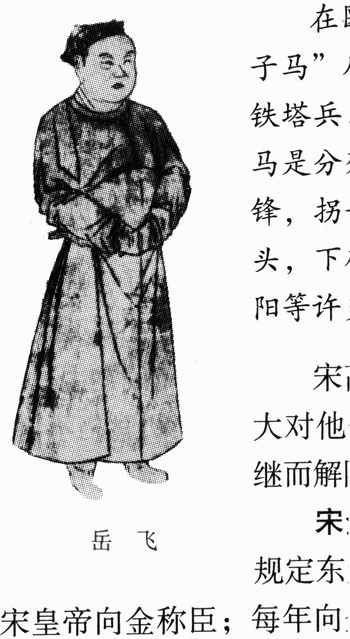
Consistent with the downplaying of the wars between the Han and the non-Han, the 2003 textbook also contains a much softer visual image of Yue Fei when discussing the war between the Southern Song and the Jin. In sharp contrast to the grand, masculine, and militant portrait of the Han general in the 1956 textbook, in which Yue Fei was shown in close-up from his chest up, wearing a fancy cap, with an impressive beard and a mustache, broad shoulders, and what appears to be a breastplate (see figure 1), in the 2003 textbook, he is shown in full figure, which makes him look much smaller and considerably less significant because the new portrait occupies only a tiny portion of the page. Moreover, in the new portrait, there is nothing that suggests Yue Fei's military role and heroism. Instead, with a chubby face, no facial hair, and very tiny feet, dressed in a plain gown and wearing a simple cap, he looks more like an ordinary, even humble, civil official (see figure 2). One can only speculate that the editors of the 2003 textbook chose this new portrait in the hope that it would be less offensive to minority people and would present the Han as less militant. Moreover, this new image is clearly more consistent with the fact that history textbooks published since the late 1970s stripped Yue Fei of his grand, “national hero” status, as well as with the general tendency in these books to present more softened descriptions of both Jin brutality and Song resistance.
Image of Yue Fei in the 1956 textbook (Chen et al. Reference Lesu1956, 86).

Image of Yue Fei in the 2003 textbook (RJCL 2003, 110).

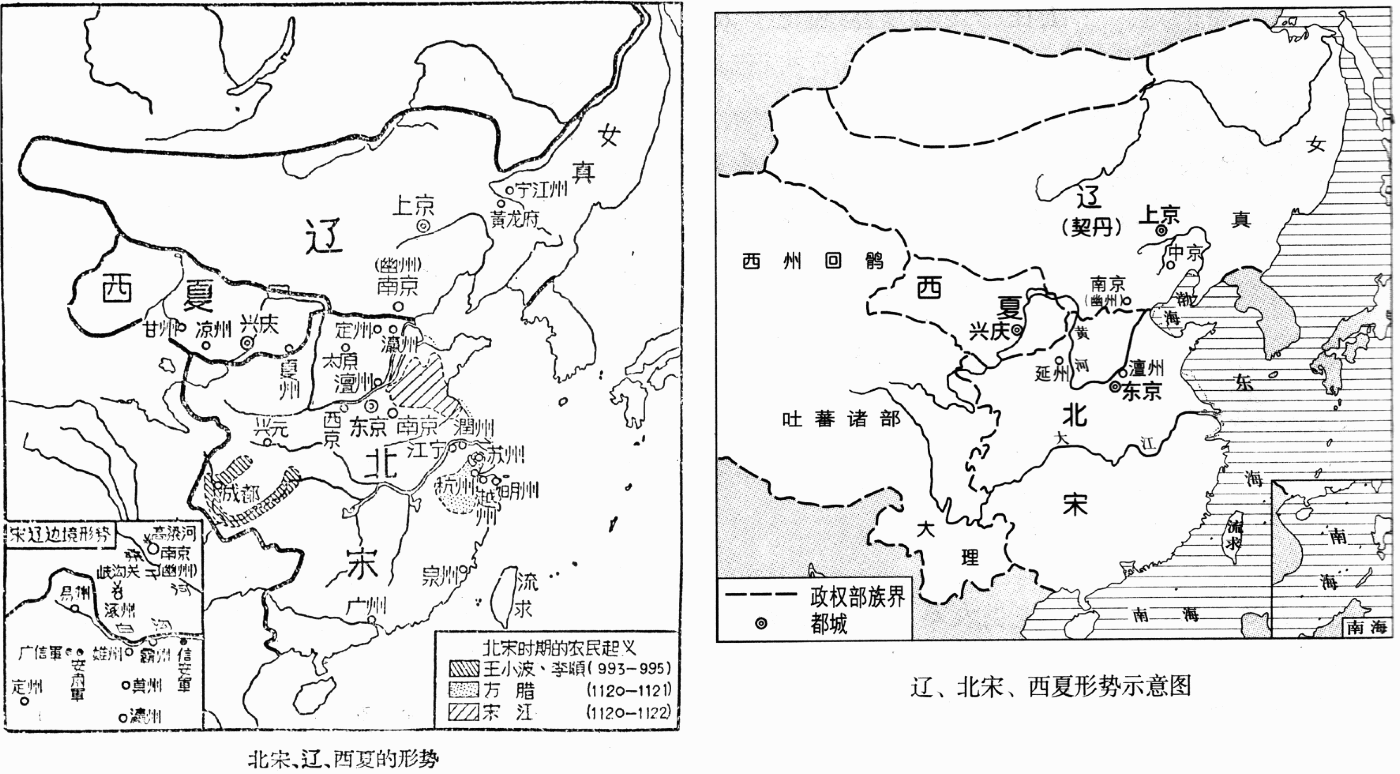
The changing representation of non-Han peoples and their relationship with China is also manifested in maps. Whereas the 1951 textbook had no maps at all, maps of the same historical periods from the 1956 and the 2003 textbooks differ considerably and nicely illustrate how non-Han peoples were cartographically represented as others in the earlier textbook while made part of the Chinese self in the later one. In its map that depicts the “Northern Song, Liao, and Western Xia,” for example, the 1956 textbook shows only the territory of these three polities, which together constitute a small portion of the territory of present-day China. The boundaries between the polities are drawn in bold, solid lines, which communicate that the Northern Song, Liao, and Western Xia were three separate entities. Although small parts of today's Tibet, Xinjiang, and Mongolia are shown in the margins of the map, these territories are not identified by name and appear as totally irrelevant to Chinese history. Moreover, consistent with the focus in the text on the dynasties of the Han people, the Song appears first in the title of the map, and graphic marks that represent additional information are drawn only on Song territory (see figure 3, left map).
Depiction of the Song, Liao, and Xia in the 1956 and 2003 textbooks (Chen et al. Reference Lesu1956, 72; RJCL 2003, 106).
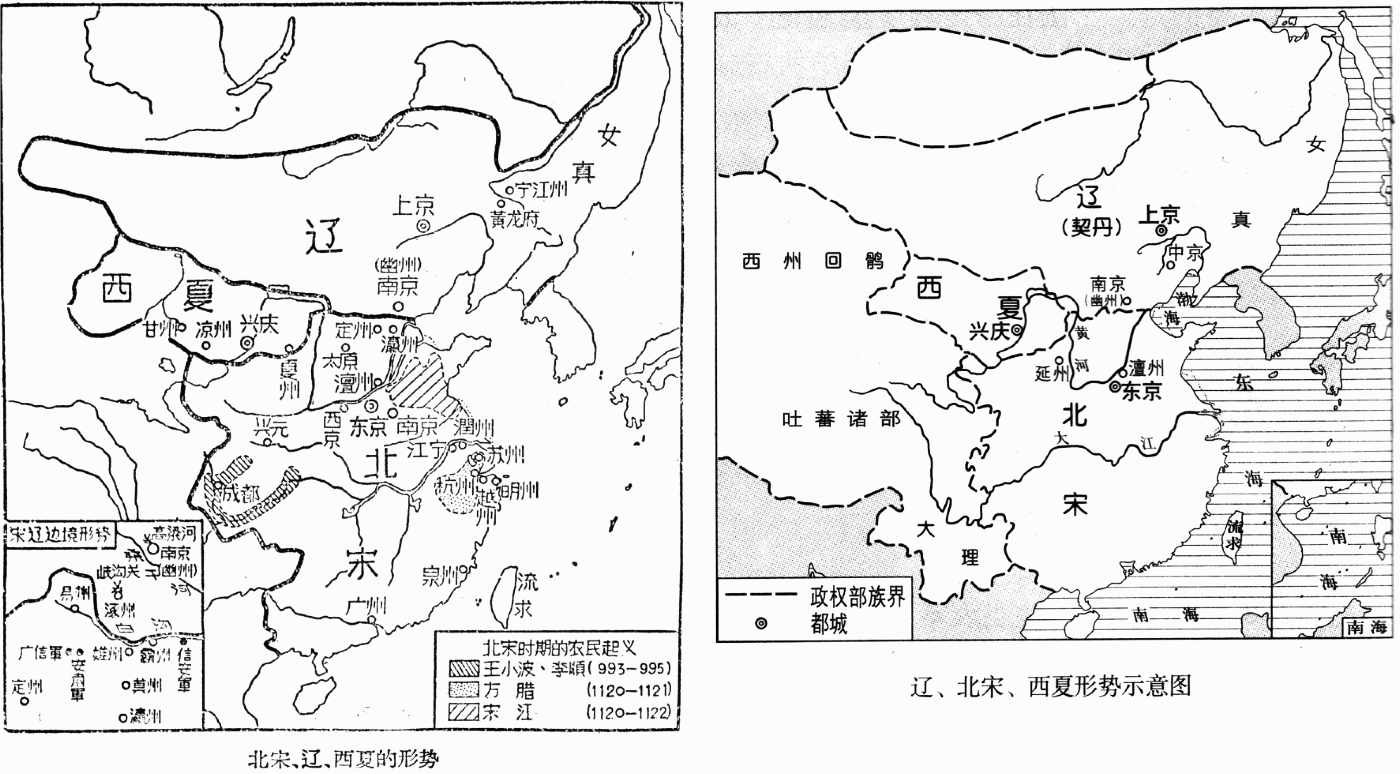
By contrast, the parallel map in the 2003 textbook (see figure 3, right map) looks much more similar to the map of present-day China, showing, in fact, most of the territory of the Qing empire at the height of its territorial expansion after the large conquests of the mid-eighteenth century. Although titled “The Liao, Northern Song, and Western Xia” (note the change in the order of the names), the map also includes the territories of the Kingdom of Dali, the “various parts/tribes of Tibet” (Tufan/Tubo zhu bu), and the “Uyghurs of the Western prefecture/state” (Xizhou Huihu).Footnote 8 All these territories (including Taiwan) appear in white, and are clearly distinguished from the rest of the world, which appears in grey (and on which no single character is printed). This contrast in colors communicates the sense that all the polities and territories that appear on the map in white actually constitute one unit. This sense is further enhanced by the fact that the boundaries between the different polities and peoples whose territories appear in white are now marked with a line of dashes, as opposed to the bold, solid line in the earlier map. The 2003 map thus communicates visually the founding concept of Fan Wenlan that historical China should be regarded as everything that existed in the past on the territory that is China today.
As noted earlier, the reformed representation of non-Han peoples also reveals itself in a new, positive evaluation of their regimes. The discussion of the Yuan dynasty in the 2003 textbook provides a good example. Whereas textbooks from the Mao era contained a comprehensive denunciation of the Mongolian dynasty, and treated the Mongols as foreigners who invaded China, annihilated the Song, brought unprecedented misery to the Han (read Chinese) people, and inflicted unparalleled destruction on the Chinese economy, particularly in agriculture, the 2003 textbook clearly turns the narrative upside down. Titled “The Establishment of the Yuan Dynasty and the Development of a Unified, Multi-Ethnic State,” the chapter on this non-Han dynasty praises it for many achievements, especially, as suggested by the title of the chapter, for unifying China and for advancing the “ethnic merging” in the country. Moreover, in a total reversal of the negative historical verdict in textbooks from the Mao era regarding the destructive effects that the dynasty had on the Chinese economy and agriculture, the text now reads, “In the period of the Liao, Song, Xia, Jin, and Yuan, the economy of our country continued to develop … The Liao, Xia, Jin, and Yuan … attached importance to agricultural production” (RJCL 2003, 113).
The 2003 textbook also suggests that during the Yuan period, the handicraft industry developed, traffic and communications saw “unparalleled development” (kongqian fada), commerce was “prosperous to an unprecedented extent” (kongqian fansheng), and the ports for foreign trade “became very famous world wide” (zai shijie shang dou hen youming) (RJCL 2003, 113). Although some of these achievements were mentioned in the 1956 textbook, they were clearly downplayed—not once, for example, were any of them described as “unparalleled”—and relegated to the margins of an extremely negative narrative. Conversely, the only trace found in the 2003 textbook of the extremely negative depictions of earlier textbooks are several softened remarks that are summarized in two lines, appear in the very end of the chapter in small print, and suggest that the negative phenomena mentioned existed only in the middle and later period of the dynasty (RJCL 2003, 113).Footnote 9
The conscious effort to incorporate the non-Han peoples into the Chinese self reveals itself also in a much more positive treatment of their leaders. These individuals are now discussed at greater length, are often praised for their talent and achievements, and are referred to by titles that were previously reserved only for Han emperors. While the 1956 textbook referred to prominent non-Han leaders only by name, the 2003 textbook, by contrast, often adds powerful superlatives. Chinggis Khan and the Jurchen leader Wanyan Aguda, for example, are referred to as “outstanding leader[s]” (jiechu shouling) (RJCL 2003, 108, 111). Similarly, just as the text now recognizes the Liao and the Jin as two legitimate Chinese dynasties and refers to them as such (chao), their non-Han founders, Yelü Abaoji and Wanyan Aguda, are referred to, like the Han founders of other dynasties, as Liao Taizu and Jin Taizu, respectively (2003, 106, 108–9). The more respectful treatment of non-Han leaders also manifests itself visually. In the chapter on the Yuan, for example, whereas the 1956 textbook only had a portrait of Chinggis Khan, a leader of universal stature who was too important to be ignored, the 2003 textbook, by contrast, also has a portrait of Kublai Khan (see RJCL 2003, 111). Along with this new addition, in another contrast to the 1956 textbook, the book from 2003 has no portrait of the Han hero Wen Tianxiang, who played an active role in resisting the Mongols.
The Reasons for the Reform of History Textbooks and Its Timing
While it is well known that the multi-ethnic vision of China had already become an accepted notion among a growing number of Han intellectuals and political leaders by the beginning of the twentieth century, few have acknowledged that this vision had to wait until the last quarter of the twentieth century to be developed and translated into a coherent and comprehensive multi-ethnic Chinese historiography and to be canonized in high school textbooks. Why did this development have to wait for so long, and how can we explain the obvious discrepancy between the exclusive historical narrative in high school textbooks of the first three decades of the PRC and the massive efforts that the Communist government made during that time to integrate the non-Han peoples into the new Chinese state?
One major reason that must have contributed to the “delay” in the reform of history textbooks is the ideological milieu in post-1949 China. It is quite possible that during the Maoist period, the editors of textbooks were so preoccupied with the project of rewriting Chinese history according to the Marxist paradigm, with its focus on class struggle (Feuerwerker Reference Feuerwerker and Feuerwerker1968, 15–18, 34; Harrison Reference Harrison1969), that issues of ethnicity simply received less attention. After all, according to Marxist theory, ethnic conflicts are a form of class struggle, and it was believed that ethnicity would disappear as China advanced toward communism. Seen from a slightly different perspective, it is also possible that the editors of textbooks felt that the rewriting of Chinese history according to Marxist ideas was already enough to construct a sense of a nation (and a state) and there was no need to pay much attention to issues of ethnicity. Indeed, after 1949, in order to be a member of “the [Chinese] people” (renmin), it did not matter, at least not theoretically, to which ethnicity one belonged, but rather to which class. Those who belonged to the right classes belonged to the nation, and those who did not belong to those classes were excluded from the nation (Fitzgerald Reference Fitzgerald and Unger1996, 78–79). In other words, class was actually made the most powerful unifying force that was supposed to help overcome China's ethnic (and regional) diversity (Fitzgerald Reference Fitzgerald and Unger1996, esp. 73–83).
Thus, since the late 1970s, the decline of the revolutionary paradigm of historiography with its emphasis on class categories (Dirlik Reference Dirlik, Dirlik, Bahl and Gran2000, esp. 125–36), created a vacuum in the nationalist narrative, and this vacuum had to be filled with a new narrative that would legitimize the Chinese state. It was at this point that a space was opened once again for ethnicity to become the dominant theme in the historical narrative. In fact, the decline of class-oriented solutions to the problem of ethnic diversity in China, combined with the realization that the problem of ethnicity was not going to disappear in the near future, left editors with few other options but to confront the problem of ethnicity in the most direct way and to look for a new historical narrative that would offer a solution to this problem. It was at this point that the editors of history textbooks must have realized that a multi-ethnic historical narrative that would fully incorporate China's non-Han peoples into Chinese history since its very early beginning had to be invented.
Another possible explanation for the timing of the change in the representation of non-Han peoples is that during the first decades of the PRC, those in charge of writing history textbooks actually chose to represent non-Han peoples as others. At first glance, this explanation may seem to contradict the first explanation, but it can also be understood as complementary. Considering that in post-1949 China, the nation-building project was still in its very beginning, it seems probable that, like their predecessors of the late nineteenth century and early twentieth centuries, those involved in the project were still primarily concerned with the “making of a majority” (Gladney Reference Gladney1998) that would constitute the core of the newly established nation-state to make it a viable polity. Thus, in the first decades after 1949, the nation-building project in China still focused on consolidating national consciousness among the Han, the majority nationality that, as several scholars have suggested, was invented not long before (G. V. Efimov, cited in Feuerwerker Reference Feuerwerker and Feuerwerker1968, 21; Chow Reference Chow and Dikötter1997; Gladney Reference Gladney and Joseph1994a, 180–82; 1996, 85), and among whom national consciousness was still very weak (Gladney Reference Gladney and Joseph1994a, 179). The othering of non-Han peoples was an excellent means to achieve that goal (Gladney Reference Gladney1994b), because throughout Chinese history, it was most often in relation to these peoples that Han identity and Chineseness had been constructed. Nonetheless, this primary concern with the unity of the Han majority did not prevent the new regime from simultaneously making many public declarations about China being a multi-ethnic state in order to advance the integration of non-Han peoples and regions into the new state.
The notion that the othering of China's minorities has been helpful in consolidating the unity of the Han majority was introduced by Dru C. Gladney in the mid-1990s (Gladney Reference Gladney and Joseph1994a, 179–82; 1994b). This theory, which stresses the conscious othering of China's minorities, is very useful in explaining the representation of non-Han peoples as others in history textbooks of the first three decades of the PRC. However, unlike Gladney, whose studies suggest that the othering of non-Han peoples increased in the post-Mao era, this essay proposes that at least where history textbooks are concerned, the opposite is true, and this othering actually weakened significantly.
This disagreement notwithstanding, the effort to incorporate the non-Han population into the Chinese self that is evident in history textbooks of the reform era could still be explained using Gladney's theory. The switch that one can find in these textbooks from an emphasis on the otherness of non-Han peoples to an emphasis on their belonging to the Chinese self can be interpreted as an indication that in the late 1970s and early 1980s, the editors of these textbooks felt that the identity and unity of the Han were already strong enough. Now that the core of the new Chinese nation-state had been consolidated, it was possible to move on to the next stage of the nation-building project, to shift the emphasis to incorporating the periphery.
The shift from an exclusive, monoethnic narrative of Chinese history to a more inclusive and multi-ethnic one, however, was not affected only by the degree of unity among the Han majority. Another factor that must have played an important role in that process was the growing agency and power of ethnic minority people, especially the minority educated elite, who started to assert their ethnic identity in public much more forcefully than ever before in the history of the PRC. These new assertions were in part a reaction to the “civilizing project” (Harrell Reference Harrell and Harrell1995) of the Maoist era, which on one hand created strong minority identities among non-Han groups, many of whom did not identify themselves as “nationalities” before the 1950s (Diamond Reference Diamond and Harrell1995; Harrell Reference Harrell and Brown1996; Kaup Reference Kaup2000; Litzinger Reference Litzinger and Harrell1995), and on the other hand aimed to assimilate them (sometimes by force) into the homogeneous socialist order (Heberer Reference Heberer1989, 23–29). The growing assertiveness among the minority elites was also a result of their long-term training and work in state institutions, where they acquired the theoretical and discursive abilities to challenge the Han-centric discourse (Harrell and Li Reference Harrell and Yongxiang2003, 364–65). Another reason for the new trend was the general liberalization in China since the late 1970s and the rise of ethnicity world wide.
The growing agency of the minority elite manifested itself in the field of historiography in the emergence of new, minority-centered historical narratives that started to challenge the hegemonic, Han-centric discourse of Chinese historiography (Bovingdon Reference Bovingdon and Starr2004; Harrell and Li Reference Harrell and Yongxiang2003; Litzinger Reference Litzinger and Harrell1995, 122, 136–38; Rudelson Reference Rudelson, Gervers and Schlepp1996; Reference Rudelson1997, 121–75; Yang Reference Yang2001, 144–49). Although with very few exceptions, the editors responsible for the writing of history textbooks were still Han, these editors were well aware of the risk of ignoring the new trend. The new minority voices had to be co-opted, and the reform of the representation of non-Han peoples in history textbooks was one important way of co-optation. The new historical narratives gave unprecedented representation, albeit still extremely marginal, to non-Han peoples and their histories, presented them in a very positive light, and recognized their difference and the particularity of their histories. But simultaneously, and most importantly, the texts incorporated these histories into a new, inclusive, and multi-ethnic single master narrative of Chinese history, according to which the non-Han peoples have always been Chinese and their different histories have always been a part of Chinese history. Indeed, the examination of history textbooks that were published in post-Mao China suggests that the stronger ethnonationalism became among China's minorities during the 1980s and 1990s, the more powerfully they were incorporated in these texts.Footnote 10
A fourth possible reason for the changing representation of non-Han peoples in Chinese history textbooks considers the objective limits of national and historiographical imagination. In his book Imagined Communities (1991), Benedict Anderson established the idea that a nation is an imagined community. Another well-established idea in the study of nationalism is that national histories tend to project the present of a nation into the past. This projection seeks to naturalize and thus legitimize the nation as it exists or as it is perceived in the present by “proving” that it has existed as such since ancient times (Duara Reference Duara1995, 4). The idea of national history being a projection of the present into the past provides an excellent example of Anderson's thesis because it implies that nationalist reconstructions of the past are a work of imagination. Yet, at the same time, this idea also implies that the imagining of a particular national past has to be grounded at least to some extent in a real present, on which the imagined past is modeled.
If we follow this logic, then the representation of non-Han peoples as others in the history textbooks of the Maoist era derived in part from the objective reality of that particular time. Considering, for instance, that as late as 1947, Xinjiang was explicitly recognized as a colony even by senior officials in the Nationalist government (Bovingdon Reference Bovingdon2001, 112), it is quite reasonable to assume that at least some of the editors who wrote the early history textbooks of the PRC were also far from convinced, to say the least, that the non-Han people in Xinjiang or in other remote “frontier areas” were Chinese. Indeed, the fact that in the early 1950s, major non-Han regions had just recently been taken over by the People's Liberation Army, that some of these regions had only a tiny Han Chinese population, that communication and transportation between those regions and China proper were poor, and that Chinese culture lacked influence in many of those regions, all made it extremely difficult for the Han Chinese editors at that time to imagine many of the non-Han peoples as Chinese. The “ethnic identification” project of the mid-1950s, combined with the decision of the new regime to grant autonomy to non-Han peoples in many areas, must have also contributed to perpetuating the notion that these people were indeed others. To be sure, it was one thing to order the military takeover of non-Han territories such as Xinjiang and Tibet and to claim sovereignty over them, and even to declare that China was a multi-ethnic state, and a totally different thing to create a comprehensive and coherent historical narrative that would make the peoples who inhabited those regions and other non-Han regions Chinese since antiquity. The scant knowledge that the Han Chinese editors had about minority regions and peoples at that time (Fan Reference Wenlan1950, 46) made the task even more impossible.
In a similar vein, the multi-ethnic historical narrative that was constructed in the reform era reflects important objective developments that took place in China in the preceding decades. In other words, it required several decades of strong Chinese control over and presence in non-Han territories, the massive immigration of millions of Han Chinese into those areas, the integration of non-Han peoples and their cultural expressions into China's mainstream culture, and the strong influence of Chinese culture among China's non-Han peoples, before it was possible to imagine these peoples as Chinese and project such a vision into the remote past.
The Politics of Incorporating the Other: Conclusions and Implications
This article has shown how the representation of non-Han peoples in Chinese high school textbooks of premodern Chinese history has changed dramatically since the establishment of the PRC. Whereas in the textbooks of the early 1950s, the non-Han peoples were treated as non-Chinese others, and initially were even called “foreigners,” by the beginning of the twenty-first century, they were totally incorporated into the Chinese self through a new narrative that claimed that they had been, in fact, always Chinese. The article has suggested that although certain important changes in the representation of non-Han peoples were already introduced during the Maoist period, the most significant point in the process of their transformation from others to part of the Chinese self occurred in the late 1970s and early 1980s, when a comprehensive reform that aimed to create a new discourse of ethnicity in history textbooks was launched.
The article has also demonstrated how the incorporation of non-Han peoples into the Chinese self was accompanied by a new representation of the Chinese nation, the Chinese state, and Chinese history. Whereas earlier textbooks propagated a monoethnic view of the Chinese nation and Chinese history, identifying China exclusively with the Han, later textbooks adopted an inclusive, multi-ethnic view of the Chinese nation and advanced the idea that China had always been a multi-ethnic state, and that “ethnic merging” constituted a major historical pattern and driving force in Chinese history.
The change in the representation of non-Han peoples in Chinese history textbooks can be viewed in two very different ways. On the one hand, it can be seen as a positive development that reflects a more pluralistic policy, gives more voice and representation to the ethnic diversity within China, and offers some of China's minorities a share in the national narrative. Indeed, although still extremely Han-centric, the new historiography adopts a more positive attitude and rhetoric toward non-Han peoples than in the past. It tells more about their cultures, histories, heroes, and achievements, and about their contributions to the history of China. The change in the representation of non-Han peoples may be viewed as particularly impressive if one considers that for the sake of creating a multi-ethnic Chinese historiography, the Han editors of the new history textbooks were even willing to sacrifice the most celebrated historical heroes of the Han majority, such as Yue Fei and Wen Tianxiang.
On the other hand, the new representation of non-Han peoples and their histories can also be seen as an oppressive “historiographical colonialism” in which the Chinese state and its privileged Han majority “claim the past” (Bovingdon Reference Bovingdon2001, 96) of non-Han peoples. Indeed, as Barry Sautman, inspired by Etienne Balibar, has suggested, “the ‘inclusive’ can also be the oppressive” (1997, 94–95). Considering that among some minority nationalities today in China there exist strong aspirations to achieve more autonomy and even independence, and that these aspirations are based on notions and well-established narratives of separate and independent histories, the incorporation of the histories of these peoples amounts to suppressing the historical narratives of these minorities, suppressing their national aspirations, and attempting to strip a crucial element of their collective identities from them.
In a 1997 article, Barry Sautman depicts the efforts made by the Chinese state during the reform era to advance the notion that China's different ethnic groups share a common ancestry.Footnote 11 Sautman, however, questions the usefulness of propagating myths of common descent as “tools for sustaining state nationalism among ethnic minority peoples” (1997, 95), observing that “the construction of racial nationalism has alienated important segments of ethnic minorities, undercuts the effort to build Chinese state nationalism, and may ultimately jeopardize the integrity of the state itself” (76).Footnote 12 The myths of common descent that the Chinese media started to propagate enthusiastically in the 1980s are part of the general trend depicted in this article. And indeed, as Sautman suggests, there are quite a few expressions of resistance among China's minorities to the efforts of the Chinese state and its privileged Han majority to incorporate their histories into China's national history. The most notable expression of such resistance can be found among the Uyghurs, where there has been a continuous effort by intellectuals belonging to this ethnic group to assert its separate origin and independent history (Baranovitch Reference Baranovitch2003, 739–40, 743, 749–50; Benson Reference Benson, Gervers and Schlepp1996; Bovingdon Reference Bovingdon and Starr2004; Rudelson Reference Rudelson, Gervers and Schlepp1996; Reference Rudelson1997, 121–75). Another important expression of resistance comes from the Tibetans, particularly the Tibetan government in exile. In its official Web site and many publications, this government has repeatedly claimed that the Tibetans are an independent nation, that Tibet was “occupied” by China in the early 1950s, and that prior to this, Tibet was an independent state (see http://www.tibet.com; Powers Reference Powers2004).Footnote 13
Nonetheless, Sautman's conclusion about the impact and implications of the new trend for China's minorities and for the Chinese state seems to overestimate resistance. While there is evidence that the new historical narrative is being rejected by some minority people, there are also important indications that this narrative is being accepted by other minority people, and that some of these people have even contributed to its development. In a recent article about the new Yi historiography that has developed since the early 1980s, a historiography that for the first time was written by the Yi themselves rather than by others, Stevan Harrell and Li Yongxiang point out that although the new Yi-centered narratives pose a challenge to the historical narratives of the Han majority, they nevertheless aim to “consolidate the position of Yi in China and in Chinese history” (Harrell and Li 2003, 363–64, 366; emphasis added).
Another example of a positive reaction by minority people to the state's effort to incorporate their histories involves the Mongols. This example is even more significant than the first because, unlike the Yi, among the Mongols there have always existed claims for an independent history and an independent state, which in several cases have even led to violent clashes (Jankowiak Reference Jankowiak1988, 270–73, Reference Jankowiak1993, 45–46; Kaup Reference Kaup2000, 2; see also Citizens Against Communist Chinese Propaganda's Free Inner Mongolia Web page at http://caccp.freedomsherald.org/im/index.html). Among the Mongols both in and outside China, Chinggis Khan has been by far the most powerful symbol of Mongolian nationalism (Khan Reference Khan and Harrell1995). The Chinese government has always recognized the powerful symbolism associated with this historical figure and the potential threat that it posed to Chinese rule, and therefore since the founding of the PRC has made important efforts to pay respect to his memory on the local level (Farquhar Reference Farquhar and Feuerwerker1968, 176; Khan Reference Khan and Harrell1995, 266–67). These efforts have reached a climax in recent years, when the Mongolian national hero was transformed into a Chinese hero and became the object of a Chinese cult (Bulag Reference Bulag2003). One would expect that such efforts would provoke angry reactions from the Mongols, who would feel threatened by the attempts of the dominant Han majority to claim ownership over their most revered symbol. However, in a recent paper, Uradyn E. Bulag proposes that this is not necessarily the case, and in fact there are Mongols who comply with the “Chinese worship of Chinggis Khan.” Explaining this compliance, Bulag observes that these Mongols “are blithely content that their ancestor is at long last worshipped by the Chinese … and [that] Mongols not only need not be harassed because of their history but can take pride in it” (2003, 3).
In conclusion, no matter what angle one chooses to emphasize, the changing representation of non-Han peoples in Chinese history textbooks is clearly helpful in understanding the mechanisms of the “psychological integration” (Benson Reference Benson, Gervers and Schlepp1996, 116) and “ideological incorporation” (Bovingdon Reference Bovingdon2001, 97) of China's minorities that have been at work in the PRC since 1949. Despite evidence of continuing resistance to the hegemonic ideas that the new history textbooks propagate, there is little doubt that China's success in maintaining its political unity in an era of rising ethnic nationalism owes much to its ability to incorporate the otherness of China's minorities on the ideological and discursive level. The creation of a comprehensive and coherent multi-ethnic narrative of Chinese history and its canonization in high school history textbooks clearly aim to naturalize China as it is in the present and to lend it legitimacy by suggesting that it has basically been the same since antiquity. Though from an academic point of view, this version of Chinese history is just another case of historiographical invention, it is hard to deny that it is a powerful one. This narrative certainly provides a more solid basis than ever before for the imagining of a multi-ethnic China that existed since antiquity, and as such it is likely to render any future resistance to the legitimacy of Chinese rule in minority areas more difficult.
Acknowledgments
I am grateful to Yuri Pines for sending me the news about the reevaluation of Yue Fei in China, which triggered the research for this article; to Natalia Roitman, Avital Pollak, Noam Urbach, and several individuals in China for their assistance in collecting important materials for the article; to Michal Biran for her clarifications regarding non-Han names; and to two anonymous readers for the Journal of Asian Studies for their valuable comments on an earlier draft of the article. The research for this article was supported by the Israel Science Foundation (Grant no. 903/03). Every effort has been made to secure necessary permissions to reproduce copyright material in this work, though in some cases it has proved impossible to trace copyright holders. If any omissions are brought to our notice, we will be happy to include appropriate acknowledgements on reprinting in any subsequent edition.