Introduction
The genus Bulbophyllum Thouars is a large orchid genus comprising about 1900 species in the tropical and subtropical parts of Asia, Africa, Australia, the Mascarene Islands and Madagascar (Pearce & Cribb, Reference Pearce and Cribb2002; Chen & Vermeulen, Reference Chen, Vermeulen, Wu, Raven and Hong2009).
In Nepal Bulbophyllum is represented by 34 species (Press et al., Reference Press, Shrestha and Sutton2000; Rajbhandari & Dahal, Reference Rajbhandari and Dahal2004; Rajbhandari & Baral, Reference Rajbhandari and Baral2010). During field work an unidentified species of Bulbophyllum was collected by the first author from the Sivapuri National Park, central Nepal, which later proved to be an undescribed species. We describe it here as Bulbophyllum nepalense which belongs to Bulbophyllum sect. Cirrhopetalum (Lindl.) Rchb.f.
Species Description
Bulbophyllum nepalense Raskoti & Ale, sp. nov.Figs 1,2.
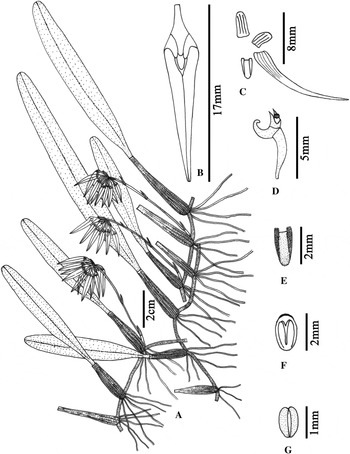
Fig. 1.Bulbophyllum nepalense Raskoti & Ale. A, flowering plant; B, flower front view; C, dorsal sepal, lateral sepals and lip (spread out); D, pedicel, ovary and column; E, lip; F, anther cap; G, pollinia. All drawn by the first author from the type specimen.
 Fig. 2.
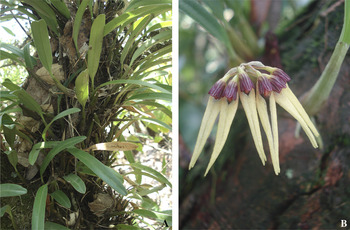
Bulbophyllum nepalense Raskoti & Ale. A, plants in the natural habitat; B, flowers (front view).


The new species is allied to Bulbophyllum retusiusculum Rchb.f. but differs by its longer and narrower pseudobulbs, the falcate acute-acuminate lateral sepals, and two strips of papillae or short hairs on the adaxial side of the lip. – Type: Nepal, Sivapuri National Park, 2300 m, 3 viii 2010, Raskoti Bhakta B. 325 (holo KATH).
Epiphytic herbs. Rhizome stout, creeping, c.5 mm in diameter, covered by dark brown sheaths. Roots from the base of the pseudobulbs, numerous, rigid, wiry, flexuose. Pseudobulbs 1–4 cm apart from each other, conical-cylindric, covered by net-veined sheaths, 2–4 cm long, 2.5–5 mm in diameter, with one terminal leaf. Leaves oblong, 4.5–12 × 0.8–1.5 cm, leathery, base contracted into a short petiole, apex obtuse and slightly emarginate. Scape arising from the base of the pseudobulb, suberect, 5–9 cm long, slender; umbel 6–10-flowered; peduncle filiform, c.1 mm in diameter, with 3–4 tubular 7–10 mm long sheaths; floral bracts narrowly lanceolate, cymbiform, 4–6 mm long, apex acuminate. Pedicel and ovary 5–7 mm long, terete. Flowers 1.5–1.7 cm long, dorsal sepal and petals pale yellow with prominent deep violet stripes, lateral sepals yellow with reddish veins at the base, lip cream with densely arranged dark purple markings. Dorsal sepal oblong, 4 × 1.5 mm, 3-veined, margin entire, apex obtuse and emarginate; lateral sepals linear, falcate, base weakly oblique, 15–17 × 2 mm, 4-veined, abaxially sparsely papillate, their upper and lower edges connate, apex acute-acuminate. Petals obliquely oblong, 3 × c.1.1 mm, margins entire or scabrid, apex obtuse. Lip decurved, ligulate, c.2–2.5 × 1 mm, fleshy, attached to the end of the column-foot by a mobile joint, base grooved, two strips of papillae or short hairs on the adaxial side close to the margins, apex obtuse. Column c.1.6 mm long, with wings slightly dilated at the base; column-foot c.2 mm long, stelidia subtriangular, c.1.5 mm long; anther cap c.0.7 mm long, papillate. Pollinia 4, elongated.
Distribution. Known only from the type locality in central Nepal.
Habitat. Epiphytic in shrubs, growing in full shade in moist humid areas in Quercus forest.
Flowering time. July–August.
Etymology. The epithet nepalense is derived from the name of the country where the type specimen was collected.
Bulbophyllum nepalense is similar to Bulbophyllum retusiusculum Rchb.f., with which it shares the oblong dorsal sepal, the elliptic petals and the oblong decurved ligulate lip (Pearce & Cribb, Reference Pearce and Cribb2002; Chen & Vermeulen, Reference Chen, Vermeulen, Wu, Raven and Hong2009). It differs from Bulbophyllum retusiusculum by having narrow pseudobulbs, the falcate, acute-acuminate lateral sepals, and two strips of papillae or short hairs on the adaxial side of the lip, close to the margins.
Another species, Bulbophyllum tigridum Hance, is somewhat similar to Bulbophyllum nepalense in petals and lip shape but B. tigridum differs in having short pseudobulbs, ovate dorsal sepals (Chen & Vermeulen, Reference Chen, Vermeulen, Wu, Raven and Hong2009; Gloria et al., Reference Gloria, Cribb and Gale2011) and lip apex with hyaline upturned protuberance (Seidenfaden, Reference Seidenfaden1973).
Acknowledgements
The authors wish to express sincere thanks to Paul Ormerod and Hubert Kurzweil for valuable suggestions during the preparation of the manuscript.