Introduction
In February 1953, a report issued by the Ministry of Rehabilitation, Government of India stated that ‘by virtue of being home makers, women do not run households, and thus training for women is only supposed to increase meager earnings of the family … we would therefore attach greater importance to training of men from the point of rehabilitation, since they are responsible for rehabilitation of the family’.Footnote 1
This blunt edict sums up the position of refugee women in the official discourse on rehabilitation. More importantly, it reflects Indian state's gendered assumptions and practices underlying women's work. As Spivak argues, a woman signals the margin; she is emblematic of a certain silence. Her stories sit in the shadows of impossible representations.Footnote 2 By not recognizing the value of women's household production services, the value of women's labour is excluded from both sides of national income and product accounts.Footnote 3 It is not surprising that refugee women were not construed as workers, separate from their existing status as structurally unequal citizens.
Nonetheless, the state did provide some refugee women with training and skills. It equipped them with the ‘requisite’ qualifications to work in ways deemed ‘suitable’ for women. The objective was to incorporate displaced women into the economy. This was something that the state could not, and would not, do for other women-citizens who were deemed to be a part of ‘stable’ and ‘settled’ patriarchal households. But how far was the state successful in generating a category of a ‘working woman’ among the refugee population? Was it able to convert them into ‘useful’ and ‘earning’ citizens? This article seeks to investigate this hitherto neglected question with a particular focus on Delhi.
The focus here on refugee women is crucial in many ways. In the South Asian context, the migration of women has been studied primarily from a male perspective, and female migrants are assumed not to have had a social or economic impact on either place of their origin or destination. Their migration is seen as more ‘private’, ‘domestic’, or ‘cultural’ and as unrelated to the sphere of economic ‘production’. As Veena Thadani and Michael Todaro have pointed out, ‘implicit in the analysis of migration is the assumption that the patterns of female migration are likely to mirror those of male migration’.Footnote 4 Scattered research on female migrations focuses on wives and children migrating to join prior waves of male labour migrants.Footnote 5 Such an approach discounts the important role of women as independent labour migrants in their own right. More recent research argues that growing women's migration represents profound transformations in the structure of families and gender roles in the division of labour.Footnote 6 This article draws on this scholarship, to break away from a male-centred conceptualization of refugee migration, and seeks to make Delhi's female migrants ‘visible’.
Second, this article makes an intervention in the way the figure of refugee woman has been understood in partition studies. While there is, admittedly, a substantial body of work on the violent experiences of refugee women and the arbitrary nature of government intervention in their lives in recovery of women of India and PakistanFootnote 7—work that has allowed the visibility of some refugee women—this was far from being the standardized experience of all refugee women. Another trend in this field is a romantic focus on the ‘coming-out’ of refugee women. For instance, Gargi Chakravarty argues that partition led to a fundamental rupture in social orthodoxies, which created space for the emergence of a new self-reliant, independent refugee woman who could challenge the rigidity of patriarchal domination.Footnote 8 In the same vein, Bagchi and Das have portrayed the dislocation of partition as a ‘blessing in disguise’, as women emerged as breadwinners who transformed feminine aspirations of Bengali women, and significantly changed the social landscape.Footnote 9
These works not only treat refugee women as a homogenous category; they also confuse these women's struggle for survival after partition with ‘emancipation’ and ‘coming out’. This article, by contrast, will reveal that refugee women were never given due recognition, whether by the state or their families, hence the argument that partition's upheavals heralded such a drastic and emancipatory change in their lives is overstated. Moreover, as Uditi Sen has remarked, most refugee women remained outside the purview of state rehabilitation policies altogether; the only women who received rehabilitation benefits were those who had been wrenched from their familial moorings.Footnote 10 This article draws on Sen's work and argues that the state rehabilitation enterprise was not suited to the needs of the great majority of refugee women who did not share this predicament.
Yet, it makes a somewhat different case. Based on census reports of 1951, Sen does not see any changes in the gender dynamics of the city of Calcutta due to the influx of refugees into the city.Footnote 11 She argues that, while there was an increase in the number of women in the population of the city, this does not translate into a larger visibility of women in the public sphere or a greater participation of women in the workforce. In contrast, this article will argue that, while patriarchal family norms admittedly had little space for women as breadwinners, there was a wide spectrum and many layers in the experiences of women in a changed and rapidly changing milieu. While official estimates enumerate the number of women gainfully employed in the formal economy, they do not take into account the experiences of refugee women who worked outside that sector, in the urban informal economy, as self-supporting workers who contributed significantly to their familial income. Their experiences have never been documented. These women may have worked throughout their lives, but they remain a very shadowy part of the scholarship on the national, regional, and local economies. This article suggests that a different picture will emerge if we try to track the experiences of refugee women over time, in a particular space, while not treating them as a homogenous category. Only then can we better grasp the complex nature of the impact of migrant women on cityscapes.
A third goal of the article is to examine the processes by which cities came to be ‘feminized’ by the imperatives and pressures faced by migrant women. This is important because women migrant workers are often seen as ‘obscure others’ and, even though the last century saw an overwhelming increase in infomalization of work,Footnote 12 many economic and labour histories of the region focus on the tiny formal sector and treat informal work as ‘residual’.Footnote 13 Feminist researchers investigating women's work in the household, in production and processing in the informal sector, have directed our attention to how their work is made invisible.Footnote 14 This ‘exclusion’ has been explained by Samita Sen on account of the intermittent nature of women's work—the fact that women's entry into the labour market is often driven by household exigencies.Footnote 15 Discourses on the nature of women's work as ‘supplementary’Footnote 16 reinforce and perpetuate a ‘maternal wall’,Footnote 17 bringing women's domestic and reproductive roles to the fore. To understand how social construction of gender shaped the lives and work of refugee women workers, wider social anxieties about women's role and position at home have to be taken into account.
A final goal of this article is to trace the historic evolution of women's informalities and new urban forms in post-colonial Delhi. Recently, urban theory has recognized the role of informality in the production of space in the contemporary cityFootnote 18 but the question of how these forms emerged historically remains neglected. For instance, scholars like Ananya Roy have identified informality as the key feature, rather than an exception in urban forms, such that Indian planning proceeds through systems of deregulation, unmapping, and exceptionalism.Footnote 19 Recent works on India's informal sector by anthropologists, sociologists, and geographers have offered rich and textured assessments of the unfolding ‘urban moment’, addressing recent patterns of informal work, economic change, the redevelopment of slums, conflicts over land use, ethnic conflict and gendered violence, and tensions between local, regional, and national governance.Footnote 20 But none of these addresses how these informal patterns emerged in the first place. This is more striking because women comprise more than 90 per cent of India's informal sectorFootnote 21; even then, they are confined within the subaltern category of urban population. Any analysis of the role of women in a South Asian city is fairly limited and tends to treat them as victims. They comprise the less dominant groups, largely invisible and more susceptible to poverty and violence.Footnote 22 How informality emerged to be their dominant mode of survival is the preoccupation of this article.
In achieving this goal, the article relies upon interdisciplinary ways of looking at empirics—to reveal everyday negotiations, alternate economies, and new urban forms that emerged in twentieth-century South Asia. While the overarching tone is of archival sources, it dwells on ethnographies, memoirs, and, most importantly, oral histories, conducted by the author in different contexts and over an extended period of time in Delhi.Footnote 23 The respondents were chosen on the basis of gender, age, community history, class and caste status, spatial location, nature of employment, and, in some cases, marital status.
This article documents refugee women's struggle against masculine state planning that compelled them to take up informal jobs. The official solution to the problem of national integration of refugee women was the ‘cottage industry’. Considering handicrafts as a ‘feminine craft’, refugee women were entrusted to build new social institutions ‘graced by their delicate touch’.Footnote 24 The aim was to give them ‘full or partial employment to supplement their family incomes’.Footnote 25 A range of women social workers were engaged to carry out this task. Socialist Kamladevi Chattopadhyay, who became the chief harbinger of women's cooperative movement in Delhi, believed this to be a true experiment in the Gandhian dream of Sarvodaya—a self-supporting community that stood for the good of all.Footnote 26 The execution of the craft was thus not just an economic compulsion, but a sacred duty.
In effect, as this article will show, the vitality (or the lack of it) of small-scale production by women had much to do with the character of the markets, which did not develop for many of the commodities the government encouraged women to produce. Unable to do justice to Gandhian principles at the level of national planning, the state left it to the refugees to revive the Indian handicrafts. Moreover, the involvement of women nationalists did not contribute to anti-patriarchal state institutions or ideologies. As social workers, women often drew upon, or were circumscribed by, gendered notions of labour, family, service, and work. The results were contingent and frequently contradictory.
As a result, refugee women took to alternative survival strategies. This article recognizes these women as a productive part of urban dynamism. By focusing on the history of mass migration, refugee women's entry into the urban economy, and their disparate endeavours towards survival, it will reveal the processes by which women subverted official discourse and negotiated everyday spaces to become a part of urban dynamism. It will reveal that many refugee women carved out survival strategies, within or outside the state's ambit, and, in the process, some emerged as small-scale ‘micro-entrepreneurs’.Footnote 27 New research on urban informality argues that capital development in cities around the world depends increasingly on urban informal practices and policies.Footnote 28 In this regard, refugee women's informalities and their small-scale enterprises changed the way we understand market spaces and South Asian cityscapes. Delhi moved increasingly towards the co-existence of residential-cum-commercial and regulated-cum-unregulated activity (and lifestyles) under a single roof, within the same family and household.
The feminization of migration
Within a short span of time after the partition and independence, Delhi became a city of refugees.Footnote 29 As the refugees squatted on the urban terrain, the anxious Indian state responded by hastily drawing out rehabilitation plans to ensure desired urban development of the nation's capital city. However, the very possibilities the city held out for their rehabilitation provided incentives for more refugees to pour in. Officials were aware of this paradox and resorted to ordinances and laws to limit the place and number of refugees in the city. The most significant was the ‘Delhi Refugees Registration Ordinance’ of 1947, which provided a ‘Certificate of Registration’ to mark their refugee status.Footnote 30
For the most part, state assistance was limited to refugees with registration numbers and the place of registration was a critical factor in rehabilitation. In a memorandum issued in 1949, the government announced that ‘a refugee registered in Delhi was not eligible for state assistance outside the province of Delhi’.Footnote 31 The location of registration thus influenced where refugees settled. In this way, registration limited the number of refugees on state aid in any particular place, while also restricting refugees’ options to move.
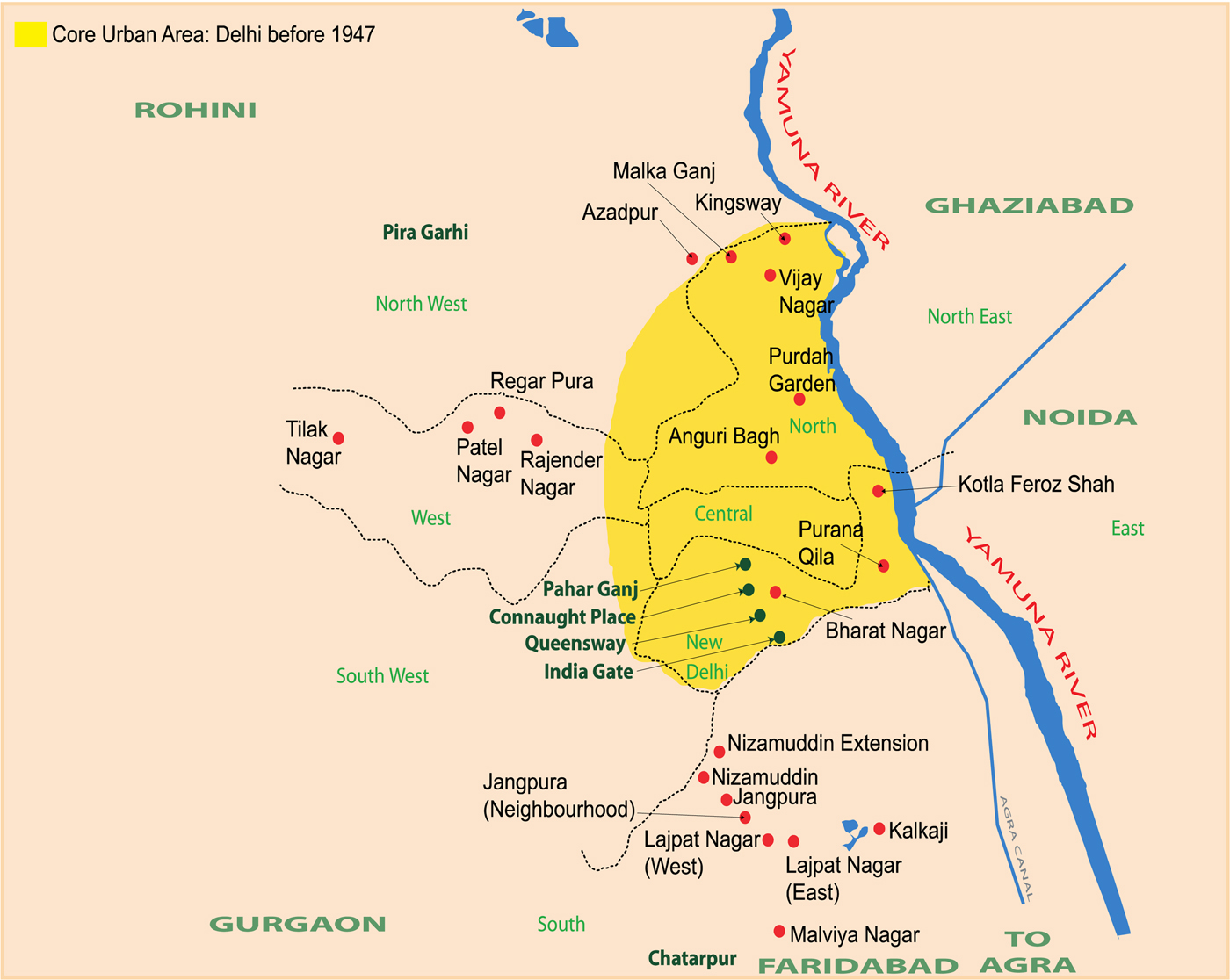
In addition, the need to keep Delhi squatter-free and decongested guided the process of rehabilitation. Refugee colonies were built in the far-flung suburbs, at some distance from the city (see Figure 1). Planning for refugees became more about rehabilitating Delhi from the consequences of partition than about rehabilitating the refugees themselves. In reality, these suburbs around Delhi were hastily planned, with few amenities. In government, a few raised their voices against this bias. The rehabilitation minister, Mohanlal Saksena, criticized the practice of building houses in far-flung townships, saying that ‘it must not be understood that I am opposed to the development of suburbs. What I am trying to emphasize is that we should make an intensive use of the available sites first in and around Delhi’.Footnote 32
Refugee colonies in Delhi, 1954.

Saksena's comments indicate that, in spite of the availability of land ‘in and around Delhi’, refugee townships were built at a considerable distance from the city.Footnote 33 Such measures highlight the depth of official preoccupation with the ‘proper growth’ of Delhi. Clearly, in Delhi, the concerns went beyond ‘denial and dispersal’, which Joya Chatterji has argued were central to government policy in Calcutta.Footnote 34 The importance of Delhi as a national capital meant that questions of urban governance and planning loomed much larger. Unable to abate the flow of refugees into Delhi, the government decided to use rehabilitation as an instrument for gaining control over the city.
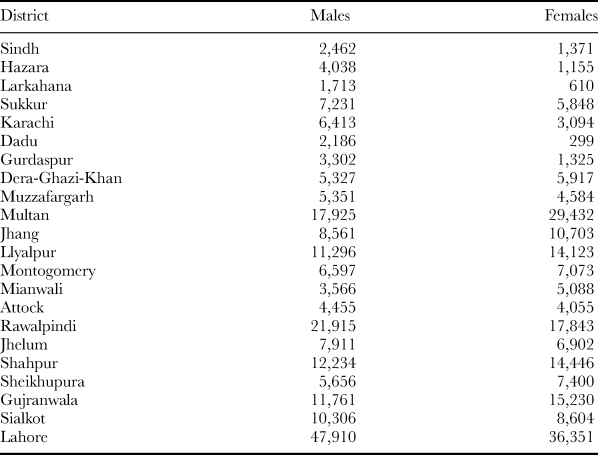
With the arrival of the refugees in Delhi, the demographic profile of the city underwent dramatic alterations, and its gender profile changed alongside. Before 1947, while Old Delhi had a more diverse make-up, and a significant female population,Footnote 35 New Delhi, had been predominantly a male domain: it was largely a city of bureaucrats, clerks, government officials, factory workers, mill workers, and military men.Footnote 36 This was reflected in the sex ratio, which was as low as 554 for the New Delhi area in 1931.Footnote 37 After partition, this ratio changed dramatically. This was because a significant proportion of Delhi's displaced migrant population comprised women. Out of a total of 495,391 displaced people who migrated to Delhi after 1947, 265,679 were males. Females constituted as many as 229,712 of the city's new inhabitantsFootnote 38 and the sex ratio for New Delhi witnessed a sudden and sizeable increase, reaching 764 by 1951.Footnote 39 The figures for female refugees are particularly striking. From many districts of Punjab, the number of women who migrated to Delhi clearly outnumbered men (see Table 1).Footnote 40
Figures indicating displaced persons by district of origin from Punjab on arrival in Delhi, 1946–48.

Source: Census of India 1951, Delhi District Census Handbook, pp. 168–174.
But, it is also a reflection of a trend towards the hitherto unexplored trend towards ‘feminization’ of migration, on account of greater employment opportunities in Delhi in traditionally female areas of production. Delhi noted a high sex ratio of 852 among the incoming-refugee population.Footnote 41 This led to a marked increase in females in refugee enclaves and a concomitant ‘feminization’ of Delhi's urban spaces. As Samita Sen has noted, the term ‘feminization’ in relation to the labour force and urban space can indicate the employment of large numbers of women so that the gender profile of the labour force, or a particular segment of it, actually changes in favour of women. It can also indicate, however, a very different process, whereby the nature of jobs changes as well.Footnote 42 From more secure and regular employment, the economy shifts to kinds of employment more associated with women: informalized, casualized, irregular, lower-paid, and insecure. This process, I suggest, was set in motion in Delhi in the mid-twentieth century and was part of a broader history of informality in the city.
The Indian state and the rhetoric of refugee woman
For the state, the uprooted women presented a ‘special problem’ of social reconstruction and required a great deal of time, money, and attention to bring them back into a ‘normal’ way of life.Footnote 43 The Delhi Women's Section was set up to provide homes and vocational and training centres to integrate some women into the economy.Footnote 44 Officials divided refugee women into two categories: ‘attached’ and ‘unattached’. The attached women were left out of the ambit of rehabilitation policy, since they were assumed to have men looking after them.
Unattached women were further divided into ‘aged’ or ‘infirm’ and ‘able-bodied’. The former were not offered training, as Rameshwari Nehru, the director of the Women's Section of the Ministry of Rehabilitation, noted in September 1950 that ‘the old and infirm are a permanent liability. They can do light work if they like in their homes, but they should not be over-burdened with training and employment’.Footnote 45 Then there was a further demarcation between women from rural and urban backgrounds. Women from the villages were, rather bizarrely, considered not to be in need.
It is clear, then, that all women were not offered training. The main focus of rehabilitation was the unattached refugee woman. Even so, different categories of such women received different treatment. For instance, ‘doubtful and resisting’ women, or women in illegal traffic, were offered training in music, Indian culture, and moral education, and kept in secluded and guarded homes, from the fear of their mixing with the general population.Footnote 46 As a result, women who actually received benefits were a miniscule part of wider refugee society: young, able-bodied, urban, and, above all, unattached. Even for them, as the evidence below will reveal, rehabilitation was eventually ad-hoc in nature.
For the government, care of ‘vulnerable’ citizens was demarcated as a sphere of ‘feminine’ intervention.Footnote 47 To achieve this goal, in the autumn months of 1947, the government appointed a small advisory committee of women social workers in the Ministry of Rehabilitation.Footnote 48 It was believed that, as women, these social workers would be more ‘sensitive’ to the needs of displaced women. As Uditi Sen has also observed, the nationalist image of the ideal Indian woman as a sacrificing and nurturing mother figure found its way into the allocation of administrative responsibility in independent India.Footnote 49
Most of these social workers came from affluent and privileged backgrounds, and were daughters and wives of powerful men. Rameshwari Nehru was the daughter of Raja Narendranath of Lahore and the wife of Jawaharlal Nehru's cousin, B. K. Nehru.Footnote 50 Aruna Asaf Ali, who later became her close associate in the Delhi woman's section, admitted that she had no knowledge of social work at all and she welcomed the idea of working with refugee women, simply because it would help her to occupy herself.Footnote 51 Mridula Sarabhai was born into the wealthy Sarabhai family of Ahmedabad. Her father was the well-known businessman and industrialist who controlled the Calico Mills and Mridula had spent a good deal of her life in England. She too recognized that the recovery of women was a ‘gigantic task for which she had no prior experience’.Footnote 52 She plunged into the task simply out of the desire to help these women. It is worth considering how far these women could see beyond their own class and caste perspectives to understand the needs of ordinary refugee women. For them, rehabilitation was a part of ‘social work’ and a means of participating in the larger project of ‘nation-building’.
The hallmarks of state-sponsored rehabilitation schemes were the training-cum-production centres and cooperative societies. U. Bhaskar Rao, who was commissioned to write up the success story of state-sponsored rehabilitation, noted that ‘cottage and small-scale industries are the ideal answers to the problems of employment. They ensure that idle hands, whether in the towns or in the villages get busy’.Footnote 53 Kamaladevi Chattopadhyaya called for a ‘craft renaissance’ in India. To her, the ‘cottage’ was to become a symbol of free India's faith in the Gandhian experiment and in his advocacy of decentralized economic opportunity, ‘heightened by awareness of so many in society who live by their hands, including those now dispossessed and uprooted by Partition’.Footnote 54 She believed refugee women were most apt for this vocation, as she said:
Due to the traditional joint family system, women are in a habit of living and working together. Therefore, it is not difficult to bring them under a common fold. All that is required is ‘awaken’ these women. The first task is to train them, after which they could be formed into cooperatives. When a woman becomes a member of the cooperative, and understands its business, I have no doubt, she will contribute more than men to their organisation.Footnote 55
Kamladevi urged that the development of a country's handicrafts rested on its women.Footnote 56 She went on to set up the Refugee Crafts Emporium for the production and marketing of goods produced by refugee women. Yet, despite her belief in social and economic decentralization, institutional plurality, Gandhian socialism, and the creation of refugee women's work, ground realities were much different. The work centres provided training to women in silai (sewing), bunai (knitting), kadhai (embroidery), pickle-making, basketry, tailoring, block- and fabric-painting, and calico-printing.Footnote 57 Attributes of domesticity and femininity were evoked in skills offered, as embroidery, tailoring, and knitting are associated with ‘extra’ household work.Footnote 58 For most young girls, training in the craft was in itself a part of their training as future housewives. For some others, however, it was a source of livelihood.
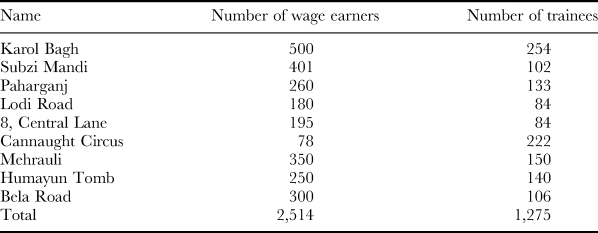
Clare Wilkinson-Weber has shown, in the context of women's work in Lucknow's embroidery industry, that embroiders’ experiences as piece-wage workers were powerfully shaped by their gender.Footnote 59 Waged work contradicts the ideal that women's primary task is the care of the family and maintenance of home.Footnote 60 Thus, their work is defined as ‘part-time’ or ‘free-time’, giving them a little extra ‘pocket’ money to supplement the main income from men. In 1948, the state launched schemes very much in this idiom. To begin with, there were eight centres in Delhi, with about 441 women workers on the registers.Footnote 61 By March 1949, many more had graduated from them (see Table 2).Footnote 62
Women employed and trained at work-cum-training centres, 1949

Source: ‘Training and Work Centers’, R&R 9(47)/1952, DSA.
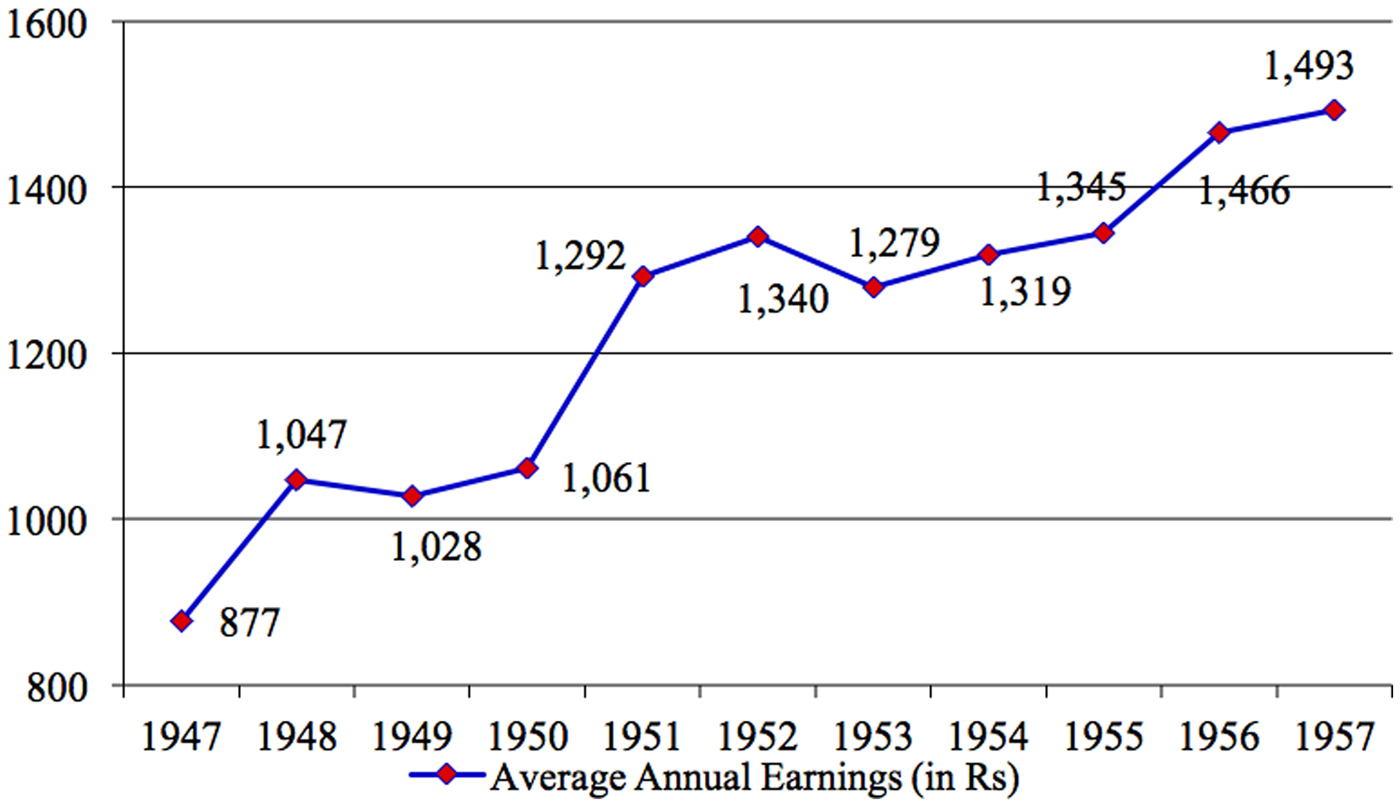
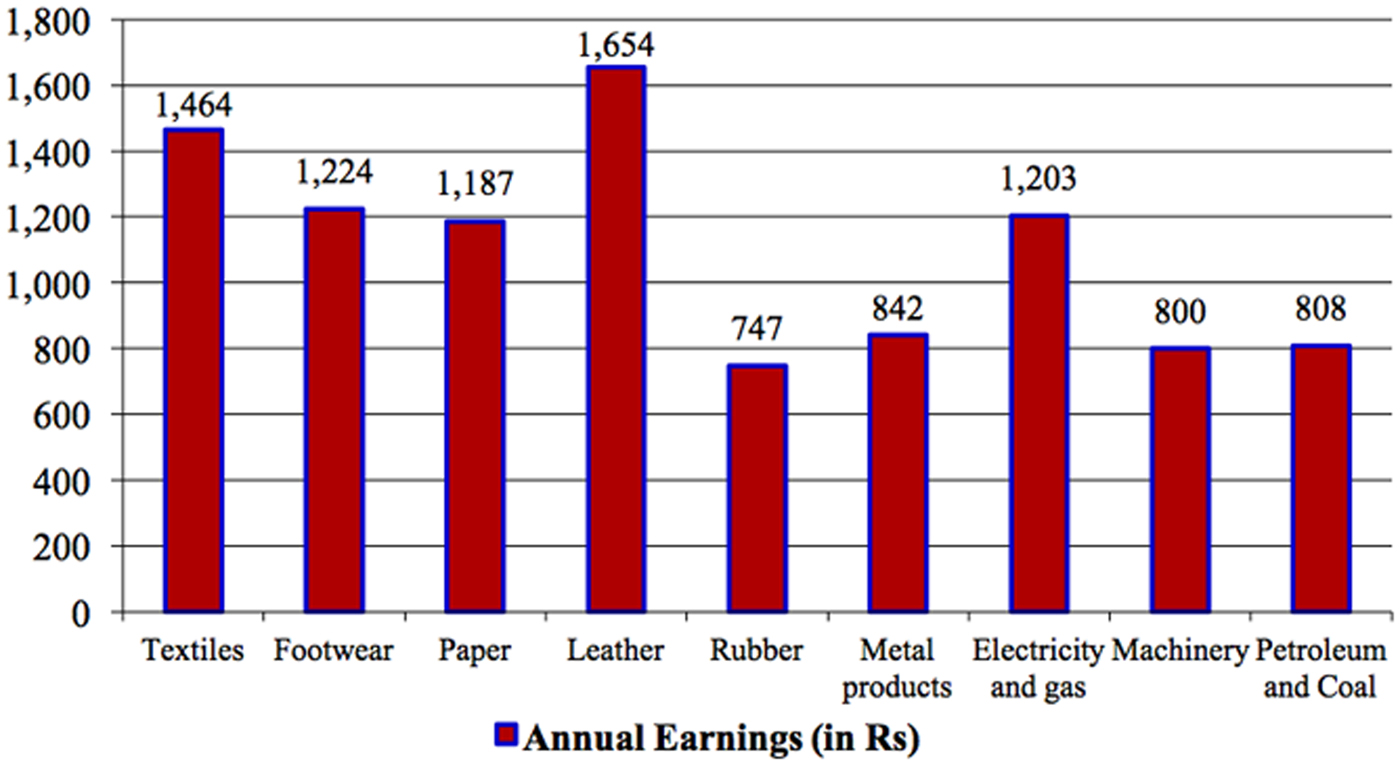
Most centres were new, but poorly equipped and, at times, women had to bring their own sewing machines.Footnote 63 Their monthly earnings in the early 1950s ranged from Rs 12 to Rs 50, amounting to between Rs 144 and Rs 600 per annum.Footnote 64 Compared to the average earnings of factory workers at this time, these were meagre sums (see Figure 2).
Average annual earnings of factory workers in Delhi, 1947–57. Source: Delhi Gazetteer, Delhi Administration, Delhi, 1974, p. 496.

Their wages compared poorly with what workers earned in Delhi's other industries (see Figure 3). In 1948, most industries were covered by the Minimum Wages Act, which standardized wages.Footnote 65 However, the female workers at the centres were excluded from it.
Average annual earnings of workers in different industries in Delhi, 1955. Source: Indian Labour Gazette, Ministry of Labour and Employment, Government of India, March 1958, p. 132.

Research on women's work and wages highlights that the very nature of household or handicraft industries complicates the calculation and standardization of wages.Footnote 66 They argue that, since wages remain depressed and women's work undervalued, it reinforces notions of ‘feminine domesticity’, rather than giving women a separate identity as a paid worker.Footnote 67 Banerjee and others have spoken of a process of ‘feminization of work’, which entails an increase in the female work-participation rates with no commensurate increase in their status.Footnote 68
To sum up these trends, after partition, without a doubt, there was a significant increase in female participation at work. As the census shows, by 1961, there were 76,169 female workers in DelhiFootnote 69—a marked increase over the 1921 figure of 20,759.Footnote 70 These figures are likely to be underestimated, as many independent and self-employed women workers were not enumerated in the census: had they been counted, the figures would have been much higher. However, while the feminization of work undoubtedly led to an increase in the number of female workers in Delhi, it was also associated with the cheapening of their wages. Flexible contracts and poor working conditions characterized their work environment, as will be seen below.
The politics of women's work: is small beautiful?
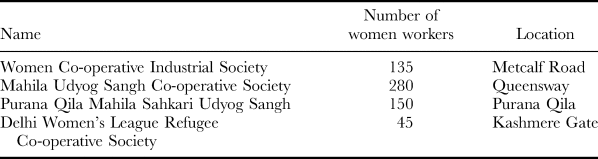
The main work of these centres consisted of sewing uniforms for the employees of the government and other public enterprises.Footnote 71 Then there was production for sale in the market. Fine embroidered linen, ready-made garments, and handicrafts manufactured by refugee women were sold at the celebrated Refugee Handicrafts shop in Delhi's posh Connaught Palace market, which opened in 1949.Footnote 72 Alongside, a number of women's cooperative societies were set up to help refugee women secure employment (see Table 3). A letter from the assistant registrar of cooperative societies mentioned in 1949 that women received orders for knitted garments, sewn uniforms, woven baskets, and painted fabric.Footnote 73 The government set up an Employment Bureau and, by 1951, out of 2,175 women registered in 1949, half had gained employment.Footnote 74
Refugee women's cooperative societies

Source: ‘Refugee Women's Co-operative Societies’, D.C. 340/1949, DSA.
However, during the course of next few years, administrative control over these centres went back and forth, twice between central and state governments; within the central government, they were tossed around between four different ministries and two departments. By 1970, most of them had closed down, on account of lack of funding and lack of work. A report stated that these women were treated as the ‘step-children’ of the Delhi government.Footnote 75 They were subject to all the formal rules and regulations of time-rate workers, such as daily attendance, fixed eight-hour day, six days a week, and monthly payments, but received none of the benefits and protection of the formal labour.Footnote 76 Many women had to sit on the floor, bending for hours over the machines. In some centres, space was congested, with concomitant health hazards, and they further shrank in due course.Footnote 77
A similar ambivalence could be seen in the administration of cooperative societies. The Refugee Women's Co-operative Society was founded in 1949, with the aim of providing employment to partition widows.Footnote 78 Chand Kohli, a prominent social worker, played an important role in running the society in the 1950s. The major source of earnings for these women were tailoring and sewing uniforms for the lower-level government employees, such as hospital workers and post-office staff. In 1949, it employed about 200 women and they received bulk orders from these organizations.Footnote 79 On average, each woman was paid between Rs 20 and Rs 60 per month, depending on the nature and amount of work she did.
In 1949, the Co-operative Society occupied the prime location in Connaught Place, right in the heart of the city. To begin with, women workers received equipment and accessories but, soon after, they were expected to bring their own along. Prem Manha, a partition widow and resident of Pahar Ganj, recalls some of these changes, thus:
I joined the Co-operative Society in 1950, at an initial earning of. Rs. 50 per month. I used to take a bus to go to work, but was never given extra money towards that. Anyway, we were provided machines, and zippers, threads etc. So, somehow I managed…but later on, the Society had limited funds, it stopped receiving orders from government employees, because they were getting cheaper uniforms from somewhere else. Work got lesser, and with this we were asked to bring our own machines. The bus fares also increased, but since I had no regular income, it became very difficult for me to carry this on. I left the Society in 1960, but got no rewards or pensions. The government didn't care enough.Footnote 80
Prem Manha was among those refugee women who became initial beneficiaries of state help but lost their livelihoods, as the Co-operative Society ceased to give them a regular income. In another interview, in-charge Manjit Kaur shared some graver facts. The Refugee Women's Co-operative Society was first established in a big room in the old Indian Oil Building but, by 1970, the society's premises had shrunk down to a small courtyard (verandah) above the Cottage Industries Emporium. By this time, the society had stopped receiving government aid. As Kaur recounted:
Things changed a lot as we lost all our orders to private agencies. Class III and IV employees were given fabric, and asked to get their uniforms stitched by private tailors. In some organisations, uniforms were no longer compulsory. Co-operative Society lost its meaning- space was limited and women had no work! Women were not treated as ‘workers’, but as temporary recipients of government's charity. Clearly, no woman could raise a dependable income from it.Footnote 81
As Kaur's testimony made clear, Co-operative Society functioned as a charitable organization, helping destitute women in need. These women were not treated on a par with other public-sector employees because they were never accorded the status of workers, contributing to production and consumption. It retained the option of shedding its ‘national’ responsibility towards these women, whenever it wanted. For the women, the withdrawal of state support meant a loss of income. They could never return to work.
Over a period of time, work centres and cooperative societies became redundant. In their interviews, most women lamented the loss of demand for their products—the fact that they did not get ‘orders’. The goods and services produced by women did not find sufficient markets and their enterprises never really flourished. The women social workers involved with the establishment and running of these centres were all too aware of some of these challenges. For instance, in a letter to the chief commissioner of Delhi in April 1949, the director of the Delhi wing of the Women's Section, Ms Achamma Matthai, noted:
As you know various work and relief centers are being run by the Women's Section in different parts of Delhi. We have on our registers over 2,000 refugee women who are working in these centers. During the winter months, these women earned Rs 1 per day due to orders received from the government for razai (blankets) and jerseys. But as the summer sets in, there is no demand for these articles. We would be grateful if orders for handmade articles like soap, stitched garments, uniforms, dusters and swabs be placed with us, so that these women can find employment and make a living during the coming months.Footnote 82
Similarly, Kamladevi Chattopadhyay mentioned the ‘absence of finance, difficulty in marketing products and lack of administrative support’ among the main reasons for the closure of women's cooperatives.Footnote 83 In her memoir, she called it ‘vandalism’ under the title ‘development’,Footnote 84 as the movement did not receive support. Archival sources clearly indicate that these centres could barely cover their running costs and struggled to find remunerative work for their women employees. They also reflect the failure of the government's commitment to handicrafts and small-scale industries. Back in 1948, the Ministry of Labour had enthusiastically passed a resolution on industrial policy that celebrated India's small-scale cottage and handicraft industries and their promise in absorbing the displaced population. It stated thus:
Cottage and small-scale industries have a very important role in the national economy, offering as they do scope for individual, village or co-operative enterprise and means for the rehabilitation of displaced persons. These industries are particularly suited for the better utilisation of local resources and for the achievement of local self-sufficiency, in respect to certain types of essential consumer goods.Footnote 85
Nehru himself believed that Indian women could be ‘awakened’ through Gandhian cooperatives.Footnote 86 As Taylor Sherman has recently argued, Gandhian economic thought was not fully ignored in the new nation. In fact, Gandhian approaches seemed to provide answers to the pressing questions of how to direct the energies of masses, and how to foster economic change with limited state sources.Footnote 87 There is little doubt that, had the state fully committed itself to small-scale industrial development in regions where refugees were clustered, refugee women could have benefited from the training schemes. However, because national planning was geared towards large-scale urban-oriented industries, economic planning for refugees based on the cottage-industry model did not yield the desired results.Footnote 88 Gandhian ideas were relegated to the pursuit of refugee women's quest for ‘moral and spiritual’ growth, complimenting their social roles as ‘providers’ and ‘nurturers’, without a stable employment. The Indian state, undoubtedly, believed in unleashing women's energies in nation-building through an assertion and reiteration of their ‘creative and productive roles’. But, it did not see them as equal participants in the new nation.
Moreover, for many nationalists, craft producers were considered emblematic of India's self-contained, self-sufficient society that they thought (mistakenly) had existed before colonial rule. As a report on the Co-operative Organization of Small-scale Cottage and Handicraft Industries in 1951 noted:
The term ‘handicrafts’ in its modern connotations can no longer be used to describe the traditional concept of craft practiced by members of an exclusive guild, and carrying with it a multitude of social and economic rights and obligations. The success of the handicrafts and small-scale industries depends upon capital investment, credit supply, division of labour and direct touch with the markets- national and international, where the products are sold. In the absence of anyone of them, the handicraft industry is doomed to fail.Footnote 89
Most leaders, including Gandhi, appear to have been oblivious to the ways in which the actual economy of artisan production was changing around them. Recent research in economic history has highlighted how weavers, dyers, printers, and gold-thread producers in early twentieth-century India used different raw materials in manufacturing textiles than their pre-colonial counterparts.Footnote 90 They produced different kinds of cloth for different kinds of markets. They frequently migrated over long distances to small weaving towns where they fashioned new forms of community, and they often deployed novel techniques of production. In short, they were not ‘traditional’ figures carrying on their ‘traditional’ professions in a timeless fashion; they were participants in processes of change in the subcontinent.
Research has also highlighted the importance of consumption and the markets behind the success of handicrafts.Footnote 91 As against the traditional interpretation, which argued that the demand for craft products was evidence of the persistence of past customary preferences, these scholars reveal the importance of the processes of cultural, economic, and social change that brought about shifts in the patterns of consumption of particular craft items, which ‘carry attitudes, ideas and world-views’.Footnote 92
The markets for handicrafts are determined by the ‘aesthetics’ of consumption. In the absence of the old elite patronage of Mughal and imperial Delhi, the consumers who patronized crafts in post-colonial India belonged to a very specific category of middle class or elites with a particular orientation towards beauty and handmade goods. Scholars suggest that consumer preferences changed dramatically during the late-colonial period, as the middle class increasingly defined its identity by purchasing and using new kinds of modern consumer items, spurring new forms of industry like medicine, hosiery, vegetable oil, ready-made clothes, and even some electrical goods, and abandoned some of the items urban Indians had exclusively obtained from local bazaars before that time.Footnote 93 The changing tastes and fashions of middle classes, with an emphasis on consumption of particular goods associated with certain practices of capitalist modernity, did not involve handicraft goods produced by refugee women.
Drawing on this research, it can be argued that the refugee handicraft industry failed to adapt itself to the changing needs of consumption and markets, in large measure because the government's design for it was flawed. Small-scale handicraft workers such as handloom weavers, embroiderers, and dyers constantly needed to adjust their products to the nature of their markets; indeed, if they did not, they often had to drop out of their professions. The skills acquired by women refugees, and the crafts they practised, were not diverse enough to suit the major shifts in consumer preferences taking place in the domestic and international market in the second half of the twentieth century. The key element in the failure of refugee handicrafts was the inability not to recruit labour, but to recognize where consumer needs were changing. To what extent were calico-painting, basket-weaving, and sewing the skills that were increasingly desired in the consumer market? Undoubtedly, the demand for these goods fell. Neither the government nor the refugee handicraft industries recognized this, and they failed to adapt to the new consumerism of urban Delhi, resulting in their stagnation and ultimate failure.
The home and the market
This partly explains why a vast majority of refugee women in Delhi had to take to another path: of self-rehabilitation. They ventured out on their own in a bid to earn and supplement family income. Their experiences were never recorded or mentioned in official records, which refused to recognize their presence. Their endeavours were scattered and highly disjointed, and remained hidden in personal narratives, family histories, or morphological histories of localities where they lived. The kind of jobs they undertook were informal and obscure. These included domestic service, running small shops in their homes, or packaging work and selling newspapers. Some of them worked only for brief parts of their lives, but many continued to sustain their families or contribute to family incomes. However, refugee women's labour participation in Delhi was contoured by their gender and work was a survival strategy rather than a choice or a means of improving standards of living or voice in the household.
In her recent work on women workers in an informal economy, social economist, Naila Kabeer, says they are mostly found in casual, isolated, part-time, irregular, and often home-based activities. They are located on the informal margins of urban informal economies, often self-employed, trying to sell their goods and services.Footnote 94 Not surprisingly, there is little in their working conditions that lends itself to self-recognition of their status as workers, let alone social recognition. Paula Kantor explains how processes of ‘exclusion’ and ‘constrained and adverse inclusion’ shape women's labour-market opportunities and outcomes in an informal economy.Footnote 95 The range of options open to women for engaging in various aspects of social and economic life are shaped by the social relations and norms defining women's labour participation. Their experiences as workers are limited by women's domestic and caretaking responsibilities, which conform to male breadwinning and female home-making gender ideologies. Home-based work, then, emerges as the only means of participating in the labour market for many women.Footnote 96 Refugee women in Delhi quite often combined domestic duties and survival strategies to create informal economies of work.
Refugee women's labour-market decisions were much more than just ‘economic’; they were socially, culturally, and spatially embedded. Yet, women's own attempts at rehabilitation frequently took them out of the ‘enclaves’ officials had created for them. They sold newspapers, worked as domestic help, and ran kiosks, and, through these small enterprises, sometimes initiated families into businesses. Durga Devi, a refugee from Sialkot, sustained her family by working for a self-made proprietor, Gyan Chand, in Bara Hindu Rao. She made the dyes deployed in printing gunny and jute bags for sale in the wholesale market of Sadar Bazar.Footnote 97 Durga Devi travelled every day from her house in Kishanganj, leaving her little children with her sister, to earn a living. She stopped going to the factory only when her children had grown up.
Another woman from Sialkot, Somavanti, sustained her family by selling garlands at Kalkaji Temple. She would wake up in the middle of the night to sew garlands of marigold flowers and take them for sale outside the temple at 4.30 a.m., when the devotees gathered there for prayers. Additionally, she cleaned households throughout the day. This went on for over ten years. Once her sons had grown up, she retired to stay at home.Footnote 98 Women like these are usually invisible in Delhi's urban spaces. A woman hawker, a domestic servant, or a petty-shopkeeper are not the women one notices on the streets of the city. Yet, in their own significant ways, by combining domestic and commercial duties, these women legitimized their participation in the labour market as well as negotiated gender relations and urban spaces.
One such woman, Bibi Ram Pyari, migrated to Delhi from Multan, where her family had been shopkeepers. As she recollected stories of her survival, she revealed something about how women adopted ingenious strategies to combine their domestic responsibilities with earning livelihoods. Her interview needs quoting at length:
As if batwara (partition) was not enough, my troubles were heightened by the fact that my husband was diagnosed with Tuberculosis. I had four children, and was in no position to work. My brother was living in Patel Nagar (a refugee colony set up by government), but he had his own set of problems. In spite of that he supported me for quite some time, especially with the expenses of my husband's treatment. I had some jewellery that I sold, and he gave me some financial help, with which I bought a two-room house in Rajendra Nagar. We shifted there, but had no fixed source of income. I could not go out to work, as there was no one to look after my children. After all, how much could Sohn Paji [brother] do for us? So, I used the front room of the house, which opened in a gali [street], and started a khokha [kiosk] there. I had no experience of it whatsoever, though my father was a small wholesale cloth shopkeeper in Multan. But I rarely visited his shop or took interest in business matters.
She explains that, to start with, she used to sell sugar-coated candies to local children:
I used to feed my children at the shop, teach them (or at least supervise their studies) and also stitch their clothes sometimes. My brother used to get items for sale, from the wholesaler market. The profits I made were very meager. My husband's condition deteriorated, and after a long struggle he passed away in 1956. Along with his loss came additional problem of running a shop without a male member in the house. My son was all of twelve years and my daughter used to substitute sometimes for me with her brother, but I insisted that they studied… In some years, I expanded the shop and kept items like laila ki ungaliyan (‘Laila's fingers’- a snack made of gram flour), bubblegum, bakery biscuits, churan (or digestive, sweet and sour powder packed in pink straws), and other items. Through great struggle I nurtured the shop, as that was my only source of livelihood.Footnote 99
The kiosk, which was started by Bibi Rampyari as a means of bare survival, slowly acquired the status of a popular general store in the refugee colony of Rajender Nagar. By 1960, the entire area had developed into a big market—a site not uncommon in other refugee colonies of the city, which expanded around a market. The store started stocking items ranging from soap, washing powder, and stationery to packets of crisps and chocolates, and Bibi Ram Pyari employed a few extra hands to help her. But it was she who had set up the initial venture. And, to do so, she deployed her resources—familial and social—in creative ways, which defied the conventional binary between public and private spheres,Footnote 100 between domestic duties and commercial tasks.
Bibi Ram Pyari's story is also a story about the emergence, and rapid expansion, of the informal commercial sector in India's cities. It illuminates the processes by which work in that sector came to be ‘feminized’ by the imperatives and pressures faced by migrant women. Bibi Rampyari is now in declining health and almost bedridden. However, looking back at her life, she feels self-made. She takes pride in the fact that she did not look up to any one for charity and that she made a space that she can call hers, in a city that was changed or shaped by her endeavours. Not only did women like Bibi Rampiyari initiate their families into business; they also contributed to the character of the localities where they worked.
In another example, in Malviya Nagar, which was a popular ‘refugee’ colony, and a booming market of south Delhi today, Sardar Navjot Singh ran a shop of electrical repairs. While his shop, which comprised the front room of the house, faced the market and had a prime location, at the rear of his shop, in his backyard, a room had acquired the status of a ‘boutique’ run by Navjot Singh's wife, Ranoji. She started as a freelance tailor in 1953. Her story is quite reflective of how different kinds of economic activity, previously thought of as discrete, increasingly rubbed up against each other under a single roof, within the same family and household. She recalls:
When we came to this small house in Malviya Nagar, we had to start from the scratch. Sardarji [her husband] had some skills in electrical repair, which he had acquired in Rawalpindi. However, business did not pick up for some time and his earnings were not sufficient to run the family. Some women in our neighborhood had joined silai (stitching) classes run by the government, so I learnt with them. But after that I could not work, as I did not find ‘proper work’, my children were young and I had an ailing father-in-law to look after …
… Later, in 1953, I started taking private orders for ladies’ suits and blouses. With time, my work picked up, so I expanded and got two or three other women (also refugees) to work with me. I covered my backyard and converted it into a room [a very common sight in Malviya Nagar] and opened a silai center. Orders started pouring in. Gradually, Sardarji's work also got going, but I continued my work … but now, my daughter-in-law, who is interested in designing, runs a boutique for ladies’ suits.Footnote 101
Like Ranoji, many people in Malviya Nagar started ventures with small shops in their homes, which gradually gave shape to the whole market. This trend could also be seen in many other refugee clusters all over Delhi, where the construction of a large number of houses, shops, and industrial establishments side by side resulted in the creation of new colonies.Footnote 102
These refugee colonies largely emerged in the south, or north-west of Delhi, where the government built refugee townships, in areas like Patel Nagar, Kingsway camp, Vijay Nagar, Jungpura, Lajpat Nagar, Kalkaji, Tilak Nagar, Rajouri Garden, and Roshanara Bagh. Most of them have a refugee market at their heart. The houses were not multi-storeyed, nor were they spacious, and, in the subsequent years, these colonies have experienced much unplanned growth. Many houses in Kalkaji still have shops in the courtyard or in the front room, which were initially set up by women. Yet, these are also spaces in which new businesses run by women—like Ram Pyari's sweetshop and Ranoji's tailoring shop—brought the ‘home’ and the ‘market’ together in new and significant ways.
However, the heterogeneity of refugee women's experiences needs to be emphasized here. Not all women took to self-rehabilitation. Many became beneficiaries of state help, or used state support to establish their own enterprises. Moreover, women's claims to rehabilitation, and their experience of it, differed as per their caste, class, age, and even their marital status. Some women displayed tremendous resilience, and used class connections and caste linkages, while others created a vocabulary of ‘martyrdom’, sacrifice, and rights to pursue their claims. One such story of Tara Devi reveals the multiplicity of support, and a series of negotiations, women engaged in to set up their small informalities.
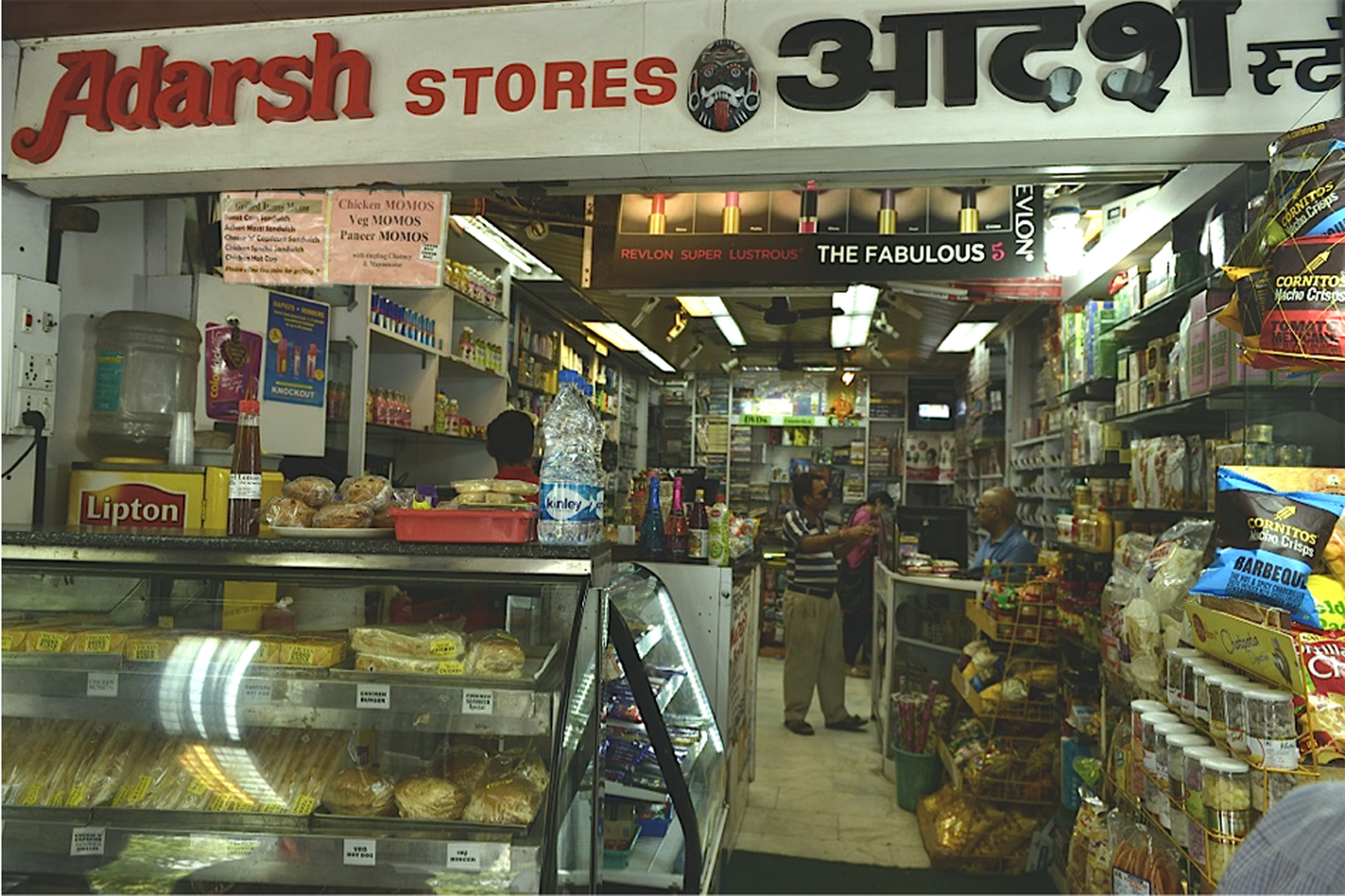
In the crowded market of Janpath in central Delhi, Adarsh Stores is a well-known shop, selling music CDs and cosmetics (see Figure 4). The shop has seen better days but, even today, is a stopover for many tourists, students, and young members of the old elite families of Delhi. As one enters the shop, one is struck by the fact that, among many music CDs, DVDs, and cosmetics on display, there are ageing jars of jam, pickles, and jellies. Their presence is so visible, and sits so oddly with the other items for sale that one cannot ignore those bottles of preserves. Asked about the mixture of items for sale in the shop, the shopkeeper began to tell the story of his mother, Tara Devi, a refugee from Jhelum, who was the original owner of the shop.
Adarsh Stores, Janpath 2012, New Delhi.

Tara Devi came to Delhi from Jhelum in 1947. She was one of eight unmarried sisters. The family was well connected in Jhelum, the father being a police officer with contacts in both British circles and the Congress. After partition, Delhi was the obvious choice for the family: Tara Devi's father was transferred under the special provisions made for government servants, to serve in Delhi as a rehabilitation officer. They had many relatives in the city. Tara Devi was later married to a businessman in Delhi. Tara Devi died in 2003 and is survived by her two sons. They keep old jam bottles in the shop in memory of the enterprise started by their mother. But jam and pickle jars are also a proud symbol of their refugee status.
The shop had been allotted to Tara Devi on a rental basis, after she had been trained in jam- and jelly-making at the Canning Lane Centre. The area is very close to the central hub of the city, Connaught Place—a market then regularly frequented by the old elites of Delhi. Claiming that their mother was a ‘warrior’ and ‘martyr’ of India's Independence, her sons recall:
Our mother was a revolutionary in Jhelum. She was a true warrior, a supporter of Indian National Congress. During her College days, she wanted to join the Indian National Army, that's why she was a fighter all her life. She acquired training in jam and jelly making at Canning Lane Centre and with the help from an old contact, Sardar Baldev Singh, she met the Rehabilitation Minister Mehr Chand Khanna. She was allotted a shop on rent in Queensway, which comprised of temporary structures, primarily constructed to help refugees with some enterprise. Form there, she sold a variety of items like toys, jams and pickles. But during the rains our roofs would leak, so shopkeepers replaced it with metal and asbestos sheets. Later in the 1970, concrete brick structures were added in their place.Footnote 103
It is interesting to note that Tara Devi seems to have claimed both her ‘victim’ and ‘martyr’ status to acquire the shop. She was subsequently allotted a large bungalow plot in Jangpura, where the family lives to the present day. The shop had seen good days, but the sons claim that, due to the urban expansion of Delhi and coming-up of ‘fancy’ shopping malls, their original business collapsed. They had to introduce cosmetics and other items like a coffee machine at the entrance to attract customers. Tara Devi ran the shop with her sons until 2002, when she died. In many ways, by providing her sons with a space from which to operate their daily source of livelihood—the shop—and by passing on her pre-established connections, she initiated her family into a business. Ever since her death, her sons have faced tremendous insecurity, considering the shop is still on rent from the government and that their mother is no more there to exercise her claim over the space as a refugee.
Like Tara Devi, many refugee women carved out survival strategies, with or without state help. There were those who took advantage of the state's help yet, because the kind of help the state offered to women rested on limiting assumptions and biases about the kind of work that was appropriate for them, women often fell back on other resources and drew intelligently on all their myriad familial and social networks. That had interesting bearing on both the household and the market. Moreover, by their decision to take up a particular kind of work, or moving from one to another, women were navigating ideas of work as well as urban spaces. In her work on the evolution of cities, Jennifer Robinson proposes an urban theory based on the ‘ordinariness’ of the cities in terms of their diversity, creativity, and distinctiveness.Footnote 104 She emphasizes a need to look at cities in greater detail, in terms of their spatiality, ideas, resources, and practices drawn from a variety of places—not infinite, but diverse—beyond the physical borders. This article urges the need to investigate the diversity and creativity within the Indian city in terms of the indigenous Indian-market concept and inclusion of women in urban spaces.
Conclusion
This article has set out the processes by which refugee women navigated around official policies to challenge discourses on women's work, social exclusion, and economic marginalization in post-colonial Delhi. Through an investigation into the feminization and commercialization of urban space, it reveals migrant women's creative roles that have shaped the character of the modern South Asian city. Using interdisciplinary methodologies of gender analysis, it documents women's attempts to transverse the complexity of urbanization characterized by patriarchal planning ideologies and gender inequalities.
Neither the newly independent Indian state nor the refugee society saw women playing a definitive role in nation-building. Their work was often made invisible. This ‘exclusion’ is explained on account of the intermittent nature of women's work—the fact that women's entry into the labour market is often driven by household exigencies. For many women, this meant that they worked all their lives, but their work was always regarded as supplementary. To understand how social construction of gender shaped the lives and work of women workers, wider social anxieties about women's role and position at home have to be taken into account.
This article has revealed that the state rehabilitation policies in independent India were not committed to the idea of a ‘working woman’ and, through discriminatory policies and ad-hoc arrangements, they undermined women's work. Clearly, the state was obsessed with planning capital spaces and restoring the social order disrupted by partition. It idealized utopian capital space, marked by ‘ordered’ modernity within the nuclear refugee families, firmly clutched within the authority of the propertied husband.
However, urban utopias are made up of a variety of interacting, and sometimes competing, visions. Refugee women slowly surmounted barriers and plunged into alternative survival strategies. Their participation in economic informality was a struggle against material and social deprivation that came about because of patriarchy and planning policies. Women combined their domestic and commercial roles, and gave multiple meanings to space, in an endeavour to sustain family income. As refugee women and men increasingly came to occupy the same public spaces for social and economic reasons, they blurred the division of space, such as ‘public’ and ‘private’, that are frequently mapped out onto gendered spaces, with the assumption that one gender's entry into another's space constitutes a social transgression.
It is imperative to assert here that, while refugee women's economic informalities provided livelihood and employment to a large proportion of undocumented urban population, their trajectories were never straightforward. By venturing into informal set-ups, women were not only challenging male domination, but also acquiring space and opportunity for a better living, for themselves and their families. They feminized the city in more than one way: by sharing space, identifying livelihoods, and also challenging ‘orderly’ post-colonial modernity in a capital city.