Political scandals have become a natural element of democratic politics. Breaking news about politicians’ involvement in illegal or immoral behaviour regularly captures the attention of journalists, pundits and mass publics. While the internal logic of scandals is an interesting topic in itself (one that has received scholarly attention), much of the public fascination with scandals is driven by the alleged effects on the public. For example, scandals typically stimulate much public speculation about changes in the popularity ratings of those individuals involved in the scandals.
However, major scandals are often regarded as something more than just specific stories about besmirched individuals. An unspoken premise of the attention is that a contract between citizens and their representatives has been violated. People learn that someone entrusted with the right to make collective decisions is accused of morally or legally unacceptable actions. Moreover, given that journalists and pundits devote much space and energy to scandals, citizens may come to perceive that bad conduct is typical of politicians. Thus, scandals could damage support for politicians in general and satisfaction with how representative democracy functions in practice.
Such broad and negative generalizations, however, should not be taken for granted. For example, expectations of politicians may already be so low, and citizens so accustomed to scandals, that more of the same does not bring about changes in attitudes. Alternatively, broader generalizations may not materialize because accusations are perceived as unfounded, irrelevant or exaggerated. Indeed, under some conditions scandals might even conceivably strengthen democratic satisfaction. This would be the case if, perhaps after an initial reaction of anger and frustration, citizens conclude that the system as a whole functions well. Individuals might be crossing the line, but media watchdogs and responsible politicians make sure wrongdoers are exposed and dealt with.
Research on the impact of scandals is not lacking. As we shall see, however, much of our earlier knowledge has come from interesting but potentially unrepresentative case studies. Less attention has been paid to systematic comparisons across contexts and scandals. We will argue that this raises methodological concerns and leaves pressing substantive questions largely unanswered. Consequently, the present study was designed to overcome the scattered character of information on scandals. We use a comparative data source covering a particularly interesting type of political context – national elections. For such contexts, we can measure the presence or absence of political scandals in some 150 elections in nineteen countries over three decades. We call them ‘scandal elections’, and we note that they merit interest because they are critical events in democracies and in the political lives of citizens. As such, they are interesting in themselves but may also contribute to an understanding of scandals as a general phenomenon in modern mass democracies.
Specifically, our approach allows us to address the following questions: (1) whether elections in Western democracies have become increasingly associated with scandals; (2) whether scandal elections systematically affect citizens’ satisfaction with the functioning of democracy; (3) if such effects change over time as scandal elections have allegedly multiplied; and (4) whether trends and effects are systematically different depending on the character of scandals in terms of the number of actors and parties involved.
In the following sections we discuss previous research and hypotheses about what to expect in terms of trends in scandal elections and their effects. We then move on to issues of definition, measurement and data, and finally to empirical analysis. The concluding section discusses the nature of the findings and implications for future research.
Media and the ‘scandalization’ of politics
According to Theodore Lowi, scandals ‘are corruption revealed’.Footnote 1 As discussed below, we conceptualize the relationship between scandal and corruption somewhat differently: not all instances of corruption are potential political scandals, and not all scandals are instances of alleged corruption – but Lowi is right in emphasizing the importance of publicity for political scandals. This means that the media are key actors in the process.Footnote 2
Media researchers have long observed that the relationship between journalists and politicians has changed in past decades. ‘Mediatisation’Footnote 3, ‘New Media Logic’Footnote 4 and ‘Media as the Fourth Branch of Government’Footnote 5 are conceptual summaries of developmental trends in most, if not all, Western democracies. At the heart of these ideas lies the notion that the media has become an independent political actor with an agenda of its own. To their more or less openly expressed dislike, politicians have been forced to adapt to a media-centred context of communication.Footnote 6
Also, the type of information disseminated to citizens has changed. Journalists are prone to emphasize strategic and conflictual aspects of politics, to focus on individuals rather than on political structures and to take the position of a watchdog protecting the interests of citizens against powerful politicians.Footnote 7 Moreover, due to increasingly complex news media structures, and shortened news cycles, the amount of political information available to citizens has multiplied. Recently, new communications technologies have fostered an even more personalized and conflictual political coverage.Footnote 8 Here it is important to note that political scandals fit perfectly into the currently dominating media format.Footnote 9 Specifically, developments in relations between the media and politics lead to the Increasing incidence hypothesis.
HYPOTHESIS 1: Over time, scandals have become both more common and more prominent themes in election campaigns.
Scandal effects on citizens: past research
It seems clear that major scandals can reduce support for the politicians involved,Footnote 10 and at least occasionally for parties and governments.Footnote 11 However, the impact on generalized orientations towards democratic institutions and actors is less researched.Footnote 12 For sure, many citizens believe politicians are prone towards immoral and illegal behaviour.Footnote 13 What is less clear, however, is the development of scandals as a general phenomenon over time, and the extent to which mistrust actually emanates from the reported behaviour of politicians.
The most closely related large-N comparative evidence concerns how citizens in different countries react to corruption, a real-world problem underlying some but not all political scandals. In particular, Anderson and Tverdova show that higher levels of perceived societal corruption are negatively associated with different forms of political trust.Footnote 14 Such findings are valuable but, by definition, only partly relevant for our understanding of scandals. Is information about scandal material, such as corruption, mainly communicated through everyday experience with the functioning of lower level government officials or also through public election scandals involving politicians and high-ranking officials?
A few major American scandals have been thoroughly scrutinized. Miller studied the Clinton–Lewinsky affair using cross-sectional data.Footnote 15 He concluded that its effects on both presidential popularity and general political trust were negligible. The explanation included highly partisan perceptions of the scandal, dissatisfaction with exaggerated media coverage and biased investigators, as well as a public whose evaluations of leaders tend to be multidimensional and differentiated.Footnote 16 Smyth and Taylor's time-series analysis of monthly popularity data sustain these findings. Analysing both Watergate and Lewinsky, they find scandal effects to be either absent or at least much smaller than those of economic performance.Footnote 17
In one of the relatively few studies focusing explicitly on more generalized political orientations, Bowler and Karp examine the impact of the congressional ‘House Bank’ scandal of the 1990s.Footnote 18 They find that mistrust of Congress is associated with knowledge about this scandal, and that distrust was greater in districts where congressmen wrote more ‘bad checks’. Moreover, Chanley, Rudolph and Rahn provide the most complete American evidence that, at the least, major scandals can affect general political trust.Footnote 19 The authors combine quarterly time-series data on trust with information on the timing of eight major scandals throughout the 1980s and 1990s. The results suggest that congressional scandals hamper both trust in Congress and general trust, whereas presidential scandals tend to mainly hurt specific presidential approval.
In the European context, Kepplinger reports that the German terms ‘Skandal’ and ‘Affäre’ became more frequent in the index of Der Spiegel between 1950 and 1989.Footnote 20 In the same edited volume, Fridrichsen studied a series of scandals during Germany's Superwahljahr of 1994.Footnote 21 Extensive media content analyses revealed nine major scandals during this year. These were all rather short lived in terms of media attention but produced short-term spikes in the public's interest in scandals. However, the outbreak of scandals did not contribute to the perception that scandals and political mistrust are important problems. There were a few cases where being interested in a particular scandal produced more support for newer and less established parties, and contributed to political mistrust as a societal problem. A similar study used open-ended survey questions to capture mistrusting Swedes’ subjective explanations of their own mistrust. Around 15 per cent mentioned scandals and affairs, making this one of the more common subjective accounts.Footnote 22
In the French context, an experimental study reports that psychology students who were reminded of ex-Minister Roland Dumas, and who were already highly knowledgeable about the ELF scandal to which he is linked, were less generally trusting of politicians than other students.Footnote 23 Likewise, Bowler and Karp analysed the 2001 UK election and found less trust in constituencies where MPs were involved in scandals.Footnote 24 Finally, in an essay on corruption in Portugal, De Sousa argued that the 1995 election ‘showed how corruption can lead to the collapse of a party in power’, and reports survey results showing that ‘Since 1993, when the PSD majority started to be rocked by scandals of corruption and financial impropriety, citizens belief in the works of democracy declined.’Footnote 25
Studying scandals and their effects
The literature review suggests a number of typical research design features. Taken together, we argue, these features call for further investigation. Most obviously, researchers have often relied on a ‘single-country-few scandals-approach’. Often only one scandal has been examined.Footnote 26 Such case studies are valuable as they illuminate ramifications of major historical events. But the approach can also be problematic if we wish to understand scandals as a general phenomenon. For instance, the design may produce a biased view of scandal effects if scholars focus on notable scandals, while slightly smaller scandals are neglected. Moreover, the case study design leaves little analytical leverage for variations in the nature of scandals. Our general approach allows us to investigate whether some forms of scandals are more likely to trigger generalizations about the functioning of democracy.
Furthermore, concentrating on one scandal at the time by definition excludes any effects due to accumulations of several scandals, or the possibility that such accumulation interacts with the impact of future scandals. As our theory and data will suggest, past scandals can continue to play a role as they enter our ‘collective scandal memory’, as revived by the media and citizens themselves during election campaigns. Similarly, we will argue that the impact of new scandals may be different depending on the nature of this collective memory.
The single-scandal design also typically forces researchers to employ individual-level independent variables, such as respondent's knowledge about, or perceptions of, a single scandal.Footnote 27 Such designs are sensitive to chicken-and-egg causality problems. But more than this, they leave out the possibility that scandal effects operate at a more contextual level. From this vantage point, trust differences may be found between scandal-ridden and scandal-free contexts, just as much as between citizens who are (unequally) exposed to the same scandal-ridden context.
Moreover, several past studies have dealt with simultaneous or short-term effects. This is true for studies analysing individual-level effects of single scandals using survey data,Footnote 28 for experimental designs,Footnote 29 as well as for studies modelling the impact of a somewhat larger number of scandals using time-series analysisFootnote 30 or within-country geographical variation.Footnote 31 While short-term effects are certainly interesting, we focus on longer-term effects, as measured some months after elections. Scandal effects on political trust are arguably of (even) greater interest if citizens draw more lasting and deeply engrained conclusions.
A final feature of past research is that elections have played a modest role. Scholars have usually studied the impact of major scandals whenever salient in the electoral cycle.Footnote 32 However, whereas the typical between-election scandal is reported as a stand-alone event, our results will suggest that election campaigns often allow several old and new scandals to (re)surface simultaneously. This is interesting not least as election campaigns tend to boost political interest and indeed affect views of the political system.Footnote 33 There is systematic evidence that elections in Western democracies, when conducted according to the standards expected by citizens, typically build political support among citizens.Footnote 34 From this point of view, studying scandals at election time is interesting as these may affect the ability of democracies to legitimize and revitalize themselves.
Hypotheses about the impact of scandal elections on political trust
We noted previously that scandals may theoretically erode, build, or be inconsequential for, generalized satisfaction with democracy. Still, we have yet to identify a single case in which researchers report that scandals – through adequate system responses to individual misbehavior – have positive effects.Footnote 35 Instead, most studies report either no or negative (short-term) effects. So we are mainly concerned with testing the following prediction:
HYPOTHESIS 2: On balance, scandal elections tend to erode satisfaction with democracy.
In testing Hypothesis 2, we consider the impact of scandal elections as well as the accumulated number of past scandal elections, assuming that past events can continue to be remembered and debated during later campaigns. Additionally, we consider interactions between scandal history and recent events. Here, there are two directly conflicting hypotheses, both of which assume that scandals have become more common. On the one hand, we test the scandal priming hypothesis. As citizens increasingly face scandal-oriented campaigns, they might consider new information along the same lines to be extra interesting and important. As the name suggests, it draws on priming theory,Footnote 36 under which the topics and themes prioritized by the mass media weigh heavier in evaluations of actors, issues and institutions.
On the other hand, there is the alternative scandal fatigue hypothesis. This assumes that citizens in fact ascribe less importance to scandals as these become more common and cumulate over time. This can in turn be the result of two processes at different levels of analysis. First, scandal fatigue may operate through the composition of scandal material. This is the case if journalists resort to more idiosyncratic, less generalizable and less democratically relevant stories to satisfy their growing scandal appetite. Citizens are then increasingly provided with peripheral scandal material of a type that did not even matter at the outset.
Second, the effects of comparable scandals may decrease as scandals accumulate. Here, scandal fatigue is also an individual-level phenomenon, with citizens becoming uninterested in, and desensitized to, scandal types that once evoked reactions. In particular, they may over time come to question the messenger and conclude that journalists are increasingly constructing or exaggerating scandal material. Similarly, they may become desensitized as moral expectations of politicians are lowered, or because the marginal informational utility of yet another scandal is low (‘I already know they're crooked.’)
To sum up:
HYPOTHESIS 3a: As the number of past scandal elections accumulate over time, the effect of yet another scandal election is magnified (the scandal priming hypothesis).
HYPOTHESIS 3b: As the number of past scandal elections accumulate over time, the effect of yet another scandal election is attenuated (the scandal fatigue hypothesis).
How homogeneous are effects of scandal elections?
So far we have discussed scandals and scandal elections as general phenomena with less consideration of within-category variation. However, the comparative approach employed here allows us also to consider the fact that scandals and scandal elections differ systematically along important variables. In principle, this remark opens up a Pandora's box of variables about involved actors, subject matter and legal/political consequences, to mention a few. Our specific contribution here, however, is to highlight the extent to which scandals concern several individuals and parties (in a word, the extent to which they are easily ‘generalizable’). When scandals simultaneously involve several individuals rather than a single besmirched politician, it is harder to dismiss alleged actions as unrepresentative deeds of one ‘bad apple’. Applying this logic on a larger scale, multiparty scandals should be even harder to dismiss as something that only concerns a particular organization – perhaps one the respondent does not sympathize with – rather than the entire system. Thus:
HYPOTHESIS 4: The impact of scandal elections on satisfaction with democracy is magnified when scandal elections concern several politicians and/or parties.
Testing Hypothesis 4 throws light on the reasons why, and the circumstances under which, citizens may generalize scandal information. Specifically, it allows us to address the two different levels of analysis involved in the scandal fatigue hypothesis. First, we investigate whether the composition of scandal material changed in the direction of less generalizable scandals. Second, we examine whether scandals of comparable generalizibility exercise weaker effects as the historical scandal baggage becomes heavier.
Measurement and data
We combine contextual data on elections and scandals with microlevel Eurobarometer surveys. Eurobarometer surveys are biannual opinion polls conducted on behalf of the European Commission in all EU member states. Data from the most often repeated survey items have been compiled in the ‘Mannheim Eurobarometer trend file’, which is distributed by the Central Archive for Empirical Social Research (ZA) in Cologne.Footnote 37 This dataset is by far the most encompassing and suitable, given our purposes, but it still only contains one indicator of generalized attitudes towards the national political system: ‘On the whole, would you say that you are very satisfied, fairly satisfied, not very satisfied, or not at all satisfied with the way democracy is functioning in [COUNTRY].’
Critics of this ubiquitous item argue that its meaning is unclear. Which aspect of ‘political support’ discussed by Norris,Footnote 38 based on Easton's conceptualization,Footnote 39 does it measure? Attachment to basic democratic principles and the political community? Generalized ‘regime support’ for political actors, or institutions, or perhaps evaluations of how actors and institutions jointly function (‘regime performance’)?Footnote 40 Its defenders agree that the meaning is unclear but maintain its usefulness as an interesting ‘hybrid’, tapping attitudes towards several concrete objects of political support, in particular regime performance.Footnote 41 Given our interest in broad generalizations from specific events, our position is that multiple measures and finer distinctions would be desirable but are not absolutely crucial, as long as we tap into at least a significant portion of political support.
The main rationale for our study is to study political scandals from a truly comparative perspective. The contextual data on scandal elections were drawn from West European Politics and Electoral Studies. These journals have published election reports since 1977 and 1982, respectively. The reports were read and checked for mentions of scandals defined as: ‘A sequence of events in which significant public attention is focused on alleged illegal, immoral or otherwise inappropriate conduct by identifiable politicians or high-rank officials.’ All in all, we coded reports from 153 parliamentary elections in nineteen countries between 1977 and 2007.Footnote 42West European Politics covered 151 of these, whereas Electoral Studies covered 116. Appendix A provides an overview of the elections covered and registers whether they are ‘scandal elections’, judging from the reports. An online supplement contains a list of specific scandals with keywords that will give country specialists a feeling for the types of events present in the data.
As illustrated by this supplement, our definition is inclusive in that it captures a broad array of alleged events, such as corruption, party/campaign finance, private financial misconduct and violation of laws and/or social norms (lying, stealing, drunk-driving and sex). It is inclusive, because our interest is directed towards political scandals as a general phenomenon. Given our ambition to move beyond the ‘one major scandal, one context’ design, we believe it is relevant to focus on all types of events that qualify according to a general definition.
However, the definition is not all-inclusive with respect to events that may be associated with the terms ‘scandals’ and ‘affairs’. For instance, we exclude bad policy performance and decision making. Failure to act upon naturally caused disasters, such as earthquakes, hurricanes and tsunamis, is a case in point; mismanagement of the economy regarding regulation of financial markets is another.
The data can be said to measure two ideal-type election scandals thus defined. First, and most obviously, they capture scandals that are initially revealed in close proximity to the election. Second, the data frequently allow older scandals to re-emerge at election time as they reportedly are part of the information environment of the citizens. The latter category is in fact more frequent, as only 22 per cent of scandal elections registered in both journals exclusively concern scandals that brokeout during the campaign.
In principle, there are no guarantees that experts are using the same definition as we do. However, in practice the reports were usually explicit enough to make it possible to determine directly from the text whether the expert mentioned scandals that fitted our particular definition. Occasionally, however, he/she would make more vague references to ‘a series of scandals’ or ‘affairs’. In such cases, we used additional sources such as major newspapers and databases like Wikipedia to determine whether the election campaign was associated with scandals fitting our definition.
Of course, to some basic extent all election campaigns are associated with scandals. It is simply unlikely that the media and the main contenders do not touch on at least some alleged misbehaviour at some point. The scandals we expect the reports to capture, however, should be more significant than those minor scandals that invariably surface around election time. After all, the reports are written by professional political scientists with an analytic/historical focus and a limited number of pages at their disposal.
We used two strategies to gauge the validity of the independent scandal variables. First, we compared the classification of elections (scandal or not) resulting from reports in the two journals, respectively. There is strong but not absolute agreement between the two: 86 per cent of the 114 elections with two reports were classified in the same way. In the descriptive analysis of development over time we generally report whether scandals were mentioned in both journals, as well as in one. Later on, however, when analysing the impact on satisfaction with democracy, we focus on an independent variable coded 1 if both journals mention scandals and 0 for all other cases. This measure should capture major scandal elections in a more unequivocal and valid manner.Footnote 43
A second strategy involved comparing our list of election scandals with the scandals discussed in three book-length publications on scandals.Footnote 44 These sources allowed us to construct an independent list of major political scandals for about half of the countries in our sample for at least a part of the thirty years covered. We found that all scandals mentioned in election reports were discussed in at least one source, indicating that reports tend to mention scandals of some relevance and magnitude.
To capture within-category variations, we have looked further into the scandal material for information about the number of involved politicians and parties. ‘Single-politician scandals’ involve the alleged wrongdoing of one specific individual, ‘multipolitician scandals’ revolve around two or more individuals from the same party, whereas ‘multiparty scandals’ involve the wrongdoings of individuals from two or more parties. The details of this coding are found in the online supplement.
The rise of scandal elections
More often than not over the time period covered, Europeans have chosen their representatives without the occurrence of a major scandal that made its way into expert analyses of elections. At least one scandal is mentioned in at least one journal in 39 per cent of the 153 parliamentary elections for which we have at least one expert report. When we apply the more demanding criterion that there shall be two expert reports and that both shall mention scandals, the corresponding figure is 30 per cent (n = 114).Footnote 45
To test Hypothesis 1, Figure 1 reports the proportion of scandal elections classified into six time periods. The results clearly support the hypothesis. In the beginning of the time period, in the late 1970s and early 1980s, elections were rarely associated with scandals. More recently, between 40 and 55 per cent are. Importantly, support for Hypothesis 1 is strong regardless of whether journals are considered jointly (both journals), separately, or in a complementary manner (either journal).
Proportion of parliamentary elections associated with scandals Note: West European Politics or Electoral Studies, N = 153; West European Politics, N = 151; Electoral Studies, N = 116; West European Politics and Electoral Studies, N = 114.

Specifically, the data indicate a continuing increase until the late 1990s, with a major shift taking place in the mid-1980s. The current time period is the first for which the proportion of scandal elections is lower than in the preceding period. Although there is a statistically significant trend in the data (btime period = 0.07; standard error = 0.023; p < 0.001), pairwise comparisons of the time periods show that most of the later differences are statistically insignificant (difference of proportion tests).Footnote 46 The cautious conclusion is that European election campaigns changed fundamentally in the mid-1980s, and that the following variations are smaller and more random.
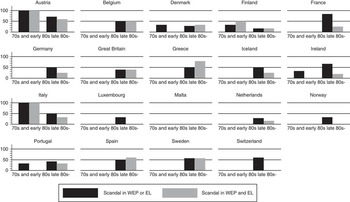
The rise of scandal elections is not driven by particular countries. Figure 2 shows a basic increase in scandal elections from the early period to the late period in fourteen of nineteen countries (only one journal). When applying the tougher criterion (both journals) an increase is found in twelve countries. Only Austria, Denmark, Finland, Italy and Malta experienced a different development in which scandals were a more common theme in the campaigns of the late 1970s and early 1980s. In Austria and Italy the level was already high in the early period, whereas in Denmark, Finland and Malta scandal elections were relatively uncommon during both periods.
Proportion of parliamentary elections for which scandals were mentioned in West European Politics or Electoral Studies

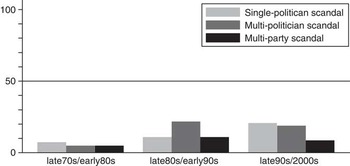
Not only has the frequency of scandal elections increased but also their composition in terms of the number of involved actors/parties appears to have shifted. Specifically, Figure 3 presents the development of three scandal election types over time: (1) multiparty scandal elections (at least one scandal with politicians from two or more parties; (2) multipolitician scandal elections (at least one scandal with more than one politician from the infected party); and (3) single politician scandal elections scandals involving (only one individual).Footnote 47 Looking at the entire period, 42 per cent of all scandal elections involve multipolitician scandals, 22 per cent multiparty and the remaining 36 per cent relate to a single politician.
Proportion of elections associated with various types of scandal

While all subtypes are more common in the later periods, the trend is more pronounced for single-politician and multipolitician scandals. This means by implication that the composition of scandal elections has changed. Whereas the three types of scandals were almost equally (in)frequent in the early period, more recent elections have been dominated by scandal material that highlights wrongdoings of individual politicians or representatives of a single party.
Scandal elections and satisfaction with democracy
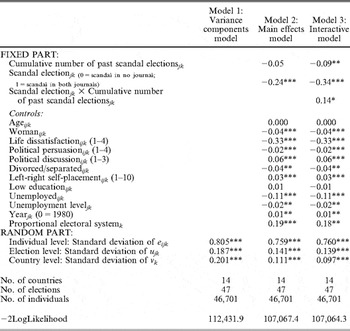
Table 1 displays estimates of multilevel models with three hierarchically ordered levels: individuals in election contexts in countries. The dependent variable is the individual respondent's satisfaction with democracy as measured, usually, one Eurobarometer wave after the elections.Footnote 48 The lag is introduced as we seek to assess the medium/long-term impact of scandals, as opposed to the short-term or simultaneous effects that have been the target of most previous studies. The dependent variable varies between 1 and 4, with higher values indicating greater satisfaction.Footnote 49
Multilevel Models of Scandal Election Effects on Satisfaction with Democracy (Three Levels, ML Estimation)

*p < 0.10, **p < 0.05, ***p < 0.01.
Notes: Unweighted data from The Mannheim Eurobarometer Trend File: Parliamentary Elections. The models also contain intercepts, the estimates of which are not displayed here.
The general analytical strategy is to compare individuals who have been exposed to scandal with individuals who have not, but who are otherwise as similar as possible. In our case, this means comparing respondents from elections marked by scandals with respondents from elections not marked by scandals. Specifically, the independent variable is a dummy capturing the presence of scandal in the election (1 = scandal in both analysed journals; 0 = otherwise).Footnote 50 The multilevel approach further allows us to control for variables related to election contexts, countries and individuals.
Model 1 is an ‘empty’ variance components model that lacks a fixed part containing independent variables. Instead, it only estimates a universal intercept, together with one random error term for each of the three levels (i = individuals, j = election contexts, k = countries).Footnote 51

Model 1 reveals significant variation at all three levels of analysis. Characteristically for survey data, around two-thirds of the overall variation can be attributed to individual-level factors (standard deviation = 0.805). Still, there are significant and non-trivial levels of variation across countries (standard deviation = 0.201), as well as across election contexts (standard deviation = 0.187). All this suggests that we are well advised to treat these data as hierarchical, and that a single-level ordinary least squares (OLS) approach could well give biased coefficients and standard errors.Footnote 52
To test Hypothesis 2, Model 2 adds independent variables. One registers whether the election is associated with scandals. In accordance with our reasoning in the previous section, another registers cumulatively the number of scandal elections that have occurred in this country prior to the election.Footnote 53
Omitted variable bias is a concern as these data are non-experimental. Selecting control variables, however, is difficult because there has been little comparative research on scandal effects. Thus, there is little specific theory or evidence about when and where scandal elections occur, and whether such factors are related to the dependent variable. Furthermore, only a few of the many individual-level variables that have been discussed in research on political trust are actually available in the data over a sufficient timespan.Footnote 54 Similarly, the rather small number of cases at the country level severely limits the number of country-level variables that can be simultaneously modelled.Footnote 55 Rather than estimating a ‘fully’ specified model, then Model 2 controls for a smaller number of variables at different levels, all of which are known to affect satisfaction with democracy.Footnote 56 In several cases, moreover, it is plausible to assume that these also correlate with the probability of scandal elections. More precisely, we control for age, gender, life satisfaction, political persuasion and discussion, marital status (divorced or not), left–right self-placement, education and unemployment status (individual level); year of election and level of unemployment (election level); and proportional versus (partly) non-proportional electoral system (national level).Footnote 57

As evidenced by a statistically significant coefficient, there is a negative main effect of a scandal election on satisfaction with democracy, taking control variables into account (β 1 = −0.24). In support of Hypothesis 2, then, scandal elections on balance seem to have eroded political trust. This effect amounts to about a third of the individual-level standard deviation (0.759). Furthermore, the election context variation drops from 0.187 in Model 1 to 0.141 in Model 2. All these indicate that scandal elections have played a significant role in explaining variation in satisfaction with democracy across election contexts.
Model 3 tests the scandal priming hypothesis (Hypothesis 3a) and the rival scandal fatigue hypothesis (Hypothesis 3b). It shows what has happened to the effect of a scandal election as the historical baggage of past scandal elections has become heavier over time. The interaction coefficient β 3 now registers whether the impact of a scandal election has decreased, increased or stayed the same as the accumulated number of past scandal elections has grown.

The effect (β 1) of a new scandal election has now increased to −0.34. As this equals roughly twice a standard deviation across elections, and almost half a standard deviation across individuals, the effect is more substantial than in Model 1. It is crucial to note, however, that this coefficient refers to the early situation before the increasing incidence of scandals. In more recent situations, the interaction coefficient suggests, the impact of a scandal election will be smaller (β 3 = 0.14). Specifically, the impact of scandal elections is predicted to have withered away completely by the time a country reaches an accumulation of two or three scandal elections as reported in both journals.
This latter finding is inconsistent with the scandal priming hypothesis (Hypothesis 3a) predicting that scandals will become more consequential as they become more common. Rather, it supports the scandal fatigue hypothesis predicting weaker effects (Hypothesis 3b). Moreover, the inclusion of an interaction term allows us to discover that cumulative election history also exercises a negative effect, though only when the recent election was not subject to scandal (β 2 = −0.09). Scandal history appears to matter when there are no major recent events.
Finally, the control variables help to put scandal effects into perspective. For example, comparison with life dissatisfaction reveals that it would take about four scandal elections to match differences between really happy/unhappy individuals. A comparison with the unemployment rate is more flattering for the scandal effect. A scandal election is about as destructive for democratic satisfaction as another 15 per cent of unemployment (assuming no threshold effects).
Scandal heterogeneity?
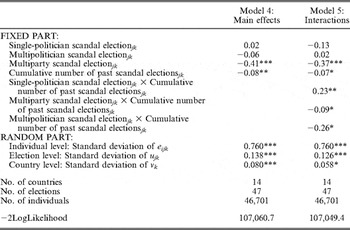
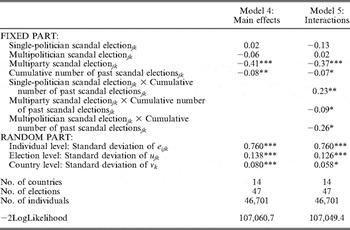
We now relax the implicit scandal homogeneity assumption made in previous analyses. According to Hypothesis 4, the generalization from specific events to general democratic dissatisfaction will be smoothed when more politicians, especially if they are from different parties, are accused of wrongdoing. To test this, we use dummies for multiparty, multipolitician and single-politician scandal elections. Table 2 displays their effects, together with interactions with accumulated scandal history.Footnote 58
Multilevel Models of Types of Scandal Elections and Satisfaction with Democracy (Three Levels; ML Estimation)
*p < 0.10, **p < 0.05, ***p < 0.01.
Notes: Unweighted data from The Mannheim Eurobarometer Trend File: Parliamentary Elections. The models also contain intercepts, as well as the same control variables as does Table 1, the estimates of which are not displayed here.
Model 4 reveals that only multiparty scandal elections, looking at the entire period, had significantly negative effects (−0.41). In other words, the overall scandal election effects reported in Table 1 are largely driven by this subtype. Model 5 then lets specific scandal types interact with accumulated scandal history. Here, we see that single politician scandals actually had an almost significant initial effect (−0.13; p = 0.20). However, this small effect was quickly wiped out by cumulated scandals. In stark contrast, the two remaining interactions reveal rising negative effects of multipolitician and multiparty scandals. Specifically, multipolitician events used to be insignificant but increasingly matter in the negative direction. The initially significant effects of multiparty scandals, finally, have increased substantively in the face of increasing incidence.
Overall, these results offer several additions and nuances. First, not even major scandal elections that qualify for our overall criteria are created equal with respect to their impact on democratic satisfaction. In fact, only multiparty scandal contexts – which should smooth generalization and complicate dismissal – have exercised systematic net negative effects over the whole time period. A second addition concerns the nature of ‘scandal fatigue’, which emerges mainly as a compositional phenomenon. At the individual level, we find little support for the idea that citizens become generally distanced from or desensitized to all sorts of scandal elections. Rather, where scandals have become more common, we instead see increasing heterogeneity in the effects, depending on the number of actors/parties involved.
Conclusions
What have the empirics shown and what are the wider implications? First, in support of Hypothesis 1, scandal elections were uncommon in the early period, whereas more recently close to half of the parliamentary elections in the nineteeen countries have been associated with scandals that scholars find worth mentioning in professional analyses. Furthermore, in support of Hypothesis 2 and most previous research, we find that scandal elections have had negative long-term net effects on satisfaction with democracy.
An unusual finding compared with previous research, however, is that negative effects were typical of an earlier historical epoch. Consistent with the ‘scandal fatigue’ hypothesis (Hypothesis 3b), but contrary to the ‘scandal priming hypothesis’, we find an interaction between recent scandal elections and the accumulated number of past scandal elections in a country. When scandal elections were novel, they had more sizeable ramifications. As they have accumulated – at different rates in different countries – their effects have shrunk. Effects are predicted to have vanished altogether by the time a country has suffered two or three major scandal elections.
Our comparative approach, moreover, enabled us to compare different types of scandals. This more finely tuned analysis helps to unpack the consequences of scandal elections conceived as a general phenomenon. Specifically, the test of Hypothesis 4 confirmed that scandals matter more if they involve several political parties. In fact, looking at the entire period, the scandal effect is entirely driven by this subset of highly ‘generalizable’ but unusual events. By the same token, single-party and single-politician scandals have usually not mattered very much. This is striking as the increase in scandal elections is mainly driven by exactly these types. Conversely, the events that have really produced democratic dissatisfaction – multiparty scandal elections – have never been common and have not become markedly more so. These observations support the compositional part of the scandal fatigue hypothesis. Scandal elections are increasingly made of material that has typically been inconsequential for satisfaction with democracy.
The ‘scandal fatigue’ hypothesis, however, also has implications for how individuals react to a given type of content. Specifically, it predicts that citizens are generally desensitized to scandals as these multiply. But this part of the story was not confirmed. We do not find a uniform trend towards weaker effects of all types of scandals. Instead, increasing scandal incidence appears to generate a clearer hierarchy of impact depending on the nature of the story. In particular, the negative effects of multiparty scandals have even grown larger than at the outset. As neither scandal fatigue nor scandal priming can accommodate this, we are in need of complementing assumptions. One plausible scenario – which may be dubbed the ‘scandal critique’ hypothesis – is that increasing scandal incidence creates a more critical approach to scandal material. As scandals accumulate, citizens are neither generally desensitized nor primed but more prone to ponder the relevance of a story and the motives of the messenger. They may perceive that the sharp increase in (less generalizable) scandal material is as much driven by modern media logic as it is by real-world events worthy of such massive attention.
Taken together, our findings strengthen the case for complementing small-N studies with systematic comparisons. But many questions remain. For example, we have concentrated on elections (with good reason, as these are critical democratic events). Nevertheless, it raises the question of whether comparable scandals have different effects outside elections. On the one hand, they may matter more as the citizenry is unusually attentive and as campaigns frequently allow simultaneous exposure to several old and new scandals. Also, scandals that overshadow substantive issues during critical campaign weeks may easily reflect poorly, not only on politicians but also on the quality of democratic processes more generally. On the other hand, substantive issues also tend to be more salient during campaigns. This may conceivably attenuate any scandal-induced impression that politics is dominated by sleaze and information is poor. In the end, we need future empirical work comparing scandals in different phases of the electoral cycle.
Likewise, we need to know more about the ‘scandal critique’ scenario as a possible explanation of weaker effects. At present, we can only note some scattered findings. For example, Miller observed in a case study of Clinton–Lewinsky:
One frequently got the impression that the journalists were all Woodward and Bernstein wannabees, but that they did not want to put any effort into checking out their sources […] Moreover, news media were constantly filled with stories about the scandal even though the public overwhelmingly reported that the affair was receiving too much coverage.Footnote 59
Interestingly, there is little evidence that the actual moral standards of West European politicians have deteriorated substantially. For instance, in a study of state administrative capacity, which is strongly affected by corruption, Bäck and Hadenius report only a very slightly negative curve during the period 1985–2000.Footnote 60 Thus, West Europeans face increasing, but less generalizable, scandal coverage at the same time as politicians appear largely as (in)corrupt as before. Perhaps citizens are asking themselves whether the increasing incidence of scandals is warranted. Politicians certainly do. By example, when Esaiasson and Holmberg surveyed Swedish parliamentarians about the causes of declining political trust, ‘scandals involving politicians’ were ranked at the bottom, whereas ‘media coverage of politics’ emerged as the most important reason.Footnote 61
In conclusion, then, scandals have become the bread-and-butter of electoral politics. But the butter appears to have been spread thinly. Scandal elections have multiplied, but the content has become less generalizable in relative terms. Perhaps exactly for this reason, the most generalizable scandals matter more than ever, whereas scandal elections – as a general phenomenon – have become less consequential for citizens’ satisfaction with representative democracy.
Appendix TABLE Parliamentary Elections Covered in 19 Western Democracies, 1977–2007

Legend: 0: No scandal reported for election context; Y: Scandal reported for election context in one journal; X: Scandal reported for election context in two journals.; ( ) Only one election report available; ;—No election report available; Ireland held two elections in 1982, the coding Y refers to the November election;* Greece held two elections in 1989, both of them are coded X.
Comment: Electoral Studies does not cover election contexts before 1980 (with the exception of France 1978 and Portugal 1979).