Introduction
Effective communication between doctors and patients is a central tenet of any medical consultation. By ensuring that information is shared openly and presented in a clearly understandable form, the physician and patient can gather, evaluate, present and discuss issues relating to the presenting complaint. Barriers to effective communication in the out-patient setting include limited consultation time, use of jargon and poor patient recall. Research has shown that a proportion of patients do not know why they have been referred, nor what is being said about them.Reference Ley1
The 1991 Patient's Charter states that ‘all patients have a right to written information about health services’.2 The UK government National Health Service Plan, published in 2000, expanded on this and proposed that patients should receive a copy of all correspondence between individual clinicians regarding their care, as a matter of right.3 This policy has been adopted by the department of ear, nose and throat surgery at the Royal United Hospital, Bath. Following an ENT consultation, patients routinely receive a copy of the letter sent to their general practitioner. An internal survey within the department showed that more than 95 per cent of patients supported this practice.Reference Pothier, Nankivel and Hall4 However, there is concern that the readability of the letters may not be appropriate for many patients.
Readability is a measurement of the grammatical complexity of a document, and hence the ease with which it can be decoded. Readability calculations are based on measurements of semantic difficulty (i.e. the number of syllables per word) and syntactic difficulty (i.e. the number of words in a sentence). A number of published studies have examined the readability of patient-orientated medical literature, including web-based information, patient information leaflets and consent forms. Most have concluded that such material is too complex, in terms of readability, compared with the average reading ability of the general population.Reference Beyer, Lauer and Davis5–Reference Friedman, Hoffman-Goetz and Arocha17
The aim of this study was to audit the readability of out-patient letters against standards of UK adult literacy. This study also assessed the efficacy of targeted training of ENT clinicians, intended to improve the readability of their letters, as measured by re-audit.
Materials and methods
There are a number of well validated indices which assess the readability of documents, including the Flesch reading ease score and the Flesch–Kincaid grade.Reference Flesch18 The Flesch reading ease assessment produces a score from zero to 100, with a higher score indicating that a document is easier to read. The Flesch–Kincaid grade converts the Flesch reading ease score into an equivalent US school grade reading level. The Flesch–Kincaid grade can also be expressed as a reading age, and corresponds to a result of 50 per cent in a comprehension test. The statistical distribution of reading age in an adult population is parametric.
The two scores are calculated as follows:

where ASL = average sentence length, and ASW = average number of syllables per word.
Audit standards for the present study were set by literature review. A Medline search was performed (on 17 September 2006) using the title term ‘readability’. A total of 274 articles were indexed. The authors reviewed published surveys of the reading level of UK adults. These studies showed that 84 to 96 per cent of British adults have a reading literacy level at least equivalent to 11 years of age (corresponding to US grade five to six, ‘Skills for Life’ entry level three and national curriculum level three to four); 4 to 16 per cent have a reading literacy level less than this.19, 20 The authors agreed that, based on current literature, a target reading age of 11 years of age should be set (equivalent to Flesch–Kincaid grade six and a Flesch reading ease score of >70). This is in accord with other studies which have demonstrated that literature aimed at a reading age of 11–13 years is more effective in conveying health messages and results in higher rates of recall, across all educational levels.Reference Davis, Mayeaux, Fredrickson, Bocchini, Jackson and Murphy21
A pilot study of 100 clinic letters was undertaken. Letters were edited to remove all patient identifiers prior to assessment, all salutations were removed, and all letters of less than 75 words were excluded as this would limit the accuracy of the readability formulae. The remaining text, comprising the body of the letter, was then highlighted using Word 2003 software (Microsoft, Redmond, Washington, USA) and the readability formulae were applied. Results were collated using Excel 2003 software (Microsoft) and analysed using the Statistical Package for the Social Sciences version 11.0 software (SPSS Inc, Chicago, Illinois, USA). A mean Flesch reading ease score of 65 was calculated, with a standard deviation of 8.5. These data were used to calculate the sample size of the main study. A sample of 16 patients in each arm would give a 90 per cent power to detect a difference of 10 per cent between means, at a significance of 95 per cent.
The first phase of the main study consisted of a retrospective audit of sequential letters written to General Practitioners following ENT consultations at a district general hospital during the period October to November 2006. All letters had been copied to patients. Analysis continued until each subject in the study had met the requisite sample size of 16 patient letters.
After this initial audit, clinicians underwent a seminar-based teaching session introducing the concept of readability and outlining how to improve the readability of their letters. Clinicians were instructed to improve the readability of their letters, but informed that letter content had higher priority. All participants were asked to commit to a change in practice. Posters were placed in every clinic room and dictaphones were labelled in order to reinforce this message.
Following this teaching session, a re-audit was undertaken, in an identical fashion to the initial audit. Letters were excluded from the study if the authoring clinician had not been present for both phases of the audit, or had not attended the readability teaching sessions.
Results and analysis
Eight clinicians were present for both phases of the study and attended the teaching sessions (five consultants, one specialist registrar, one staff grade doctor and one senior house officer). Following exclusions, 295 and 301 letters were analysed in the pre- and post-intervention phases, respectively.
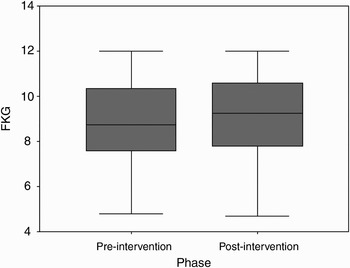
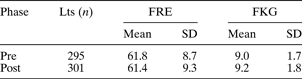
Results were distributed parametrically (Figures 1 and 2). The means and standard deviations for the Flesch reading ease score and the Flesch–Kincaid grade, for each audit phase, are shown in Table I. There was no statistically significant difference between pre- and post-intervention letter readability as judged by either parameter, using the non-paired t-test (p = 0.586 for Flesch reading ease score and p = 0.133 for Flesch–Kincaid grade).
Box and whisker plot showing Flesch reading ease (FRE) scores for letters written before (295 letters) and after (301 letters) intervention. Circles beneath main plots indicate for pre-intervention (1, 29, 28 and 4, in descending order) and post-intervention (319 and 321, in descending order).

Box and whisker plot showing Flesch–Kincaid grades (FKG) for letters written before (295 letters) and after (301 letters) intervention.

Readability scores: pre- and post-intervention phases
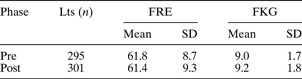
Lts = letters; FRE = Flesch reading ease score; FKG = Flesch–Kincaid grade; SD = standard deviation; pre = pre-intervention; post = post-intervention
When audited against the agreed readability standards, in the pre-intervention phase, 16.9 per cent of letters met the target Flesch reading ease score of >70.0, and 2.4 per cent of letters met the target Flesch–Kincaid grade score of <6. In the post-intervention phase, 18.3 and 3.3 per cent of letters met the target Flesch reading ease score and Flesch–Kincaid grade, respectively (Table II).
Comparison of readability scores versus targets: pre- and post-intervention phases

Percentage data represent the proportion of letters reaching the target standard. *FRE > 70.0; †FKG < 6.0. Lts = letters; pre = pre-intervention; post = post-intervention
Discussion
The National Health Service Plan recommends that patients should, as a right, receive copies of letters between clinicians concerning the patient's health care.3 Following ENT out-patient consultations, we routinely sent patients a copy of the letter addressed to their general practitioner. This study demonstrates that the readability of this out-patient correspondence is inappropriately complex when compared to UK adult literacy figures. Furthermore, our intervention failed to significantly improve the readability of such correspondence. Whilst this may reflect an inadequacy in the intervention itself, there may be other reasons why improvements in readability may not have been seen. The out-patient letter must communicate complex medical information between clinicians. We propose that it may not be feasible to present this information in a highly readable form without removing essential details. In a 2006 study conducted by Roberts et al. at Charing Cross Hospital, London, 84 patients were sent a copy of their general practitioner letter and also a letter specifically written for the patient themselves.Reference Roberts and Partridge22 Patients were asked to circle terms and phrases they did not understand in both letters. Letters were assessed for readability using validated scoring systems. The Flesch reading ease scores were significantly better, and significantly fewer words were circled, in the patient-specific letters. Patients preferred to receive the patient-specific letter, or both. However, 62.5 per cent of the general practitioners wanted only the general practitioner letter, stating that the patient-specific letters lacked sufficient clinical detail and structure.
• The National Health Service Plan (2000) recommends that patients should receive a copy of all correspondence between clinicians regarding their care
• The reading age of patient-orientated medical literature is too complex, in terms of readability, compared with the average reading age of the population
• Out-patient correspondence is inappropriately complex when compared with UK adult literacy figures
• It does not seem possible to improve the readability of out-patient correspondence by educating clinicians
• It may not be feasible to present information intended for general practitioners in a way that is readable to most of the UK adult population
Readability scores do not always present the full picture. Indices such as the Flesch reading ease score and the Flesch–Kincaid grade do not assess medical terminology or jargon, nor do they measure the proportion of active versus passive sentences, both of which have been shown to influence the readability of a document. Recent studies have attempted to address this using novel but unvalidated observer-based scoring systems, based on the ‘Plain English Campaign’ guidelines.Reference Ofo, Seymour and Kalan23 In one study, 15 random out-patient letters from eight consultants were assessed for readability using these guidelines. Individual feedback was given following the first phase, highlighting areas in which readability could be improved. This study showed a similar failure to improve the overall readability of the department's letters, with variable results for individual clinicians. The 10-point readability scoring system included more subjective measures than the current study, such as ‘medical jargon avoided’, ‘minimal nominalisations’, ‘use of positive language’, ‘mix of words’ and ‘personal touch’. Therefore, despite the limitations of readability scores, our study had the advantage of using well validated, objective and reproducible criteria.
The findings of this and other recent studies raise important issues. Given that the vast majority of patients support the practice of receiving letters following a clinic attendance, and that the same letter cannot satisfy both patient and general practitioner, due to a conflict of audience and function, it should be considered whether separate letters should be composed to general practitioners and patients.
Conclusion
In this study, out-patient correspondence copied to patients did not meet readability standards. The readability of letters was not significantly improved by educating clinicians. We suggest that it may not be feasible to present medical information intended for general practitioners in a way that is highly readable to most of the UK adult population, whilst still fulfilling the original purpose of the letter as medical communication with general practitioners.