1. Introduction
The expression of temporal categories is a fundamental topic in the scientific study of language, from both synchronic and diachronic perspectives. More than one approach must be integrated if one's aim is to put forward not only a description but also an adequate explanation of how such categories ultimately arise and develop in the grammatical system of a language, viz. in a speaker's mind. Hence I propose that historical data should be reasonably taken into account as well, so that new light may be shed on the core of the matter which is more often examined using a synchronic approach of both typological and acquisitional linguistics and neurolinguistics. Although attempts to combine synchronic and diachronic perspectives have been made (see, among others, Bybee, Perkins & Pagulica Reference Bybee, Perkins and Pagliuca1994, Slobin Reference Slobin and Slobin1997, Ziegeler Reference Ziegeler1997), as far as I know, many Indo-Europeanists do not usually interpret data on ancient languages in the light of recent synchronic approaches concerning this topic. Current Indo-European studies on the reconstruction of the earlier verbal system show that there is no general agreement about the diachronic emergence of tense-aspect categories (Clackson Reference Clackson2007: 114). More specifically, not only the precedence of aspect vs. tense in the emergent inflectional verbal system, but also the lexical vs. grammatical character of the verbal categories in question are still debated. While in more recent years it has been widely recognized that within the PIE verbal system grammatical aspect is a more recent category in respect of both root lexical aspectFootnote 2 and grammatical tense distinctions (see, among others, Lazzeroni Reference Lazzeroni1977: 5, Szemerényi Reference Szemerényi1987: 17, Strunk Reference Strunk1994: 421), it is still not clear how the earlier tense-based inflection emerged. Accordingly, I shall focus on the reconstruction of the primitive characteristics of the verbal system of Proto-Indo-European, a reconstructed language, in an attempt to reveal what historical linguistics can tell us about the debated issue regarding the origins of tense and aspect in the verbal system of a language. On the basis of a comparison between the most ancient verbal forms of Vedic Sanskrit and Homeric Greek, I shall attempt to establish how the Proto-Indo-European verbal system was organized with respect to temporal categories.
2. The state of the art
As is well known, since the 1970s scholars have been debating about the emergence of tense-aspect morphology in language acquisition. Most previous studies in the domain of language acquisition have given prominence to the interaction between inherent verb meaning and tense-aspect markers in child language (see Li & Shirai Reference Li and Shirai2000: 5). To give just a brief outline of the psycholinguistic literature on this topic, it is worth mentioning early studies such as those by Bronckart & Sinclair (Reference Bronckart and Sinclair1973) or Antinucci & Miller (Reference Antinucci and Miller1976), whose claims are at the basis of the so-called Defective Tense Hypothesis (Weist, Wysocka, Witkowska-Stadnik, Buczowska & Konieczna Reference Weist, Wysocka, Ewa Buczowska and Konieczna1984; see also Li & Shirai Reference Li and Shirai2000: 40). According to these authors, children at an early stage in their growth lack the category of tense, for they have not yet developed the notion of temporal deixis (cf. Shirai & Andersen Reference Shirai and Andersen1995: 745 for some discussion). When they do begin to use past tense inflection, it is only with telic verbs. These verbs express an observable action or event viewed from the perspective of its end point, with the result that tense distinctions turn out to be redundant and mostly dependent on lexical aspect distinctions. A more nuanced and less strong version of this theory is represented by the so-called Aspect Hypothesis, which was first formulated by Shirai (Reference Shirai1991), Shirai & Andersen (Reference Shirai and Andersen1995: 746) and then re-proposed by Li & Shirai (Reference Li and Shirai2000). These authors base their argument on a prototype account of tense-aspect acquisition and point out that children acquire tense distinctions gradually, usually starting with an initial association between past tense (and perfective) morphology on the one hand and those prototypical verbs characterized by [+telic], [+punctual] and [+result] features on the other. Then, at a later stage, children also begin extending the past tense (and perfective) morphology to non-prototypical verbs, i.e. those verbs lacking one of these features. More precisely, the (perfective) past marking is first applied to achievement and accomplishment verbs, for, as [+telic], they represent the prototype of the temporal category of past; only later the (perfective) past marking can be extended to activity and state verbs, which, as [−telic], are less prototypical. Therefore, unlike the previous and absolute Defective Tense Hypothesis, the prototype model advances the view that not all past tense inflections are associated with [+telic] verbs, but rather that there is a gradual extension from an early stage, which shows a predominance of past morphology attached to achievement and accomplishment verbs, toward a later stage, which exhibits a development to non-prototype past for activity and state verbs as well.
The point to be emphasized here is that in these theories a prominent role is assigned to lexical aspect, i.e. to the inherent semantic meaning of the verb. In fact, there is a strong interaction both between lexical and morphological aspect, and between these two and tense inflection: on the one hand, perfective morphology, i.e. grammatical aspect, turns out to be prototypically associated with telic verbs, i.e. with lexical aspect, and on the other, the prototype of the category past is similar to that of the category perfective,Footnote 3 so that both tense and aspect morphology prove to be very strictly interrelated with lexical aspect. And because the acquisition of tense-aspect morphology proves to be dependent on the Aktionsart (i.e. lexical aspect) features of the verb, it is not surprising that this interrelatedness, which fits well with a lexicalist approach, is in line with recent theories on language evolution, according to which ‘the origin of all grammatical morphemes (function words, inflections) is in lexical stems’ (Hurford Reference Hurford, Christiansen and Kirby2003: 53; see also Heine & Kuteva Reference Heine, Kuteva and Wray2002: 394).Footnote 4 It is noteworthy that these results are also strikingly in line with the neurological data discussed by Ziegeler (Reference Ziegeler1997: 235), who, citing Givón (Reference Givón1995), underlines the independent but parallel processes in diachronic and ontogenetic grammaticalization. She emphasizes how lexical sources, realized as complete lexemes or identifiable only as prototypical lexical properties, have been found to be at the origin of the development of grammatical morphology across time. The neurological order of development would demonstrate that grammar, which develops only after a lexicon has emerged and stabilized, is highly affected by lexical semantics.Footnote 5
I will now argue that the inflectional marking of tense in the Proto-Indo-European verbal system turns out to be dependent on the lexical features of the verbal stems. As an anonymous reviewer has pointed out, the interrelation between tense inflection and inherent features of the verb would in fact support Bybee et al. (Reference Bybee, Perkins and Pagliuca1994) hypothesis, according to which perfective aspect emerges with telic verbs, imperfective aspect with atelic verbs. This hypothesis underlines once again the fundamental role which the inherent lexical features of verbs play in determining the emergence of inflectional categories like grammatical aspect. In this paper I do not take grammatical aspect into consideration, but the data I have examined fully confirms the primary role of the verbal root's lexical features in emergent inflectional paradigms. In particular, the PIE grammatical past tense is a more recent acquisition in the evolutionary path of emergent paradigms, as also demonstrated by Bybee et al. (Reference Bybee, Perkins and Pagliuca1994: 92) and confirmed by data presented in this study. These latter will show that the PIE past tense marker is a recent gram that gradually came to be applied to all verbs regardless of their lexical aspect, mostly after the PIE typological shift to a nominative–accusative stage where tense distinctions became more important than the earlier aspectual ones (see section 7). Furthermore, the precedence of lexical aspect in respect of tense distinctions is also in line with Bybee's semantic relevance hierarchy, according to which, being the most relevant category to the verb, aspect is likely to be lexicalized rather than grammaticalized within a paradigm (Bybee Reference Bybee1985: 21–22). Tense was firstly expressed within the inflectional paradigm of the protolanguage by means of different sets of (personal) endings. As will be specified in the following sections, the early PIE verbal system was characterized by a binary distinction between root–stem formations with [+telic] and root–stem formations with [−telic] feature, added with personal endings only. However, an originally temporal and locative adverbial particle gradually coalesced with verbs as a suffix added to the personal endings in order to mark the present tense. The important fact to be noticed is that this suffix was initially added only to those root–stem formations with an inherent [−telic] feature, from which a present tense stem could subsequently be derived. On the contrary, from root–stems with a [+telic] feature, present tense forms were impossible and in fact are unattested (see Strunk Reference Strunk1994: 420). Therefore, [+telic] root formations without this suffix began automatically to indicate past tense.
Furthermore, it is worth indicating what kind of theoretical contribution Indo-European studies could provide to the general linguistic debate over the classification of verbal aspectual classes. In fact, verbs are traditionally classified as telic or atelic according to the action or event they express, respectively with or without an inherent endpoint (see, among others, Bybee Reference Bybee1985: 100). After the early well-known Vendlerian four-class distinction, however, it has been pointed out that aspectual class is a compositional property (Verkuyl Reference Verkuyl1972). Many scholars have argued that aspect is not only a semantic but mostly a syntactic property, which ‘pertains to VPs and whole sentences, and not to verbs as such’ (Slabakova Reference Slabakova2001: 23). Following Verkuyl's hypothesis, verbs are even analyzed as complex structures built up upon a completely neutral root with no information about its argument structure (see Slabakova Reference Slabakova2001: 40). The aspectual class of a verb is often difficult to classify since it depends on the verb's combination with arguments, adverbials, etc., which can coerce one and the same verb into denoting different situation types. However, this does not prevent us from considering a basic prototypical lexical classification as fundamental.Footnote 6 In other words, a verb is initially encoded in the lexicon of a language with a prototypical aspectual entry, even if its [±telic] trait can be modified depending on the context.
In this paper I will argue that it is possible to classify verbs according to their main prototypical [±telic] lexical aspect feature.Footnote 7 Determining this latter feature makes it possible to account in a more satisfactory way for the different semantic and syntactic combinations in which a verb occurs, as well as how and why its morphological paradigm is structured as it is. To be precise, it is the kind of forms and their distribution within the morphological paradigm of a verb which helps us to determine its lexical (a)telicity. Thus, as will be seen from the data to be presented in this paper, in cases where a verb is inflected in a paradigm as a root formation only in the aorist stem while its present stem is a derived formation (i.e. affixed, reduplicated, etc.), this can only be explained if the verbal root is considered to be prototypically [+telic]. Conversely, when a verb is inflected as a root formation only in the present stem while its aorist stem is a derived (and therefore a more recent) formation, it means that the verbal root is prototypically [−telic] (see also Strunk Reference Strunk1994: 419). Moreover, the analysis of the contexts in which the verb occurs will confirm the morphological data as well. This kind of correspondence is proved to be valid for the PIE language, as I will try to demonstrate both on the basis of morphological parameters (drawing on the verb's non-random paradigm structure) and on the basis of syntactic–semantic parameters (drawing on the sentence context). Following this approach, traditional Indo-European studies of the tense-aspect system have tended to reconstruct one unitary basic prototypical lexical (a)telicity feature for a given verb, regardless of the many different meanings which this verb may assume.Footnote 8 In fact, semantic change due to different contexts could have obscured the relationship between the original lexical aspect of the root and the structure of its morphological paradigm (see Clackson Reference Clackson2007: 135).
A historical perspective: ie *e- as a past tense marker in Vedic Sanskrit and Homeric Greek
In light of the above survey of some of the influential literature on the emergence of tense-aspect morphology from an ontogenetic perspective, one might wonder if a historical analysis can help us find traces of a similar evolution path. In other words, what can historical linguistics say about the emergence of a tense-aspect system in a proto-language? Tracing back to the most ancient articulated verbal systems that we can reconstruct in the history of language evolution, we can investigate how the Proto-Indo-European verbal system might have been organized at the earliest stages. Comparative Indo-European studies generally agree with the thesis according to which the first verbal system of the proto-language was originally characterized by a ‘non-inflected state’ (see, among others, Lehmann Reference Lehmann2002: 167). More precisely, many traditional Indo-Europeanists reject the old hypothesis which was formed in order to explain the rich inherited inflectional system proper to the attested historical languages (see Drinka Reference Drinka and Andersen1993: 143 for discussion) and according to which Proto-Indo-European would have been characterized by a complex and articulated morphology. On the contrary, attention to residual forms attested in earlier stages of Indo-European languages such as Homeric Greek and Vedic Sanskrit (known also as ‘Old Indic’), provides insights into the earliest possible strata of the proto-language, at a time before a more complex verbal morphology had been stabilized (see also Lehmann Reference Lehmann2002: 172). Therefore, drawing on the comparative method and the procedure of examining residual archaisms in both the Rigveda and the Homeric poems, this paper will focus on sketching the distribution of primitive verbal forms in the proto-language and then trying to account for this distribution. These earlier forms consisted of verbs with broad meaning, which were still inflectionally underspecified as regards verbal categories such as tense or mood. The only kind of categorial differentiation which could be ascribed to these verbs was lexical in nature, in the sense that there existed verb stems indicating actions or events with an inherent endpoint [+telic], and verb stems indicating actions or events without an inherent endpoint [−telic]. At this stage it was the pragmatic context that played the fundamental role in distinguishing the specific meaning of each verb, which could indifferently refer to present or past actions, to statements as well as to prohibitions, to gnomic or atemporal events, such as those referring to habitual (timeless) activities of gods (West Reference West1989: 135). Only in a later stage were inflectional elements gradually added to these verbal forms. Among such inflectional elements, which were originally deictic particles or adverbs, it is possible to reconstruct a past tense marker *e-, the so-called augment, which was common to both Vedic Sanskrit and Homeric Greek (as well as Armenian and Phrygian). This prefix *e-, which meant illic et tunc, i.e. ‘there and then’, came to characterize the distal tense as opposed to the proximal tense, which in turn was already expressed by the suffix *-i meaning hic et nunc, i.e. ‘here and now’. As will be more fully explained in the next section, this past tense marker *e- is a more recent trait, which came to be added to all verbs irrespective of their lexical feature, in order to mark the past tense in the late Indo-European language. The residual augmentless verbs thus testify to a previous PIE stage which is still preserved in the history of languages such as Vedic Sanskrit and Homeric Greek. These augmentless verbs, which co-exist with the augmented forms only in the earliest literature of both Sanskrit and Greek, have traditionally been considered as an optional usage proper to poetry (see section 5). They are instead essential in order to reconstruct the steps of the inflectional path that was followed by the evolving PIE verbal system.
What is the injunctive?
To underline the role of residual forms in the verbal system of Proto-Indo-European, it is necessary to note the importance of the category of the injunctive within the development of the earliest evidence of conjugation. Putting aside terminological questions, the injunctive is considered the most ancient verbal form of Proto-Indo-European, without tense or mood specification (paceHoenigswald, Woodard & Clackson Reference Hoenigswald, Woodard, Clackson and Woodard2004: 544), as, among others, Thurneysen (Reference Thurneysen1885: 172) and more recently Hoffmann (Reference Hoffmann1967: 278) and Lazzeroni (Reference Lazzeroni1977: 4) have pointed out. It was common only to the oldest stage of both Vedic Sanskrit and Homeric Greek, and it had only a lexical aspectual characterization, distinguishing between inherent telic and atelic aspectual features of the lexical roots. The injunctive was accordingly a default or primitive base-form, whose stem only subsequently developed into either present tense (through addition of the deictic particle *-i) or past tense (through addition of the augment *e-). As will be discussed in the next section, the more recent addition of the augment *e- testifies to a stage, both in Vedic Sanskrit and Homeric Greek, in which tense tends to incorporate all temporal distinctions related to the verb (including aspect). The injunctive was thus a primary verbal stem modified only by the addition of personal endings. It should be stressed again that injunctive forms were characterized only by lexical-aspectual features of the verbal root, without involving any other temporal features such as tense. As can be seen in the sentence below (1), for instance, even what has been called the ‘aorist injunctive’ generally does not have a preterite value:
(1) divé-dive s
 ryo darśató bhū-t day-day sun visible become-inj ‘day by day the Sun becomes visible’ (Sanskrit – RV. VI 30,2c)
 ryo darśató bhū-t day-day sun visible become-
In this passage the aorist injunctive bhūt (lexical stem bhū plus secondary personal ending -t) does not indicate a past event, but rather has a general meaning whose only characterization is (lexical) aspectual, given that ‘becomes’ is inherently marked by a [+telic] feature. Examples like this could easily be multiplied, since the injunctive, linked to an aorist or a present stem, can assume diverse meanings, referring to general activities of the gods, ritual actions, general qualities or abilities, iterative happenings and – more rarely – also to a past action or event (see Hoffmann Reference Hoffmann1967: 135, Lehmann Reference Lehmann2002: 173).Footnote 9
The personal endings that are added to injunctive verbal stems are termed ‘secondary’ because in the historical languages, as is well known, they were normally added to those verbal forms which indicated the past tense, and so should be distinguished from what are called ‘primary’ endings, i.e. endings added to those verbal forms which indicate the present tense. However, if we go back to the prehistory of the proto-language, such a distinction between primary and secondary endings cannot be original, since the only endings existing in the most ancient stage were the ‘secondary’ endings, i.e. *-m, *-s, *-t, *-nt (cf. Szemerényi Reference Szemerényi1985: 370). By way of recapitulation, let us consider an example. Starting from the Proto-Indo-European root *bher- ‘bear’, we can reconstruct an injunctive 3sg form *bheret by comparing the attested Vedic Sanskrit present injunctive 3sgbharat and the corresponding Greek unaugmented imperfect 3sg φέρε phére. As mentioned above, the injunctive in the Rigveda was fundamentally neutral in respect of tense and mood, since it could be used with different values such as present or past tense, indicative, imperative, optative or subjunctive mood, so that it could be considered as a sort of default verbal form depending on the context.Footnote 10 A similar behaviour is also attested, in residual form, in Homeric Greek, where sometimes the so-called ‘augmentless preterite’ does not indicate a past tense, but rather seems to show only a gnomic or an atemporal value.Footnote 11
Now, turning back to the example, it is possible to reconstruct an evolutionary path for Proto-Indo-European tense morphology as follows. Starting from the aforementioned injunctive form *bheret, a present tense 3sg *bheret-i can be postulated by comparing the attested Vedic Sanskrit indicative present 3sgbharati and the corresponding Greek indicative present 3sg φέρει phérei.Footnote 12 As has been said, the present tense formation is characterized by the addition of the suffix *-i to the personal endings of the injunctive, to indicate an action or event occurring in present time (see also Watkins Reference Watkins, Ramat and Ramat1998: 60–62). In the same way, through comparison of the attested Vedic Sanskrit indicative imperfect 3sgabharat and the corresponding Greek indicative imperfect 3sg ἔφερε éphere, a past or preterite 3sg *ebheret can also be derived, starting from the same injunctive plus the prefix *e-, to indicate that the action or event occurred in the past.Footnote 13
The distribution of the unaugmented forms in Homeric Greek
On the basis of the comparison between the formations above, it is generally agreed that the IE prefix augment *e-, inherited both by Gr. ἐ- e- and Skr. a-, is a sign of more recent verbal forms with past tense distinctions. There were no grammatical tense distinctions at the earliest stages of the proto-language (see, among others, Stempel Reference Stempel1999: 42, Lehmann Reference Lehmann2002: 173).Footnote 14 One might think that the correspondence between augmentless forms in Vedic Sanskrit and Homeric Greek could be an innovation proper only to those two languages, and hence not ascribable to a more ancient Proto-Indo-European stage. However, even if the augment is traditionally considered a more recent innovating dialectal trait shared by Sanskrit and Greek, the augmentless forms of injunctive must have assumed a past meaning already in a pan-Indo-European (pre-Sanskrit and pre-Greek) stage. In fact, when the injunctive endings began to take the suffix *-i in order to indicate the present tense, all the injunctive forms without this suffix began automatically to indicate the past tense, i.e. the non-present tense. As pointed out by Blumenthal (Reference Blumenthal1974: 71), ‘the separate IE particle *e, which became the augment, came into use as a contrastive mark of pastness marking the past tenses’. However, initially, ‘the augment as a mark of pastness is strictly unnecessary, as can be seen from Hittite, where endings alone mark time’ (Blumenthal Reference Blumenthal1974: 71). As remarked in the previous sections, at the early PIE stage there existed verbal forms supplied with personal endings only, thereby forming an archaic, earliest system characterized by a binary distinction between root–stem formations with a [+telic] feature and root–stem formations with a [−telic] feature. Then the originally temporal and locative adverbial particle *-i gradually coalesced with verbs as a suffix added to the personal endings (which then became 1sg *-mi, 2sg *-si, 3sg *-ti, 3pl *-nti from original 1sg *-m, 2sg *-s, 3sg *-t, 3pl *-nt) in order to mark a present action or event taking place ‘here and now’. At first, the new endings marked with *-i were added only to those root–stem formations with an inherent [−telic] feature, such as the PIE root *es- ‘be’ (PIE 3sg *es-ti, Ved. ásti, Gr. ἔστι ésti, etc. ‘is’), from which it was possible to derive a present tense stem. On the contrary, from a root–stem with a [+telic] feature, such as the PIE root *g wā- ‘come’ (Ved. ágāt, Gr. ἔβη ébē, etc. ‘came’), present tense forms such as PIE 3sg *g wā-ti were impossible; they were never coined and are unattested (see Strunk Reference Strunk1994: 420).
By this time, all root–stem formations without the present tense marker *-i had come to indicate past tense. Therefore, the prefixed augment *e- turns out to be a more recent trait which marks the past tense redundantly, a trait shared only by a specific dialectal Indo-European area. This fact is not in conflict with the hypothesis here proposed, according to which the correspondence between the Vedic Sanskrit and Homeric Greek augmentless forms goes back to an earlier Proto-Indo-European stage: personal endings endowed with the suffix *-i are in fact common to most of the attested Indo-European languages, testifying to a system where present stem was marked in opposition to an unmarked past tense. As I will show in the next section, the data argues that the inflectional tense morphology of the verbal system of both Sanskrit and Greek was constructed originally on the basis of the lexical–semantic value of the bare verbal root. In fact, since initially there was no difference between the personal endings of the present and the aorist stems, it was the inherent lexical aspect of the underlying root which governed the assignment of a given verb to the emergent system of aorist or present (see also Clackson Reference Clackson2007: 133). Furthermore, the distribution of the residual augmentless verbs in Homeric Greek sheds light on the fate of primitive injunctive forms; in Classical Greek such forms disappear and the augment is obligatorily prefixed in the past tense, both imperfect and aorist. In fact, however, the distribution of the augment in Homeric Greek turns out to be not random, but is perfectly in line with the distribution of injunctive forms in the Rigveda. This correspondence thus permits us to reconstruct a primitive stage which can be ascribed to the proto-language.
In greater detail, it can be seen that in contexts where a present injunctive is expected in the Rigveda, Homeric Greek exhibits an unaugmented imperfect and never (or very rarely) an aorist, as can be seen in the examples below:
(2)
tám bhara-t súbhtaṃ crv índuḥ Order bear-inj greatly.esteemed dear juice (Soma) ‘the Soma-juice holds the dear Order greatly esteemed’ (Sanskrit – RV. IX 97,24d)
(3) τὴν δὲ πρóσω φέρ-ε κ
μα, θέμωσε δὲ χέρσoν ἱκέσθαιtèn dè prósō phér-e kúma, thémōse dè chérson hikésthaiit part ahead bear-impf wave drive then shore reach‘the wave bore it (the ship) ahead, then it drove it to reach the shore’ (Old Greek – Od. IX, 542)
 μα, θέμωσε δὲ χέρσoν ἱκέσθαιtèn dè prósō phér-e kúma, thémōse dè chérson hikésthaiit
From a morphological point of view, the Vedic present injunctive 3sgbharat in (2) corresponds formally to the Homeric Greek augmentless imperfect indicative 3sg φέρε phére in (3), both forms deriving from the IE root *bher-.
In a similar way, in contexts like those where an aorist injunctive would be expected in the Rigveda, Homeric Greek shows an unaugmented aorist and never (or very rarely) an imperfect, as can be seen in (4) and (5):
(4) órv
d gávām mat jānatgā-t enclosure cows mother knowing come-inj ‘the Cows' Mother comes from the cowshed knowing (the road)’ (Sanskrit – RV. V 45,2b)
 gā-t enclosure cows mother knowing come-
(5) α
τὰρ ὁ βῆ Λυκίηνδε θεῶν πˈ ἀμύμoνι πoμπῇ autàr ho bê Lukíēnde theôn hup' amúmoni pompêthen he come-aor Lycia.to gods under glorious guidance ‘then he came to Lycia under the glorious guidance of the gods’ (Old Greek – Il. VI, 171)
 τὰρ ὁ βῆ Λυκίηνδε θεῶν
 πˈ ἀμύμoνι πoμπῇ autàr ho bê Lukíēnde theôn hup' amúmoni pompêthen he come-
In (4) and (5), the augmentless aorist of the same verb come occurs as the Vedic injunctive gāt and the Homeric indicative βῆ bê, both forms being derived from the IE root *g wā-.
The important datum to be underlined here is that this correspondence in the distribution of verbal forms reflects exactly the lexical features of the Proto-Indo-European verbal roots. When the lexical aspect feature of the root is [−telic], then most of the injunctives of the corresponding verbs in the Rigveda are found in the ‘present injunctive’ (never or very rarely in the aorist injunctive) and the corresponding augmentless preterites in Homeric Greek are imperfect (never or very rarely aorist). On the contrary, when the lexical aspect feature of the root is [+telic], then most of the injunctives of the corresponding verbs in the Rigveda appear in the ‘aorist injunctive’ (never or very rarely in the present injunctive) and the corresponding augmentless preterites in Homeric Greek turn out to be in the aorist (never or very rarely in the present). It should also be noted that, unlike the Homeric language, in the later stage represented by Classical Greek all morphological distinctions, both of tense and aspect, are uniformly distributed throughout the verbal system, regardless of the lexical aspect features of the root.Footnote 15
As stated above, tense distinctions are not expected in the earliest stages; the tense specification present or aorist added by scholars to the injunctive are merely the widely accepted conventional terms used to designate those injunctive forms which would evolve into the present or the aorist system at a later stage of Sanskrit verbal morphology (by means of the adjunction of the suffix *-i and the prefix augment *e- respectively). It goes without saying that all the augmented imperfect or aorist forms found in the Iliad and the Odyssey represent a more recent stage with respect to the unaugmented imperfect and aorist forms derived from the same verb. Clearly, then, the correlation between telicity and grammatical marking underwent a progressive weakening. It is well known that unaugmented verbal forms have disappeared in Classical Greek. By that time the structure of verbal paradigms was already stabilized with a regular tense distinction and the past tense was always marked with the augment.
Analyzing the data
Having sketched an outline of the main features of the topic discussed in the paper, let us now turn our attention to the data. This section will examine in detail the Proto-Indo-European verbal conjugation, tracing it back to those attested early Vedic and Greek forms which consisted only of the so-called reconstructed ‘secondary personal endings’ *-m, *-s, *-t, *-nt Footnote 16 added to the lexical stems from which the present and aorist tenses would subsequently be derived through the addition of specific affixes. The aim will be to better understand the kind of relationship existing between the Vedic injunctive forms on the one hand and the corresponding Homeric Greek preterite forms without temporal augment on the other. These latter, which represent forms of an ancient Proto-Indo-European injunctive as well (see, among others, West Reference West1989: 135), have traditionally been explained as occurring randomly and optionally throughout the Homeric poems or in accordance with the so-called μετρικὴ ἀνάγκη metrikè anánkē, i.e. ‘metrical necessity’, which would have induced the poet to incorporate the prefixed augment according to metrical considerations proper to poetry.Footnote 17 As Hoffmann (Reference Hoffmann1967: 145) points out, the same trait of optionality has often been alleged for Vedic language as well. To the contrary, the analysis of our data will show instead that the distribution of such augmentless forms in Vedic Sanskrit and Homeric Greek indicates a precise rule linked to the lexical aspect of the original verbal roots.
The corpus examined here consists of all occurrences of Vedic injunctives which have a reliable correspondence with augmentless preterites in Homeric Greek, taking into account only those injunctives which have a non-modal (indicative) sense and ruling out those having a modal (subjunctive, optative or imperative) sense.Footnote 18 The texts considered for Vedic Sanskrit are the Rigveda and the Atharvaveda; the injunctive is most common in the former, less common in the latter and it definitively disappears from the later language, i.e. Classical Sanskrit. As for Greek, I have examined the Homeric poems Iliad and Odyssey, and Homeric Hymns.Footnote 19
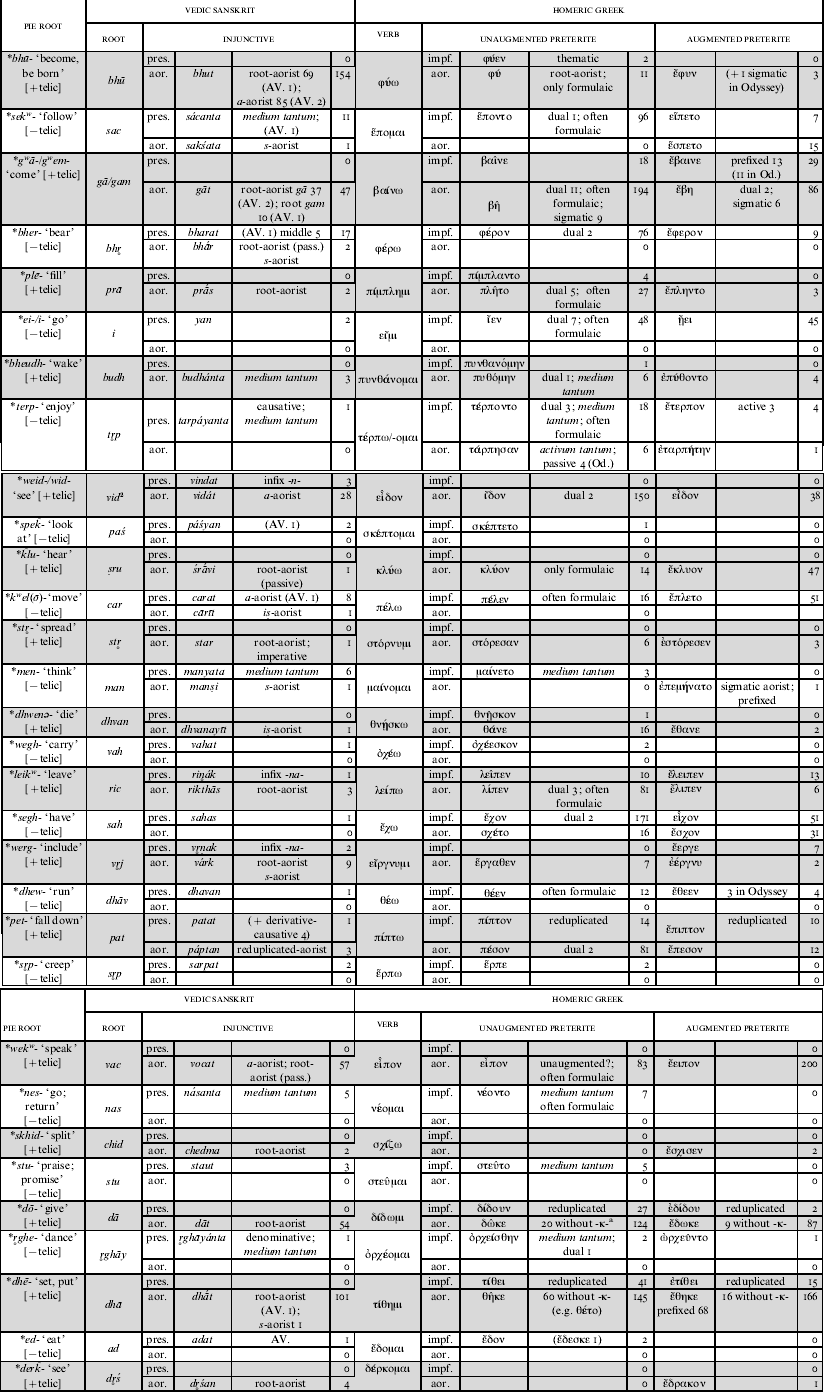
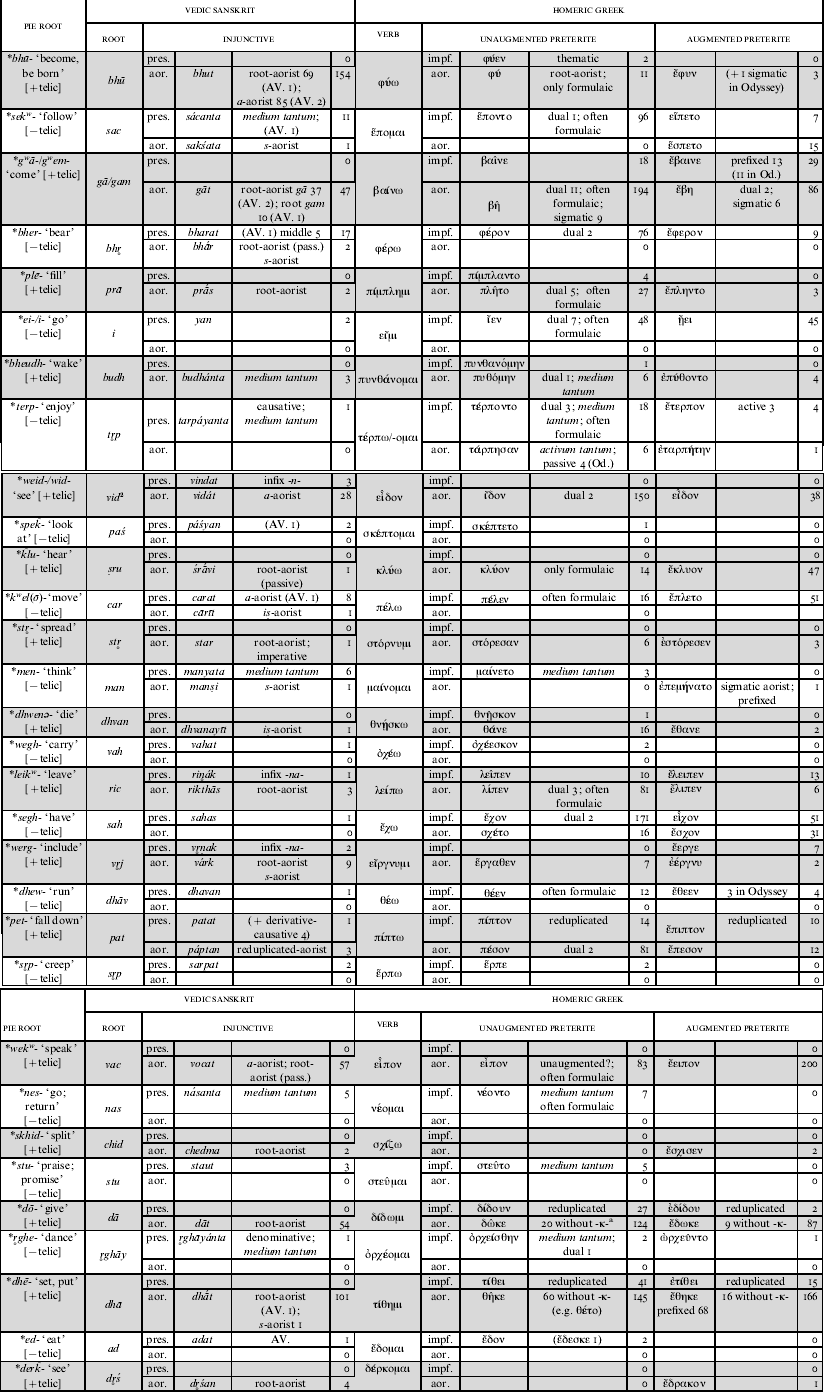
Table 1 displays the data by comparing on the same line the number of occurrences in Vedic and Greek. The table is organized as follows. The first column on the left is for Proto-Indo-European roots reconstructed by comparing Vedic and Homeric Greek verbs, including their meaning and Aktionsart [±telic], i.e. the inherent lexical aspect of the root.Footnote 20 The second column on the same line gives the corresponding inherited Vedic Sanskrit root, and the next column is for both present (pres.) and aorist (aor.) injunctives; this is followed, when appropriate, by relevant remarks or observations, and, finally, by the number of occurrences in the Vedas, i.e. Rigveda and Atharvaveda. In order to more easily visualize the data in the table, only a single injunctive form is given in each row. I have chosen, where possible, the most reliable for reconstruction, the less marked, the most ancient form (it goes without saying that, for instance, the root aorist is older than reduplicated or other extended forms of the aorist), which also shows the better correspondence with the equivalent Homeric Greek preterite.
Distribution of occurrences of Vedic injunctives and Homeric Greek preterites.
a As regards the two Greek verbs of the *-mi conjugation examined here, i.e. δίδωμι and τίθημι, it should be noted that in order to try to reconstruct an earlier stage it is important to consider the most ancient forms of the aorist, i.e. the athematic forms without -κ-; this affix, albeit very ancient, is in fact a more recent development.
As with the Vedic occurrences, I display on the right side of table 1 first the Greek verbs (regularly given as indicative present 1 singular) derived from the Proto-Indo-European root which is indicated in the same row, then the augmentless preterite forms both imperfect (impf.) and aorist (aor.), followed by any relevant observations and finally, the number of occurrences. In the last three columns I have added the corresponding augmented forms of the same Homeric verbs, followed at times by remarks and finally by the number of occurrences, in order to compare thoroughly the non-random quantitative distribution of the augment in the verbal paradigm.Footnote 21 Again, also for the Greek part, only a single form of each verb is given per row, in order to provide a concise overview of the data. These single verbal forms have been chosen following the same criteria as for the Vedic forms.
The remarks are intended to clarify some important issues concerning the analyzed forms. More precisely, often some residual features have been indicated which are well known to be characteristic of previous stages. These include (i) occurrences of the ancient category of dual, which tends to disappear in the later language;Footnote 22 (ii) the presence of root formations, which are more ancient than the derived, reduplicated or affixed stems; (iii) the existence of media tantum; (iv) formulaic expressions; and so on. Formations are also given which indicate a more advanced stage of development; representative examples are derived (e.g. causative, desiderative, denominative, etc.), reduplicated or affixed stems (e.g. -na- and -κ- stems for Vedic and Homeric Greek, respectively, and Greek prefixed prepositional stems, among others). Furthermore, it is sometimes specified if an inflected form is attested in those texts which are traditionally considered to be more recent, such as the Atharvaveda with respect to the Rigveda, or the Odyssey with respect to the Iliad, and the Homeric Hymns with respect to both Homeric poems.
Finally, the 31 PIE roots are ordered alternating the [+telic] and [−telic] and according to the most reliable correspondence between derived injunctives, taking into consideration parameters such as the period of the occurrences, the regularity of forms, and so on.
6. Discussion
The results of this research address the fundamental question of how aspectual meaning contributes to temporal information within an emergent grammar. Does the lexical or inherent aspect (Aktionsart), which is determined by the meaning of the verb, in fact support and condition the genesis and the distribution of forms within the inflectional paradigm before tense breaks through into the verbal system? The present findings constitute strong evidence for an affirmative answer and are consistent with the aforementioned lexical aspect hypothesis: the distribution of both Vedic injunctives and Greek augmentless preterites, i.e. the most ancient forms within the inflectional system for all 31 of the PIE verbal roots here examined, does indeed depend on the lexical aspectual features inherent to the roots of the proto-language. Furthermore, it is not a coincidence that these earlier residual verbal forms have led us to deal with the most ancient roots which are generally attributed to the proto-language in the Indo-European literature (see, among others, Pokorny Reference Pokorny1959). These roots seem in fact to belong to the most basic lexicon of the proto-language.Footnote 23
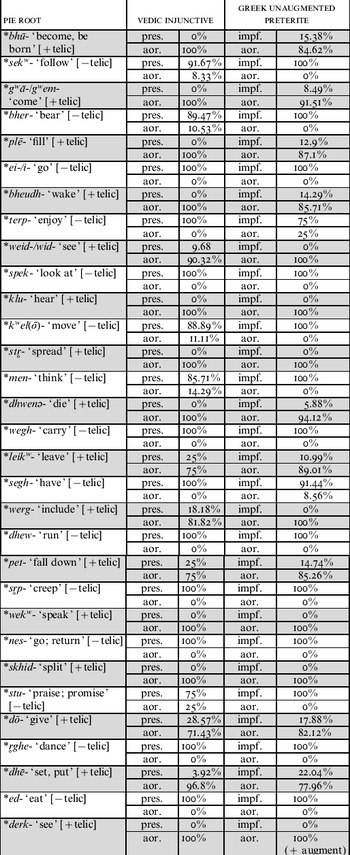
If the occurrences are examined in terms of percentages (see table 2), the data reveal a strong numerical predominance of present injunctives in Vedic and unaugmented imperfects in Greek in those cases where the Proto-Indo-European root is [−telic], and vice versa, a strong numerical predominance of aorist injunctives in Vedic and augmentless aorists in Greek when the Proto-Indo-European root is [+telic]. Crucially, in some cases, such as for the [−telic] roots *ei-/i- ‘go’, *wegh- ‘carry’, *spe  - ‘look at’, *stu- ‘praise’, *dhew- ‘run’, *s
 p- ‘creep’, *ed- ‘eat’, *nes- ‘go; return’, *ghe- ‘dance’, there is absolutely no trace of either Vedic aorist injunctives or Homeric Greek unaugmented aorists. By contrast, in other cases, such as for the [+telic] roots *lu- ‘hear’, *st - ‘spread’, *wek w- ‘speak’, *skhid- ‘split’, *der - ‘see’, there is not trace of either Vedic present injunctives or Homeric Greek unaugmented imperfects. As a consequence, it is the inherent features of such lexical verbal roots, prototypically [+telic] or [−telic], which plausibly triggered the creation of suppletive paradigms which are ascribed to the historical Indo-European languages.Footnote 24 For instance, as can be seen in the verbal system of both Sanskrit and Greek, the inflectional paradigms built upon PIE *es- ‘to be’, a prototypically [−telic] root, lacked an aorist; they therefore borrowed their aorist forms from a different root which is prototypically [+telic], i.e. the PIE root *bhū-, meaning ‘to become, be born’ but frequently also used with the meaning ‘to be’ (see, among others, Deshpande Reference Deshpande1992: 44). Consider, for example, the following passages from the Rigveda (6) and the Odyssey (7):
(6) índrasya kart
svápastamo bhū-t Indra maker best.work be-inj ‘most noble was the work of Indra Maker’ (Sanskrit – RV. IV 17, 4b)
(7) ἔν τˈ ἄρα oἱ φ
χειρὶ ἔπoς τˈ ἔφατˈ ἔκ τˈ ὀνóμαζε én t' ára hoi phÛ cheirì épos t' éphat'ék t' onómazein then him be-aor hand word and say prev and tell ‘(Hecuba) then was close to him with (her) hand and said words and told (him)’ (Old Greek – Il. VI, 253)
In these passages, the verb to be in the aorist tense is expressed by Vedic bhū and Homeric Greek φύω phúō, which both derive from the above-mentioned IE [+telic] root *bhū-, originally ‘become’, but which soon came to mean ‘be’ in the past tense.
Percentages of distribution of Vedic injunctives and Homeric Greek preterites.

As mentioned above, table 2 summarizes and shows the relationship in terms of percentages between Vedic and Homeric Greek verbs as regards the distribution of the injunctive and augmentless preterite, respectively. It is noteworthy that in both languages the proportion of percentage values shown in the table is exactly inverted according to the parameter [±telic] of the PIE root. For instance, when the percentage proportion between present/imperfect forms and aorist forms is 100%: 0%, as with verbs derived (in both languages) from the PIE root *ei-/i- ‘go’, this result is always consistent with a [−telic] feature; on the contrary, when the percentage proportion is inverted, i.e. 0%: 100%, as with verbs built upon the PIE root *st - ‘spread’, this result is always consistent with a [+telic] feature. Furthermore, as can be seen in the table, even when the percentage proportion between present/imperfect forms and aorist forms is not categorically 100%: 0% or 0%: 100%, it systematically yields a proportion very near to one or the other of these extremes in a parallel way in both Vedic and Greek.
Before proceeding to the concluding remarks in the final section, one last issue must be addressed. As pointed out by an anonymous reviewer, it is tricky to explain how a given verb is to be classified as telic or atelic, since each concrete occurrence of the verb is part of a VP which can be either [+telic] or [−telic] depending on the context (see Rothstein Reference Rothstein2008: 3). Nevertheless, it is exactly the distribution of forms and the kind of forms within the paradigm which sheds light on this point. The fundamental question is, why should an emergent inflectional verbal paradigm be organized by choosing as basic certain forms rather than others? In other words, why are some verbs initially inflected only as root formations while other verbs are inflected only as derived formations? Moreover, why do some verbs inflect only in the present stem and lack completely an aorist stem, while others inflect only in the aorist stem and lack completely a present stem? An answer can be given only if the prototypical lexical aspect feature of the verbal root is taken into consideration. For example, when a verb is inflected as a root formation only in the aorist, as with Vedic gāt and Homeric Greek (ἔ)βην (é)bēn, while the present stem is a more recent derived formation, as with Vedic jigāti and Homeric Greek βαίνω baínō, this is because the PIE root *g wā- ‘go’ is prototypically [+telic]. Such evidence is confirmed by the distributional percentages, which show a strong predominance of both Vedic aorist injunctives and Greek augmentless aorists instead of present injunctives and augmentless imperfects respectively (see table 2). These latter are in fact more recent formations in the paradigm of jigāti and βαίνω baínō. On the other hand, when a verb is inflected as a root formation only in the present stem, like for example Vedic ásmi and Greek εἰμί eimí ‘be’, which both completely lack an aorist stem, this is because the PIE root *es- is [−telic].
Two other highly relevant examples in this connection are PIE *lu- ‘hear’ and *wek w- ‘speak’; these, as the anonymous reviewer points out, are normally considered as atelic, and yet in the present research they turn out to be telic. This latter classification is not arbitrary, however the result of the analysis of the distribution of forms in both Vedic and Homeric Greek. In fact, as can be seen from tables 1 and 2, only aorist injunctives and unaugmented aorists are attested respectively in the Rigveda and in the Homeric poems, while no present or imperfective stem is derived from *lu- or *wek w-. Moreover, not only frequency counts but also textual analysis provides evidence of the [+telic] meaning which originally characterized both the roots *lu- and *wek w-. Let us begin with *lu-, which is traditionally translated as ‘hear’. This verb occurs in the Homeric poems only as unaugmented aorist in an ancient formulaic expression (14 x), as can be seen for example in Iliad VII, 379–380:
(8) ˋ`Ως ἔφαθˈ, o
δˈ ἄρα τo μάλα μὲν κλύονἠδˈἐπίθοντο· Hos éphath', hoi d'ára toÛ mála mèn klúon ēd' epíthonto; so said they then him certainly hear-aor and obey-aor δóρπoν ἔπειθˈ εἴλoντo κατὰ στρατòν ἐν τελέεσσιν·dórpon épeith' heílonto katà stratòn en teléessin; meal afterwards take-aorthroughout army in ranks ‘So (Priam) said, and then they certainly heard and obeyed him; afterwards they had their meal in the ranks throughout the army’ (Old Greek – Il. VII, 379–380)
 δˈ ἄρα τo
On the one hand, the distribution of forms clearly shows that κλύω klúō ‘hear’ lacks an imperfective stem in the Homeric poems: there are 61 occurrences of forms derived from an aorist or perfective stem vs. 0 occurrences of forms derived from a present or imperfective stem. On the other hand, as can also be seen from the passage above, the verb inflected as unaugmented root aorist in the poems means ‘hear’ not in the proper sense of physical hearing, but rather in the more conscious sense of ‘understand, comprehend’. In fact, the augmentless aorist κλύoν klúon occurs throughout the poems not randomly, but only in hendiadys with ἐπίθoντo epíthonto ‘obeyed’; thus it does not indicate a simple, passively conceived notion ‘hear’, but a more conscious action, a sort of comprehension which, as a consequence, drives someone to obey. The presence of the [+telic] feature proper to the verb ‘obey’ is confirmed in the Rigveda both by the distribution of forms of the Vedic verbal root śru (only aorist injunctives are attested, while forms derived from a present or imperfective stem are not attested) and by textual analysis. For example, consider I, 68, 9a–b:
(9) pitúr ná putráh krátuṃ juṣanta father like son advice delight-inj-3plśrósan yé asya ś
saṃ tursaḥobey-inj they his order eager ‘(They) delight in his advice like sons (delight in their) father's (advice), they eagerly obey his order’ (Sanskrit – RV. I 68, 9a–b)
Here the aorist injunctive śrósan from the root śru <*lu- clearly means ‘obey’ and not ‘hear’ an order (ś  sam).
Similar considerations apply to PIE *wek w-, which is traditionally translated as ‘speak’. On the one hand, the distribution of forms provides evidence for the [+telic] feature of the original root, since only aorist forms of this root are attested in Vedic and in Homeric Greek (see table 1); on the other hand, textual analysis shows that verbs derived from *wek w- refer to the [+telic] transitive action of ‘utter’ or ‘pronounce’ a word rather than to the [−telic] intransitive action of ‘speak’ or ‘talk’. Let us analyze the text. Consider first Odyssey, VII, 330,
(10) ὣς φάτo, γήθησεν δὲ πoλύτλας δῖoς 'Oδυσσεύς, hòs pháto, géthēsen dè polútlas dîos Odusseús, so said rejoice part long.suffering godlike Odysseus,ε
χóμενoς δˈἄρα εἶπενἔπος τˈ ἔφατˈ ἔκ τ' ὀνóμαζε·euchómenos d’ára eîpenépos t' éphat' ék t' onómazepraying then utter-aor word and said-impf pre-v and speak-impf ‘So (Alcinous) said, the godlike long-suffering Odysseus rejoiced, then praying he uttered a word and said:’ (Old Greek – Il. VII, 329–330)
Here the aorist εἶπεν eîpen ‘uttered’ has ἔπoς épos ‘word’ as a complement, in order to focus on the exact moment in which Odysseus begins to speak. This latter non punctive action is then expressed by the verbs ἔφατo éphato and ὀνóμαζε onómaze, which are both imperfect and [−telic]. In Rigveda X, 69, 5d, we have the following passage:
(11) prá nú vocaṃ v
dhryaśvasya nma forth now utter-inj vdhryaśva name ‘I now utter forth the name of Vdhryaśva’ (Sanskrit – RV. X 69, 5d)
Here the aorist injunctive vocaṃ clearly refers to the punctual [+telic] moment of naming a name, and not to the general act of speaking.
To sum up, the PIE roots *lu- and *wek w- have been demonstrated to be characterized by a [+telic] feature according to the following parameters:
i proportional distribution of forms in the paradigm
ii type of inflected forms in the paradigm
iii syntactic–semantic context of the sentence.
7. Conclusion
I have been concerned here with ascertaining the role of the distribution of the residual forms of injunctive in the verbal systems of Vedic Sanskrit and Homeric Greek, so as to reconstruct a previous Proto-Indo-European stage at which a first verbal inflection developed within an early tense-aspect system. Research on ancient texts such as the Vedas and the Homeric poems reveals a similar behaviour in the two languages with regard to the distribution of injunctive forms related to the same lexical verbal PIE roots. Moreover, since the data shows a homogeneous distribution over all the roots analyzed, the results of the investigation are consistent with the anteriority of lexical aspect vis-à-vis tense distinctions in constructing the earliest Indo-European verbal inflectional paradigm. It is noteworthy that these data include many Proto-Indo-European roots having the most ancient and secure etymologies. This is the reason why it can plausibly be hypothesized that the archaic morphological system of early Proto-Indo-European started to expand and to reorganize itself precisely on the basis of the inherent aspectual features of lexical roots. The distribution of such primitive verbal ‘survivals’ constitutes strong evidence that the emergent grammar of the early Proto-Indo-European verbal system followed an evolutionary path proceeding from lexical aspect to tense morphology.
Another point worth stressing here is the role of form distribution related to the lexicon of the proto-language. In fact, the results of the present study are consistent with the active–stative typology hypothesis (Lehmann Reference Lehmann2002): in an early PIE system which had not yet been reorganized towards a more grammaticalized paradigm, the lexicon was formed by verbal roots basically differentiated by inherent lexical aspectual features like [±telic]. In this kind of typology, the concrete semantic or lexical relationships between words (both verbs and nouns) were more important than abstract structural syntactic ones. As the subsequent structural, i.e. more grammaticalized, pattern of the nominative–accusative typology began to spread in a late IE stage, the original paradigm organization was replaced. Needless to say, this issue requires more careful examination of data and further discussion, and I hope that these initial results will be augmented in the future by finding more correspondences within the Indo-European languages, and verified thoroughly by investigating other language families and proto-languages. From a methodological perspective, finally, the approach of the research program I have sketched here is consistent with a multidisciplinary framework, in which the results of historical linguistics can fruitfully be integrated with those of synchronic perspectives, yielding new insights into language.