INTRODUCTION
The smooth clam Callista chione (Linnaeus, 1758) is an Atlantic–Mediterranean warm-temperate species that inhabits sandy to muddy bottoms, occurring at depths between 10 and 130 m (Poppe & Goto, Reference Poppe and Goto1993). This species is commercially exploited in Portugal (Gaspar et al., Reference Gaspar, Dias, Campos, Monteiro, Santos, Chícharo and Chícharo2001), Spain (Tirado et al., Reference Tirado, Rodríguez, Bruzón, López, Salas and Márquez2002), France (Charles et al., Reference Charles, Amoroux and Grémare1999), Italy (Valli et al., Reference Valli, Bidoli and Marussi1983–84; Canestri-Trotti et al., Reference Canestri-Trotti, Baccarani, Paesanti and Turolla2000) and Greece (Metaxatos, Reference Metaxatos2004). In mainland Portugal, C. chione is more abundant on the south-western coast, where it is preferentially distributed in clean sand bottoms at depths ranging from 10 to 20 m (Gaspar et al., Reference Gaspar, Dias and Monteiro1998, Reference Gaspar, Dias, Campos, Monteiro, Santos, Chícharo and Chícharo2001). On this part of the coast C. chione is exploited by a dredge fleet, but despite its commercial importance, its biology, namely its reproductive cycle, has not hitherto been studied, making difficult the implementation of suitable management measures. To the authors' knowledge, the reproductive cycle of C. chione was first described by Valli et al. (Reference Valli, Bidoli and Marussi1983–84) for an Italian population (Gulf of Trieste). Tirado et al. (Reference Tirado, Rodríguez, Bruzón, López, Salas and Márquez2002) described the sex-ratio, gonadal development and spawning in a smooth clam population from Spain (Malaga). More recently, Metaxatos (Reference Metaxatos2004) studied the reproductive cycle of C. chione from the northern Euboikos Gulf (Aegean Sea, Greece) by means of microscopic examination of smears of the gonads.
Studying the reproductive cycle is essential to establish the timing of spawning and to estimate the shell length at first maturity. Different techniques have been used to assess the reproductive condition in bivalves. When studying sexual maturation, a microscopic analysis of histological sections of the gonads must be carried out, since a purely macroscopic observation may result in errors when interpreting the processes that take place within the gonads. Therefore, the most reliable and detailed information on the yearly reproductive cycle is that obtained from the histological preparation of gonad samples (Paulet, Reference Paulet1990). However, when studying gametogenesis based on cytological characteristics, there is some subjectivity in determining the state of maturation of an individual that presents gametes at various development stages (Barber & Blake, Reference Barber, Blake and Shumway1991). In order to overcome such discrepancies, various authors have tried to measure and count oocytes as a complementary method, by using histological techniques and image analysis (Lango-Reynoso et al., Reference Lango-Reynoso, Chávez-Villalba, Cochard and Le Pennec2000; Metaxatos, Reference Metaxatos2004). Other non-histological methods such as condition indices have also been used to describe the reproductive cycle of marine invertebrates. These indices provide information on the physiological activity of the specimens (Rodríguez-Rúa et al., Reference Rodríguez-Rúa, Prado, Romero and Bruzón2003) and assume that a low condition is related to the release of gametes (Tirado et al., Reference Tirado, Rodríguez, Bruzón, López, Salas and Márquez2002). Using all these methods, we studied the reproductive cycle and estimated the size at first maturity of a C. chione population off Arrábida (south-western Portugal).
MATERIALS AND METHODS
Samples of Callista chione were collected by dredging onboard various commercial vessels from a site off Arrábida (10 to 20 m depth) between January 2004 and May 2005 at approximately monthly intervals.
Sex-ratio
In order to study the sex-ratio, around 110 specimens measuring between 36 and 94 mm in shell length (SL) were analysed monthly. In most cases, the sex was identified macroscopically as the colour and consistency of the gonad differs between sexes. Female gonads are whitish with a milky consistency, while male gonads are yellowish-orange with a granular consistency. Whenever the sex was not able to be identified macroscopically, a smear of the gonad was taken and examined under a microscope. Sex-ratios were tested against a 1:1 ratio with χ2 statistics.
Gametogenic cycle and condition index
Approximately 20 individuals greater than 60 mm SL were selected each month in order to study the gametogenic cycle. The internal structure of the gonad was examined by histological preparation. Microscopic examinations of each section permitted assigning each specimen to a stage of gonadal development (Gaspar & Monteiro, Reference Gaspar and Monteiro1998): Stage 0, inactive/resting; Stage I, early active; Stage II, late active; Stage III, ripe; Stage IV, partially spawned; and Stage V, spent. Whenever two or more stages occurred simultaneously in one single section, the staging criteria decision was based upon the condition of the major part of the preparation. The period of reproduction was defined as the time when the clams were in Stage IV. The images were recorded with a Sony DKC-CM30 camera and processed using the image analysis software Zeiss-KS100 (release 3.0). A quantitative analysis of the preparations of female gonads was also carried out. In each section, a follicle was randomly selected, in which all oocytes were counted and measured for total diameter. The same procedure was followed for a further four follicles: the second follicle above, below, on the left and on the right of the follicle initially chosen. In addition to this histological study, the evolution of the reproductive activity was assessed through the use of a condition index (CI) (ash-free dry weight/dry shell weight; Walne & Mann, Reference Walne, Mann and Barnes1975). This index was calculated for a standard animal of 80 mm SL, in order to suppress the results of growth, so that accumulation or loss of organic matter associated with reproduction can be shown.
Size at first maturity
In order to determine the size at first maturity, defined as the SL at which 50% of the population is mature, an additional sample of 226 specimens (ranging between 20 and 75 mm SL) was analysed in May 2005. This month was selected because, according to the histological analysis made in the same month of the previous year, all adult specimens were either at the ripe or spawning stages. The gonads of these specimens were monitored using the histological methods described above. The individuals were considered mature when the gonad was determined as Stage III or Stage IV.
RESULTS
Sex-ratio
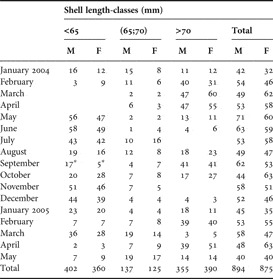
Callista chione is gonochoric and no hermaphrodites or sex reversal were encountered during the present study. The proportions of smooth clam females and males obtained from monthly gonad samples and by size-classes are shown in Table 1. From a total of 1873 individuals analysed, 46.7% were females, 47.7% were males and the remaining individuals (5.6%) were undifferentiated. The overall sex-ratio determined for the total number of individuals sampled and for each month was not significantly different from 1:1 (χ2-test, P > 0.05). For the first two size-classes males outnumbered females, while females dominated in the greater size-class (Table 1). However, the results of the χ2-test showed that sex-ratios for the three size-classes were also not divergent from parity.
Sexual proportion in function of shell length categories during the study period.

M, males; F, females; *, χ2-test P < 0.05.
Gametogenic cycle and condition index
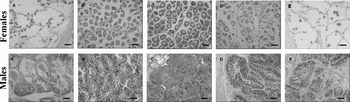
After analysing the histological sections, five stages of development of the gonads were defined. It is worth mentioning that this species did not present a resting phase and therefore Stage 0 was not considered in the present study. The photomicrographs of the five gametogenic stages are shown in Figure 1. During the present study, a synchronism was observed on gametogenesis and spawning between females and males. For this reason, it was decided to analyse the reproductive cycle of all specimens independently of the sex.
Callista chione. Photomicrographs of developmental stages of female (above) and male (below) gonads: (A) Stage I—early active; (B) Stage II—late active; (C) Stage III—ripe; (D) Stage IV—partially spawned; and (E) Stage V—spent. Scale Bar: 50 µm.

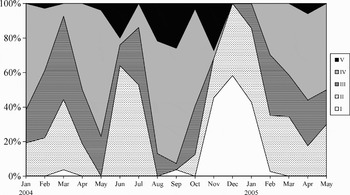
The percentage of individuals at each gonadal stage during the study period is shown in Figure 2. The gametogenic cycle had already begun in January 2004 as 62% of the specimens were in the spawning stage (IV). Spawning continued until October 2004. However, in March, June and July 2004 the percentage of individuals spawning was lower and most specimens were late active (II) or ripe (III). A new gametogenic cycle began in November. Between this month and January 2005, early active (I) and late active stages (II) dominated the samples. In January 2005, 14% of the population was ripe and the release of gametes took place from February to May that year. The periods between January and February, April and May, August and October 2004 and February and May 2005, were considered the most important in terms of gametes release, as relatively significant spawning took place during these periods. Spawning in January 2004 was the main difference between the same months studied in 2004 and 2005.
Callista chione. Monthly frequency of gonad developmental stages.

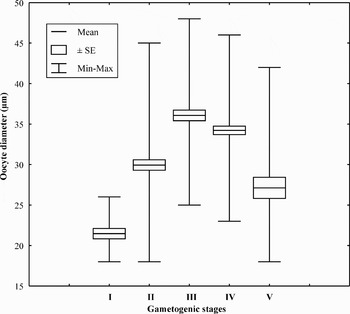
The average diameter of the oocytes for each gonadal stage identified in the present study is illustrated in Figure 3. Early gametogenesis (Stage I) was characterized by an oocyte diameter close to 18.5 µm. The mean oocyte diameter increased during the gonad maturation, attaining 36 µm in ripe gonads. In Stage IV (partially spawned) and Stage V (spent) the oocyte diameter decreased.
Callista chione. Average oocyte diameters relating to each stage of development (I, early active; II, late active; III, ripe; IV, partially spawned; V, spent).

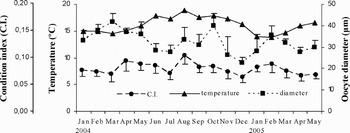
Figure 4 shows the evolution of the surface seawater temperature, oocyte diameter and CI during the studied period. Seawater temperature registered off Arrábida showed a clearly seasonal variation. The colder months (November to April) had temperatures under 16°C, with the lowest temperature being registered in February 2005 (13.8°C). The surface seawater temperature started to increase in April and reached its maximum during August (18.9°C). This environmental parameter remained relatively high until October, the time of the year when the seawater temperature started to decrease. Little variations between consecutive years were observed (Figure 4). The oocyte diameter increased during the winter months, between January and March. During this last month, with the rising of seawater temperature the mean oocyte diameter sharply decreased until June. After this month, the oocytes increased in size until October, as seawater temperature remained almost constant and relatively high. Once spawning began, the mean oocyte diameter decreased until attaining a minimum during December 2004. Afterwards, this trend was reversed and the size of oocytes increased in the next two months. In February, the mean oocyte diameter decreased again (Figure 4). The evolution of the CI followed the pattern observed for oocyte diameter. The main difference was observed between January and March when oocyte diameter and CI showed opposite trends (Figure 4). The decreasing condition observed between January and March 2004 may also correspond to a spawning period, which despite varying inversely from oocyte size (Figure 4), coincided with the gametogenic cycle illustrated in Figure 2. The above was consistent with histological observations, which revealed that the highest reproductive activity took place from January to May 2004, August to October 2004 and between February and May 2005.
Variation in average oocyte diameter, condition index (CI) and surface seawater temperature off the south-western coast of Portugal, between January 2004 and May 2005.

Size at first maturity
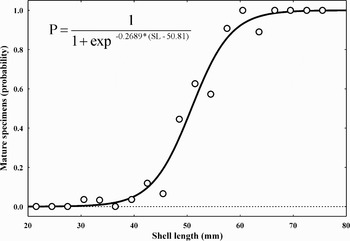
To establish the size at first maturity in the C. chione population studied, individuals were grouped into size-classes of 3 mm SL and the relative frequency of ripe and spawning organisms per size-class were fitted to a logistic model (r = 0.96, Figure 5). Although individual organisms may start spawning at 30 mm SL, the size at first maturity estimated for C. chione was 50.81 mm SL.
Callista chione. Shell length at first maturity. Proportion of mature individuals during May 2005 in relation to shell length.

DISCUSSION
The reproductive cycle of a smooth clam population off Arrábida was studied throughout a 17-month period using standard histological techniques, quantitative indicators (oocyte diameter distribution) and a CI. This study found that the sex-ratio in the population studied was 1:1. This finding coincides with previous reports made for this species in other localities, namely in the Gulf of Trieste (Valli et al., Reference Valli, Bidoli and Marussi1983–84) and Spain (Tirado et al., Reference Tirado, Rodríguez, Bruzón, López, Salas and Márquez2002). On the contrary, Metaxatos (Reference Metaxatos2004) noted that the proportion of males was higher in samples collected in Greece, but without presenting any statistical analysis. In our study, no significant differences in the sex-ratio were observed for the three size-classes analysed, which suggests that mortality does not differ between sexes and that growth rate is similar in males and females.
The gametogenic cycle of Callista chione is a continuous process with a complete gonadal restitution after the end of the reproductive season and without a resting period. The absence of a resting phase was also reported by Valli et al. (Reference Valli, Bidoli and Marussi1983–84) for a smooth clam population from the Gulf of Trieste. The present study has also revealed that the smooth clam has a prolonged reproductive cycle. Its high reproductive capacity was demonstrated by the occurrence of various spawning periods during the 17 months sampled, as well as by the simultaneous presence of gametes at various stages of maturation. In 2004, spawning occurred between January and late October, but the bulk of spawning activity was concentrated between January and February, April and May, August and October 2004. In 2005 the onset of spawning occurred in February. A prolonged spawning season with one main spawning period was also reported for C. chione from the Gulf of Trieste, where this species spawned from February until September with a maximum of gamete release between May and August (Valli et al., Reference Valli, Bidoli and Marussi1983–84). In an investigation made in northern Euboikos Gulf, Metaxatos (Reference Metaxatos2004) reported that C. chione is capable of year-round reproduction. Finally, smooth clams from Andalucía (western Mediterranean) spawned year-round but primarily from February until September (Tirado et al., Reference Tirado, Rodríguez, Bruzón, López, Salas and Márquez2002). This reproductive strategy characterized by a prolonged spawning period may be advantageous for the species, since it may ensure a continuous ‘input’ of settling juveniles over many months, thereby spreading reproduction risk over time.
In the histological preparations, the smallest and the largest oocytes measured 18.3 and 48.5 µm in diameter, respectively. The comparison of this result with the oocyte diameters reported by Metaxatos (Reference Metaxatos2004) for a smooth clam population from Greece, revealed that in this population the oocytes were much larger, ranging between 54.5 and 130 µm in diameter. In our case the measurements were made in previously fixed gonads, whereas Metaxatos (Reference Metaxatos2004) measured fresh oocytes. According to this author, the way in which the animals are preserved or fixed can influence the oocyte size, which may explain the differences observed between these studies. Oocyte growth depends on an adequate energy supply being available for gametogenesis, which in turn depends on food availability and the animal's metabolic rate (Barber & Blake, Reference Barber and Blake1983). Another possible explanation for the differences observed in the size of oocytes from Portuguese and Greek smooth clam populations may be related with genetic differences, as stated by Lango-Reynoso et al. (Reference Lango-Reynoso, Chávez-Villalba, Cochard and Le Pennec2000) for the Pacific oyster, Crassostrea gigas. In general, the evolution of the oocyte size throughout the study period followed the gametogenic cycle described above. Small oocytes occurred in the first two stages of gametogenesis, whereas large oocytes were observed in ripe and spawning individuals. Nevertheless, oocytes at different maturation stages were observed in the same individual, indicating that the analysis of oocyte developmental stage and frequency of diameters from smears of the gonads are of limited use for the classification of the gametogenic cycle, as previously noted by Heffernan et al. (Reference Heffernan, Walker and Carr1989) and Metaxatos (Reference Metaxatos2004).
The CI used in the present study also followed the gametogenic cycle of C. chione. This index increased before spawning due to the gametogenic development that produced an increase in the size of the gonad and decreased during the spawning period. The CI increased immediately after the spawning season, indicating a rapid recovery and an accumulation of reserves that may be used in the subsequent gametogenesis. Tirado et al. (Reference Tirado, Rodríguez, Bruzón, López, Salas and Márquez2002) observed the same pattern in a smooth clam population from Andalucía (Spain). This correlation between the CI and the gametogenic cycle was also observed in several other species from the Portuguese coast, such as the razor clam (Ensis siliqua; Gaspar & Monteiro, Reference Gaspar and Monteiro1998), the donax clam (Donax trunculus; Gaspar et al., Reference Gaspar, Ferreira and Monteiro1999), the striped venus (Venus striatul/Chamelea gallina; Gaspar & Monteiro, Reference Gaspar and Monteiro1998) and the surf clam (Spisula solida; Gaspar & Monteiro, Reference Gaspar and Monteiro1999). However, CI should not be interpreted without an accompanying histological study because these indices may decrease without the release of gametes (Tirado et al., Reference Tirado, Rodríguez, Bruzón, López, Salas and Márquez2002). In fact, there are other factors such as food availability, temperature and salinity that are able to influence the condition of bivalves (Hickman & Illingworth, Reference Hickman and Illingworth1980; Smaal & van Stralen, Reference Smaal and van Stralen1990).
The present study showed that C. chione male and female gonads developed and underwent spawning in parallel through time. This synchronization was also observed for other Portuguese bivalve populations such as D. trunculus (Gaspar et al., Reference Gaspar, Ferreira and Monteiro1999), S. solida (Gaspar & Monteiro, Reference Gaspar and Monteiro1999), V. striatula/C. gallina (Gaspar & Monteiro, Reference Gaspar and Monteiro1998) and E. siliqua (Gaspar & Monteiro, Reference Gaspar and Monteiro1998). The synchrony in the timing of gamete release is fundamental to reproductive success, ensuring that the sperm and eggs are in the water column concurrently. Indeed, according to Levitan (Reference Levitan1993) since in most bivalves fertilization is external, it is of utmost importance that individuals of a population spawn at the same time, in order to augment the probability of fertilization. Otherwise, this probability decreases if synchronous spawning does not occur, because spawned gametes may drift away from their parents due to currents (Levitan, Reference Levitan1993). As stated by O'Connor & Heasman (Reference O'Connor and Heasman1995) synchrony in free-spawning species may result from the presence of sperm in the water column, which stimulates spawning in the other reproductively mature individuals of the population.
Timing of the reproductive cycle of bivalves from gametogenesis to spawning is controlled by an interaction of environmental and endogenous factors (Sastry, Reference Sastry, Giese and Pearse1979). Several environmental factors may be responsible for triggering spawning, including rising seawater temperature, changes in salinity, light, food availability, etc. Among these, changes in seawater temperature are considered the main environmental factor for inducing gametogenesis and spawning (e.g. Loosanoff & Davis, Reference Loosanoff and Davis1951; Harvey & Vincent, Reference Harvey and Vincent1989; Grant & Creese, Reference Grant and Creese1995) especially in species living in temperate zones. Gametogenesis and spawning are known to vary between geographical locations along a latitudinal range (Hesselman et al., Reference Hesselman, Barber and Blake1989) due to phenotypical responses to variations in environmental conditions, mainly temperature. The extent and duration of gametogenesis are usually related to variations in temperature, whereas spawning is induced when a limited range of minimum temperatures is achieved (Brown, Reference Brown1984). On the south-western coast of Portugal, the seasonal pattern of the seawater temperature is characterized by relatively low temperatures during the winter, increasing during early spring, stabilizing in the summer and decreasing during the autumn. Smooth clam reproduction seems to be related to seawater temperature. Spawning in April 2004 and February 2005 appears to have been triggered by the rise in the seawater temperature. The release of gametes continued during late spring and summer, when seawater temperature was relatively high, and ceased in November, when temperature started decreasing. Between this month and January 2005, temperature continued declining and most individuals were undergoing gametogenesis. It is worth noting that in January 2004 about 60% of the smooth clams were already spawning, whereas in 2005 the onset of spawning was in February. This difference may have been caused by the abnormally high seawater temperatures (20ºC) observed during part of December 2003. This phenomenon may have stimulated gonad ripening and triggered spawning.
The reproductive strategy of C. chione, characterized by a prolonged spawning and lacking a resting phase, differs from other species that occur in temperate areas, where most marine bivalves have an annual reproductive cycle, with well defined periods of storage, gametogenesis, spawning and inactivity controlled by the variation of several environmental factors, mainly temperature (Lubet & Mann, Reference Lubet and Mann1987; Pouvreau et al., Reference Pouvreau, Gangnery, Tiapari, Lagarde, Garnier and Bodoy2000). This strategy is usually observed in species from tropical areas, where environmental conditions and food availability remain almost constant year round (Barnes, Reference Barnes1957; Urban, Reference Urban2000). Nevertheless, a prolonged spawning period in C. chione seems to be characteristic of this species since, as mentioned above, it was reported for other smooth clam populations. According to Valli et al. (Reference Valli, Bidoli and Marussi1983–84) this may be related to the depth distribution of this species. These authors noted that within the range of depth distribution of this species, the environmental conditions are more stable than in shallower waters, which may explain the reproductive behaviour of the smooth clam.
Concerning the size at first maturity of C. chione (50.81 mm SL) no comparisons were possible, given that no background information is available. However, Tirado et al. (Reference Tirado, Rodríguez, Bruzón, López, Salas and Márquez2002) reported that most individuals longer than 40 mm SL had a clearly differentiated gonad formation, which is above the smallest length for a spawning organism (30 mm SL) observed in the present study.
ACKNOWLEDGEMENTS
The authors wish to thank the IPIMAR's Setúbal Delegation technical staff, namely Maria Luz and António Laranjo, for their collaboration in collecting the samples. This study was carried out within the framework of the project ‘Observatório Científico de las Pesquerias Artesanales’ (OCIPESCA) under the INTERREG IIIB Programme—Atlantic Area, co-financed by the European Union (ERDF) and the Portuguese government.