I
In the eighteenth century, the French government's record on its debt commitments was very poor: partial defaults and unilateral debt restructurings followed one another, offering an unpleasant contrast with France's competitor across the Channel. One interpretation of the fiscal and monetary events in the last years of the Old Regime and the French Revolution is to see them as attempts at establishing a better record as a trustworthy borrower.Footnote 2 Indeed, after the great default of 1797 during which the national debt was cut by two-thirds, the successive regimes kept their word when it came to the public debt.
The following, the biography of a long-lived debt, will give a measure of this commitment. I first provide background information on the use of life annuities as a form of public debt in the eighteenth century, and describe how only one of them has survived to the present day. I then explain the origin of the annuity in a transaction between a French nobleman, the duke of Bouillon, and his servant named Claude Linotte. This private debt became part of the public debt in the aftermath of the French Revolution, after the complex relations between the Bouillon family and the French state were untangled. I then trace the annuity's survival to our day, and conclude by casting this story as a parable about public finance, debt and inflation.
II
A life annuity (in French: rente viagère) is a loan contract whereby the lender transfers a capital in exchange for constant, periodic payments continuing until the death of a designated individual, the tête or nominee. Nominee and lender need not be the same person. The rate of the loan is the ratio of the annual payments to the initial capital. In certain variants the annuity is contingent on more than one life: that is, the annual payment continues until all members of a given group are dead. In another variant, owners are nominees, gathered into groups, and the payments to deceased nominees are redistributed to the surviving nominees until the last one dies: such contracts are named tontines after a seventeenth-century promoter, the Italian banker Tonti.
Life annuities have a long history in public finance, stretching back to municipal loans in the Middle Ages.Footnote 3 The French monarchy sold perpetual annuities from 1522, and experimented with life annuities and their multiple-life variants under Louis XIV.Footnote 4 The first life annuities issued from 1689 offered rates that depended on the age of the nominee, but the rents issued toward the end of the reign and up to the liquidation of John Law's System in 1720 offered flat rates independent of age. Life annuities were again issued in large volumes during the wars of the eighteenth century, from 1733 to 1737 (War of Polish Succession), from 1741 to 1745 (War of Austrian Succession), and from 1754 to 1759 (Seven Years War), usually with age-dependent rates.Footnote 5 Following the suspension of payments in October 1759, the French government found it difficult to float new loans, and returned to the practice of flat rates. From 1761 to 1787 flat-rate life annuities (typically 10 percent for one nominee) were issued in large amounts, particularly under the finance ministers Necker and Calonne. The implicit rates on these loans were high for nominees aged less than 50, and this loophole induced many lenders to designate young and healthy individuals as nominees. Swiss bankers perfected an early example of securitization: they bought large chunks of life annuities on the heads of young Genevan girls old enough to have escaped the main childhood diseases and chosen for their families' good health history; they then sold small shares in pools of 30 or 50 heads.Footnote 6 This financial innovation vastly expanded the demand for the French government's debt but at the cost of a relatively high interest rate. By 1789 the annual payments on the life annuities amounted to 105m livres, compared to the state's fiscal revenues of 475m livres.
The advisability of issuing life annuities, on moral or financial grounds, had been debated for many years.Footnote 7 The Revolutionaries disparaged them as a tool of public finance. In a lengthy reportFootnote 8 to the Convention in March 1794, Pierre-Joseph Cambon, chairman of the finance committee, castigated the ‘bad faith or ignorance’ of previous governments for having floated these loans ‘without any regard to any calculation’ even though the necessary knowledge was available in French since the work of Deparcieux, and in English and Dutch as well. He traced the current disorder of French finance in part to the flat-rate life annuities, illustrating his point with the story of the Genevan girls, and declared that ‘with these operations speculators have promoted the Revolution of 1789’.
Cambon then proposed to ‘free the nation from this severe loss without violating the strictest sense of justice’. The committee had considered a selective default on the speculators' life annuities, but decided that ‘exceptions to general laws always lead to arbitrariness’ and the word speculator ‘is very difficult to define legally’. It would also have been possible to claw back past excess payments by deducting them from future payments, but this would have been unfair to owners who had born the risk of their nominee's death and would have turned too many against the Revolution. Cambon finally proposed that life annuities would henceforth be based on actuarially fair rates. More precisely, the value of each existing life annuity was assessed to the lesser of the capital paid initially (10 times the annuity) or its expected present value (at a 5 percent rate). Since 10 times the annuity was actuarially fair for a nominee aged 52, this conversion reduced the expected value of an annuity to an actuarially fair rate for nominees aged 51 and under, and left the annuities on older nominees intact. The resulting capital value was then converted at the owner's option into either a 5 per cent perpetual annuity or (up to a maximum) a new life annuity at an actuarially fair rate. The method of computing present values and the life tables employed in the calculation were based on the work of Emmanuel-Étienne Duvillard.Footnote 9
The life annuities, thus reduced, became part of the new national debt and suffered through various events with it. For several years the interest was paid in increasingly worthless paper money, the assignat. After the return to metallic currency, the burden of the debt remained high and successive governments struggled with the interest payments until a radical government carried out the so-called Two-Thirds Bankruptcy in 1797; two-thirds of the debt, including the life annuities, was technically reimbursed in paper that proved worthless, and only one-third was kept on the General Ledger.Footnote 10 In 1802, after Bonaparte took power, payment in specie on the debt resumed; by then, the life annuities had been reduced to 20m francs, and the annual payments fell steadily as nominees died out.
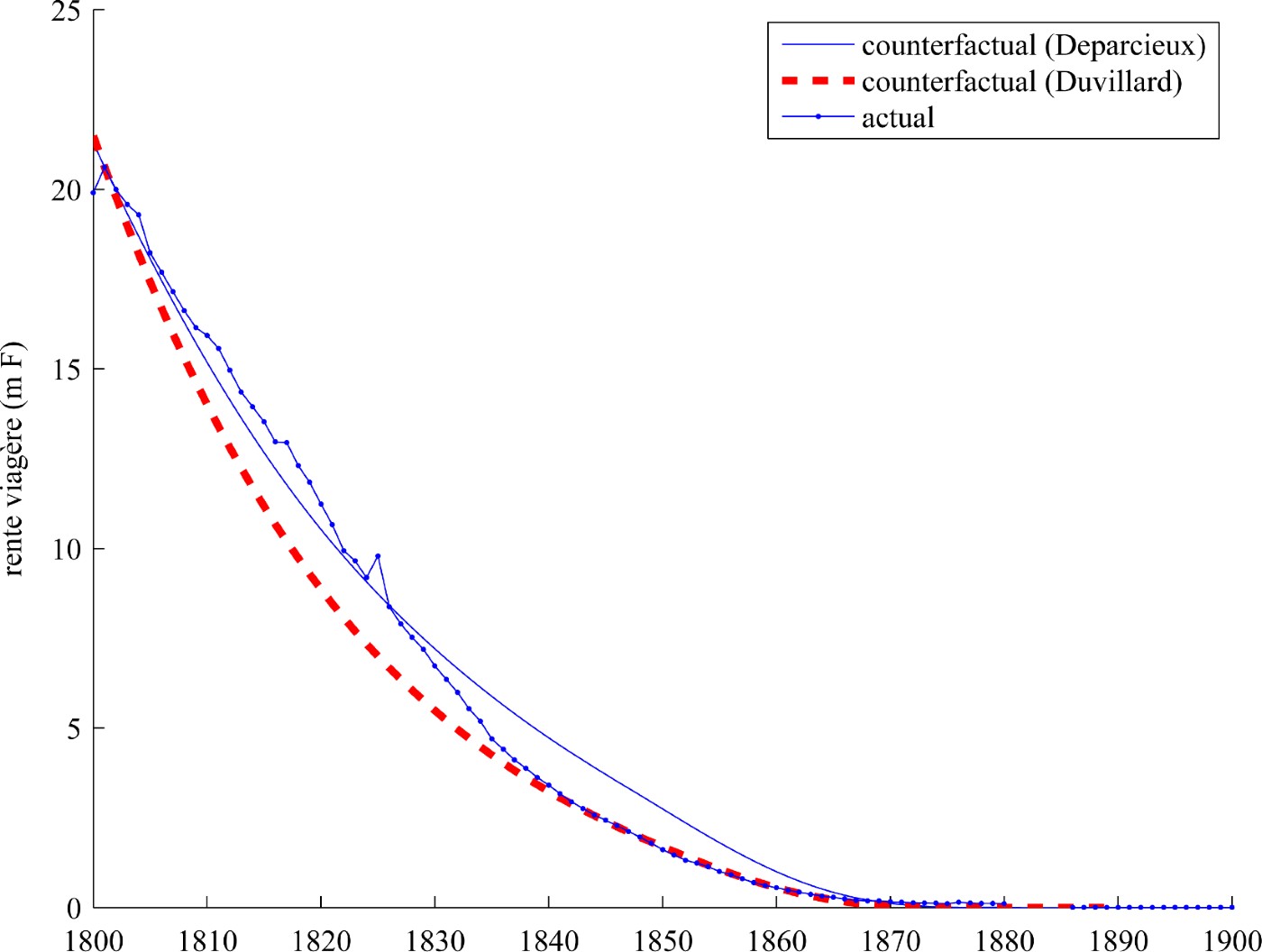
I was curious to assess the quality of the government's calculations during the conversion of 1794, particularly in regard to the choice of life tables. To compute the net present values of the existing annuities that were converted, and the rates on the new annuities into which they were converted, Cambon had set aside the life tables of Deparcieux,Footnote 11 in common use until then, and derived from mortality rates of participants in the French government's tontines of 1689 and 1696. Instead, he used life tables provided by Duvillard. The government's report in 1794 provided the distribution of life annuities by age of tête at the time of the conversion.Footnote 12 It also provided net present values per age, thus allowing me to back out the life tables provided by Duvillard to the government.Footnote 13 Finally, I had the actual path of life annuity payments throughout the nineteenth century from budgetary sources.Footnote 14
The results of this comparison are shown in Figure 1, where I plot the expected path of interest payments on life annuities assuming the Deparcieux and the Duvillard life tables, versus the actual path. This in effect compares the accuracy of the life tables where age groups are weighted by their share of the 1794 annuitants. Figure 1 shows that Deparcieux's table would have provided a more accurate predictor of future annuity payments, with the difference in net present value (at a 5 percent discount rate) of about 0.6 percent, as opposed to 8.7 percent with Duvillard. Duvillard's tables over-estimated mortality, with the result that the French government was more generous with its creditors than its own sense of fairness required.
Actual path of life annuity payments and projected paths using the life tables of Deparcieux and Duvillard
III
As I searched for the figures on actual life annuity payments by the French government, I stumbled upon the object of this note.Footnote 15
In 1880, payments on the life annuities amounted to 109,000 francs. By 1886, only three annuities remained, for a total of 1,385 francs. One annuitant born in 1800 died in 1895, extinguishing 395 francs, but 990 francs remained. The next year, the minister of finance inquired of the Public Debt Office when further extinctions could be expected to close forever this chapter of French financial history. One annuity of 200 francs could be expected to disappear soon, since the rentier was born in 1811.Footnote 16 The extinction of the last annuity, for 790 francs, was ‘impossible to predict’. In 1898, the 200 francs annuity disappeared. The annuity of 790 francs remained, the only item left in the section of the budget devoted to the life annuities of ancient origin. My curiosity was piqued.
Year after year the parliament voted the appropriation of 790 francs, with increasing annoyance. In 1903 the budget committee of the Assemblée nationale asked the ministry of finance who the recipient of this annuity could possibly be. The ministry answered that the annuity was registered in the Grand Livre de la Dette Publique (general ledger of the public debt) under the number 99345 and in name of ‘Linotte de Poupéhan (Amable Suzanne Élisabeth), born on 4 March 1790, widow of Charles-Louis Bodson de Noirfontaine, for her own enjoyment during her life, and after her death for her children and descendants to be extinguished with the last survivor’. In 1905, the budget committee, with some irritation, complained of the persistence of this item in the budget, and asked the ministry to do something about it. After all, the Assembly had, that same year, voted the mandatory redemption of a category of perpetual annuities created by Napoléon I as endowments for his nobility (the majorats). These annuities, it had been argued at the time, arose from favors granted unilaterally by the sovereign and were not inviolable like a real debt. Could not a similar operation be carried out? The ministry answered that it had already made unofficial contact with the beneficiaries in 1900 in an attempt to redeem the annuity, without success. The ministry pointedly noted that the annuity did not arise from a grant of the sovereign, but from a contract ‘considered to this day as inviolable’.
In the following years, 1906–8, the budget committee repeated its desire to see the ministry redeem the debt. Having received no response, the budget committee in 1909 recommended that the appropriation of 790 francs be voted, but strongly urged the ministry to contact the beneficiaries, and threatened to recommend in the future that the Assembly refuse to appropriate the funds. Why had the ministry not carried out the Assembly's wishes? The ministry answered that, in 1900, it had proposed to the beneficiaries that the rent be capitalized at 5 percent and redeemed for 15,800 francs (a generous sum, at a time when French 3 percent perpetuals were at par).Footnote 17 The beneficiaries had refused, and the ministry had decided that it did not have the authority to offer better terms. The budget committee demanded that negotiations resume. On 15 February 1909, the ministry wrote a letter to the family's notaire, Me Loithron, asking what terms might induce the family to relinquish its claim. The notaire informed the ministry that the family wished to keep the enjoyment of their annuity, and refused to discuss any terms. This put an end to the matter, and the Assembly had no choice but to continue to vote the appropriation of 790 francs every year thereafter.
IV
In whose favor was such an unusual annuity created, and why?
The reports of the budget committee of the National Assembly, aside from the text of the registration in the Grand Livre, only state that the annuity was acquired by Claude-Henri Linotte before 1764. From this meager lead, I was fortunate to reconstruct the following story, which begins in the town of Bouillon.
Bouillon is a small city in Belgium's province of Luxembourg, a few miles from the French border.Footnote 18 It was the seat of the medieval duchy of Bouillon, which, by the eighteenth century, had been considerably cut to size but had nevertheless retained its full sovereignty. It consisted mainly of the town of Bouillon itself and a dozen small villages, with a total area of 55 square miles and a population of about 2,500 in 1789.
The duchy had belonged to Godefroi de Bouillon, the famous leader of the First Crusade and elected first Latin king of Jerusalem; but Godefroi, to finance his expedition, had sold Bouillon to the bishop of Liège. The bishops owned Bouillon for the next few centuries, but due to its distance from their main possessions, left it in the care of local castellans. Over time, the castellans of Bouillon grew increasingly independent, and in the late fifteenth century the La Marck family, which owned the nearby independent territories of Sedan and Raucourt, wrestled control of Bouillon from the bishops.
In 1529, Spain took Bouillon and returned it to the bishops of Liège, who kept it until 1676. Members of the La Marck family nonetheless continued to style themselves dukes of Bouillon, while retaining actual control over Sedan, a gateway to France through the Ardennes. Who owned Sedan was of strategic importance to the kings of France and when Charlotte de La Marck inherited Sedan, King Henri IV made sure that she married his companion in arms Henri de La Tour d'Auvergne in 1591.Footnote 19 Charlotte died without leaving children, but left her estate to her husband, who remarried and founded the dynasty of the La Tour, princes of Sedan and titular dukes of Bouillon.
Henri's successor was Frédéric-Maurice de La Tour d'Auvergne (1605–52), a Protestant who served in the armies of the Dutch Estates-General, then converted to Catholicism and returned to France. He did not get along well with Richelieu, and his involvement in a conspiracy during the Thirty Years War got him arrested in 1642 and facing a possible death sentence. His wife threatened to open Sedan to the Spanish troops, and Richelieu had to spare the prince's life. This episode made clear how important Sedan was to France, and Richelieu began negotiations to acquire Sedan and Raucourt for France. The principle of an exchange was agreed upon in 1647, and a contract was signed on 20 March 1651, by Louis XIV ‘on the faith and word of a king’ and the duke of Bouillon ‘on the faith and word of a prince’. For Sedan and Raucourt, the duke received lands in France, including two duchies and the county of Évreux. This exchange will be very important to our story.Footnote 20
The La Tour d'Auvergne, as dukes of Albret, were now peers of France, an exalted status, but with Sedan they had given up the additional prestige of being actual sovereign princes. They still styled themselves dukes of Bouillon, but this title had been theoretical since 1529. In 1676, during the Franco-Dutch War, French troops seized the town of Bouillon and Louis XIV turned over possession of the duchy to the La Tour d'Auvergne family, possession confirmed in international law by article 28 of the Treaty of Nijmegen of 1679.
The La Tour d'Auvergne continued their social ascent: by virtue of their little duchy, they had rank as foreign princes at the French court, ahead of dukes. Having all the titles they needed, the La Tour could marry for money: Frédéric-Maurice's son Godefroi-Maurice (1641–1721) married one of Mazarin's nieces.Footnote 21
Of course, the duke did not live in Bouillon but resided either at court in Versailles, in the sumptuous Parisian hôtel bought and renovated in 1676, or in the splendid castle built at Navarre, near Évreux, in 1686. While the duke resided in Paris or Navarre, his manager (intendant des maison, affaires et finances) corresponded with officials in Bouillon on various administrative matters.Footnote 22
We now meet Claude Linotte (1686-1768), born in Paris of a court clerk.Footnote 23 He became a lawyer, then entered the service of the dukes of Bouillon and became one of the duke's advisors in Paris in 1726, and a member of the court of justice of Bouillon. When Duke Emmanuel-Théodore died in 1730, Linotte became tuteur onéraire of the successor, Charles-Godefroi (1706–71), and his two children: the onerary holder of a function is the one who actually bears the burden, or onus, of performing the duties. As such he played an active role in protecting their inheritance and interests. As it turned out, the inheritance consisted of 2.8m livres in free assets and 6m livres in debts, and the duke was forced to sell the viscounty of Turenne to the king of France for 4.2m livres on 8 May 1738.Footnote 24 Claude Linotte proved a tough negotiator and earned the respect of the minister of finance, Philbert Orry. The minister tried to bribe Linotte with an offer of 40,000 livres, a respectable amount. Linotte felt compelled to inform his master, the duke of Bouillon, who naturally forbade him to accept such a present, but obviously had to match the offer. He couldn't match it with cash and instead offered Linotte a 2,000 livres life annuity; Linotte displayed much gratitude, but remarked that he had no capital to leave to his family, and begged the prince to extend the favor to his whole family.Footnote 25
The duke accepted, and in a contract dated 22 April 1738, he created a perpetual annuity of 1,000 livres, worth 20,000 livres, to be paid to Linotte, his wife, his children born and to-be, which would be extinguished ‘as of the date of death of the last survivor among the descendants of Mr and Mrs Linotte’.Footnote 26
It seemed obvious that this annuity, with its extraordinary reversibility clause, was the same as the 790 franc annuity which so exasperated the budget committee of 1908. But how did it change from 1,000 livres to 790 francs, and more importantly, how did a personal debt of the duke of Bouillon for 1,000 livres become an obligation of the French state for 790 francs that would last for hundreds of years?
V
Linotte himself must have asked what chance his annuity had of lasting as long as promised. The duke's generous intentions were manifest, but would the annuity survive his eventual demise?
To secure the annuity the duke was persuaded to use a brevet de retenue, or warrant of reserve, as security for the principal and interest of the annuity. A warrant of reserve was a favor that the king could grant to one of his officers. It imposed on the officer's successor in the office the obligation to pay a specified sum to said officer or his heirs.Footnote 27 This was a way for the king to give a cash value to those offices that were not venal.
Of course, the beneficiary of the warrant could not enjoy the money as long as he held the office, but it represented a valuable asset, since it was a claim on a payment that would necessarily be made in the future (at the death or resignation of the officer). Thus the warrant could serve as collateral for debts or obligations. In 1754 the duke secured the reversible annuity he had given to Linotte with a warrant that he had received in 1743 on his office of Grand Chambellan de France or Great Chamberlain, although Linotte's lien was subordinated to existing liens, namely life annuities to four other individuals.Footnote 28
The duke used this method to secure another favor he bestowed on the Linotte family. On 8 December 1760, Claude's only child, Claude-Henri (1737-1806), married Anne-Marie-Élisabeth Bodson de Noirfontaine, daughter, grand-daughter and great-grand-daughter of the last three procureurs-généraux or attorneys general of the court of justice of Bouillon. On that day, the duke of Bouillon ennobled the groom as lord of Poupéhan, a village in the duchy that was part of the bride's dowry. Furthermore, the duke granted to the couple a life annuity of 1,200 livres, starting after the death of the groom's father, Claude Linotte, and lasting until the death of the surviving spouse. This annuity was also secured by a lien on the same warrant of 1743, as well as a lien on another warrant of 1745 on the office of governor of Auvergne.Footnote 29 The same month, Claude-Henri moved to Bouillon and succeeded his father-in-law to become procureur-général of Bouillon. By 1774, when Claude-Henri Linotte de Poupéhan became acting commander of the duchy, he was the most powerful man in the duchy after the duke himself.
In 1771, the duke died and was succeeded by his son Godefroi-Charles-Henri (1728–92). On 18 August 1775, the new duke of Bouillon resigned the office of chamberlain in favor of his sister's son, the prince de Guéméné (1745-1809). This triggered the operation of the warrant. Two days later the prince, as successor in the office, deposited the sum of 800,000 livres with a notaire in fulfillment of all the existing warrants, and the same day was able to take the oath of office. The sum was now in escrow and any liens placed on the warrant had to be cleared before the beneficiary could collect whatever remained of the sum.
As part of this process, the duke's intendant wrote to Claude-Henri Linotte on 20 October to inform him of the situation, and ask him to come to Paris, or invest someone with powers of attorney, so that Linotte's lien on the warrant might be cleared. Linotte chose an old friend of his from law school, the solicitor Marais, and wrote to him on 26 October to ask if he might represent his family interests in this matter. In this letter, he tells the whole tale of the reversible annuity's origin (see the Appendix, document 2). Curiously, the intendant was only aware of the life annuity of 1760, not of the reversible annuity of 1738; Linotte pointed out the omission and the intendant had to draft a new power of attorney.Footnote 30
From notarial archivesFootnote 31 we can follow the proceedings. The warrant of 1743, which secured the reversible annuity as well as the life annuity of 1760, amounted to 200,000 livres. Of this sum, 50,000 livres were paid to various creditors, and 150,000 livres were designated as security for the four creditors who were senior to Linotte. Only one creditor survived as of 1776, and it was arranged that the prince de Guéméné would keep the 150,000 livres, pay the remaining life annuity until the creditor's death, then pay the life annuity of 1,200 livres of Linotte (as well as other debts) until extinction; after which, whatever was left over of the 150,000 livres was to be turned over to the duke of Bouillon. This arrangement was endorsed by an arrêt du Conseil d'État of 28 September 1776 and the sum given to the prince de Guéméné. Linotte's lien on the warrant of governor of Auvergne was transferred to a new warrant on 17 November 1779. Strangely, although the lien for the reversible annuity appears on the warrant of 1743, none of the documents associated with the removal of the liens mentions it: only the life annuity of 1,200 livres appears. In fact, a complete account of the liabilities of the estate of the late duke drawn in 1781 does not mention the life annuity of 1760, but lists Linotte as creditor for a perpetual rent of 1,000 livres created by a contract of 22 April 1738 and adds: ‘there is every reason to believe that it is regularly paid in Bouillon’. Also, a general account of all rents paid by the duke de Bouillon, dated 1781, mentions the annuity of 1738, with the note: ‘His Highness pays this annuity voluntarily and in honor, since it was created by the late prince for persons who had served him during his upbringing; it is paid in Bouillon.’Footnote 32 We can surmise that the life annuity had become a liability of the prince de Guéméné, but that the duke continued to allow payment of the reversible annuity out of his own funds, by special arrangement.
This was just as well for Linotte. On 30 September 1782, it is learned that His Most Serene Highness the prince de Guéméné was bankrupt. The debt was then estimated at 15m livres: it turned out later to total 33m livres, a colossal sum at the time, equal to the French Navy's annual budget (wags called it the Most Serene Bankruptcy).Footnote 33
The disgraced prince had to resign his office, and his wife resigned as tutor of the royal children. The Rohan family tried to help, but it finally took the king's good will to save his ‘cousin’: the finance minister Calonne arranged for the king to buy some of the Rohan possessions in Brittany at inflated prices, and transfer the debts to the state. But Linotte appears nowhere in the lists of the thousands of Guéméné creditors. He probably felt it safer to continue to collect his rent from the revenues of the duchy of Bouillon, which he was administering. Events soon showed that it had been a good move.
VI
When the French Revolution broke out Godefroi-Charles-Henri reigned as duke of Bouillon. An eccentric character, he strongly supported liberal ideas and his own cahier de doléances, presented on 14 March 1789, was full of proposals for reform. Six days after the storming of the Bastille, he was elected commander of the National Guard of Évreux where he resided and enjoyed broad popularity. In Bouillon he let the locals form their own Constituent Assembly and write a constitution.
But the Revolution was nevertheless bringing trouble to the family of La Tour d'Auvergne and to those attached to it. The French Assemblée Constituante saw as its mission the complete overhaul of French institutions and laws, reforming centuries of mistakes and abuses. Nothing in the past was safe from re-examination. One of the many areas ripe for reform was the management of the crown's domain, now called the national domain. Kings had imposed on themselves the discipline that the domain could not be alienated; but budgetary needs had often led them to enter in indefinite or perpetual leases called engagements. Kings had also used portions of the domain for exchanges of territories, which was deemed allowable as long as the exchange did not diminish the royal domain but merely replaced some estates with others of no lesser value. Whether the king was receiving anything real in exchange, or in fair proportion rather than as a favor, was often doubtful. The Guéméné exchanges of 1786 were a case in point, denounced as typical of Old Regime cronyism and corruption.
A complete reform of the management of the domain was proposed to the Assembly by its committee on the domain in November 1790, and a law passed (1 December 1790). The section dealing with exchanges prescribed that exchanges which had not been completed, that is, for which the required procedures had not been entirely followed and final ratification obtained from the courts, were to be examined individually and decided upon by decree of the legislature (articles 18 and 19). The committee's report mentioned the fact that research into incomplete exchanges had already been carried out under the Old Regime, and an 800-page manuscript listing 102 questionable exchanges from 1647 to 1786 had already been compiled. The first date corresponded to the 1647 agreement over Sedan and the last to the Guéméné bailout.Footnote 34
Indeed, the Sedan exchange was not in perfect order, even after 130 years. Although the contract of exchange of 1651 had been preceded by two estimates of the value of Sedan and Raucourt (one in 1647, rejected as too low by Bouillon, and one in 1648), the contract had been only the beginning of a long process. Letters patent to appoint commissioners for the assessment of the estates were sent in March 1651 to the courts for registration, but the latter raised objections and amended the terms of the contract. Louis XIV ordered his commissioners to proceed without the formal endorsement of the contract by the courts. Twenty years later, in 1674, the commissioners presented their assessments, but Bouillon objected that the commissioners had neglected certain expenses that should have been incurred by the king. New commissioners were appointed in 1676 to revise the assessments. A hundred years later, no progress had been made, and at Bouillon's request Louis XV appointed a new commission to examine the duke's complaints in 1770. By the time of the Revolution, the issues were still unresolved, and formally, the exchange had not been brought to a conclusion: as late as 1776 the chamber of accounts prohibited the duke from receiving fee and homage from the vassals of the French lands he had received in the exchange as long as letters of ratification remained unregistered.Footnote 35
The Constituent Assembly had only opened uncompleted exchanges to examination. The committee had shied away from outright cancelation: ‘a general repeal would have created great disturbances in society, giving rise suddenly to a multitude of claims and suits capable of overturning the most secure estates’. Its report, indeed, demonstrates how much thinking went into the bill, drawing on history and public law textbooks. The duke was still able to enjoy possession of the estates he had received in 1651, and they formed the bulk of his wealth.
As the Revolution unfolded, attitudes changed. Soon after Léopold (1746–1802) succeeded his father as sovereign duke of Bouillon in 1792, he took an oath to the constitution of Bouillon, and continued to reside at Navarre, near Évreux, rather than emigrate. A foreign war had begun, civil war had erupted, and fiscal revenues collapsed, even as spending was exploding. The Convention was looking for any way to increase its resources, and Cambon, head of the finance committee, proposed to drastically revise the law of December 1790. It had not worked, he contended, and 18,000 lawsuits were clogging the courts: ‘your committee of finance has thought that we must cut down to size the claims of these gentlemen … Let us begin by taking over the engaged estates, earlier laws notwithstanding; let us put them for sale; in that way we will end all the lawsuits, because those who have started them only to remain in possession as they were, once they have been dispossessed, will have no reason to continue their chicanery.’ The Convention agreed, and under the law of 10 frimaire II (10 December 1793) incomplete exchanges were immediately canceled, all estates were to be taken over at once and the original counterparts of the exchanges returned.Footnote 36
Léopold thus lost the vast majority of the estates that provided his income. He petitioned the Convention, arguing that these laws were not applicable to the contract of 1651, which, being a treaty between sovereigns, was only subject to international law and could not be revoked unilaterally. The committees of the Convention rejected his claim and upheld the cancelation in pure Jacobin language. As the committee's reporter told the Convention, sovereignty belongs to the people. Léopold's ancestors had usurped sovereignty in Bouillon and could found no legitimate claim on that basis: ‘let him stop exaggerating the importance of the cession made by his ancestor to the tyrant of the French; it was void from the beginning in regard to the things he values so much; it was itself a political crime, because the policy of free nations knows no laws but those of nature’. Obviously, sovereignty over Sedan could not be returned to Léopold. He could not claim the fortifications or any indemnity for them, since, ‘built for the people, their expense had been paid for with the people's sweat’. Nor could he claim any real estate that was of public use. ‘La Tour d'Auvergne, having become a French citizen, must have the character of one; and when everyone is rushing to make voluntary sacrifices, he will see without complaint the sacrifice which the laws of nature and reason demand from him.’ A law of 8 floréal II (27 April 1794) rescinded the exchange of 1651 (Archives parlementaires, 1re série (1862–), vol. 89, pp. 421–3).
The citoyen La Tour d'Auvergne was now deprived of most of his estates, and he was briefly detained during the Terror. The duchy of Bouillon was conquered in the summer of 1794 and annexed by France on 1 October 1795. One can imagine that the creditors of the ci-devant duc were not getting paid much anymore. But the Terror came to an end, and a less hostile regime replaced it. La Tour d'Auvergne was freed from jail and spent the next years fighting to regain his estates.Footnote 37 He managed to get a law passed on 7 nivôse V (27 December 1796) restoring all his estates to him. But after the coups of 1797 and 1798, a more radical executive (the same that carried out the Two-Thirds Bankruptcy) sequestered all the estates of Bouillon related to the 1651 exchange on 9 fructidor VI (26 August 1798).
Then, a law passed on 14 ventôse VII (4 March 1799) offered a modicum of hope to La Tour d'Auvergne. It allowed parties to incomplete exchanges to secure permanent ownership of the disputed estates on condition that they pay in cash 25 percent of the assessed value. La Tour d'Auvergne found the wherewithal to make a submission and in this manner buy his estates in Auvergne, but others remained sequestered.
For Léopold as for many others, Bonaparte's accession to power in November 1799 offered hope of a final resolution to the chain of events of the Revolution. He obtained a decree of 1 germinal VIII (22 March 1800), which ended the sequester of his remaining estates. However, he was still obliged to pay the 25 percent of assessed value he had offered to pay, and forested areas larger than 150 hectares were returned to him only on a provisional basis. He continued to lobby for a permanent repeal of the law of 8 floréal II and a validation of the exchange of 1651, sending petitions to the First Consul.
Meanwhile, he had to pay the bills, and his situation was grim. The loss of his income over five years had left him with 3m francs in debts; he was hounded by the tax collectors and his creditors, and his expenses exceeded current revenues by 200,000 francs every year. In January 1801, he agreed to lease all of his estates to a syndicate of farmers who offered to pay his creditors themselves, pay his taxes and leave him with a fixed 100,000 francs per year. This lease, approved by the government on 13 germinal IX (3 April 1801), included a listing of all his creditors, whose annual payments would now come from the representative of the leaseholder, Antoine Roy. In that list, with number 141 out of 289, appears the name of Linotte for a life annuity of 1,200 livres, dated 10 December 1760. There is no mention of the reversible annuity.
The citoyen Léopold La Tour d'Auvergne died in February 1802, the last of his lineage. Because many of his relatives and heirs were émigrés (in particular his first cousin the prince de Guéméné, he of the bankruptcy), and because of the remaining uncertainty over the status of the 1651 exchange, his estates were once again placed under sequester on 20 December 1802.
How had the Linotte family survived the Revolution? Claude-Henri Linotte had peacefully served as procureur-général of Bouillon until 1789. His only son Claude-Louis (1764–1837) graduated as a bachelier at age 20 and took seat in the court of Bouillon at 22. In 1789, the young Claude-Louis married, in the presence of and with the blessing of the duke of Bouillon, who on that occasion extended the life annuity of 1,200 livres to the last survivor of the newlyweds, as his father had done at the marriage of Claude-Henri. Soon after, Claude-Henri resigned his office and let his 25-year-old son take over. The office disappeared with the reforms in the little duchy, but Claude-Louis Linotte was elected judge, and served in this capacity until the annexation by France. Later, under Napoleon, he became mayor of Bouillon.
One can imagine that the Linotte family did not collect much on their rents during that period. But, from 1801, they were able to collect at least the elder Linotte's life annuity. A decree of 30 messidor XI (19 July 1803) authorized the payment by the Régie des Domaines of all the rents listed in the annex to the decree of germinal IX, and the leaseholder Antoine Roy was authorized to continue payment on behalf of the state. When the forests in the Bouillon succession were united to the national domain on 15 floréal XII (5 May 1804), payment of the creditors was allowed out of the revenues of these forests, as a favor to the creditors, until final resolution. The same decree recognized that there existed other debts aside from those enumerated in germinal IX, either not identified at the time or created later, and it was decided that such additional debts, after verification, should enjoy the same treatment. Accordingly, a list of additional liabilities of the Bouillon estate was compiled and included in a bill drawn up by the Conseil d'État, which proposed to have those rents paid by the Caisse de l'Administration de l'Enregistrement et des Domaines. Napoleon was at the time on the Polish–Russian border, engaged in talks with Czar Alexander I. The text of the bill, with its annexed list of 96 creditors, was sent to Poland and submitted to the emperor, who approved and signed the decree on 20 June 1807 ‘in our imperial camp of Tilsitt’. In the seventh entry of the annexed list, our infinitely reversible rent has reappeared after an eclipse of 30 years, and the emperor's own hand vouched for its payment by the French state.Footnote 38
The matter of the Bouillon inheritance was not settled, however. The 1807 decree authorized payment in conformity with the decree of 30 messidor XI, which said: ‘provisionally and until otherwise provided’. Linotte was still the creditor of a dead man, his annuity paid out of a sequestered and disputed inheritance. Debates on what to do with the sequestered estates continued within the French administration from 1807 to 1809. Heirs had presented themselves, all of them collateral, and some quite distant (descended from the last duke's maternal great-grandmother by a first marriage, for example). It was found that the assets amounted to 5.93m francs and the liabilities to 8.46m francs, even before counting the state's claims under the cancelation of the exchange of 1651, valued at 10m francs. Thus the heirs and the hundreds of creditors could expect little from more years of legal quagmire. The Conseil d'État advised that it would be worthy of His Majesty's generosity to confiscate all sequestered estates and add the creditors' claims to the public debt. The heirs would actually profit from the arrangement, since the chattel and a few estates had not been sequestered, and would be free from liens. The state would make a net loss, but it gained some handsome properties, including the hôtel de Bouillon in Paris and the castle at Navarre; and there is reason to suspect that the castle was willfully underestimated by the state.
This opinion was endorsed by Napoleon and approved on 3 January 1809. Napoleon quickly made good use of the real estate thus acquired. The Parisian hôtel went to a cousin of the Empress Joséphine and the castle of Navarre to Joséphine herself the following year, as part of her divorce settlement; to the estate Napoleon attached the strange title of duchess of Navarre.Footnote 39
As for the liabilities of the Bouillon succession, a complete inventory of the debts was drawn up in 1809.Footnote 40 Linotte's life annuity of 1760 appears as number 239, but it is observed that it ceased to be paid from his death in 1806; the extension to Claude-Louis and his wife had never been properly notarized, and was rejected. However, under number 337, we find a perpetual rent of 1,000 livres, subject to 20 percent withholding, to Claude-Louis Linotte, with date of title 22 April 1738. This same rent appears in the annex to the decree of 20 February 1811, which orders the inscription of 96 perpetual rents and 135 life annuities on the Grand Livre de la Dette Publique. No. 96 is a rent to Claude-Louis Linotte, for 790 francs. This sum represents the conversion of the 800 livres (net of withholding taxes) into francs, following the law of 25 germinal IV. The rent was listed as a perpetual rent, which it was not: somehow, in the process, the exact terms of the annuity had been lost. A decree of 18 January 1813 rectified this error, ordering that the rent of 790 francs in the name of Claude Louis Linotte be registered in the Grand Livre de la Dette Viagère ‘for him to enjoy alone during his lifetime, and after his death it will revert to his children and descendants to be extinguished with the last survivor’.Footnote 41
After the fall of Napoleon in 1814, French borders retreated to their positions of 1792, and the fate of the former duchy of Bouillon hung in the air. The Congress of Vienna decided not to recreate the statelet and awarded the territory to the Grand Duchy of Luxembourg.Footnote 42 In 1816, Claude-Louis Linotte was confirmed as a member of the nobility and made mayor of Bouillon. His only daughter, Amable-Suzanne-Élisabeth (1790–1874), married her cousin Charles-Louis Bodson de Noirfontaine. As sole descendant of Claude Linotte, it was in her name that the annuity was inscribed on the French Book of Public Debt. She left two daughters, and a decision by the minister of finance of 8 February 1876 confirmed the annuity and specified that it would remain in her name after her death, and that her descendants would just have to provide proof of affiliation.
By 1900, when the ministry of finance identified the owner and tried to negotiate redemption of the annuity, the only surviving descendant of Amable, and therefore of Claude Linotte, was Marie-Louise-Alexandrine Aubriot (1837–1914), wife of Maximilien-Melchior Chabiel de Morière. It was with their solicitor that the government negotiated in vain. The annuity continued to exist, the last of the life annuities. At her death in 1914, the annuity remained indivise (undivided) between her two children, Hugues-Melchior-Charles Chabiel de Morière (1874-1939) and Caroline-Marie-Valentine (1862-1946), married to Charles Gentilliez.
The year 1914 was also the end of the stable franc. With the opening of hostilities, the Bank of France suspended the link between francs and gold, and part of the war was financed with large issues of paper currency. When France's Prime Minister Poincaré re-established the link in 1928, he could only do so at 20 percent of its pre-war parity. In other words, the owners of the Linotte annuity only collected a fifth as much gold as before the war. It was after all denominated in francs, and monetary laws upheld by court decisions left the government free to decide what a franc was, and whether it would pay the 790 francs in gold or in paper.Footnote 43 This ability to substitute paper, produced at zero cost, to gold, made the burden of debt lighter. The Linotte annuity could well live on: inflation would slowly (or rapidly) erode it away.
And the annuity lived on. Occasionally, someone noticed its existence in the French state's annual budget and wondered about its origin. Such a query was published in the Intermédiaire des chercheurs et des curieux on 30 December 1931; and another one in L'Intransigeant on 26 January 1935. On 12 February 1935, the same daily published a response from Hugues Chabiel de Morière: strangely, his explanation for the origin of the annuity was incorrect (he thought it had come down to him from the Bodson de Noirfontaine family); its true history had already been lost even to its owners.Footnote 44
And at present? The Compte de la Dette Publique of 1988 explains that all perpetual annuities from 1793 to 1945 were reimbursed by ministerial arrêt of 9 April 1987, closing the book on centuries of public finance tradition. But among the life annuities, there is one remaining, ‘indefinitely reversible to the descendants of its first owner, whose origin goes back before 1764, and inscribed on the Great Book pursuant to a decree of 18 January 1813’.Footnote 45 This is, of course, the annuity of Claude Linotte; now 250 years old, weather-beaten and scarred by time's passage and inflation, bereft of two zeros by the 1960 conversion from old francs to new francs, but tenacious and enduring, alive with dynastic permanence, and yielding each year enough to buy a café-crème at the bistro on the way out of the Treasury.
In reply to my inquiry, the ministry confirmed the annuity's existence, although no one appeared to collect it.Footnote 46 That is not due to lack of potential claimants; the descendants of Claude Linotte are numerous: as of 1998, there were 58, of which half were under the age of 20.Footnote 47 But it seems that all memory of the annuity has been lost in the family. The French state will remember indefinitely. In French law there is a five-year statute of limitation on uncollected interest (article 2277 of the Code Civil), but not on the annuity itself, even if it is uncollected for decades. Until the last of the descendants of Claude Linotte dies, the French Treasury stands ready to honor its commitment and pay out €1.20 every year.
VII
The story of the Linotte annuity may seem like nothing more than an anecdote. If it were nothing else, it would still be an enlightening one.
The twists and turns of the story take us into the details of the Old Regime's financial legacy. At first sight, this legacy was a very large public debt. But some of the debt had been issued on terms that, after the fact, seemed patently unfair to the men handling this legacy, like the Genevan annuities. Other commitments, like those arising from the Guéméné affair, could look like instances of pure cronyism to men less appreciative of the circumstances under which these commitments had been made. Even the Linotte annuity had its origin in an attempt at bribery.
Revolutions are dangerous times for creditors. It is after all a classic result of optimal taxationFootnote 48 that a one-time capital levy at t = 0 (or Year I, in the Republican calendar) is a good idea. Defaulting on the debt is a capital levy: just blame the predecessors, especially if you can paint them as corrupt and inept, and promise never to do it again. But, ruthless as they were in other respects, Robespierre and his colleagues did not follow that path; quite the opposite. They displayed extraordinary sensitivity to the perceived need of honoring its creditors' claims. In March 1794, when the Revolution's internal and external struggles were at their fiercest, Cambon found the time to engage in complex calculations and reduce the existing life annuities to actuarially fair claims. Likewise, the long story of the Sedan exchange after its cancelation in 1793 shows how courts and legislatures carefully considered the interests of private creditors and even the ex-duke of Bouillon.
The Linotte annuity became part of the French debt in 1811, after the Two-Thirds Bankruptcy of 1797. It never endured what the many loans issued under the Old Regime had: suspension of payments, unilateral restructurings and partial defaults. Napoleon and the successor regimes kept their word. The extraordinary survival of the Linotte annuityFootnote 49 is a testament to their punctiliousness and the effectiveness of their commitment mechanism (whatever it might be). The legislators of 1903 who invoked the inviolability of the national debt kept their word and stood ready to honor an inherited commitment, however annoying. A hundred years later the French state will honor the same commitment, however trivial.
And this is where the Linotte annuity becomes, more than an anecdote, a parable. In 1811, the annual commitment of the French state to the (single) descendant of Linotte represented 229g of gold. In 2009, it represents 0.05g, to be shared among dozens of descendants. True, the French state honored its commitment unfailingly for over two hundred years; but it did so at nominal values, as it was entitled to by longstanding legal principles. And this is how it (as many other states) has dealt with debt: the annuity survives, but shorn of any real value by a century of inflation.
The Linotte annuity, with its pitiful return of €1.20, is nothing but the value of an eighteenth-century servant's loyalty, adjusted for all the misfortunes that befell France in the intervening two and a half centuries.
Appendix
1 Contract creating an annuity of 1,000 livres for Claude Linotte and all his descendants; 22 April 1738; mortgage of the brevet de retenue, 24 January 1754 (AN MC LXVIII 405; AN R/2/182, p. 48).
2 Letter from Linotte to Marais; 26 October 1775 (A /R/2/182, p. 50).
3 Decree of 1 June 1807 (AN AF/IV/259-1).
4 Decree of 13 January 1813 (AN AF/IV/717 dossier 5753).
Document 1
Par devant le conseiller du Roi Notaire au Chastelet de Paris soussigné fut présent très haut etc. Monseigneur le duc de Bouillon,
Lequel en considération et pour récompenser des services rendus à S.A. par Me Claude Linotte avocat au Parlement, conseiller intendant de ses maison, affaires et finance, a par les présentes donné par donation entre vifs pure, simple et irrévocable en la meilleure forme que donation puisse avoir audit Sieur Linotte et à la Dame Marie-Anne Delpy son épouse qu'il autorise à l'effet des présentes et au survivant d'eux et après eux aux enfants nés et à naître de leur mariage, les S. et D. Linotte demeurant à Paris à l'hôtel de Bouillon présents et acceptant tant pour eux que pour leurs enfants nés et à naître
Mil livres de rente annuelle et perpétuelle au principal et rachetable de la somme de 20,000 livres que S.A. Monseigneur le duc de Bouillon s'oblige de payer ou faire payer aux S. et D. Linotte et à leurs enfants en cette ville de Paris ou au porteur aux quatre quartiers accoutumés également, dont le premier qui a commencé le premier janvier dernier, est échu le dernier Mars dernier, et ainsi continuera tant que ladite rente aura cours, à l'avoir et prendre généralement sur tous les biens meubles et immeubles présents et à venir de Mgr le duc de Bouillon que S.A. a chargé, affecté, obligé et hypothéqué à garantir le principal de ladite rente et à fournir et faire valoir les arrérages d'icelle bons et bien payables par chacun an aux quatre quartiers et sans aucune diminution nonobstant toutes choses à ce contraire désaisissant, jusqu'à due concurrence voulant constituer procurant le porteur donnant pouvoir pour par lesdits S. et D. Linotte et leurs enfants nés et à naître jouir, faire et disposer des 1000 livres de rente en principal et arrérage en pleine propriété comme chose leur appartenant;
Sera ladite rente rachetable à toujours en payant pour les racheteurs quand bon leur semblera en une fois et un seul paiement la somme de 20,000 livres avec les arrérages qui en seront lors dûs et échus. Cette donation ainsi faite pour les causes susdites et parce que telle est la volonté de S.A. dont les S. et D. Linotte l'ont très humblement remercié. Si les enfants de S. et D. Linotte survivants leur père et mère venaient à décéder leurs enfants ou leurs descendants sans enfants, en ce cas ladite rente de 1000 livres demeure éteinte et amortie et M. le duc de Bouillon, ses hoirs, successeurs et ayant causes en demeureront déchargé du jour du décès du dernier survivant des descendants du mariage de S. et D. Linotte.
Nonobstant toutes les clauses ci définies S.A. le duc de Bouillon déclare que son intention est qu'il veut et entend que le S. Linotte dispose de ladite rente et du principal d'icelle ainsi que bon lui semblera, qu'il en puisse même recevoir le remboursement sans être obligé d'en faire emploi, et que lesdites clauses viagères n'ayant leur exécution que dans le cas qu'il n'ait pas disposé du principal et des arrérages de la rente.
Pour faire insinuer, fait à Paris en l'hôtel de Bouillon l'an 1738, le 22 avril avant midi et ont signé la minute des présentes demeurée à Me Bougainville.
Le duc de Bouillon, lequel voulant donner à M. Claude Linotte, avocat au Parlement, qui a été son tuteur onéraire et depuis intendant de sa maison, affaires et finance une plus grande assurance de la rente et pension viagère de 600 livres que Mgr le duc de Bouillon lui a constituée […] par contrat passé le 3 mars 1732, et de la rente annuelle et perpétuelle de 1000 au principal de 20,000 livres dont Mgr l'a gratifié […] le 22 avril 1738, veut et entend S.A. le duc de Bouillon que le brevet de retenue à lui accordé par Sa Majesté le 13 juin 1743 déposé devant M. Bougainville le 23 juillet, de la somme de 200,000 livres sur la charge de Grand Chambellan de France, soit et demeure spécialement affecté à la garantie du paiement des arrérages de ladite rente et pension viagère de 600 livres et à la garantie du capital et payement des arrérages de ladite rente de 1000 livres au principal de 20,000 livres, après néanmoins et à mesure de l'extinction d'autres rentes viagères que Mgr le duc de Bouillon a constitué aux S. de La Mazelière et Walle de Barantigny, et la D. épouse du S. Sonning, et à M. Louis Hodier de La Varenne capitaine au régiment des gardes françaises, auxquelles pour sûreté des rentes viagères ledit brevet de retenue a été affecté par Mgr le duc de Bouillon suivant les mentions qui sont transcrites sur ledit brevet. Consentant Mgr le duc de Bouillon que ces mentions soient faites en son absence sur l'original du brevet. […] Fait et passé à l'hôtel de Bouillon l'an 1754, le 24 janvier.
Mention faite sur le brevet de retenue le 8 février 1754.
Document 2
A Bouillon, ce 26 Octobre 1775.
Mon ancien ami,
Après la vente du vicomté de Turenne,Footnote 50 M. le Contrôleur-Général lors en placeFootnote 51 eut la bonté de dire à mon père que la résistance constante et sincère qu'il avait opposé à l'aliénation de cette principauté en qualité de tuteur des princes, princesses et substitutions de leur maison, n'avait rien à diminuer à l'estime qu'il avait conçu pour lui et qu'il n'en croyait que plus juste de le gratifier d'un pot de vin qu'il annonça ne pouvoir être moins de 40,000 livres.
Mon père remercia très humblement le ministre d'un aussi grand témoignage de bonté, et sans accepter ni refuser il répondit qu'il croyait qu'il était de son devoir de rendre compte à Mgr le duc de Bouillon de sa bonne volonté et de prendre sur cela ses ordres.
Mgr le duc de Bouillon a eu dans le temps d'excellentes raisons que mon père a respectées et que je respecte après lui, de refuser son consentement à une gratification qui devait assurer sa petite fortune et par conséquent celle de sa femme et de son enfant et n'eut rien de plus pressé que de retourner chez M. le Contrôleur Général pour lui rendre compte de la répugnance que S.A.S. avait témoigné de lui voir accepter ce pot de vin et de le supplier de lui éviter la fâcheuse alternative ou de désobéir à Sa Majesté, ou de déplaire à son maître.
Le prince, pour dédommager mon père, lui fit proposer par une personne qui vit encore de le gratifier d'une pension viagère de 2,000 livres. Mon père fit répondre par cette même personne qu'il se trouverait trop honoré et qu'il serait toujours content de ce que S.A.S. voudrait bien faire pour lui, mais que considérant qu'il n'avait pas le plus petit patrimoine à laisser à sa femme et à son enfant, il la suppliait d'étendre ses bontés jusques sur sa famille.
En conséquence, le 22 avril 1738 S.A.S. a daigné gratifier mon père d'une rente annuelle et perpétuelle de 1,000 livres au principal de 20,000 livres par contrat passé pardevant maître de Bougainville et son confrère.
Ce prince, pour plus grande assurance de cette rente, voulut par acte reçu par le même notaire le 24 janvier 1754 affecter spécialement à la garantie du principal et payement des arrérages de ladite rente le brevet de retenue à lui accordé par Sa Majesté le 13 juin 1743 de la somme de 200,000 livres sur la charge de Grand Chambellan de France, et la mention de ladite affectation a été faite par M. de Bougainville sur l'original dudit brevet le 8 février 1754.
S.A.S. désirant témoigner la satisfaction qu'elle avait de mon alliance avec la Demoiselle Bodson a daigné intervenir à mon contrat de mariage reçu par Me Dupré le 16 décembre 1760, et de nous y faire donation de 1,200 livres de rente viagère réversible sur la tête du survivant, pour ladite rente ne commencer à courir que du jour que les pensions aussi viagères de mon père seraient éteintes par son décès. Le prince eut encore la bonté de consentir à la même affectation. En conséquence autre mention de ladite affectation fut faite en marge du même brevet par Me Dupré le 19 mai 1761.
Vous voyez, mon cher ami, que le brevet de retenue de la somme de 200,000 livres accordé à S.A.S. sur la charge de Grand Chambellan de France m'a été doublement affecté et hypothéqué pour sûreté tant de ma rente perpétuelle que de ma pension viagère. Je dois cependant vous faire remarquer que ces affectations n'ont du avoir lieu qu'au fur et à mesure de l'extinction d'autres affectations précédentes.
S.A.S. Mgr le duc de Bouillon ayant jugé à propos de donner sa démission de la charge de Grand Chambellan en faveur de Mgr le prince de Guéméné son neveu en s'en réservant la survivance de l'agrément de Sa Majesté, le jeune prince pour éviter des longueurs et hâter sa réception a pris le parti de déposer chez Me Lebrun notaire, la somme de 800,000 livres à quoi se sont trouvés monter les brevets de retenue accordés par Sa Majesté. Voici donc mon gage et celui de plusieurs créanciers ou pensionnaires en dépôt chez un notaire.
Dans ces circonstances M. Perrault, intendant général des maison et affaires de S.A.S. Mgr le duc de Bouillon, m'a envoyé un modèle de procuration qui a pour objet de consentir par moi ou mon fondé de procuration au dépôt de la somme de 200,000 livres portée au brevet de retenue du 13 juin 1743, soit entre les mains d'un notaire soit entre les mains de M. le prince de Guéméné, de décharger le brevet de retenue et enfin de prendre au surplus tous les arrangements qui seront convenus et arrêtés pour raison dudit fond envers qui il appartiendra.
La confiance entière que j'ai en l'équité de M. Perrault, qui est véritablement le plus galant homme possible et qui vient de me donner assez récemment des preuves de la meilleure volonté, m'a déterminé à lui envoyer directement cette procuration. Je lui mande que je m'abandonne à lui sans réserves, en un mot qu'il peut faire de ma procuration tel usage qu'il voudra, je n'ai cependant pas l'indiscrétion de le prier de s'en charger; d'ailleurs la qualité d'intendant de S.A.S. est je pense incompatible avec celle de fondé de pouvoir d'une partie prenante, je le préviens que je prendrai la liberté de vous charger de cette corvée, je compte assez sur votre amitié pour me persuader que vous voudrez bien rendre ce service à votre ancien disciple et ami.
J'ai donc l'honneur de vous prier d'aller aussitôt la présente reçue chez M. Perrault à l'hôtel pour accepter cette procuration, s'il n'y trouve pas de difficulté, et pour conférer avec lui sur ce qu'on pourra faire de mieux pour la conservation de mon petit patrimoine, c'est en homme d'honneur tout ce que mon père m'a laissé.
Quoique cette petite affaire soit pour moi très importante, vous concevez cependant qu'étant très fidèlement et très respectueusement attaché à S.A.S. elle me trouvera dans tous les temps et dans toutes les occasions disposé à me conformer à ses volontés.
C'est d'après ce principe invariable que je vous prie de parler et d'agir, et par une conséquence nécessaire d'avoir toute sorte de condescendance pour l'avis de M. Perrault. Seulement, si par impossible, ce que je ne peux croire, il me fallait sacrifier toutes mes sûretés je vous serais obligé de me donner avis de l'état de la question.
Voilà mon cher ami tout ce que je peux vous dire, vous jugez que je fais des vœux pour que mes affaires aillent au mieux possible, au surplus la volonté de Dieu et de mon souverain soit faite.
Faites s'il vous plaît agréer à votre famille mes plus humbles compliments et à notre aimable demoiselle mes tendres et respectueux hommages, j'aurais bien de la satisfaction d'apprendre de leurs nouvelles et des vôtres.
Document 3
Conseil d'État
Extrait du Registre des délibérations
Séance du 30 mai 1807 Du 20 Juin 1807
Approuvé en notre camp Imp.l de Tilsit
Nap
Projet de décret
Napoléon, Empereur des Français et Roi d'Italie
Sur le rapport de notre ministre des finances
Vu l'arrêté des consuls du 13 germinal an 9 qui ordonne l'exécution du traité passé le 15 nivôse précédent entre Jacques Bouillon La Tour d'Auvergne et Audoin Roy.
Vu l'arrêté du gouvernement du 30 messidor an 11 qui autorise en conséquence le paiement par la Régie des Domaines à compter du 1er vendémiaire an 10 des arrérages des rentes dues aux créanciers du dit Bouillon … jusqu'à la concurrence de la somme de 392,648 livres 16 sols
Vu l'arrêté du gouvernement du 10 floréal n 12 portant qu'il soit ajouté à ces rentes celles postérieures au traité confirmé par l'arrêté du 13 germinal an 9 lorsque la légitimité en aura été reconnue
Vu notre décision du 13 ventôse an 13
Considérant que jusqu'à ce moment les rentes payées aux créanciers Bouillon ne se sont élevées qu'à une somme inférieure a celle autorisée par les arrêtés précités et que les créanciers reconnus légitimes quoique postérieurement au traité entre défunt Bouillon et le Sr Roy ont des droits égaux aux créanciers légitimes reconnus antérieurement
Notre Conseil d'État entendu
Nous avons décrété ce qui suit:
1 Notre Ministre des finances est autorisé à faire acquitter pour le passé et l'avenir, conformément aux dispositions de l'arrêté du 30 messidor an 11, par la caisse de l'administration de l'enregistrement et des domaines et sur le produit des biens séquestrés provenant de la succession du défunt Jacques Léopold Charles Godefroy Bouillon Latour d'Auvergne, que de ceux provenant de l'échange de 1651 et réunis au domaine national, sauf la déduction des arrérages qui pourraient avoir déjà été acquittés, la somme de quarante quatre mille trois cent quatre vingt neuf francs onze centimes, savoir, 1, celle de quatre mille deux cent trente neuf francs onze centimes montant des rentes perpétuelles et viagères constituées par le dit Bouillon Latour d'Auvergne, tant en numéraire qu'en denrées, antérieurement au traité du 15 nivôse an 9 entre lui et le Sr Roy; 2, celle de quarante mille cent cinquante francs montant des rentes viagères léguées à différents particuliers et serviteurs de sa maison par son testament du 4 nivôse an 10 et dont l'état nominatif est joint au présent décret.
2 Les créanciers en capitaux exigibles sont renvoyés à se pourvoir après la levée du séquestre contre les héritiers et ayants droits de la succession Bouillon.
3 Notre ministre des finances est chargé de l'exécution du présent décret.
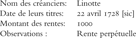
État des créanciers de la succession Bouillon non portés dans l'état du 15 nivôse an 9 qui ont demandé et n'ont pas encore obtenu le paiement de leurs rentes:
Document 4
Conseil d'État
Extrait du Registre des délibérations Séance du 9 octobre 1812
Tuileries le 18 Janvier 1813
Approuvé Napoléon
Napoléon, Empereur des Français, Roi d'Italie, Protecteur de la Confédération du Rhin, Médiateur de la Confédération Suisse, etc etc etc.
Sur le rapport de notre ministre des finances,
Vu nos décrets impériaux des 3 janvier 1809 et 20 février 1811 concernant l'inscription des rentes perpétuelles et viagères dues par la succession Bouillon et les états annexés au décret du 20 février
Vu les pièces jointes au dit rapport
Notre Conseil d'État entendu
Nous avons décrété et décrétons ce qui suit
1 La rente de sept cent quatre vingt dix francs au nom du sieur Linotte (Claude Louis) portée par erreur sur l'état des rentes perpétuelles dues par la succession Bouillon annexé à notre décret impérial du 20 février 1811, article 96, sera inscrite au grand livre de la dette viagère au nom du dit sieur Linotte (Claude Louis) né le 10 février 1764, pour en jouir d'abord par lui seul sa vie durant, et après son décès retournera à ses enfants et descendants pour s'éteindre au dernier survivant.
2 Nos ministres du Trésor impérial et des Finances sont chargés chacun en ce qui les concerne, de l'exécution du présent décret.