Background and Literature Review
As health care systems in Canada and worldwide are evolving to accommodate population aging, practitioners are facing the long-term care needs of individuals who spend a significant portion of adult life in “old age”, which is typically defined as age 65 and older (Canadian Institute of Health Information [CIHI], 2009; Shi, Mörike, & Klotz, Reference Shi, Mörike and Klotz2008; Statistics Canada, 2007). Aging and old age are associated with a person’s increasing risk of having at least one chronic condition (Denton & Spencer, Reference Denton and Spencer2010; Wolff, Starfield, & Anderson, Reference Wolff, Starfield and Anderson2002), and of a person’s increased use of health services (CIHI, 2009; Denton & Spencer, Reference Denton and Spencer2010; Kennerfalk, Ruigómez, Wallander, Wilhelmsen, & Johansson, Reference Kennerfalk, Ruigómez, Wallander, Wilhelmsen and Johansson2002).
Concurrent with an aging population, a growing market in prescription drugs has resulted in increased prescribing to the elderly. For example, in the Canadian context, a recent report indicated that total public drug spending on seniors grew at an average annual rate of 8.6 per cent from 2002 to 2008, and that in 2008, 62 per cent of Canadians aged 65 and older were using five or more types of prescription drugs, and 21 per cent were using 10 or more types (CIHI, 2010Footnote 1). IMS Health Canada reported that in 2005 pharmacists dispensed an average of 12 prescriptions per person, while Canadians aged 80 and over averaged 73 prescriptions per person, and those aged 60 to 79 averaged 35 prescriptions per person (IMS Health Canada, 2006). Figures such as these indicate that drug prescribing has become a routine component of the medical care provided for the elderly.
Clinical researchers and economists have identified patient non-adherence to prescription medication directives as one of the central problems and inefficiencies in drug-related health care (DiMatteo, Reference DiMatteo2004; Shi et al., Reference Shi, Mörike and Klotz2008). Adherence refers to the extent to which a patient follows medical directives when using a specific product or service (Garber, Nau, Erickson, Aikens, & Lawrence J, Reference Garber, Nau, Erickson, Aikens and Lawrence2004; McElnay, Reference McElnay2005). The concept of “adherence”, like the related concept of “compliance”, assumes a particular kind of relationship between a patient and a health care professional involving a relatively passive role for the patient (see, for example, Bissell, May, & Noyce, Reference Bissell, May and Noyce2004; Vermeire, Hearnshaw, Van Royen, & Denekens, Reference Vermeire, Hearnshaw, Van Royen and Denekens2001). The health professional’s role is to conduct an assessment and diagnosis of the patient’s problem, and to recommend a treatment – that should amount to “best practice” for the particular problem identified, and “best outcomes”, provided the patient adheres to the treatment directives given.
The research literature on adherence is typically focused on describing adherence or non-adherence levels for different types of drug therapies and health conditions, or on examining correlates of low or high adherence. Other adherence research is aimed at the practical problems of medicine-taking and is focused on the contributions of aids for increasing adherence to medication directives. This latter body of research is based on an underlying assumption that medication users are rational decision makers (i.e., are motivated to follow the best practices recommended by a medical professional), but the complexity of medication regimes accounts for poor or sub-optimal adherence. The characterization of the problem of non-adherence according to this rational–behavioural model – in which actual behaviour related to drug-taking is precisely measured against expected behaviour – is illustrative of the positivist epistemology that underlies adherence research. Indeed, against these standards, clinical pharmacy and medical researchers have registered due concern given the sub-optimal medication adherence rates reported in the literature (i.e., ranging from 20% to 50%) (Haynes, Ackloo, Sahota, McDonald, & Yao, Reference Haynes, Ackloo, Sahota, McDonald and Yao2008; Kripalani, Yao, & Haynes, Reference Kripalani, Yao and Haynes2007).
Medication adherence studies are limited in two major ways: (a) they are primarily confined to prescription drugs, and perhaps more significantly, (b) they provide inadequate explanations of non-adherence. Nevertheless, a general intent to understand and optimize the appropriate use of medicines, especially by elderly persons, is important. The elderly are particularly at risk of iatrogenic illness associated with drug use because of age-related physiology and changes in drug metabolism and excretion (Beck, Reference Beck1998; Wynne, Reference Wynne2005); they also have an increased likelihood of incurring multiple health problems requiring medication (Schwartz, Reference Schwartz2007; Wolff et al., Reference Wolff, Starfield and Anderson2002). Further, there is ample evidence of the serious risks of the inappropriate use of medicines by the elderly – including falls (Berry et al., Reference Berry, Quach, Procter-Gray, Kiel, Wenjun and Samelson2010), adverse drug reactions and hospitalizations (Laroche, Charmes, Nouaille, Picard, & Merle, Reference Laroche, Charmes, Nouaille, Picard and Merle2007; Lau, Kasper, Potter, Lyles, & Bennett, Reference Lau, Kasper, Potter, Lyles and Bennett2005; Page & Ruscin Reference Page and Ruscin2006; Passarelli, Jacob-Filho, & Figueras, Reference Passarelli, Jacob-Filho and Figueras2005; Vik at al, Reference Vik, Hogan, Patten, Johnson, Romonko-Slack and Maxwell2006), premature transition to a nursing home (Zuckerman et al., Reference Zuckerman, Langenberg, Baumgarten, Orwig, Byrns and Simoni-Wastila2006), and death (Jyrkka, Enlund, Korhonen, Sulkava, & Hartikainen, Reference Jyrkka, Enlund, Korhonen, Sulkava and Hartikainen2009; Lau et al., Reference Lau, Kasper, Potter, Lyles and Bennett2005; Page & Ruscin Reference Page and Ruscin2006; Vik et al., Reference Vik, Hogan, Patten, Johnson, Romonko-Slack and Maxwell2006). Some classes of prescription medication are reported to be overprescribed to seniors, including antipsychotics for persons with dementia (Banerjee, Reference Banerjee2009), and benzodiazepines and other sedative-hypnotics (Linjakumpu et al, Reference Linjakumpu, Hartikainen, Klaukka, Koponen, Kivela and Isoaho2002; Straand and Rokstad, Reference Straand and Rokstad1997; Tamblyn, Abrahamowicz, du Berger, McLeod, & Bartlett, Reference Tamblyn, Abrahamowicz, du Berger, McLeod and Bartlett2005). Underutilization of prescription drugs – that is, when medically indicated but not prescribed – is also a potential problem (Lǖthje et al., Reference Lǖthje, Nurmi-Lǖthje, Kaukonen, Kuurne, Naboulsi and Kataja2009; Kuijpers, van Marum, Egberts, Jansen, & the OLDY study group, Reference Kuijpers, van Marum, Egberts and Jansen2007; Rodriguez, Hanlon, Perera, Jaffe, & Sevick, Reference Rodriguez, Hanlon, Perera, Jaffe and Sevick2010; Sloane et al., Reference Sloane, Gruber-Baldini, Zimmerman, Roth, Watson and Boustani2004).
The challenge of appropriate medicine use is not restricted to clinical research or health economics. In a rich body of research from medical sociology and anthropology, patient culture is viewed as separate from biomedical culture; and a limited body of research is focused on medicine use from a socio-cultural perspective. This literature has informed our research examining the implications of medicine use by old-aged persons. We have adapted Martin’s concept of the “pharmaceutical person” (Martin, Reference Martin2006) to the elderly medication user whom we conceive to be an active decision maker in matters of health and health care. Martin’s “pharmaceutical person” emerges in the course of her ethnographic work examining psychotropic drug use for the management of mental disorders. She depicts “the pill” as having human characteristics (strong, fast-acting, tough, gentle, relief provider) that are desired by the user, and selected to enhance or improve on one’s “authentic self” – that is, oneself without the interference of a mental disorder. Along a similar vein, Bloor, Monaghan, Dobash, and Dobash (Reference Bloor, Monaghan, Dobash, Dobash, Nettleton and Watson1998) captured the process of negotiation of steroids by bodybuilder “ethnopharmacologists” who, experimenting with their own bodies, and drawing on peers’ experiences, magazine articles, and “underground handbooks”, develop expertise about the appropriate use of steroids. Bloor et al. (Reference Bloor, Monaghan, Dobash, Dobash, Nettleton and Watson1998) and others examining self-care among persons living with chronic conditions (Bodenheimer, Lorig, Holman, & Grumbach, Reference Bodenheimer, Lorig, Holman and Grumbach2002; Schoenberg, Amey, & Coward, Reference Schoenberg, Amey and Coward1998; Thorne, Nyhlin, & Paterson, Reference Thorne, Nyhlin and Paterson2000) depicted a lay culture of medication knowledge and practice that is separate from scientific pharmacology. These researchers described how idiosyncratic knowledge emerges about which drugs, drug combinations, and courses of treatment are most effective for a particular individual, while other researchers emphasized how structural conditions in the lay environment enable or impede the use of medicines that are considered (in biomedicine) standard treatment for diseases like diabetes mellitus (Bissell et al., Reference Bissell, May and Noyce2004).
Bloor et al. (Reference Bloor, Monaghan, Dobash, Dobash, Nettleton and Watson1998), Martin (Reference Martin2006), and others have captured users’ ambivalence about medicines. For example, Bloor and colleagues suggested that bodybuilders distinguish between appropriate and abusive use of steroids, and Martin elaborated on the metaphor of pills “as remedy and poison”. And, ambivalence about medicines has been articulated in other research on lay uses of medicines, where caution about taking medicines, resistance to medicine, and the lay practice of testing medicines are typical (Britten, Reference Britten, Williams and Calnan1996; Britten, Stevenson, Gafaranga, Barry, & Bradley, Reference Britten, Stevenson, Gafaranga, Barry and Bradley2004; Hansson Scherman & Löwhagen, Reference Hansson Scherman and Löwhagen2004; Lumme-Sandt & Virtanen, Reference Lumme-Sandt and Virtanen2002; see Pound et al., Reference Pound, Britten, Morgan, Yardley, Pope and Daker-White2005 for a review). Pound et al. concluded that a number of concerns accounted for the public’s ambivalence toward medicines and to the resistance to medicine use reflected in adherence studies. These concerns involved such issues as (a) dependence, (b) tolerance, (c) long-term use of medicines, (d) the possibility of medicines masking other symptoms, or (e) harms related to stigma of chronic medicine use.
Ambivalence toward medicines may be related to the contemporary political context of neo-liberalism in which, given high demand for limited health care resources, the citizen faces the obligation of the government of the self as a medicine user (Howson, Reference Howson, Nettleton and Watson1998; Rose, Reference Rose and Ericson2003). In this context, health is an enterprise of oneself, whereby an individual faces a duty to be and to stay well (Greco, Reference Greco1993). Assuming the individual has considerable agency over health, the pharmaceutical person participates in collaborative care in which he or she is a consumer of information and a problem solver (Bodenheimer et al., Reference Bodenheimer, Lorig, Holman and Grumbach2002), a lay scientist in search of multiple forms of expert and non-expert advice (Rose, Reference Rose and Ericson2003). The nature of medicines as minuscule and easily hidden technologies of the self, and whose uses occur primarily in lay – rather than medical–institutional – environments, enhances the opportunity and obligation for self-surveillance and -regulation with respect to medicine use and greatly diminishes the opportunity for professional surveillance of this activity.
Medical anthropologists have long observed and documented the varieties of ethno-medical health systems (Bates, Rankin-Hill, & Sanchez-Ayendez, Reference Bates, Rankin-Hill and Sanchez-Ayendez1997) that may help to account for lay perspectives on health, health care, and medicines use. Different cultural systems offer different legitimations of the cause of illness or disease and of acceptable intervention or treatment approaches. For instance, consider these four examples of ethnocultural outlooks: (a) beliefs in concepts like “yin” and “yang”, the “harmony of different humors”, the “balance of energies”, and the interconnectedness of mind and body with nature and the larger universe in traditional Chinese medicine (Lee, Charn, Chew, & Ng, Reference Lee, Charn, Chew and Ng2004; Kaptchuk, Reference Kaptchuk1983); (b) Puerto Rican cultural priorities over family and community that reinforce a health care orientation valuing an integrated, holistic view of mind and body (Bates et al., Reference Bates, Rankin-Hill and Sanchez-Ayendez1997); (c) traditional Korean beliefs that health is a state of environmental, social, and physical harmony (um and yang) (Kim, Hae-Ra, Kim, & Duong, Reference Kim, Hae-Ra, Kim and Duong2002); and (d) the Portuguese traditional reliance on the herbalista, the curandeiros, and the bruxas (spiritualist) for multi-sourced, holistic, spiritual-based healing (Bezansan, Foster, & James, Reference Bezansan, Foster, James, Moodlye and West2005).
Canada’s multiculturalism provides a structural context for examining the expanding reach of unorthodox health care and the syncretism of multiple health systems (Lee et al., Reference Lee, Charn, Chew and Ng2004) in a context of biomedical hegemony. Limited research in this area captures the impact of ethnic identity and culture: belief in alternative theories regarding health, illness, and remedies; and general access to and experiences with alternative approaches to health care on lay approaches to health help-seeking in conventional health care settings (Horne et al., Reference Horne, Graupner, Frost, Weinman, Wright and Hankins2004; Lee et al., Reference Lee, Charn, Chew and Ng2004; Pang, Reference Pang1996). Borrowing from Pierre Bourdieu’s theory of practice, Lo and Stacey (Reference Lo and Stacey2008) offered an account of the patient culture that has evolved in this context. For Bourdieu, habitus captures the dispositions and action-schemes that come to be embodied in an individual through constant exposure to one’s social conditions. An individual’s dispositions and ways of being (habitus) are generated through practice, and carried out in a habitual, less than fully conscious manner. Yet, practices are never fully predictable (structured), since the contexts of social action are highly situational (Jenkins, Reference Jenkins2002). Lo and Stacey (Reference Lo and Stacey2008) applied the concept of “hybrid habitus” to describe a patient culture in which the presence of multiple and intersecting social structures allow and account for “fuzzy” (flexible, unpredictable) health-related actions and practice. Their theory suggests that health care beliefs and practice are informed by a person’s less-than-conscious habits of practice as well as the opportunity structure that evolves and changes over a person’s life course. In reference to the habitus of the older medication user in a Canadian (multicultural) setting, biomedical culture may inform, but may not necessarily define, an individual’s beliefs and practices.
In this article, we argue that biomedicine’s increasing reliance on medicines for the treatment of the elderly has placed new kinds of demands on persons navigating later life and old age than were experienced by earlier, less medicated generations. Understanding the risks and benefits of medicines for old, frail bodies is important. Given the limitations of adherence research, which counts but does not account for the suboptimal levels of medication adherence found in the literature, we seek to represent the older person as a pharmaceutical person – an active decision maker who is able to account for medicines-related beliefs, motivations, and actions. To capture the complexity of medication use decisions, we drew on a diverse sample of elderly people for our study. Following our analysis, we suggest directions for medical practitioners seeking to maximize medication outcomes among elderly patients.
Methodology
We conducted a qualitative study, which received ethics review and approval from the University of Toronto and Trent University Research Ethics Boards, examining how medicine use is negotiated among an ethnoculturally diverse group of older adults. Sampling proceeded in two stages. Initially, study participants were selected with assistance from a downtown Toronto urban community centre, whose catchment area includes an ethnically diverse population (City of Toronto, 2008).Footnote 2 This community includes a large Cantonese- and Mandarin-speaking population, and a smaller community of Portuguese-Canadians and immigrants. A purposive sample of 30 older adults aged 65 and older was recruited, stratified by gender (by approximately a 2:1 female-to-male [F/M] ratio in each group) and language group (Portuguese, n = 6, Cantonese, n = 12, and Mandarin, n = 12), reflecting the relative proportions of these groups in the area. Participants volunteered to take part in a study whose purpose was to assess how older adults make decisions about health care and how they learn about, choose, and use medicines.
In this first phase, we purposefully selected participants with limited English proficiency (LEP), because we assumed that language fluency and use reflects knowledge of, beliefs in, and experiences related to health maintenance and care in an ethnic culture. For this initial sample, a series of one to four in-depth interviews conducted over a 22-month period enabled the construction of health “life stories” for each participant. A final count of 96 interviews was completed with the original 30 participants.
A second convenience sample of 14 English-proficient seniors from a nearby small urban city (population: ∼70,000) with less cultural, ethnic, and health care diversity than in the original setting was also selected through that community’s seniors’ services. Participants making up the smaller urban sample completed a single interview.Footnote 3
Data were collected through in-depth, loosely structured interviews, in which participants were encouraged to speak freely about their perspectives and experiences.Footnote 4 The interview design and data analysis was situated in a structural symbolic interactionist framework (Stryker, Reference Stryker2008), and it was assumed that a participant’s subjective experiences would reflect pre-existing cultural discourses, the structuring effect of their social location, and their creative use of available cultural and social resources (Ezzy, Reference Ezzy1997). Accordingly, interviews focused on participants’ current health and illness status, informal health care, and formal health care utilization, including the role of medicines in current health care regimes,Footnote 5 discussed in relation to life course experiences of health and illness, family and social network, work and retirement, and migration.
For the first sample, interviews were undertaken with the assistance of an interpreter who was fluent in Mandarin and Cantonese, and with a Portuguese-speaking interpreter. The Chinese interpreter was a layperson, without medical training. The Portuguese interpreter was a graduate student and professional dentist. The interpreters were oriented to the study by the primary interviewer (P.B.), and were provided with materials describing the study, including detailed information and consent forms that were also provided in written form to study participants.
Interviews were tape recorded, and the English components of the tapes were transcribed verbatim. Data were analysed through the interpretive methods of narrative analysis (Bury, Reference Bury2001; Ryan, Bissell, & Morecroft, Reference Ryan, Bissell and Morecroft2007) and constructivist grounded theory (Charmaz, Reference Charmaz, Denzin and Lincoln2000). A narrative is an account of a human experience that has a temporal dimension – a beginning, middle, and end – with the events relayed in the story relevant to the endpoint, and related to each other (Becker, Reference Becker1999). Interviews were open-ended, and we encouraged and were attentive to the broad life stories about how participants arrived at their present state of health and well-being. We also conducted inductive content analysis of all interviews, based on the general questions that formed our interview guide, and a reiterative reading and constant comparison of participants’ responses to the interview questions. NVivo software (QRS International, 2007) was used for the management of the textual data for content analysis.
Findings
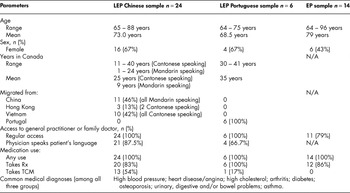
Table 1 presents demographic and medical information about the sample. Participants ranged in age from 64 to 96. Most participants were living in the community and were sufficiently mobile to attend interviews in their communities.Footnote 6 The sex distribution in the Toronto sample was purposively selected. The small-urban sample – with more men than women – was based on convenience selection.
Demographic and medical details of sample

EP = English-proficient; LEP = limited English proficiency; TCM = traditional Chinese medicine
The majority of the Cantonese-speaking Chinese participants had migrated to Canada after spending many of their younger years in Vietnam. This group, on average, had been living in Canada for 25 years. In contrast, the Mandarin-speaking group had migrated to Canada more recently (on average, nine years earlier), usually directly from China. On average, the Portuguese members of the sample immigrated to Canada 35 years prior to the initial interviews. Almost all participants had regular access to a family doctor, and most of the LEP participants had family doctors with whom they could fluently communicate. Three participants from the English-proficient group had difficulty getting access to their family doctor or, as one individual described, had “restricted access” that was inadequate for the needs of a senior citizen with complex health problems. All participants reported taking some type of medicine; most had prescription drugs, and many of the Chinese participants (and one Portuguese participant) also took traditional Chinese medicines (TCM). The list of common diagnoses or health problems in Table 1 is typical for a group of people over age 65 (Denton & Spencer, Reference Denton and Spencer2010).
Interviews were typically initiated with a request that participants describe their current state of health. This usually led to a broader discussion of a participant’s health history, with the narrative describing the onset of previous or ongoing health problems and their context. Frequently, assessments of current health and health care needs were made with reference to earlier life course burdens of employment and family obligations, and to migration experiences. For example, an 88-year-old woman who emigrated from Hong Kong 27 years earlier described the “cause” of her rheumatism and chronic back pain:
Interviewer: Mrs. X was saying her back sometimes hurts, and her knees – can she tell us about this?
Translator: She’s talking of the old days, because of the war when Japanese came to Hong Kong, she had to go back to Mainland China, and she worked on the farm about three years and eight months … she goes to plant in the fields too much. She said she had to work in the farm, and had not done that job before, and did not know how to do it. But she had to do anyway, so she hurt her back even though she didn’t know at that time. She said, “When I got aged, these problems emerged”. It got worse after she moved here [Canada]. She said it might be related to the chilly weather or aging. (3CAF-1)
A 67-year-old woman, who had emigrated from Portugal 40 years earlier, described her years of dealing with depression after her arrival in Canada and the lasting effects on her health:
Participant: [speaking on own in English] When I started … [experiencing depression], I know I work too much … I started doing everything … doing everything! Now I look back and I told myself, How come you did so much work? You were like a machine! It’s true: you spend your time doing the food, doing the kids, doing the husband, doing this, doing that. … and the years, go, go, go, go. And then … you are sick. When you came from a poor country – this is another thing, because you don’t have nothing in your country – you want to gain everything in the other side … okay. You have the work, you have this, you have that, you have been more hours, and more hours, and more hours, then – who pays that? Your body. It’s your body. (4POF-2)
These narratives illustrate the expansive lifetime experiences participants drew on when describing their current state of health.
Meaning of Health
Participants were asked to describe their own conceptualization of health. In an atypical response, health was defined by the absence of illness:
Translator: [Mandarin translation in progress] She never has a cold, and she doesn’t cough, and she doesn’t ... what is it? She doesn’t have a runny nose, and that’s what the doctor told her: that she has good health. (4MAF-3)
More typically, health was defined in relation to age and aging, current social roles, and the functional needs or goals of everyday life:
Participant: [speaking on own in English] Good health … is when … you know if you have a good diet, good exercise, and even some social activities, you know, and we can’t – we can’t – be isolated. Because I understand some seniors, if they have been isolated for long periods, I would say this would affect their health. (3CAM-4)
Participant: [speaking on own in English] If you ask me, I’ll give you something: Three – right now. three things for good health…. One thing: exercise. If there’s feet, it means the feet go. Physical. And singing some times for the mental. For my mind. The third thing is medical. You see? Three things for good health. Three things: mental, physical, medical. You see that? And … no argument with people … a good thing is no hurt some people. No argument. Harmony important. (4CAM-3)
Female Participant: Well, I don’t think about it, we just take it so for granted. Um well, it’s, uh, for one thing, a trouble-free body, so that you’re able to do the things that you want to do. Male Participant: I think for me it’s … feeling well and having a fair amount of energy, being physically active and mentally active. (3PTBO-F/M)
Notably, many of the responses to what health is were made with reference to how health is achieved. Responses of this type reflect the responsibility for health assumed by participants, and the preponderance and function of self-care.
Achieving Health – Self-Responsibility
Participants frequently conveyed a sense that health was achieved and maintained through their own initiative and actions:
Interviewer: What benefit does he get from doing tai chi, can he tell me that?
Translator: [Mandarin translation in progress] First for breathing, Second is for the brain, and you added up, it’s active and quiet … it’s good for health. [Mandarin translation in progress] Tai chi and brain and breathing are all mixed together, and help the body better, and the blood flow better. (4MAM-1)
Participant: I have … the usual aches and pains but haven’t had any hip surgery or leg surgery, thank goodness; no heart surgery. I’ve been fortunate since I’ve been riding my bicycle regularly, except my years in the army, since I was four, and I still do five miles every day.
Interviewer: Still now?
Participant: Religiously as a discipline, yes. … If the weather will allow, and I don’t just trundle along slowly. I do it from the “ticker” point of view, a wonderful exercise for the heart.
Interviewer: In the winter, what … do you find something to replace that with?
Participant: I just replace it with my indoor bike.
Interviewer: Oh, you have an indoor bike … And so you’ll get on that almost every day in the winter?
Participant: Not “almost”: religiously. (7PTBO-M)
Responsibility was assumed not only for the maintenance of health, but also for health recovery. Often in discussions of a new or previous diagnosis, participants assumed responsibility for health problems in the everyday activities of preparing food and eating, scheduling one’s day around activity and rest, and in using natural health products, TCM, or medicinal foods for health. The next excerpts illustrate diet-related health care and use of medicinal foods:
Translator: [translation in progress] She’s saying the blood pressure is lower little bit.
Interviewer: The blood pressure’s lower a bit? And how did it get lower?
Translator: [translation in progress] She’s saying she’s taking the medicine on time and she’s also making like a Chinese soup and is eating less fried food. (1CAF-4)
Interviewer: I was asking about her health and her diet because last time she said she was making the medication for her cholesterol – with avocado, other vegetables, and lemons, et cetera. Can you ask her if she is still taking that medication?
Translator: [Portuguese translation in progress] She said that she keeps taking the homemade anti-cholesterol. She thinks that it’s very effective. She says she goes by her feelings, so she thinks that for the cholesterol and high blood pressure, she can control them without taking medicines. But she never stopped taking the bone pills (for bone density) because she feels she needs more calcium. (2POF-3)
Self-care was sometimes assumed following serious medical events. In the next example, the woman self-diagnosed a stroke that paralyzed her left arm while she was on an extended trip to Portugal. She only got a formal diagnosis “months later” when she returned to Canada. She initiated (her own) rehabilitation in Portugal, by forcing herself to use her left arm by scrubbing clothing on a washboard:
Participant: [speaking on own in English] I read, I have an encyclopaedia, and once in a while I try to read when I have symptoms, I go there and I tried to read about that symptom. That’s why I knew it was a stroke. (4POF-1)
Achieving Health – Support from Family and Others
Participants spoke of how their efforts to maintain good health were aided by support from trusted family members or friends, such as is illustrated in the following example:
Interviewer: Are there any side effects from taking the medication?
Translator: [Portuguese translation in progress] She said that her daughter, for each medicine that the doctor prescribes, her daughter has a medicine book at home, and she reads the adverse – possible side effects. And then she wouldn’t let her take the medicines because it’s not good. (2POF-1)
In the next case, a Chinese woman who immigrated to Toronto nine years earlier was determined to avoid “Western” medicines (prescription drugs). She treated her angina with traditional Chinese herbs recommended by her brother, who lived in China and who regularly relied on TCM:
Translator: [Mandarin translation in progress] So after [heart episode] that happened, she called her brother, because her brother knows a lot about medical… and her brother gave her some Chinese medicine.
Interviewer: Is her brother a Chinese practitioner?
Translator: No… but because he has some kind of sickness, he knows – himself.
Interviewer: Does her brother live in Toronto?
Translator: [Mandarin translation in progress] No, he’s in China. She said her brother told her that it is really dangerous [referring to the symptoms of angina], so he asked somebody to bring her the medicine from China.
Interviewer: Did she use that herb and did it help, in her opinion?
Translator: Yes, it helped, because she doesn’t have that anymore. It helps for the blood … the blood flow. (5MAF-1)
However, family involvement in health care decision making wasn’t always assumed to be beneficial, as suggested in these examples:
Interviewer: Your daughter translates for you?
Participant: Mmm …
Interviewer: [to translator] So, the doctor doesn’t talk to her, the doctor talks to her daughter?
Translator: [Cantonese translation in progress] The doctor explained to her, but she doesn’t understand, so the daughter explains – translates. And she thinks the daughter, maybe, is not telling her, and she wonders if she has cancer. (2CAF-3)
Translator: [Cantonese translation in progress] Her husband has a friend in the U.S., maybe he is promoting the medicine – and her husband bought it. It’s for the brain, and it helps for the memory – but we don’t have it here [Canada].
Interviewer: Oh – so her husband has a friend –
Translator: [Cantonese translation in progress] Oh, her husband said that that medicine helps him. But she doesn’t trust that.
Interviewer: Does she take it?
Translator: No. But her husband’s friend knows somebody who took that medicine, who said it helps. (7CAF-1)
Achieving Health – Role of Health Professionals
All participants in the study regularly consulted a “conventional” medical doctor. Additionally, some sought or received health care advice from other health care professionals:
Interviewer: Could you talk about that – the things that you do to be healthy, be a healthy person.
Participant: Um, probably once a month, I go to the naturopath, have my body chemistry done and that tells me whether my system is too acid or too alkaline … never too alkaline (laughter). Quite often it’s too acidic. And then to balance that out, usually it’s something as simple as putting lemon in distilled water. I have Greens Plus that I take … it has different … has calcium and B vitamins. B vitamins are really important for the brain, and I’m always kind of concerned about my own brain after going through that [husband’s dementia-related decline]. (4PTBO-F)
Female Participant: Now um, our daughter has a good friend who’s a pharmacist and she gave me this thing about… well, I was looking for alternative treatments for cholesterol. And, she gave me this sheet and Vitamin C is apparently good for your blood vessels ’cause cholesterol and heart attacks can, from what I understand, can be caused from inflammation in the blood vessels. She recommended I take these slow-release ones and it stays in …. ’cause it is a vitamin that can go in and out of your body pretty fast. So I take three of these a day. (5PTBO-MF)
Many Chinese participants described their trust and reliance on a Chinese traditional practitioner for regular health care, including herbal treatment and acupuncture:
Translator: [Cantonese translation in progress] Before, she can’t put her hands towards the back, after the accident. She could not put her clothes on.
Interviewer: So, how did she fix this?
Translator: She knows – when she was in Vietnam, she knows there some kind of Chinese herbal that helps for arthritis. So she bought that … to help her.
Interviewer: And she said she tried acupuncture? How long ago did she try acupuncture?
Translator: Two months ago.
Interviewer: And, did her doctor recommend the acupuncture, or how did she decide? Who told her that maybe acupuncture could be something to try?
Translator: [Cantonese translation in progress] Herself. Her (Western) family doctor is also doing acupuncture, but she didn’t do it there, because she usually is going to the Chinese doctor’s store – the [Chinese] doctor helped her do acupuncture. (6CAF-1)
Interviewer: So currently, he’s being treated for high blood pressure and diabetes – does he have a regular Western doctor?
Translator: [Cantonese translation occurring] he’s seeing both the Western doctor and the Chinese doctor … (2CAM-1)
Interviewer: Yeah, okay. The other thing I’m just wondering about is, when did she learn about all these things, about monitoring her blood pressure, about the Chinese tea –
Translator: [Mandarin translation in progress] She went to a community centre in East York … there is a Chinese practitioner who is helping seniors, too – she just heard this from the Chinese practitioner. (8MAF-3)
For some, health was attributed to advice provided by a medical doctor, but participants didn’t necessarily expect to have much communication with the doctor. This is evident in several excerpts:
Interviewer: Around those two diagnoses, the high blood pressure, high cholesterol – did your doctor talk to you about what the symptoms are, or that the symptoms might be silent, and why he would want you to take the medications? Do you have those kinds of conversations with your physician?
Participant: [speaking on own in English] So far, I don’t have any discussions with my family doctor. Because he has professional training, and I would expect based on what kind of test, they will figure out that this patient has to take that kind of medicine. So far, to me – maybe you can say a lot of Oriental people, we just trust the doctor.
Interviewer: … to have the doctor do what they’ve been trained to do.
Participant: Right, right … the doctor is running some kind of business. And they can’t spend a lot of time to discuss with the patient about the medicine they are writing down on the prescription slip. (3CAM-2)
Interviewer: Okay. So what sort of information does the doctor give, then?
Translator: [translation in progress] She say no kind of information given to them ’cause they’re only taking blood tests and just tell them the results.
Interviewer: So it’s very clinical information that they give?
Translator: [translation in progress] It’s just like the doctor, they don’t have too much time.
Interviewer: Does she trust her doctor?
Translator: [translation in progress] Yes. If you don’t trust the family doctor, you don’t know what to do. She’s saying when the first time that she seeing family doctor and the doctor tells her that she have diabetes and she takes blood tests to tell her what kind of sickness she has. And she … 99% will trust her doctor. She’s saying the family doctor tell her what to do, then she will follow. The family doctor tells her to take what kind of medicine, then she will follow because she doesn’t know anything about medicine. (6MAF-4)
Some participants revealed that they were cautious or suspicious of their doctors’ opinions or advice. Sometimes they disagreed with a physician’s recommended treatment. When we asked, however, all participants indicated they kept their disagreements to themselves, and they did not report their medication non-adherence to their doctors. For example, a 75-year-old participant reported that he had recently been diagnosed with osteoporosis. He rejected one medication because of side effects; after a trial with it, he accepted a different medication. This required supplementation with calcium and Vitamin D, whose recommended dosage he reduced. In our study interview, he challenged his physician’s opinion about how much calcium he should take, explaining his belief that too much supplemental calcium will cause gallstones or kidney stones:
Translator: [Mandarin translation in progress] He was afraid that if he took too much calcium, it would cause him a gallstone or a kidney stone. But the doctor said it won’t. He said the doctor tells him that older people should take more calcium. But he thinks – he’s just afraid – and would rather take – drink more milk or get more vegetables. (2MAM-1)
In another case, the participant described her reliance on the traditional Chinese practitioner and explained her view of the difference between conventional Western medicine and Chinese medicine.
Translator: [Cantonese translation in progress] Sometimes when she’s not feeling well, then she goes and sees a Chinese doctor… a Chinese herbalist.
Interviewer: Did she grow up seeing a Chinese herbalist or … in Hong Kong, did she see a Western doctor? I’m trying to get her orientation about medical care.
Translator: She used to see … she see a Chinese doctor in Hong Kong, but since she moved here, she’s also using the Western doctor.
Interviewer: What does the Chinese herbalist give that the Western doctor doesn’t give? What does that person do for her?
Translator: For the Western doctor, if you have stomach problems they give you a pill for the stomach. If you have a headache, they give you painkillers, or whatever. For the Chinese herbal, because it contains not just one medicine, but it’s a lot of combinations, so, if you take the first one it’ll help a little bit, but the second one will heal. She said the Chinese herbal helps a little bit more than the Western, because the Western medicines help only one problem. (3CAF-1)
Another Chinese woman described having difficulty communicating with Western doctors, especially with the specialists (due to a language barrier), leaving her feeling unsure about what a doctor is recommending (and unable to decipher English-language instructions on prescriptions). Additionally, she indicated that she and her Chinese friends are suspicious about whether the doctor really knows how to diagnose the root of a problem after the symptoms have resolved:
Translator: [Mandarin translation in progress] She says it’s not helpful, because some diseases or sickness have to be treated at the time that it happened, but after a few days or some time, you can’t tell what’s the problem. (5MAF-1)
In this woman’s case, she and her husband preferred to consult with her brother and other friends and family in China, and with her daughter in Toronto who bought her over-the-counter medicines and natural health products including Chinese herbs. She took no prescription drugs, and believed she resolved heart-related symptoms (angina) by using TCM. When her (Western) doctor told her he couldn’t heal the arthritis in her knees but could recommend an artificial joint (replacement), she was so offended by the invasiveness of the suggested treatment that she asserted she would not see that doctor again.
In another interview, the importance of access to a physician was noted, even when his or her advice may be viewed with skepticism. A 67-year-old Chinese man explained:
Interviewer: Before, you reported to us a diagnosis of hypertension, or high blood pressure, and high cholesterol. Do you feel at risk because of those diagnoses?
Participant [speaking on own in English]: Yes, certainly, from common sense I understand that high blood pressure or high cholesterol is bad for the health.
Interviewer: Yes.
Participant: But personally I figured out that I can control it by myself.
Interviewer: And how do you think you’re controlling the cholesterol and the blood pressure? Are you monitoring with your doctor?
Participant: Yes, every two months I will get back to visit my family doctor.
Interviewer: And he tests your cholesterol, does the bloodwork, does the blood pressure; and they’re better, or not worse?
Participant: Yes. You can say that it’s at a stable level.
Interviewer: So, your doctor still wants you to take the meds?
Participant: Yes, that’s true, that’s true.
Interviewer: So he believes that the medications have brought you to the normal level.
Participant: Yes, that’s true. Personally, I feel that we can have some trial and error, maybe we should stop for a while, and let’s see how good or how bad. But sometimes it’s no good for the patient to let the doctor know about that kind of experiment. Otherwise – we have to respect they are professionals.
Interviewer: You respect that they are professionals, they made a professional decision, but nonetheless in your body, you said, I’m going to do this experiment. Not take the drugs, and see what happens. If your cholesterol had gone up or if your blood pressure had gone up, would you take the meds?
Participant: Then I will take it. I would take that, because it looks to me, for my own way, trial and error, it doesn’t work. So, I don’t have a choice. (3CAM-2)
This participant attributed his stabilized blood pressure and cholesterol to his lifestyle, while the doctor attributed these improvements to the medicines which were not actually being consumed. The participant recognized that both he and the doctor were satisfied, and he emphasized his respect for the physician, rather than his deception of him.
In another interview, a woman indicated she avoided telling her doctor about her acupuncture treatment, because of the possibility of the physician’s disapproval.
Interviewer: Does Dr. X know that she sees an acupuncturist?
Translator: [Cantonese translation in progress]. She didn’t tell Dr. X that she’s taking acupuncture.
Interviewer: Why didn’t she tell him?
Translator: She’s worried about Dr. X not being happy. (3CAF-1)
These excerpts suggest that our respondents valued a variety of sources of professional health care expertise and selected from among conventional Western physicians, traditional Chinese practitioners, naturopaths, and pharmacists. Participants also sought out and followed advice given by others who were perceived to be well-informed (family, acquaintances, friends – sometimes strangers); they stored experiences from the past, and learned vicariously about approaches to health problems similar to their own. This was in a context wherein all participants had access to a family practitioner (with whom most could fluently converse), and most visited their doctors regularly. For some participants, the advice of the Western doctor was not always followed – but the physician was respected as providing a kind of consulting or monitoring role supporting participants’ self-directed health care. For LEP participants, concerns or suspicions about Western medical approaches and medical doctors were not usually based on language discordance, but on the lack of communication and/or conflicting views of the appropriateness of invasive techniques (including medicines) used in Western medicine.
Views of/Negotiations of Medicines
As Table 1 shows, all participants in the study took medicines of some sort. Most took prescription medicines, except for four Chinese LEP and two English-proficient participants. Some ceased using their prescription medications over the course of our study, and others modified their doses or timing. Using a strict definition of adherence (following directives related to the dose, timing, and duration of a prescription drug), most participants using prescription medicines during the study period would be classified as non-adherent. Thirteen Chinese (one Portuguese) participants reported using TCM, so negotiations of medicines and surveillance for side effects or effects for these participants (and for others using over-the-counter medicines and natural health products) were complicated.
Here, we describe the negotiations of medicines as they were discussed in interviews with study participants. Some participants reported their intentions to adhere to a doctor’s directives for taking medicines:
Participant: [speaking on own in English] I believe my doctor. If something wrong, I believe my doctor. It work for me, any advice, I follow that. One thing I talk to you - some people take their medicines outside, buy it themselves. But I believe my doctor. (4CAM-1)
However, unintended non-adherence occurred, and participants described careful and continuous monitoring of their medicine-taking:
Interviewer: Has she ever forgotten to take this medication?
Translator: [Cantonese interview in progress] She says she have to take it one a day, and sometimes she forgets, but after she forgets she feels a little bit different, like slightly high, it affects her head, like a little bit pain.
Interviewer: She gets a headache when she forgets to take this medication.
Translator: Yes, and she will take it [medicine] after. (1CAF-3)
All study participants discussed their “negotiations” over medicines – that is, (a) using (involving scheduling and remembering); (b) resisting (involving experimentation of the effects of non-use or reduced doses); (c) modifying (changing the timing or dose); or (d) refusing medicines. Their explanations indicated ambivalence about using medicines. In the following two excerpts, the participants described their general resistance to taking medicines, based on the belief that medicines may cause adverse and unintended consequences:
Translator: [Mandarin translation in progress] He doesn’t like to see the doctor that much.
Participant: [speaking on own in English] Not like my wife, she likes to see doctor and likes to take medicines. If I have mild problems, I just take some [herbal] medicines myself. If it gets worse or the [herbal] medicine doesn’t help, then I will go to see the doctor …
Translator: He says the doctor usually give him the medicine for three or five days, but he only takes for few days (one day), and then he feels better and then he stops …
Participant: There is a Chinese saying, “Every medicine has some toxic effects on you.” (2MAM-1)
Translator: [Mandarin translation in progress] She just tries to avoid taking medicines.
Interviewer: Why is that? Why does she avoid medicines?
Translator: She takes good control of dietary, and to exercise, and she eats green, green stuff like vegetables.
Interviewer: So, why does she try to avoid medicines?
Translator: [Mandarin translation in progress] She thinks most of the medicines contain poison … some of the Western medicine has negative effect. She said that all medicines have maybe 30% of poison.
Interviewer: So does she think they’re harmful to people?
Translator: Yes. Some are harmful for the kidney, or the lung, or the liver.
Interviewer: How did she come to that conclusion?
Translator: Because her husband took too much medicine – he took a lot of medicine. She’s thinking she would rather exercise. She’d rather exercise instead of taking medicine. (8MAF-1)
The next excerpts show a common response where a prescribed medicine was perceived as unnecessary:
Translator: [Cantonese translation occurring] She didn’t bring the high cholesterol medicine. She sometimes not taking that.
Interviewer: Why not? Can she explain that? Does she not feel that it’s a problem?
Translator: Because she’s doing exercise every day, and ’cause she sweat a little bit … so she is not needing it. And she is taking a Chinese tea for cholesterol.
Interviewer: And that’s a treatment for cholesterol?
Translator: Yeah. (7CAF-2)
Translator: [Portuguese translation in progress] She said that she’s quit taking medicines [4 prescription medications for asthma, hypertension, and high cholesterol], and taking more exercise, she’s feeling a lot better. She believes she’s getting better because of this. And she thinks the medicines are drugs and she says that if she can avoid them, she will. (2POF-2) (emphasis added)
Interviewer: [speaking to the participant] In that time, was he [doctor] giving you medication to help you while you were recuperating from pain?
Participant: [speaking on own in English] Yeah, but I didn’t take it. My husband took it.
Translator: [Portuguese translation in progress] Mrs. X was telling that there was a young girl (family friend) who needed an operation on her feet, and – she was in pain, she didn’t take the medicine, but she didn’t have to take, she handled the pain, and she thought, well, why—
Participant: —and I learn.
Interviewer: Oh, so, you thought you can [also] do without the pain medication. (3POF-1)
The following excerpt illustrates a woman’s concern that reliance on medication for depression undermined her sense of self-worth:
Interviewer: [discussion of woman’s diagnosis of depression in younger years] … and did you take some treatment for it?
Participant: [speaking on own in English] Oh, yes. Valium.
Interviewer: Valium? And was that helpful?
Participant: Valium. Yes, but one day, I took – he gave me so many medications, and when I came here, because we used to live in Montréal for 14 years, 15 years, then I came here and I threw the medication in the toilet. I told myself, I don’t want to have medication, because I’m not that kind of person … and I put everything in the toilet.
Interviewer: What did you mean when you said that you’re not that kind of person?
Participant: Because, you know, I feel like … when you have depression, sometimes in your depression you go back to [think about] your value as a person later, right? How I can say … yes, I went back and I thought to myself, I don’t want more medication, and I stopped. (4POF-2)
Participants reported a variety of active approaches to taking medicines. These included (a) attempts to fully adhere to recommended prescriptions – requiring ongoing monitoring for mistakes such as forgetting a dose; (b) experimentation with recommended medicines (using lower doses or using prescribed doses less frequently); (c) failing to use a prescribed medicine at all; or (d) mixing or replacing prescription medicines with traditional Chinese medicines or with medicinal foods and drinks. Medication effects and side effects, or the effects of failing to use a medicine or of its replacement with an herbal or “natural” replacement were conscientiously monitored. Participants demonstrated caution toward, and suspicion of, drugs – especially those that masked symptoms and failed to “cure” a problem. A belief that a medicine may help one problem but cause another was expressed by several participants. Additional concerns – dependence, stigma – and vicarious learning about the possible harms of medicine use were also expressed.
Cost as a Structural Determinant of Health Help-Seeking
Finally, participants identified structural determinants of health help-seeking and medicines use. For example, access to “free” medical care and drugs enhanced some respondents’ willingness to regularly consult or attend appointments with a physician, and to use or “try” Western medicines. One Chinese woman noted that the very availability of publicly insured health care and drug benefits indicated that seniors were valued, and equal to other citizens. Other Chinese participants expressly rejected using traditional Chinese medicines because of the cost of these, and because “Western” medicines were insured under the Ontario Drug Benefit Plan:
Interviewer: Before, you said some people, they go out and buy their own medicine, but you don’t …
Translator: [Cantonese translation in progress] He just thinks Chinese medicine is good, outside Chinese herbalists [in Toronto] are good too, but it’s not good because you have to pay for it.
Participant: [speaking in English] I living in Asia before – I take Chinese medicine. Some – is very good too. Here – and thank you, Canada, all seniors don’t need pay the medicines. It’s good for me. So I believe the [Western] doctor, I don’t take some Chinese herbs. (4CAM-1)
This participant also explained that Western medicines are more convenient to use than traditional Chinese herbals, especially those that have to be prepared:
Participant: [speaking on own in English] Chinese medicine is good, too. Because in China, no – no risk about the herbal, so, it is good – but sometimes too late. Chemical [Western] medicine, fast for the feeling [effect].
Interviewer: Yes. Chinese medicine takes time.
Participant: Slowly, slowly … the cooking, boiling, is good too, but it wastes time. (4CAM-1)
Another participant suggested that she stopped seeing a Chinese practitioner because of the out-of-pocket cost:
Interviewer: Does she see a traditional Chinese practitioner in Toronto?
Translator: [Mandarin translation in progress] Maybe two to three years ago, she went to see a Chinese practitioner for her knee. She went three times, but because it’s too expensive, she doesn’t go see him anymore. When she goes back to China, she will see the Chinese practitioner in China. (5MAF-1)
Thus, cost and insurance availability influenced participants’ use of medicines (and avoidance of them). As illustrated in the excerpts, cost and convenience trumped treatment philosophy (Eastern versus Western medicine) for some Chinese persons – although there were participants who emphatically avoided Western medicines (and sometimes Western medical doctors). Several relied on family or friends bringing supplies of Chinese herbs and mixtures when returning from trips to China.
Discussion
We have argued that biomedicine’s growing reliance on medicines-based health care for the elderly has placed new kinds of demands on persons navigating later life and old age than were experienced by earlier, less medicated generations. Situating our study in a structural-interactionist framework (Stryker, Reference Stryker2008), we have examined the influence of life course ethnocultural experiences and discourses, current social locations, and strategic use of available social and cultural resources on participants’ negotiations of medicines and their accounts of medication uses.
Assuming that the meaning of medicines would be contextualized in terms of the broader notion of health, we began interviews with this concept. In most interviews, we found that health was framed in terms of social connectedness, being functional (or relatively functional), and able to engage in desired activities. Participants in this study did not medicalize their own aging but instead resisted it, expressing their goals for living in relation to expectations of existing health problems, and with a mission to avoid future health challenges in the context of aging, old age, and frailty.
Participants from all groups had established lay strategies for health and health care. These typically included self-monitoring and modifications to diet, physical and social activity, and the vetting of medical explanations and recommendations. Lay strategies were executed in social settings – and based on particular kinds of social ties and support. Families provided instrumental and informational support, and sometimes presented conflict around the meaning of a health problem and “appropriate” solutions to it. Portuguese- and Chinese-language television was specifically mentioned as an important source of health information – these seemed to support an ideology of individual responsibility for health – and one that was firmly entrenched in our participants’ minds and practices.
Medical consultations were given high priority, but participants described a broad range of other informal and “alternative” options for health care. Alternative types of health care were discussed relative to Western medicine, indicating a shared view of biomedicine as the dominant form of health care. Chinese participants made a clear distinction between Eastern and Western medical paradigms when discussing health, illness, and the use of medicines. About half reported regularly using Chinese herbs or other therapies (acupuncture, qigong, tai chi) and prioritized these for particular types of health problems. Portuguese participants described traditional remedies for health that were based on knowledge and practice passed down through generations. These were often medicinal diets, or herbal remedies for specific health conditions, similar to the approach of the herbalista from traditional rural Portugal (Bezansan et al., Reference Bezansan, Foster, James, Moodlye and West2005). Other participants described seeking health care from naturopaths or acupuncturists, or from other advisors (including pharmacists), especially when they perceived that Western health care was not (or was no longer) beneficial for their particular problems. Participants who regularly used alternative health care were concerned with demonstrating respect for their medical doctors or at least with avoiding the conflict they felt would arise with disclosure of their full range of health care practices.
All participants in the study reported using medicines, although some rejected Western prescription medicines. Discussions about medicines were contradictory, reflecting ambivalence about medicines, as has been found in other studies. Participants drew on individual experience or cultural accounts acquired over their lifetimes to explain how they used (or why they avoided) medicines. They performed as “ethnopharmacologists” (Bloor et al., Reference Bloor, Monaghan, Dobash, Dobash, Nettleton and Watson1998), using their own bodies to test their theories on high cholesterol, hypertension, asthma, and so on, and to assess the benefits or costs of taking a medicine. When prescription medicines were rejected (or ceased after being started), participants were thoughtful, reasoned non-users. Some participants illustrated their reasoned approach to rejecting prescription medicines when they described keeping regular medical appointments so that conventional assessment technologies (e.g., for cholesterol, blood pressure, bone density) could be used to test the effects of substituting diet and/or exercise, other behavioural regimes, or other options (e.g., TCM) in place of the medicine(s). One participant implied that medicine users have a responsibility to test medicines which may be unnecessary or harmful to their bodies.
Participants showed themselves to be drawn to “conventional” health care in a context in which it was available as a right of citizenship. For some, publicly insured medical care and prescription medications trumped non-insured health care such as the services of a traditional Chinese practitioner or traditional herbal medicines.
In taking into consideration the health, health care, and medicines perspectives of a diverse sample of persons navigating “old age” in the Canadian context, we have shown that participants’ health-related dispositions and actions are informed, but not defined, by biomedical culture. Instead, our participants’ narratives reflect a “hybrid habitus” (Lo & Stacey, Reference Lo and Stacey2008) – a patient culture influenced by life course experiences within diverse ethnocultural contexts wherein conventional and alternative approaches to health, illness, and healing are embraced.
There are several limitations of our study: it is based on a selective sample, and on participants’ interpretations of our questions and their choices about how to represent their own lifetime experiences. Our dependence, in the majority of interviews, on the interpreters’ skills in conveying the dialogue between the interviewer and participant was fraught with risks and challenges (Temple & Young, Reference Temple and Young2004). However, the use of interpreters enabled new voices to be added to the growing discussions on cross-cultural medicine and gerontology and helped us to elaborate the complexity of lay approaches and accounts of medicines-related health care. While our findings cannot be generalized to broader populations, they provide an account of medication (non)-adherence, and as such, have important implications for professional practice.
Implications
What seemed evident from our findings is that patient-professional communication is extremely limited. Further, in this study where the majority of participants had limited English proficiency, the lack of communication was not due to patient-professional language discordance. Rather, our participants’ narratives suggest a parallel world of “lay alternative” health care – one that intermittently intersects with conventional medicine, but frequently exists as separate from it.
Our participants articulated that while they regularly sought and accessed conventional health care they also: (a) often disagreed with the assessment and recommended treatment and sought out and tested alternative “treatments”; (b) deliberately avoided discussing their various self- and alternative health care practices with their physicians; (c) typically were not asked about either their intentions regarding recommended health care and medicines use nor about their uses or substitutions of medically recommended health care with “alternatives”; and (d) were purposeful in keeping to their recommended schedules for medical appointments (usually following a three-month schedule intended for prescription review and renewal) so that medical surveillance technologies (i.e., for blood pressure, cholesterol, or bone-density testing) were accessible. It is notable that some participants indicated that they did not expect their relationship with the medical doctor to include discussion and debate – that the physician was professionally trained, and not accountable to them. Finally, participants emphasized their respect for the physician, and thought that withholding opinions and actions that were considered contrary to the physician’s advice reflected that respect.
We can speculate as to why this communication gap exists, just as our participants did when it was suggested that time constraints and a focus on the interpretation of clinical tests determined the clinician’s use of time during patient consultations. However, with respect to the alarming levels of non-adherence reported in the literature, our findings can be interpreted as indicating that the level of patient (non)adherence appears to reflect the effort made to show patients the necessity of following medical advice and/or to explore what their other health practices actually were.Footnote 7
Our findings, and our conclusion, reinforce the conclusions reached by other investigators who have emphasized that clinical treatment cannot be fully informed (nor fully effective) if it is not based on a good understanding of the patient – gained through good communication (Barry, Stevenson, Britten, Barber, & Bradley, Reference Barry, Stevenson, Britten, Barber and Bradley2001; Sleath, Rubin, Campbell, Gwyther, & Clark, Reference Sleath, Rubin, Campbell, Gwyther and Clark2001). Further, with regard to our interests in understanding the health care experiences of LEP patients in English-dominant health care settings, we are concerned that efforts made (and expenses incurred) to provide patient translators will not be effective in enhancing patient experiences and outcomes so long as the nature of the communication is limited to “strictly medical talk” (Barry et al., Reference Barry, Stevenson, Britten, Barber and Bradley2001) and does not address the broader life world of the patient.
One step toward addressing the communication gap indicated in this research might be to conduct follow-up research in which findings such as ours are taken to health care professionals for their responses to and reflections on patients’ actions and adaptations of medical advice and prescriptions. Given the predominance of medicine reliant health care for the elderly and the sub-optimal “adherence” to medicines, the older person-as-patient needs to be re-conceptualized as a “pharmaceutical person” – wherein the negotiation of the benefits and costs of medication use in the aging body is reconciled as integral to the life world of the older patient, and wherein patient-professional communication and interaction is prioritized for optimal medication use outcomes.