Introduction
Most quality-of-life (QoL) studies have historically focused on hospitalised patients or those attending clinical practices to assess the impact of specific diseases and determine treatment success (Steptoe et al., Reference Steptoe, Deaton and Stone2015). Measurement of QoL among older populations has reflected this global trend, with clinical assessment of wellbeing, health status and disease traditionally being restricted to biological and physiological parameters or even difficulty engaging with particular ‘social roles’. As an attempt to overcome the major limitations of such an approach, the notion of healthy and active ageing has been set forth in order to emphasise the positive aspects of QoL (Minayo and Coimbra, Reference Minayo and Coimbra2002).
Following this movement, the scientific literature began to measure QoL in broader terms among several age groups, including older people. Some instruments still focus on indirect indicators of QoL, including health conditions (EuroQol Group, 1990; Hennessy et al., Reference Hennessy, Moriarty, Zack, Scherr and Brackbill1994; Ware and Sherbourne, Reference Ware and Sherbourne1992), or older peoples’ perceptions of what matters most to them in their lives (Bowling, Reference Bowling1995). Such initiatives have been widely criticised for several reasons, however. It has been argued particularly that these instruments are either restricted to factors that have an impact on health or emphasise specific diseases that do not refer to QoL per se. By so doing, these instruments reduce QoL to a measure of impairment and disability (Higginson and Carr, Reference Higginson and Carr2001; Higgs et al., Reference Higgs, Hyde, Wiggins and Blane2003).
To overcome the limitations mentioned above, we adopt a perspective that critically situates QoL in relation to two fundamental concepts: (a) eudaimonia, which refers to control over one's own life, personal growth and purpose in life; and (b) hedonism, which emphasises life satisfaction (Steptoe et al., Reference Steptoe, Deaton and Stone2015). In addition to these constructs, we also build on Maslow's (Reference Maslow1968), as well as Doyal and Gough's (Reference Doyal and Gough1991) theory of the hierarchy of human needs, whose core proposition relies on four additional constructs closely related to eudaimonia and hedonism. Control (freely acting on another person's environment), autonomy (being free of interference from others; Patrick et al., Reference Patrick, Skinner and Connell1993) and self-realization (the reflection of the human being on their own life) are considered eudaimonic. The hedonic construct, on the other hand, is pleasure, which combines fun and concrete life experiences (Jary et al., Reference Jary, Savage, Levitas, Lyon, Chaney, Jancovich, DeNora, Macdonald, Burke, Witz, Tribe, Shore, Turner, McCrone, Allen, Currie, Prout, James, Christian and Bauman1991; Turner, Reference Turner, Featherstone and Wernick1995).
Based on Maslow's (Reference Maslow1968) psychological model, motivated by Ryff and Keyes’ (Reference Ryff and Keyes1995) eudaimonic model, as well as Doyal and Gough's (Reference Doyal and Gough1991) theory, the instrument Control, Autonomy, Self-realization and Pleasure (CASP-19) was developed in the United Kingdom (UK) to assess QoL among older people. This instrument differs from extant scales in that it was specifically designed for older people and considers their ability to overcome and adapt to limitations, diseases or weaknesses (Higgs et al., Reference Higgs, Hyde, Wiggins and Blane2003; Hyde et al., Reference Hyde, Wiggins, Higgs and Blane2003). The CASP-19 is composed of 19 items, divided into four first-order factors: control (four items), autonomy (five items), self-realization (five items) and pleasure (five items). QoL itself is taken as a higher-order factor. Each item has four response options (often, sometimes, rarely or never), such that their summation results in a raw score ranging from 0 to 57, with higher values indicating better QoL. The instrument has been used in more than 20 countries (Hyde et al., Reference Hyde, Higgs, Wiggins and Blane2015), including Brazil, for which two Portuguese versions have been made available (Lima et al., Reference Lima, Hyde, Chungkham, Correia, Campos, Campos, Novaes, Laks and Petribu2014; Neri et al., Reference Neri, Borim, Batistoni, Cachioni, Rabelo, Fontes and Yassuda2018).
Alternative factorial solutions, which include from six to 19 items, have also been proposed for the CASP-19. In addition to the original configural structure referred to above, studies (Vanhoutte and CCSR Manchester, Reference Vanhoutte2012; Sexton et al., Reference Sexton, King-Kallimanis, Conroy and Hickey2013; Kim et al., Reference Kim, Netuveli, Blane, Peasey, Malyutina, Simonova, Kubinova, Pajak, Croezen, Bobak and Pikhart2015) propose a two-factor model, which combines control and autonomy into one dimension, as well as self-realization and pleasure into a second one. Lima et al. (Reference Lima, Hyde, Chungkham, Correia, Campos, Campos, Novaes, Laks and Petribu2014) were responsible for the first attempt at adapting the CASP-19 to Brazilian Portuguese. The authors sought to test the original configural structure of the instrument in a convenience sample of 87 respondents aged 65–97 years, living in Recife (Northeastern Brazil). The final model, as selected by the authors, included the four original factors (control, autonomy, self-realization and pleasure), but indicated that three items should be removed, resulting in a scale with 16 items. Another Brazilian version of the CASP-19 was proposed by Neri et al. (Reference Neri, Borim, Batistoni, Cachioni, Rabelo, Fontes and Yassuda2018), who administered the instrument to 368 individuals aged 44 years and over, residing in Southeastern, Northeastern and Southern Brazilian cities. Unlike the study by Lima et al. (Reference Lima, Hyde, Chungkham, Correia, Campos, Campos, Novaes, Laks and Petribu2014), the latter work recommended a new configural structure for CASP-19 by grouping the six items that reflect a negative perspective on QoL into a single factor, while retaining the other 13 items in a separate dimension.
Though the study by Lima et al. (Reference Lima, Hyde, Chungkham, Correia, Campos, Campos, Novaes, Laks and Petribu2014) suggests a complete inadequacy of the original configural structure proposed for CASP-19 in the Brazilian context, Neri et al. (Reference Neri, Borim, Batistoni, Cachioni, Rabelo, Fontes and Yassuda2018) set forth a configural structure that is not interpretable, as it combines items that originally belong to different sub-dimensions of QoL. In addition, the relatively good model fit at which Neri et al. (Reference Neri, Borim, Batistoni, Cachioni, Rabelo, Fontes and Yassuda2018) arrived should be seen as stemming from common method bias, with no substantive meaning (Podsakoff et al., Reference Podsakoff, MacKenzie, Lee and Podsakoff2003). Both of the Brazilian psychometric assessments were based on small or medium-sized studies, whose respondents were drawn by means of non-probabilistic sampling procedures. Taken together, the findings and methodological characteristics of these studies suggest that the configural and metric structures of the CAP-19 should be reassessed among older people who reflect a defined and broader population base.
A detailed examination of the configural and metric structures of CASP-19 in a larger and probabilistic sample would allow us to: (a) confirm whether the instrument is promising for use in different Brazilian research contexts; and, if so, (b) help determine which latent structure should be considered in multivariate models including QoL as either a dependent or an independent variable. Such an initiative would help reconcile the existing divergent psychometric findings on the Brazilian CASP-19, as well as provide some backing to studies on determinants and consequences of QoL.
The present study thus sought to answer the following three inter-related research questions:
(1) Can the configural and metric structures originally proposed for the CASP-19 (Hyde et al., Reference Hyde, Wiggins, Higgs and Blane2003) be replicated in Brazil?
(2) Can the findings by Lima et al. (Reference Lima, Hyde, Chungkham, Correia, Campos, Campos, Novaes, Laks and Petribu2014) and Neri et al. (Reference Neri, Borim, Batistoni, Cachioni, Rabelo, Fontes and Yassuda2018) be confirmed in a defined and broader population base?
-
If not, what structure seems more tenable for the Brazilian CASP-19, based on a thorough reassessment of the scale?
-
Methods
Participants
The sample of this study consisted of 1,197 respondents who took part in the second wave of the EpiFloripa Ageing Cohort Study (response rate of 70.3%), a household-based study of older people (63–98 years) residing in the urban area of Florianópolis, the state capital of Santa Catarina, Southern Brazil. The city had approximately 486,000 inhabitants in 2015, 13.6 per cent of whom were 60 years of age and over (Brazilian Institute of Geography and Statistics, 2015). Florianópolis has a high Municipal Human Development Index (MHDI = 0.847) and Longevity MHDI (0.873), as well as a life expectancy at birth of 77.4 years, which is 3.5 years above the national average (Institute for Applied Economic Research, 2010). Data collection comprised the period between November 2013 and November 2014. Further methodological information on the study can be found in Schneider et al. (Reference Schneider, Confortin, Bernardo, Bolsoni, Antes, Pereira, Ono, Marques, Borges and Giehl2017) and Confortin et al. (Reference Confortin, Schneider, Antes, Cembranel, Ono, Marques, Borges, Krug and d'Orsi2017).
Participants whose data were provided by a proxy informant (4.7%) were excluded from the present analysis. Study losses referred to those who refused to answer the QoL instrument as a whole (0.2%), as well as those lacking information on any of its individual items (0.6%), rendering an analytical sample of 1,131 respondents. Upon comparing the characteristics of the 66 losses with the analytical sample, a statistically significant difference was observed for age (63.6% of the losses versus 20.7% of the analytical sample were 80 years and over), education (59.4% of losses versus 42.9% of the analytical sample had 0–4 years of study) and marital status (47.0% of losses versus 30.5% of the analytical sample were widowed). There was no statistically significant difference, however, regarding gender when the two samples were compared with each other (27.3% of losses versus 35.5% of the sample were men).
Measures
The following socio-economic and demographic data were collected: gender (men or women), age (60–69, 70–79 or 80+ years old), education (0, 1–4, 5–8, 9–11 or 12+ years of study) and marital status (married/with a partner, single, divorced or widowed). QoL was assessed with the Brazilian version of the CASP-19, as proposed by Lima et al. (Reference Lima, Hyde, Chungkham, Correia, Campos, Campos, Novaes, Laks and Petribu2014). Even though the CASP-19 was originally developed as a self-administered scale, a face-to-face data collection procedure took place in the EpiFloripa Ageing Study. A printed version of the CASP-19 was therefore handed over to respondents, so that they could follow what the interviewer was asking. In the case of illiterate participants (7.1%), the CASP's items were read aloud by the interviewers.
Data analysis
The sample was described according to the socio-economic and demographic characteristics mentioned above. We began with Confirmatory Factor Analysis (CFA) to test empirically the propositions set forth by Hyde et al. (Reference Hyde, Wiggins, Higgs and Blane2003), Lima et al. (Reference Lima, Hyde, Chungkham, Correia, Campos, Campos, Novaes, Laks and Petribu2014) and Neri et al. (Reference Neri, Borim, Batistoni, Cachioni, Rabelo, Fontes and Yassuda2018). Considering the suggestion of Lima et al. (Reference Lima, Hyde, Chungkham, Correia, Campos, Campos, Novaes, Laks and Petribu2014) that the CASP-19 original configural structure did not show a good fit, as well as that the study of Neri et al. (Reference Neri, Borim, Batistoni, Cachioni, Rabelo, Fontes and Yassuda2018) arrived at a configural structure not meaningfully interpretable, alternative solutions were explored and examined as to their theoretical pertinence and model fit according to the methods detailed below.
To identify a more tenable configural structure for the instrument, the sample was randomly divided into two parts of equal size, following the split-half procedure (Brown, Reference Brown2015). In the first sub-sample, items were analysed with Exploratory Factor Analysis (EFA) and Exploratory Structural Equation Models (ESEM). These were run to determine the number of underlying dimensions, the magnitude of the factor loadings, the occurrence of cross-loadings and residual correlations between specific pairs of items (Pett et al., Reference Pett, Lackey and Sullivan2003; Hair et al., Reference Hair, Black, Babin and Anderson2010; Brown, Reference Brown2015). Factors were retained using geometric oblique rotation whenever they showed eigenvalues equal to or above 1.0.
The most tenable configural/metric structures identified in the EFA and ESEM were then subjected to confirmation (via CFA) in the second half of the sample. Modification Indices (MIs) and Expected Parameters Changes were also estimated to identify alternative models with better fit and theoretical support – these models could even exclude some items with high residual correlations or loading estimates below the recommended threshold (detailed below). In the ESEM and CFA, the following indicators of fit were estimated: the chi-square test of model and the baseline model (smaller values indicate better fit), Root Mean Square Error of Approximation (RMSEA; acceptable values are those below 0.06), Bentler's Comparative Fit Index and the Tucker–Lewis Index (CFI and TLI, respectively; values that reflect good fit are above 0.95) and Weighted Root Mean Square Residual (WRMR; values below 1.0 are indicative of adequate model fit) (Brown, Reference Brown2015).
Data coding, manipulation and sample description were done using Stata version 14.2 for Windows. EFA, ESEM and CFA were conducted with MPlus version 7.1. All analyses took the sampling weights and the complex sampling design into consideration. We used the Weighted Least Squares Mean and Variance Adjusted estimation method, given the ordinal nature of the items. Models were also formally compared against each other using Robust Maximum Likelihood Estimation and the Bayesian Information Criterion (BIC), with lower values suggesting better fit to the data.
Results
Sample description
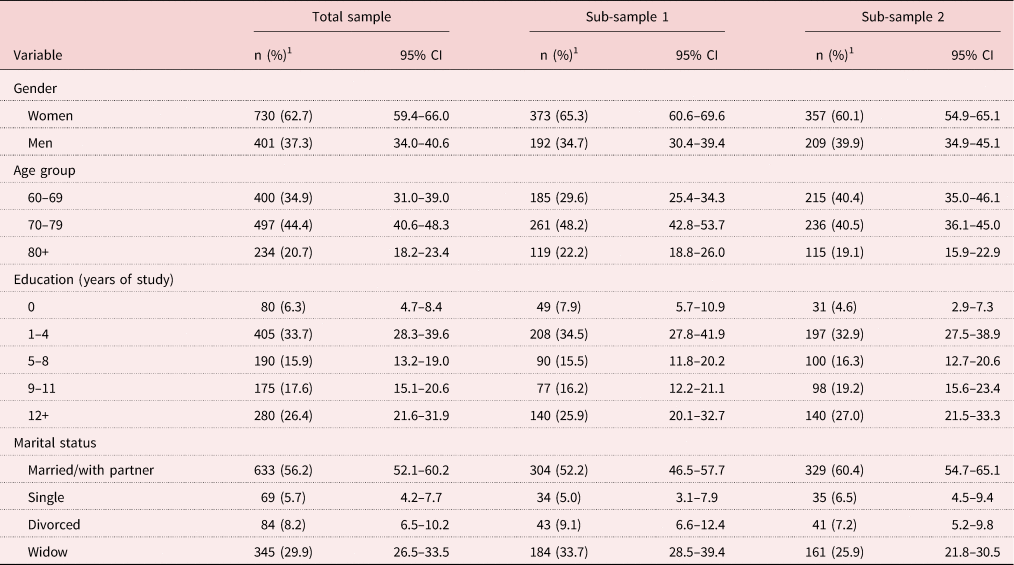
Of the 1,131 respondents included in the analytical sample, 44.4 per cent were 70–79 years old, 64.5 per cent were women, 35.8 per cent had 1–4 years of study and 56.0 per cent were married or had a partner. The two sub-samples were similar according to these socio-economic and demographic characteristics. Further details are shown in Table 1.
Socio-economic and demographic characteristics of the analytical sample, EpiFloripa Ageing Study, Florianópolis, Southern Brazil, 2013–2014

Notes: 1. Sampling weights were used in the estimation of proportions. CI: confidence interval.
Existing propositions for the CASP-19 configural structure in Brazil
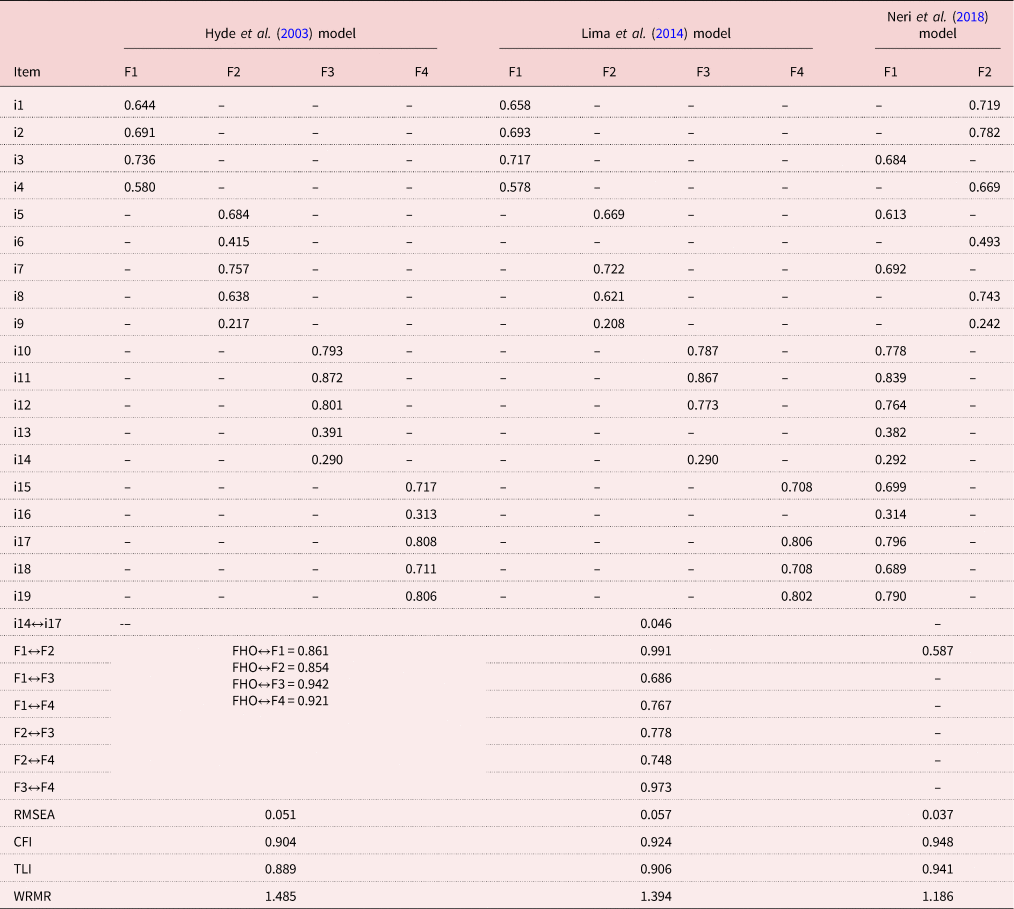
The original model of the CASP-19 presented an unsatisfactory fit to the data, as shown by the respective indicators, a BIC equal to 24,173.309 and a significant number of MIs suggesting residual correlations between the following pairs of items: i1–i8 (MI = 72.158), i8–i7 (MI = 10.768) and i1–i2 (MI = 10.049). The model by Lima et al. (Reference Lima, Hyde, Chungkham, Correia, Campos, Campos, Novaes, Laks and Petribu2014) also had an unsatisfactory fit to the data, with a significant number of MIs which were suggestive of residual correlations between the following pairs of items: i1–i8, i8–i15, i1–i3, i1–i2, i5–i7 and i7–i8, despite a BIC of 20,095.001. The model by Neri et al. (Reference Neri, Borim, Batistoni, Cachioni, Rabelo, Fontes and Yassuda2018), on the other hand, presented an acceptable fit to the data and a BIC of 23,999.125. It showed, however, three MIs indicating residual correlations between these pairs of items: i8–i15 (MI = 15.883), i1–i8 (MI = 12.109) and i5–i7 (MI = 10.433). These MIs reveal a considerable misfit of the proposed factorial solutions (see Table 2).
Replication, via Confirmatory Factor Analysis, of the Hyde et al. (Reference Hyde, Wiggins, Higgs and Blane2003), Lima et al. (Reference Lima, Hyde, Chungkham, Correia, Campos, Campos, Novaes, Laks and Petribu2014) and Neri et al. (Reference Neri, Borim, Batistoni, Cachioni, Rabelo, Fontes and Yassuda2018) models for CASP-19 using data from the EpiFloripa Ageing Study, Florianópolis, Southern Brazil, 2013–2014

Notes: Hyde et al. (Reference Hyde, Wiggins, Higgs and Blane2003) model: composed of 19 items, organised into four first-order factors. Lima et al. (Reference Lima, Hyde, Chungkham, Correia, Campos, Campos, Novaes, Laks and Petribu2014) model: composed of 16 items (excluded items i6, i13 and i16), organised into four factors, with residual correlation between items i14 (‘On balance, I look back on my life with a sense of happiness’) and i17 (‘I feel satisfied with the way my life has turned out’). Neri et al. (Reference Neri, Borim, Batistoni, Cachioni, Rabelo, Fontes and Yassuda2018) model: composed of 19 items, organised into two factors, control + autonomy (items i1, i2, i4, i6, i8, i9) and self-realization + pleasure (i3, i5, i7, i10, i11, i12, i13, i14, i15, i16, i17, i18, i19). F columns: standardised factor loadings; F1, F2, F3 and F4: specific scale factors; i: specific scale item. ↔: correlation among factors/items. FHO: higher-order factor. RMSEA: Root Mean Square Error of Approximation. CFI: Bentler's Comparative Fit Index. TLI: Tucker–Lewis Index. WRMR: Weighted Root Mean Square Residual.
Exploratory Factor Analysis and Exploratory Structural Equation Models
In view of the unsatisfactory fit of the models by Hyde et al. (Reference Hyde, Wiggins, Higgs and Blane2003) and Lima et al. (Reference Lima, Hyde, Chungkham, Correia, Campos, Campos, Novaes, Laks and Petribu2014), as well as the need to find a meaningfully interpretable model (as opposed to the model of Neri et al., Reference Neri, Borim, Batistoni, Cachioni, Rabelo, Fontes and Yassuda2018), a more tenable factorial solution was sought. In the EFA, with the first half of the sample, solutions with up to five factors were examined, as these presented eigenvalues above 1.0 in a preliminary analytical step. A close inspection of the five- and four-factor solutions indicated that they should not be pursued: only item i6 (‘Family responsibilities prevent me from doing what I want to do’) loaded with significant magnitude on one of the factors identified in both models (λ = 0.425 and λ = 0.432, respectively).
The three-factor model showed that most of the items were distributed along two dimensions, while the third factor was represented by items that originally belong to distinct theoretical dimensions: item i1 (‘My age prevents me from doing the things I would like to do’) which was developed to reflect the control dimension; item i8 (‘My health stops me from doing things I want to do’), originally developed to reflect the autonomy dimension; and item i15 (‘I feel full of energy these days’), which should reflect the self-realization dimension. Given the similar wording of items i1 and i8, the factor on which they loaded was deemed spurious (for further details, see the Discussion section). In addition, this factorial solution showed some items with non-ignorable cross-loadings: items i8 and i15 showed cross-loadings with moderate (λ = 0.416) and high (λ = 0.538) magnitudes, respectively. These results suggested that a three-factor solution should not be pursued further.
The one-factor solution was not tenable as well from a theoretical and empirical viewpoint, mainly due to the low factor loadings (λ = 0.287 to λ = 0.362) for a subset of five items (i6, i9, i13, i14 and i16) and the several MIs suggestive of residual correlations between four distinct pairs of items: i1–i8, i5–i7, i15–i16 and i18–i19. The two-factor solution suggested that the items originally from the control and autonomy dimensions could be grouped into one single factor, while the self-realization and pleasure items loaded on to a second one. This factorial solution also revealed that item i15 had a cross-loading of moderate magnitude (λ = 0.425). Given the theoretical support, the distribution of loadings across factors and the few cross-loadings of low magnitude, this two-factor solution was examined further with ESEM. The two-factor solution showed a fit to the data that was below the recommended thresholds for the CFI, the TLI and the WRMR, but not the RMSEA (RMSEA = 0.036, CFI = 0.947, TLI = 0.932 and WRMR = 1.014). This ESEM also revealed a weak residual correlation (r = 0.358) between items i15 (‘I feel full of energy these days’) and i16 (‘Family responsibilities prevent me from doing what I want to do’). This last item also had zero standardised loading on its original factor.
Confirmatory Factor Analysis
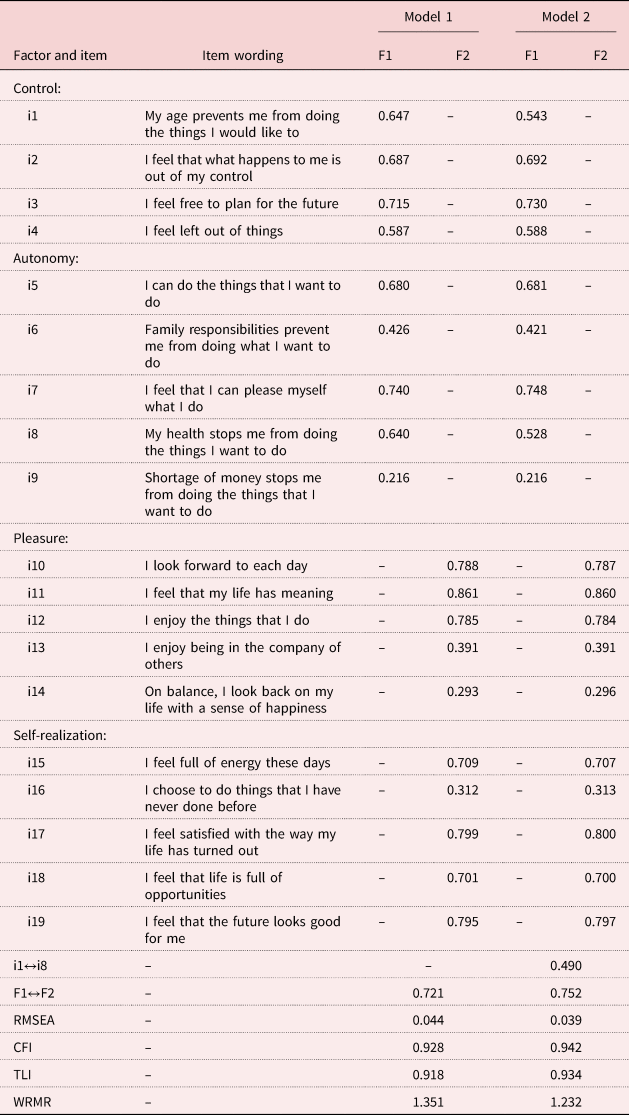
The two-factor model that emerged from the EFA and ESEM was then tested in the second half of the sample (Table 3, Model 1). Except for the RMSEA value, such a model presented an unsatisfactory fit to the data according to the CFI, TLI and WRMR (RMSEA = 0.044, CFI = 0.928, TLI = 0.918 and WRMR = 1.351). This model also showed a strong correlation between the two factors (r = 0.721). Additionally, the CFA revealed considerable residual correlations – through MIs – between items i1 (‘My age prevents me from doing the things I would like to’) and i8 (‘My health stops me from doing things I want to do’) (MI = 36.932), and i8–i15 (‘I feel full of energy these days’) (MI = 12.575).
Confirmatory Factor Analysis models of CASP-19 using data from the EpiFloripa Ageing Study, Florianópolis, Southern Brazil, 2013–2014

Notes: Model 1: Confirmatory Factor Analysis with 19 items and two factors. Model 2: Confirmatory Factor Analysis with 19 items, two factors and residual correlation between items i1 and i8. F columns: standardised factor loadings; F1 and F2: specific scale factors. i: specific scale item. ↔: correlation among factors/items. RMSEA: Root Mean Square Error of Approximation. CFI: Bentler's Comparative Fit Index. TLI: Tucker–Lewis Index. WRMR: Weighted Root Mean Square Residual.
Due to the MIs in the first CFA model, and the psychometric performance of the CASP-19 in other populations which reveals the presence of residual correlations between negative-worded items (see the Discussion section), a residual correlation between items i1–i8 was estimated (see Table 3, Model 2). Upon freeing this residual correlation, the overall fit of the model improved, but still remained below the minimum acceptable levels for the CFI, TLI and WRMR, with a BIC equal to 24,002.395. This model also indicated MIs suggestive of residual correlations between items i8–i15 (MI = 19.212), i1 (‘My age prevents me from doing the things I would like to’) and i2 (‘I feel that what happens to me is out of my control’) (MI = 18.559). The CFA also showed some items with consistently low loadings, such as i9 (‘Shortage of money stops me from doing things that I want to do’) (λ = 0.216), i14 (‘On balance, I look back on my life with a sense of happiness’) (λ = 0.293; λ = 0.296), i16 (‘I choose to do things that I have never done before’) (λ = 0.312; λ = 0.313) and i13 (‘I enjoy being in the company of others’) (λ = 0.391) (Table 3).
Additional models excluding items with low loadings or significant residual correlations (i.e. i1, i2 and i8) showed slightly improved indices of fit, with CFI and TLI values around 0.95 and 0.96, for example. We decided not to pursue these models further, however, following the principle that item removal may sometimes be more harmful than beneficial for the scale as a whole. Future studies should confirm whether or not these items consistently perform poorly in other Brazilian populations.
Discussion
The present study reassessed the configural and metric structures of the CASP-19 in a population-based sample of older respondents from Southern Brazil. The original model with four first-order factors and one higher-order factor (Hyde et al., Reference Hyde, Wiggins, Higgs and Blane2003) as well as the factorial solution proposed by Lima et al. (Reference Lima, Hyde, Chungkham, Correia, Campos, Campos, Novaes, Laks and Petribu2014) were not confirmed with our population-based data. Such propositions were either not endorsed in the initial data analysis or showed indices of fit well below the acceptable levels. Despite showing a reasonable fit to the data and similar BIC in comparison to our proposed final model (Model 2), the factorial solution by Neri et al. (Reference Neri, Borim, Batistoni, Cachioni, Rabelo, Fontes and Yassuda2018) was not taken as the most plausible one given that its performance derived from a technical artifact widely discussed in the literature: common method bias. As long discussed in the psychometric literature, the grouping of similarly worded items into distinct factors artificially inflates model fit, and renders models whose factors cannot be meaningfully interpreted (Podsakoff et al., Reference Podsakoff, MacKenzie, Lee and Podsakoff2003; Brown, Reference Brown2015). We believe that is the case with the model of Neri et al. (Reference Neri, Borim, Batistoni, Cachioni, Rabelo, Fontes and Yassuda2018), and therefore did not take their factorial solution as worthy of further consideration.
The findings discussed above allowed us to propose a model with 19 items distributed along two factors, as well as a residual correlation between items i1 (‘My age prevents me from doing the things I would like to’) and i8 (‘My health stops me from doing things I want to do’). This solution was parsimonious by combining items related to the control and autonomy dimensions in one factor, and items that reflect both self-realization and pleasure in another one. Despite conflicting with the configural structure originally proposed for the instrument, the reduced number of factors from four or three to two can be supported. From an empirical stance, one of the factors identified in the EFA and ESEM was clearly spurious, because it derived from a significant residual correlation between items i1–i8, which was later confirmed with the CFA. According to the CASP-19 literature, there is consistent evidence supporting the combination of the control and autonomy dimensions (Wiggins et al., Reference Wiggins, Netuveli, Hyde, Higgs and Blane2008; Sim et al., Reference Sim, Bartlam and Bernard2011; Vanhoutte and CCSR Manchester, Reference Vanhoutte2012; Pérez-Rojo et al., Reference Pérez-Rojo, Martín, Noriega and López2018; Stoner et al., Reference Stoner, Orrell and Spector2019), as well as for combining self-realization and pleasure in another factor (Sexton et al., Reference Sexton, King-Kallimanis, Conroy and Hickey2013; Kim et al., Reference Kim, Netuveli, Blane, Peasey, Malyutina, Simonova, Kubinova, Pajak, Croezen, Bobak and Pikhart2015).
Additionally, while control is the ability to intervene actively upon one's environment, autonomy is the right of an individual to be free from unwanted interference from others (Patrick et al., Reference Patrick, Skinner and Connell1993). In other words, the distinction between the two dimensions refers only to the possibility of being influenced by others, with freedom as an underlying idea in both cases. Self-realization and pleasure both reflect wellbeing, life purposes and life satisfaction. Since they reflect closely related ideas, their items have been grouped into a second factor in the present analysis (Jary et al., Reference Jary, Savage, Levitas, Lyon, Chaney, Jancovich, DeNora, Macdonald, Burke, Witz, Tribe, Shore, Turner, McCrone, Allen, Currie, Prout, James, Christian and Bauman1991; Turner, Reference Turner, Featherstone and Wernick1995). This reduction of factors – from four to two – also has implications for the conceptual development of the CASP-19. The grouping of items into two factors suggests that the instrument is essentially an eudaimonic measure of QoL, since the only factor, initially conceptualised to reflect an alternative perspective, the hedonic one (pleasure), was linked to the self-realization dimension (Vanhoutte and CCSR Manchester, Reference Vanhoutte2012; Sexton et al., Reference Sexton, King-Kallimanis, Conroy and Hickey2013; Vanhoutte, Reference Vanhoutte2014; Neri et al., Reference Neri, Borim, Batistoni, Cachioni, Rabelo, Fontes and Yassuda2018).
The suggested residual correlation between items i1–i8 may indicate content redundancy and the need to revise their adaptation to Brazilian Portuguese. According to the proponents of the CASP-19 in the UK (Higgs et al., Reference Higgs, Hyde, Wiggins and Blane2003; Hyde et al., Reference Hyde, Wiggins, Higgs and Blane2003), these items were intended to broaden the assessment of QoL by moving beyond health conditions and distinguishing the roles of age and health in QoL levels. This residual correlation suggests that such an objective was not necessarily achieved in this Brazilian version of CASP-19, which might be due to the rapid demographic transition taking place in Brazil, where increased life expectancy has not yet matched reductions in morbidity. Focus groups (Krueger, Reference Krueger1994; Morgan, Reference Morgan1997; Bischoping and Dykema, Reference Bischoping and Dykema1999), cognitive interviews (Fowler and Roman, Reference Fowler and Roman1992; Campanelli, Reference Campanelli1994) and additional pretests of the instrument (Pasquali, Reference Pasquali1998, Reference Pasquali2010) may illuminate this issue, indicating possibilities of semantic refinement of the respective items.
Our results pointed to low standardised factor loadings of some items, specifically i9, i13, i14 and i16. Lima et al. (Reference Lima, Hyde, Chungkham, Correia, Campos, Campos, Novaes, Laks and Petribu2014) also showed that items i13 and i16 had weak loadings; they removed item i16 based on its low item-total correlation (r = 0.20) and item i13 due to its null loading (λ = 0.08). In the other Brazilian version of the instrument, adapted by Neri et al. (Reference Neri, Borim, Batistoni, Cachioni, Rabelo, Fontes and Yassuda2018), items i9 (λ = 0.396) and i16 (λ = 0.387) also presented weak loadings. Together, these results indicate that items i9, i13 and i16 have consistently shown low factor loadings in the three CASP-19 psychometric studies conducted in Brazil to date. The content and moderate cross-loading of item i15, on the other hand, suggests that it reflects a consequence of a person's QoL status rather than QoL itself (Towers et al., Reference Towers, Yeung, Stevenson, Stephens and Alpass2015; Pérez-Rojo et al., Reference Pérez-Rojo, Martín, Noriega and López2018).
Despite examining the configural and metric structures of CASP-19 in a representative and broader sample than the previous Brazilian initiatives (Lima et al., Reference Lima, Hyde, Chungkham, Correia, Campos, Campos, Novaes, Laks and Petribu2014; Neri et al., Reference Neri, Borim, Batistoni, Cachioni, Rabelo, Fontes and Yassuda2018), the present study has some important limitations that are worth considering. The sample was restricted to respondents from a city with overall good living standards, above the national average; such a limitation potentially implied less variability in item responses, attenuating the magnitude of all sorts of parameters estimated in the present study. There were random differences between the total sample and the two sub-samples. Another limitation refers to the face-to-face administration of the CASP-19 in this study, which may have affected responses to the items in multiple directions. This mode of administration was adopted in the study to allow participants with low educational level or low visual capacity to answer the research questionnaire. It is noteworthy, however, that studies adopting different CASP-19 administration techniques did not show differences in QoL scores (Stoner et al., Reference Stoner, Orrell and Spector2019), and indicated that all models presented a satisfactory fit (Wiggins et al., Reference Wiggins, Brown and Ploubidis2017).
Our findings should be taken as an attempt at establishing a rich dialogue with the different factor solutions proposed for the Brazilian versions of the CASP-19 thus far. If the two-factor solution proposed here is confirmed by further psychometric assessment, it should be adopted in models estimated to investigate antecedents or consequences of QoL. We hope that the present study contributes to strengthening the notion of healthy and active ageing, as well as actions to support aged populations in Brazil and around the world.
Conclusion
Our analysis pointed to a two-factor model; the first, with items originally from the control and autonomy dimensions, and the second, with self-realization and pleasure items. This study advances the psychometric examination of the CASP-19 in Brazil by highlighting the need to achieve a consensual configural and metric structure for the instrument. Future studies should, in addition to examining whether our results hold in other Brazilian contexts, examine the scalar structure of the CASP-19 for Brazilian Portuguese, as well as assess the instrument's invariance among groups defined on the basis of education, gender, age, etc.
Financial support
This work was partially supported by the Coordination for the Improvement of Higher Education Personnel – Brazil (CAPES) (grant finance code 001); the infrastructure and equipment required for the interviews were provided by the Federal University of Santa Catarina (UFSC); the netbooks were provided by the Oswaldo Cruz Foundation(Fiocruz), Rio de Janeiro; the fieldwork supervisors were UFSC graduate students, some supported by CAPES; JLB (case number 304503/2018-5) and ED received research productivity grants from the National Council for Scientific and Technological Development - Brazil (CNPq)Conselho Nacional de Desenvolvimento Científico e Tecnológico – Brazil.
Conflict of interest
The authors declare no conflicts of interest.
Ethical standards
The research project was approved by the Human Research Ethics Committee of the Federal University of Santa Catarina on 9 July 2013 (protocol number 329.650). Informed consent was obtained from all individual participants included in the study.