Introduction
Cockchafers belong to Melolonthinae, a large sub-family of Scarabaeidae, which includes more than 4000 species, distributed in all geographical regions but New Zealand. Among the most detrimental species, two congeneric Cockchafers, Melolontha melolontha L. and M. hippocastani Fabricius (Scarabaeidae: Melolonthinae: Melolonthini), occur in Western Europe. Both have been considered as major pests until the fifties, the former for agriculture and the latter for forestry. Melolontha melolontha became much rarer following massive campaigns of eradication, but a progressive comeback was observed during these last years. Melolontha hippocastani is localised to sandy forest and neighbouring regions. As for M. melolontha, its populations have increased in some localities during the last decade (Svestka, Reference Svestka2006; Reinecke et al., Reference Reinecke, Ruther and Hilker2006). In the north-eastern area of the Fontainebleau Forest (France, 48°27′20″N, 2°42′13″E), the two species are sympatric and present every year at spring. They remained rare during the second half of the 20th century but started to pullulate these last years. We observed three swarming years (2004, 2007 and 2010) for M. hippocastani, which is compatible with a three-year development cycle. Melolontha melolontha started to pullulate later, with a first year of swarming in 2009. In their typical forms, the morphologies of the two species are clearly distinct: M . melolontha is larger, has a black thorax and a large pygidium, while M. hippocastani is smaller, has a reddish thorax and a short and thin pygidium, but multiple variations of their phenotype exist (Baraud, Reference Baraud1992). These variations, such as those of body size, colour, hair, pygidium and antenna morphology, involve the same characters in the two species, making some specimens of M. melolontha resemble M. hippocastani and vice versa. Because the species are sympatric, this might be due to the presence of hybrids, a hypothesis that we checked by both genetic and cytogenetic analyses. Literature data on chromosomes of Melolonthinae species are old (Smith & Virkki, Reference Smith and Virkki1978; Yadav & Pillai, Reference Yadav and Pillai1979) or restricted to neotropical species (Moura et al., Reference Moura, Souza, Melo and Lira-Neto2003), and only the chromosome number was reported for M. hippocastani (Virkki, Reference Virkki1951). Typical and atypical adult specimens of these two species occurring in a limited territory were captured over a three-week period. The karyotypes of the two species, previously not described, were found quite different from each other, and we tried to determine which one was the closest to the ancestral form. Hence, they were compared to the karyotypes of two other Melolonthinae species that we also report for the first time: Phyllophaga pleei Blanchard from Guadeloupe (Rhizotrogini) and Melolontha pectoralis Germar from Central and Eastern Europe. In parallel, we assessed their phylogenetic relationships, exploiting the molecular characteristics of mitochondrial cytochrome oxidase subunit 1 (COI) gene. Due to the high mutation rate of mitochondrial DNA (mtDNA), resulting in substantially high nucleotide differences between closely related species, it constitutes a valuable molecular tool for the identification of morphologically similar species (Avise, Reference Avise1994). Moreover, its maternal inheritance, the lack of recombination and the high copy number are characteristics that make mtDNA suitable for phylogenetic analysis.
Material and methods
Insect specimens
Both M. melolontha and M. hippocastani specimens were collected in spring 2007, 2008 and 2009 at Bois-le-Roi (France, 48°27′20″N, 2°42′13″E), at the border of the Fontainebleau Forest, in an oak planted surface of about 2000 m². The species and sex were determined on morphology. Specimens of P. pleei were captured at Petit-Bourg (Guadeloupe, 16°12′N, 61°39′W) in February and December 2008 and 2009 by light traps. Specimen 1 of M. pectoralis was captured near Leptokaria (Greece, 41°10′N, 25°50′E) and specimen 2 near Meteors (Greece, 39°41′N, 21°39′E), both in June 2009.
Chromosomes
Cytogenetic studies are usually performed on male germinal cells. Unfortunately, spermatogenesis of Melolontha species is completely achieved before the emergence of the imagines, making other strategies necessary for obtaining dividing cells. We used eggs from M. hippocastani, obtained in May 2007, and of M. melolontha, obtained in May 2008 and 2009. For imagine of the three Melolontha species, we slightly modified the method of Angus (Reference Angus1982) on cells from the mid gut. Briefly, after dissection, gut fragments were cleared out of their content and rinsed with KCl 0.88 M in distilled water. They were transferred and dilacerated in a small jar containing clean 0.88 M KCl, where they remained for 30 min, after addition of colcemid. After centrifugation, the cells were transferred into diluted calf serum (distilled water/serum: 3 vol./1vol.) for 15 min. Fixation, metaphase harvesting and chromosome staining and banding were as described (Dutrillaux et al., Reference Dutrillaux, Moulin and Dutrillaux2006, Reference Dutrillaux, Mercier, Xie and Dutrillaux2008). For P. pleei, both germinal and gut cells were used (Dutrillaux et al., Reference Dutrillaux, Moulin and Dutrillaux2006, Reference Dutrillaux, Mercier, Xie and Dutrillaux2008).
Sequencing analysis of the mitochondrial COI gene
Mitochondrial DNA was isolated from 11 individuals: two M. pectoralis (specimens 1 and 2), four M. melolontha (specimens 6, 8, K and C), two M. hippocastani (specimens M and S) and three P. pleei (specimens 2, 4 and W), according to Aljanabi & Martinez (Reference Aljanabi and Martinez1997). All but one specimen of M. pectoralis were also cytogenetically studied. A 710 bp segment at the 3′ end of the COI gene was amplified using the primers C1-J-2195 (5′-TTGATTTTTTGGTCATCCAGAAGT-3′) and L2-N-3014 (5′-TCCAATGCACTAATCTGCCATATTA-3′) (Simon et al., Reference Simon, Frati, Beckenbach, Crespi, Liu and Flook1994). PCR reactions (50 μl) contained 200–500 ng DNA, 1×Taq buffer, 2 mM MgCl2, 0.2 mM of each dNTP, 50 pmoles of each primer and 1 U Taq polymerase (Invitrogen, Carlsbad, USA). The cycling conditions consisted of an initial denaturation at 95°C for 5 min followed by 35 cycles of denaturation at 95°C for 30 s, annealing at 52°C for 40 s and extension at 72°C for 1 min, with a final extension at 72°C for 10 min. PCR products were purified using QIAquick PCR Purification Kit (QIAGEN, Hilden, Germany) and sequenced bi-directionally by Macrogen Inc., Seoul, Korea. Nucleotide sequences were aligned using ClustalW (Thomson et al., 1997). For all sequences, base composition, nucleotide variation, polymorphic and parsimony informative sites were assessed using MEGA4 (Tamura et al., Reference Tamura, Dudley, Nei and Kumar2007). In order to find the model of evolution that fits the data set, we used the findmodel server (http://hcv.lanl.gov/content/hcv-db/findmodel/findmodel.html); and a phylogenetic tree, using the maximum likelihood method, was inferred using phyml online web server (Guindon et al., Reference Guindon, Lethiec, Duroux and Gascuel2005).
Results and discussion
Chromosome data
All karyotypes are composed of 20 chromosomes: 20,XY in the males and 20,XX in the females. Published data on the species of this study only exist for M. hippocastani, indicating a number of ten bivalents at meiosis I (Virkki, Reference Virkki1951), thus compatible with 20 mitotic chromosomes.
M. hippocastani
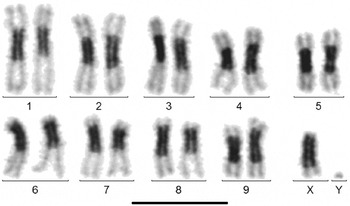
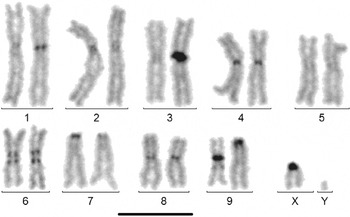
All autosomes are sub-metacentric after Giemsa staining, but their chromatids appear elongated and tightly associated around centromeric regions (fig. 1). This corresponds to heterochromatin, strongly C-banded (fig. 2). These regions are stained by neither DAPI nor quinacrine mustard, which suggests they are not A-T rich. The location of these heterochromatic segments is constant; but their sizes, always large, vary among homologous and non-homologous chromosomes, generating a polymorphism. The X chromosome has a very small euchromatic short arm, and the Y, punctiform, is the only chromosome without C-banding. The same chromosomal characteristics are observed on either eggs laid in 2007 (adults expected in 2010) or adults captured in 2009. Because of the size variation of heterochromatin, the chromosomes were classified by decreasing size of their euchromatic content.
M. hippocastani karyotype. Giemsa-stained karyotype of M. hippocastani exhibiting chromatid association and elongation largely spread around centromere regions. As in all other figures, bar represents 10 μm.

M. hippocastani karyotype. C-banded karyotype of M. hippocastani.

M. melolontha
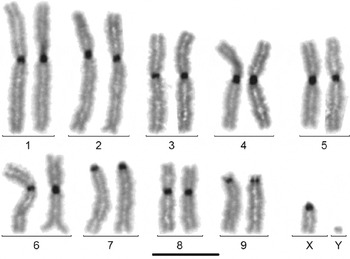
At difference with the preceding karyotype, the X and some autosomes are acrocentric. The number of acrocentric autosomes ranges from two to four from one specimen to another, the other autosomes being more or less metacentric. Careful karyotyping indicates that only pair N° 9 is involved in these variations, likely to be the consequence of a pericentric inversion. Among ten karyotyped specimens, pair N° 9 is acrocentric, metacentric or mixed acro-/metacentric in two, three and five instances, respectively. This proportion is compatible with an equal frequency of the two chromosome morphologies. C-banding displays a second type of polymorphism (fig. 3); the centromeric regions are quite unevenly stained, and always much less than in M. hippocastani. The size variations of C-bands principally involve the centromeric regions of chromosomes 3, 9, 1 and 6. In addition, chromosomes 6 and 9 carry a second small C-band at the proximal part of their long arm. These additional C-bands are stained by silver, suggesting they represent the nucleolus organizer regions (NORs). These regions are also frequently elongated, and unstained by Giemsa, as are the NORs usually.
M. melolontha karyotype. C-banded karyotype of M. melolontha displaying heterozygosity for a pericentric inversion of chromosome 9 and for heterochromatin amounts on various chromosomes (N° 1, 3, 7).

M. pectoralis
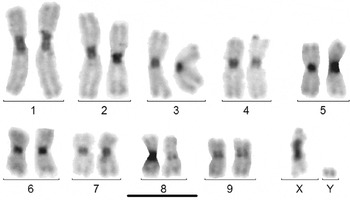
The single karyotype established comprises seven pairs of more or less metacentric and two pairs of acrocentric autosomes. The X is acrocentric and the Y punctiform. After C-banding (fig. 4), all juxta-centromeric regions, but that of the Y, display C-bands of fairly similar size. The long arm of pair N° 6, and occasionally N° 9, carry an elongated region, which presumably corresponds to the NOR, as in M. melolontha. Thus, the euchromatic components are quite similar to those of M. melolontha with four acrocentrics, but the heterochromatin is quite different.
M. pectoralis karyotype. C-banded karyotype of M. pectoralis.

Phyllophaga pleei
Its karyotype is composed of meta- and sub-metacentric autosomes, a sub-metacentric X and a small acrocentric Y (fig. 5). C-banding is fairly homogeneous at centromeric regions of autosomes, as in M. pectoralis, and much larger on chromosome X. The short arm of this chromosome is elongated (satellite-like) and carries the NOR, as confirmed by meiotic studies (not shown).
P. pleei karyotype. C-banded karyotype of P. pleei. The filament like short arm of the X is carrier of the NOR.

Karyotype and phenotype variations in M. melolontha and M. hippocastani
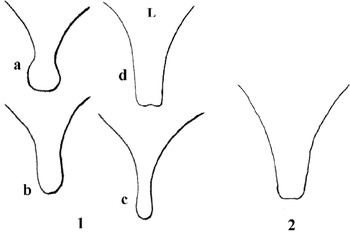
Species identification was initially performed on morphological characters. It was unambiguous in most instances, but a few variants or ambiguous specimens were selected for analyses. Beside genitalia morphology, a major character separating the two species is the pygidium morphology, linearly prolonged by a thick and large appendix in M. melolontha and angularly prolonged by a thinner, shorter and knob-shaped appendix in M. hippocastani. However, sexual dimorphism of pygidium morphology and individual variations (fig. 6) sometimes make this criterion uneasy. In addition, in their typical forms, M. melolontha specimens are larger, with a black thorax and sparsely hairy elytrons, while those of M. hippocastani are smaller, with a brown-reddish thorax and densely hairy elytrons. All these characters vary in each species.
Pygidium morphologies. Schematic representation of pygidium morphologies of M. hippocastani (1) and M. melolontha (2). In (1), (a) typical and (b–d) variant forms of the specimens studied. Form (d), from specimen L, is quite similar to the morphology of M. melolontha.

Eight presumed M. hippocastani were selected, including two specimens with a black thorax (specimens A and G), one specimen (M) with a black thorax and dark elytrons and one large specimen (C) with a black thorax, an ambiguous pygidium and hairy elytra. The three formers had a typical karyotype of M. hippocastani while the latter had a M. melolontha karyotype with four acrocentric autosomes. The post mortem examination of its genitalia confirmed the status of M. melolontha.
Ten presumed M. melolontha were also selected, including one with a short pygidium (specimen B) and one small (21-mm long) male (specimen L) with fairly typical characters. Specimen B had a karyotype of M. melolontha, with four acrocentric autosomes. Specimen L had a karyotype of M. hippocastani. The reassessment of its phenotypic characters displayed genitalia of the melolontha type, but the pygidium remained of the hippocastani type (fig. 6).
Thus, among six atypical specimens, two wrong diagnoses might have been performed. Interestingly, these specimens had typical karyotypes and genotype (see below) of either M. melolontha or M. hippocastani, discarding any possibility of hybridization.
No correlation was found between phenotypic variations and chromosome polymorphism (either heterochromatin variations in both species, or morphology of pair N° 9 in M. melolontha).
Comparison of karyotypes and reconstruction of the presumed ancestral karyotype of Melolonthinae
As known for long, the karyotype of most Scarabaeidae species is composed of 20 chromosomes (Smith & Virkki, Reference Smith and Virkki1978; Yadav et al., Reference Yadav, Pillai and Karamjeet1979). Data on chromosome morphology, although ancient (Yadav & Pillai, Reference Yadav and Pillai1979), remained scarce until recent reports on series of species confirmed that the sub-metacentric morphology is the most frequent (Wilson & Angus, Reference Wilson and Angus2004, Reference Wilson and Angus2005; Dutrillaux et al., Reference Dutrillaux, Xie and Dutrillaux2007, Reference Dutrillaux, Mercier, Xie and Dutrillaux2008). In Dynastinae, a sub-family related to Melolonthinae (Hunt et al., Reference Hunt, Bergsten, Levkanikova, Papadopoulou, St. John, Wild, Hammond, Ahrens, Balke, Caterino, Gomez-Zurita, Ribera, Barraclough, Bocakova, Bocak and Vogler2007), the ancestral karyotype, tentatively reconstructed by comparing the chromosomes of specimens from five tribes, was composed of 18 meta-/sub-metacentric autosomes, of progressively decreasing size, an acrocentric X and a punctiform Y (Dutrillaux et al., Reference Dutrillaux, Xie and Dutrillaux2007).
Chromosome sizes and morphologies, heterochromatin location and size, NOR location and number were considered for comparisons, with the following conclusions:
(i) M. melolontha and M. pectoralis have the most similar chromosome morphologies;
(ii) P. pleei has the chromosome morphologies the closest to that of the presumed ancestor of Dynastinae;
(iii) M. melolontha and M. hippocastani have the most derived heterochromatin, the former by reduction and the latter by amplification of the C-band positive heterochromatin;
(iv) P. pleei exhibits a NOR location on X chromosome short arm, as the presumed Dynastinae ancestor. This may be the ancestral position for Melolonthinae. The other species have an autosomal NOR. M. melolontha differs from others by the presence of a second autosomal NOR.
Thus, the nominal taxon M. melolontha appears to be the most derived chromosomally. M. pectoralis and P. pleei are its closest and most distant relatives, respectively. M. hippocastani is clearly in intermediate position. The ancestral Melolonthinae karyotype may be closer to that of P. pleei than Melolontha species.
Nucleotide analysis and phylogenetic reconstruction
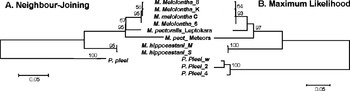
Sequences obtained, primers excluded, correspond to nucleotides 715–1424 (amino acids 239–474) of Rhopaea magnicornis (Melolonthinae) COI gene, which is the most related species. Haplotypes were evaluated and compared to published sequences in Genbank. All but one (M. melolontha C, initially thought M. hippocastani), identical to DQ295262, corresponded to new sequences and, thus, were submitted to GenBank. Their accession numbers are: HM120756 and HM120757 for M. hippocastani M and S, respectively; HM120751 and HM120752 for M. pectoralis from Leptokara and Meteors, respectively; HM120753, HM120754 and HM120755 for M. melolontha 6, 8 and K, respectively, and HM120758, HM120759 and HM120760 for P. pleei 2, 4 and w, respectively. None of the sequences had insertions, deletions or in-frame stop codons, which shows that they correspond to functional mitochondrial COI gene fragments and are not derived from nuclear mitochondrial pseudogenes (numts), which seems to be a common phenomenon in most eukaryotic species studied so far (Richly & Leister, Reference Richly and Leister2004; Cameron et al., Reference Cameron, Sullivan, Song, Miller and Whiting2009). The A+T percentage content was 67%, on average, which is very high, but a common feature of animal mitochondrial genes (Brown, Reference Brown and Macintyre1985). Out of the 710 sites, 185 were variable while 159 of them were informative for parsimony. Among the 185 variable sites, 80.5% are third codon positions, while first and second codon positions are much more conserved (17% and 3%, respectively). This pattern typically is observed in segments under strong functional constraints. Similarly, of the 185 variable sites, only 17 result in amino acid substitution. The sequence divergence within species ranged from 0.14% for M. hippocastani to 8.5% for M. pectoralis. No sequence particularity was observed for morphologically atypical specimens (M. melolontha C and M. hippocastani M), in agreement with chromosomal data. In the genus Melolontha, the highest sequence divergence was observed between M. pectoralis and M. hippocastani (13.7%) while, in the family, the respective value was, as expected, higher (17.9% between M. pectoralis and P. pleei). Findmodel server revealed general time reversible plus gamma (GTR+γ, γ=0.18366) as the model of sequence evolution that best fit our data. Accordingly, based on sequence data, a maximum likelihood (ML) phylogenetic tree was constructed (fig. 7b) with 1000 bootstrap replicates. The main branches exhibit high bootstrap values and clearly separate the species in distinct clades. Mega4 (Tamura et al., Reference Tamura, Dudley, Nei and Kumar2007) was also used to calculate the Tamura-Nei (Tamura & Nei, Reference Tamura and Nei1993) genetic distance (with γ=0.18366) to construct a neighbour-joining (NJ) phylogenetic tree (fig. 7a). Both ML and NJ trees showed identical results. Using P. pleei as outgroup, a NJ tree showed that M. hippocastani had a more basal (ancestral) position than the two other Melolontha species (fig. 7a). These conclusions are perfectly coherent with chromosomal data reported above. In the only comprehensive study published so far on the COI gene from M. melolontha collected near Innsbruck (Austria) (Juen & Traugott, Reference Juen and Traugott2006), the ten sequences retrieved from the Genbank cluster together with the sequences from the specimens analyzed in this study (data not shown).
Phylogenetic trees. Trees resulting from (a) neighbour-joining (NJ) and (b) ML analyses clustering the 11 haplotypes. P. pleei haplotypes were used as outgroup for the NJ analysis. In the NJ tree, specimens of P. pleei were compressed. Numbers above branches represent percentages of bootstrap values (1000 replicates). Bootstrap values below 50% were omitted. Because different specimens within M. hippocastani showed the same haplotype, we randomly choose one specimen, M. hippocastani M.

Chromosomal and morphological polymorphisms and speciation
Melolontha melolontha, M. pectoralis and M. hippocastani are three species for which multiple and recurrent morphological variations are described. These variations affect the pigmentation of the thorax principally, but also of the elytra and legs. They also affect pubescence, body size and, more rarely, the morphology of the pygidium, which is a major criterion for systematics, together with paramera morphology (Baraud, Reference Baraud1992). Interestingly, infrequent variants of a species often reproduce a typical character of another species. For example, the usually red-brown pronotum of M. hippocastani may be black, and the usually black pronotum of M. melolontha and M. pectoralis may be red-brown. The presence or absence of a dense pubescence on elytra follows similar variations. In other words, the marked intra-specific polymorphism is also inter-specific, only the incidence of each character varies. This polymorphism seams to be independent from any chromosomal variations, and we could exclude the role of inter-specific hybridisations. In our study, both M. melolontha and M. hippocastani variants were collected at the same place and period, which makes environmental effects on developmental variations unlikely. Therefore, the origin of the polymorphism could be principally genetic. It implies that the same alleles exist in different species, but with very different frequencies. These alleles may have two origins:
(i) they similarly occurred by mutations in the three species independently;
(ii) they have an unique origin and were transmitted through a common ancestral population, which already had the same polymorphism.
The first interpretation is compatible with a classical dichotomic mode of speciation. By contrast, the second one is hardly compatible with dichotomy, which makes the passage through a reduced number of individuals (bottleneck) necessary, which hinders polymorphism transmission. By contrast, a network (reticulated) evolution can keep a polymorphism and is more parsimonious for mutations (Dutrillaux et al., Reference Dutrillaux, Couturier and Chauvier1980).
The marked chromosome difference between M. hippocastani and the other two Melolontha species indicates their ancient separation, with a likely interruption of the gene flow. This fits well with their morphological differences (Baraud, Reference Baraud1992) and the sympatry without hybridization between M. hippocastani and M. melolontha.
M. melolontha and M. pectoralis are morphologically and genetically closer (Baraud, Reference Baraud1992; this report). Their karyotypes are close and similarly derived by the formation of two acrocentric pairs by inversion of their presumed ancestral sub-metacentrics. One of them (pair 9), however, is polymorphic in M. melolontha. This also can be best explained by a network speciation process. The inversion of pair 7 would have occurred early and spread in the whole common ancestral population of the two species. The inversion of pair 9 would have occurred later and not entirely spread in the ancestral population, generating a polymorphism still detected in M. melolontha. The study of other specimens of M. pectoralis is necessary to know if this polymorphism also exists in this species. In conclusion, unless admitting the occurrence of multiple reverse and/or convergent gene mutations and chromosome rearrangements, a network speciation appears to be the most likely process in the evolution of the genus Melolontha.
Acknowledgements
Molecular analyses were financed by the postgraduate courses ‘Biotechnology-quality assessment in nutrition and the environment’ and ‘Applications of Molecular Biology-Genetics. Diagnostic Biomarkers’ of the Department of Biochemistry and Biotechnology, University of Thessaly, Greece.