INTRODUCTION
Biodiversity in Europe is in a crisis of continuous decline (EEA 2015). Biodiversity degradation is considered a serious topic by eight out of ten Europeans (EU 2015), yet this concern apparently is not translated into successful action (Pearce Reference Pearce2007). Attempts to address this problem now frequently take the approach of researching ecosystem services (e.g. MEA 2005) to inform private and public decision making. Ecosystem services as a concept has attained broad global institutionalization, as is visible for example in the global initiative The Economics of Ecosystems and Biodiversity (TEEB 2013) and large-scale research programmes such as the Intergovernmental Science-Policy Platform on Biodiversity and Ecosystem Services (IPBES 2015) and the European Horizon 2020 (Admiraal et al. Reference Admiraal, Musters and de Snoo2016), making ecosystem services the foremost way of expressing the value of biodiversity to society.
Nevertheless, the ecosystem services approach appears to fail in its motivational objective of halting further biodiversity degradation (Tittensor et al. Reference Tittensor2014), which has prompted reflections on its limitations (O'Neill Reference O'Neill1997; Norgaard Reference Norgaard2010). Specifically, related economic approaches may crowd out other non-economic motivations (Gómez-Baggethun & Ruiz-Pérez Reference Gómez-Baggethun and Ruiz-Pérez2011; Rode et al. Reference Rode, Gómez-Baggethun and Krause2015). Research from outside the ecosystem services community demonstrates that committed action for nature rests on grounds other than economic values, such as the development of trust between stakeholders and other moral standards (Flint et al. Reference Flint, Kunze, Muhar, Yoshida and Penker2013; Hiedanpää & Borgström Reference Hiedanpää and Borgström2014; Sponarski et al. Reference Sponarski, Vaske, Bath and Musiani2014) and room for autonomous action in conservation initiatives (Dedeurwaerdere et al. Reference Dedeurwaerdere, Admiraal, Beringer, Bonaiuto, Cicero, Fernandez-Wulff, Hagens, Hiedanpaa, Knights, Molinario, Melindi-Ghidi, Popa, Silc, Soethe, Soininen and Vivero2016).
Personal motivations to act for biodiversity are complex, but must be understood more fully in order to grasp where current efforts to motivate people fall short. Environmental psychology researchers have conducted a large number of studies on motivation for environmental action, but this research is often focused on single factors that are assumed to be pivotal for action. Examples include connectedness to nature (Mayer & Frantz Reference Mayer and Frantz2004), egoistic, altruistic and biospheric environmental concerns (Schultz Reference Schultz2001), place attachment (Williams & Vaske Reference Williams and Vaske2003), community (Asah & Blahna Reference Asah and Blahna2013), empathy (Schultz Reference Schultz2000), time perspective (Corral-Verdugo et al. Reference Corral-Verdugo, Fraijo-Sing and Pinheiro2006), views on human–nature relationships (Van den Born et al. Reference van den Born, Lenders, De Groot and Huijsman2001) and emotions, habits and rational choices (Carrus et al. Reference Carrus, Passafaro and Bonnes2008). These studies almost invariably conclude that these factors of interest perform a role in environmental behaviour.
What remains unknown is how these factors act in concert or in relation to each other. Gifford and Nilsson (Reference Gifford and Nilsson2014), for example, provide an overview of no less than 17 ‘categories of influence’ on environmental behaviour and conclude that research should focus on how these influences interact with each other. In the search for theories of interaction, several studies depart from a relatively wide set of motivational factors. Kollmuss and Agyeman (Reference Kollmuss and Agyeman2002), for example, attempted to incorporate multiple factors, including knowledge, values, attitudes and emotions. Clark et al. (Reference Clark, Kotchen and Moore2003) and Ryan and Deci (Reference Ryan and Deci2000) distinguish between internal and external influences on behaviour. Perkins (Reference Perkins2010) combines several factors in order to measure people's emotional relationships with nature. These studies find that these factors are related to each other and that humans do not act for nature primarily in order to safeguard ecosystem services, but rather for a complex combination of reasons that is difficult to model.
What motivates individuals to protect the environment therefore remains a key issue, and an interdisciplinary approach is needed for a better understanding of it (Perkins Reference Perkins2010). The present paper stands in this tradition of interdisciplinary ‘multi-factor studies’, with the added value of focusing on a group of highly committed individuals – so-called ‘biodiversity activists’. This group forms an important yet underexplored source of information about motivations to act for biodiversity.
The conservation motivations of committed ‘biodiversity activists’ likely differ from the motivations of other types of activist. In general, people may engage in conservation activities only in the margins of their lives (e.g. when donating to a conservation charity). Regarding motivations, a lifetime devotion to biodiversity conservation might be driven by moral values, while a marginal action might be motivated by a felt obligation or a social norm. Our research question was: how do committed actors for biodiversity rank their motivations to act for nature given a broad set of motivational options? To clarify how the motivations of committed biodiversity actors might differ from those of non-biodiversity actors, we compare our ‘biodiversity activists’ to a group of counterpart activists who work with similar capacities and within similar work environments, but are committed to non-biodiversity-related work. Mapping the specific motivations as ranked by both groups themselves would provide clarity that could help to stimulate both committed conservationists already working in the field and people acting for nature in the margins of their lives.
METHODS
Participant selection
In Belgium, Finland, Germany, Italy, The Netherlands, Slovenia and the UK, biodiversity activists were identified and interviewed using identical methods in order to map their individual motivations for conservation action. The project recognized that motivation for biodiversity conservation can play out in many sectors of society, from managers making strategic decisions in business to elementary school teachers stimulating a wonder for nature in children. A list of three sectors with sub-categories was thus used as a criterion for selecting interviewees in each country. These sectors were: (i) the public domain (including local governments, city parks and projects as parts of Natura 2000 and the UNESCO Man and the Biosphere Programme); (ii) business (including fishing, farming, forestry, food production, corporate land ownership and tourism); and (iii) civil society (including school teachers, non-governmental organizations (NGOs), foundations, media professionals and civil activists). The categories were interpreted broadly in the search for interviewees and were not intended for statistical analysis.
For each sub-category and country in the list, a ‘biodiversity activist’ was identified: a person who spends more time or energy on conservation than could be expected from job duties. Examples of such actions include founding a biodiversity NGO, radically greening a firm or spending tireless energy on nature education. The term ‘biodiversity activist’ here includes many non-political actors, such as civil servants and school teachers.
For the control group, actors were identified who worked in similar work environments and had similar capacities, abilities or opportunities to act as the biodiversity activists, but did so for other causes. In contrast, a random sample of the population would be less precise for testing the factor of biodiversity as a topic for action, because too many other variables could be of major influence. Because of the diversity of backgrounds of the biodiversity activists, for each biodiversity activist we searched for a specific non-biodiversity counterpart with a fittingly similar background in a similar work environment to the activist. Thus, pairs of interviewees were created that matched in as many factors as possible, with only the topic of biodiversity differing between them in their work. The founder of a biodiversity-related foundation may therefore get as a counterpart the founder of a social issue foundation, for such an individual may be the best match regarding similar capacities and a similar work environment underlying their actions.
The non-biodiversity actors nearly always reported strong motivations for other causes, which were often socially related. The first reason for this is that the appropriate counterparts to the biodiversity activists also frequently worked in environments that predisposed them to be committed to certain goals, such as poverty reduction, projects for disabled people, community building or any other goal not directly related to biodiversity. Secondly, our interview structure forced interviewees to consider their main interests and passions. Therefore, we took the factor ‘activism’ as one of the matching characteristics between the biodiversity activists and the control group, while the topic of biodiversity itself remained the differing factor. For simplicity's sake, we refer to the control group as ‘non-biodiversity activists’ here.
Whilst selecting the biodiversity activists, most individuals turned out to be long-standing activists, male and with a high educational background. Since the search for counterparts to these activists occurred in a pairwise manner, most counterparts had similar characteristics. We made a conscious effort to include female interviewees in both the activist and control groups when comparable candidates were found. In total, 217 interviewees took part in the card ranking task, of which 168 were male and 49 female; 109 of the 217 interviewees were classified as ‘biodiversity activists’ and 68 were classified as ‘non-biodiversity activists’. For clarity of interpretations, 40 interviewees were reclassified as not being part of either group, since the interviews showed that they did not report a clear commitment to any cause.
Interview structure
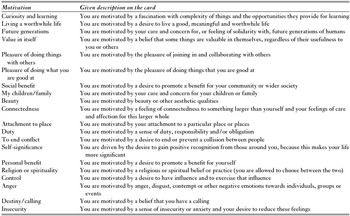
The interview consisted of a semi-structured life history part, followed by a task involving the sorting of cards that displayed motivations. In the life history part, the interviewees reflected on the histories of their committed actions in the context of their more general life story. For the card sorting element, the life history part acted as a ‘primer’, focusing the interviewees on their actions and getting them to develop a ‘feel’ for how their actions were embedded in the context of their lives (see Table S1 (available online) for the interview structure). Subsequently, the interviewees were given a set of 20 cards in random order, with a motivation on one side and a brief explanation of the motivation on the other side (Table 1). The interviewees were asked to rank the cards in relation to their actions on a six-step scale from most important (6) to least important (1), and they could freely distribute the motivations over the six levels.
The 20 motivations with a short description of each, as presented to the interviewees.

The procedure of the card rankings differed between the two groups in that the non-biodiversity activists were asked to rank the cards twice: once for their non-biodiversity cause (their main cause as defined by the interviewees themselves) and a second time for any biodiversity action they had engaged in. Their actions for biodiversity were usually fairly minor (e.g. making a small monthly donation to a conservancy). The resulting motivational rankings of both groups of actors allowed us to make three comparisons:
-
1. Motivations to act for biodiversity between both groups.
-
2. Motivations of the biodiversity activists to act for biodiversity on the one hand and of the non-biodiversity activists to act for their main causes on the other.
-
3. Motivations within the group of non-biodiversity activists to act for their main cause and for biodiversity.
Creating the motivation list
The list of 20 motivations for the card set was grounded in a two-step, multidisciplinary exploration that sought to represent fundamental motivational concepts found in philosophy, social psychology and governance science. The first step was a literature review carried out by researchers of these disciplines and subsequently compiled into a reference document (BIOMOT 2013). The second step consisted of a 4-day workshop involving all of the researchers in order to create the list of motivations. These discussions were inspired by the professional experience and cultural diversity of the researchers, resulting in a list of 20 motivations that was considered ‘saturated’ (i.e. comprising all fundamental concepts). Representatives of all seven study countries participated in discussions about the interpretations of the motivations in their own languages, and all researchers followed these interpretations during the interviews. The cards were translated and back-translated as a control into the languages of the seven countries.
The concepts from the various disciplines appeared to overlap well in meaning; examples are the items of ‘hedonic’ in Schwartz (Reference Schwartz1992) and ‘instrumental’ in Muraca (Reference Muraca2011), as well as the items of ‘power’ in Schwartz (Reference Schwartz1992) and ‘control’ in Fiske (Reference Fiske2014). Another example of an overlap of concepts is that the concept of ‘connectedness’ was found in the literatures of different fields, including environmental psychology (Tam Reference Tam2013) and philosophy (Nolt Reference Nolt2006). However, on the level of frameworks that authors tend to use in order to arrive at a structured classification, interdisciplinary convergence turned out to be impossible. For example, motivations can be grouped into classes such as intrinsic versus extrinsic, individually based versus group based or hedonic versus moral, but these classes could not be moulded into a single structured classification. This is corroborated by Kollmuss and Agyeman (Reference Kollmuss and Agyeman2002), who encountered similar problems in combining models of environmental behaviour. The card set thus represented values, emotional states and end goals, which could all be potential motivations. They were presented as an unstructured list (Table 1), open to being classified in follow-up studies depending on aim, research context or disciplinary tradition.
Due to coordination difficulties between partners, in three countries (Belgium, Finland and the UK), the non-biodiversity activists were asked to rank the cards only for their main cause, but the total numbers of the rankings in the entire dataset were still considered sufficient for the three comparisons.
Statistical analysis
We used R (R Core Team Reference Core Team2012) and lme4 (Bates et al. Reference Bates, Maechler, Bolker and Walker2015) to create a linear mixed-effects model in order to analyse the relationship between the scores (1–6) given to the 20 motivations and the group of actors (biodiversity or non-biodiversity) and whether they scored for their main interest or nature activities. Three comparisons were made, as explained above. The relevant datasets were selected each time before the model was run, making for three different datasets as inputs. In the model, group was a fixed factor, while an individual interviewee were regarded as a factor with random intercepts, because individual interviewees may rank motivations generally higher or lower than other interviewees. The model reads as ‘lmer (score~motivation*group +(1|interviewee)’, with (1|interviewee) referring to the random factor. We ran the model once for each of the three comparisons, and in each run t-values were generated for how each motivation differed in score between the two groups that we selected for. Due to the random factor of the individual interviewees, the degrees of freedom were no longer well defined, which makes it impossible to properly estimate p-values. However, we considered t-values lower than –2 and higher than +2 as critical values indicating a significant difference between the scores, as these values correspond to p < 0.05.
For investigating the general effects of group, gender and country, we used the approach of testing two models against each other with an analysis of variance test. One model would include the fixed factor for gender or country and the second model would not include this factor. A χ 2 test showed whether significant differences existed between the models. All of the interactions between the fixed factors were included in the model.
RESULTS
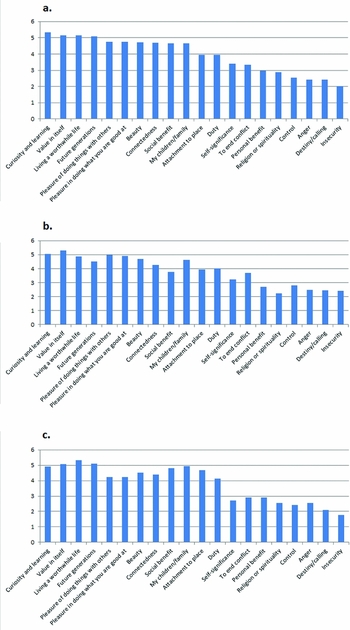
In the ranking of motivations of the biodiversity activists, the 10 highest-ranking motivations differed little in their scores (Fig. 1(a)). This suggests that conservation action is founded on a broad selection of possible motivations. High-ranking motivations were curiosity and learning, value of nature in itself, living a worthwhile life and future generations, which also showed the lowest deviations in their scores. The motivations of personal benefit and self-significance received low ratings, as did anger, control and insecurity. Religion or spirituality and destiny also received low ratings on average. However, a high standard deviation for religion or spirituality indicated that this motivation often received either a high or low score.
Motivations of biodiversity and non-biodiversity activists for their main interests and actions for biodiversity. The bars represent average values given to motivations by the interviewees. (a) Values given by biodiversity activists. (b) Values given by non-biodiversity activists for their main cause. (c) Values given by non-biodiversity activists for biodiversity action.

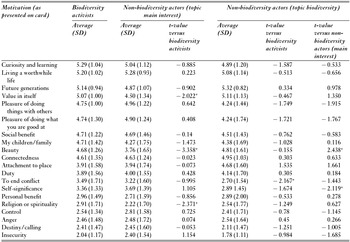
The rankings for main interest differed between the two groups (biodiversity cause versus non-biodiversity cause; likelihood ratio test, χ 2 = 54.996, df = 20, p < 0.001), although most motivations were rated similarly high or low between the two groups (Fig. 1). More precisely, value in itself, beauty and religion or spirituality were rated lower by the non-biodiversity activists for their main cause than by the biodiversity activists for their biodiversity cause (Table 2). This indicates that value in itself and beauty generally played more important roles in motivation when biodiversity conservation is the topic of interest. Religion or spirituality, however, had a low rating relative to the other motivations, indicating that it played a smaller role in general.
Motivation rankings. * Significant difference of a t-value of less than –2 and greater than +2.

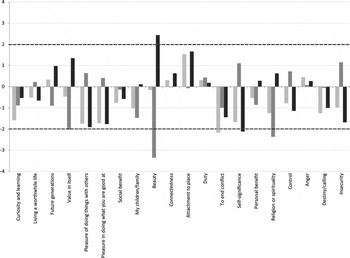
The follow-up question addressed the motivations that were important to non-biodiversity activists for biodiversity conservation (Fig. 1(c)). In general, significant differences existed between the two groups regarding the motivations to act for biodiversity (likelihood ratio test, χ 2 = 33.694, df = 20, p = 0.028). More specifically, the highest-rated motivations were very similar between the two groups, but the motivation to end conflict was rated lower (Fig. 2). This suggests that non-biodiversity activists may feel less driven to deal with conflicts involving biodiversity conservation. Yet, in comparison with the motivations for their main interest (likelihood ratio test, χ 2 = 60.945, df = 20, p < 0.001), for the non-biodiversity activists, beauty was an important motivation regarding acting for biodiversity as well, as they ranked it higher for biodiversity conservation than for their main interests (Table 2). No comparable difference was seen in the ratings for value in itself and religion or spirituality for biodiversity conservation, suggesting that these motivations were less important to this group for biodiversity conservation. Self-significance received lower scores for biodiversity conservation.
t-values of the comparisons of motivation rankings. Dashed lines delimit the values of greater than +2 and less than −2, signifying significant difference. Light grey bars represent the values of biodiversity activists versus non-biodiversity activists for biodiversity action. Dark grey bars represent the values of biodiversity activists versus non-biodiversity activists for their main cause. Black bars represent the values of non-biodiversity activists for their main cause versus biodiversity action.

In summary, while both groups are very similar in their highest-ranking motivations, the biodiversity activists felt a greater affinity for the motivations of value in itself and occasionally religion or spirituality. The non-biodiversity activists felt greater affinity for beauty regarding actions for biodiversity in contrast to their main interest, and this affinity was also echoed by the biodiversity activists. However, the non-biodiversity actors differed from the activists in that the motivations of to end conflict and self-significance dropped for actions for biodiversity.
No significant effect of gender was found in the model between the two groups and their rankings of motivations for their main interest (p = 0.2154), nor for biodiversity conservation (p = 0.8811), nor within the non-biodiversity activists between their main interest and biodiversity conservation (p = 0.1488). There was a country effect between the two groups for their main interest (likelihood ratio test, χ 2 = 423.95, df = 240, p < 0.001). The greatest differences between countries were found in the ratings of Germany and the UK, whose non-biodiversity activists scored the highest for many motivations. However, the motivations value in itself, beauty and religion or spirituality, which differed the most in the total comparison (Fig. 2), were ranked similarly among the countries; the average rankings between countries might therefore differ, but the same motivations were rated differently between the groups in all countries.
DISCUSSION
Overview
Although the rankings by biodiversity activists for their conservation work differ significantly from the rankings by non-biodiversity activists for their main interests, a deeper investigation clarifies that only a few specific motivations show significant differences between these two groups, and the top- and bottom-ranked motivations are very similar in both groups (Fig. 2). This suggests not only that biodiversity conservation is supported by a broad palette of motivations, but also that this palette of motivations for committed action is shared amongst people regardless of the topic of interest. The similarities in ratings between the countries further underscore a universality of these motivations. Although our list of motivations was unstructured in setup, we interpreted the four top-ranking motivations as values, following the scheme of environmental values by Muraca (Reference Muraca2011), according to whom the worthwhile life motivation can be seen as a relational value, next to moral values. These four top-ranking motivations could be interpreted as aggregating into two groups: (i) living a meaningful life (living a worthwhile life and curiosity and learning); and (ii) moral values (future generations and value in itself). We explore this broad palette more deeply below.
The motivations referring to living a meaningful life make a set of values explicit that have been called eudaimonistic, differing from hedonic or moral values (Muraca Reference Muraca2011) and from welfare maximization in neo-classical economics (O'Neill & Spash Reference O'Neill and Spash2000). The notion of eudaimonistic value can be traced back to Aristotle – it originally referred to the obligation of every human to “live in truth to his or her daimon,” a kind of inner voice speaking about good or bad (Norton Reference Norton1976). The concept is still used in literature on motivation (Ryff & Singer Reference Ryff and Singer2008) and also appears in the ‘quest for significance’ theory of Kruglanski et al. (Reference Kruglanski, Chen, Dechesne, Fishman and Orehek2009). Ryan et al. (Reference Ryan, Huta and Deci2008) define the meaningful life as self-realization. In environmental psychology, analogous concepts surface in environmental self-identity (Van der Werff et al. Reference van der Werff, Steg and Keizer2013) and ecological responsibility (Jagers & Matti Reference Jagers and Matti2010), which refers to how people regard themselves and their environmental behaviour.
The motivations value in itself and future generations refer to moral values. The public perceptions of nature's value in itself – often called intrinsic value – have been investigated before in European countries (Grendstad & Wollebaek Reference Grendstad and Wollebaek1998; Butler & Acott Reference Butler and Acott2007; Van den Born Reference van den Born2008), leading to the consensus that the great majority of people recognize the intrinsic value of nature. This is corroborated by research into human–nature relationships. As shown by Kempton et al. (Reference Kempton, Boster and Hartley1995) and De Groot and Van den Born (Reference de Groot and Van den Born2007), respondents show high levels of adherence to ecocentric stewardship in which people are seen as part of nature, being responsible for taking care of nature and for preserving nature for future generations.
For the non-biodiversity activists, the motivations underlying being involved in biodiversity conservation are largely the same as for the biodiversity activists in that future generations, value in itself and living a worthwhile life are rated highly. However, in comparison to the biodiversity activists, the motivations of to end conflict and self-significance have less importance for non-biodiversity actors regarding these activities. Possibly, non-biodiversity activists already achieve a sense of self-significance through their main non-biodiversity interests. In contrast, the motivation of beauty appeared to be very important for their biodiversity actions and to be less important for their main interest. These findings suggest that the discovery of beauty and values in nature may be foundational for less committed actors to act for biodiversity. Richards (Reference Richards2001) has argued how beauty could support environmental awareness. Stimulating biodiversity actions amongst non-biodiversity activists may require a strong focus on beauty in addition to the four highest-ranking motivations.
Limitations
The method used has some limitations. First, the cards may have been interpreted differently. One example of this is the description of the connectedness card, which refers to “connectedness with a larger whole” and might have been too esoteric for respondents. This may explain why scores for connectedness are lower than expected. Connectedness has been introduced before as a key motivational drive (Nolt Reference Nolt2006; Tam Reference Tam2013), and a feeling of connectedness with nature may underlie many other motivations. In addition, the motivation to end conflict created some confusion, because its relevance to biodiversity conservation was occasionally unclear. Issues of interpretation were addressed during the interviews by asking interviewees for their interpretations and explaining to them the interpretations that were agreed upon at the workshop.
Secondly, some cards describe values, other emotional states and yet others emphasize end goals. It is unclear how much this lack of homogeneity in the list influenced the ranking by respondents (cf. Ryan et al. Reference Ryan, Huta and Deci2008). This limitation is a consequence of the broad selection of motivations in our list, which was meant to reflect the full breadth of knowledge in the literature. It enabled the recognition of important motivations that might otherwise have gone undetected, such as the role of eudaimonistic values, which has thus far been neglected in motivation research for nature conservation. In addition, the social relations and conflicts of interest that may be very relevant in real-life situations are not covered in the card ranking method, and some motivations carry positive or negative associations that may influence the ranking of some cards, such as living a worthwhile life, personal benefit and insecurity. Nevertheless, the results offer an inroad for follow-up research on the context of motivation, such as with regards to life history and the possible existence of different types of activists and their relations to affiliations or groups of motivations.
Finally, because our data were gathered only in European countries, it is unclear whether they are generalizable to other regions. However, experiences of successful conservation in Europe are of interest to other regions who follow similar developmental paths (Boitani & Sutherland Reference Boitani and Sutherland2015). The selection procedure identified committed actors who operated successfully within many different social environments. This successful embedding of conservation within social environments and the motivations that support this, such as working for future generations and the pleasure of working with others, may be important in other regions as well.
Policy relevance
Ecosystem services are increasingly being communicated in policy as the main reasons to act for biodiversity. Although motivations such as curiosity and learning, value in itself, living a worthwhile life and beauty can be connected to ‘cultural ecosystem services’ such as spiritual services (MEA 2005), and although groupings of ecosystem services appear to be connected with different values (Hicks et al. Reference Hicks, Cinner, Stoeckl and McClanahan2015), a back-translation from services to motivation appears to be problematic for stimulating conservation. The functionalistic outlook of the ecosystem services concept, in which biodiversity produces services for society, may be inappropriate for expressing and stimulating motivations to act, as human–nature relationships appear to be more complex than this approach would allow (Flint et al. Reference Flint, Kunze, Muhar, Yoshida and Penker2013).
Our results offer scope to address this limitation of ecosystem services through the stimulation of motivation for biodiversity conservation. First, the highest-ranking motivations driving biodiversity activists – curiosity and learning about nature, seeing conservation as a part of living a meaningful life, caring for future generations and nature's intrinsic value – should be recognized and supported in order to stimulate the ongoing activities of these activists and the growth of new, young conservation enthusiasts. Secondly, in order to involve actors from other sectors, a slightly different set of motivations may need to be addressed, including a stronger focus on natural beauty.
This study shows that people act for biodiversity mainly out of eudaimonistic and moral values. Ecosystem services themselves may provide an initial inspiration to get more people on board, but this approach is limited in terms of motivating conservation leaders and does not halt biodiversity loss on its own. Acknowledging the full gamut of such motivations is necessary to inspire conservation leaders and get more people to act for nature conservation. An improved policy basis for motivating biodiversity conservation would therefore consist of three elements: (i) nature as meaningful in the lives of people; (ii) nature as having intrinsic value; and (iii) nature delivering ecosystem services. Advertising only the services of nature offers a weak and possibly even counterproductive basis for large-scale individual action for biodiversity.
ACKNOWLEDGEMENTS
This material is based on work supported by the European Research Council under FP7 Grant Agreement FP7 282625, BIOMOT: MOTivational strength of ecosystem services and alternative ways to express the value of BIOdiversity. The authors are grateful to the interviewees who participated in this study.
FINANCIAL SUPPORT
This research was supported by FP7 Grant Agreement 282625, BIOMOT: MOTivational strength of ecosystem services and alternative ways to express the value of BIOdiversity.
CONFLICT OF INTEREST
None.
Supplementary Material
For supplementary material accompanying this paper, visit https://doi.org/10.1017/S037689291700008X