Introduction
Intimate partner violence (IPV) is a major social policy issue that has the greatest impact on young, low-income women (Tjaden and Thoennes, Reference Tjaden and Thoennes2000; Wenzel, Tucker, Elliott, Marshall and Williamson, Reference Wenzel, Tucker, Elliott, Marshall and Williamson2004). IPV is commonly defined as physical, emotional, verbal or sexual abuse by an intimate partner (Saltzman, Fanslow, McMahon and Shelley, Reference Saltzman, Fanslow, McMahon and Shelley1999). Many experts agree that IPV is repetitive, done with minimal provocation in the interest of coercive control and almost exclusively perpetrated by men against women (Dobash and Dobash, Reference Dobash and Dobash1998). For this paper, the definition of IPV includes physical, emotional, sexual or economic abuse by an intimate partner.
IPV risk factors include poverty, stress, substance use, depression and history of child abuse (Bensley et al., Reference Bensley, Van Eenwyk and Wynkoop Simmons2003). This paper focuses on the major protective factors of human, social and financial capital for vulnerable women. Financial capital may be the most salient for low-income minority women and includes income and assets (Sherraden, Reference Sherraden1991). Human capital refers to workplace competencies and qualifications (Beverly and Sherraden, Reference Beverly and Sherraden1997). Social capital pertains to formal and informal relationships and resources (Grootaert et al., Reference Grootaert, Narayan, Jones and Woolcock2004).
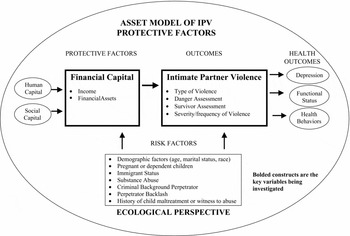
Traditional IPV interventions focus on increasing social capital through counseling, legal sanctions and shelter. Social work was the first discipline to look at the person-situation perspective (Laird, Reference Laird and Germain1979). Using an ecological framework, we propose that human, social and financial capital all need to be developed to bolster protective factors for IPV as shown in the Asset Model of IPV Protective Factors (see Figure 1). Thus, IPV may be related in a complex way to systems connecting the individual to his/her environment.
Figure 1.

Microenterprise growth in developing countries has shown success in the past 30 years by providing micro loans to poor women for creating self-employment, empowerment and homeownership. The Grameen Bank and its founder Dr Muhammad Yunus, were awarded the Nobel Peace Prize in 2006 for their social and economic development initiatives in underdeveloped countries and for influencing the empowerment of historically poor and oppressed women. Social work scholar Michael Sherraden (Reference Sherraden1991) suggested a similar initiative for the US called Individual Development Accounts (IDAs).
In the past decade, IDA initiatives have been instituted in the US, Canada, Taiwan and other developed countries as one policy strategy to help low-income individuals build (a) financial capital through investment in homeownership, small business development, or post-secondary education, (b) human capital through economic education and (c) social capital through group training and support. IDA participants set savings goals, receive economic education and receive matching funds upon reaching their goals. While IDAs have not yet specifically targeted IPV, we extend the current conceptualisation by suggesting that IDAs may serve as a protective factor for IPV.
Intimate partner violence
The ecological model of IPV suggests that violence comprises a complex network of individual, social and societal risk factors (World Health Organization, 2002). For example, individual risk factors for violence include traits (e.g. impulsivity) and personal history (e.g. substance abuse, prior history of abuse or aggression). Social risk factors include relationships with informal (e.g. family and friends) and formal (e.g. schools, workplaces and neighbourhoods) networks. Finally, cultural norms, structures and attitudes that support violence against women place women and children at risk for abuse (Dahlberg and Krug, Reference Dahlberg and Krug2006).
Up to 35 per cent of all women in the US and as much as 63 per cent of low-income women are physically or sexually abused by a current or former partner at some point in their lives (Tjaden and Thoennes, Reference Tjaden and Thoennes2000). While IPV occurs in all socioeconomic and racially diverse households, rates are higher for young, economically vulnerable couples living in densely populated urban areas (Dahlberg and Krug, Reference Dahlberg and Krug2006; Greenfeld et al., Reference Greenfeld1998). Economic abuse is an IPV component that is universally acknowledged but has received relatively little empirical inquiry or intervention support; it includes incidents that exert power and control over a woman's salary, savings, debt, credit and employment through actions or threats (Sanders, Reference Sanders2004; VonDeLinde, Reference VonDeLinde2002). Disparities in power over income in heterosexual relationships may place women at greater risk of IPV (Lyon, Reference Lyon2000).
Resolution of intimate partner violence
The transtheoretical model of change (Prochaska, Reference Prochaska1979) has increasingly been applied to describe the different stages in the process of IPV resolution (Burke, Denison, Gielen, McDonnell and O'Campo, Reference Burke, Denison, Gielen, McDonnell and O'Campo2004; Cluss et al., Reference Cluss, Chang, Hawker, Scholle, Dado, Buranosky and Goldstrohm2006; Dienemann, Campbell, Curry and Landenburger, Reference Dienemann, Campbell, Curry and Landenburger2002; Shurman and Rodriguez, Reference Shurman and Rodriguez2006). This model recognises that change in a chronic problem such as IPV is complex, non-linear and evolves over time. Thus, a victim's action to end the IPV relationship is not a one-off event, but instead is a multifaceted process.
There is clear evidence that when a women reaches the stage where she decides to leave the abuser, the danger has not ended; in fact this stage of independence and empowerment is also a time of increased risk for serious injury (Campbell et al., Reference Campbell, Garza, Gielen, O'Campo, Kub, Dienemann, Jones, Jafar and Modrow2003; Menard, Reference Menard2001). This stage may support the backlash hypothesis whereby increasing a woman's financial assets will increase violence. In other words, the IPV perpetrator may reassert control over a woman and her newly acquired assets as punishment for increasing her equity in the relationship. This phenomena has been found when women increase their human capital through employment (Riger and Staggs, Reference Riger and Scaggs2004).
The ecological model purports that IPV is complex and the ability to remain or leave an abusive relationship is dependent upon a number of environmental factors (Dahlberg and Krug, Reference Dahlberg and Krug2006). Frieze (Reference Frieze2005) suggests that levels of human, social and financial capital are related to IPV; socialist feminists link them to inequities in social class and gender (Martin et al., Reference Martin, Vieraitis and Britto2006). Anderson and colleagues (2003) found the most common reasons given by women who stayed in abusive relationships were lack of money, shelter and police support.
Income and asset poverty
Twenty eight per cent of female-headed households experienced poverty in 2004 compared with 13 per cent of male-headed households (US Census Bureau, 2005). One contributing factor is household composition; over 10 million single women compared with 2.2 million single men maintain households with children in 2000 (US Census Bureau, 2003). Another factor is related to inequitable wages; women in developed countries earn, on average, 77 cents for every dollar earned by a male (Global Policy Forum, 2005). However, this figure includes only 50 per cent of women and 85 per cent of men who work full-time over a 50-week period. Rose and Hartmann (Reference Rose and Hartmann2004) calculated wages for all women and men over a 15-year period and found that each year women earn approximately 57 cents on each dollar men earn. Some reasons for inequities include gender segregation in the labour market, part-time employment and labour market irregularities due to child rearing. Income disparities by race and ethnicity are also pronounced, with approximately 8.6 per cent of non-Hispanic white households living in poverty compared with 24.7 per cent of African-American and 21.9 per cent of Latino households (US Census Bureau, 2005).
Financial assets, such as home ownership and savings, provide economic stability, a means to buffer financial crises and appreciated wealth over time (Caner and Wolff, Reference Caner and Wolff2002). Almost 20 per cent of US households hold zero net worth and low-income female heads of households hold only 40 per cent of the net worth held by males (Woo et al., Reference Woo, Thomas, Buchholz and Uher2005). Excluding home equity, the disparity in assets among racial and ethnic groups is massive, with the median net worth of white households ($22,566) eclipsing Hispanic ($1,850) and African-American households ($1,166) (Orzechowski and Sepielli, Reference Orzechowski and Sepielli2003).
Household economic resources and IPV
Recent findings indicate a significant interaction between household income, locality and intimate partner violence, with low-income women living in disadvantaged neighbourhoods twice as likely to be victims of abuse (Benson and Fox, Reference Benson and Fox2004). Incidences of economic abuse play an important role in IPV experiences. For example, a study of over 350 male–female domestic abuse cases in Quincy, MA, found that nearly 60 per cent of women reported some type of abusive control over their money by their partners (Buzawa et al., Reference Buzawa, Hotaling, Klein and Byrne2000).
Couples who report extensive economic strain are three times more likely to experience violence than couples with low levels of economic strain. In addition, widening race and ethnicity differences in rates of IPV seem to begin at the mid-income level and increase as economic strain increases (Benson and Fox, Reference Benson and Fox2004). For example, when controlling for economic strain, researchers found the differences for IPV among mid-income African-Americans and non-Hispanic white people disappear or are dramatically diminished (Mahoney et al., Reference Mahoney, Williams and West2001; Schollenberger et al., Reference Schollenberger, Campbell, Sharps, O'Campo, Gielen, Dienemann and Kub2003).
The effects of IPV on the economic well-being of women who exit abusive relationships are daunting, often resulting in homelessness and severe economic strain. Recognising that income and asset poverty are important barriers to or consequences of leaving an abusive relationship for many women (Sanders, Reference Sanders2004), some IPV programs are now including financial education and economic advocacy as interventions (Correia and Von De Linde, Reference Correia and VonDeLinde2002). Thus, the development of an ecological framework for IPV prevention and treatment may help address the risk and protective factors of IPV for women.
Human capital
The concept of human capital can be attributed to economists such as Schultz (Reference Schultz1975), Becker (Reference Becker1964) and Mincer (Reference Mincer1974) and is defined as individual skills and competencies used for future privilege. Researchers have focused on educational attainment as a proxy measure since it is highly associated with higher earnings, benefits and advancement opportunities (Beverly and Sherraden, Reference Beverly and Sherraden1997; Filmer, Reference Filmer2003). Conversely, individuals without a high school education are more likely to be unemployed, receive welfare benefits and experience substance abuse and incarceration (Kirsch, Jungeblut, Jenkins and Kolstad, Reference Kirsch, Jungeblut, Jenkins and Kolstad1993).
Socialist feminists view gender and class as compounding factors contributing to male violence (Bailey, Reference Bailey1999; Escholtz and Vieraitis, Reference Eschholz and Vieraitis2004; Whaley, Reference Whaley2001). In a city-level study of rape, Martin et al. (Reference Martin, Vieraitis and Britto2006) found support for the socialist feminist view. They note that rape rates were lower in cities where women's absolute status (educational level, income and managerial position levels) was higher. Rape rates were higher in cities where inequity was greatest, thereby supporting the backlash hypothesis.
Alternately, there is empirical support for increased employment opportunities for women serving as a buffer for IPV (Farmer and Tiefenthaler, Reference Farmer and Tiefenthaler1997). Women with higher earned income and a comparable educational level to their partners are less likely to be abused than women with low-incomes and lower educational attainment (Lambert and Firestone, Reference Lambert and Firestone2000). Women with economic resources also are more able to end an abusive relationship and less likely to enter an abusive relationship (Campbell, Rose, Kub and Nedd, Reference Campbell, Rose, Kub and Nedd1998).
However, IPV also serves as a barrier to employment, with many IPV victims' jobs being sabotaged by perpetrators (Raphael, Reference Raphael2000; Riger and Staggs, Reference Riger and Scaggs2004). In terms of financial costs, IPV results in over $18 million in lost earnings for women annually and nearly $1.8 billion in lost productivity (CDC, 2003; Greenfeld et al., Reference Greenfeld1998). In addition, high turnover rates result in fewer benefits that are associated with work tenure (Moe and Bell, Reference Moe and Bell2004).
Social capital
Social capital is a multidimensional concept that has initiated extensive debate among political scientists, economists, ecologists and organisational researchers. Social capital is the intensity and extent of involvement in informal networks and formal community organisations that needs support over time or it will diminish (Adler and Kwon, Reference Adler, Kwon and Lesser2000; Grootaert et al., Reference Grootaert, Narayan, Jones and Woolcock2004). People experiencing poverty are more reliant on informal networks to meet daily needs and unstable employment reduces social connections that lead to promotions or other avenues to the middle class (Nurius et al., Reference Nurius, Macy, Bhuyan, Holt, Kernic and Rivara2003).
Abusers have been found to isolate women from informal and formal social networks to increase control (Waldrop and Resisk, Reference Waldrop and Resick2004). For low-income women, this also reduces their opportunities to barter for necessities such as childcare, food, small loans, or transportation. Isolation becomes even more problematic during times of financial, health, or other crises (World Bank, 2002). Most IPV interventions depend on women using their social capital for information and support from informal and formal sources such as health care providers, hotlines or websites (Sullivan and Gillum, Reference Sullivan, Gillum, Renzetti, Edleson and Bergen2001). While social support can serve as a protective factor against reabuse (Burke et al., Reference Burke, Denison, Gielen, McDonnell and O'Campo2004; Goodman et al., Reference Goodman, Dutton, Vankos and Weinfurt2005), women ending abusive relationships often relocate for safety, thereby leaving friends and family behind (Wilcox, Reference Wilcox2000).
Financial capital
Financial capital is defined as savings and other interest-bearing bank accounts, investments and property assets that generate increased value (Sherraden, Reference Sherraden1991). A certain level of economic prosperity is needed to meet basic needs such as food, clothing, shelter, and health care (Hancock, Reference Hancock2001). While income provides a cash flow, assets can help reduce IPV by providing individuals with economic protection, a safer neighbourhood and future investment opportunities (Caner and Wolff, Reference Caner and Wolff2002; Raphael, Reference Raphael2001). Petersen (Reference Petersen1980), Schuler and Hashemi (Reference Schuler and Hashemi1994) and Levinson (Reference Levinson1989) found a negative relationship between assets and marital abuse in independent studies both nationally and internationally.
Given the low home ownership rate of women and the limited availability of affordable or government subsidised housing in the US, many women leaving abusive relationships must access homeless shelters or become homeless. One study reports that 38 per cent of women became homeless immediately after leaving their partners; housing problems were still prevalent for 25 per cent to 50 per cent of women one year after they left. Even if they access housing, formerly abused women may lose shelter due to perpetrators damaging property or threatening landlords or other tenants (Baker, Cook and Norris, Reference Baker, Cook and Norris2003; Menard, Reference Menard2001).
Economic strain occurs when there is insufficient income to meet basic needs. Some long-term consequences of economic strain may include homelessness, malnutrition, illness and loss of reliable transportation. A financial crisis may quickly become dire if there are no assets to provide an ‘economic safety net’. Low-income IPV victims are often economically dependent upon their perpetrators and are not in a position to acquire or control financial assets (Lambert and Firestone, Reference Lambert and Firestone2000). Thus, economic dependency is an important factor women consider when deciding whether to leave an abusive relationship (Anderson et al., Reference Anderson, Gillig, Sitaker, McCloskey, Malloy and Grigsby2003; Sanders, Reference Sanders2004).
Social policy strategy
Individual development accounts
One approach to moving people out of poverty is by supporting asset development policy initiatives. Historical examples in the US include the Homestead Act for home ownership, the G.I. Bill for veterans to seek post-secondary education and home ownership and, most recently, Individual Development Accounts (IDAs). IDAs provide dedicated savings accounts for low-income individuals to obtain homeownership, post secondary education or small business development (Sherraden, Reference Sherraden1991). Eligible IDA participants set savings goals, receive economic education and are provided with matching funds for a specified asset purchase. Welfare recipients are also eligible, through special policy arrangements in the Personal Responsibility and Work Opportunity Reconciliation Act of 1996 that removed traditional penalties, to accumulate assets (Edwards, Reference Edwards2005).
The success of IDA programs offsets common misconceptions that people experiencing poverty lack the motivation to save, delay gratification, accrue too many bills, or suffer from ‘rampant consumerism’ (Conley, Reference Conley1999). In the past ten years over 500 IDA programs, totaling 20,000 IDA accounts, have been instituted in 49 states (Edwards and Mason, Reference Edwards and Mason2003). IDAs have been used with populations experiencing significant markers of disadvantage, including poverty, mental illness, homelessness and immigration, with positive results.
Yet IDA programs have not been identified as an IPV prevention or intervention programme, nor have IPV data been collected for IDA participants. IDA programs may be ideal for women who have experienced domestic violence since they are known primarily as ‘female-driven’ initiatives; 75 per cent of non-Hispanic white and 85 per cent of African American IDA savers are female (Grinstein-Weiss and Sherraden, Reference Grinstein-Weiss and Sherraden2004). Zhan (Reference Zhan2003) found that despite low wages, lack of child support and minimal public assistance benefits, single, low-income female IDA savers were able to successfully build assets over time.
While IDA programs do not target IPV victims, some do have social work case management supports for IDA participants. Sanders (Reference Sanders2004) outlines an IDA program specifically designed to support IPV victims in St Louis, Missouri through economic education, IPV counseling and advocacy and community education. The Redevelopment Opportunities for Women's Economic Action Program (REAP) consists of 13 domestic violence and three homeless agencies serving IPV victims. Future empirical findings related to the REAP program can help educate future programs that address in whole or in part IPV.
IDAs and intimate partner violence
Many US communities offer IDA programs to assist low-income families build assets. Recent research indicates that IDAs increase specific measures of well being, including future orientation, additional asset development, self-efficacy, child well-being and decrease economic strain (Shobe and Boyd, Reference Shobe and Boyd2005; Shobe and Christy-McMullin, Reference Shobe and Boyd2005). We propose targeting widespread IDA programs for low-income women with a history or disclosure of IPV. IDAs are traditionally placed in the name of the IDA member alone, thus joint accounts are not generally initiated. This IDA program would be part of an existing comprehensive IPV program that addresses evidence-based risk factors and that provides social work case management services to address IPV-related issues.
The usual length of time for an IDA participant to reach their goal and have the down payment for a home, tuition for secondary education or capital for a small business is 1–3 years. Evaluation of the long-term well being of the IDA participants, drop outs and a control group of agency participants would include IPV status including reabuse of victims, employment stability, size and intensity of social supports, intensity of IPV service use and financial capital one and two years after completing the program.
Conclusion
There is preliminary evidence that financial capital may serve as a buffer against intimate partner violence. Such financial capital includes both sufficient income for basic needs and assets for a safety net when crises occur. This would support asset theory, first proposed by Sherraden (Reference Sherraden1991), whereby the presence of assets has positive effects on well-being, independent of income. In the past decade, individual development accounts initiatives have been instituted nationwide based on this theory. So far, they have demonstrated the efficacy of low-income people to save and build assets. Longitudinal studies are needed to demonstrate stable movement into the middle class by participants.
This would also lend support to the ecological perspective. Given the high rates of poverty among young households and the hypothesised mediating factors of human, social and financial capital for decreasing rates of IPV, interventions should include activities to address all three areas. Since IDAs address financial capital deficits and support human and social capital gains, they may provide an effective addition to IPV-focused social policies and programs.