Rhabdomyomas are the most common paediatric tumour, accounting for 33.1% of all cardiac tumours in paediatrics.Reference Tzani, Doulamis, Mylonas, Avgerinos and Nasioudis1 These tumours are usually benign with no hemodynamic issues and they do regress over time. However, there are some reports of the tumour leading to obstruction of ventricular outflow requiring surgical resection.Reference Obeidat, Qawasmeh, Tarawneh, Sawalhah and Tawalbeh2–Reference Ibrahim, Thakker, Miller and Barron5 We report a neonate who was diagnosed with multiple rhabdomyomas in the right ventricular cavity leading to significant cyanosis. The patient was treated with prostaglandin infusion and required Blalock–Taussig shunt.
Case report
A 36-year-old Gravida 1 Para 0 female presented to our cardiology foetal clinic for a foetal echocardiogram. At 30 weeks of gestation, the fetus was found to have multiple homogenous cardiac masses and the largest mass was located in right ventricle attached to the ventricular septum, measuring up to 2.0 × 1.5 cm. The second largest one was in the left atrioventricular groove, measuring up to 1.5 × 1.2 cm. A follow-up foetal echocardiogram at 36 weeks and 3 days of gestation revealed that the largest mass obliterated the tricuspid valve, right ventricle cavity, and pulmonary valve. There was unrestricted right-to-left shunt across the patent foramen ovale. The flow across the pulmonary valve did not demonstrate. There was no tricuspid valve regurgitation. Biventricular function appeared to be normal. A small amount of pericardial effusion was present.
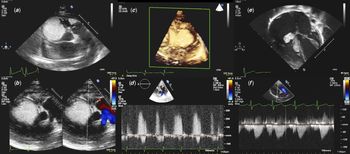
Therefore, the decision was made to perform urgent C-section for concerns for hydrops fetalis. A baby girl was born at 36 weeks gestation with a birth weight of 2845 g. A postnatal echocardiogram confirmed multiple rhabdomyomas in right and left ventricle. The mass in the right ventricle is occupying virtually entire right ventricle and obstructing the tricuspid valve inflow. The tumour size was 2.5 × 2.0 cm (Fig 1a). The 1.0 × 1.0 cm mass in the left ventricle was located in the left side of atrioventricular grove close to the mitral lateral leaflet. There was no mitral valve stenosis or significant regurgitation. There was no flow noted across the tricuspid valve with colour as well as spectral Doppler. The pulmonary valve was normal in morphology with no forward flow across the valve and behaving more like a functional pulmonary valve atresia (Fig 1b and d). There was mild pulmonary valve insufficiency confirming the functional pulmonary valve. The pulmonary venous return was normal. The right ventricular rhabdomyoma was assessed using the 3D echocardiogram (Fig. 1c). There was a moderate size patent foramen ovale with entirely right to left shunt. There was a large patent ductus arteriosus with left-to-right shunt. As no flow was seen across the pulmonary valve, the patient was started with prostaglandin infusion. She continued to be stable on prostaglandins and it was decided to perform right Blalock–Taussig shunt. She had successful Blalock–Taussig shunt performed on day 12 of age and prostaglandins infusion was weaned off. During the hospital stay, she was diagnosed as tuberous sclerosis. She was discharged in hemodynamically stable condition with aspirin for Blalock–Taussig shunt.
Echocardiogram at birth (a–d) and at 5 years of age (e and f). (a) Echocardiogram at birth showed a large tumour occupying the entire right ventricle cavity. (b, d) No forward flow through pulmonary valve was detected on Doppler echocardiogram. (c) 3D images of the mass. (e and f) Follow-up echocardiogram at 5 years of age showed regression of the mass with forward flow through pulmonary valve on Doppler echocardiogram.

She continued to have progressive regression of tumours. At 2 years of age, she demonstrated the improvement in the size of the rhabdomyomas and forward flow across the right ventricular outflow tract was documented. She underwent cardiac catheterisation for test occlusion of Blalock–Taussig shunt, followed by device closure. Test occlusion was performed with 5-Fr Berman wedge catheter balloon with satisfactory cardiac index and oxygen saturation level. Therefore, Blalock–Taussig shunt was occluded by 5 mm AMPLAZER™ Vascular Plug 4. She is presently 5 years of age, and she has the 2.3 × 0.3 cm tumour in right ventricle without any evidence of obstruction (Fig 1e and f). She also has small atrial septal defect on echocardiogram, which has been followed.
Discussion
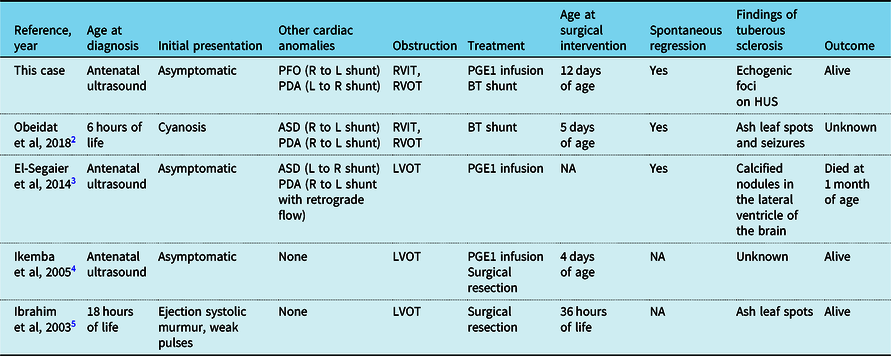
Cardiac rhabdomyomas are the most common primary cardiac tumour in children, accounting for 33.1% of all cardiac tumours in paediatrics. They are usually multiple homogenous echogenic tumours present in right and left ventricle, more common in the left ventricle.Reference Tzani, Doulamis, Mylonas, Avgerinos and Nasioudis1 They are mostly benign and usually regress in size spontaneously after the birth of the child, with most of them regressing in first years of life.Reference Fesslova, Villa, Rizzuti, Mastrangelo and Mosca6 However, sometime these tumours due to their size and location lead to ventricular inflow or outflow obstruction leading to decrease cardiac output and hemodynamic compromise.Reference Obeidat, Qawasmeh, Tarawneh, Sawalhah and Tawalbeh2–Reference Ibrahim, Thakker, Miller and Barron5 Previously reported paediatric cases with ventricular inflow or outflow obstruction are summarised in Table 1.
Clinical features of children with significant ventricular inlet or outlet obstruction caused by cardiac rhabdomyoma

ASD = atrial septal defect; BT = Blalock–Taussig; HUS = head ultrasound; L = left; LVOT = left ventricular outflow tract; PDA = patent ductus arteriosus; PGE1 = prostaglandin-E1; R = right; RVIT = right ventricular inflow tract; RVOT = right ventricular outflow tract.
Obeidat et al reported the similar case of a newborn who had multiple rhabdomyomas in the interventricular septum which caused right ventricular inflow obstruction. The patient presented cyanosis at 6 hours of life, required prostaglandin, and underwent Blalock–Taussig shunt at day 5 of age. This patient demonstrated the regression of the mass at the age of 7 months and was planned for Blalock–Taussig shunt closure at the catheterisation lab. The patient was subsequently diagnosed as tuberous sclerosis.Reference Obeidat, Qawasmeh, Tarawneh, Sawalhah and Tawalbeh2
Most patients with cardiac rhabdomyoma do not require surgery, and the management is usually conservative. However, patients with hemodynamic compromise or severe arrhythmia are indicated for surgical treatment. The surgery for cardiac rhabdomyomas can be either of total or partial resection of the tumour. Some previously reported patients had partial resection because a large tumour could not be fully resected. Even in such cases, partial resection can relieve the clinical symptoms and improve hemodynamic compromise. The residual tumours are expected to regress thereafter.
In our case, Blalock–Taussig shunt was necessary because of severe right ventricle cavity and right ventricular outflow tract obstruction and ductal dependence. The flow across the patent foramen ovale was entirely right to left during and no obvious flow was seen across the tricuspid valve and pulmonary valve during first few days of life making this a ductal dependent lesion even in presence of normal pulmonary valve and tricuspid valve. There was a spontaneous regression of the tumour, which gradually improved the flow through right ventricular outflow tract. She did not require surgical resection. Although the best treatment option for rhabdomyomas with right ventricular outflow tract obstruction is still unknown, our case suggested that a palliation with Blalock–Taussig shunt is an alternative approach as these tumours tend to regress over time.
Acknowledgements
None.
Author contributions
D.T.: writing the manuscript; all authors: critically reviewing the manuscript.
Financial support
This research received no specific grant from any funding agency, commercial or not-for-profit sectors.
Conflicts of interest
None.
Ethical standards
Not applicable.