Introduction
With the development of wireless communication technology, more and more spectrum is being developed and utilized, and many terminal devices need to work in multiple frequency bands. The multi-band technology of the antenna allows a single antenna to realize multiple working frequency bands in multiple communication standards, which is gaining increasing attention. Researchers have proposed a series of methods, such as gap loading technology [Reference Yeap, Yeo, Lai and Xo1–Reference Li, Mou, Ji, Yu, Li and Jiang8], multi-branch technology [Reference Liu, Sun and Li9–Reference Wang and Wang15], reconfigurable technology [Reference Ullah, Ahmad, Khan and Flint16, Reference Mansoul and Seddiki17], loading a soft magnetic ferrite film [Reference Wu, Yu, Pang, Wang and Zhou18], and so on.
A tri-band E-shaped printed antenna with C-shaped slots was presented by Kim Ho Yeap [Reference Yeap, Yeo, Lai and Xo1], which operated at a tri-band of 1.51/2.46/6.11 GHz. A coplanar waveguide (CPW)-fed compact tri-band antenna composed of three monopole radiators is proposed by Liu in [Reference Liu, Sun and Li9]. The antenna works at three bands 2.36–2.82, 3.28–3.88, and 4.50–6.53 GHz for WLAN/WiMAX application. Ullah proposed an antenna that works at six frequencies: 2.10, 2.40, 3.35, 3.50, 5.28, and 5.97 GHz for Wi-Fi, 3G advanced, WiMAX, and WLAN wireless applications; the antenna uses reconfigurable technology, operates in four different frequency modes by the state of the two lumped element switches [Reference Ullah, Ahmad, Khan and Flint16]. However, as the size of the antenna increases with decreasing frequency, the present multi-band antenna technology is mainly concentrated above 1 GHz, and the research on multi-band antenna below 1 GHz is relatively few. On the other hand, low-frequency communication has the advantages of long coverage distance, and many communication frequencies are lower than 1 GHz, such as GSM 850/900, radio frequency identification (RFID), etc.
A multiband planar antenna was reported in [Reference Cui, Yang, Liu and Li13], which covers four frequency bands (−6 dB impedance): 696–970 MHz, 683–2700 MHz, 3070–3755 MHz, and 4590–7604 MHz. The size of the antenna is 15 mm × 65 mm, and the dimension of ground plane is 110 mm × 65 mm. In [Reference Wu, Yu, Pang, Wang and Zhou18], by loading a soft magnetic ferrite film on the strong radiation area, the frequencies (−6 dB impedance) shifted to cover the range of 692–1191 MHz and 1698–3020 MHz. The antenna area occupies a size of 11 mm × 30 mm on the left corner above the system circuit board which has a standard dimension of 115 mm × 60 mm. These planar antennas have a low profile, but they need a large ground plane.
A planar monopole antenna with added L- and U-shaped monopoles was presented in [Reference Yousuf and Tlili12] to provide four operating bands: 858–931 MHz, 1.571–2.845 GHz, 3.42–4.42 GHz, and 5.26–6.32 GHz. In [Reference Wang and Wang15], a monopole reader antenna for RFID portable devices was developed to cover three frequency bands: 902–928 MHz, 2.4–2.48 GHz, and 5.725–5.875 GHz. However, the size of the antenna is too large for the miniaturization of the terminal devices.
In [Reference Li, Mou, Ji, Yu, Li and Jiang8], an antenna of size 30 mm × 30 mm for RFID applications was reported, operating at 0.915–0.925, 2.425–2.455, and 5.45–6.16 GHz. However, the gain at the low resonant frequency 0.92 GHz was only −12.1 dBi.
Moreover, the available designs have a small number of frequency bands, narrow frequency coverage, which cannot meet the application requirements of multiple communication standards [Reference Wang and Chan19, Reference Singh, Kanaujia, Pandey, Gangwar and Kumar20].
The main factor that differentiates our study from the summarization study is a compact multiband antenna without large ground plane, which covers the lowest frequency band 820–990 MHz, and the highest band 5.47–8.9 GHz. With three branches, the antenna resonate at five frequencies (−10 dB impedance) 0.9/2.0/2.7/4.15/5.8 GHz, the simulated gain at the five frequencies is −3.30, 0.82, 1.08, 3.42, and 3.00 dBi, respectively, which can meet RFID (0.92/2.45/5.8 GHz), GSM900 (0.9 GHz), GSM1900 (1.9 GHz), WLAN (2.4/5.8 GHz), WiMAX (2.5 GHz), sub 6 GHz in 5G mobile communication system, satellite communication, and other application requirements.
Antenna description
Antenna structure
The traditional monopole antenna is formed by removing one arm of the dipole antenna according to the mirror principle through an infinite ground plane. The planar monopole and the ground plane of the proposed antenna are printed on the same side of the dielectric substrate. Impedance matching is achieved by adjusting the ground area and the gap size between the monopole and the ground.
The length of monopole antenna is about a quarter wavelength, and the wavelength λ of electromagnetic wave in free space can be calculated by using equation (1). However, due to the use of a dielectric substrate, part of the electromagnetic wave propagates in free space, while the other part propagates in the dielectric substrate. The wavelength λe in the dielectric substrate is determined by using equation (2). Therefore, the wavelength corresponding to the length of monopole should be between λ and λe:


where c represents the propagation velocity, f represents the frequency of the electromagnetic wave, and ɛr represents the dielectric constant of the dielectric substrate.
Configuration of the proposed antenna is shown in Fig. 1. The antenna was designed on a low cost FR4 substrate, with a dielectric constant of 4.4, loss tangent angle of 0.02, and thickness of 1 mm. The antenna is fed by a CPW. In order to achieve multi-band coverage, the monopole adopts three branches with different lengths. Because the wavelength of low frequency 900 MHz is very long, the longest branch was bent to achieve the miniaturization of the antenna. The space occupied by the left and right branches is different, the ground plane of the short branch is cut accordingly, and then the feeding position is not in the central position of the antenna.
Geometry of the proposed antenna.

According to the quarter wavelength of formulas (1) and (2), the initial length and the final optimized simulation length of each branch are shown in Table 1. The shortest branch is 10 mm for 5.8 GHz, the longest branch is 75 mm for 900 MHz, and the middle length branch is 25 mm for 2 GHz.
Lengths of the three branches

Principle of operation
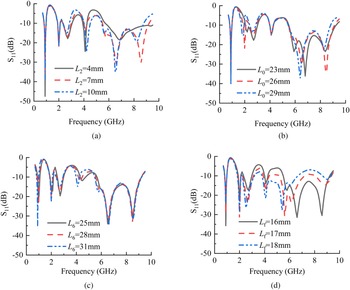
In order to explain the principle of the antenna, several key parameters are studied as shown in Fig. 2. In Fig. 2(a), it can be seen that the length L 2 of the shortest branch mainly affects the high-frequency bands, and has no effect on the low frequency 0.9/2.0 GHz. As L 2 increases, the resonant frequency moves to low frequency. Figure 2(b) depicts the effect of the length L 0 of the middle branch. L 0 mainly affects 2.0/2.7/5.8 GHz, has no effect on low frequency 0.9 GHz, and has little effect on 4.15 GHz. The impact of the length L 6 of the longest branch on the antenna is shown in Fig. 2(c). The low-frequency resonant frequency decreases with the increase of L 6, but L 6 has no effect on the high frequency of 5.8 GHz. Figure 2(d) illustrates that the length of Lf of the feed microstrip line affects the impedance matching of all resonant frequency points. Meanwhile, as the Lf increases, the resonant frequency decreases in the high band. However, it has almost no effect on the 0.9 GHz resonant frequency, because the length of the branch in this frequency is much longer than Lf, and the change of Lf has little effect on the total length, so it does not affect the resonant frequency.
Simulated S 11 for different lengths of (a) L 2, (b) L 0, (c) L 6, and (d) L f.

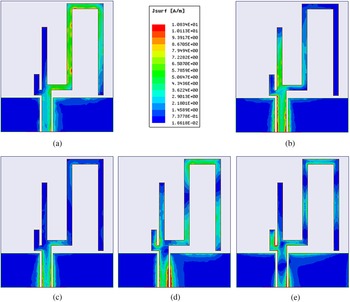
The surface current distribution of the antenna at five different resonant frequencies is shown in Fig. 3. In Fig. 3(a), the current mainly flows at the longest branch, it indicates that the low-frequency band at 0.9 GHz is determined by the longest branch. The current at 2.0 GHz spreads at the middle branch with middle length as shown in Fig. 3(b). At the resonant frequency of 2.7 GHz, the strong current flows at the microstrip line and the left short branch. In Fig. 3(d), we can see that the strong current distributes at the longest branches, but two obvious current zero points can be seen, indicating that the resonance point is in the form of high mode. The highest frequency 5.8 GHz current spreads at the shortest branch. The current distributions are consistent with the previous parameter analysis results.
Surface current distributions of at different frequencies: (a) 0.9 GHz, (b) 2.0 GHz, (c) 2.7 GHz, (d) 4.15 GHz, and (e) 5.8 GHz.

Results and discussion
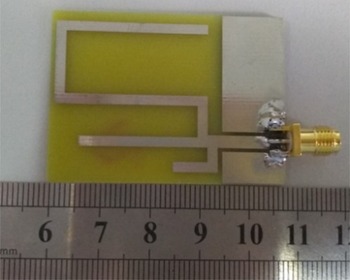
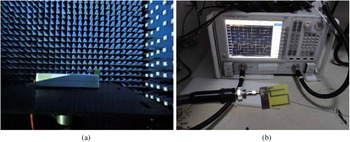
Through detailed simulation and optimization, the dimensions of the antenna are shown in Table 2. The prototype is fabricated and displayed in Fig. 4. Measured results of return loss and radiation patterns were obtained by a network analyzer and a chamber antenna measurement system, and Fig. 5 shows the actual environment of far-field radiation characteristics measurements. Experimental results show that the proposed antenna with a compact size of 48 mm × 35 mm × 1 mm has good impedance matching and nearly omni-directional radiation patterns at five resonant bands.
Prototype of the proposed antenna.

Prototype of the measurement environment: (a) far-field radiation characteristics and (b) return loss.

Dimensions for the proposed antenna

Figure 6 depicts simulated and measured return loss of the proposed antenna. There is reasonably good agreement between the measured and the simulated results. It can be seen that the antenna has −10 dB impedance band widths of 170 MHz (0.820–0.990 GHz), 210 MHz (1.87–2.08 GHz), 560 MHz (2.37–2.93 GHz), 290 MHz (3.98–4.27 GHz), and 3.43 GHz (5.47–8.9 GHz). The first band is essentially useful for the RFID (860–960 MHz) and GSM900 (890–915 MHz and 935–960 MHz). The second band finds wide applications in the GSM. The third band serves the RFID (2.4–2.483 GHz), WLAN (2.4–2.484 GHz), and WiMAX (2.5–2.69 GHz). The fourth frequency band can be used for 5G communications. And the fifth band is essentially useful for RFID and WLAN (5.725–5.875 GHz), the WiFi 6 band form the IEEE 802.11ax (5.925–7.125 GHz), and the unlicensed frequency bands are commonly used for satellite communications, and may soon be opened for mobile services.
Simulated and measured return loss S 11 of the proposed antenna.

The simulation peak gain and radiation efficiency of the antenna are depicted in Fig. 7. The gains of the resonant frequencies we interest at 0.9/2.0/2.7/4.15/5.8 GHz are −3.30/0.82/1.08/3.42/3.00 dBi respectively. The highest peak gain is 5.1 dBi, the mid-to-high-frequency band does not change much. But, the gain of the low-frequency band is significantly reduced due to the reduction of the antenna size, which will shorten the radiation distance of the antenna. The minimum gain is −4 dBi in 0.820–0.990 GHz bandwidth. The radiation efficiency of the antenna in the operated bands is more than 88%, and reached a maximum of 96%, while a huge decrease in antenna efficiency is noticed at 1.3 GHz. This sudden decrease in efficiency shows that the antenna cannot operate in this band.
Simulated peak gain and efficiency of the antenna.

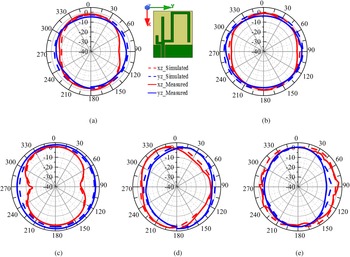
The simulated and measured radiation patterns in the xz plane and yz plane at five resonant frequencies are shown in Fig. 8. In the yz plane at the five resonant frequencies the radiation patterns are approximately circular, indicating that the antenna has good omni-directionality.
Measured and simulated radiation patterns of the proposed antenna at xz plane and yz plane: (a) 0.9 GHz, (b) 2.0 GHz, (c) 2.7 GHz, (d) 4.15 GHz, and (e) 5.8 GHz.

In Table 3, the performance of the proposed multiband antenna is compared with the antennas reported in the literature, which can cover the frequency band below 1 GHz. The size comparisons are performed based on the air wavelength λ 0 at the lowest resonant frequency. The bandwidths are −10 dB impedance bandwidth in [Reference Li, Mou, Ji, Yu, Li and Jiang8, Reference Yousuf and Tlili12, Reference Mandal and Pattnaik14, Reference Wang and Wang15], while the bandwidths are −6 dB impedance bandwidth in [Reference Cui, Yang, Liu and Li13, Reference Wu, Yu, Pang, Wang and Zhou18]. The −10 dB impedance bandwidth in [Reference Cui, Yang, Liu and Li13, Reference Wu, Yu, Pang, Wang and Zhou18] is smaller than the given value in the table. The proposed antenna has compact size with simple structure, without large ground plane. At the lowest resonant frequency 900 MHz, the size of the proposed antenna is much smaller than a quarter wavelength from equations (1) and (2). Although the dimension of the proposed antenna is a little larger than that in [Reference Li, Mou, Ji, Yu, Li and Jiang8], the antenna gain at 900 MHz is −3.30 dBi, which is much higher than −12 dBi in [Reference Li, Mou, Ji, Yu, Li and Jiang8]. And the proposed antenna has the widest impedance band and the maximum number of frequency bands, which covers the lower band 0.82–0.99 GHz and the higher band 5.47–8.9 GHz.
Comparison of the proposed antenna with existed literatures

Conclusion
A compact CPW-fed monopole antenna with three branches is designed, fabricated, and tested. According to the measured results, the −10 dB matching bandwidth is 170 MHz (820–990 MHz), 210 MHz (1.87–2.08 GHz), 560 MHz (2.37–2.93 GHz), 290 MHz (3.98–4.27 GHz), and 3.43 GHz (5.47–8.9 GHz). The radiation pattern in the yz plane of the antenna is nearly omnidirectional. The minimum antenna gain is −3.30 dBi at the lowest resonant frequency 900 MHz. The antenna may be applied to terminal devices of wireless communication system with multiple communication standards.
Acknowledgement
This study was supported by the Natural Science Research Project of Education Department of Anhui Province (KJHS2020B14, KJ2020A0684, and KJHS2019B01), and the Science & Technology Project of Huangshan City (2020KG-04).
 YunYan Zhou received her M.S. degree in circuits and systems from Anhui University, Anhui Province, China, in 2009. She is a lecturer in the College of Mechanical and Electrical Engineering, Huangshan University, Anhui Province, China. Her current research interest is in planar antenna design.
 NianShun Zhao received his Ph.D. in 2018 from Northwest Polytechnical University, Shaanxi Province, China. He is an associate professor in the College of Mechanical and Electrical Engineering, Huangshan University. He has authored more than 30 research articles. He is active in the study of functional ceramic materials.
 RenXia Ning received her M.S. degree in circuits and systems from Anhui University, Anhui Province, China. She is an associate professor in the College of Information Engineering of Huangshan University, Anhui Province, China. She has authored more than 20 research articles. Her current research interest is electromagnetic properties and applications of graphene.
 Jie Bao received her Ph.D. in 2017 from Shanghai University, Shanghai, China. She is a professor in the College of Mechanical and Electrical Engineering, Huangshan University, China. She has authored more than 30 research articles. Her current research interest is semiconductor packaging technology.