INTRODUCTION
Living with a chronic, debilitating illness poses immense stress for patients, their caregivers, and loved ones and negatively impacts many aspects of their lives (Aoun et al., Reference Aoun, Kristjanson and Currow2005). Despite medical and technological advances that extend the lifespan for those living with a chronic condition, the course of such illnesses remains unpredictable in terms of its severity, symptomology, and personal experience (Aoun et al., Reference Aoun, Kristjanson and Currow2005; Baanders & Heijmans, Reference Baanders and Heijmans2007). Related to the unpredictability of chronic illnesses, patients must negotiate conflicting roles (e.g., sick vs. well, caregiver vs. care-receiver), social relations (unknown impact on long-term relationships), and responses (e.g., stigma versus acceptance), and unclear financial consequences (Bayliss et al., Reference Bayliss, Edwards and Steiner2008; Biordi, Reference Biordi, Lubkin and Larsen2002). Grief and loss are commonly experienced as patients deal with the disruption in their functioning and activities they had achieved prior to the illness (Zemzar, Reference Zemzar and Milligan1984; Poochikian-Sarkissian et al., Reference Poochikian-Sarkissian, Sidani and Wenneberg2008). As chronic illnesses progress and become more debilitating, many patients become more reliant on their caregivers, and their loss of independence can lead to a sense of powerlessness (Miller, Reference Miller2000). Social isolation can often become a way to cope and control a situation that seems overwhelming (Biordi, Reference Biordi, Lubkin and Larsen2002).
Approximately 52 million Americans (over 30% of the adult population) provide “informal care” to a friend or family member who is ill or disabled (McCorkle et al., Reference McCorkle, Hughes and Levinson1998). As a patient's health trajectory worsens, caregivers take on increasingly important roles and face their own group of challenges similar and different from the patients themselves. These caregivers, who are often family and friends of the patients, can experience depression and fatigue (Travis & Piercy, Reference Travis, Piercy, Lubkin and Larsen2002), stress and exhaustion (Wardlaw, Reference Wardlaw1994), uncertainty (Brown & Powell, Reference Brown and Powell-Cope1991; Palattiyil & Chakrabarti, Reference Palattiyil and Chakrabarti2008), lack of knowledge about patient care and role changes (Aoun et al., Reference Aoun, Kristjanson and Currow2005), and economic strain (Aoun et al., Reference Aoun, Kristjanson and Currow2005; Baanders & Heijmans, Reference Baanders and Heijmans2007; Palattiyil & Chakrabarti, Reference Palattiyil and Chakrabarti2008). In addition, caregivers' personal and social lives also suffer under the strain and time involved in caregiving (Baanders & Heijmans, Reference Baanders and Heijmans2007). Caregivers can experience isolation and resentment as a result of their caregiving duties (Aoun et al., Reference Aoun, Kristjanson and Currow2005).
Deficits in resources and support exacerbate the stress and burden of caregivers (Hughes, Reference Hughes2005). Findings indicate greater stress among low-income caregivers, among caregivers with less external support, and those who juggle multiple roles and responsibilities (e.g., childrearing, full-time employment) and manage such expenses as mortgage and childcare along with caregiving responsibilities (Turner & Catania, Reference Turner and Catania1997). Gaugler et al. (Reference Gaugler, Hanna and Linder2005) highlight the challenge of caregiving among low-income families by reporting that “families with fewer economic resources may be restricted to providing care within the family, leading to a sense of frustration or even feelings of entrapment due to care responsibilities.” The large number of patients and caregivers facing the difficult challenges of living with chronic, debilitating illnesses have implications for how palliative care is provided.
With medical advances in life-prolonging and palliative treatments, the distinctions between treatments intended to prolong life and those intended to improve a patient's comfort and quality of life are often blurred and occur concurrently in palliative care initiatives (Byock & Twohig, Reference Byock, Twohig, Ferrell and Coyle2006). By definition, palliative care includes medical care to patients with advanced, incurable illnesses that is introduced at diagnosis and extends through the course of treatment, decline, death, and grief. This model of health service delivery is more consistent with the needs of chronically ill patients and their families but is currently not being practiced in most medical settings (Davies & Higginson, Reference Davies and Higginson2004).
To more fully understand the needs of patients and caregivers with limited resources and barriers to accessing resources, we used an ecological approach to collect data on the stresses of daily living that patients with chronic health conditions and their caregivers experience, the barriers and obstacles to receiving help, and resources in patients' environments to help with these stresses. Based on these data, our goal was to develop an interdisciplinary intervention to address the barriers to palliative care experienced by underserved patients and caregivers.
BACKGROUND LITERATURE
Social and Economic Barriers to Palliative Care
A growing body of research highlights the disparities that exist around access to adequate healthcare in general, and palliative care specifically, by medically underserved populations. While “medically underserved” may have many definitions, the term typically encompasses populations with inadequate access to healthcare and often includes elderly, poor, urban-dwelling minorities (Gaston et al., Reference Gaston, Barrett and Johnson1998). While there is strong evidence that health disparities exist among racial and ethnic minorities living with chronic illnesses such as cancer, diabetes, and heart disease, socioeconomic status (SES) is a key risk factor across the illness continuum, from preventative services to palliative care. Furthermore, social and economic barriers can hinder access to quality palliative and end-of-life care. The underutilization of hospice is a case in point (Connor et al., Reference Connor, Teno and Spence2008).
Despite the growing consensus around the benefits of hospice care for patients who are dying or likely to die from their illness, many inner-city racial and ethnic minority patients do not have access to this care. This lack of access is either because they have little knowledge related to the benefits of palliative care as an option to make important decisions about what they need or want, or because healthcare centers that offer expertise in palliative or end-of-life care do not want to be challenged by the economic or safety risks of serving poor, downtrodden communities that lack coordinated resources. In other words, palliative care disparities are related to lack of empowerment in decision-making or lack of access to services.
Hospice underutilization among African Americans and Latinos is well documented (Connor et al., Reference Connor, Teno and Spence2008). Obstacles to adequate hospice care for these groups may include limited financial resources or health insurance; lack of available or willing healthcare providers or volunteers; limited access to consistent primary care providers; historically or culturally based mistrust of the medical system; provider insensitivity to cultural, ethnic, linguistic, or religious differences; and other competing psychosocial factors such as substance abuse and mental illness (Kane et al., Reference Kane, Wales and Berstein1984; Gaston et al., Reference Gaston, Barrett and Johnson1998; Reese et al., Reference Reese, Aher and Nair1999; Dy et al., Reference Dy, Reder and McHale2003; Winston et al., Reference Winston, Leshner and Kramer2005). Barriers to hospice utilization have been also tied to lack of awareness, prohibitive cost, and language challenges on the part of Latinos and African-American urban dwellers (Kane et al., Reference Kane, Wales and Berstein1984). One study found that elderly, low-income, urban-dwelling, black women living alone with cancer were most likely to have unmet homecare needs and high levels of symptom distress (O'Hare et al., Reference O'Hare, Malone and Lusk1993). Beyond issues of access, there has been a growing appreciation in recent years for cultural competence in the delivery of palliative care. In particular, the culture and backgrounds of patients can help or hinder traditional approaches to palliative care intervention, as well as the ways in which delivery of palliative care must be modified in order to provide effective care to patients and families of all backgrounds (Krakauer et al., Reference Krakauer, Crenner and Fox2002; Morrison & Meier, Reference Morrison and Meier2004; Reese et al., Reference Reese, Melton and Ciaravino2004; Johnson et al., Reference Johnson, Kassner and Houser2005; Fatone et al., Reference Fatone, Moadel and Foley2007; Koffman et al., Reference Koffman, Burke and Dias2007; O'Mahony et al., Reference O'Mahony, McHenry and Snow2008; Smith et al., Reference Smith, McCarthy and Paulk2008).
Although there is a greater burden shared by racial and ethnic groups specifically with the chronic illness of cancer (Kane et al., Reference Kane, Berstein and Wales1985), there has been little research on developing and measuring the effect of palliative and end-of-life care delivery systems specifically directed to inner-city, poor, and less-educated residents and their families. This lack of research evaluating palliative care models has been primarily attributed to the challenge of building trust before any process or program can be implemented. However, barriers to palliative and end-of-life care are likely to include more than just mistrust and include: (1) segregated urban environments in which palliative and end-of-life care staff limit services because of safety concerns; (2) lack of pain management options, including poor pharmacy access, pharmacies unwilling to stock certain opioids or narcotics because of high crime levels, and unwillingness to use and supervise these drugs in homecare situations in these neighborhoods; (3) lack of palliative care daycare programs and shifting residences including homelessness; (4) fragile support systems, including familial estrangement related to addiction and violence histories; (5) unavailability of family members for health proxy or surrogacy; and (6) stressful effects of stigma forcing those with chronic illnesses to isolate themselves (Bayliss et al., Reference Bayliss, Edwards and Steiner2008). Furthermore, there is substantial evidence of barriers and inequalities in palliative care that are relevant to all chronic illnesses commonly seen in palliative care programs (HF, COPD, chronic pain, organ transplants, severe trauma, and CVAs) (Reese et al., Reference Reese, Melton and Ciaravino2004). Poverty and lack of education pose formidable risks to health and wellness generally. Consequently, when this is the context for dealing with chronic illnesses, coupled with systemic challenges in terms of institutional disparities as well as lack of trust on the part of patients and families, barriers to adequate quality care across a chronic or end-of-life trajectory continuum will continue unless a culturally relevant approach is used to identify a successful intervention.
Models of Service Delivery of Palliative Care
Specialist palliative care in the United States is most commonly accessed through home hospice programs or through an increasing number of hospital- or nursing facility–based palliative care consultation programs (Bayliss et al., Reference Bayliss, Edwards and Steiner2008), many of which have demonstrated improved outcomes for cancer patients and their families (Hearn & Higginson, Reference Hearn and Higginson1998; Higginson et al., Reference Higginson, Finlay and Goodwin2002; Elsayem et al., Reference Elsayem, Swint and Fisch2004; Gysels & Higginson, Reference Gysels and Higginson2004; Fadul et al., Reference Fadul, Elsayem and Palmer2007). Home hospice services, too, typically achieve high patient and family satisfaction (National Hospice and Palliative Care Organization, 2007) and are accessed by more than a million Americans each year, particularly those with cancer. The median length of stay in hospice programs, however, continues to be less than three weeks, and hospice utilization is relatively low among nonwhite patients (Connor et al., Reference Connor, Teno and Spence2008). While most patients state a preference to die at home, the majority of Americans continue to die in acute-care facilities (Teno et al., Reference Teno, Clarridge and Casey2004) rather than at home with hospice care. Despite the benefits of home hospice, these services may not be the appropriate choice for all patients and are limited by an expected prognosis of six months. Depending on the complexity of psychosocial or medical need, some patients may be better served by receiving end-of-life care in a hospital or other inpatient setting (Elsayem et al., Reference Elsayem, Smith and Parmley2006; El Osta & Bruera, Reference El Osta, Bruera, Bruera, Higginson, von Gunten and Ripamonti2006). Access to specialist-level palliative care is limited for those patients who wish to remain at home but do not qualify or are otherwise inappropriate for home hospice, and new models must therefore be explored.
While some level of palliative care intervention can be achieved by traditional visiting nurse programs, the effectiveness of such interventions is usually compromised by lack of nursing education or training in palliative care (Ferrell et al., Reference Ferrell, Virani and Grant1998; Reference Ferrell, Virani and Grant1999), confusion about palliative treatment plans, undertreatment of physical symptoms and other sources of distress, lack of clarity about advance care planning, limited caregiver support, and general lack of expertise in the care of the dying (Watson et al., Reference Watson, Hockley and Dewar2006). This lack of palliative care expertise often extends to primary care physician and community-based social service agencies, as well (Jablonski & Wyatt, Reference Jablonski and Wyatt2005; Johnson et al., Reference Johnson, Kassner and Houser2005). A recent project piloted by Bookbinder et al. (Reference Bookbinder, Glajchen and McHugh2011) focused on the economic feasibility of a nurse practitioner/social worker dyad providing specialist-level palliative care to homebound, medically underserved elders. Although the program was not financially self-sustainable, the authors highlight the range of unmet medical and, in particular, psychosocial palliative care needs in frail, medically complex elders who are ineligible or otherwise inappropriate for traditional home hospice care. To address some of these shortcomings, visiting nurse agencies have begun to develop palliative care or “bridge-to-hospice” programs for patients with palliative care needs who are not enrolled in home hospice programs. Even these programs are limited, however, in their ability to provide effective palliative care intervention — particularly around psychosocial aspects of care — and much work thus remains to identify and treat the palliative care needs of many patients and families living at home with chronic illnesses.
A Community-Based Participatory Research Approach to Improve Palliative Care Access
To understand the psychosocial stresses of patients and the challenges in accessing palliative care services for a patient population in low-socioeconomic, inner-city neighborhoods, a community-based participatory research (CBPR) research approach was used to collect and synthesize information from patients, families, community stakeholders, religious leaders, and palliative care personnel. CBPR is a research approach or methodology that requires a collaborative process between researchers and community representatives. The methodology intentionally engages community members in sharing local knowledge about healthcare issues and what they see as solutions from the perspective of using research skills together toward culturally relevant and sensitive interventions and solutions. Significantly, collaborating in this meaningful way often increases community member investment in the processes and products of the research (Israel et al., Reference Israel, Schulz and Parker1998; Minkler & Wallerstein, Reference Minkler and Wallerstein2003; Faridi et al., Reference Faridi, Grunbaum and Gray2007; Jones & Wells, Reference Jones and Wells2007). CBPR projects begin with defining a “community of concern” (Harkness & DeMarco, Reference Harkness and DeMarco2012). A community can be considered a group of individuals who are concerned about a health issue, a defined geopolitical region or groups that have a particular goal they want to reach. A unique characteristic of CBPR is the partnership of educated and trained researchers from a particular discipline or across several disciplines working together in a commitment to share the process of understanding the health challenge, and the process of finding a solution, testing the solution, and disseminating the outcomes for others to share if applicable (Faridi et al., Reference Faridi, Grunbaum and Gray2007). Equitable partnerships require sharing power, resources, credit, results, and knowledge as well as a reciprocal appreciation of each partner's knowledge and skills at each stage of the project, including problem definition/issue selection, research design, conducting research, interpreting the results, and determining how the results should be used for action and policy change (Minkler & Wallerstein, Reference Minkler and Wallerstein2003). CBPR builds on the strengths and resources of the community or the “community of concern” by building a sense of capability or capacity and thus offers an assets approach to solutions rather than a deficit perspective (DeMarco & Segraves, Reference DeMarco, Segraves, Harkness and DeMarco2012). “Capacity building” generally refers to a process to increase the skills, infrastructure, and resources of individuals, organizations, and communities. Capacity building is a key strategy for the promotion, delivery, and sustainability of prevention programs (Centers for Disease Control and Prevention, 2011). Finally, CPBR is uniquely situated to not just create knowledge for its own sake but to create an iterative process where partners from the research and community use research methods that are appropriate and acceptable, reflect on the findings, and build a cyclical process of research, reflection, and action until solutions are obtained (Christopher et al., Reference Christopher, Watts and McCormick2008). In the end, the method provides solutions that are intended to be sustainable by the community of concern and really make a difference in real-life situations.
Research Questions
The following questions were used to guide our data collection from our community participants (patients, caregivers, community stakeholders, palliative care personnel) and synthesis of the data:
1. What are the stresses of daily living that patients with chronic health conditions and their caregivers in the inner-city community face?
2. What are barriers and obstacles to receiving help?
3. What resources in a patient's environment can aid in dealing with these stresses?
METHODS
Participants
To analyze the problems of access to palliative care for patients and caregivers in inner-city communities, we conducted focus groups at three neighborhood health centers and an African-American church. The sample included 33 participants who were community stakeholders, healthcare professionals (social workers and nurses), persons living with chronic illnesses (HIV/AIDS, cancer, heart failure), family caregivers, and religious leaders from five inner-city communities. Participants were interviewed in four focus groups using semistructured interviews. Since a community-based participatory approach was being used, individuals were recruited by community partners, which included three neighborhood health centers and an African-American church. The format for the focus groups was designed to collect data on access to palliative care, unmet psychosocial needs, and suggestions for innovative approaches to meeting palliative care needs. The focus group method was chosen to facilitate generating a broad range of responses to our questions.
The focus groups participants worked and/or lived in five inner-city communities that form a “necklace” around the center of the city of Boston: Dorchester, Hyde Park, Mattapan, Roxbury, and South Boston. They are some of the poorest neighborhoods in Boston and, except for South Boston, have high concentrations of racial/ethnic minorities (Massachusetts Department of Public Health, 2007). Health statistics indicate disparities in the incidence of chronic diseases and mortality rates between these communities and the rest of the Boston area. In 2001, the incidence of and death rates from cardiovascular disease for South Boston were the highest among Boston's neighborhoods — 46.3% higher than the overall Boston rate. Age-adjusted cancer mortality rates for these Boston neighborhoods were higher than the rate for Boston overall. South Boston had the highest rate of cancer among all the neighborhoods, with a 43.6% higher rate than Boston. Mattapan's rate was 18.1% higher than Boston and cancer mortality rates for the remaining neighborhoods ranged between 1 and 11% higher than Boston (Massachusetts Department of Public Health, 2007).
Procedure
Participants were identified and recruited by the research community partners (three neighborhood health agencies and a church). Approval of the human subjects protocol was obtained from the authors' University Institutional Review Board, and participants provided informed consent prior to participating. Focus groups were facilitated by two investigators and a research assistant, who wrote down detailed notes during meetings. A focus group guide with an introduction and questions was employed to facilitate the group discussion. Four questions were asked: (1) What are the stresses of daily living that patients with chronic health conditions and their caregivers in your community face? (2) What factors or things in a patient's environment can help them with these stresses? (3) What are some of the barriers or obstacles to getting the type of help that patients and their families need in dealing with a serious and chronic illness? and (4) How do you feel about the role of the community (faith-based or neighborhood) in responding to the palliative care needs of patients and families/caregivers? If they have a role, what types of support could the community provide? At the end of the structured questions, we described a potential home-based nurse/social work/consumer program to address the psychosocial needs of patients and families and asked for their feedback on the proposed program.
To analyze the qualitative data, the focus group recorders printed the responses of the participants, distributed them to the research team, and the team individually identified themes for each question. We then discussed and compared the individually coded group recordings for reliability and consistency of themes. When there were interpretive disagreements, we explored and discussed the meaning of the discrepancies in our interpretations, eventually reaching consensus on the themes.
RESULTS
Palliative Stressors and Barriers to Care
Overall, the focus group participants were quite open with their comments, and many had poignant examples from their own experience with having a chronic illness or caring for an ill family member. Although we asked two separate questions about their daily stresses as patients or caregivers and barriers to accessing care, their responses seemed to cover the same issues. Hence, we categorized the responses to the questions about daily stresses and barriers into five themes: (1) lack of family support, (2) minority stress, (3) strained communication with primary health provider, (4) caregiver burden, and (5) spiritual/existential issues. These five issues were both causes of stress to patients and caregivers and obstacles to meeting psychosocial needs.
Lack of Family Support
The participants described how strained relationships with their families made it difficult to engage family members in providing needed support to deal with their health needs. The types of support they needed included practical assistance (transportation, housecleaning, etc.) and emotional support. They expressed a particular concern that there was a lack of communication with family members and little understanding of their illness and palliative needs. One reason respondents with a chronic illness were reluctant to ask for support from family members had to do with a history of drug use or family violence. A sense of shame about past behaviors made it difficult to reach out to their adult children:
Patients have difficulty asking for help. Patients and families will neglect telling anybody what they need because of not wanting to feel dependent [Community-based Social Worker].
Because I'm HIV-positive, if I become really sick, who will take care of me? A nursing home? Will my daughter take care of me? (. . .) My family doesn't get it, sometimes I need a hug. People don't get it — I need support [Patient].
Minority Stress
Participants spoke very poignantly about their sense of vulnerability and isolation, largely due to being a minority, based on their race, sexuality, or socioeconomic class. They felt disempowered by healthcare providers and felt there was no one to trust or advocate for them. This sense of disempowerment stemmed from a lack of knowledge of their options for care and medical treatment, and how to access such information. Inconsistency of care was also mentioned as many of the patients were seeking medical treatment in emergency rooms and not from a primary care physician. This added to the disconnection between healthcare providers and minority patients.
Who will advocate for us, to really convey our feelings and concerns? We, as the patients are left out, especially in the Black community [Patient].
We are looking for someone in our community who we can trust [Patient].
Strained Communication with Primary Healthcare Provider
Participants (patients and caregivers) spoke extensively about the communication problems that they experienced with their primary healthcare provider. Communication problems were described on two levels: (1) content of communication (receiving information about their choices to help them make decisions), and (2) process (being heard and understood by healthcare providers). The following quotes illustrate some of the common issues that participants had with their physicians:
Many times people don't know about their medication or why they are taking it [Community Nurse].
We need to empower ourselves with more knowledge. It's hard to get doctors to listen to us because they went to medical school and have the MD [Patient].
One participant summed up feelings of being unheard and silenced by saying, “Patients have no voice.”
Caregiver Burden
All of the focus groups discussed stresses that were particularly challenging to caregivers. These included expectations that caregivers work with complex technology in caring for patients, no respite care, time constraints, balancing caregiving with other family or work roles, social isolation, financial stress, and difficulty accessing services. While services may be available to people living in inner-city communities, participants stated that the system of accessing help was often too complex and confusing. Furthermore, people tended not to leave their homes either because of a lack of transportation, a lack of knowledge about facilities, or needing an escort to accompany them.
I was a caregiver for my brother when he was misdiagnosed with HIV/AIDS; I was the only one taking care of him. It was stressful; I was a single mom with three children. I felt alone in the process because my family was not involved [Caregiver].
Spiritual/Existential Issues
Some of the participants stated that they wanted to address spiritual issues about the meaning of illness and death. This issue was particularly expressed by participants who were HIV-positive and had felt that others were not accepting of them, primarily due to the stigma associated with their disease. Although they felt alienated from the faith-based community, they still thought that the church had a role in helping patients and caregivers with palliative needs. Two participants stated,
The church needs to become a loving place—to be more accepting.
Am I going to die? Don't need to explain to anyone. Don't want to be judged. Don't know what I have been through if you haven't walked in my shoes.
Coping with Stressors
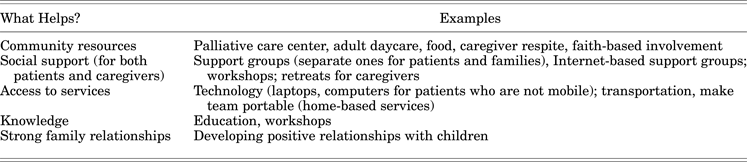
In response to the question as to what helps in coping with the stresses associated with having a chronic illness or caring for a person with a chronic illness, we recorded 51 different responses and then grouped them into the following five categories: (1) community resources, (2) social support, (3) access to services, (4) knowledge, and (5) strong family relationships. Table 1 provides specific examples of these five categories that the respondents mentioned. We followed up with the question about “what helps?” by asking for feedback on a proposed home-based intervention with an interdisciplinary team consisting of a nurse, social worker, and consumer. Overall, participants liked the idea of a psychoeducational intervention provided by a team. However, there appeared to be a mixed reaction to the home-based intervention method. Many participants agreed that bringing resources to people's homes was a positive way to deliver services — especially for people who are seriously ill — but some participants thought that entering homes could be problematic because of privacy issues. Providing information about resources with the use of computers (Internet, Skype) was thought to be appropriate for caregivers but less feasible for patients since many did not own or use computers.
Resources for addressing palliative care needs

DISCUSSION
The focus group participants provided numerous examples of stresses of daily living and barriers to palliative care and supportive resources for palliative care. In synthesizing these data, themes around family support, minority stress, communication, caregiver stress, and spiritual support emerged. While these issues are similar to what other researchers have found to be concerns of underserved patient populations (Kane et al., Reference Kane, Wales and Berstein1984; Gaston et al., Reference Gaston, Barrett and Johnson1998; Reese et al., Reference Reese, Aher and Nair1999; Reference Reese, Melton and Ciaravino2004; Dy et al., Reference Dy, Reder and McHale2003; Winston et al., Reference Winston, Leshner and Kramer2005), the patients and caregivers in our sample tended to emphasize an awareness of stigma and stress related to being a minority, whereas healthcare providers focused a great deal on the stress experienced by caregivers.
There seemed to be a consensus regarding the need for more community resources and access to services. Meeting with stakeholders from different communities within the inner city enabled us to see that the type of support or services requested by participants varied according to the particular culture of the community. African-American participants seemed more interested in and comfortable with informal helpers as opposed to professionals providing support. African-American participants expressed interest in training laypeople to deliver services to parishioners with chronic serious illnesses. On the other hand, in a primarily white community that had seen many of its churches close in recent years, involving the faith-based community was not seen as a viable way to deliver services. White participants had weaker family bonds and informal support networks as compared to their African-American counterparts; subsequently, they were concerned about burdening their families and were more receptive to formal services (e.g., visiting nurses, food-delivery programs).
Recommendations for Palliative Care Interventions
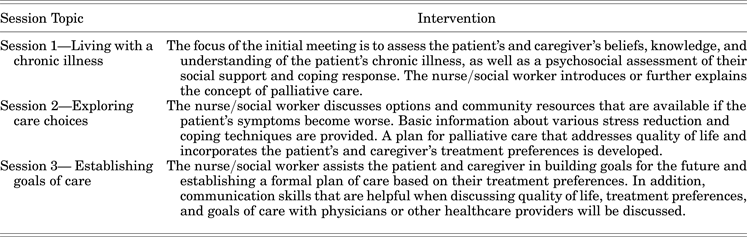
Based on our analysis of the focus group data and meetings with a steering committee composed of a visiting nurse, community-based social worker, minister, and layperson, we developed a protocol for an Interdisciplinary Palliative Care Intervention (IPCI). It consists of structured sessions with a patient and family member or other informal caregiver. Input from the committee on the content of the protocol and method of delivering the intervention led us to make modifications to the protocol based on their knowledge of the community. As a result of these discussions, we have developed a three-session psychoeducational intervention delivered by a social worker/nurse team. The three sessions with each topic and team members are described in Table 2. Each member of the team brings a unique knowledge base and skill set to this intervention. Building on her/his knowledge about the psychosocial aspects of a chronic illness and the community resources, the social worker uses assessment and clinical skills to help the patient and caregiver manage stress and access support. The nurse brings knowledge regarding the health-science aspects of palliative care and the options available for a plan of care.
Sessions of interdisciplinary palliative care intervention
A community-based participatory research approach was well suited for working with health centers in minority communities and provided an important venue for reaching patients living with chronic illness and their caregivers. There were, however, a few limitations that should be noted. The majority of participants in the focus groups and on the steering committee were female. Although a same-gender group may have led to a more open dialogue, the lack of the male perspective is a limitation. Similarly, the small focus group size may have facilitated more discussion among the participants but may have limited the richness of our findings. CBPR is primarily focused on producing change in a local community that is comprised of unique and complex contextual components. Therefore, the generalizability of the findings are limited. However, the participatory process of actively engaging researchers, healthcare providers, patients, and caregivers in partnership to meet the palliative care needs of minority patients living with chronic illness and caregivers is relevant and replicable.
CONCLUSION
This preliminary study sheds light on the issues and challenges facing underserved communities that include large populations living with chronic illness. The inclusion of community stakeholders in research is critical to developing effective interventions related to palliative care in these communities. Furthermore, input about the method of implementation is equally important to the success of an intervention. Our preliminary study presents a compelling case for using a CBPR approach in assessing the particular culture of the community and neighborhoods, identifying the barriers to accessing palliative care, prioritizing identified needs, and designing interventions to meet the unmet needs of patients and their caregivers.