Introduction
Depressive symptoms in later life affect an estimated 5 million elders in the U.S.A. (National Institute of Mental Health, 2007), with attendant emotional distress, functional impairment and reductions in quality of life. Depression is linked to suicidal ideation and attempts in this age group, and to declines in cognitive functioning. The oldest old, those in residential long-term care, and frail or medically ill elders suffer from depression at higher rates than community-dwelling, functionally robust elders. Health, developmental and social factors operating in later life would suggest that geriatric depression may look different from the depression in younger individuals. Among older adults, differentiating depressive symptoms from somatic symptoms caused by medical conditions, advanced age or physical frailty can be difficult. Determining the clinical relevance and relative importance of a range of possible symptoms is a challenge, particularly among oldest-old or frail elders (Watson et al., Reference Watson, Lewis, Kistler, Amick and Boustani2004).
Since the late 1990s, interest in conditions not meeting criteria for major depressive disorder has increased among researchers working with older adults (Chopra et al., Reference Chopra2005). The research literature increasingly shows that depressive symptoms not meeting criteria for a specific disorder, e.g. subthreshold or subsyndromal depressive symptoms, may be clinically relevant and associated with decreased functioning (Lyness et al., Reference Lyness, King, Cox, Yoerdiono and Caine1999; Lavretsky and Kumar, Reference Lavretsky and Kumar2002; Blazer, Reference Blazer2003), lower quality of life (Chachamovich et al., Reference Chachamovich, Fleck, Laidlaw and Power2008), and poorer outcomes in comparison to those of non-depressed older adults (Gallo et al., Reference Gallo, Rabins, Lyketsos, Tien and Anthony1997; Horowitz et al., Reference Horowitz, Reinhardt and Kennedy2005; Lyness, Reference Lyness2008; Hybels et al., Reference Hybels, Pieper, Blazer and Steffens2008). Evidence is accumulating which suggests that these non-major presentations of depressive symptoms are more common among older persons than among younger adults (Charney et al., Reference Charney2003). Questions of which depressive symptoms to count and how to determine a level deserving of attention become more complex in light of these recent findings.
Two forms of standardized measures to assess depressive conditions among older adults are commonly used in practice and research: (1) clinical interviews or self-report instruments matched to official diagnostic criteria for depressive disorders, and (2) rapid screening scales with a variety of symptoms that are meant to determine whether further assessment or treatment might be needed (Newmann et al., Reference Newmann, Klein, Jensen and Essex1996). Screening scales are popular because of their ease of use and low level of burden to the respondent, yet they are not intended to diagnose the disorder.
The Geriatric Depression Scale (GDS; Brink et al., Reference Brink, Yesavage, Lum, Heersema, Adey and Rose1982) is a well-known, brief screening scale that has been used in hundreds of studies with older adults (Peach et al., Reference Peach, Koob and Kraus2001). The GDS was designed specifically for older adults; its developers chose a yes/no response format in order to minimize confusion and fatigue among older respondents, left out frankly somatic items, and also left out items about sexual symptoms and suicidal ideation, thinking these might be offensive to older cohorts (Yesavage et al., Reference Yesavage1983). An advantage of the GDS is that it can be self-administered or administered by lay interviewers (Debruyne et al., Reference Debruyne, van Buggenhout, LeBastard, Aries, Audenaert, DeDeyn and Engelborghs2009). As a screening scale, the GDS may be used to determine whether or not individuals require further screening; cut-off points are calculated to suggest being “at risk” for a depressive disorder. The original authors identified 0–10 as “normal” or non-depressed, and 11 or above as indicative of mild to moderate depression (Yesavage et al., Reference Yesavage1983). The GDS-15 was created from the original GDS items to reduce time and respondent burden in administering the measure (Sheikh and Yesavage, Reference Sheikh, Yesavage, Sheikh and Yesavage1986), making it an attractive alternative to the longer instrument with half the number of questions.
Although they have gained established status in the clinical and research literature, emerging evidence suggests that scales such as the GDS or GDS-15 may not adequately screen for minor or subthreshold depression in various sub-populations of elders. Several recent studies using Receiver Operator Curve (ROC) methods to ascertain appropriate scoring cut points on the GDS have reported highly disparate results, particularly when screening for minor or subthreshold depression. For example, Schreiner and colleagues (Reference Schreiner, Hayakawa, Morimoto and Kakuma2003) reported a cut-off of 6 or more on the GDS allowing optimal identification of minor depression in Japanese subjects. Blank et al. (Reference Blank, Gruman and Robison2004) found that a GDS cut point of 10 or more was best for capturing depression not meeting criteria for major depressive disorder, whereas Lavretsky and Kumar (Reference Lavretsky and Kumar2002) found a cut point of 12 or more on the GDS to be appropriate in identifying minor depression. Most importantly, a systematic review of geriatric depression screening studies in primary care concluded that both the full GDS and GDS-15 performed poorly in the detection of nonmajor depression (Watson and Pignone, Reference Watson and Pignone2003).
Possible reasons for the failure of the GDS to detect non-major depression accurately among some groups of older adults may relate to particular items or groups of items. Certain GDS items overlap with symptoms attributable to normal aging, chronic health conditions or cognitive impairment, or with adaptations made in response to these, e.g. Withdrawal Apathy and Lack of Vigor (WAV) items (Adams, Reference Adams2001; Adams et al., Reference Adams, Matto and Sanders2004). These would be expected to be endorsed at higher rates by older adults with chronic illness or functional impairments regardless of depression status, and therefore to reduce the scale's specificity for classifying true depression. Other apects of the GDS, such as failure to include or to word appropriately somatic, cognitive, or affective symptoms that are common complaints of depressed elders, may contribute to reduced sensitivity for non-major depression.
The current study sought to examine the GDS at the item level to discover problematic items in detecting non-major depression. Based on data gathered from a sample of older residents in congregate housing, a group expected to have a high prevalence of functional impairment and health concerns, the purpose of the current study was three-fold: (i) to examine the agreement between classification by a brief diagnostic measure and the GDS and GDS-15 at cut points in standard use and to estimate optimal cut points through use of ROC equations for each scale; (ii) to examine the accuracy of each individual item of the GDS and four newly developed items in predicting the classification of depression (combining the categories of major and two levels of non-major) by official diagnostic criteria; and (iii) to subject all of the items to internal consistency reliability measures to ascertain item fit.
Methods
Procedures and participants
Residents of six congregate housing facilities (N = 178) completed the 30-item GDS, along with five other yes/no indicators of geriatric depression, as part of a self-administered survey. The congregate housing facilities included three non-profit (one Jewish, one primarily African-American) and three for-profit independent living or assisted living facilities comprising a total population of approximately 1500 residents. After gaining permission from the Case Western Reserve University Institutional Review Board and the research boards of each facility, flyers, signs and in-person visits were used to publicize the survey in each. Blank survey packets with self-addressed stamped envelopes were left in a labeled box near residents’ mailboxes in each facility. Of those respondents who returned completed questionnaires, 166 also provided contact information for a follow-up telephone call and were reached by research assistants with social work or psychology experience and training for the administration of brief diagnostic interview questions.
Measures
The major depressive episode (MDE) module from the MINI (Mini International Neurolopsychiatric Inventory; Sheehan et al., Reference Sheehan1998) was administered by telephone to determine depression status. The MINI is based on diagnostic criteria of the DSM-IV (American Psychiatric Association, 2000), and the ICD-9. This measure has been reported to be valid and reliable when compared with longer diagnostic interviews (Sheehan et al., Reference Sheehan1998). For instance, MINI's sensitivity for MDE as identified by the SCID-P (Structured Clinical Interview for DSM-III-R, Patient Version) was 0.96 and its specificity 0.88, and when identified by the CIDI (Composite International Diagnostic Interview), MINI's sensitivity was 0.94 and specificity was 0.79 (Sheehan et al., Reference Sheehan1998). Several investigators have used the MINI with older adults and several have successfully administered it over the telephone (e.g. Olfson et al., Reference Olfson, Broadhead, Weissman, Leon, Farber, Hoven and Kathol1996; Haringsma et al., Reference Haringsma, Engels, Beekman and Spinhoven2004; Shvartzman et al., Reference Shvartzman, Weiner, Vardy, Friger, Sherf and Biderman2005).
Four depression classifications could be extracted from the MINI data as follows: Major Depressive Episode (met criteria for MDE of at least one key criterion, low interest or depressed mood, plus four other symptoms for most of the time over past two weeks); Minor Depression (as defined in the DSM-IV-TR: one of the two key symptoms with a total of two to four depressive symptoms most of the time over the past two weeks); Subthreshold Depression (any two to four symptoms endorsed, may or may not include one of the key symptoms; met time criterion) or Non-depressed (one or no symptoms endorsed).
The definition of subthreshold depression used here (any two to four of the nine depression symptoms listed in the DSM-IV-TR without one of the key criteria), has been used in several studies examining subthreshold or subsyndromal symptoms of depression (SSD) and makes sense when considering that it is a phenomenon not meeting criteria for Minor Depression (Judd et al., Reference Judd, Akiskal and Paulus1997; Rapoport and Judd, Reference Rapaport and Judd1998). In one large epidemiological study, subthreshold depression was found to increase the odds of medical, emergency room, or mental health services use, suicidal thoughts or attempts when compared to no depression (Judd et al., Reference Judd, Akiskal and Paulus1997). Lavretsky and Kumar (Reference Lavretsky and Kumar2002) noted that subsyndromal depressive spectrum disorders encompass four or fewer clinically significant symptoms of major depression and frequently do not meet criteria for minor depression (e.g. no 14-day requirement of depressed mood or anhedonia). This category is also referred to simply as depressive symptoms in studies using large samples (e.g. Shvartzman et al., Reference Shvartzman, Weiner, Vardy, Friger, Sherf and Biderman2005). In a review of some of this literature on adults in primary care, Lyness (Reference Lyness2008) noted that “patients with minor depression may fare slightly worse than those with SSD, but these differences are not always statistically or clinically significant”.
Items and scale scores comprising the 30-item full GDS and the subset comprising the GDS-15 were tested in this study against the MINI criterion. The GDS was self-administered via the written survey questionnaire. Cronbach's α reliability in this study for the full scale GDS was found to be 0.85 and for the GDS-15 was 0.74.
Four additional items for this study were included on an exploratory basis to tap potential late-life depressive symptoms not included among the GDS items. The items were developed by the author to address indicators or symptoms of geriatric depression found in the clinical and research literature which were missing from the GDS. Two of the newly developed items address vague somatic symptoms of the type that may be likely to signal depression: “I have a bothersome physical problem and the doctors don't seem to know what the trouble is” and, “Lately, I just don't feel like myself.” These were added based upon several recent studies which have reported the utility and importance of somatic symptoms as indicators of depression in older adults (e.g. King and Markus, Reference King, Markus, Whitbourne and Whitbourne2000; Sheehan et al., Reference Sheehan, Bass, Briggs and Jacoby2003; Norris et al., Reference Norris, Arnau, Bramson and Meagher2004). Another new item was added to address feeling a burden on others. By virtue of frailties leading to increased dependence on others, older adults are subject to concerns about their worth and autonomy. These concerns may translate into worry about burdening family and loved ones and may be important in some depressive presentations (Gallo and Rabins, Reference Gallo and Rabins1999; Blazer, Reference Blazer2003). The GDS includes an item related to this concern: “I feel pretty worthless the way I am now.” The present study added the new less strongly worded item, “I feel I'm a burden to others.” The final additional depression item included in this study was “I often think about dying” which was added because suicidal ideation or frequent thoughts about death are reflected in a number of depression screening scales and are among the DSM-IV-TR criteria for major depressive episode, yet were not included on the GDS. These new items were worded as yes/no statements, similar to those of the GDS.
Analytic strategies
Missing items on the Geriatric Depression Scale and the four additional items were replaced with the sample mean for that item, a conservative way of retaining cases that did nothing to increase or decrease the hit rate of that item. Levels of agreement between the GDS and the MINI and the GDS-15 and the MINI were first made by running cross-tabulations of the designations as “depressed,” using a conservative criterion from the literature, 11 or above for the total GDS and 5 or above for the GDS-15. Further, ROC curve equations were estimated for both the GDS and the GDS-15, plotting GDS total score against the MINI classification, to determine the area under the curve (AUC) and estimate a cut-off score for the GDS with an optimal sensitivity and specificity to reflect subthreshold or greater level of depression, as identified by the MINI.
Against the criterion of MINI diagnostic interview scores indicative of either subthreshold, minor or major depression as the standard, classification efficiency of each GDS item and the four new items as discriminators of depression was estimated by calculating the items’ positive and negative hit rates (Norris and Woehr, Reference Norris and Woehr1998). Item hit rates are defined as the probability of being in a depression category given the presence (endorsement) – positive hit rate (Hp) – or absence (lack of endorsement) – negative hit rate (Hn) – of a particular symptom. Following the methods of Norris and Woehr (Reference Norris and Woehr1998), each item's Hp and Hn were averaged to make a total hit rate. These totals could then be compared to the base rate, the proportion of respondents who scored above criterion for that depression category. If the total hit rate is higher than the base rate, that item improves the scale's discriminatory ability for that category. Finally, the best performing new items were added to the original GDS and GDS-15 items in determining new Cronbach's α reliabilities and item-to-total correlations were calculated for each item in these newly augmented scales.
Results
The sample of older adults was 78.3% female, 77.1% white and 22.9% African American, ranging in age from 64 to 96 years with a mean age of 82.9. All participants were living in either independent or assisted living facilities. The great majority were unmarried. Participants averaged over two chronic illnesses or conditions. Over 60% of the sample reported impairment in at least one instrumental activity of daily living and over 25% tested in the mildly cognitively impaired range with the telephone screening measure, the Modified Telephone Interview for Cognitive Status (TICS-M; Welsh et al., Reference Welsh, Breitner and Magruderhabib1993). Sample characteristics have been described in greater detail elsewhere (Adams and Moon, Reference Adams and Moon2009; Adams and Roberts, Reference Adams and Roberts2010).
Depression categories
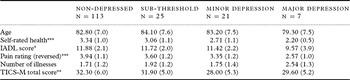
Using MINI criteria, 53 out of 166 participants, or 31.9%, were categorized with depression: 25 (15.1% of the total) with subthreshold depression, 21 (12.7%) with minor depression, and seven (4.2%) who met criteria for major depressive episode. Of the depressed group, 47.2% had subthreshold depressive symptoms, 39.6% had minor depression and 13.2% had major depression. Table 1 shows descriptive data for these four groups on several key variables, demonstrating a trend towards worse health and functioning at higher levels of MINI depressive symptoms.
Age, health and functioning variable group means by MINI depression category

Note: Self-rated health and pain rating from SF(12) v2, adjusted per instructions; higher scores mean better health and less pain
IADL = Instrumental Activities of Daily Living score (higher scores mean better functioning); TICS-M = Telephone Interview for Cognitive Screening-Modified (higher scores mean better cognitive abilities).
*p < 0.01, **p < 0.05, ***p < 0.01 in one-way ANOVA.
By the GDS, with a cut point of 11 points or above for depression, 35 out of 166, or 21.1%, were categorized as depressed. Agreement between GDS and MINI categories for depressed and non-depressed was calculated through a cross-tabulation; 122 cases (73.5%) were in agreement and 44 cases were not in agreement. Using the MINI as the reference method, 88.5% of those non-depressed by MINI were also found non-depressed by GDS, but only 58.5% of those categorized with some form of depression by the MINI were categorized as depressed on the GDS. Using the GDS as the reference, 76.3% of those considered non-depressed were also considered non-depressed by the MINI, while 62.9% of those categorized as depressed by the GDS were also found depressed by the MINI.
Results with the GDS-15 were also calculated, using the usual 5 points or greater cut-off. With the GDS-15, agreement with the MINI was 72.9%. The difference in this result from that with the total GDS was in additional cases found to be depressed by GDS-15 that were categorized as non-depressed by MINI.
ROC estimates were calculated for the GDS and then separately for the GDS-15, in relation to the MINI depression category, inclusive of subthreshold, minor, or major depression. The AUC (area under the curve) in these equations indicates the accuracy of the measure (here the GDS score) in predicting the criterion (here the MINI). An AUC of 0.5 would suggest accuracy that is no better than chance, and there is a better fit with higher numbers up to near 1.0, which would indicate perfect accuracy. This study's AUC for the total GDS score equation was 0.733 (95% confidence interval 0.649–0.816; standard error = 0.043). The best balance of adequate sensitivity (0.736) and specificity (0.602) was achieved with a cut point of 5.4 points on the GDS. ROC curve analysis with the GDS-15 resulted in AUC of 0.692 (95% confidence interval 0.607–0.778; standard error = 0.044). For the GDS-15, the best combination of sensitivity (0.679) and specificity (0.575) was obtained for a cut point of 2.1 points. Other combinations of sensitivity and specificity for either the GDS or GDS-15 sacrificed one or the other to a great extent, indicating the lack of agreement between the MINI and these measures.
Item classification efficiency
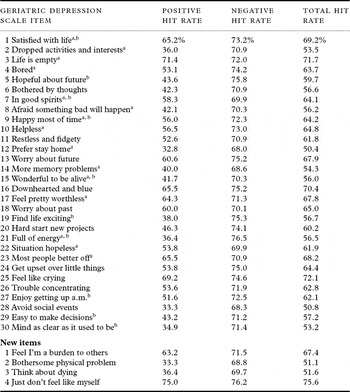
Positive and negative hit rates for GDS items and the four additional items tested are shown in Table 2. As noted above, in this sample the base rate of depression as defined by a score of over 11 or greater for the GDS was 21.1% and for subthreshold, minor or major depression on the MINI was 31.9%. Each individual item's average total hit rate exceeded these base rates, thus each item improved the scale's discriminatory ability for depression over simple chance. However, as the table shows, positive hit rates were generally far lower than negative hit rates. The highest total hit rates were in the 68–72% range, for items denoting dysphoria and negative affect, including item 25, “Often feel like crying,” item 3, “Life is empty,” and 16, “Downhearted and blue,” and reversed item 1, “Basically satisfied with life.” The lowest total hit rates, in the 50–55% range, were obtained by Withdrawal/Apathy/Lack of Vigor items 12, “Prefer to stay home;” 28, “Avoid social gatherings;” and 2, “Dropped activities and interests;” and the cognitive item, 30, “Mind as clear as it once was.”
Item hit rates for Geriatric Depression Scale (GDS) and GDS-15 items for prediction of MINI subthreshold, minor and major depression (N = 166)

aItem is included in the GDS-15.
bItem is reverse scored.
Two of the four new items performed very well in terms of total hit rates for MINI subthreshold, minor or major depression. The best performing new item, “Lately, I just don't feel like myself,” with Hp of 75 and Hn of 76.2, obtained a total hit rate or 75.2, which was higher than any of the GDS items. Another new item also performed very well: “I feel that I'm a burden to others,” with Hp = 63.2, Hn = 71.5 and total of 67.4. This second new item discriminated MINI depression better than approximately three-quarters of the GDS items.
Internal consistency
In order to determine how well these two best-discrimating new items fit with the original set of GDS items, they were added to both the full scale GDS and GDS-15 items for estimating new Cronbach's internal consistency reliability coefficients (Table 3.) Missing data were replaced with the sample mean for these new items, as they were for the GDS items, thus conserving cases with missing responses. The two new items had good item-to-total correlations with the other items and improved upon the original internal consistency reliability coefficients. Turning first to the full 30-item GDS, the two new items obtained item-to-total correlations of 0.457 and 0.513, and the Cronbach's α for the GDS with the additional two items was 0.865. The two new items also had very good item-to-total correlations with the set of GDS-15 items; Cronbach's α for the GDS-15 plus two items was 0.781.
Item-to-total correlations for Geriatric Depression Scale (GDS) and GDS-15 items with two additional items added (N = 166)

aItem is included in the GDS-15.
bItem is reverse scored.
Individual GDS items with the poorest item-to-total correlations were: 12 “Prefer to stay at home, rather than going out and doing new things;” 28 “Prefer to avoid social gatherings;” 18 “Worry about the past;” 14 “More problems with memory than most;” and 30 “Mind as clear as it used to be.” Two of these five poorly fitting items are WAV items (12 and 28), two are cognitive items (14 and 30), and the remaining item (18) is from an anxiety or worry factor (Adams et al., Reference Adams, Matto and Sanders2004). Looking only at GDS-15 items, those with poor item-to-total correlations were 14 “More memory problems than most” and 12 “Prefer to stay at home.”
Discussion
The goal of this study was to determine the contributions of GDS or GDS-15 scale scores, items and four newly developed items towards accurate classification of depression across a spectrum from subthreshold depressive symptoms to major depression. Residents of congregate living facilities were categorized as depressed (comprising subthreshold, minor, or major depression) or non-depressed using the MINI diagnostic interview and comparisons made between these categories and participants’ scores of the Geriatric Depression Scale (GDS), its short form the GDS-15, along with responses to individual GDS items and to four other yes/no items.
More participants fell into the depressed category according to the MINI than were considered depressed by longstanding suggested cut-off scores for either GDS or GDS-15. Because a greater number of participants were categorized as depressed by the admittedly liberal MINI depression designation than by either GDS score, ROC cut points for both the GDS and GDS-15 identified were lower than those usually suggested in the literature. Hence, traditional cut points on the GDS scales missed some respondents classified as depressed by the MINI, inclusive of subthreshold and minor depression.
The MINI major depression module, based on the nine depression symptoms used for diagnosis in the DSM-IV, and the GDS, with 30 items developed in the early 1980s to identify older people at risk for depression, overlap in important areas. Several GDS items approximate the two key depression diagnostic symptoms of “low mood” and “lack of interest,” and others tap symptoms of feeling worthless, low energy and difficulty concentrating. Specific wording of the items, however, may make a difference in endorsement, as noted by Chodosh and colleagues (Reference Chodosh, Buckwalter, Blazer and Seeman2004) in their study comparing two different measures for geriatric depression. The MINI's nine items also include three symptom areas – sleep difficulties, appetite difficulties and thoughts of death or suicide—which do not appear in the GDS. Somatic symptoms are heavily represented within the official diagnostic criteria for major depressive episode, and thus within the MINI and other diagnostic measures. Use of fairly broad inclusion criteria in classifying subthreshold depression (e.g. any two to four out of nine depression symptoms without requiring one of the two key symptoms) would seem to increase the possibility for confounding with physical illness. In fact, in an earlier publication, we have noted that those in this sample of older adults with subtheshold and minor depression identified by the MINI, in comparison to the non-depressed group, reported significantly worse self-rated health and greater pain rating (Adams and Moon, Reference Adams and Moon2009). On the other hand, participants classified by the with MINI non-major depression also reported several significant differences in characteristics unrelated to health status, including more loneliness, more recent major losses, and more financial concerns, giving support to the argument that somatic symptoms may offer unique contributions to the identification of depression among older adults (Gallo et al., Reference Gallo, Anthony and Muthen1994; Norris and Woehr, Reference Norris and Woehr1998; Norris, et al., Reference Norris, Arnau, Bramson and Meagher2004; Sheehan et al., 2004).
Examination of the hit rates of individual GDS items revealed a range of accuracy in identifying those respondents with MINI subthreshold, minor or major depression. The GDS items with the best total hit rates included several that address negative or dysphoric affect. Items with the worst hit rates included several that deal with low energy, apathy and cognitive changes. Low hit rates suggest that particular items may not adequately represent diagnostic criteria for depression among these older residents of congregate housing. For instance, preferring to stay home or giving up former interests may be realistically adaptive rather than a sign of pathological withdrawal, apathy or depression. Likewise, concerns about fading memory or indecisiveness may also be due to effects of aging, illness or disability, and not necessarily related to depression. Although these items did not tend to classify accurately respondents’ depression status by MINI diagnostic criteria, they may characterize a somewhat distinct “depletion” syndrome among older adults at advanced ages, particularly those living with physical and cognitive impairments (Newmann et al., Reference Newmann, Klein, Jensen and Essex1996; Adams, Reference Adams2001; Adams et al., Reference Adams, Matto and Sanders2004).
The two new items with excellent hit rates and item-to-total correlations with the GDS items in this study – “Feel I'm a burden to others” and “Just don't feel like myself” – may be useful indicators of depression in screening vulnerable older adults. When older people must rely on others for various types of assistance, whether paid helpers or family or friends, they may be susceptible to worry about burdening others. Because it is socially acceptable to mention not wanting to be a burden, it may be easier to endorse this feeling than to admit to feeling worthless or helpless. The other new item, “not feeling like oneself,” appears to tap into the sort of vague somatic concerns that depression is known to bring in a simple, straightforward statement. The other two trial items regarding thinking of death and having a bothersome physical problem obtained low hit rates for the MINI depression category. As they were worded here, they did not contribute anything further towards detecting depression among the residents of congregate housing.
While the two new items with good hit rates fit well within the construct of depression as measured by the GDS and GDS-15, a few of the original GDS items obtained very poor item-to-total correlations with the other GDS and GDS-15 items, suggesting these did not fit well for this sample of older adults with high rates of impairment. Three of these ill-fitting items – 12 “Prefer to stay at home;” 28 “Avoid social events;” and 14 “More memory problems than most” – were also among those with the lowest hit rates for classifying MINI depression. The first two of these items are part of the withdrawal, apathy, lack of vigor (WAV) factor (Adams, et al., Reference Adams, Matto and Sanders2004). They might be interpreted as describing possible adaptations to chronic conditions or frailty, or personal preference for quiet, low key activities. The memory item is problematic within any sample of older adults who may actually have some memory loss. As noted, approximately one quarter of this sample was found to have some mild cognitive impairment during their telephone screening with the TICS-M, thus confounding memory concerns as a depressive symptom.
Several limitations to this study must be noted. The moderately sized convenience sample of older adults from congregate housing limits generalizability to other older residents of similar housing. The administration of the MINI by telephone rather than in person, while an established research practice, nevertheless limited the use of clinical judgment in determining responses. Further, the MINI interviews took place from 3 to 10 days after the survey questionnaires were returned; thus some differences in depressive symptom responses may pertain to actual change over time. Among the study's noteworthy strengths, however, was the use of the nine symptoms comprising official diagnostic criteria for depression and the ability to compare these with a commonly used depression screening measure, followed by critical examination of the particular symptoms we consider to represent late life depression. Our focus on older adults in age-segregated residential settings takes note of the growing numbers living in this sort of non-nursing home residential situation, such as senior apartments, assisted living homes and continuing care retirement communities. Additional strengths include the number of oldest-old in the study and the relatively large percentage of African American respondents. In sum, the analyses in this study with a group of older adults in congregate housing contribute to the process of refining the conceptualization and measurement of the non-major depressive presentations that are quite common among older adults.
Implications for future research and practice
This study contributes to the knowledge base about geriatric depression and to progress in refining our depression measures to better characterize the symptoms experienced by the growing numbers of vulnerable older adults at advanced ages. Specifically, the study has shown how depression identified by the GDS and with a range of symptom levels from the official diagnostic depression criteria differ for a group of vulnerable elders. The sample of participants in this study represents a growing population of older adults, most over 80 and many over 85, with several chronic conditions and functional impairments. The GDS and the GDS-15 offered from 70 to 75% accuracy with regard to the MINI diagnostic interview at what may be considered “standard” cut-off scores. Cut points needed to be set lower than standard to approach satisfactory sensitivity and barely adequate specificity when tested against the MINI as criterion with this sample.
Refinement or development of measures which most accurately capture the range of symptoms characterizing subthreshold or minor depression among older adults is an important goal in light of the increasing longevity of older adults. Among the most interesting findings here is that certain items used on screening scales such as the GDS may confuse adaptations and effects of aging with depressive symptoms (Lewinsohn et al., Reference Lewinsohn, Rohde and Crozier1991). For instance, “preferring to stay home” can be an adaptation that older adults make because of health difficulties or impairments of old age and not necessarily due to depression. Item-level examinations such as those in the current study are helpful in updating not only our assessment tools but, indirectly, our conceptualizations of geriatric depression.
A number of authors (Judd and Akiskal, Reference Judd and Akiskal2002; Lavretsky and Kumar, Reference Lavretsky and Kumar2002; Blazer, Reference Blazer2003; Holland, Reference Holland2010) have discussed the advantages of taking a dimensional approach to the clinical treatment and management of depression in late life, rather than adhering to strict diagnostic criteria. Facilitating that approach will require more research on the range of depressive symptoms that are most common and most problematic among older adults, particularly the oldest old and functionally impaired, from which new classification criteria may be considered and assessment measures developed. One implication of the findings from this study is that the utility of the GDS and similar screening scales may be improved through the removal of selected items that do not individually distinguish depression well and the substitution of selected depression indicators which more accurately represent the clinical presentation of geriatric depression among the types of older adults frequently seen by clinicians and providers in contemporary practice. Future studies with independent samples of older adults will be needed to continue this promising line of research.
Conflict of interest
None.
Acknowledgment
The author wishes to acknowledge the generous support of the John A. Hartford Geriatric Social Work Faculty Scholars program for the conduct of this research.