Implications
A future strategy for organic pig production could be production of entire males, to meet public expectation on animal welfare regarding castration of pigs. However, entire male production has increased risk of carcasses with boar taint. As skatole can be absorbed through the skin of pigs, reduction of soiling could be a strategy for reduction of boar taint within organic housing facilities, as these increases the risk of pigs being heavily soiled. The present study reveals that improving hygiene management can reduce boar taint, although with the need of concurrent consideration of other boar taint reducing factors.
Introduction
Production of entire male pigs could be a beneficial strategy in pig production, as an alternative to castrates, due to an increased feed efficiency and daily gain of entires (Andersson et al., Reference Andersson, Schaub, Andersson, Lundström, Thomke and Hansson1997). In organic pig production entire males could be even more attractive due to very high feed costs compared to conventional production. The castration procedure causes pain and distress resulting in decreased animal welfare (Prunier et al., Reference Prunier, Bonneau, von Borell, Cinotti, Gunn, Fredriksen, Giersing, Morton, Tuyttens and Velarde2006). Within the organic production system, the castration procedure further conflicts with the values of organic farming in terms of animal integrity (Verhoog et al., Reference Verhoog, Lund and Alrøe2004).
However, production of entire males leads to increased risk of carcasses with boar taint that, if not reduced in future entire male production, will diminish the demand for pork.
Boar taint primarily originates from skatole and androstenone (Bonneau, Reference Bonneau1982). Skatole is produced by microbial degradation of tryptophan in the gastrointestinal tract and a fraction of the synthesized skatole is absorbed from the gut and deposited in body fat. There are some indications (Nonboe, Reference Nonboe1991 and Udesen, Reference Udesen1992 cited in Hansen et al., Reference Hansen, Larsen, Jensen, Hansen-Møller and Barton-Gade1994) that skatole can be absorbed either through the skin from contact with faeces or by inhalation in a gaseous form through the lungs. Studies by Hansen et al. (Reference Hansen, Larsen, Jensen, Hansen-Møller and Barton-Gade1994 and Reference Hansen, Larsen and Hansen-Møller1995) showed that keeping pigs dirty on a concrete floor and at a high stocking rate for at least a week before slaughter increased the skatole concentration in back fat of the pigs when compared with keeping the pigs clean on a wholly slatted floor. Aluwé et al. (Reference Aluwé, Bekaert, Tuyttens, Vanhaecke, De Smet, De Brabander, De Brabander and Millet2011) found no effect on fat skatole with treatments of entire males from a dirty group with extra soiling (rubbed with faeces daily) compared with a clean group (washed daily), but did so when detecting boar taint by use of a standardized consumer panel.
Androstenone is a male steroid related to sexual maturity rather than to environmental factors and is therefore not expected to be directly associated with soiling. However, Bekaert et al. (Reference Bekaert, Aluwé, Millet, Goethals, Nijs, Isebaert, De Brabander, Verheyden, De Brabander, Vanhaecke and Tuyttens2012) found a positive correlation between androstenone levels and degree of soiling in entire male pigs. Moreover, it is known that androstenone influences skatole accretion by reducing its degradation in the liver (Babol et al., Reference Babol, Squires and Lundström1999).
Other factors suggested to affect boar taint arising from skatole are less slatted floors in the pens (Hansen et al., Reference Hansen, Larsen, Jensen, Hansen-Møller and Barton-Gade1994), roughage feeding and other specific feed ingredients (Hansen et al., Reference Hansen, Stolzenbach, Jensen, Henckel, Hansen-Møller, Syriopoulos and Byrne2008). In relation to androstenone, age and weight at slaughter as well as season of the year are found to be influencing factors (Babol et al., Reference Babol, Zamaratskaia, Juneja and Lundström2004; Fredriksen et al., Reference Fredriksen, Lium, Marka, Heier, Dahl, Choinski and Nafstad2006; Fábrega et al., Reference Fabrega, Gispert, Tibau, Hortos, Oliver and Furnols2011).
In Denmark organic slaughter pigs are raised in pens, including an indoor-bedded area with straw, an activity area, with a minimum of solid floor of 0.40 to 0.75 m2 per pig depending on weight and access to an outdoor area with partially solid flooring. The outdoor area is mainly used for defecation (Møller and Olsen, Reference Møller and Olsen1998; Olsen et al., Reference Olsen, Dybkjær and Simonsen2001), leaving the area occasionally with large amounts of manure. Natural ventilation limits the possibilities to control the temperature, and straw-bedded systems increase the risk of reaching the upper critical temperature during summer (Temple et al., Reference Temple, Courboulay, Manteca, Velarde and Dalmau2012). The pigs will then use the outdoor area to thermo regulate by wallowing in the excreta (Huynh et al., Reference Huynh, Aarnink, Gerrits, Heetkamp, Canh and Spoolder2005; Temple et al., Reference Temple, Courboulay, Manteca, Velarde and Dalmau2012). Temperature affects excretory behaviour as well as pen soiling (Aarnink et al., Reference Aarnink, Schrama, Heetkamp, Stefanowska and Hyunh2006), as an increase in temperature changes the lying behaviour and in consequence forces the animals to defecate in unsuitable areas, for example on solid floors. In accordance with this, studies by Scott et al. (Reference Scott, Chennells, Campell, Hunt, Armstrong, Taylor, Gill and Edwards2006) and Temple et al. (Reference Temple, Courboulay, Manteca, Velarde and Dalmau2012) found that pigs in straw-bedded systems had a higher level of soiling than pigs in non-bedded systems. Temple et al. (Reference Temple, Courboulay, Manteca, Velarde and Dalmau2012) found that older pigs presented a higher risk of soiling compared with younger ones, as older pigs spend more time lying, require a higher evaporative heat loss as well as having a decreased space allowance relative to body size that may increase the probability of lying in the dunging area. Thus, organic pigs have a relatively higher risk of being heavily fouled with manure before slaughter.
The objective of the study was to investigate (a) if pen soiling affects pig soiling, based on scores of pen soiling for three different pen areas and scores for pig soiling for different body areas and (b) if increased pig/pen soiling increases skatole and androstenone concentration in carcass fat at slaughter measured chemically or by sensory evaluation using the human nose method. Soiling is defined as being dirty from excreta and not from mud/soil, to which animals in this system have no access.
Material and methods
The animals in the present study were part of a larger study design on organic entire male pigs described in Thomsen et al. (Reference Thomsen, Edwards, Jensen, Rousing and Sørensen2015).
Animals
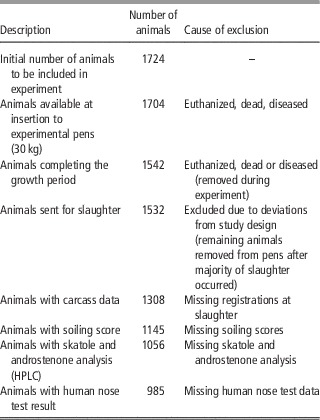
The target population constituted an experimental population representing entire male pigs reared within the organic pig production system in Denmark, as entire male pigs are not currently produced on a regular basis within Danish organic pig production. The study population included organic entire male pigs of the breed (Landrace×Yorkshire)×Duroc reared in parallel in five Danish commercial organic pig herds. In total 1724 experimental pigs in the finishing stage of the production cycle were initially included in the study. Of these, 579 animals were subsequently excluded due to disease, death, deviations from study design and missing registrations at slaughter or of soiling scores (Table 1).
Number of animals and causes of exclusion from the data set before analysis

Housing system
The experimental pens all consisted of an indoor area divided into a lying area with straw bedding and an activity area with solid or partially slatted floors. Moreover, an outdoor run was accessible, predominantly with solid concrete flooring, but also including areas of slatted flooring. A sprinkling system was placed outdoors. The fixed facilities in the pens included automatic feeders or feeding troughs and water nipples/stations. Concentrate feed was offered ad libitum and included soybean cake, rapeseed cake, sunflower cake, peas and potato protein as protein sources. Carbohydrate sources included barley, wheat, oats, rye and triticale. Roughage was provided daily on the indoor floor area. A summary table with specific production system details is given in Supplementary Table S1.
Study design
The study was designed with parallel groups between and within five commercial organic herds. Each herd produced four batches of entire male pigs during a 2-year period (2011 to 2013); with each batch including four experimental pens. Before the experimental period the pigs were kept according to the rearing system normally used in the participating farms (in pens mixed with female pigs (herd 1, 3 (one pen) and 5) or in single-sex pens (herd 2, 3 (one pen) and 4)). Allocation of pigs into experimental pens was done at an average of 30 kg live weight to give group sizes of either 15 or 30 pigs and according to two different grouping strategies, either regrouping or simple relocation. Slaughtering was performed in two steps within each pen (split marketing) when animals approximated an average live weight of 95 kg (first delivery) and 115 kg (second delivery). The pigs were randomly allocated to slaughter groups (95 or 115 kg) but, for 415 pigs out of the total of 1724, the allocation was modified before slaughter in order to accommodate contract specifications of the slaughter house (restricted live weight range of slaughter pigs of 86 to 130 kg).
Measurements
Each experimental pig had an electronic ear tag with a number that was linked to all registrations made on that particular pig in the herd, in the slaughter house and in the laboratory.
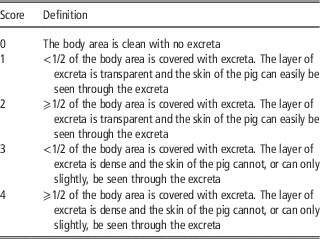
Pen soiling was assessed individually for three areas; the indoor area, divided into activity and bedding area, and the outdoor area. The assessment was done by use of a score based on the degree of soiling of the surface of the pen and nature of the surface by four categories; dry: area with no excreta or with excreta that has dried up, humid: area with excreta that is somewhat moist, but not sticky, wet: area with solid excreta that is very moist and sticky or fluid: area with excreta that is not solid but fluid. The percentage share of the total area for each of these options was registered, summing up to 100% for each of the three pen areas. A total pen soiling score for each area was calculated by assigning each surface category a number graded by degree of soiling (dry=5, humid=10, wet=15 and fluid=20), multiplying this with the percentage share assigned to that category and finally adding them together. This gave an individual pen soiling score for each of the three pen areas. Pig soiling was assessed by a five point scale (Table 2) including size of the area covered with manure and the transparency/density of the manure layer. A score was assigned to each of two body areas of the pig; head and abdomen area, for both left and right side of the pig. Head and abdomen body area were chosen as these body areas are believed to be the most important as regards absorption of skatole, based on the study by Friis (Reference Friis1993) showing that around 40% of radioactive marked skatole passed through the skin of the belly, in contrast to only 6% on the back. The assessment of pig soiling was done by two observers. Inter-observer reliability for assessment of pig soiling based on κ calculations ranged from moderate (0.4 to 0.6) to high (>0.6) agreement (Cohen, Reference Cohen1960; Petersen et al., Reference Petersen, Enøe and Nielsen2004).
Scale for pig soiling score

Pen and pig soiling were recorded on four occasions during the experimental period: at ~30 (1 week after insertion into experimental pens), 70, 95 and 115 kg. As the number of days between registration of soiling and slaughter varied between animals, a maximum of 7 days was used as an inclusion criterion for the analyses. This excluded 163 animals and gave a remaining total of 1145 pigs with both pen and pig soiling scores (see Table 1).
Season of the year was defined based on slaughter period, with animals slaughtered in January to March (batch 1 and 3) constituting the ‘winter season’ and animals slaughtered in June to August (batch 2 and 4) constituting the ‘summer season’. Mean temperature for the two summer periods was 15°C and16°C and for the winter periods 0°C and 2°C (www.DMI.dk).
Boar taint analysis
Boar taint was assessed by two different methods: measuring the concentration of skatole and androstenone by the HPLC method and qualitatively determining smell by the human nose method, in order to have both a quantitative and a qualitative measure of boar taint.
HPLC method
Quantitative determination of skatole (3-methylindole skatole) and androstenone (5a-Androst-16-en-3-one) was done by use of the HPLC method described by Hansen-Møller (Reference Hansen-Møller1994) with some modifications. A description of the method is given in Supplementary Material S1. Skatole and androstenone measurement was done on fat from 1056 animals (Table 1).
Human nose method
Qualitative determination of boar taint was estimated from the human nose method. Four different laboratory personnel were involved in the human nose scoring, with two persons at a time sniffing the same sample. The personnel were trained to sniff androstenone and skatole and were all pre-screened to be sensitive to androstenone. The trained personnel regularly underwent calibration by sniffing five different samples with addition of androstenone and skatole constituting samples with known smell. With two or more erroneous assessments retraining was executed.
Samples of subcutaneous fat from the neck region were collected from the experimental pigs after slaughter. A small piece (5 g) of fat was heated by lowering it into a test tube in boiling water for 2 min. Subsequently the trained personnel sniffed the sample and scored the odour either 0 for no odour, 1 for vague odour and 2 for off odour. Before this procedure a sample with no smell was sniffed, constituting a reference sample. Only the score 2 from the human nose method results in carcasses being sorted out at the abattoir based on odour, and so this score was used for calculating the percentages of positive scores. A human nose score was assigned to 985 pigs (Table 1).
Statistical analysis
Statistical analyses were performed using the statistical software R (R Core Team, 2014).
Before analysis, pen soiling scores were transformed into a dichotomous scale, defining a low and a high pen soiling category for each of the three pen areas, with the threshold based on an assessment of the scores attained from the pen soiling scale. Pig soiling was divided into two scores for each body area with one reflecting manure transparency/density and one reflecting size of the area (<1/2 or ⩾1/2) covered with manure (thus giving head transparency, head area, abdomen transparency and abdomen area, respectively). For each of the four dichotomous variables, left and right scores of soiling were combined with the highest score in the individual pig constituting the final outcome. Analysis of the effect of pen soiling on pig soiling was performed by a logistic regression model. The analysis was performed for each of the registration rounds of soiling; however, with 95 and 115 kg registrations combined to reflect the final registration before slaughter for each individual animal. The logistic regression model was in addition used for analysis of differences between herds and seasons for pen and pig soiling.
Effects of the explanatory variables pen and pig soiling on skatole and androstenone concentration were analyzed by a linear mixed effects model using the lmer function from the package lme4 (Bates et al., Reference Bates, Maechler, Bolker and Walker2014) in R. Before the analysis, skatole and androstenone were log transformed to obtain a normal distribution. The other boar taint outcome, the human nose test, was analyzed to evaluate the potential risk of tainted meat and effects of the explanatory predictors, using a logistic binomial mixed model, adjusted by use of the package lme4 (Bates et al., Reference Bates, Maechler, Bolker and Walker2014) of the statistical software R (R Core Team, 2014). The P-values of the likelihood ratio tests were calculated using parametric bootstrap (Davidson and Hinkley, Reference Davidson and Hinkley1997; Faraway, Reference Faraway2006). For each outcome of boar taint, pig and pen soiling were analyzed in separate models, using only the 95 or 115 kg registrations constituting the final registration before slaughter for each individual animal. For all analyses, a strategy with backwards elimination of variables was applied using a significance level of 5% to include variables and interactions.
Explanatory variables tested in all model-building processes were: pen soiling scores for three pen areas: outdoor, bedding and activity area. Pig soiling scores for two body areas, head and abdomen, with variables of both size of area and transparency/density. Season was tested as a nominal variable with two levels: summer and winter. Herd was tested as a categorical variable with five levels. Interaction terms between soiling scores and season and herd, were also included in the model. Group size and grouping strategy were tested as nominal co-variables, as the wider study design involved different group sizes and grouping strategies. Owing to the study design, independence between animals within each herd, within each season for the different group sizes and grouping strategies was not expected. To account for this, a variable including herd, season, group size and grouping strategy (HSGG) was made. In addition, pigs within the same pen were considered to be dependent and a variable including pen, season, group size and grouping strategy (PSGG) was made. Only this variable was used in the further analyses as the HSGG was nested in PSGG. The variable was set as random in the mixed effects model.
As a final model check, residual plots and Shapiro–Wilk normality tests were used to evaluate the linear mixed effects model assumptions of normal distribution of fixed effects in each analysis, as well as to identify outlier observations.
In addition to the statistical analysis, a diagnostic test on the human nose method was performed, to analyze the relationship of a positive human nose test to chemical analyses of skatole and androstenone. This was done by calculating the sensitivity and specificity of the human nose method based on all 985 samples analyzed in this experiment, using skatole above or below 0.25 µg/g or androstenone above or below 1 µg/g as the gold standard.
Results
Soiling of pens and pigs
For all three registration rounds (30, 70 and 95/115 kg) pen soiling effected pig soiling; however, with different outcomes for different combinations of pen and pig soiling variables. The general trend was that pen soiling had higher influence on the area covered in manure compared with density of the manure layer. Pen soiling increased during winter compared with summer, whereas pig soiling increased during summer compared with winter. Effects of pen soiling on pig soiling as well as P-values for differences in pen and pig soiling levels between herds and seasons is given in Supplementary Table S2. Pig soiling was not consistent across the four registration rounds of 30, 70, 95 and 115 kg, meaning that only on a very few occasions did the same animal get the same score in each registration round. As regards pen soiling no consistency was found for outdoor pen soiling, whereas for indoor activity and bedding area more than half the pens were assigned to the low soiling category in all four registration rounds, revealing a consistent low soiling level for these areas.
Skatole
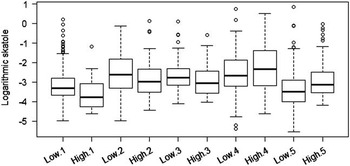
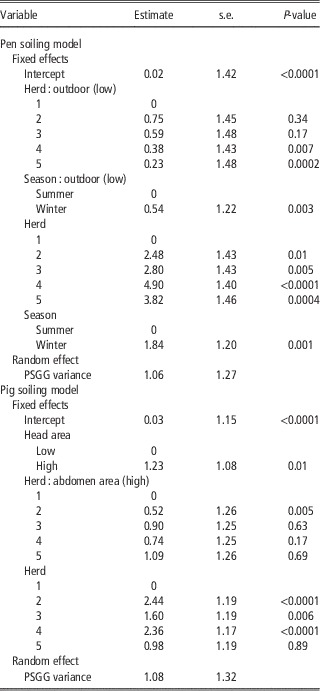
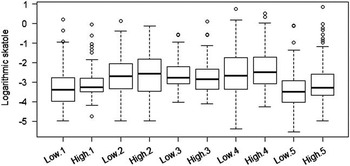
A large variation in skatole concentration in fat was found across herds and seasons, with a 10% and 90% percentile for the whole population of 0.02 and 2.25 µg/g, respectively. The overall median level was 0.05 µg/g. More detailed analyses of skatole concentrations are presented in Thomsen et al. (Reference Thomsen, Edwards, Jensen, Rousing and Sørensen2015). Table 3 summarizes model estimates of the variables significantly affecting skatole concentration. Soiling on the outdoor area significantly affected skatole concentrations as an interaction with herd (P<0.001), revealing an increased fat skatole level for high soiling levels only for some herds. In addition to the interaction with herd, outdoor pen soiling also showed an interaction with season (P=0.003), showing higher fat skatole levels for high soiling levels during winter. The soiling level in the indoor pen areas (activity and bedding), did not affect the skatole concentration. Figure 1 shows the variation of fat skatole concentration stratified by high or low outdoor area soiling score and herd number.
Variation of logarithmic fat skatole concentration stratified by high or low outdoor area soiling score (high or low) and herd number (1 to 5). Lower and upper line of the boxes illustrates 1st and 3rd quartile ranges with the bold line illustrating the median. Dotted lines above and below boxes represents the minimum and maximum value.

Estimates of the significant effects from the fixed effects models describing the pen and pig soiling effect on logarithmic skatole concentration in entire male pigs

PSGG=pen, season, group size and grouping strategy.
Values are back transformed.
As regards pig soiling, the soiling of the head area of the pig significantly affected fat skatole (P<0.01), with increased fat skatole levels when the head area was covered more than half in manure. The soiling of the abdomen area also showed a significant effect on fat skatole, but only as an interaction with herd (P<0.01), with higher fat skatole levels for abdomen areas covered less than half with manure for some herds. Further analysis of the interaction revealed an overall difference in skatole between large and small soiled abdomen area close to zero, suggesting the significant output reflects a random herd event. In general, the size of the area covered with manure showed a more significant influence in the models than the effect of the manure layer being either transparent or dense. Group size or grouping strategy did not affect fat skatole levels. Figure 2 shows the variation of fat skatole concentration stratified by size of the head area of the pig being soiled and herd number.
Variation of logarithmic fat skatole concentration stratified by size of the head area of the pig being soiled (low, <1/2 and high, >1/2) and herd number (1 to 5). Lower and upper line of the boxes illustrates 1st and 3rd quartile ranges with the bold line illustrating the median. Dotted lines above and below boxes represents the minimum and maximum value.

Androstenone
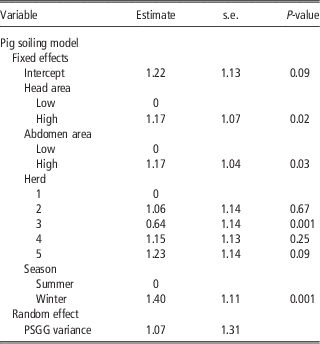
A large variation in androstenone concentration in fat was found across herds and seasons, with a 10% and 90% percentile for the whole population of 0.53 and 4.84 µg/g, respectively. The overall median level was 1.83 µg/g. More detailed analyses of androstenone concentrations are presented in Thomsen et al. (Reference Thomsen, Edwards, Jensen, Rousing and Sørensen2015). Table 4 summarizes model estimates of the variables significantly affecting androstenone concentration. None of the pen area soiling scores significantly affected androstenone concentration. However, soiling of both the head and abdomen area of the pig significantly affected fat androstenone (P=0.01 and P=0.02, respectively), with increased fat androstenone levels when the areas were more than half covered in manure. Herd and season significantly affected fat androstenone (P<0.001), with higher levels during winter compared with summer. Grouping strategy and group size showed no significant effect.
Estimates of the significant effects from the fixed effects model describing the pig soiling effect on logarithmic androstenone concentration in entire male pigs

PSGG=pen, season, group size and grouping strategy.
Values are back transformed.
Human nose test
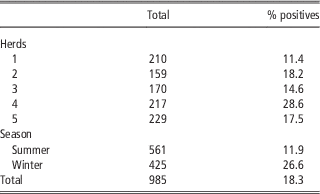
The percentage of positive outcomes from the human nose test was in total 18.3%. The prevalence of positive tests varied across herd and season (Table 5).
Number of human nose tests conducted and percentage of positive tests, stratified by herd and season

For boar taint as a sensory evaluation measured by the human nose test, no significant effect of pig soiling was found. A significant effect of outdoor pen soiling was found as an interaction with herd (P=0.005), with more registrations of a high soiling score compared with a low score for positive outcomes of the human nose evaluation only present in one herd. In addition, soiling in the bedding area in the pens significantly affected the human nose test as an interaction with season (P=0.003), with more positive outcomes of the human nose evaluation for high soiling scores in winter periods. Season of the year and herd significantly affected human nose positive risk (P<0.001), whereas no significant effect was found of cleanliness of the pen activity area, or of group size and grouping strategy.
Diagnostic test
The diagnostic test calculating the relationship of a positive human nose test to chemical analyses showed, for a skatole threshold of 0.25 µg/g as a gold standard, a sensitivity of 88% and a specificity of 89%. For androstenone, with a threshold of 1 µg/g as the gold standard, the sensitivity was 22% and the specificity 92%. Using a combination of skatole (threshold of 0.25 µg/g) and androstenone (threshold of 1 µg/g) as a gold standard gave a sensitivity of 22% and a specificity of 94%.
Rejection of carcasses
The percentages of carcasses, which would be rejected due to respective threshold levels, varied between boar taint compounds and detection methods. For all carcasses, 75.7% had concentrations above 1.0 µg/g androstenone, 9.8% had concentrations above 0.25 µg/g skatole and 18.3% gained a positive test from the human nose method.
Discussion
Pen and pig soiling varied between herds reflecting differences in the hygiene management strategy, eventually caused by different pen layouts as regards access to the outdoor area, affecting the possibility to clean, differences in prioritization of cleaning the pen areas or different quality of the climate control affecting the animals’ thermal comfort and need for wallowing.
For all herds more dirty animals were found during summer, whereas a higher pen soiling level was found during winter. In general, high pen soiling gave a higher probability of a large area of skin covered in manure compared with low pen soiling. In contrast, high pen soiling was associated with a lower probability of being soiled with a dense manure layer. The effects, in combination with the difference in soiling level of pigs and pens between seasons, reflect how the behaviour of the animals has an influence on the pig soiling level. During hot weather the pigs actively seek areas with a possibility to wallow (Huynh et al., Reference Huynh, Aarnink, Gerrits, Heetkamp, Canh and Spoolder2005), which are areas with manure, especially the outdoor run. The present study indicates a somewhat optimal use of the functional areas available, with the highest soiling level found on the outdoor run, mainly being used for defecating, and the bedding area having the lowest soiling level, mainly being used for resting. Inconsistency of soiling levels across registration rounds indicate that pig soiling is not solely an individual behavioural trait, but is affected by environmental factors. Temperatures above the thermal comfort zone of the pigs were only occasionally reached during the experiment, minimizing the effect of temperature on the pig soiling levels found.
The present investigation of the association between soiling and different boar taint measures within the organic pig production system can partly verify the hypothesis of Hansen et al. (Reference Hansen, Larsen, Jensen, Hansen-Møller and Barton-Gade1994) that soiling affects skatole levels. In the present study, skatole, androstenone and human nose sensory evaluation were used as measures of boar taint. Each of these measures revealed different results when analyzed for association with soiling of pigs and pens. This was also the result of Aluwé et al. (Reference Aluwé, Bekaert, Tuyttens, Vanhaecke, De Smet, De Brabander, De Brabander and Millet2011), who had seven different measures of boar taint, including chemical analysis and different sensory evaluations, and only found an effect of soiling by a standardized consumer panel evaluating the sensory quality of the meat. However, in the present study, soiling affected each of the included boar taint measures in some way or other.
Outdoor pen soiling significantly affected both skatole concentration and human nose positive risk as an interaction with herd. In addition, the effect of outdoor pen soiling on skatole varied across seasons, whereas for the human nose positive test the season effect was shown as an interaction with soiling in the bedding area. The results show that it is the outdoor pen area that most significantly affects boar taint measures, this being the area mostly used for defecating. The varying effect of outdoor pen soiling between herds could reflect differences in time spent on the area, as a consequence of the behaviour of the animals, as well as differences in soiling levels between herds. The interactive effect with season could indicate that temperature plays a role with regard to absorption of skatole, as the temperature affects the transformation of skatole into a gaseous form (Nonboe, Reference Nonboe1991 cited in Hansen et al., Reference Hansen, Larsen, Jensen, Hansen-Møller and Barton-Gade1994). Our results, however, show an increased effect of soiling on skatole during winter periods. Owing to the natural ventilation system on organic farms, together with access to a straw-bedded area and open access to an outdoor run, temperature would probably have a more unpredictable influence on skatole absorption as compared with conventional housing with temperature control systems. In comparison with the outdoor area, the bedding area holds very small amounts of manure and the interaction effect with season on human nose positive test was unexpected. This could reflect an indirect effect of animal behaviour with differences in time spent indoor compared with outdoor depending on season and, in addition, a seasonal effect on soiling in the bedding area, with faster volatilisation and drying of the bedding material in summer periods.
Pig soiling affected both skatole and androstenone concentrations, with the size of the area covered in manure being more influential than the density of the manure layer. Soiling of both the head and abdomen area were found to have a significant effect, though in the case of the abdomen area only as an interaction with herd as regards the effect on skatole. The results cannot clarify if skatole and androstenone are absorbed through the skin or inhaled through the lungs. Both the head and abdomen body area holds areas with thin skin which increases the absorption of skatole, as found by Friis (Reference Friis1993), showing that only 6% of radioactive marked skatole passed through the skin on the back, in contrast to around 40% of the belly. However, inhalation of skatole in a gaseous form could be possible from soiling in the head area.
Even though an effect of pig soiling was found, it should be emphasized that a large variation in the different boar taint measures was found for both high and low scores of pen and pig soiling, and, in addition, that only a small difference in skatole and androstenone concentrations between the high and low soiling categories was found. No effect of pig soiling was found on human nose positive risk.
As skatole is present in the manure, the hypothesis for a relationship with soiling through absorption of skatole through the skin or lungs is relevant. However, the association between soiling and androstenone found in our study is not easy to explain. A similar association was found by Bekaert et al. (Reference Bekaert, Aluwé, Millet, Goethals, Nijs, Isebaert, De Brabander, Verheyden, De Brabander, Vanhaecke and Tuyttens2012), who found a positive correlation between androstenone levels and degree of soiling in entire male pigs at 20 and 22 weeks of age. A difference in behaviour of pigs as they become sexually mature, leading to increased soiling, or the interplay between skatole and androstenone reported by Babol et al. (Reference Babol, Squires and Lundström1999) may cause this result.
Skatole and androstenone concentrations varied greatly both between and within herds. No obvious differences between herds regarding feed composition, production system or breeds were present between herds explaining such variation. However, variation in stage of puberty between animals as well as health status could be causable factors (Claus et al., Reference Claus, Weiler and Herzog1994; Skrlep et al., Reference Skrlep, Batorek, Bonneau, Fazarinc, Segula and Candek-Potokar2012). Moreover, pre-slaughter conditions inducing stress is suggested to affect both skatole and androstenone concentrations (Wesoly et al., Reference Wesoly, Jungbluth, Stefanski and Weiler2015), and even this is not accounted for in the present study, such conditions could vary between herds.
The relationship of a positive human nose test to chemical analyses was assessed by use of a diagnostic analysis. Using a threshold level for skatole of 0.25 µg/g as the gold standard, the analysis revealed a high sensitivity indicating that a high amount of carcasses above this threshold would be classified as testing positive and a high specificity indicating that a high amount of carcasses with skatole concentration below the threshold would be classified as testing negative. However, when using androstenone with a concentration of 1 µg/g as the gold standard, a low sensitivity, but a high specificity were revealed, indicating that the human nose method only to a limited extent detects carcasses with high androstenone concentrations, whereas for carcasses with low androstenone concentration the chance of testing negative is high. Using a gold standard combining skatole and androstenone concentrations, revealed almost the same levels as for androstenone alone. This indicates that the human nose method is not an optimal method for predicting boar taint caused by androstenone. Similar results were found in the study by Mathur et al. (Reference Mathur, ten Napel, Bloemhof, Heres, Knol and Mulder2012).
Percentages of carcasses that would be rejected due to threshold criteria for the different boar taint compounds and detection methods showed 75.7% for androstenone (>1.0 µg/g), 9.8% for skatole (>0.25 µg/g) and 18.3% with a positive test from the human nose sensory evaluation. This covers animals with a 10% and 90% percentile of 91 and 130 kg live weight, respectively. A large variation in rejection percentages is found for skatole and androstenone in literature (Table 6). The rejection rates in the present study seem somewhat higher, especially regarding androstenone, when compared with the results of different studies of conventional raised entire male pigs, suggesting higher percentages of carcasses rejected within the organic system. This may reflect effects of housing system (e.g. soiling, light conditions) and different types of diets as well as a puberty related effect due to, for example, slower growth and breed type used. The difference found stresses the importance of investigating factors able to reduce boar taint levels within the organic system.
Carcass rejection percentages based on skatole, androstenone and human nose method for entire male pigs in six different studies

1 Conventional production system.
2 Organic production system.
3 0.25 µg/g skatole.
4 Carcass weight.
5 Live weight.
6 2% in Denmark.
Conclusion
Pen soiling was found to affect pig soiling; however, pen soiling increased during winter periods compared with summer periods, whereas pig soiling level was higher during summer periods. Pen and pig soiling affected boar taint measured as skatole and androstenone concentration as well as a human nose sensory evaluation. The effect on the different boar taint measures was, however, not consistent for each of the different soiling measures. In addition, a large variation in the different boar taint measures was found for both high and low scores of pen and pig soiling, and only a small difference in skatole and androstenone concentrations between the high and low soiling categories was found. The herd and season effects on boar taint levels should be emphasized when interpreting results, as individual herd differences are of importance in relation to hygiene management and other skatole causal factors. The results indicate that increasing the hygiene management on organic pig herds could be a strategy for reducing boar taint of organic entire male pigs, but it cannot ensure a taint-free pig production, and other boar taint reducing factors should be used in combination. As regards boar taint detection methods, the results of a diagnostic analysis indicate that the human nose method can function as an applicable method for boar taint detection, but is mostly based on skatole.
Acknowledgements
The work was carried out under the project ‘Organic pig production without castration’, which is part of the Organic RDD program. This is coordinated by International Centre for Research in Organic Food Systems, ICROFS, and was funded by the Danish AgriFish Agency, Ministry of Food, Agriculture and Fisheries. The authors thank Center of Development for Outdoor Livestock production for collaboration during the project, the participating farmers for their cooperation and technician Pia Haun Poulsen for help on data recording.
Supplementary material
To view supplementary material for this article, please visit http://dx.doi.org/10.1017/S1751731115000798