Introduction
The year 1971 was a watershed year in the history of abortion in India. The Indian Penal code, which was enacted in 1860, declared induced abortion as an illegal act, except when it was necessary to save the life of the woman. Faced with countless deaths of women attempting illegal abortion, the Indian Penal code was changed in 1971 by introducing the Medical Termination of Pregnancy (MTP) Act. This Act, which was implemented on 1st April 1972, allowed induced abortion provided it was performed by a qualified doctor at an approved clinic or hospital and satisfied certain requirements. Circumstances when abortion was allowed included: (a) women whose physical and/or mental health were endangered by the pregnancy; (b) women facing the birth of a potentially handicapped or malformed child; (c) rape; (d) pregnancies in unmarried girls under the age of 18 with the consent of a guardian; (e) pregnancies in ‘lunatics’ with the consent of a guardian; (f) pregnancies that are a result of failure of sterilization. It was also specified that the length of the pregnancy must not exceed 20 weeks. According to the Consortium on National Consensus for Medical Abortion in India, ‘Every year, on an average, about 210 million women become pregnant throughout the world. Approximately, one-third of these, or 75 million pregnancies, are unwanted. About 40–50 million of these women resort to abortion, 30 million abortions being performed in the developing countries. At least 20 million of the total abortions are thought to be unsafe, i.e. carried out by an untrained person or in a setting lacking the minimal medical standards or both,’ (see http://web.archive.org/web/20081120105036/ http://www.aiims.edu//aiims/events/Gynaewebsite/ma_finalsite/introduction.html for detail). This makes the subject matter of this study of considerable policy importance.
While the closely related phenomena of maternal health issues, son preference and ‘missing women’ have attracted much attention both in the economic literature (Kynch & Sen, Reference Kynch and Sen1983; Dasgupta, Reference Dasgupta1995; Pande & Astone, Reference Pande and Astone2007) and in other disciplines (Potdar & Gurak, Reference Potdar and Gurak2003; Das Gupta, Reference Das Gupta2005; Potdar, Reference Potdar2005; Koenig et al., Reference Koenig, Jamil, Streatfield, Saha, Al-Sabir and Arifeen2007), there is very little in the economics literature on pregnancy and abortion. For example, Potdar & Gurak (Reference Potdar and Gurak2003) and Potdar (Reference Potdar2005), which draw on Potdar's doctoral dissertation (Potdar, Reference Potdar2002), studied the effect of son preference on fertility of women from a socio-demographic perspective. Potdar's study, which is based on the National Family Health Survey (NFHS-2) 1998–99 in India, investigates the impact of son preference on fertility of women of different educational levels drawing on data from fourteen Indian states. The states were placed in two groups with eight states from the northern/western region with strong son preference placed in one group, and six states from the southern/western region with relatively weak son preference placed in the other. There is, however, limited literature on abortion in the demographic, biosocial and biological sciences. Ahmed et al. (Reference Ahmed, Rahman and van Ginneken1998) studied the incidence of induced abortion in Matlab, a rural area of Bangladesh. They prefaced their study by noting that ‘neither the incidence of induced abortion nor the characteristics of women who rely on abortion have been well studied,’ (p. 128). Other examples of studies on abortion include Ahiadeke (Reference Ahiadeke2001)'s study on induced abortion in southern Ghana, Babu et al. (Reference Babu, Nidhi and Verma1998) on spontaneous and induced abortion in India, Hussain (Reference Hussain1998) on spontaneous abortion in Karachi, Pakistan, Norsker et al. (Reference Norsker, Espenhain, á Rogvi, Morgen, Andersen and Nybo Andersen2012) on spontaneous abortion in Denmark, Johri et al. (Reference Johri, Morales, Boivin, Samayoa, Hoch and Grazioso2011) on spontaneous abortion in Guatemala, Agadjanian & Qian (Reference Agadjanian and Qian1997) on induced abortion in Kazakstan, Ping & Smith (Reference Ping and Smith1995) on induced abortion and its policy implications in China, Calvès (Reference Calvès2002) on induced abortion in urban Cameroon, and Parazzini et al. (Reference Parazzini, Chatenoud, Tozzi, Benzi, Pino and Fedele1997) on spontaneous abortion in Milan in Italy.
The paucity of evidence on abortion is largely due to the absence of reliable data on pregnancy and abortion. The lack of data at the individual level, relating a women's experience of pregnancy and its outcome with a host of individual, family and community characteristics, explains not only the limited evidence on pregnancy and abortion but also the fact that such evidence has been restricted to quantifying their incidence rather than identifying their principal determinants. Yet, from a policy viewpoint, the latter is at least as important as the former. If, as is widely believed, son preference is a prime cause of induced abortion in countries such as India, and given the implications of sex-selective abortion for ‘missing women’, who could have contributed so much to society if they had not been aborted, it is essential to identify the key determinants of abortion. These will identify the women who are most likely to abort, and help devise effective intervention strategies.
The lack of evidence on the socioeconomic determinants of abortion has been rectified recently by the publication of two studies on Indian data. Bose & Trent (Reference Bose and Trent2006) used data from NFHS-2 ‘to examine the net effects of social and demographic characteristics of women on the likelihood of abortion while emphasizing important differences between women from northern and southern states,’ (p. 261). Elul (Reference Elul2011) extended the evidence on the determinants of induced abortion in India provided by Bose & Trent (Reference Bose and Trent2006) by using data from the Indian state of Rajasthan to consider a wider set of determinants that included community and contextual factors. Moreover, Elul (Reference Elul2011), quite uniquely, used a framework that jointly determined the probability of pregnancy and the conditional probability of abortion. A significant new finding of Elul's (Reference Elul2011) study was the role of personal networks in a woman's decision to terminate a pregnancy.
The present study extends this line of investigation in three significant respects: (a) it distinguishes between induced and spontaneous abortion; (b) in line with this distinction, it extends the bivariate probit estimation framework of Elul (Reference Elul2011) to that of a trivariate probit that estimates induced and spontaneous abortion simultaneously, conditional on pregnancy; (c) it compares the sign and magnitude of the estimated coefficients of the determinants of the two types of abortion. The distinction between induced and spontaneous abortion is a significant point of departure from the previous literature. It is important to note the difference between the two forms of abortion as used in this study. While induced abortion stems from unintended pregnancies and is defined as terminating a pregnancy intentionally, spontaneous abortion or miscarriage is defined as the unintentional expulsion of an embryo or fetus before the 24th week of gestation. While induced abortion is carried out by medical providers, spontaneous abortion often involves using herbal and other non-medical means to terminate a pregnancy, including illegal methods. The two forms of abortion have different policy implications, yet a distinction between them has been conspicuous by its absence in the literature. Much of the recent evidence on the determinants on abortion, including the econometric studies by Bose & Trent (Reference Bose and Trent2006) and Elul (Reference Elul2011), has been on induced abortion rather than on spontaneous abortion. Yet, available evidence suggests that the risk of spontaneous abortion is, generally, much higher than that of induced abortion. As this study reports, the two types of abortion differ markedly in the size and magnitude of their key determinants. The study also provides evidence that underlines the importance of analysing the determinants using an estimation framework that recognizes abortion, with the distinction drawn between the two types of abortion, as conditional on pregnancy. Interaction between the two types of abortion is a significant characteristic of the trivariate probit estimation strategy that is followed in this exercise. Past research has shown considerable regional variation in abortion rates in India (see, for example, Babu et al., Reference Babu, Nidhi and Verma1998). The incidence of abortion might be correlated with unobserved regional characteristics, such as geographical positions, climate factors and natural resources. State-fixed effects are, therefore, employed to allow for regional variation in the pattern of abortion observed in India.
Another distinctive feature of this study is the use of a large-scale data set from India, namely, the District Level Household Survey 2007–08 (henceforth, DLHS 2007), which contains a wealth of information that goes down to district level. With the data collection for DLHS carried out under the Reproductive and Child Health (RCH) programme launched by the Government of India, these district-level data make this data set a very rich source of information, especially for the subject matter of this study. It provides much more detailed information on a woman's socioeconomic, family and community characteristics than is available from the NFHS that has been used in previous Indian investigations (Babu et al., Reference Babu, Nidhi and Verma1998; Bose & Trent, Reference Bose and Trent2006). The sample size in the DLHS 2007 data set far exceeds that considered in the study on the determinants of abortion of women in Rajasthan by Elul (Reference Elul2011) and allows the examination of the robustness of the evidence presented there to extension to the all-India picture. It also allows a distinction to be made between women who have a son preference and those who don't, and between women who desire more children and those who don't. Analogous to the distinction between induced and spontaneous abortion, the results on the comparison of the determinants of pregnancy and abortion between the two types of women based on (a) their son preference (see also Bairagi, Reference Bairagi2001) and (b) their desire for more children, have several features that have considerable policy significance.
Analytical Framework and Economic Perspective
Early studies of fertility used an economic framework for the analysis of fertility behaviour (see, for example, Becker, Reference Becker1960; Leibenstein, Reference Leibenstein1974, and Easterlin, Reference Easterlin1975). Similar studies on abortion are conspicuous by their absence. The main contribution of economists to the analysis of fertility has been the issue of women's choice on the number of children to have, similar to a consumer choosing a consumption bundle that maximizes her/his utility subject to a set of constraints. More specifically, as Easterlin (Reference Easterlin1975, p. 54) explains, ‘In the application of the [economic] theory to fertility analysis, children are viewed as a special kind of good, and fertility is seen as a response to the consumer's demand for children relative to other goods’. The economic analysis of fertility behaviour distinguishes between the ‘quantity’ and ‘quality’ of children, and argues that both of these must be considered in analysing fertility behaviour. This has strong implications for the income effect on fertility, both within and between countries. In economies that do not have a strong social security system, the poorer families tend to look to children both as a contributor to household earnings via child labour (see Basu & Van, Reference Basu and Van1998), and as a security in old age. In such cases, the ‘quantity of children’ component will dominate the ‘quality of children’ component and this in turn implies that the ‘benefits’ outweigh the ‘costs’ of children in poorer households. There will therefore be a large demand for children in such households. As the economy develops, along with its institutions and social welfare mechanisms, and households become more affluent, the child becomes less of an economic necessity and attention turns to improvement in the quality of that child, which in turn will increase the cost of the child. Further upward pressure on the cost of a child in more affluent families comes from the larger opportunity cost of a child in terms of foregone employment earnings by the mother and the cost of child care. As the household becomes more affluent and the wages of the household members increase, so will the opportunity cost of a child. As the price of a child relative to goods and services increases, there will be a substitution from children to market goods in more affluent households. The income and substitution effects on the demand for children will work in the same direction in the affluent households, namely, lead to a move away from ‘quantity’ to ‘quality’ of children. The recent utility-based literature in economics on ‘equivalence scales’ has focused entirely on the ‘cost’ of a child ignoring the income benefit that a child provides to poorer families, especially in developing countries (see, for example, Ray, Reference Ray1983, and Browning, Reference Browning1992). If the cost of the child increases more than proportionately to household income, then the resulting substitution of the quantity by the quality of children can result in the demand for children becoming an inferior good leading to a drop in fertility at the upper end of the wealth spectrum. This process, which has been referred to as ‘demographic transition’ (Easterlin, Reference Easterlin1975, p. 54), is used to explain fertility differentials between and within countries.
The step from the economic analysis of fertility to that of abortion is a fairly straightforward one. Since abortion is one way of controlling fertility, the demographic transition of fertility will translate into a testable hypothesis that predicts an inverse relationship between household affluence and pregnancy and a positive relationship between affluence and demand for abortion. An empirical test of such a hypothesis is a significant feature of the present study. There are some additional aspects that need to be considered in an economic analysis of abortion. Abortion has costs such as social stigma and medical risks from unsafe abortion practices that are not present in other forms of fertility behaviour. The risk of unsafe abortion is inversely related to wealth and affluence both within and between countries. For example, The Economist has recently reported statistics on abortion rates (http://www.economist.com/blogs/graphicdetail/2012/01/daily-chart-7) that show that unsafe abortion constitutes as much as 90% of all abortion cases in Latin America and Africa and upwards of 40% in Asia. This contrasts with the reported unsafe abortion rates of 10% or less in developed countries. Women in richer households have access to superior abortion providers compared with those in poorer households. This provides an additional rationale for the abortion rates to increase with household affluence. This makes the study of abortion and its determinants one of importance from a public health viewpoint in developing countries.
A significant departure of the economist's approach to abortion from that of others is the assumption that the woman's decision on abortion is a choice variable (see Levine, Reference Levine2004) for a distinction between the ‘pro-life’ and ‘pro-choice’ positions on abortion. As Levine (Reference Levine2004) explains, ‘Pro-choice activists believe in a woman's right to control her own body, and the ability to have an abortion represents an expression of that right’. An economist sets up the ‘choice’ as an optimization exercise by the woman that maximizes her welfare, specified as a welfare function, subject to a set of characteristics such as the woman's education, wealth status, sex preference, etc. If and when these characteristics change, so will the woman's decision, since the optimization exercise may guide the woman to choose a different outcome. This study seeks to capture the effect of changing circumstances of the decision-maker, which is the woman in this case, on her choices, namely, on whether to terminate the pregnancy or carry through to live birth, through the probit regressions of pregnancy and abortion on a set of characteristics. Fundamental to this approach is the assumption that the woman is not only able to exercise her ‘right’ to decide on pregnancy and abortion, but that she arrives at a decision that maximizes her welfare subject to a set of constraints. If the demand for abortion is a choice variable, then what determines that choice? In answering this question, the factors that influence the woman's decisions on pregnancy and abortion need to be understood. This approach helps to make the analysis of abortion normative and amenable to policy formulation. In doing so, the fact that pregnancy must precede abortion and that the two decisions are not independent must be taken into account. This is incorporated in the estimation strategy outlined below. The choice-based approach to abortion also allows an examination of other influences on the woman's abortion decision, such as her desire for more children and son preference. The economic framework for fertility analysis used by Leibenstein (Reference Leibenstein1974), Becker (Reference Becker1960) and Easterlin (Reference Easterlin1975) did not consider son preference on the part of the mother or her family. Yet, the considerations that are cited as reasons for high fertility in developing countries can also be used, given the male child sex bias, to explain a skewed sex ratio in favour of boys in such societies. Since cultural norms that value a male child over a female child are responsible for sex-selective abortion in many parts of the world, for example China and South Asia, the issue of whether the mother's desire for more children and son preference has any impact on her decision to terminate a pregnancy is of much interest. The subject has acquired considerable importance in view of the existence today of sophisticated methods of prenatal sex discernment.
In recent years, the economic framework has moved away from the traditional unitary model that assumes centralized decision-making by the household to the collective model, which takes into account the preferences of the individual household members and allows for intra-household bargaining and decentralized decision-making (see, for example, Bourguignon & Chiappori, Reference Bourguignon, Chiappori, Blundell, Preston and Walker1994; Basu, Reference Basu2006). This provides a convenient framework for the analysis of abortion since it allows the woman greater say in the decision on both her pregnancy and abortion. This is consistent with the choice theoretic economic framework adopted in the present study. In the collective model, education plays an important role since it gives the household member, namely the woman in the present context, greater bargaining power and hence greater control in household decision-making, especially on matters that are directly related to her welfare, such as her decisions on pregnancy and abortion. Ceteris paribus, one would therefore expect the mother's education to have a negative effect on the likelihood of her becoming pregnant and a positive impact on the chances of her terminating her pregnancy. The effect of the mother's education on her pregnancy and abortion is qualitatively similar to that of wealth, as discussed above, though the basis is quite different between the two determinants. The former is rooted in the recent collective choice model, the latter in the traditional unitary model that has been used in economic analysis. Both the predictions that stem from the adoption of an economic framework, namely the negative effects of wealth and education on pregnancy, and positive effects on abortion chances, are confirmed by the empirical results reported later.
This raises the question: is the abortion decision really a choice variable as the economist assumes? This study attempts to answer this question by comparing the magnitude and determinants of induced and spontaneous abortion. The latter is, by definition, not a choice variable, since spontaneous abortion is caused by factors that are largely outside the woman's control. If, therefore, evidence is found that induced abortion is much more responsive to several of the key economic variables, especially wealth, education and contraceptive practice, than spontaneous abortion, then this provides some support for the basic premise in the economist's choice-based approach to abortion.
Methods and Data
Estimation strategy
The estimation strategy involves estimating the three probit equations individually, then the pregnancy and induced abortion equations jointly, then the pregnancy and spontaneous abortion equations jointly and, finally, all the three equations simultaneously. The probit estimation methodology can be briefly explained as follows. It is assumed that the decision of woman i to (a) become pregnant and (b) abort depend on unobservable indices, Ii and Ji, respectively. These indices, also known as latent variables, are determined by a set of determinants, denoted by X, Y and Z, where X includes the woman's and her husband's characteristics, Y includes her household characteristics, and Z includes her village characteristics. Given the above discussion, the variables that are of special interest from the economic perspective as determinants of the woman's decisions on pregnancy and abortion are the wealth status of her household, which is contained in Y, and her education, which is contained in X. The latent variables are unobserved but are related to the observables, namely, the decision to become pregnant (if Ii crosses a certain threshold) and the decision to abort (if Ji crosses a certain threshold). In this paper, the thresholds for induced abortion (Ji 1) and spontaneous abortion (Ji 2) are distinguished.
Abortion definitions
Pregnancy leads to one of four possible outcomes: (a) induced abortion, (b) spontaneous abortion, (c) still birth, and (d) live birth. The following quote from the DLHS manual (DLHS 2007, pp. 46–47) defines the four categories.
Abortion is a termination of pregnancy before the fetus has become viable, i.e., capable of independent existence once delivered by the mother. A fetus is assumed to be viable after 28 weeks of pregnancy. An abortion may occur spontaneously in the course of pregnancy, in which case it is called a miscarriage or more technically a spontaneous abortion. An abortion can also take place due to deliberate outside intervention, in which case it is termed induced abortion or MTP (Medical Termination of Pregnancy). Birth of a dead child, i.e., a child who did not show any signs of life by crying, breathing or moving, is known as a still birth. A pregnancy that terminates after the fetus is at least 28 weeks old should also be classified as a still birth.
These definitions are consistent with those used in the study of abortion in Matlab, Bangladesh (Ahmed et al., Reference Ahmed, Rahman and van Ginneken1998), which is normally used as a benchmark.
A few qualifications need to be made to the distinction between induced and spontaneous abortion. In several cases, a woman may report an induced abortion as a spontaneous abortion, especially if the abortion is due to family pressures or due to economic circumstances. A spontaneous abortion in India does not have the stigma that is attached to induced abortion. While this may lead to an upward bias in the number of reported cases of spontaneous abortion, the bias could also be in the opposite direction if a miscarriage occurs at a very early stage in the woman's pregnancy and is not detected as a miscarriage. Also, in several cases, there could be a genuine error in identifying an abortion as induced or spontaneous, and this needs to be borne in mind when reading the abortion statistics reported below.
Data
The DLHS 2007 was conducted under the Reproductive and Child Health (RCH) programme launched by the Government of India. It contains details on the data set, questionnaires and so on, and was the third round of the RCH surveys. Unlike the previous two rounds, DLHS 2007 covered all the districts of the country during 2007–08. A key distinguishing feature of these data is that the district is the basic nucleus of planning and implementation of the RCH and, consequently, is the starting point of the DLHS 2007. It involved interviewing a randomly selected group of ever-married women between the ages of 15 and 49 years and unmarried women between the ages of 15 and 24 years. As noted in the DLHS manual, ‘for each state, regional agencies are selected for conducting this survey, which include mapping and house listing of selected areas, administering the questionnaires and gathering information from government health facilities and villages’. The data on the incidence of pregnancy and its outcome were contained in the answer to the question that was asked of the respondent on ‘the number of times she was pregnant, which resulted in live births, still births or abortion since January 1st 2004’. The sample only included the eighteen major states in India (Punjab, Uttaranchal, Haryana, Rajasthan, Uttar Pradesh, Bihar, Assam, West Bengal, Jharkhand, Orissa, Chhattisgarh, Madhya Pradesh, Gujarat, Maharashtra, Andhra Pradesh, Karnataka, Kerala, and Tamil Nadu).
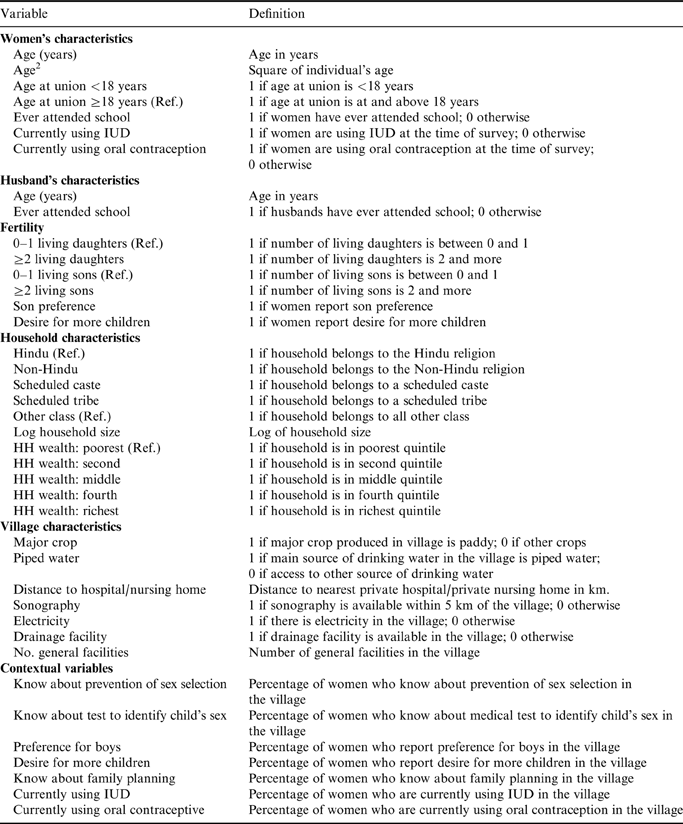
The determinants were split into the following categories: (a) the woman's characteristics, (b) the husband's characteristics, (c) household characteristics, (d) village characteristics, (e) contextual variables. While (a) to (d) are self-evident, the contextual variables in (e) were constructed, as village-level percentages, from the respondent's responses to questions on her (i) knowledge of prevention of sex selection and medical tests to identify the child's sex, (ii) preference for boys, desire for more children and knowledge of family planning, and (iii) currently using IUD or oral contraception. A full list of the variables, along with their meaning, is provided in the Appendix (Table A1).
Results
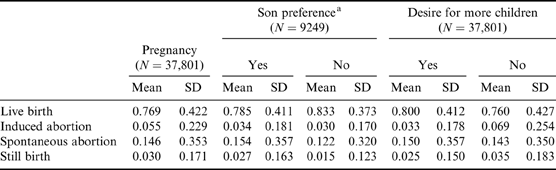
Table 1 presents the overall sample size and its split between the number of pregnant and non-pregnant women, and a further split between those pregnant women who had an induced abortion and those who reported a spontaneous abortion. To keep the calculations manageable, only the rural sample and ever-married women aged between 15 and 44 who recorded pregnancies and both forms of abortion during the 3 years preceding the survey were considered. Note, however, that, as shown by Potdar & Gurak (Reference Potdar and Gurak2003) and Potdar (Reference Potdar2005), son preference is more common among urban, educated couples. This needs to be kept in mind when generalizing the results from rural to urban India. Table 2 reports the summary statistics of pregnancy cases by the four possible outcomes, namely, live birth, induced abortion, spontaneous abortion and still birth. This also reports the split by son preference (scored 1 for yes, i.e. there is son preference, and 0 for no son preference) and desire for more children (scored 1 for yes, i.e. there is desire for more children, and 0 for no desire for more children). Son preference seems to have no impact on the rates of induced abortion, but the rates of spontaneous abortion are higher in the subgroup of women who have a positive preference for boys compared with those who don't have a son preference. Consequently, the subgroup of women that has son preference has much lower rates of live births than the subgroup that does not report son preference. This observation is consistent with the results of Potdar & Gurak (Reference Potdar and Gurak2003) and Potdar (Reference Potdar2005), who find that ‘the intensification of son preference results in fewer children but of a particular gender composition’. A similar picture is portrayed by the second half of Table 2, which reports that women who desire more children record a higher rate of live births. The effect is felt mainly through the sharp increase in the rate of induced abortion, nearly a doubling of the rate, on moving from women who desire more children to those who don't.
Breakdown of sample of rural currently married women aged 15–44 years, India, DLHS 2007

aYes means that a married woman reports one or more pregnancy, and one or more abortion (induced or spontaneous); bNo means that a married woman did not report any pregnancy or abortion (induced or spontaneous).
Summary statistics of pregnancy cases by the four possible outcomes, rural currently married women aged 15–44 years, India, DLHS 2007

a The sample size for son preference was less due to missing information.
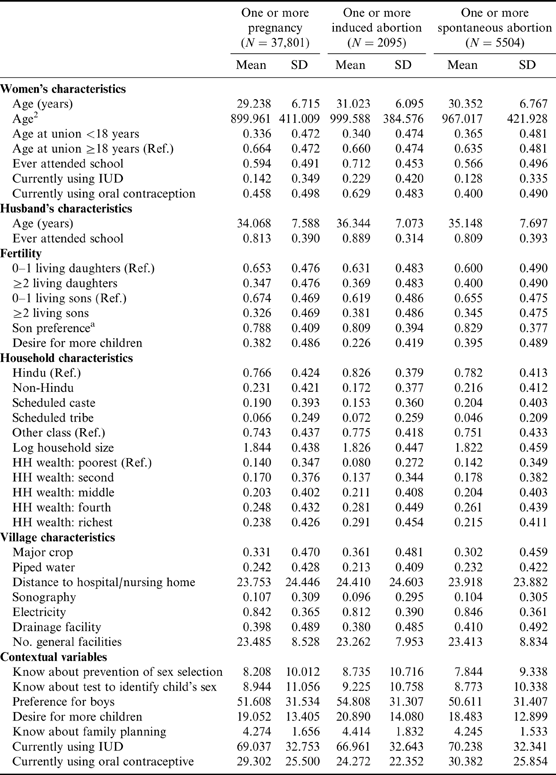
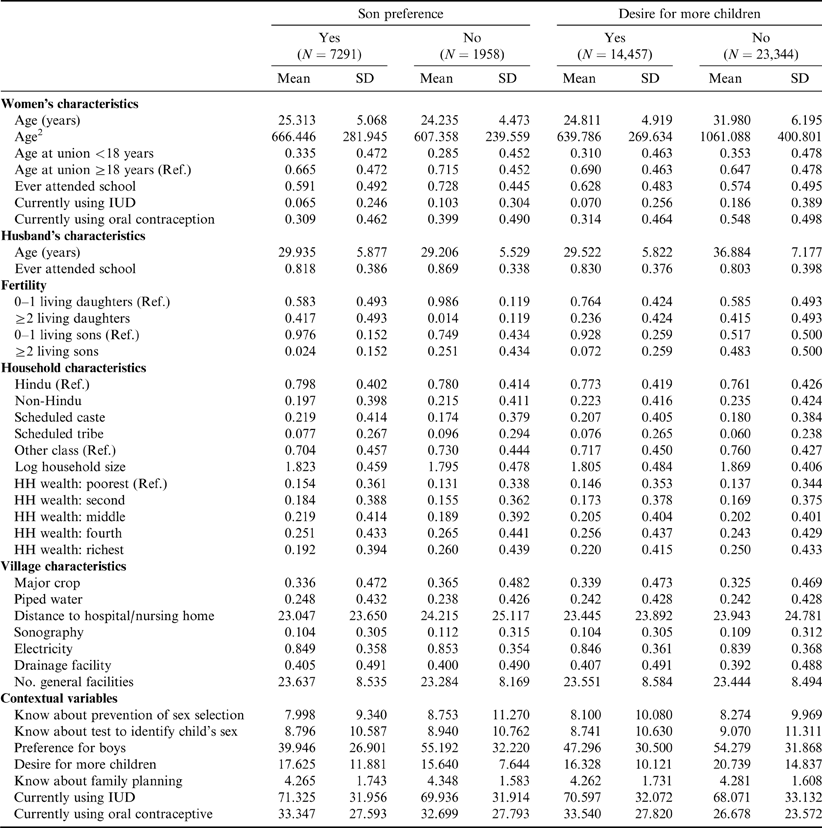
Table 3 presents the summary statistics of all the variables used in the study. Table 4 provides a more complete picture of the effect of son preference and desire for more children on the summary statistics by reporting their split between the two subsamples. A result of considerable significance is the observation that women who have son preference have fewer living daughters and more living sons compared with women who don't have a son preference. While son preference could be a possible cause for more living sons, this may not necessarily be the case, since women with more sons could state a son preference after childbearing. The results point to a high degree of correlation between the mother's son preference and the sex composition of her children, but should not be interpreted as confirming any causal relationship between the two. The association between the sex composition of children and the mother's son preference points to a possible explanation for the phenomenon of ‘missing women’ in India (Kynch & Sen, Reference Kynch and Sen1983). Note, also, that women who attended school record a sharply lower rate of son preference than those who didn't. This is consistent with the results of Pande & Astone (Reference Pande and Astone2007) based on the NFHS data. This observation needs to be qualified by noting the findings of Potdar & Gurak (Reference Potdar and Gurak2003) and Potdar (Reference Potdar2005), who show that the correlation between son preference and female education varies by region and state in India. Bose & Trent (2005) also warn against assuming that the results at the all-India level will hold for different regions in the country, as is evident in the sharp differences that they find between women from northern and southern states. Table 4 shows that wealth exerts a similar influence with women saying ‘no’ to son preference being more likely to belong to the top two quintiles in the wealth distribution than those who had son preference. It also shows that a lack of desire for more children exhibits an association with the sex composition of living children that is similar to that of son preference. It is important to re-emphasize that the results in Table 4 simply points to a correlation – they do not establish causation.
Summary statistics for rural currently married women aged 15–44 years reporting one or more pregnancy and one or more abortion (induced or spontaneous) in the 3 years preceding the survey, India, DLHS 2007
a Only includes data from sample women reporting son preference in the 3 years preceding the survey.
Descriptive statistics by son preference and desire for more children, rural currently married women aged 15–44 years reporting one or more pregnancy and one or more abortion (induced or spontaneous) in the 3 years preceding the survey, India, DLHS 2007
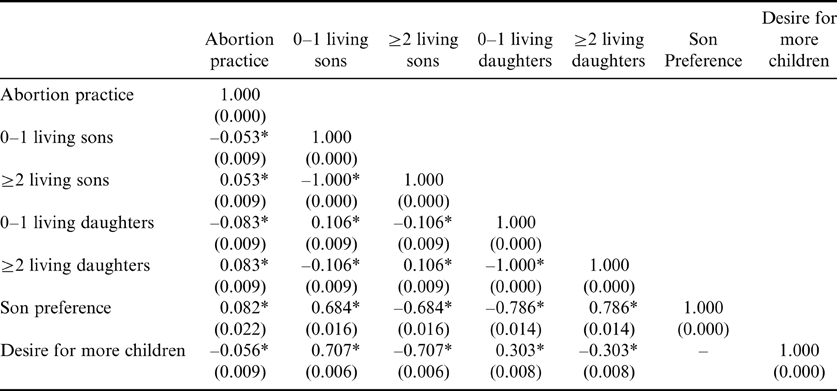
Further evidence on the nature and strength of association between abortion incidence, sex composition of children, son preference and desire for more children is provided in the Appendix Table A2. Nearly always, the pair-wise correlation is, statistically, highly significant, though the strength of the association is not large in all cases. Son preference is evident in mothers with 0 or 1 son, but much less evident in mothers with 2 or more sons. The reverse is the case if we switch the sex of the child, with an increase in the number of daughters being associated with an increase in the son preference of the mother. The desire for more children goes down with an increase in the number of children. It is worth noting that the desire for more children declines much more as the number of sons increases than when there is a similar increase in the number of girls (see also Potdar, Reference Potdar2002).
Univariate probit analysis
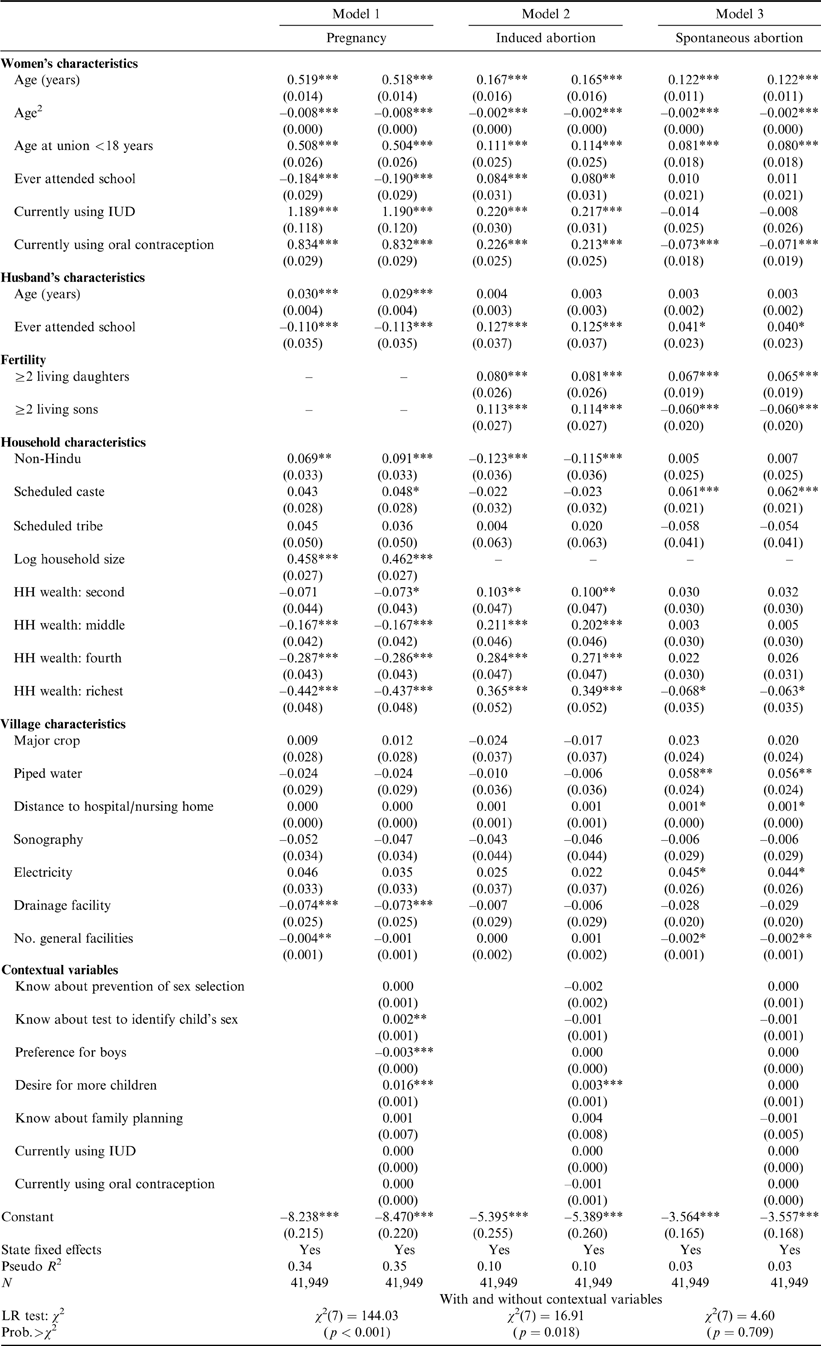
The univariate probit coefficient estimates of the three key dependent variables, namely, pregnancy, induced abortion and spontaneous abortion, are presented in Table 5. The equations were estimated as independent probits, and the conditional dependence of abortion on pregnancy was ignored. The robustness of the results was checked using logit models, and the results were found to be similar overall. Each of the equations was estimated with and without the contextual variables, and both sets of estimates are presented for comparison. The following features are worth noting.
Univariate probit estimates of pregnancy and induced and spontaneous abortion, rural currently married women aged 15–44 years, India, DLHS 2007
Robust standard errors are in parentheses and are clustered at the village level. Due to computational difficulties the variables ‘2 or more daughters’ and ‘2 or more sons’ were excluded from pregnancy probit models.
***p<0.01; **p<0.05; *p<0.1.
Older women are more likely to become pregnant, and more likely to abort as well, with the latter being true for both types of abortion. The former result is consistent with Elul (Reference Elul2011), and the latter with Bose & Trent (Reference Bose and Trent2006). None of these studies introduced non-linearities in the age variable. Table 5 suggests that in each case the effect weakens with age and that a turning point occurs around 32 years for pregnancy, 42 years for induced abortion and 31 years for spontaneous abortion. Older women beyond these age groups are less likely to become pregnant, and less likely to terminate their pregnancies or suffer miscarriage.
Age at union was also controlled in the analysis. This is a dichotomous variable that indicates whether or not a woman aged below 18 has started living with her husband (the reference category is those women who started living with their husband at age 18 or above). The results show that women who have started living with their husbands at a very young age are more likely to become pregnant, and more likely to abort as well. This result holds true for both types of abortion. Interestingly, Bose & Trent (Reference Bose and Trent2006) find the opposite result for the northern part of India. These authors argue that older women in union with their husbands are more likely to abort due to strong pressure to produce sons. Note, incidentally, that Bose & Trent (Reference Bose and Trent2006) did not distinguish between induced and spontaneous abortion. One possible explanation for our findings is that young women in union with their husbands have a lack of knowledge about use of any contraceptive method, and family planning, and thus they are more likely to become pregnant and seek an induced abortion to terminate the unwanted pregnancy. However, it is also possible that in populations at the outset of fertility transition, with low contraceptive prevalence rates, women's motivation to terminate an unwanted pregnancy may well exceed their ability to practise contraception. Hence, induced abortion provides an alternative mechanism to modern contraception allowing young women to control birth spacing and fertility behaviour. In the case of spontaneous abortion, the results suggest that young women are at an increased risk of experiencing miscarriage compared with older women in union.
Educated women, i.e. those who have attended school, are less likely to become pregnant but, if they do, they are more likely to terminate their pregnancy. The latter effect is much greater in both size and significance in the case of induced abortion than for spontaneous abortion. These results are of interest because educated women are generally expected to use contraceptives to prevent an unwanted pregnancy. However, effective and efficient use of contraceptives is not guaranteed in many parts of India due to cost and lack of services (Saha & Chatterjee, Reference Saha and Chatterjee1998). Thus, educated women in rural India may be relying on abortion to regulate the number of children they have.
Somewhat paradoxically, contraception (both IUD and oral) increases a woman's chances of becoming pregnant. This is consistent with the evidence presented in Razzaque et al. (Reference Razzaque, Ahmed, Alam and van Genneken2002) in their study on Matlab in Bangladesh. These authors argued that the result could be explained by the fact that a contraceptive user who wants to limit family size can subsequently be pregnant either for discontinuation due to side-effects, change in family size or use failure. Whatever the cause of the problem, the results suggest the need for active promotion of effective family planning methods in rural India. While both forms of contraception increase a woman's chances of having an induced abortion, the IUD has no effect on spontaneous abortion and reduces the chances of this type of abortion (see Parazzini et al., Reference Parazzini, Chatenoud, Tozzi, Benzi, Pino and Fedele1997, for a possible explanation).
Fertility has highly significant effects on both types of abortion. In other words, a woman's previous live birth history has an impact on her decision to abort a fetus. There is, however, an interesting difference between induced and spontaneous abortion. Having girls tends to increase a woman's chance of terminating a pregnancy of both the induced and spontaneous types. However, ceteris paribus, having sons, or a marginal increase in the number of sons, increases the chances of having an induced abortion, but reduces the chances of having a spontaneous abortion. Clearly, in the case of spontaneous abortion, but not induced abortion, the sex composition of the existing children does matter for the termination of pregnancy. To understand the former result, one needs to recall the definition of ‘spontaneous abortion’ stated earlier, which used the term to denote the use of herbal and non-medical methods to terminate a pregnancy, including illegal methods. This makes spontaneous abortion less ‘natural’ than implied by the name.
Consistent with previous evidence (e.g. Bose & Trent, Reference Bose and Trent2006), non-Hindu women (the reference category is Hindu women) are more likely to become pregnant, but less likely to have an induced abortion. But, quite significantly, this result does not extend to spontaneous abortion, where religion has no effect. Affluent women, especially those in the top two quintiles, are less likely to become pregnant and, if they do, are more likely to terminate their pregnancy by induced methods. This finding reflects, perhaps, women having the financial means to pay for the procedure. Once again, this result does not extend to spontaneous abortion.
Village characteristics are generally insignificant in their effects. An exception is drainage: the availability of drainage in the village reduces a woman's chances of pregnancy. This is simply noted as a negative association between drainage and pregnancy since there is no obvious explanation for any causal link. However, the contextual variables have much greater impact on a woman's pregnancy decision than on her decision to abort. For example, women living in villages where there is a preponderance of preference for boys are less likely to become pregnant, and those living in villages where the desire to have more children dominates, are more likely to become pregnant. The latter effect prevails in the case of induced abortion as well but is weaker in size in the case of spontaneous abortion (though not significant at the conventional levels of significance). The likelihood ratio (LR) tests, reported at the bottom of Table 5, confirm that, taken together, the contextual variables are highly significant in their effect on the pregnancy decision; less so for induced abortion (but still significant at the 5% level), but insignificant for spontaneous abortion. The results on the effects of the woman's and her household characteristics on her decisions on pregnancy and abortion are, generally, robust to the inclusion of the contextual variables.
The main feature of these results is that they point to the need to distinguish between induced and spontaneous abortion in analysing their determinants and in devising effective policy interventions. Table 5 does raise, however, the question of the robustness of the above results to estimation methods, in particular, relaxing the assumption of independence of the decisions to become pregnant, abort by induced methods and suffer termination as a miscarriage. The robustness of the results presented above is examined in the next section.
Bivariate probit analysis
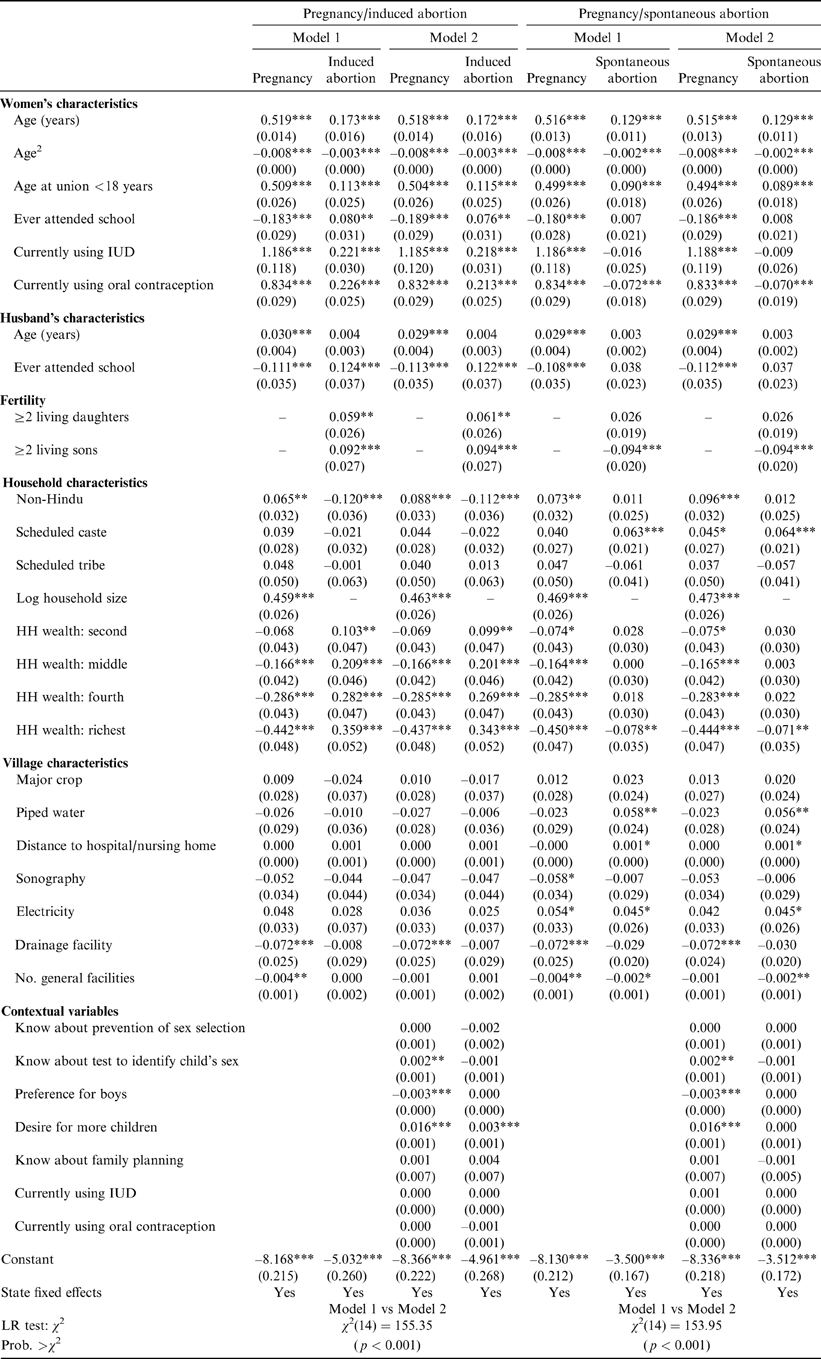
Table 6 presents the bivariate probit estimates of pregnancy and induced abortion, and pregnancy and spontaneous abortion. The estimates are presented for both cases, namely, when the contextual variables are omitted or included in the estimations. The estimation framework is the same as Elul (Reference Elul2011) but extended to distinguish between induced and spontaneous abortion. The principal results are robust to the change to a specification that recognizes abortion as conditional on pregnancy. Woman's age has an inverted U-shaped effect on all three events, with the turning point around the same levels, as noted in the case of pregnancy in the previous specification but not in the case of both types of abortion. Moreover, the size of the age effect is much lower in the case of spontaneous abortion than for induced abortion. Fertility and the sex composition of a woman's children have significant effects on induced abortion but the effects are sharply different in the case of spontaneous abortion. As before, the presence of a girl child has no effect on non-induced termination of pregnancy, but that of a son increases quite significantly the chances of such termination. The schooling and wealth effects are also similar to those reported in Table 5. The two types of abortion differ sharply with respect to the wealth effects: women in the top wealth quintile are more likely to abort by induced methods and less likely to abort spontaneously compared with those in the lower quintiles. The reason lies in the fact that termination of pregnancy by induced abortion is, mostly, a result of a decision by the woman, but spontaneous abortion or miscarriage is often due to factors outside a woman's control, such as malnourishment and lack of medical care. These are associated with women in the lower wealth quintiles, not with the top ones. Rising affluence lowers the chances of both pregnancy and involuntary miscarriage, but the reasons for these effects are quite different. Note, also, that the magnitude of the wealth effects is much higher in the case of pregnancy than for spontaneous abortion.
Bivariate probit estimates of pregnancy and induced and spontaneous abortion, rural currently married women aged 15–44 years, India, DLHS 2007
Robust standard errors are in parentheses and are clustered at the village level. Due to computational difficulties the variables ‘2 or more daughters’ and ‘2 or more sons’ were excluded from pregnancy bivariate probit models.
***p<0.01; **p<0.05; *p<0.1.
As before, the LR tests indicate that the models with and without contextual variables are significantly different from one another. For the induced abortion models the value of χ2(14) is 155.35 (p<0.01), while for the spontaneous abortion models it is 153.95 (p<0.01). Inspection of the individual coefficient estimates suggests that this finding is mainly due to the significance of the effects of contextual characteristics on pregnancy rather than on either form of abortion.
The Wald tests confirm that conditional dependence of the decision to terminate a pregnancy on the pregnancy decision itself is strongly supported by the results for both forms of abortion. In other words, these results support the framework of Elul (Reference Elul2011) as an advance over that of Bose & Trent (Reference Bose and Trent2006). Note, however, that, in the case of both forms of pregnancy termination, the introduction of the contextual variables weakens somewhat the statistical significance of this dependence, but does not eliminate it. This is reflected in the fact that the size of the Wald statistic declines with the introduction of the contextual variables but it retains its statistical significance. Of some interest is the further result that the conditional dependence is much weaker in the case of spontaneous abortion than for induced abortion. This reflects the fact that miscarriage or spontaneous abortion is much less in the control of the woman and, hence, less of a choice-based decision than induced abortion.
Trivariate probit analysis
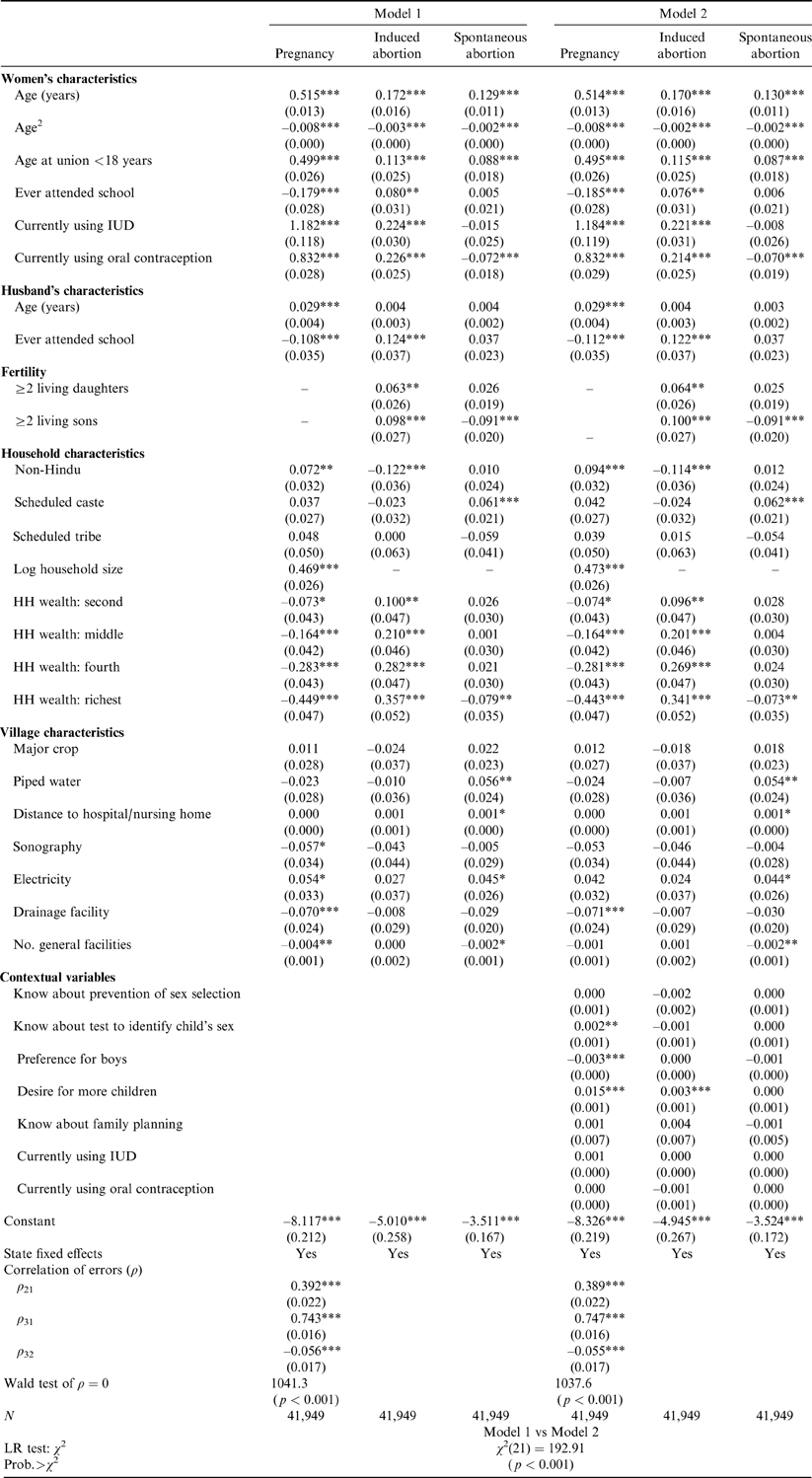
The bivariate probit estimation framework of Table 6 ignores the further (and mutual) dependence of induced and spontaneous abortion. To relax this restrictiveness and examine the robustness of the evidence presented so far, Table 7 presents the results from a trivariate probit estimation, which allows for three-way dependence between pregnancy, induced and spontaneous abortion. These results confirm the robustness of most of the results presented earlier. For example, the inverted U age effect on pregnancy and both forms of abortion holds, as does the mother's age at which the turning points occur. Wealth has different effects on induced and spontaneous abortion, with the effects being exactly the reverse of one another for the most affluent women. The Wald test rejects the assumption of independence underlying the base case of independent probit equations reported in Table 5. The estimates of the pair-wise correlation between the errors in the three equations show that all the pairs are significantly correlated. Note, however, that the estimated correlation between the errors in the equations for induced and spontaneous abortion (ρ 32) is much smaller than the others. This reflects the fact that there is very little overlap between the omitted characteristics in the two abortion equations. Taken in conjunction with the result that the included characteristics often differ sharply in size and significance, it points to the need to distinguish between the two forms of pregnancy termination in analysis and policy formulation.
Trivariate probit estimates of pregnancy and induced and spontaneous abortion, rural currently married women aged 15–44 years, India, DLHS 2007
Results of the trivariate probit model are estimated by SML with 210 pseudo-random draws. Robust standard errors are in parentheses and are clustered at the village level. Due to computational difficulties the variables ‘2 or more daughters’ and ‘2 or more sons’ were excluded from pregnancy trivariate probit models.
***p<0.01; **p<0.05; *p<0.1.
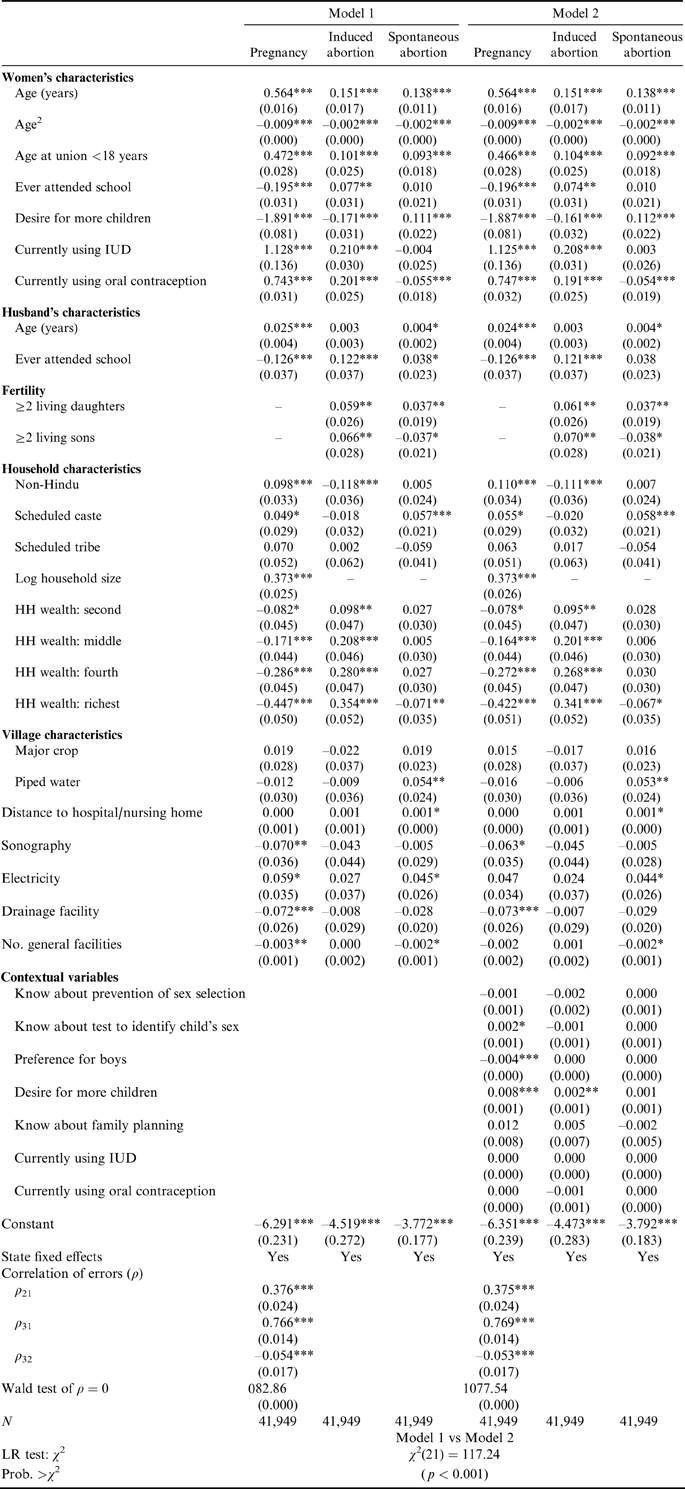
Table 8 provides evidence on the effect of a woman's desire for more children on pregnancy and the two forms of abortion. As in Table 7, this provides the trivariate probit estimates of pregnancy and abortion, both in the absence of the contextual variables (Model 1) and in their presence (Model 2). A comparison of Tables 7 and 8 shows that the results are quite robust to the inclusion of the woman's desire for more children as a determinant in the pregnancy and abortion equations. For example, the contextual variables continue to be jointly significant in their effect on the pregnancy and abortion decisions. The pair-wise correlation of the errors in the three equations continues to be highly significant in all cases. The sign and magnitude of the effects of the determinants on pregnancy and abortion are quite robust. There are several instances of wide divergence between induced and spontaneous abortion with respect to the nature and magnitude of the effect of their determinants. The key result from Table 8 is that, ceteris paribus, an increase in a woman's desire for children leads to fewer pregnancies and fewer induced abortions but an increase in spontaneous abortions. The effects of a woman's desire for children on pregnancy and both forms of abortion are always highly significant. These results perhaps suggest that women who desire more children are contraception users who want to delay the next birth and/or are unsure of the timing of the birth of their children but, if they become pregnant, are less likely to terminate their pregnancy through induced methods. However, these findings should be treated with some caution since, due to lack of data, it was not possible to control for the husband's attitude towards fertility preferences, and the ideal family size among couples.
Trivariate probit estimates of pregnancy and induced and spontaneous abortion, with desire for more children as an added determinant, rural currently married women aged 15–44 years, India, DLHS 2007
Results of the trivariate probit model are estimated by SML with 210 pseudo-random draws. Robust standard errors are in parentheses and are clustered at the village level. Due to computational difficulties the variables ‘2 or more daughters’ and ‘2 or more sons’ were excluded from pregnancy trivariate probit models.
***p<0.01; **p<0.05; *p<0.1.
Checks of robustness
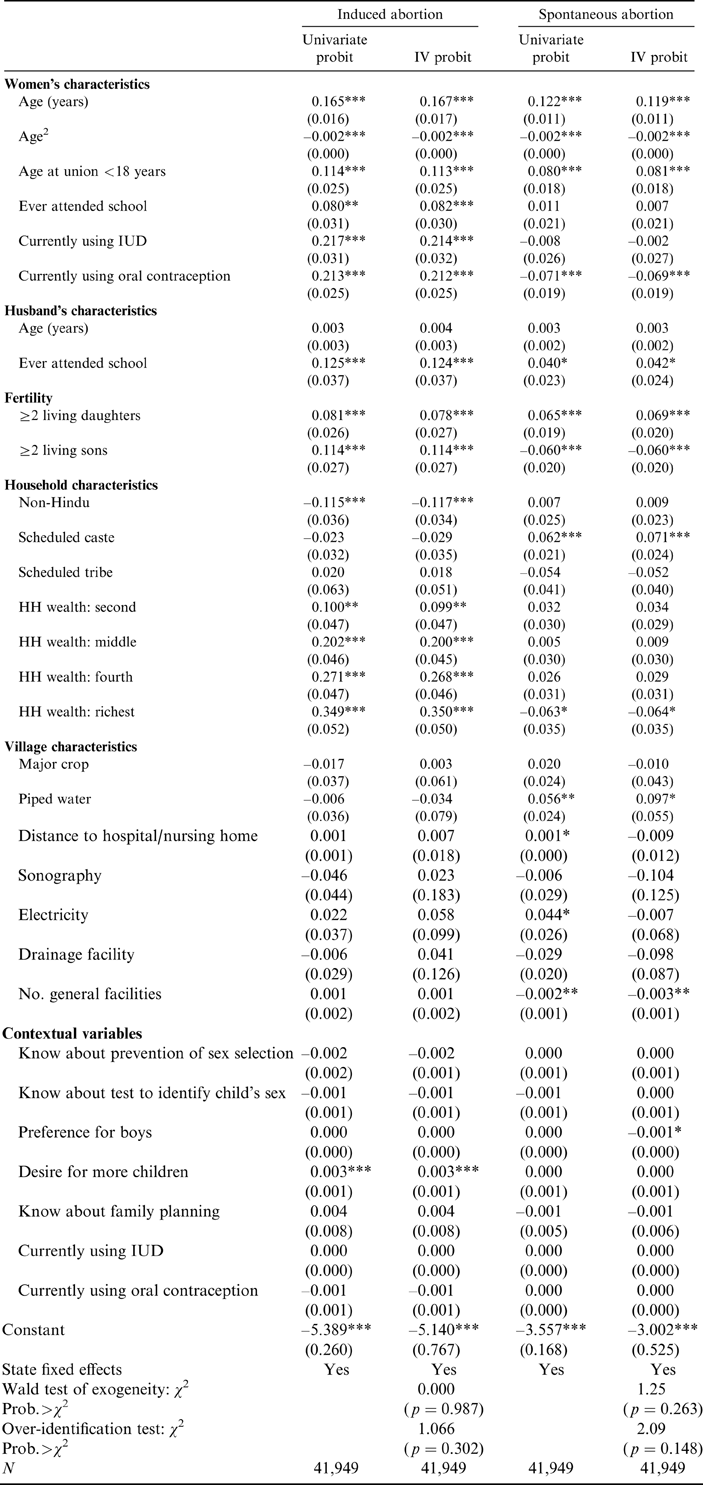
The final issue is that of endogeneity, and the robustness of the evidence presented. Several of the regressors are likely to depend as much on pregnancy and its outcome as the reverse. The treatment of endogeneity is often quite difficult, if not impossible, given the demand it places on the presence of valid instruments in the data. The more regressors chosen to treat as endogenous, the more instruments are needed for a satisfactory instrumental variable (IV) estimation. In this study, the distance to the nearest private hospital/private nursing home is considered as the most obvious example of an endogenous regressor in the abortion equation. More specifically, travel distance to an abortion provider may be determined by unobserved factors, such as local attitudes to abortion and local medical use patterns, which may affect the supply of, and demand for, abortion services. The IV probit method was employed to control for this endogeneity. Since travel distance measures abortion availability and abortion availability should be related to the overall supply of medical services, indicators of the availability of medical services can be used as IVs (Brown et al., Reference Brown, Jewell and Rous2001). The numbers of female doctors and trained birth attendants are used as IVs. An F-test was performed that coefficients on the instruments were jointly zero. The first-stage F-statistic is 26.84 with a negligible p-value. The value of R 2 is 0.14, indicating that instruments add significantly to the prediction of the travel distance to the nearest private hospital/private nursing home. The over-identification test indicates that the instruments are valid in the sense that their influence works only through the endogenous variable. Table 9 presents the evidence on robustness to the treatment of distance to the nearest private hospital/private nursing home as an endogenous regressor. The univariate probit and IV probit coefficient estimates are presented side-by-side to allow ready comparison. The Wald test statistic is not significant suggesting that there is insufficient evidence in the sample to reject the null that there is no endogeneity. This finding indicates that univariate probit estimates may be appropriate. There is very little change in the coefficient of IV probit estimates. The limited introduction of endogeneity does not change the results.
Instrumental variable (IV) probit estimates of pregnancy and induced and spontaneous abortion, rural currently married women aged 15–44 years, India, DLHS 2007
Robust standard errors are in parentheses and are clustered at the village level. Univariate probit estimates are copied from Table 5. Instruments for ‘distance to hospital/nursing home’ are ‘number of lady doctors in the village’ and ‘number of trained birth attendant in the village’.
***p<0.01; **p<0.05; *p<0.1.
Further checks of robustness were done by dropping both the contraception variables at the individual level, namely, IUD and oral. The use of contraceptives is potentially endogenous because it is jointly determined by sexual activity, pregnancy and abortion (Elul, Reference Elul2011). Both types of contraception were excluded and the univariate probit models re-estimated to gauge whether excluding these variables affected the findings. The sign and magnitude of the univariate probit estimates of the models that omitted the contraception variables were very similar to those presented in Table 5. In other words, the results are fairly robust to the inclusion or exclusion of the contraception variables and, more generally, to a limited treatment of endogenous regressors through IV methods.
Discussion
This study takes place against mounting interest in the incidence and determinants of abortion. While there has been much research done on abortion, especially the causes of miscarriage, in the biological and biosocial sciences, this cannot be said in the area of economics. While economists spend much time and effort on gender bias, ‘missing women’, etc., there has not been much of an attempt to study their source, namely, the fetus in the mother's womb, the decision to get pregnant and the subsequent decision to abort or carry through to live birth. Pregnancy and abortion have been viewed traditionally as being in the preserve of the medics, and not in the domain of economics. Part of this lack of interest has been due to the absence of data allowing the systematic examination of the socioeconomic determinants of pregnancy and abortion. Moreover, historically, whatever data were available were at the aggregate country level, and did not provide for the variation in individual and socioeconomic characteristics that is needed to conduct an econometric investigation. This is now changing with the availability of data sets that provide individual-level information supplemented by the mother's family and community characteristics, on pregnancy and her decision to abort or otherwise. There is now an increasing realization that abortion and pregnancy are not just in the medical domain but are socioeconomic phenomena as well. There is now some appreciation that pregnancy and abortion are caused not only by health issues but are also influenced by socioeconomic factors. This has opened up the possibility of devising targeted social and economic interventions that were not possible before.
The principal motivation of this study was to add to the growing literature on the socioeconomic determinants of pregnancy and abortion. It extends the studies of Potdar & Gurak (Reference Potdar and Gurak2003), Potdar (Reference Potdar2005) and Pande & Astone (Reference Pande and Astone2007) by studying the impact of son preference on the likelihood of abortion. The points of departure of this study from the previous literature include the following: (a) distinction between induced and spontaneous abortion, and a systematic comparison of their incidence and determinants, along with that of pregnancy, (b) recognition of the conditional dependence of abortion on pregnancy and, further, the interaction of the two forms of abortion and their joint dependence on pregnancy via the use of a trivariate probit model that extends the bivariate probit model that has been used recently, (c) use of a much wider set of individual, family and community characteristics than has been done before, in studying their impact on pregnancy and abortion, and (d) examination of the effect of fertility, not just in aggregate but also the effects of sex composition of the respondent's children, her preference for sons and desire for more children on her pregnancy and abortion decisions. The appeal to an underlying economic framework that rests on the assumption that a woman's decision on abortion is the result of her welfare maximization exercise subject to her characteristics is another point of departure of the present study from previous studies on abortion. The recent move in economic analysis to a collective choice framework that accords primacy to individual welfare and preferences in decision-making, away from the traditional unitary framework based on the assumption of dictatorial decision-making, is quite a convenient methodological development for this type of analysis that rests on a woman's right to decide based on her preferences and welfare.
The study was performed on a data set that is rich in detailed information, right up to the district level, on the respondent's pregnancy and its outcome and her individual, family and community characteristics. The latter include not only her village characteristics but also a set of contextual variables that were constructed at the village level from the respondent's answers to questions on son preference, desire for more children, and knowledge of methods to identify sex of a child, and so on. This study therefore allows not only for the possible effect of the respondent's son preference, or otherwise, on her pregnancy and abortion chances but also for the possible impact of the majority view in the respondent's place of residence in such matters as her pregnancy and its outcome. A result of some significance is that while these contextual variables have a significant effect on pregnancy, their effect on its outcome is much less significant. A comparison between induced and spontaneous abortion shows that the two differ markedly in their incidence and determinants. The results suggest that induced abortion is generally much more responsive than spontaneous abortion to the various determinants used in the estimation. This is consistent with the economic framework, which assumes that the woman is the decision-maker on her pregnancy and abortion since, unlike induced abortion, spontaneous abortion is caused by factors that are largely outside the control of the decision-maker. The latter is therefore less of a choice variable than the former. In some cases, e.g. wealth, the effects are diametrically opposite: women in the top quintile are more likely to abort artificially (i.e. report induced abortion) but less likely to suffer miscarriages associated with spontaneous abortion. Similar divergence between induced and spontaneous abortion is reported for the effect of a mother's desire for children on the probability of abortion. Ceteris paribus, desire for children by the mother has a negative effect on the likelihood of induced abortion, but has a positive effect on that of spontaneous abortion. The effect is highly significant in both cases. The results also suggest that woman's age has a non-linear, inverted U-shaped effect on pregnancy and induced and spontaneous abortion, a possibility that was not allowed in previous investigations. The result that the chances of pregnancy and abortion are at their peak for women in the age group 28–32 years, and that they decline outside this range, can be explained as follows. Young females, especially those in their late teens and early twenties, are prepared to wait and get settled before starting a family. The opportunity cost of a child to them in terms of foregone education and employment will be quite high. They are therefore less likely to get pregnant and, hence, will report fewer cases of induced abortion. At the other end, older women beyond the age group 28–32 years will have achieved their desired family size and, hence, will be less likely to get pregnant and will report fewer induced abortions. Many of these older women are likely to be looking to get back to employment and less eager to add to their family. Moreover, the risk to the health of both the mother and her child increases non-linearly once a woman passes her early 30s. This could also explain the result that the chances of pregnancy decline sharply for older women. The results also focus attention on the role that son preference, desire for more children and the sex composition of the woman's children play in her decision to become pregnant and, once she has, whether she aborts or carries through to live birth. The results are shown to be generally robust to alternative estimation methods, including a limited treatment of endogeneity through the use of IV probit estimation.
The empirical evidence of this study has several policy implications. The first and most significant lesson is the need to have more reliable data on abortion, especially more accurate data on spontaneous abortion. The results suggest that many of the reported cases of spontaneous abortion are actually induced abortions that have been misreported as spontaneous because of the social stigma associated with the former. Second, the result that women in less affluent households are more likely to become pregnant suggests the need to direct resources towards women in such households to increase their awareness of the consequences of motherhood, and to ensure safe childbirth through improved hospital facilities and better pre- and postnatal care. Third, the result that the chances of both pregnancy and abortion reach their peak for women in the narrow age group 28–32 years suggests that such women should be targeted with improved pre- and postnatal medical care and also safe abortion practice. Fourth, the link found between the sex composition of children in the household and abortion points to the possibility that some of the reported cases of abortion may be related to the sex of the aborted child. The fact that this link is found for spontaneous abortion as well suggests that such abortion may not always be spontaneous. This calls for more information on the sex of aborted children to enable effective policies to prevent sex-based abortion practices that lead to ‘missing women’. The present study was unable to provide direct evidence on the effect of a woman's son preference on her abortion chances because the sample size dropped sharply if son preference was included as a determinant of abortion. An important lesson from this study is the need to gather more information on mothers' cultural beliefs and sex preferences, along with her abortion history, to allow a meaningful estimation of the extent of sex-selective abortion. Since abortion chances are higher in less affluent households, data on the sex of aborted children should be collected from such households. Finally, the results stress the importance of education in helping women make informed choices on pregnancy and abortion. It is worth noting that education plays a role similar to that of household wealth in affecting pregnancy and induced abortion outcomes. However, unlike household wealth, the promotion of woman's education is open to direct policy intervention. Education empowers women to have a greater influence on intra-household decision-making and this is important for pregnancy and abortion, which affect them directly.
The results of this study point to the rich potential for further contributions to the subject from social scientists, especially economists. The increasing availability of survey data of the sort used here will encourage such applications in future. That will go a long way to establishing pregnancy and abortion as being as much in the domain of the social sciences as they have been in the biomedical literature.
Acknowledgments
The financial support of an Australian Research Council Discovery Grant is gratefully acknowledged. The authors are also grateful to Professor M. Guruswamy of the International Institute for Population Sciences in Mumbai for providing the DLHS data set used in this study The authors thank a reviewer for helpful comments on earlier versions of this paper.
Description of the variables used in the study (DLHS 2007)
Correlation between abortion incidence, sex composition of children, son preference and desire for more children