The ship
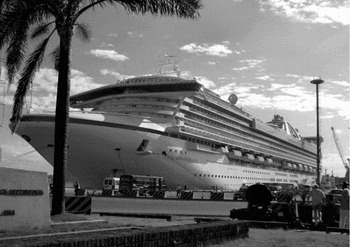
MS Golden Princess (Fig. 1) has an overall length of 289 m (950 ft), beam 36 m (118ft), maximum draught 8.45m (27ft), and a gross registered tonnage 108,865 tonnes. Built in Italy in 2001 and registered in Hamilton, Bermuda, she is designed for world cruising with a crew of 1,060, and is certified to carry up to 3,100 passengers. The service speed is 21 knots, and the maximum speed is 23.4 knots. Two fixed-pitch propellers, two semi-balanced rudders, and three forward and three aft thrusters provide high manoeuvrability. The ship uses a NACOS track pilot system. An integrated bridge allows all controls, navigation and track monitoring to be operated by computers from the centre position, with all safety and engine systems also monitored on adjacent screens. Golden Princess has no ice-breaking capacity, and must, therefore, proceed with extreme caution in Antarctic waters, avoiding areas in which there are high densities of floating ice.
MS Golden Princess, the largest liner that has so far cruised in Antarctic waters. Photograph: Caroline Gunn.

The voyage to Antarctica was organised by Princess Cruises, a sister line to P&O Cruises. As a US-registered company operating a non-governmental activity in the area covered by the Antarctic Treaty, the company was obliged to conform to regulations under the US Antarctic Science, Tourism and Conservation Act of 1996. Princess Cruises had previously negotiated for three cruises to Antarctic waters involving two of its smaller liners:
1. Royal Princess visited Antarctic waters from 31 December 2003 to 2 January 2004 with 1022 passengers and 549 crew, en route from Cape Town to Valparaiso.
2. Royal Princess repeated the itinerary from 29 December 2004 to 1 January 2005 with 1032 passengers and 553 crew.
3. The slightly larger Regal Princess visited Antarctic waters from 18 to 21 January 2006 with 1553 passengers and 672 crew, en route from Rio de Janeiro to Valparaiso.
Following these voyages, the company qualified in 2007 for full membership of the International Association of Antarctica Tour Operators (IAATO). For details of IAATO and its membership requirements see Landau and Splettstoesser (Reference Landau, Splettstoesser, Snyder and Stonehouse2007), and the IAATO website. Golden Princess was thus subject to all IAATO procedures and guidelines for large ships, including the requirement not to land passengers in Antarctica imposed on all ships carrying 500 passengers or more. The ship carried an experienced ice pilot, and three of the bridge officers aboard had gained previous Antarctic experience on the 2006 Regal Princess voyage.
The cruise
The advertised itinerary of the voyage included visits to Argentine and Chilean ports and the Falkland Islands, with landings and excursions ashore if weather permitted. The Antarctic itinerary listed scenic cruising at specified localities including Elephant Island, Esperanza Station, Admiralty Bay, Gerlache Strait, Neumayer Channel and Deception Island, a standard route now used with slight variations by all large cruise ships in the Antarctic Peninsula region. The only possibility for passengers to step ashore in the Antarctic region was provided by an optional excursion flight from Punta Arenas, Chile, over the South Shetland Islands and Bransfield Strait, with a brief landing at the Chilean station Teniente Marsh on King George Island.
Golden Princess sailed from Rio de Janeiro on 23 January 2007, spending a day each in Puerto Madryn and Stanley. She left Stanley in the evening of 29 January 2007, crossing the Antarctic Convergence in calm weather shortly after midday the following day, and arriving off the eastern group of the South Shetland Islands at 0740 on the morning of 31 January. The first iceberg, a large tabular berg, had already been spotted at 0410. During the morning the visibility was mostly good with calm sea conditions and occasional snow showers interspersed with clear sky, which allowed good views of Elephant Island. After circumnavigating Gibbs Island and viewing Aspland Island, at 1730 the ship set course across Bransfield Strait toward Trinity Peninsula, slowing overnight to 7 kts to reduce danger from brash ice.
The ship entered Antarctic Sound at 0500 on 1 February, arriving off Hope Bay at 0705. The morning cleared to allow excellent views of the bay, the station and the Adélie penguin colony from 1.35 nautical miles offshore. Esperanza station was contacted by radio. At 0745 the ship set course back to Bransfield Strait, passing among tabular bergs up to 800 m long. The ship crossed Bransfield Strait in cloudy weather, but by mid-afternoon had entered Admiralty Bay, King George Island under clear skies. By previous arrangement four Polish scientists from Arctowski Station came aboard and gave a talk to the passengers about their research and life on the station during the winter months. Meanwhile MV Discovery, a smaller cruise ship, was anchored in the bay landing passengers for a visit to the station and penguin colony. While it was formerly rare for Antarctic cruise ships to encounter each other, particularly at landings, the recent rapid increase in numbers of cruise ships of all sizes (Landau and Splettstoesser Reference Landau, Splettstoesser, Snyder and Stonehouse2007: 201) now makes encounters frequent and inevitable.
Overnight Golden Princess headed south across Bransfield Strait, and at first light on 2 February entered Gerlache Strait in beautifully clear and calm weather. Shortly before 1000 the ship reached its southernmost latitude (65° S) in Flandres Bay, rounding Wiencke Island to enter the southern end of Neumayer Channel. The weather remained clear during the passage of the channel, which proceeded past Port Lockroy and through patches of light brash ice to exit at 1312. Golden Princess crossed Gerlache Strait into Bryde Channel and Paradise Harbour, and then returned to Gerlache Strait and set course for Deception Island.
From 0800 on 3 February Golden Princess lay off Baily Head, Deception Island, again in fine clear weather with a calm sea, among rafts of chinstrap penguins with numerous sightings of humpback and minke whales (which were not approached). At 0900, in response to a radioed request from IAATO, the ship headed eastward along the South Shetland Islands to pick up crew and expedition staff from the Norwegian passenger vessel MV Nordkapp, which was anchored off Bellingshausen Station, Maxwell Bay, following a damaging incident at Deception Island a few days earlier. After embarking 43 crew members, Golden Princess left at 1400, cleared King George Island and headed toward Drake Passage, completing the Antarctic section of the cruise.
The voyage continued with scenic cruising at Cape Horn, and stops at Ushuaia, Punta Arenas and Montevideo. Passengers finally disembarked at Buenos Aires on 12 Febuary 2007.
Impressions of the cruise
The impression derived by the authors concerning the cruise was of a carefully planned, unhurried and well-executed cruise operation, in which environmental protection requirements and constraints appear to have been closely observed. In a lecture before entering Antarctic waters the captain and staff captain emphasised the importance of all on board keeping strictly to special environmental regulation. The crew received similar instruction.
As Antarctic special guest lecturers, the first and second authors were given ample facilities and high priority to educate and inform both passengers and crew, including lectures and presentations in the theatre (which were attended to capacity) and commentaries from the bridge during daylight hours. Though competing for attention with many other shipboard activities, from bingo to ballroom-dancing instruction, Antarctic presentations were given priority immediately before and during the four days in the far south. All passengers with whom the authors exchanged views seemed keen to learn about the Antarctic, and showed genuine interest and concern over the future of the continent. The impression was that the educational element played a special rôle which the company was concerned to foster, one that may readily be maintained, encouraged and developed on all such cruises.
The voyage was blessed by fine weather, and appeared to be enjoyed and appreciated by the passengers. Although the Antarctic leg of the cruise occupied less than one fifth of the total time, many passengers told us that they had chosen the cruise specifically to visit Antarctica. Many too had chosen the comfort of a large ship, foregoing the possibility of landings, in preference to a more adventurous but less comfortable small-ship passage. These included elderly and disabled passengers, who could not have withstood rough sea passages and Zodiac landings, but accepted gratefully this opportunity to visit Antarctica. Some passengers had chosen a non-landing cruise in the belief that they would thereby lessen environmental impacts on Antarctica, a sentiment previously observed by the authors on other non-landing passenger vessels (Bertram Reference Bertram2005:144–145). All were happy to relax and enjoy the excellent viewing facilities, scenery and wildlife. Large cruise liners and the smaller ships clearly cater for different constituencies of clients.
Particularly highlighted by the cruise was the impact of so large a ship during visits to gateway ports (Bertram and others Reference Bertram, Muir, Stonehouse, Snyder and Stonehouse2007: 126). In Stanley, Falkland Islands, the number of passengers landing far exceeded the local population, stretching community resources to the limit. Tours had been fully booked months before the voyage: passengers seeking private tours on the day found no taxis or public transport available. Tours from Punta Arenas, including the flight over Antarctica, had also been fully booked long before the cruise began. At Puerto Madryn, all tours scheduled for the afternoon were cancelled, as the Valdez Peninsula venue had recently been privatised for conservation purposes, and tourism on so large a scale was not welcome.
A growing market
The first appearance in Antarctic waters of a large cruise ship carrying some 3500 passengers and crew cannot fail to alert observers concerned with the safety both of ships and of the Antarctic environment. However, the advent of Golden Princess follows a trend common to cruise operations generally, that of big ships tending to replace smaller ones because they provide economies of scale for operators.
The trend has already been discernable among the small ships of 50–120 passenger capacity that have for long carried the bulk of tourists to Antarctica. As the smaller ships carrying fewer than 100 passengers are pensioned from service, they tend to be replaced by larger ones of 150–250 capacity, meeting the expanding requirements of a market that has grown unsteadily but inexorably for over half a century.
The first cruise liner to enter the field, MV Ocean Princess in the three seasons 1990–93, had a total capacity of over 500 but limited bookings to 250–400 for Antarctic cruises. This vessel was soon followed by other medium-sized liners carrying 350–500. Up to June 2001, operators of ships carrying more than 400 passengers were barred from IAATO membership. After some five years of annual debate, they were eventually accommodated in a category separate from the smaller ships, but those carrying over 500 passengers were not allowed to land passengers. Operators of all ships following IAATO regulations, regardless of size, are required to limit to 100 the number of passengers ashore at any time (Landau and Splettstoesser Reference Landau, Splettstoesser, Snyder and Stonehouse2007: 199).
In 1999–2000, the first cruise liner capable of carrying over 1000 passengers MV Rotterdam, brought 936 passengers on a pioneering, non-landing Antarctic cruise (Stonehouse and Brigham Reference Stonehouse and Brigham2000). In seven subsequent seasons this market has consolidated and grown. No liner of comparable size visited in the following season, but in 2004–2005 four such liners carried 5027 passengers, and in 2006–2007 Golden Princess, with double the passenger capacity of any previous ship, contributed to a total of approximately 7500 cruise liner visitors (Landau and Splettstoeser 2007). Operators of these large liners that conform to IAATO requirements are now accommodated within the organisation.
Despite misgivings that big ships are potentially more hazardous than small ones, no convincing case against the use of large cruise liners has as yet been made. Operators at present safeguard their position in several ways. In applying for permits they tend to follow Holland America's lead in choosing to meet the very stringent safety requirements imposed by the authorities of Glacier Bay, Alaska, in preference to the less demanding ones imposed on them for Antarctic cruises (Stonehouse and Brigham Reference Stonehouse and Brigham2000: 347). Apart from very high standards of personnel and equipment on board, for Antarctic cruises they employ experienced ice pilots, follow conservative itineraries in well-charted waters, allow adequate time to complete their passages at safe speeds, and carry all the equipment required under international conventions to deal with oil spills and other emergencies.
In their comments on the initial MV Rotterdam voyage to Antarctica, Stonehouse and Brigham (2000: 349) drew attention to the over-riding need, in the event of a disaster, to pick up survivors within one or two days, and indicated that the capacity of smaller cruise ships and nearby research stations to help would be very limited. They suggested that the presence of a second large cruise ship in the area, or at least within two days’ travel, would provide a useful safeguard. This has to some degree been met by the increasing number of such ships now employed during the season. However, a large cruise liner foundering in Antarctic waters would clearly have a potential for disaster unprecedented in the history of the region.
From time to time, Antarctic Treaty Consultative Meetings (ATCMs), in full consultation with IAATO, have given serious consideration to tourist shipping developments in Antarctic waters. However, market forces alone continue to determine the numbers of ships, voyages and tourists, and the size of ships, that visit the continent. Neither the Antarctic Treaty System nor IAATO impose limits on the number or capacity of ships that can become involved, so long as the cruise specifications satisfy the responsible licensing agencies of the states from which the companies operate.
A recent draft resolution contained in a working paper submitted by the United States to the 30th ATCM in April–May 2007, raised several questions concerning Antarctic shipborne tourism generally, and the presence of large ships in particular (United States 2007). The resolution invited treaty parties to consider, among other questions, whether vessels with a capacity of more than 500 passengers should be subject to special construction standards, and whether the presence of increasingly larger ships and greater congestion in waters near the Antarctic peninsula require the adoption of more stringent, regionally-specific navigational standards. The resolution too questioned the adequacy of search and rescue procedures as they apply to passenger vessels in Antarctic waters.
This development can only be welcomed by all for whom the seemingly unlimited growth and diversification of Antarctic shipborne tourism are matters for concern. However, those who initiate advances in Antarctic tourism move faster than those who aspire to control it. Should the Golden Princess voyage have proved as satisfactory to its originators as it was to its clients, we see every likelihood of more large-ship cruises to Antarctica in the near future, with no limit to the size of ships involved.
Acknowledgements
We thank the officers and crew of MS Golden Princess, notably Captain D. Calabrese, Staff Captain Todd MacBain, First Officer and Navigator Tim Wingate and Ice Pilot, Captain Bob Parsons, USCG (Ret.), for their ready help, advice and information onboard, and the many passengers who gave us their views on the MS Golden Princess cruise. Bob Parsons and John Snyder made helpful comments on earlier drafts of this paper.