





Introduction
Regular physical activity during pregnancy is widely recognised as an important contributor to maternal health. 1,Reference Schwartz, Schmill and Cadney2 Moderate-intensity exercise has been associated with improved cardiovascular function, muscular strength, psychological wellbeing, reduced risk of excessive gestational weight gain, and a lower risk of pregnancy complications. Reference Prather, Spitznagle and Hunt3,Reference Santos-Rocha, Branco and Prior de Freitas4 Benefits may also extend to offspring, with studies reporting healthier growth trajectories, lower birth weight, reduced body mass index, and potential cognitive benefits among children born to physically active mothers, without evidence of harm. Reference Hui, Back and Ludwig5–Reference Moyer, Reoyo and May8 However, common barriers, including safety concerns, time constraints, and misconceptions regarding exercise during pregnancy, may limit participation in physical activity among pregnant women. Reference Prather, Spitznagle and Hunt3,9
Maternal lifestyle factors, including both physical activity and diet, play an important role in shaping neonatal outcomes. Reference Hui, Back and Ludwig5,Reference May, Allen and Gustafson6,Reference Saunders, Guldner and Costet10 Adherence to a Mediterranean diet during pregnancy has been associated with favourable pregnancy outcomes, including a reduced risk of preterm birth among overweight and obese women. Reference Saunders, Guldner and Costet10 While the benefits of physical activity for maternal health are well established, 9 its relationship with neonatal body composition remains less clear. Neonatal body composition, particularly body fat percentage, is increasingly recognised as an important indicator of fetal growth and metabolic health, providing a more sensitive measure of body fat percentage than traditional anthropometric measures such as birth weight or body mass index alone. Reference Catalano, Thomas, Huston-Presley and Amini11 Higher neonatal body fat percentage has been associated with an increased risk of childhood overweight and obesity Reference Moore, Harrall, Sauder, Glueck and Dabelea12 and previous studies have reported associations between maternal physical activity during pregnancy and offspring body fat percentage. Reference Bisson, Tremblay and St-Onge13 However, evidence remains limited and inconsistent, particularly regarding sex-specific associations and studies using objective measures of neonatal body composition. Air-displacement plethysmography (ADP), using the PEA POD system, is considered the gold standard for measuring infant body composition Reference Wagner, Heath, Spencer, Evans, McBride and Burch14 ; however, its high cost and limited availability restrict widespread use. Reference Barbour, Hernandez and Reynolds15 Consequently, few Australian studies have examined the association between maternal physical activity during pregnancy and neonatal body composition measured using PEA POD. Reference Barbour, Hernandez and Reynolds15,Reference McCarthy, Khashan and Murray16 Given the limited number of studies using direct measures of neonatal body composition, further research is needed to clarify the relationship between maternal physical activity and neonatal body fat percentage and determine whether these associations differ by infant sex.
The primary objective of this study was to investigate the relationship between maternal self-reported physical activity levels during the second trimester of pregnancy and infant body composition at birth, stratified according to infant sex.
Method
Demographics and study background
Recruitment to the ORIGINS cohort commenced in October 2016 and targeted pregnant women intending to give birth at Joondalup Health Campus, a tertiary maternity service in Perth, Western Australia, incorporating both public and private care pathways. Recruitment concluded in October 2024, resulting in a cohort of 10,450 mothers and their children. The majority of births (9473; 90.7%) occurred at Joondalup Health Campus, while 977 children (9.3%) were born at other hospitals across Western Australia. Of the enrolled cohort, 3933 participants consented to active participation, which involved ongoing follow-up from pregnancy through birth and early childhood, via questionnaires, biological sample collection, and research clinic visits. Reference Davis, Talati and Whalan17
Data collection
The ORIGINS participants completed antenatal online questionnaires, specifically the International Physical Activity Questionnaires (IPAQ) and the Godin Leisure-Time Exercise (Godin) questionnaire, which provided information on the types and intensity of physical activities engaged in by the participants. Reference Booth18,Reference Sikes, Richardson, Cederberg, Sasaki, Sandroff and Motl19 Various studies have assessed the validity of these questionnaires, yielding modest agreement with objective measures, Reference Helmerhorst, Brage, Warren, Besson and Ekelund20 which is considered acceptable for self-reported physical activity measures in large population studies. The IPAQ and Godin questionnaires were included in this study because they capture complementary aspects of physical activity. The IPAQ assesses overall physical activity across multiple domains, whereas the Godin questionnaire focuses on the frequency and intensity of leisure-time exercise. Using both measures enabled assessment of whether associations with infant body composition were consistent across different dimensions of maternal physical activity.
International Physical Activity Questionnaires (IPAQ)
The IPAQ is a widely used self-report questionnaire designed to assess an individual’s physical activity levels over a specific period. Reference Noda, Yoshida and Kawakami21 It includes questions on various types of physical activities, including leisure time, work-related, transportation, and domestic activities. Physical activity levels derived from the IPAQ were expressed as Metabolic Equivalent of Task (MET)-minutes per week, calculated from reported walking, moderate-intensity, and vigorous-intensity activities. Participants were classified into low, moderate, or high physical activity categories according to standard IPAQ scoring protocols based on the frequency, duration, and intensity of activity reported during the previous seven days. Reference Booth18
High physical activity was defined as vigorous activity on at least 3 d accumulating ≥1500 MET-minutes/week or any combination of activities achieving ≥3000 MET-minutes/week. Moderate physical activity was defined according to standard IPAQ criteria, including ≥600 MET-minutes/week, while participants not meeting these criteria were classified as having low physical activity.
The Godin Leisure-Time Exercise questionnaire (Godin)
The Godin Leisure-Time Exercise questionnaire is a brief and easy-to-administer self-report tool to assess leisure-time physical activity over the past seven days. Reference Sikes, Richardson, Cederberg, Sasaki, Sandroff and Motl19 The Godin questionnaire categorises physical activities into three intensities: strenuous (e.g., running, soccer), moderate (e.g., swimming, bicycling), and mild/light exercise. Participants reported the frequency of engaging in strenuous (e.g., running, vigorous swimming, hockey), moderate (e.g., fast walking, easy cycling, recreational tennis), and mild/light (e.g., easy walking, yoga, bowling, golf, light stretching) leisure-time activities for periods of at least 15 min during a typical week. A total Leisure Score Index (LSI) was calculated by weighting the frequency of strenuous, moderate, and mild activities by metabolic equivalents (9, 5, and 3 METs, respectively) and summing the resulting values, with higher scores reflecting greater leisure-time physical activity. The Godin questionnaire is particularly useful for assessing moderate and vigorous physical activity because it quantifies the frequency of leisure-time exercise performed at different intensity levels. Reference Sikes, Richardson, Cederberg, Sasaki, Sandroff and Motl19
Additional covarites
Information was also collected on additional covariates including socioeconomic status (SEIFA, IRSAD), Mediterranean diet (MDI), ethnicity, maternal age, pre-pregnancy BMI, and parity. Reference Ashwin, Gibson, Hagemann, D’Vaz, Bear and Silva22
The Index of Relative Socio-Economic Advantage and Disadvantage (IRSAD) is a part of the Socio-Economic Indexes for Areas (SEIFA), developed by the Australian Bureau of Statistics. 23 IRSAD scores measure the socioeconomic status of geographic areas in Australia based on indicators like income, education, employment, and housing. 23 Higher scores indicate more socioeconomic advantage, while lower scores indicate greater disadvantage. 23
The MDI is a measurement tool used to evaluate adherence to the Mediterranean diet, a healthful eating pattern inspired by the traditions of Mediterranean countries. Reference Ashwin, Gibson, Hagemann, D’Vaz, Bear and Silva22,Reference Amati, Hassounah and Swaka24 The MDI assesses how well someone follows the diet’s principles, which include consuming abundant fruits and vegetables, whole grains, healthy fats like olive oil, lean proteins, and limiting red meat. Reference Ashwin, Gibson, Hagemann, D’Vaz, Bear and Silva22 The index assigns scores based on adherence to these guidelines, offering insights into a diet associated with various health benefits, such as reduced risk of chronic diseases. Reference Ashwin, Gibson, Hagemann, D’Vaz, Bear and Silva22 The Mediterranean Diet index employed in this study comprised 13 questions (excluding the alcohol-related item). Participants received a positive score for consuming (1) a high ratio of monounsaturated fats to saturated fats, (2) high olive oil intake, (3) high vegetable intake, (4) high fruit intake, (5) low intake of meat and meat products, (6) low intake of saturated fats, (7) low intake of sweetened carbonated beverages, (8) high legume intake, (9) high fish or seafood intake, (10) less sweets/pastry intake, (11) high intake of nuts, (12) a higher consumption of white meat to red meat ratio, and (13) high sofrito (tomato/onion-based) sauce use when cooking. The medians, stratified according to sex within the sample, served as cutoff points, Reference Costacou, Bamia, Ferrari, Riboli, Trichopoulos and Trichopoulou25 and grams per day were used as the intake measurement. Reference Trichopoulou, Kouris-Blazos and Wahlqvist26
Body composition assessment
Infant body composition was assessed within 7 d of birth using the PEA POD® Infant Body Composition System (COSMED, Concord, CA, USA), an ADP device that estimates body composition through whole-body densitometry in infants weighing between 1 and 8 kg. Reference McCarthy, Khashan and Murray16 The PEA POD is a non-invasive, validated method that has been widely used in neonatal research due to its accuracy, ease of use, and ability to provide rapid measurements. Reference McCarthy, Khashan and Murray16
For each assessment, infants were undressed and weighed using the integrated electronic scale. Body volume was then determined by measuring air displacement within the chamber. Standard corrections were applied for air contained within the lungs and for the isothermal air layer adjacent to the skin. Body density was calculated from the measured mass and volume, and body composition was subsequently estimated using a two-compartment model comprising body fat percentage and fat-free mass. Percentage body fat was derived using established assumptions regarding fat density and age-and sex-specific fat-free mass densities based on reference data from Fomon et al. Reference Fomon, Haschke, Ziegler and Nelson27 Once body density had been calculated, body fat percentage and fat-free mass percentage were estimated automatically by the PEA POD software (version 3.0.1).
Participant selection and exclusion criteria
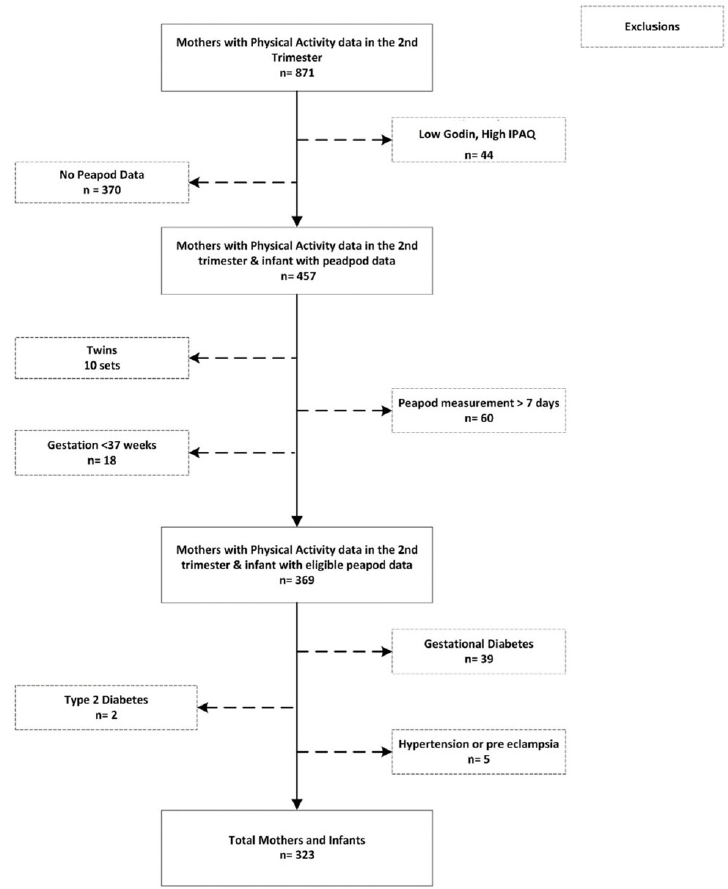
The study focused on a subset of the ORIGINS participants (n = 871) who met specific eligibility criteria, resulting in 323 (37%) participants being included in the analysis (Fig. 1). These criteria included consent to ORIGINS, singleton pregnancies, birthing at Joondalup Health Campus, completion of the IPAQ or Godin questionnaire during the second trimester, mismatch between Godin and IPAQ (those with a inactive score for Godin and high activity level for IPAQ), newborns with a gestational age of at least 37 weeks, and availability of PEA POD measurements within 7 d of birth. Participants with discordant physical activity classifications between the IPAQ and Godin questionnaires were excluded to minimise potential exposure misclassification and increase confidence in physical activity categorisation.
Inclusion and exclusion criteria.

Data analysis methods
Categorical data was presented as frequencies and percentages. For continuous outcomes and predictors, the data was reported as means and standard deviations when normally distributed and medians and interquartile ranges when data was skewed.
As MDI could be both a confounder and a mediator in the relationship between maternal physical activity and infant body fat percentage, we assessed associations between physical activity levels and MDI, which was done using chi-squared tests. Differences in body fat percentage between female and male infants was analysed using an independent t test.
To analyse the association of physical activity with infant body fat percentage (Peapod fat percent), two linear regression models where used. Model 1 examined the IPAQ as the main predictor, with low physical activity as the reference category. Model 2 examined the Godin, with inactive behaviour as the reference. In both models an interaction term between physical activity and infant sex was included to assess sex-specific differences in association. The models were adjusted for the potential confounding effects of socioeconomic status (SEIFA, IRSAD), MDI, ethnicity, maternal age, pre-pregnancy BMI, and parity. Multiple imputations using chained equations was performed to handle missing data for MDI (missing n = 14) and ethnicity (Caucasian, missing n = 1), with 20 imputed datasets generated. We tested for a linear trend in the outcome across the three ordered physical activity categories within sex using the orthogonal polynomial linear contrast of covariate-adjusted marginal means. Statistical significance was set at p < 0.05. All statistical analysis was performed using Stata v 16.1 (StataCorp, College Station, Texas).
Ethics approval
Prior to commencing this study, ethics approval was obtained from the Ramsay Health Care WA|SA Human Research Ethics Committee (#1440).
Results
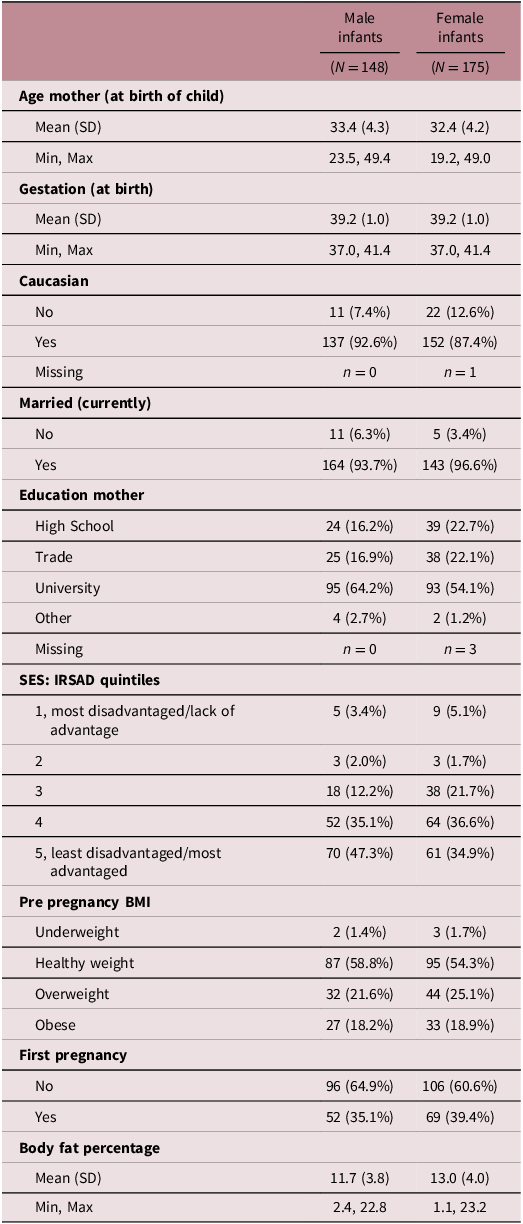
Table 1 summarises characteristics of 148 male and 175 female infants. The mothers were aged on average 33 years, spanning from 19 to 49 years. The mean gestation period was approximately 39 weeks for both sexes. Most mothers identified as Caucasian (87.4%–92.6%), were married (93.7%–96.6%), and had a university-level education (54.1%–64.2%). Additionally, the largest proportion of participants belonged to the least disadvantaged IRSAD quintile (34.9%–47.3%), indicating relatively high socioeconomic advantage within the cohort. Approximately 60% of mothers had previous pregnancies. There was a significant difference in body fat percentage between male and female infants, with a mean body fat percentage in males of 11.7% vs 13.0% in females (p = 0.005).
Maternal and infant characteristics by infant sex of 323 ORIGINS participants

Table 1. Long description
A table comparing maternal and infant characteristics by infant sex for 323 participants. The table has 14 rows and 4 columns. Column headers are Age mother (at birth of child), Gestation (at birth), Caucasian, Married (currently), Education mother, SES: IRSAD quintiles, Pre pregnancy BMI, First pregnancy, and Body fat percentage. Row labels are Male infants (N = 148) and Female infants (N = 175). Row 1: Age mother (at birth of child), Mean (SD), 33.4 (4.3), 32.4 (4.2). Row 1: Age mother (at birth of child), Min, Max, 23.5, 49.4, 19.2, 49.0. Row 2: Gestation (at birth), Mean (SD), 39.2 (1.0), 39.2 (1.0). Row 2: Gestation (at birth), Min, Max, 37.0, 41.4, 37.0, 41.4. Row 3: Caucasian, No, 11 (7.4%), 22 (12.6%). Row 3: Caucasian, Yes, 137 (92.6%), 152 (87.4%). Row 3: Caucasian, Missing, n = 0, n = 1. Row 4: Married (currently), No, 11 (6.3%), 5 (3.4%). Row 4: Married (currently), Yes, 164 (93.7%), 143 (96.6%). Row 5: Education mother, High School, 24 (16.2%), 39 (22.7%). Row 5: Education mother, Trade, 25 (16.9%), 38 (22.1%). Row 5: Education mother, University, 95 (64.2%), 93 (54.1%). Row 5: Education mother, Other, 4 (2.7%), 2 (1.2%). Row 5: Education mother, Missing, n = 0, n = 3. Row 6: SES: IRSAD quintiles, 1, most disadvantaged/lack of advantage, 5 (3.4%), 9 (5.1%). Row 6: SES: IRSAD quintiles, 2, 3 (2.0%), 3 (1.7%). Row 6: SES: IRSAD quintiles, 3, 18 (12.2%), 38 (21.7%). Row 6: SES: IRSAD quintiles, 4, 52 (35.1%), 64 (36.6%). Row 6: SES: IRSAD quintiles, 5, least disadvantaged/most advantaged, 70 (47.3%), 61 (34.9%). Row 7: Pre pregnancy BMI, Underweight, 2 (1.4%), 3 (1.7%). Row 7: Pre pregnancy BMI, Healthy weight, 87 (58.8%), 95 (54.3%). Row 7: Pre pregnancy BMI, Overweight, 32 (21.6%), 44 (25.1%). Row 7: Pre pregnancy BMI, Obese, 27 (18.2%), 33 (18.9%). Row 8: First pregnancy, No, 96 (64.9%), 106 (60.6%). Row 8: First pregnancy, Yes, 52 (35.1%), 69 (39.4%). Row 9: Body fat percentage, Mean (SD), 11.7 (3.8), 13.0 (4.0). Row 9: Body fat percentage, Min, Max, 2.4, 22.8, 1.1, 23.2.
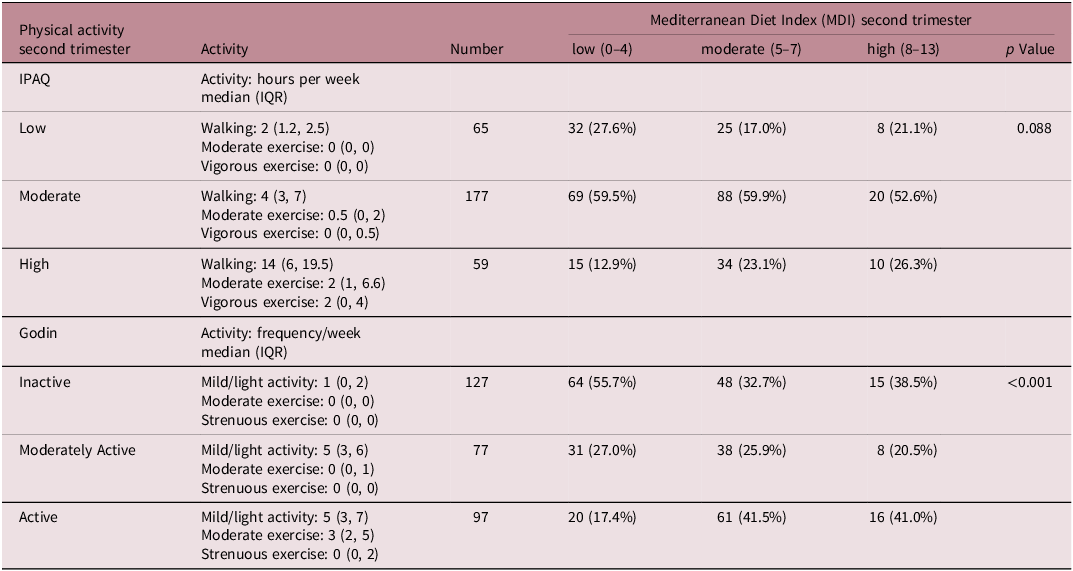
Table 2 provides details of the associations between physical activity and adherence to a Mediterranean diet during the second trimester of pregnancy. Participants with a low MDI presented with lower physical activity, whereas mothers with moderate to high MDI scores recorded higher physical activity scores. A significant association was observed between the MDI and Godin questionnaire (p < 0.001). The majority of those with a low MDI were classified as having inactive activity levels (Godin: 56%), compared to participants with a high MDI where only 38% were classified as inactive. The highest level of physical activity (Godin) was observed in mothers with moderate or high MDI with approximately 40% participants recorded an active exercise level when adhering to a moderate or high MDI diet. In comparison only 17% of participants with a low MDI were classified as being active.
Association between maternal physical activity (IPAQ and Godin) and Mediterranean Diet Index (MDI) during the second trimester for 323 ORIGINS participants

Table 2. Long description
The table presents data on the associations between physical activity and adherence to a Mediterranean diet during the second trimester of pregnancy. It includes information on 323 participants, categorized by their physical activity levels and Mediterranean Diet Index (MDI) scores. The table has 10 rows and 6 columns. The columns are labeled as follows: Physical activity second trimester, Activity, Number, Mediterranean Diet Index (MDI) second trimester (low (0-4), moderate (5-7), high (8-13)), and p Value. The rows are categorized into IPAQ and Godin activities, with further subdivisions based on activity levels (low, moderate, high for IPAQ; inactive, moderately active, active for Godin). Each row provides details on the type and frequency of activities, the number of participants, and their distribution across different MDI scores. Notable trends include higher physical activity levels associated with higher MDI scores and a significant association between MDI and Godin questionnaire scores (p<0.001). For example, participants with low MDI scores were predominantly inactive (56%), while those with high MDI scores had a lower percentage of inactivity (38%). Additionally, around 40% of participants with moderate or high MDI scores were classified as active, compared to only 17% of those with low MDI scores.
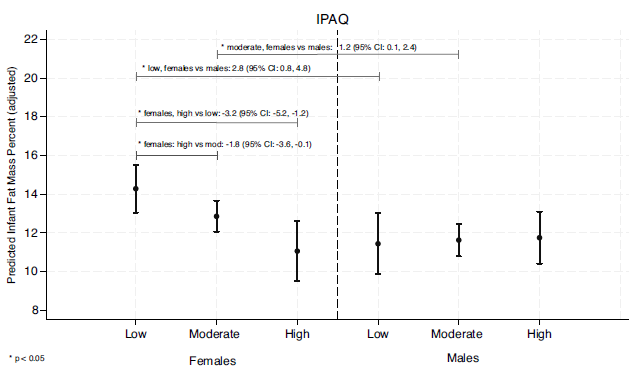
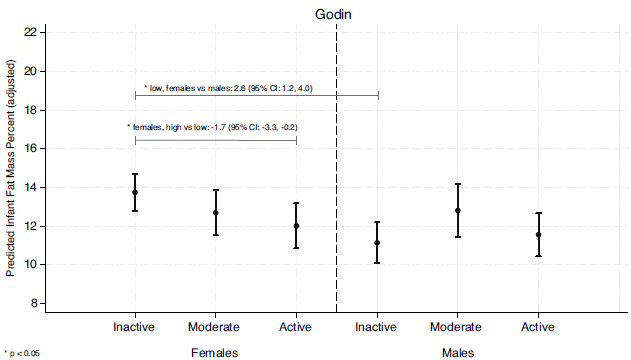
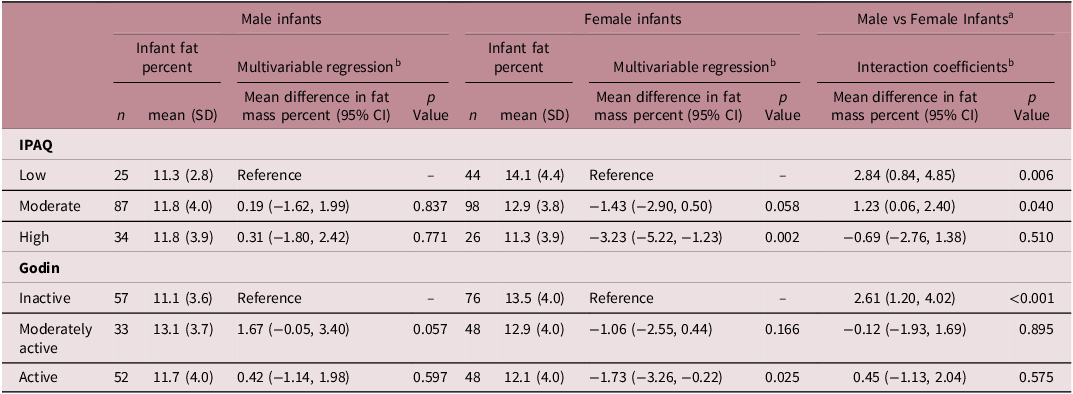
Table 3 and Figs. 2 and 3 present the associations between body fat percentage in male and female infants according to physical activity levels measured with Godin and IPAQ during the second trimester of pregnancy. Female infant body fat percentage decreased with increasing level of maternal physical activity during the second trimester (test for linear trend: IPAQ p = 0.002, Godin p = 0.025). For the IPAQ, male infants demonstrated similar infant fat percentages regardless of exercise level, while the Godin indicated there was increased body fat percentage for mothers with moderate activity level, but this did not meet statistical significance (p = 0.057).
Adjusted linear predictions showing infant body body fat percentage (Y axis) by maternal physical activity IPAQ categories for female and male infants.

Adjusted linear predictions showing infant body body fat percentage (Y axis) by maternal physical activity Godin categories for female and male infants.

Associations between maternal second-trimester physical activity, measured either by IPAQ or Godin, and infant body fat percentage (Peapod body fat percentage) by infant sex for 323 ORIGINS participants

Table 3. Long description
A table comparing infant fat percent and maternal physical activity levels by infant sex. The table has 10 rows and 12 columns. The columns are divided into three main sections: Male infants, Female infants, and Male vs Female Infants. Each section contains sub-columns for Infant fat percent, Multivariable regression, and Interaction coefficients. The Infant fat percent sub-column includes the number of participants (n) and the mean fat percent with standard deviation (SD). The Multivariable regression sub-column includes the mean difference in fat mass percent with 95 percent confidence interval (CI) and p-value. The Interaction coefficients sub-column includes the mean difference in fat mass percent with 95 percent confidence interval (CI) and p-value. The rows are divided into two main categories based on the physical activity measurement tools: IPAQ and Godin. Each category has sub-rows for different activity levels: Low, Moderate, and High for IPAQ; Inactive, Moderately active, and Active for Godin. For IPAQ, male infants have similar fat percentages across activity levels, while female infants show a decrease in fat percent with increasing activity levels. For Godin, male infants show increased fat percent with moderate activity, while female infants show a decrease in fat percent with increasing activity levels. Notable trends include a significant interaction coefficient for low IPAQ activity level and inactive Godin activity level between male and female infants.
a Comparison of males vs females, with negative score indicating males have a lower fat percentage compared to females.
b Adjusted for: Socioeconomic status (SEIFA, IRSAD), Mediterranean diet (MDI), ethnicity, maternal age, pre-pregnancy BMI, and parity.
Difference between female and male infants body fat percentage was observed for both the IPAQ and Godin (omnibus interaction term: p = 0.003 and p = 0.006 respectively). Female infants had higher body fat percentage than males, with the largest differences observed when the mother was inactive or engaged in low levels of activity (female infants body fat percentage was higher by 2.8% [p = 0.006] on the IPAQ and 2.6% [p < 0.001] on the Godin). Additionally, the IPAQ indicated that mothers participating in moderate activity had female infants with higher body fat percentage than male infants (1.2% higher, 95% CI: 0.1% to 2.4%, p = 0.040).
Discussion
The results from this study of 323 mothers and infants from the Western Australian ORIGINS birth cohort revealed higher body fat percentage in female infants, compared with male infants, and significant associations between maternal physical activity levels and infant body fat percentage. High physical activity in mothers during the second trimester, assessed with either IPAQ or Godin, was associated with reduced body fat percentage in female infants. No association between maternal physical activity and infant body fat percentage was observed for male infants.
Maternal lifestyle during pregnancy is a subject of great importance due to its potential influence on infant health and development. Reference Moyer, Reoyo and May8,Reference Evenson, Barakat and Brown28 Literature suggests that infants of active mothers have increased gestational age, lower birth weight, and lower body mass index. Reference Hopkins, Baldi, Cutfield, McCowan and Hofman7 Moreover, previous studies indicate that these effects persist into early childhood, with offspring of physically active mothers showing lean body mass at the age of five. Reference Prather, Spitznagle and Hunt3 The findings presented in this study contribute to the ongoing research in the field of maternal and infant health regarding the relationship between maternal physical activity, diet, and infant body fat percentage.
Our study found that the body fat percentage levels of female infants were consistently higher compared to male infants. This aligns with existing literature that highlights higher body fat levels in female newborns compared to male infants. Reference Hawkes, Hourihane, Kenny, Irvine, Kiely and Murray29 Our study also found that female infants born to highly active mothers showed significantly lower body fat percentage, based on both IPAQ and Godin measures. This supports existing literature that highlights potential sex-specific differences in the relationship between maternal physical activity during pregnancy and infant outcomes. Reference Hawkes, Hourihane, Kenny, Irvine, Kiely and Murray29–Reference Rich-Edwards, Kaiser, Chen, Manson and Goldstein31 Also, this consistent trend aligns with previous studies highlighting the positive maternal activity impact on offspring health outcomes. Reference Prather, Spitznagle and Hunt3,Reference Zerfu, Pinto and Baye32 The robustness of these findings across different physical activity measures reinforces this relationship’s validity. Furthermore, these results underscore that the relationship remains even after adjusting for maternal diet (MDI), emphasising the independent contribution of physical activity to female infant body fat percentage. In contrast, male infants exhibited diverse outcomes in the multivariable analysis, indicating that moderately active mothers had male infants with higher body fat percentage compared to their inactive counterparts. This observation emphasises the complex nature of maternal activity’s impact, potentially influenced by genetic, hormonal, or metabolic factors interacting with maternal activity to affect male and female infants differently. Reference Ikenoue, Kasuga, Endo, Tanaka and Ochiai30
To further explain these sex-specific findings, however, emerging evidence suggests the differing effects of maternal physical activity during pregnancy on improved offspring body composition by fetal sex may be due to metabolic factors. A plausible biological explanation lies in sexual dimorphism of the placenta, with female placentas demonstrating greater adaptive capacity to environmental exposures, including maternal metabolic and behavioural factors. Reference Meakin, Cuffe, Darby, Morrison and Clifton33,Reference Stenhouse, Bazer and Ashworth34 Maternal exercise is known to improve insulin sensitivity, reduce inflammation, and enhance placental vascular function, all of which may influence fetal nutrient delivery and adipogenesis. Reference Menke, Duchette, Tinius, Wilson, Altizer and Maples35,Reference Mudd, Scheurer, Pruett, Demerath, Kapur and Ramel36 These physiological changes may be more effectively translated in female fetuses, resulting in lower body fat percentage, whereas male fetuses, characterised by a more growth-driven and less flexible placental phenotype, may be less responsive to such environmental modulation. Reference Meakin, Cuffe, Darby, Morrison and Clifton33 However, current human evidence remains inconsistent, with some studies reporting stronger associations between maternal physical activity and reduced neonatal body fat percentage in males rather than females. Reference Dieberger, Obermayer-Pietsch, Harreiter, Desoye, Van Poppel and group37 These discrepancies likely reflect differences in study design, timing and intensity of physical activity, and methods of body composition assessment. Overall, these findings support a model of sex-specific developmental programming, highlighting the importance of considering fetal sex in studies examining early-life determinants of body fat percentage. Further exploration is necessary to uncover the factors driving this sex-specific response.
These findings may also be interpreted within the framework of fetal programming and early body fat percentage trajectories. Maternal physical activity during pregnancy may contribute to a more favourable intrauterine environment through improvements in maternal glucose regulation, lipid metabolism, placental perfusion, and inflammatory pathways, thereby influencing fetal adipose tissue development and energy metabolism. Reference Chae, Son and Du38,Reference Mottola and Artal39 Lower neonatal body fat percentage observed among female infants of highly active mothers may therefore reflect early alterations in body fat percentage trajectories that persist beyond infancy. Previous longitudinal studies have demonstrated that neonatal body composition is associated with later childhood body fat percentage and metabolic health, Reference Admassu, Wells and Girma40 suggesting that even modest differences in body fat percentage at birth may have implications for future obesity risk. Consequently, promoting maternal physical activity during pregnancy may represent an important early-life strategy for influencing offspring body fat percentage trajectories and reducing the intergenerational transmission of obesity risk.
This study found an association between maternal physical activity and adherence to the Mediterranean diet. Combining physical activity with a healthy diet during pregnancy has been associated with various benefits for the mother, including improved gestational weight gain, decreased risk of gestational diabetes, and enhanced cardiovascular health. Reference Grenier, Atkinson and Mottola41 This highlights the potential synergistic benefits of these healthy behaviours for both maternal health and wellbeing and infant outcomes. Examining these associations can help inform prenatal care and interventions that promote healthy lifestyles during pregnancy, potentially leading to improved outcomes for both mothers and infants. Therefore, healthcare providers should encourage pregnant individuals to adopt and maintain both regular physical activity and healthy Mediterranean dietary habits to promote the best possible health for themselves and their infants.
While this study provides valuable insights into the relationships between maternal physical activity, diet, and infant body fat percentage, several limitations need to be taken into consideration. One limitation lies in the use of self-reported measures for both maternal physical activity and diet. Self-reported data can introduce recall bias and social desirability bias, potentially affecting the accuracy of the reported behaviours. Reference Rosenman, Tennekoon and Hill42 However, the self-reported information on physical activity and diet was collected prospectively during pregnancy and before the infant was born and was thus most likely to be random and bias the estimated towards the null. Future research could incorporate objective measures, such as accelerometers for physical activity and dietary biomarkers, to provide a more accurate assessment of maternal behaviours. Also, the exclusion of discordant physical activity classifications between the IPAQ and Godin questionnaires may have introduced bias, as discordance between self-reported physical activity measures may reflect measurement variability rather than invalid responses. However, given that the discordant classifications were only 5% of the total sample, the impact is unlikely to be significant. Additionally, this study focused on the second trimester of pregnancy, and therefore, the potential effects of maternal behaviours in other trimesters were not explored. Investigating the potential trimester-specific effects could offer a better understanding of how these behaviours impact infant body fat percentage at different stages of development. Furthermore, the study mainly focused on an Australian population, which limits the generalisability of the findings to more diverse demographics. Including a more diverse sample that encompasses a broader range of ethnicities, socioeconomic statuses, and geographical locations would enhance the external validity of the results.
In conclusion, the findings from the study indicated sex-specific associations between maternal physical activity during the second trimester and infant body fat percentage, with higher physical activity being associated with lower body fat percentage in female infants, but not male infants. Furthermore, female infants consistently exhibited higher body fat percentage levels compared to males. The research also indicated a connection between higher physical activity levels and adherence to the Mediterranean diet. The study’s findings align with and expand upon existing literature regarding early-life influences on infant body fat percentage. The research indicates sex-specific responses and suggests a need for personalised prenatal care strategies that promote both physical activity and a healthy diet, potentially enhancing infant health outcomes.
Data availability statement
The data underlying this article cannot be shared publicly due to privacy of the individuals that participated in the study.
Acknowledgments
We are grateful to all the ORIGINS families who support the project. We would like to acknowledge Sharon Vincent Vadakara for contribution towards the earlier version of the manuscript. We would also like to acknowledge and thank the following teams and individuals who have made ORIGINS possible: ORIGINS project team; Joondalup Health Campus (JHC); members of ORIGINS Community Reference and Participant Reference Groups; Research Interest Groups and the ORIGINS Scientific Committee; The Kids Research Institute Australia; City of Wanneroo; City of Joondalup; and Professor Fiona Stanley.
Author contribution
JD and DS conceptualised the study. JD, KE, DS, RS, SW and LG designed the study. KE and JD wrote the manuscript. KE performed the statistical analyses and prepared the tables. All authors contributed to interpretation of the findings and read and approved the manuscript before submission.
Financial support
This work was supported by ORIGINS core donations from the Telethon Perth Children’s Hospital Research Fund, Joondalup Health Campus, the Paul Ramsay Foundation and the Commonwealth Government of Australia through the Channel 7 Telethon Trust. Substantial in-kind support has been provided by The Kids Research Institute Australia and Joondalup Health Campus.
Competing interests
None
Ethical standard
The authors assert that all procedures contributing to this work comply with the ethical standards of the Australian National Statement on Ethical Conduct in Human Research (2007, updated 2018) and with the Helsinki Declaration of 1975, as revised in 2008, and has been approved by the Ramsay Health Care WA I SA Human Research Ethics Committee (ref: 2016/ETH/1440).
All ORIGINS study participants provided written consent for data collection, biological sample collection and storage, access to all medical records collected at JHC, and for details of personal health and wellbeing to be released by the Australian government to the ORIGINS researchers.
Use of artificial intelligence (AI) tools
ChatGPT (OpenAI) was used to assist with improving readability and English grammar during manuscript preparation. The authors reviewed and edited all outputs and take full responsibility for the content of the manuscript.

 Open access

