1. Introduction
A brief stroll about the cityscape of South Korea (henceforth ‘Korea’) testifies to Curtin's (Reference Curtin2014) presumptive cosmopolitanism, whereby locals are expected to possess a high degree of competence in linguistically accommodating newcomers or world travellers by using English or other international languages in the linguistic landscape. One can easily spot English monolingual, Korean–English bilingual, and multilingual signs for ‘advertising billboards, street names, place names, commercial shop[s] and . . . government buildings’ (Landry & Bourhis, Reference Landry and Bourhis1997: 25), helping visitors and new arrivals negotiate the environment without being literate in the local language, Korean. The current English-flooded linguistic landscape of urban areas is well described in J. S. Lee's (Reference Lee2016) study, in which an elderly interviewee confirms, ‘[E]verywhere you go, you see English – banks, markets, and things. When we go shopping these days, brand names and street signs are all in English’ (331).
The tables have turned – to a certain degree. Over the past few years, a trend has emerged among Koreans, who have witnessed the Korean Wave – the widespread enthusiasm for Korean culture – beginning to sweep ‘East Asia in the 1990s and continuing more recently in the United States, Latin America, the Middle East, and parts of Europe’ (Ravina, Reference Ravina2009: 436). According to a newspaper article published in 2018, Korean youth prefer shop names and labels in Hangeul (or Hangul) – the Korean alphabet – to faux-posh foreign names (Chosun.com, 9 October, 2018). As one 26-year-old student is quoted, ‘Many people of my generation have traveled abroad a lot and are able to speak foreign languages, so we feel it's cooler to see plain Hangeul than foreign languages used badly or wrongly’ (para. 6).
Substantiating the observations that nationalistic language attitudes in Korea are just as prominent as the heated pursuit of English (Park, Reference Park2009), S. Kim's (Reference Kim2020) analysis of user-generated comments on news sites and social media vis-à-vis the use of monolingual English signage in public buildings indicated that almost 91% of the commenters expressed unfavourable views towards the practice. Reasons for opposition included the Korean script's aesthetic value and uniqueness, as illustrated in the following statements: ‘I find it difficult to believe that some people still think using English makes them look cool’ and ‘Someone who hasn't caught up with the growing trend seems to have designed the sign’ (5). Such perceptual changes, coupled with the mass prevalence of English–Korean bilingualism in Korea (Shim, Reference Shim1994), have entailed the ability to manoeuvre through the linguistic forms of many different languages for creative practices such as bilingual punning in brand naming (Friedman, Reference Friedman1994). As English has lost some of its cachet, creative English–Korean wordplay has begun to appear in the Korean linguistic landscape.
Creative bilingual practices in linguistic landscapes have been reported in different parts of the Outer and Expanding Circles. Luk (Reference Luk2013), for instance, examined ten visual bilingual texts used for playful effects in Hong Kong. Her analysis of the textual properties, semantic features and socio-pragmatic use of these examples identified distinct strategies of bilingual language play – such as phonological/lexical crossover, semantic enhancement, and visual parody – and provided evidence of local creative use of bilingual resources. Similarly, Rivlina (Reference Rivlina2015) examined formal and functional aspects of English–Russian language play. In outlining the variety, scope, and peculiarities of the creative use of English, she addressed sociolinguistic realities such as the mass English–Russian bilingualism and localisation (or nativisation) of English in modern Russia.
Curtin's (Reference Curtin2014) study explored the emergence of a bona fide cosmopolitanism indexed via orthographic scripts and images in the linguistic landscape of Taipei, Taiwan. The findings suggested that the cosmopolitan feel of Taipei's current linguistic landscape has been cumulatively achieved via the multilingual scripts on display throughout the city. J. W. Lee (Reference Lee2014) examined a variety of linguistic tactics present in the linguistic landscapes of Korea and ethnic Korean enclaves in the US. He demonstrated that the language practices in these areas – such as sensational spelling, inventive portmanteaus, transgressive romanisation, and polylingual punning – ‘disrupt and destabilize language boundaries established through metadiscursive regimes’ (63) and that such fluidity deconstitutes traditional boundaries of language.
Although there is a growing interest in the various aspects of bilingual creativity in a locale's linguistic landscape, little academic effort has been made thus far to explore patterns of the creative manipulation of orthographic forms in the Korean linguistic landscape apart from Lee (Reference Lee2014). To add to the relatively small body of literature addressing the peculiarities of the linguistic realisation of playful techniques in different language combinations (Rivlina, Reference Rivlina, Nelson, Proshina and Davis2020), this study traces the emergence of orthographies on signs in public space that index ‘bilingual creativity’, which Kachru (Reference Kachru1985) defines as ‘creative linguistic processes which are the result of competence in two or more languages’ (20).
2. Methodology
A corpus comprising approximately 300 representative examples of bi-/multilingual and multisemiotic creativity patterns provides the basis of the study, which focuses exclusively on instances of language play in English–Korean interaction. Here, wordplay between Korean and English loanwords (e.g., burger, oasis) or foreign company names in English (e.g., McDonald's) is included. The corpus was compiled by the author using data collected through incidental sampling from two types of sources: (1) pictures of public and commercial signs retrieved from local community websites on which people from different parts of Korea share community announcements and information about restaurants or other places in their neighbourhoods; and (2) photographs the author took during fieldwork in 2019.
The fieldwork was undertaken in and around Seoul (the capital of Korea), Busan (Korea's second most populous city) and Jeju Island (the largest island in Korea), and encompassed commercial vs. residential areas, commercial districts targeting students vs. office workers, and traditional markets vs. high-end downtown shopping malls. Since no particular areas or districts of a certain nature stood out in terms of their use of bilingual creativity on signage, all the collected data were compiled into a single corpus file. Data analysis was conducted by repeating the coding, categorising, and recoding of the data until they could be grouped into salient, neatly definable categories.
3. Findings
The analysis of the corpus data indicated that a range of devices are employed for English–Korean linguistic creativity. Interestingly, regional dialects, which have not been a popular source of trade names (Praninskas, Reference Praninskas1968), were shown to constitute an important sound source in the Korean linguistic landscape. The bilingual creativity tactics discussed in the first three subsections below are widely prevalent, while the fourth is relatively new but is beginning to catch on. The final tactic is truly innovative and has only recently emerged in the Korean linguistic landscape.
3.1 Nonce transliteration of Korean into English
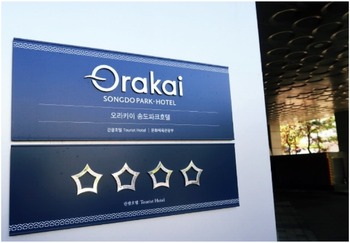
One manifestation of bilingual creativity is found in nonce transliterations (script-switching) of Korean lexical units into the Roman alphabet – a widespread mode of graphic creativity in the Outer and Expanding Circle contexts (Rivlina, Reference Rivlina2015). The creativity in such transliterations is not for the sake of lexical borrowing but places special emphasis on ‘fun, amusement and entertainment in language manipulation’ (Zemskaia et al., as cited in Rivlina, Reference Rivlina2015: 440). For example, the Korean hotel group ‘Orakai’ (see Figure 1) illustrates how Korean brand names are transliterated into English.
The sign of the Orakai hotel

The name might well be regarded as nearly homophonic wordplay evoking the word ‘Boracay’ – the world-famous tourist island in the Philippines. This reading is visually reinforced by the clever graphic insertion of a wavy line (~) penetrating the initial letter ‘O’. In fact, the name is an excellent example of wordplay, representing the transliteration of the Korean sentence ‘please come’ or ‘I told you to come!’ in the dialect of Gyeongsang Province (although Korean dialects have distinctive characteristics at all linguistic levels, they are often largely mutually intelligible). Korean is an orthographically transparent language, with almost one-to-one correspondence between grapheme (letter) and phoneme (sound) (Kim, Reference Kim2007). Influenced by this characteristic of their mother tongue, most Koreans pronounce the letters ‘a’ and ‘i’ in unfamiliar words on signs as /a/ and /i/, respectively, and never as a diphthong (/ei/ or /ai/).
Another entertaining example is ‘Sushi Ari’, a sushi restaurant located within a food court in a major department store. World travellers would find nothing peculiar in this name, as it follows the typical branding trend in which ‘Sushi’ is followed by a Japanese (sur)name, as in ‘Sushi Saito’. However, if one reads the sign in Korean, the sounds correspond to those of a Korean compound noun ‘스시앓이’, which translates into ‘a desperate craving for sushi’. Because few Koreans know that ‘Ari’ is a Japanese girl's name, it is inferred that the name is supposed to be read in Korean, not in English, at least by Korean customers.
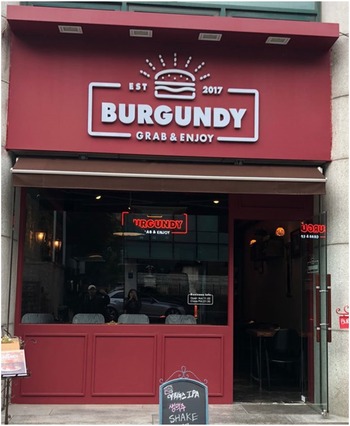
As a mode of creative language used for amusement, nonce transliteration is often adopted for the specific purpose of polysemy – the association of a single word with two or more distinct meanings. Although both meanings in Korean and English make logical sense, the use of this device in brand naming produces indexical readings of varying degrees for different passersby. The burger restaurant ‘BURGUNDY’ (see Figure 2) aptly demonstrates the adoption of bilingual polysemy as a creativity device.
The sign of the burger restaurant ‘BURGUNDY’

Although it would not be difficult for world travellers to identify the restaurant as a burger place because of the burger icon on the sign, the name itself barely conveys any meaningful message other than reflecting the exterior colour of the place. Under ordinary circumstances, a random colour would be considered an obscure and nondescript name for a business, and such a choice goes against common marketing strategies for promoting brand awareness. However, ‘BURGUNDY’ is, in fact, a transliteration of the Korean sentence ‘it/this is a burger’ in the dialect of Jeolla Province, although it might appear to be only a colour name to those for whom the referential context of the Korean message is not accessible. The flower shop ‘The Peony’ exhibits the same pattern. Its pronunciation is homophonous with the Korean phrase ‘더 피오니’ – an honourific expression meaning ‘blooming more’. Unlike ‘BURGUNDY’, ‘The Peony’ properly indexes its line of business (floriculture), even when the name is read in English.
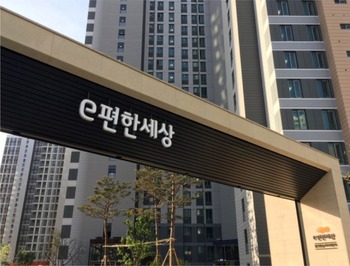
Unlike in the aforementioned examples, nonce transliteration sometimes involves partial transliteration of Korean morphemes into English, resulting in script mixing. In these cases, an English word or a letter is embedded into a string of Korean morphemes, playing on its homophony with the Korean morpheme it replaces. A typical example can be seen in the apartment complex brand ‘e편한세상’ /i-pyə-nan-se-saŋ/ (see Figure 3). (Since Korean is a syllable-timed language in which all vowels are clearly pronounced, the /ʌ/ sound occurring in stressed syllables and the schwa /ə/ occurring in unstressed syllables are not differentiated. Therefore, the phonetic symbol /ə/ will be used consistently to represent the /ʌ, ə/ sounds of the Korean vowel ‘ㅓ’.) The first two Korean syllables – ‘편한’ – mean ‘comfortable’, and the next two syllables – ‘세상’ – mean ‘world’.
The sign for the ‘e편한세상’ apartment complex

In Korean, ‘이’ – which is homophonous with the letter ‘e’ – can be used as a degree quantifier meaning ‘this/very much’, and thus, the name can be interpreted as ‘this much comfortable world’ when the letter ‘e’ is read in Korean. Korean letters are written in blocks, with each block representing a syllable (Sohn, Reference Sohn1999). Therefore, the substitution of the syllabic block ‘이’ with ‘e’ does not destroy the phonetic structure of the Korean sentence. Other examples highlighting how separate grapheme substitutions are not only feasible but also widespread in orthographically transparent languages when they interact with English (Rivlina, Reference Rivlina2015) include (A) store names beginning with the English definite article ‘the’ across all lines of business and (B) names of dental clinics incorporating the letter ‘e’, a trend that has now become cliché.
To uncover the reason behind (A), one needs to understand that the way Koreans pronounce the article ‘the’ roughly approximates the sound of the Korean comparative marker ‘더’ /də/ (‘more’). Although the grammatical meaning that the definite article carries in English is supposed to be lost in Korean contexts (Korean is an articleless language), it is assumed that it is applied to some store names for semantic purposes to accentuate definiteness or singularity. Corresponding examples – which belong to the ‘code-switching’ category discussed in Section 3.2 – include ‘the 한의원’ /ha-ni-wən/ (‘an oriental medical clinic’) and ‘The 김밥’ /kim-bap/ (‘a Korean seaweed rice roll’). While the definite article immediately precedes the explicit type of business in these examples, there are cases where the word following ‘the’ is an abstract noun, as in the organic bakery ‘The-dambaek’ (‘plainness and simplicity of taste’); a noun phrase comprising an adjective and a noun denoting the line of the business, as in the beef soup restaurant ‘The 진국’ /dƷin-kuk/ (‘strong broth’); an adjective, as in the stew restaurant ‘The기찬’ /gi-tʃan/ (‘fantastic’); or even a verb, as in the beauty salon ‘THE BANADA’ – the transliteration of ‘반하다’ (‘to fall for something/someone’). In these cases, ‘the’ might well be interpreted as a comparative marker meaning ‘more’, implying the owner's promise to customers to provide better quality than expected – yielding the meanings ‘[healthy breads with] plainer and simpler taste’, ‘stronger broth’, ‘more fantastic stew’, and ‘more attractive hair styles’, respectively.
To understand the phenomenon in (B), one needs to know that the Korean word for ‘tooth/teeth’ is ‘이’, whose pronunciation is homophonous with that of the letter ‘e’. (The Korean word ‘이’ has various meanings, functioning as multiple parts of speech.) Therefore, the name of the dental clinic ‘e튼튼치과’ /i-tun-tun-tʃi-kwa/ (‘튼튼’ and ‘치과’ mean ‘strong/healthy’ and ‘a dental clinic’, respectively) means ‘healthy tooth dental clinic’.
3.2 Code-switching
Code-switching in the Korean linguistic landscape is often practised in a way that does not incorporate script mixing, obscuring the distinction between the languages being switched into and out of. A case in which the Roman script is employed can be seen in the Korean skincare and cosmetics brand ‘Hanskin’. This name is a colloquial Korean expression meaning ‘very good skin’. The Korean prefix ‘한’ /han/ is used to describe something that is regarded as second to none in both positive and negative contexts, as in ‘한미모’ /han-mi-mo/ (‘great beauty’) and ‘한성깔’ /han-səŋ-kal/ (‘a quite crabby temperament’).
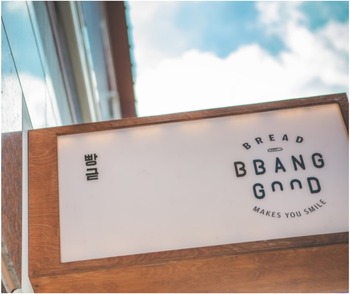
An example of the adoption of the Hangeul script is provided by the logo of the bakery ‘빵귿’ /bbaŋ-gud/, in which several bilingual and graphic creativity devices are at work (see Figure 4). The word for ‘bread’ in Korean is ‘빵’ /bbaŋ/, and ‘빵긋’ /bbaŋ-gud/ is a mimetic word used to describe a face cracking into a smile. By deliberately distorting the spelling of the second syllable ‘긋’ to ‘귿’ (the Roman letter ‘d’ corresponds to the Korean letter ‘ㄷ’), the name faithfully transliterates the English ‘good’, making it a clear case of code-switching in which the Korean ‘빵’ and the transliterated English word ‘good’ are bound together. As illustrated in the figure, the English sentence ‘BBANG GOOD MAKES YOU SMILE’ is laid out in a way that resembles a smiling face. This visual effect is enhanced by the inclusion of only the upper halves of the consecutive letters ‘OO’ in ‘good’, which creates the image of smiling eyes.
The sign of the bakery ‘빵귿’

Bilingual punning as a form of linguistic creativity is widely implemented in the Outer and Expanding Circle contexts (Hoffer, Reference Hoffer2002), and code-switching explicitly for this purpose is common in the Korean linguistic landscape as well. The practice entails ‘foregrounded lexical ambiguity’ (Wales, Reference Wales2001: 326) based upon the ‘homophony of words, morphemes, or syllables in the juxtaposed languages, which invokes additional meanings in code-switched or code-mixed . . . products’ (Rivlina, Reference Rivlina2015: 445).
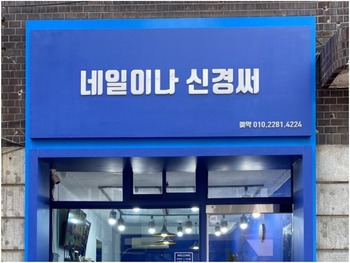
A clear majority of English–Korean puns are employed at the word level, wherein a Korean word is replaced by an English word evoking the corresponding domain either in transliteration or in its original Roman script. This practice lends support to Stefanowitsch's (Reference Stefanowitsch2002: 68) claim that bilingual puns often show ‘a high degree of semantic motivation’. One example of bilingual paronomasia is a nail salon called ‘네일이나 신경써’ /ne-il-i-na sin-kyəŋ-ssə/ (see Figure 5).
The sign of the nail salon ‘네일이나 신경써’

The first two syllables – ‘네일’ (‘nail’) – play on components homophonous in English and Korean but conveying two distinct meanings depending on how one reads them. When the syllables are read in English, the sign translates into ‘Take care of your own nails’, an appropriate name for a nail salon; when they are read in Korean, it translates into the common English saying ‘Mind your own business’, although a space should be inserted between the two syllables for orthographical accuracy. Another nail shop, ‘Nail을 위한 오늘’ /ne-il-wul wi-han o-nul/, features ‘Nail’ in Roman script, but there is a catch here as well. Its pronunciation differs only marginally from that of the Korean word ‘내일’ (‘tomorrow’). Thus, the sign literally means ‘Today is for nails’ but is understood as the supposedly more familiar phrase ‘Today is for tomorrow’ in most cases.
3.3 Coinage of a bilingual compound
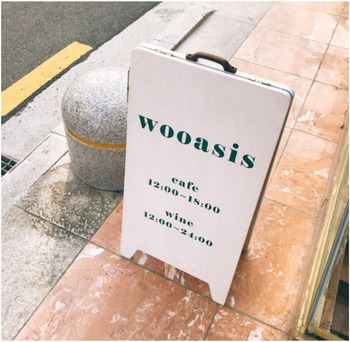
Some brand names exhibit bilingual creativity in the use of a newly coined English–Korean compound. For example, the name of the coffee and wine bar ‘wooasis’ (see Figure 6), located in one of Seoul's busiest areas, features a combination of Korean ‘우아’ /wu-a/ (‘elegance or grace’) and English ‘oasis’.
The sign of the coffee and wine bar ‘wooasis’

The Korean and English meanings blend well in this combination, suggesting ‘wooasis’ to be ‘a refined place for those seeking a refuge from hectic city life’. Considering the status of ‘oasis’ as a foreign-derived loanword in Korean, the naming of the place as such directly embodies Crystal's (Reference Crystal1998) ‘familiarity principle’, which maintains that language play can only be appreciated when people are familiar with the language played on.
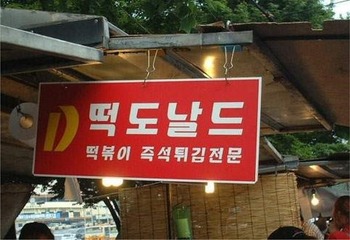
Another example can be found in ‘떡도날드’ /tək-do-nal-du/, the name of a street vendor that sells tteok-bokki (‘a Korean rice cake dish seasoned with spicy chili paste’) as the main menu item (see Figure 7). The name is a compound of the Korean noun ‘떡’ /tək/ (‘rice cake’) – the main ingredient of tteok-bokki – and the transliteration of the world-famous fast food company ‘McDonald’, ‘맥도날드’. Here, ‘떡’ replaces the ‘Mc’ part of the company name (when transliterated in Korean, the possessive 's in McDonald's is dropped), wittingly signalling the vendor's main line of business – tteok-bokki, an all-time favourite snack among Koreans.
The sign of the street vendor ‘떡도날드’

3.4 Phoneme-based transliteration of English into Korean
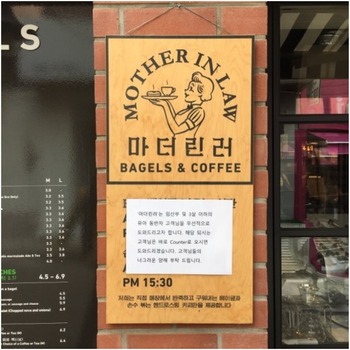
One phenomenon that has recently emerged in the Korean linguistic landscape entails the phoneme-based transliteration of English words into Korean. Influenced by the moraic syllable structure of the Korean language (Broselow & Park, Reference Broselow, Park and Archibald1995), it has been an established convention to transliterate English compound nouns, phrases, and sentences all at the word level irrespective of sound change or elision across word boundaries (Convention T1). The four-word phrase ‘once upon a time’, for example, is transliterated into four distinct segments: ‘원스 어폰 어 타임’ /wən-su ə-pon ə ta-im/. However, the new approach challenges this long-standing convention. A representative example can be seen in the transliteration of the name of the bagel shop ‘Mother-in-law Bagels’ (see Figure 8).
The sign of ‘Mother-in-law Bagels’

The English name is presented together with the Korean ‘마더린러’ /ma-də-rin-lə/. (Both /r/ and /l/ sounds are pronounced as a flap in Korean.) What is peculiar about this transliteration is that the third syllable – ‘린’ /rin/ – reflects the follow-through occurring at the word boundaries between the final consonant ‘r’ in ‘mother’ and the initial vowel ‘i’ in ‘in’. Compared to its traditional counterpart ‘마더인로’ /ma-də-in-lo/, this transliteration reflects a more natural pronunciation of the phrase.
Likewise, the cafe ‘유원섬 커피’ /yu-wən-səm kə-pi/ follows the phoneme-based transliteration model (both the /p/ and /f/ sounds are pronounced as /p/ in Korean). Another well established convention in Korea is to transliterate a monosyllabic English word ending in a consonant, such as ‘want’, in a way that adds an epenthetic vowel at the end of the word (Convention T2), resulting in a bisyllabic word with the final consonant in the onset position of the second syllable – ‘원트’ /wən-tu/ (Broselow & Park, Reference Broselow, Park and Archibald1995). Since most Koreans are not familiar with phoneme-based transliterations due to Conventions T1 and T2, it might not be clear that ‘유원섬’ on the sign is not the name of the owner (‘유’ is a common Korean surname) until one reads the indoor sign: ‘You want some?’
Contrary to the observations made in Backhaus (Reference Backhaus2007), which analysed transliterations in the Japanese linguistic landscape as ‘idiosyncrasies’ or ‘deviation from what is considered “proper” language use’ (117), Korean transliterations of this nature make sense only to those who are familiar with ‘proper’ English pronunciation. Although only beginning to be manifested in the Korean linguistic landscape, phoneme-based transliteration of a few set phrases – such as ‘왓썹’ /wat-ssəp/ for ‘What's up?’ and ‘유남생’ /yu-nam-seŋ/ for ‘You know what I'm saying?’ – has, in fact, long prevailed in Korean online communities.
3.5 Spelling manipulation
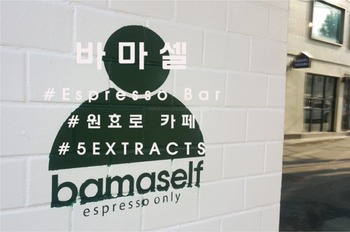
The use of manipulated spelling is not only a traditional marketing technique (Pound, Reference Pound1923) but also a branding trend used in the digital world to draw attention to or trademark an otherwise common word/phrase. However, this newly emerging phenomenon in the Korean linguistic landscape differentiates itself from other cases, such as ‘Krispy Kreme Doughnuts’ or ‘Flickr’, in that the spelling deliberatively deviates from orthographic convention to approximate native pronunciation. The cafe ‘bamaself’ offers a good example (see Figure 9).
The sign of the cafe ‘bamaself’

The manipulated spelling ‘bamaself’ is designed to reflect the pronunciation of the phrase ‘by myself’ at a natural pace, given that most Koreans would pronounce the ‘bama’ part of the name as /ba-ma/. The corresponding Korean transliteration – ‘바마셀’ /ba-ma-sel/ – is equally interesting. According to Convention T2, the final letter of the word ‘self’, which is not accompanied by a vowel, can only be transliterated in Korean by dividing the monosyllabic word into morae and syllabifying the last consonant. Since pronouncing a consonant not followed by a vowel sound only trivially is not allowed as it is in English, the owner of this coffee shop must have faced a choice of adopting the conventional bisyllabic ‘셀프’ /sel-fu/ or dropping the last consonant and arriving at ‘셀’ /sel/. While neither correctly represents the correct pronunciation of ‘self’, the owner seems to have speculated that the latter mimics it more closely.
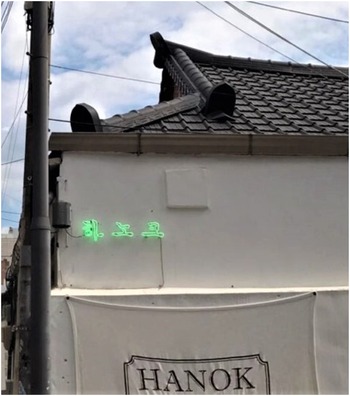
An equally interesting instance involves manipulation of a Korean spelling, as exemplified in the name of the cafe ‘하노크’ /ha-no-ku/, a business located in a renovated hanok (‘a traditional Korean house’) (see Figure 10). The correct spelling for hanok is ‘한옥’ /han-ok/, but this spelling is manipulated in a way that mimics how foreigners would read its romanisation. While spelling anomalies of this nature are only beginning to appear in the Korean linguistic landscape, their use has been fairly widespread among the younger generation in referring to the Korean conglomerates ‘Samsung’ (‘삼성’ /sam-səŋ/) and ‘Hyundai’ (‘현대’ /hyən-dæ/) and more recently in the use of the abstract noun ‘gamsung’ (‘감성’ /gam-səŋ/, ‘ambiance or vibes’): These terms are playfully misspelled and mispronounced as ‘샘숭’ /sæm-suŋ/, ‘현다이’ /hyən-da-i/ and ‘갬성’ /gæm-səŋ/, respectively.
The sign of the cafe ‘하노크’

4. Conclusion
The examples discussed in this paper demonstrate the variety and the scope of English–Korean language play, underlining that English has become an important addition to the resources of linguistic creativity (Rivlina, Reference Rivlina2015). As it is in the languages of many Outer and Expanding Circle countries, English is often embedded into Korean not only for the sake of ‘other-languageness’ (Kachru, Reference Kachru2006: 224) but, more importantly, as a linguistic source of enjoyment (Crystal, Reference Crystal1998).
The amalgam of witty bilingual creativity devices has moulded the current public space of Korea, which is assuming a more dynamic and whimsical shape than ever. The fact that advertising failure is economically taxing explains the growing popularity of creative manipulation in bilingual language play: As Bhatia and Ritchie (Reference Bhatia, Ritchie, Bhatia and Ritchie2013) point out, such practices help achieve ‘low-level cosmetic effects’ (570), including ad hoc attention-getting and memory facilitating.
Given that bilingual wordplay entails enjoyment of cultural difference and a concomitant sense of global consciousness integrated into everyday life practices (Tomlinson, Reference Tomlinson1999), the linguistic landscape of Korea is expected to become even more diversified. As with other social phenomena, creative uses of English catch on and are reproduced in the Korean linguistic landscape. The emergence of the new bilingual creativity devices (introduced in Sections 3.4 and 3.5) in particular attests to the continuing use of rich linguistic repertoires in an innovative and playful manner, causing them to evolve far beyond their initial form. It is hoped that this paper adds meaningfully to the study of the linguistic landscape and that future research into bilingual creativity will yield a more comprehensive picture of English diffusion in World Englishes today.
 SUGENE KIM is an associate professor in the Department of English Studies at Nagoya University of Commerce & Business in Japan. Her main research specialisations are in academic writing, pedagogical grammar, and second language (L2) acquisition, and she has related interests in sociolinguistic variation and World Englishes. Her published research articles primarily concern academic literacy development and L2 writing pedagogy. Email: sugene_kim@nucba.ac.jp