Introduction
Oppositional defiant disorder (ODD) is a common disruptive behavioral disorder in children, with overall prevalence rates in community samples ranging from around 3–5%, while this rises to 28-65% in clinical samples (Boylan et al., Reference Boylan, Vaillancourt, Boyle and Szatmari2007). The main characteristics of ODD are ongoing patterns of angry/irritable mood, argumentative/defiant behavior, and vindictiveness (American Psychiatric Association, 2013). In the Diagnostic and Statistical Manual of Mental Disorders-Fifth Edition (DSM-5), the diagnosis of a child with ODD requires the presence of at least four of the eight symptoms for at least six months. These eight ODD symptoms are usually divided into three subdimensions Irritable (Temper, Touchy, Angry), Headstrong (Argues, Defies, Annoys, Blames), and Hurtful (Spiteful). The presence of ODD increases a child’s risk of adjustment problems, behavioral disorders, and criminal behavior (Burke et al., Reference Burke, Loeber and Birmaher2002), as well as other mental health problems throughout life (Copeland et al., Reference Copeland, Shanahan, Costello and Angold2009). Although ODD development seems to result from an interaction between genetic and environmental factors (Hawes, Reference Hawes2023), symptomatology research suggests that disordered emotion regulation may be a core deficit in ODD (Cavanagh et al., Reference Cavanagh, Quinn, Duncan, Graham and Balbuena2017). Recent longitudinal studies have also shown that decreased emotion regulation predicts increased ODD symptoms throughout child development from preschool to adolescence (Nobakht et al., Reference Nobakht, Steinsbekk and Wichstrøm2024; Zhang, Li, et al., Reference Zhang, Li, Li, Stephen Hinshaw and Lin2023). However, emotion regulation is only one component of self-regulation, and it is not clear whether other types of self-regulation are also strongly associated with ODD symptoms.
Researchers have not yet conducted a detailed study of the relation between self-regulation and ODD symptoms in children. First, self-regulation, including emotional and behavioral regulation, has been shown to have a close relation with internalizing and externalizing problems in childhood (Robson et al., Reference Robson, Allen and Howard2020). Meanwhile, in addition to emotional dysregulation, behavioral dysregulation is likewise a typical clinical feature of ODD (Nobakht et al., Reference Nobakht, Steinsbekk and Wichstrøm2024). Thus, it is reasonable to hypothesize that ODD is associated with a wide range of self-regulation problems, but so far our knowledge of the associations between different types of self-regulation and ODD symptoms is limited. Second, ODD is a highly heterogeneous disorder (Hawes, Reference Hawes2023), and two patients who also meet the DSM-5 diagnosis may have completely different symptoms. Previous literature usually examines associations between variables using the ODD symptom total score, ignoring heterogeneity between symptoms. Third, there are gender differences in both self-regulation and ODD symptoms in school-age children, but it is not known whether the association between them varies by gender. Fourth, current research on ODD in children focuses on developed countries and Western cultural contexts, and it is not clear whether children in developing countries and Chinese cultural contexts will exhibit different characteristics.
The self-regulation model: components of self-regulation and ODD symptoms
Self-regulation is commonly defined as the ability to inhibit dominant impulses to modify thought, feeling and behavior (Robson et al., Reference Robson, Allen and Howard2020). In a broad sense, self-regulation is a multifaceted temperament that is genetically based but also subject to change in response to biological maturation processes and environmental influences (Bridgett et al., Reference Bridgett, Burt, Edwards and Deater-Deckard2015). According to the self-regulation model of Bridgett et al. (Reference Bridgett, Burt, Edwards and Deater-Deckard2015), self-regulation can be divided into two interacting components: “top-down” (effortful) self-regulation and “bottom-up” (reactive) self-regulation. The “top-down” self-regulation refers to individuals’ cognitive control of their attention and behavior through voluntary processes related to neural structures within the frontal and anterior cingulate cortex. In contrast, “bottom-up” self-regulation is impulse- and stimulus-driven attention and behavior, an automated process of subcortical structures. Although these two types of self-regulation involve different neural and behavioral mechanisms, they are both closely associated with ODD symptoms.
The “top-down” self-regulation can be divided into two subcomponents: emotional and behavioral. Emotional self-regulation, that is, emotion regulation refers to regulating emotional arousal to optimally engage with the environment by possessing emotional self-awareness and engaging in situationally appropriate emotional expression (Kim & Cicchetti, Reference Kim and Cicchetti2010). Early school age is an important period for the development of emotion regulation skills and the emergence of ODD symptoms, and emotion regulation longitudinally negatively predicted the Irritable and Headstrong subdimension of the three dimensions of ODD symptoms but was not significantly associated with the Hurtful subdimension (Yu et al., Reference Yu, Goulter and McMahon2022). In contrast to emotional self-regulation, behavioral self-regulation includes many similar but not completely overlapping constructs, such as self-control, effort control, and executive functioning (Bridgett et al., Reference Bridgett, Burt, Edwards and Deater-Deckard2015). For example, self-control refer to overcoming salient but maladaptive behavioral impulses, whereas executive functioning refers collectively to a wide range of cognitive control abilities. Previous studies have shown that children with ODD have deficits in self-control compared to typical children (Frankel & Feinberg, Reference Frankel and Feinberg2002), and that children’s ODD symptoms are significantly and negatively correlated with self-control (Feldman et al., Reference Feldman, Tung and Lee2017). Additionally, one study further found that multiple types of executive functioning (sustained attention, response inhibition, and working memory) all significantly predicted the Irritable subdimension of ODD symptoms after controlling for ADHD symptoms (Griffith et al., Reference Griffith, Arnold, Rolon-Arroyo and Harvey2019).
The “bottom-up” self-regulation can be divided into two subcomponents: behavioral inhibition/fear and impulsivity. Behavioral inhibition/fear is a reactive, over-controlled form of self-regulation and is a significant risk factor for anxiety disorders (Fox et al., Reference Fox, Henderson, Marshall, Nichols and Ghera2005). In contrast, impulsivity is a reactive, under-controlled self-regulation failure strongly associated with disruptive behavior disorder. Evidence from twin studies suggests that only the Headstrong subdimension of ODD is associated with hyperactive-impulsive symptoms and is affected by shared genetic influences (Waldman et al., Reference Waldman, Rowe, Boylan and Burke2021). Emotional impulsivity, also known as emotion lability/negativity, can be described as a child’s rapid response to emotionally arousing stimuli while having difficulty recovering from a negative emotional response (Kim-Spoon et al., Reference Kim-Spoon, Cicchetti and Rogosch2013). Numerous studies have shown that emotion lability/negativity is also positively associated with ODD symptoms in children. For example, a cross-national study including 1093 children further found that emotion lability/negativity was a significant predictor of the Irritable subdimension of ODD (Aebi et al., Reference Aebi, Müller, Asherson, Banaschewski, Buitelaar, Ebstein, Eisenberg, Gill, Manor, Miranda, Oades, Roeyers, Rothenberger, Sergeant, Sonuga-Barke, Thompson, Taylor, Faraone and Steinhausen2010).
In summary, research presented to date has tended to focus on one subcomponent of self-regulation and has lacked a comprehensive examination of the relation between self-regulation and ODD based on the self-regulation model. More importantly, the results of existing studies are limited to the dimensional level of ODD, and we know relatively little about the factors that influence the ODD at the symptom level.
The coercion theory: interaction of self-regulation and ODD symptoms
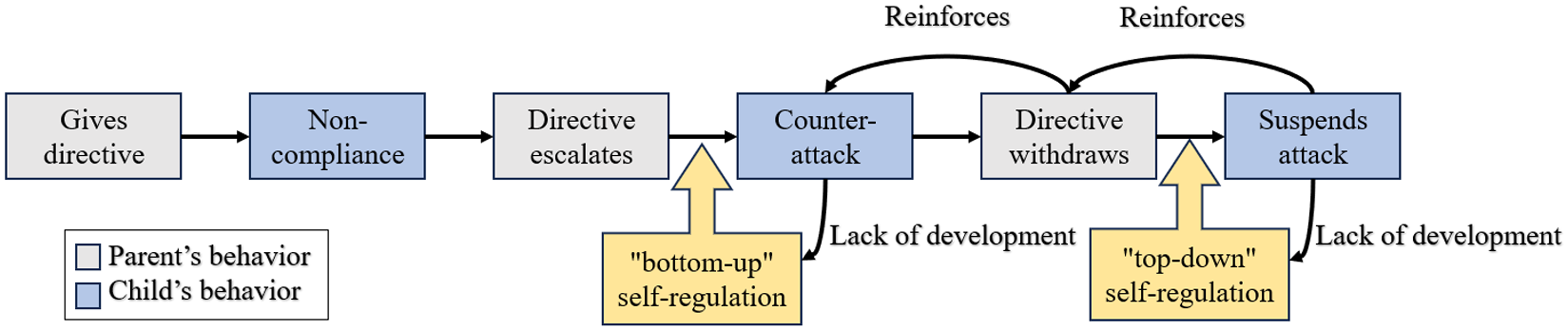
Coercion theory is a critical model for the development of ODD symptoms in children, which suggests that ODD emerges as a result of children learning a negative intra-familial style of interaction (Hawes, Reference Hawes2023). Specifically, when a parent gives their child a directive, the child sometimes chooses not to obey. When parents continue to use a harsher approach to giving the directive, the child might become angry and develop defiant behavior. If in this case the parents compromise with the child and withdraw the directive, the practice allows the parents to avoid or escape the escalation of the child’s aversive behavior in the short term. However, in the long term, this pattern forces and reinforces the child’s aversive behavior (see Figure 1). When coercive interactions are dominant in the family, children’s ODD symptoms are more likely to emerge and may stabilize throughout development.
Reinforcement of parent–child coercion cycle.

According to the self-regulation model, the production of children’s ODD symptoms in this interaction model cannot be separated from the role of self-regulation. For example, children with weak “bottom-up” self-regulation will have more difficulty suppressing impulses and show more ODD symptoms such as anger and defiance after receiving harsh parental directives. If the child stops the parental directive in this way, the child’s “bottom-up” self-regulation is not given the opportunity to develop. Subsequently, as parents respond to the child’s ODD symptoms by avoiding them, the child can only let his or her emotions and behaviors subside unconsciously and naturally, resulting in a lack of adult guidance for the child’s “top-down” self-regulation. In summary, ‘bottom-up’ and ‘top-down’ self-regulation play critical roles in the development of ODD symptoms in children, but it is not clear which ODD symptoms they are associated with, respectively. Therefore, it is necessary to examine the relation between self-regulation and ODD symptoms at the symptom level.
The network theory of mental disorders: symptoms network of ODD
The reflective model of psychopathology has long been commonly used to model and analyze mental disorders such as ODD. Specifically, researchers have concluded that mental disorders are similar to physical illnesses in that there is an underlying etiology (common cause) that leads to the appearance of all observable psychopathologic symptoms. This means that all ODD symptoms are independent and can be completely interchangeable. However, current research suggests that no single risk factor accounts for ODD, which appears to result from an interaction between genes and environmental factors (Hawes, Reference Hawes2023). Recently, the network theory of mental disorders has put forward a novel hypothesis that conceptualizes mental disorders as direct interactions between symptoms rather than as the result of common causes (Borsboom, Reference Borsboom2017). For example, a bad-tempered child may frequently defy parental requests, and parents may interpret this behavior as deliberately annoying them and reinforcing negative perceptions of the child’s temper. A child’s ODD symptoms will remain activated over time through a feedback loop between symptoms. Therefore, examining the interactions between different ODD symptoms and the relative importance of different symptoms is important for understanding the mechanisms of ODD development and maintenance.
A statistical technique that has been proposed alongside the network theory of mental disorders is network analysis, which characterizes each symptom as a node in a network and the links between symptoms as edges in the network (Borsboom, Reference Borsboom2017). Thus, network analysis techniques allow us to examine the relation between each symptom in a mental disorder at the symptom level, as well as the relation between self-regulation and each symptom.
Several studies have examined ODD through network analyses (Gomez, Stavropoulos, Gomez et al., Reference Gomez, Stavropoulos, Gomez, Brown and Watson2022; Smith et al., Reference Smith, Lee, Martel and Axelrad2017), but only a few have examined the role of self-regulation in ODD symptom networks. Gomez et al. (Reference Gomez, Stavropoulos, Watson, Brown and Chen2022) used cross-sectional network analysis to examine three dimensions of ODD (anger/irritability, vindictiveness, and argumentative/defiant behavior) and five components of impulsivity in emerging adults. The study’s results showed that only the Irritable dimension of ODD had a strong association with the tendency to rash action while under extreme negative emotions. Zhang et al. (Reference Zhang, Tang, Wu, Zhou and Lin2023) examined the network structure of ODD symptoms and multilevel family factors in migrant children aged 7–14 years and found a significant association between only “Touchy” symptoms of ODD and children’s emotion regulation.
The moderating role of gender
There were significant gender differences in ODD symptoms and self-regulation in childhood. A meta-analysis of the prevalence of ODD in mid-childhood found that it was significantly higher in boys than in girls (Risk Ratio = 1.59, 95% CI [1.36, 1.86]) (Demmer et al., Reference Demmer, Hooley, Sheen, McGillivray and Lum2017). It has also been widely found in self-regulation studies that girls have a significant advantage in self-regulation before puberty (Hosseini-Kamkar & Morton, Reference Hosseini-Kamkar and Morton2014). More importantly, gender might interact with self-regulation to influence ODD symptoms and vice versa. Firstly, the biological factors view of gender differences in ODD suggests that girls mature physically earlier than boys, allowing them to develop better language, social, and emotional skills during childhood (Crick & Zahn–Waxler, Reference Crick and Zahn-Waxler2003). Thus, a higher level of development of self-regulation will allow girls to be protected from the onset of ODD in childhood. Studies of the lifetime prevalence of ODD have also found that gender differences in prevalence in adult populations are no longer apparent when both males and females reach full maturity (males = 11.2%; females = 9.2%) (Nock et al., Reference Nock, Kazdin, Hiripi and Kessler2007). Second, the three level model (Eme, Reference Eme2007) proposes evolutionary processes that generated genetic sex differences (Level 1) and resultant biological consequences (Level 2) have resulted in the risk mechanism (Level 3) of a greater male disposition to engage in aggressive behavior (e.g., being more fearless in the face of threats and resorting to retaliatory attacks). Consequently, in the modern parent–child relation, boys tend to resort to angry outbursts and disobedience to counter commands from their parents. According to coercion theory (Moed, Reference Moed2024), if the provider reinforces this negative parent–child interaction, the child’s self-regulation skills will be inadequate. Overall, based on the available evidence, we can infer that children’s gender may play a moderating role in the bidirectional relation between self-regulation and ODD symptoms.
The current study
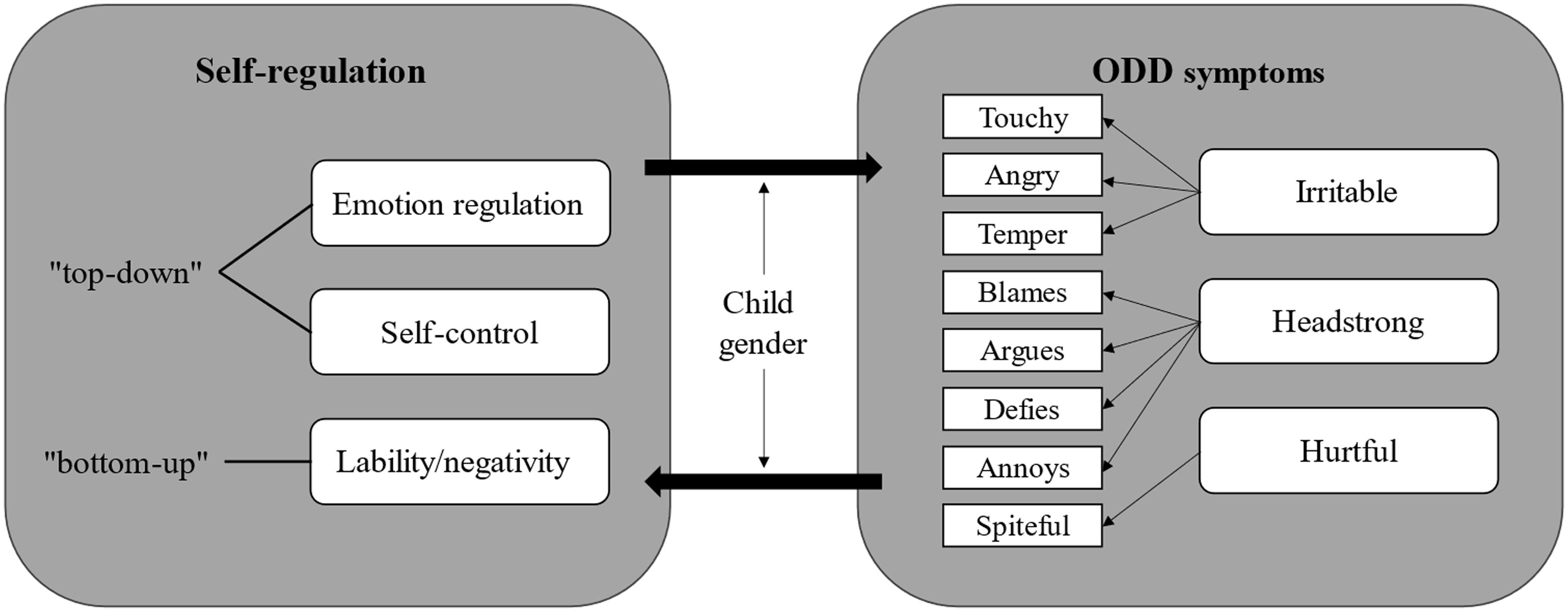
Prior research has shown complex associations between self-regulation subcomponents (emotion regulation, self-control, lability/negativity) and subdimensions of ODD (Irritable, Headstrong, Hurtful). Therefore, in this study, we will examine the relation between children’s self-regulation and ODD symptom networks, and the moderating role of children’s gender therein, through a moderated network analysis approach (see Figure 2). Based on the results of previous studies, we hypothesized that emotion regulation will negatively correlate with symptoms in the Irritable and Headstrong subdimensions; self-control will negatively correlate with symptoms in the Irritable subdimension; and emotion lability/negativity will positively correlate with symptoms in the Irritable subdimension.
Representation of the potential association between self-regulation and oppositional defiant disorder symptoms in children.

Methods
Participants
The data for this study were obtained from an ODD children research project conducted in mainland China to follow-up on children’s ODD symptoms, which started in March 2023, and conducted follow-up surveys every six months. The first wave of data comes from five primary schools in Beijing, China, each with about 2,000 children. Each class in these schools consists of approximately 50 students and one classroom teacher. The classroom teacher is with the students from the beginning to the end of the school day and has deep knowledge of the students’ behavior. Therefore, children with possible emotional and behavioral problems and their parents were invited to participate in the study through the class teacher. In this study, each classroom teacher invited approximately two to four students and parents to participate in the study.
A total of 544 children, their parents and the class teacher participated. Of the 544 samples, 40 parents were excluded for not completing the full survey, resulting in 504 samples whose data were included in the analysis (demographic characteristics are presented in Table 1). We recruited children who exhibited symptoms of ODD and were not necessarily diagnosed with ODD. After six months, 255 of these children, their parents, and class teachers were given follow-up surveys similarly. Children’s ODD symptoms were scored by the same teacher at both time points. All parents and class teachers signed an informed consent form before the survey and were given a gift worth 100 RMB afterward. The Institutional Review Board of Beijing Normal University in China approved the research protocol. The Little’s Missingness Completely at Random test showed that the attrition was missing completely at random (χ 2(9) = 15.198, p = 0.86).
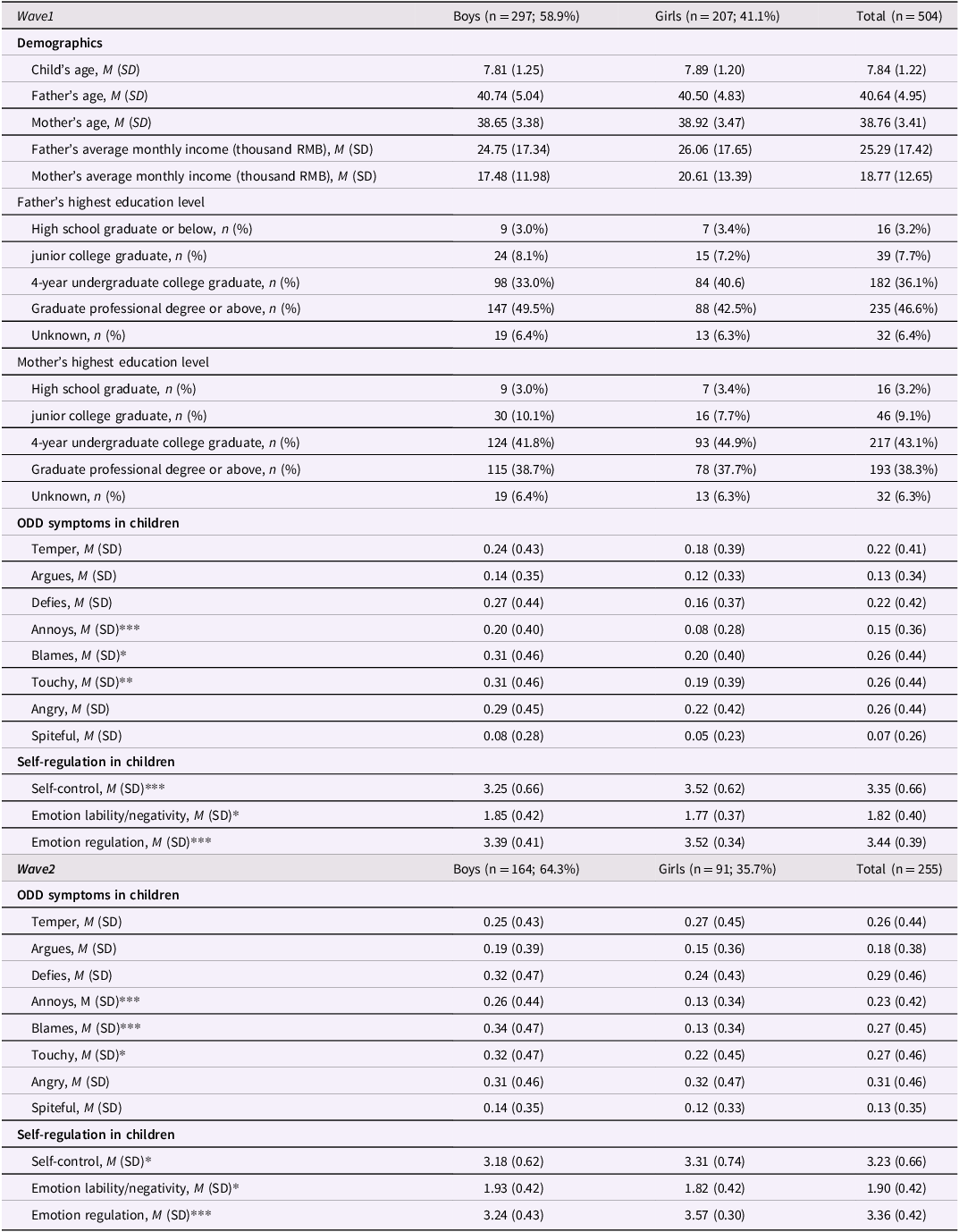
Descriptive statistics of children

Note. M = mean. SD = standard deviation. The star symbol highlights significant gender differences ( p<0.05, p<0.01, p<0.001).
Measures
Oppositional defiant disorder symptoms
The ODD symptoms in children were reported by their class teachers using an 8-item scale derived from eight symptoms indicated in DSM-V (American Psychiatric Association, 2013). Previous research has shown that teachers are reliable and accurate reporters of children’s ODD symptoms and can more accurately report children’s symptom presentation in school situations (McNeilis et al., Reference McNeilis, Maughan, Goodman and Rowe2018). Each ODD symptom was rated on a dichotomous scale (0 = no and 1 = yes). The Cronbach’s alpha coefficients were 0.84 and 0.92 at wave 1 and wave 2 in the present study, respectively.
Self-control
Children’s mothers reported children’s self-control using the Tangney’s Brief Self-Control Scale (BSCS) (Tangney et al., Reference Tangney, Baumeister and Boone2004). The one-dimensional structure and good reliability and validity of the BSCS have also been validated in Chinese adolescents (Chen et al., Reference Chen, Zhang, Tian and Zhao2022). The BSCS consists of 13 items, for example “My child is good at resisting temptation.” Each item is scored on a 5-point Likert-type scale ranging from 1 (very unlike) to 5 (very like), 9 of which are reverse scored. A higher score means the child has more self-control. In this study, Cronbach’s alpha coefficients were 0.86 and 0.88 at wave 1 and wave 2, respectively.
Emotion regulation and lability/negativity
In the present study, the mothers reported the children’s emotion lability/negativity and emotion regulation using the Emotion Regulation Checklist (ERC) (Shields & Cicchetti, Reference Shields and Cicchetti1997). The Chinese version of the ERC has been shown to have good reliability and validity among Chinese primary school students (Zhang et al., Reference Zhang, Tang, Wu, Zhou and Lin2023). The ERC is composed of 24 items, answered by a Likert scale of 4 points (1 = “never” to 4 = “almost always”). The questionnaire is divided into two sub-scales: emotion lability/negativity and emotion regulation. The emotion lability/negativity subscale, comprising 15 items, measures mood swings, anger outbursts, and intensity of both positive and negative emotions (such as “Exhibits wide mood swings”). In this study, Cronbach’s alpha coefficients were 0.82 and 0.84 at wave 1 and wave 2, respectively. A higher total score means that the child is more emotionally instability. The emotion regulation subscale, consisting of 8 items, assesses the social appropriateness of a child’s emotions, including emotion understanding and empathy (such as “Can modulate excitement in emotionally arousing situations”). A higher total score means that the child has better emotional regulation. In this study, Cronbach’s coefficient alpha were 0.70 and 0.71 at wave 1 and wave 2, respectively.
Statistical analysis
All analyses were performed using R version 4.3.0 (R Core Team, 2023), and p < 0.05 reflecting statistical significance. The multiple imputation techniques for missing data via the mice package in R, thus making the data complete for all samples (Buuren & Groothuis-Oudshoorn, Reference Buuren and Groothuis-Oudshoorn2011). We explored sample characteristics using descriptive statistics and gender differences through Pearson’s Chi-squared test and the two-sample Wilcoxon test.
Network estimation
Since our data are a mixture of binary and ordinal and focus on the moderating effects between variables, we use Moderation Network Models (MNMs) for estimation (Swanson, Reference Swanson2020). Considering that traditional variable selection methods (particularly L1-regularization, i.e., the LASSO) in MNMs containing higher-order interactions do not ensure that all relevant lower-order terms are retained in the model, the present study uses hierarchical LASSO for variable selection in MNMs (Bien et al., Reference Bien, Taylor and Tibshirani2013). We performed variable selection through the varSelect function in the modnets package and then estimated MNMs based on the variable selection objects using the fitNetwork function (Swanson, 2021). In the network visualization, we used the AND rule, that is, connecting by solid edges only when both nodewise regressions between two nodes pass the threshold and connecting by dashed edges only when both relevant interaction terms pass the significance threshold. Based on this, the results of our network estimation reflect the bidirectional relation between the two nodes. We evaluated the importance of each node across the network using the expected impact centrality index, which reflects a measure that provides overall positive connectivity in networks with positive and negative edges (Robinaugh et al., Reference Robinaugh, Millner and McNally2016).
Network stability
We evaluated the stability of the node centrality index by estimating the correlation stability coefficients (CS-coefficients), which are greater than 0.25 is acceptable, and greater than 0.5 is better (Epskamp et al., Reference Epskamp, Borsboom and Fried2018). Stability was also assessed by estimating the case-dropping subset bootstraps, which evaluates the maximum proportion of cases that can be dropped when the correlation between the original centrality index and the new index remains above 0.7. We used the bootNet function in the modnets package for all stability estimates (Swanson, 2021). We used a model comparison procedure to check the invariance of the two wave networks by a log-likelihood ratio test for the whole network and each node.
Results
Descriptive information of data
Table 1 provides descriptive statistics for all variables for boys and girls and the full sample. Boys and girls did not differ significantly in all demographics but showed gender differences in some main variables. Specifically, in both survey waves, boys had significantly more Annoys, Blames, and Touchy symptoms than girls. In addition, boys had significantly more emotion lability/negativity than girls, while self-control and emotion regulation were significantly lower than girls.
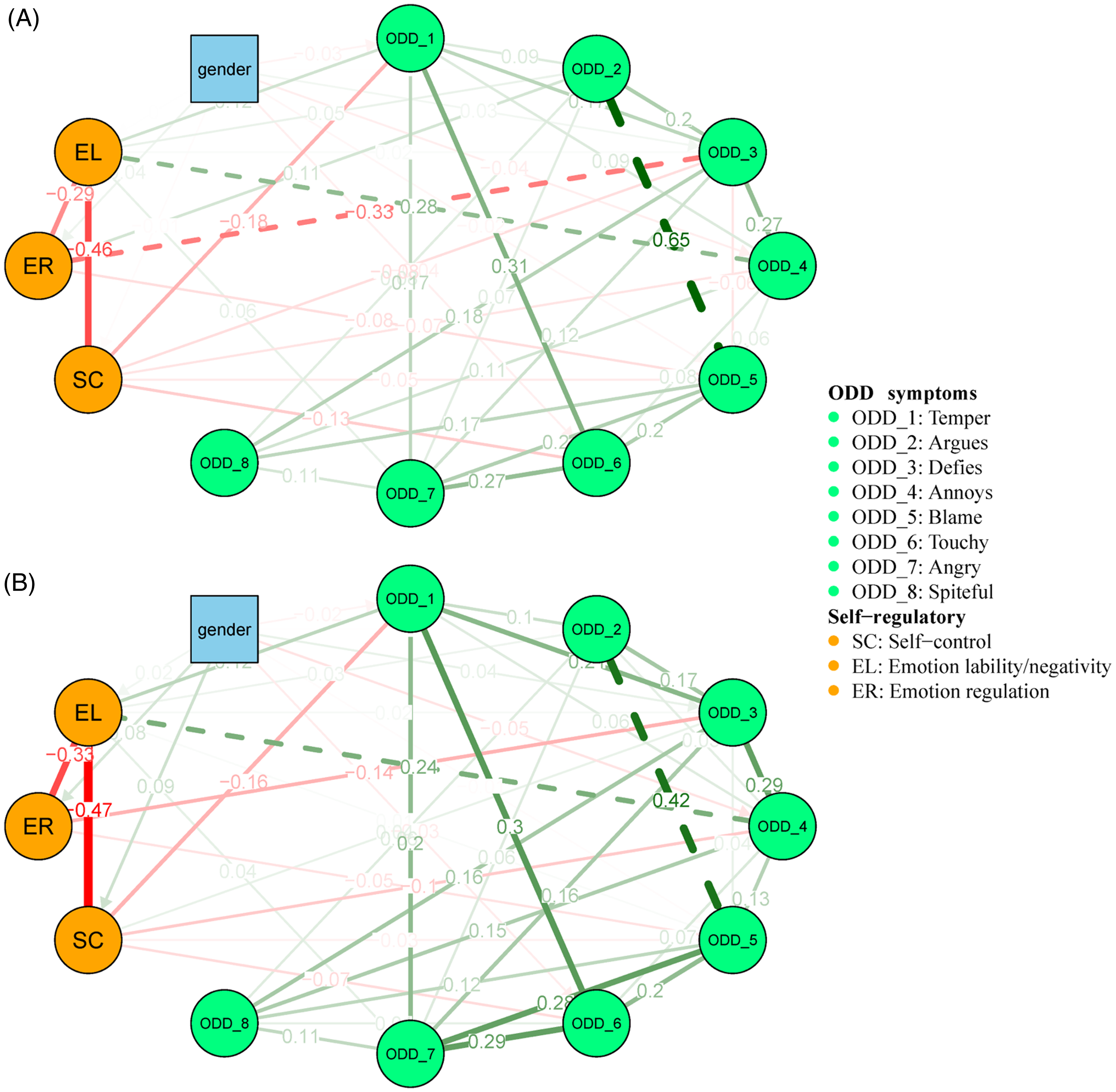
Description of the network
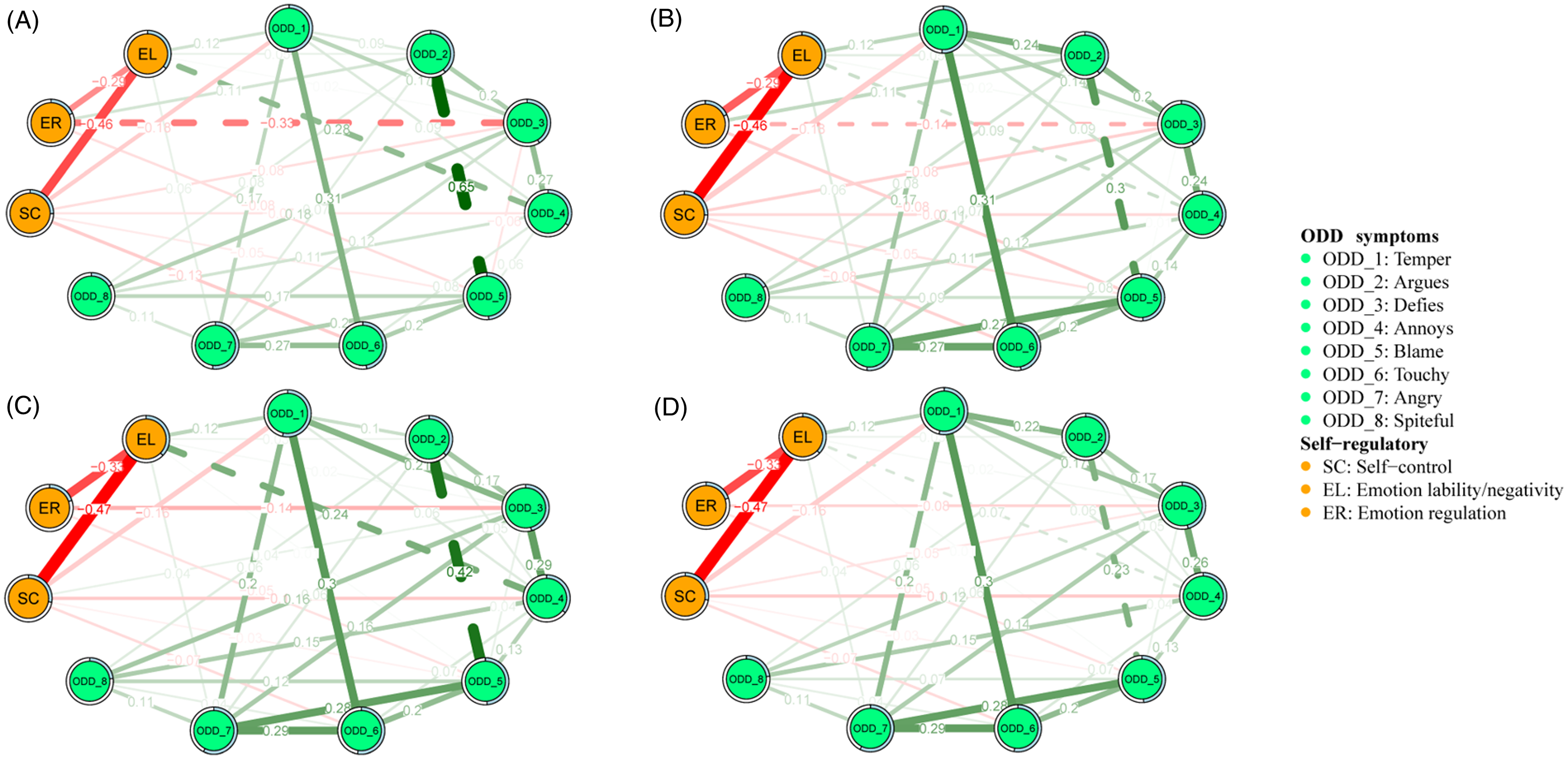
As shown in Figure 3, the MNMs model revealed bidirectional relations between self-control, emotion lability/negativity, emotion regulation, ODD symptoms, and the moderating role of child gender on these bidirectional relations. In the MNMs of wave 1 (the nodewise adjacency matrix see Table S1), the strongest positive bidirectional relation was shown between “Argues” and “Blames,” followed by “Temper” and “Touchy,” “Annoys” and EL (Emotion lability/negativity). Similar results were found in the MNMs of wave 2 (the nodewise adjacency matrix see Table S2), with the strongest positive edges in order of “Argues” and “Blames,” “Temper” and “Touchy,” “Touchy” and “Angry.” Both in Wave 1 and Wave 2, a strong negative bidirectional relation was shown between SC (Self-control) and EL (Emotion lability/negativity), ER (Emotion regulation) and EL (Emotion lability/negativity), ER (Emotion regulation) and “Defies.” In addition, the bidirectional relation between “Argues” and “Blames,” EL (Emotion lability/negativity), and “Annoys” was continuously moderated by gender in wave 1 and in wave 2, whereas ER (Emotion regulation) and “Defies” were moderated only in wave 1 (the matrix of interaction terms see Table S3 and Table S4).
Moderation network model with the exogenous moderator for wave1 (A) and wave2 (B). The color saturation of the edges is scaled against the largest edge weight, represented by the beta weight. The green solid edge indicates a positive correlation (p < 0.05) between the two nodes. In contrast, the red solid edge indicates a negative correlation (p < 0.05). The dashed edge further indicates that the interactive relations between the two nodes are both moderated by gender.

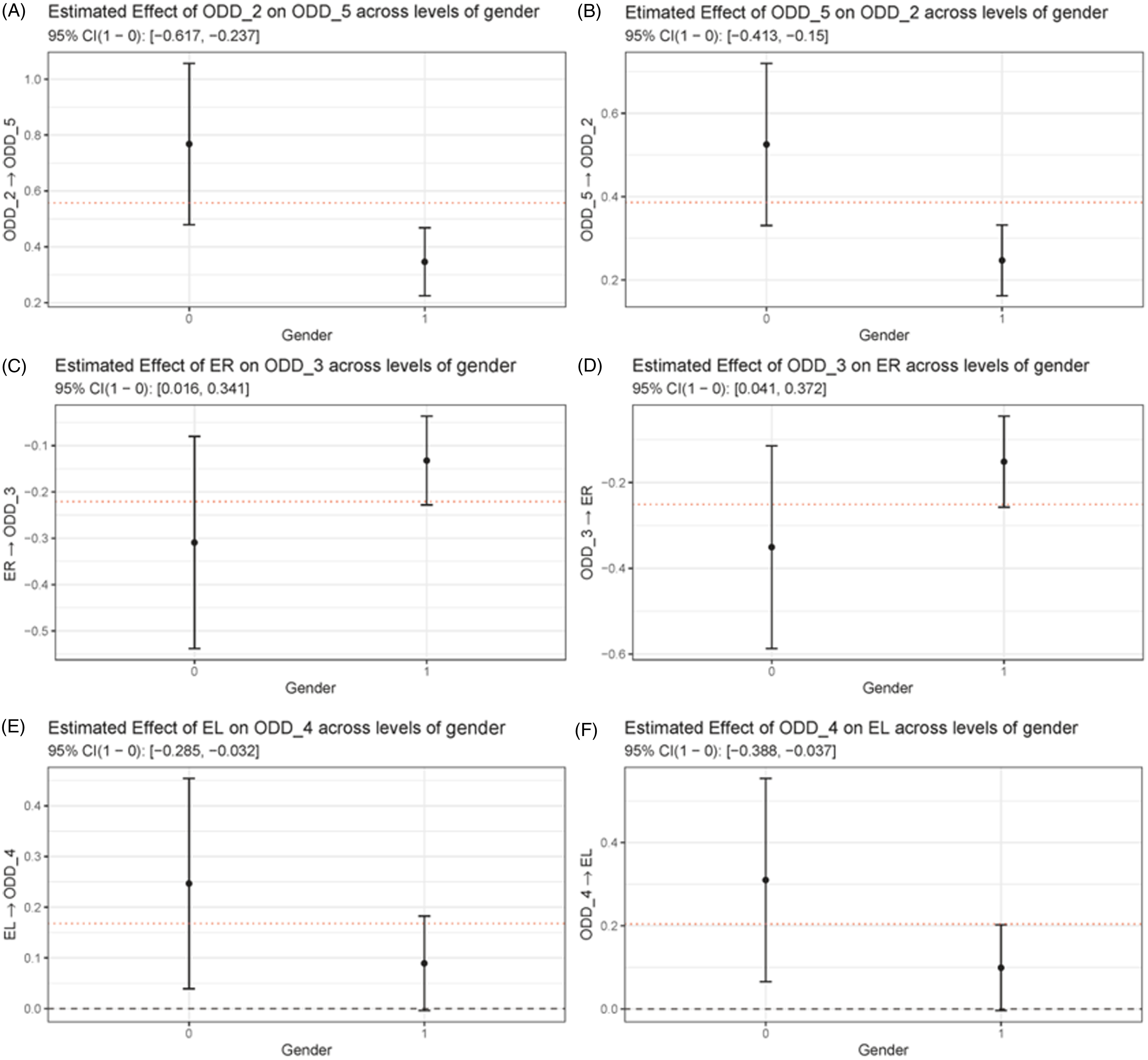
Figures 4A and 4B show the network structure for boys and girls in wave 1, respectively, while Figure 5a further shows the relation between children’s ODD symptoms and emotion regulation across genders in wave 1. We could found that there was a smaller positive effect of “Argues” on “Blames” for girls compared to boys (95% CI: [−0.617, −0.237]), and vice versa (95% CI: [−0.413, −0.15). There was a greater negative effect of ER (Emotion regulation) on “Defies” for boys compared to girls (95% CI: [0.016, 0.341]), and vice versa (95% CI: [0.041, 0.372]). In addition, there was a smaller positive effect of EL (Emotion lability/negativity) on “Annoys” for girls compared to boys (95% CI: [−0.285, −0.032]), and vice versa (95% CI: [−0.388, −0.037]).
Moderation networks of boys (A and C) and girls (B and D) in wave1 (A and B) and wave2 (C and D). The color saturation of the edges is scaled against the largest edge weight, represented by the beta weight. The green solid edge indicates a positive correlation (p < 0.05) between the two nodes. In contrast, the red solid edge indicates a negative correlation (p < 0.05). The dashed edge further indicates that the interactive relations between the two nodes are both moderated by gender.

The plots of conditional effects of wave 1. Boy = 0, girl = 1. In (A), the plot shows the conditional effects of Argues × gender on Blame. In (B), the plot shows the conditional effects of Blame × gender on Argues. In (C), the plot shows the conditional effects of ER × gender on Defies. In (D), the plot shows the conditional effects of Defies × gender on ER. In (E), the plot shows the conditional effects of EL × gender on Annoys. In (F), the plot shows the conditional effects of Annoys × gender on EL.

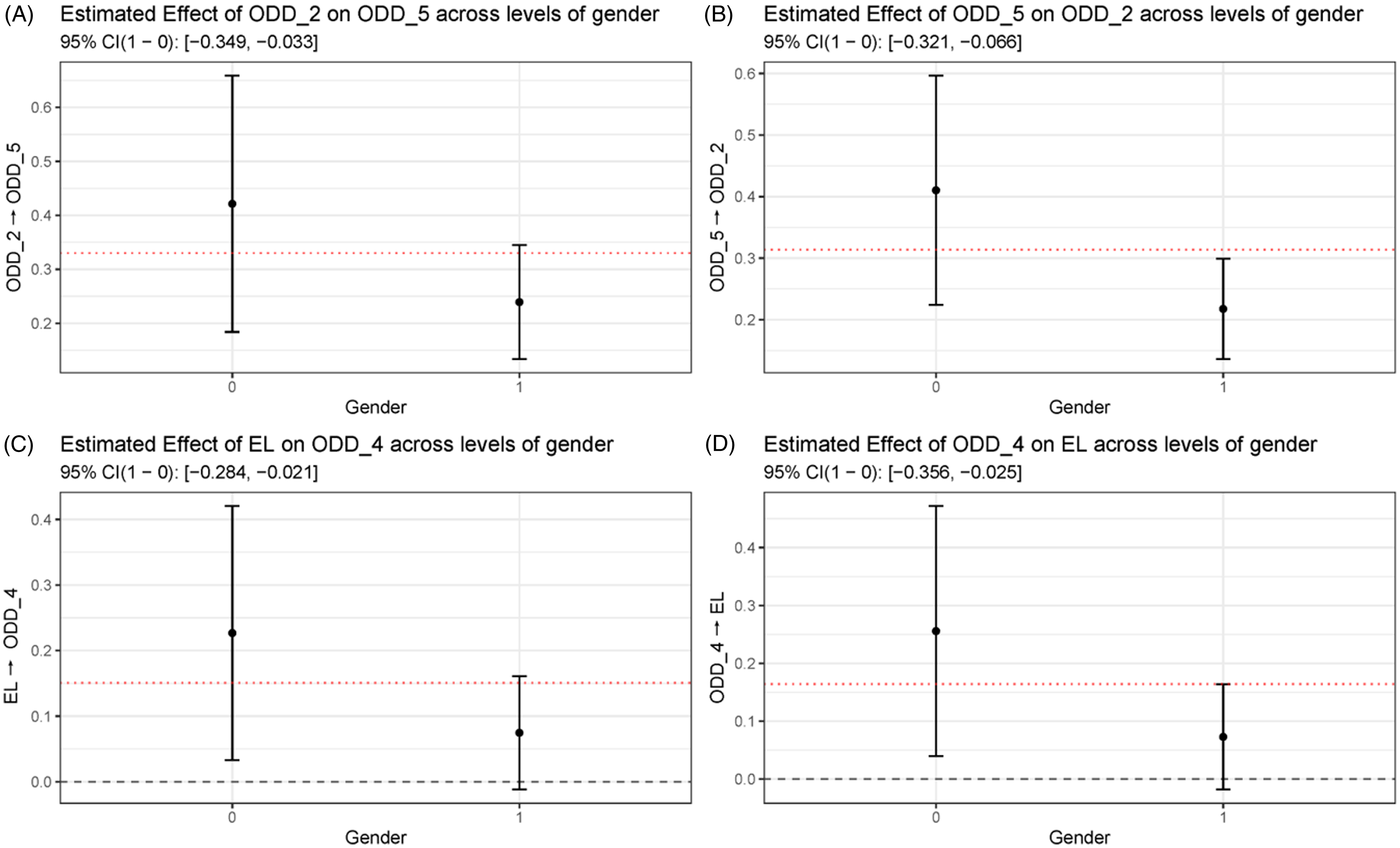
Figures 4C and 4D show the network structure for boys and girls in wave 2, respectively, while Figure 5b further shows the relation between children’s ODD symptoms and emotion regulation across genders in wave 2. We found that consistent with results from six months earlier, there was a smaller positive effect of “Argues” on “Blames” for girls compared to boys (95% CI: [−0.349, −0.033]), and vice versa (95% CI: [−0.321, −0.066]). In addition, there was a smaller positive effect of EL (Emotion lability/negativity) on “Annoys” for girls compared to boys (95% CI: [−0.284, −0.021]), and vice versa (95% CI: [−0.356, −0.025]).
The plots of conditional effects of wave 2. Boy = 0, girl = 1. In (A), the plot shows the conditional effects of Argues × gender on Blame. In (B), the plot shows the conditional effects of Blame × gender on Argues. In (C), the plot shows the conditional effects of EL × gender on Annoys. In (D), the plot shows the conditional effects of Annoys × gender on EL.

Network centrality, stability, and replication
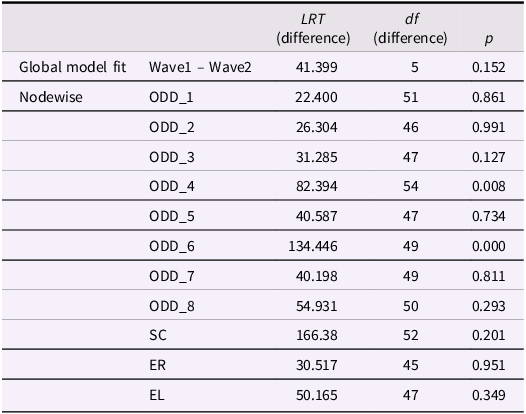
In the MNMs of wave 1 (see Figure S1A), the node with the highest EI value is “Argues,” and the lowest node is SC (Self-control). However, in the MNMs of wave 2 (see Figure S1B), the node with the highest EI value is “Temper,” and the lowest node is ER (Emotion regulation). For both wave MNMs, Expected Influence centrality indices were stable (see Figures S2 and S3), the CS coefficient was 0.75/0.52 (interactions/pairwise) for wave 1 and 0.75/0.52 (interactions/pairwise) for wave 2, both above the stringent threshold for stability (CS > 0.50) and case-dropping bootstraps remained over 0.7. Model comparison tests demonstrated the replicability of the ODD symptom and emotion regulation networks: there were no significant differences in the global MNM structure between wave 1 and wave 2, nor in the majority of nodes (see Table 2).
Model comparison test (likelihood ratio test)

Note. ODD_1 = Temper; ODD_2 = Argues; ODD_3 = Defies; ODD_4 = Annoys; ODD_5 = Blames; ODD_6 = Touchy; ODD_7 = Angry; ODD_8, = Spiteful; SC = Self-control; EL = Emotion lability/negativity; ER = Emotion regulation.
Discussion
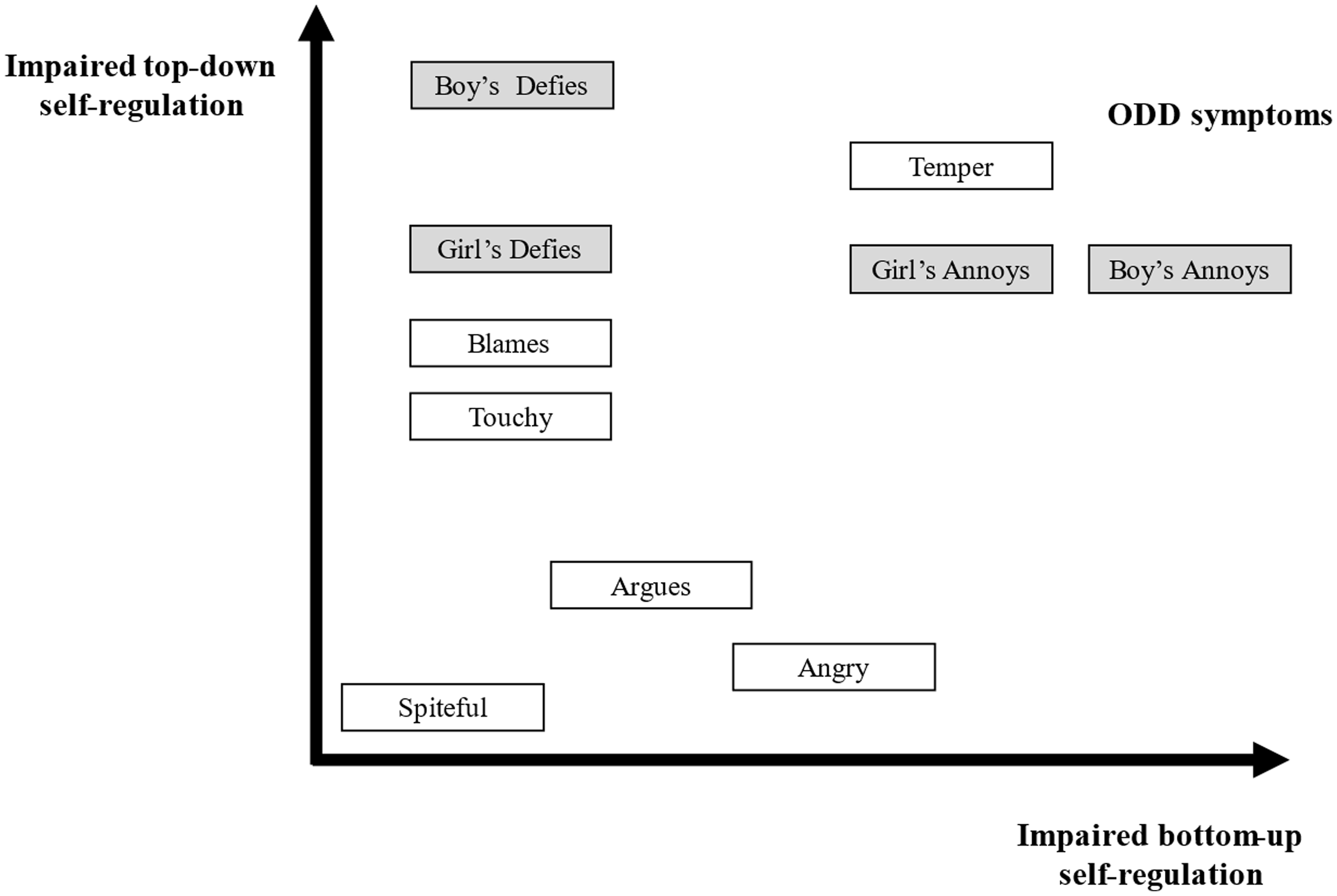
Based on the self-regulation model, coercion theory, and network theory of mental disorders, the present study analyzed two waves of data from primary school children to examine the complex relation between emotion regulation, self-control, emotion lability/negativity, and ODD symptoms, as well as the moderating role of gender. Using moderation network analyses, we found that: (1) Different subcomponents of self-regulation are associated with the ODD symptom network, which suggests conceptualizing ODD as a self-regulation disorder; (2) ODD is a heterogeneous disorder with different symptoms related to different self-regulation impairments, and these findings emphasize the importance of examining ODD at the symptom level in future studies; (3) Several bidirectional relations between self-regulation and ODD symptoms were moderated by gender, suggesting that there are differences between boys and girls in the development of ODD. (4) We constructed a two-dimensional model of self-regulation and ODD symptoms, which distinguishes ODD symptoms according to bottom-up and top-down self-regulation.
Consistent with the theoretical framework, we found that different self-regulation subcomponents had significant bidirectional relations with most ODD symptoms. First, consistent with previous longitudinal studies (Chen et al., Reference Chen, He, Xu, Zhao, Li and Lin2021; Nobakht et al., Reference Nobakht, Steinsbekk and Wichstrøm2024), we found a significant and stable relation between emotion regulation and ODD symptoms, which again demonstrates that emotion regulation is a central driver of ODD. In particular, emotion regulation has the strongest link with “Defies,” implying that “Defies” symptoms occur primarily because children lack the subjective awareness to regulate their emotions. Therefore, by teaching children effective emotion regulation strategies, it will be more effective to help children with ODD who are mainly characterized by “Defies” symptoms (Stadler et al., Reference Stadler, Freitag, Popma, Nauta-Jansen, Konrad, Unternaehrer, Ackermann, Bernhard, Martinelli, Oldenhof, Gundlach, Kohls, Prätzlich, Kieser, Limprecht, Raschle, Vriends, Trestman, Kirchner and Kersten2024).
Second, our results further suggest that in addition to emotion regulation, other subcomponents of self-regulation, such as emotion lability/negativity and self-control, have equally important roles in ODD development. The stable association between emotion lability/negativity and “Annoys” suggests that children’s deliberate annoying of others may be an unconscious ‘bottom-up’ process. In contrast, the stable association between self-control and ‘Temper’ suggests that children’s temper behaviors are conscious ‘top-down’ behaviors.
Third, we also found bidirectional relations between emotion lability/negativity and emotion regulation, emotion lability/negativity and self-control. This indicates that there might be a mutually influence between “top-down” and “bottom-up” self-regulation, which together contribute to the development and maintenance of the ODD symptom network (Nigg, Reference Nigg2017). Above all, we suggest that ODD should be conceptualized as not just an emotion regulation disorder, but also as a self-regulation disorder.
Importantly, we found a stronger correlation between “Temper,” “Defies,” and “Annoys” and self-regulation compared to other ODD symptoms. Specifically, Specifically, both “Temper” and ODD4 (Annoys) were significantly associated with both emotion lability/negativity and self-control. Although our design did not allow for causal inferences, this finding partially suggests that the emergence of Temper and Annoys symptoms could be related to multiple impairments in children’s self-regulation (Christiansen et al., Reference Christiansen, Hirsch, Albrecht and Chavanon2019). In other words, these two symptoms occur when the child is unable to regulate both “bottom-up” reactive impulses and “top-down” active control of behavior. In contrast, “Defies” is only strongly associated with “top-down” emotion regulation. Overall, based on the self-regulation model, we demonstrated that ODD is associated with a wide range of self-regulation and preliminarily examined differences in impaired self-regulation across ODD symptoms.
Although a large body of research, as well as the DSM-5, suggests that ODD symptom structure is invariant across gender. However, our study found for the first time that some of the maintenance processes in the ODD symptom network differed by gender. For example, we found that gender moderated the bidirectional relation between “Argues” and “Blames.” The stronger association between Argues and Blames symptoms in boys may be related to parenting styles in the Chinese cultural context, where boys tend to experience more authoritarian parenting compared to girls (Huang et al., Reference Huang, Hsieh, Shen, Wei, Feng, Hwa and Feng2019). Emotional attitudes of indifference and a high degree of control probably exacerbated the extent of the boy’s conflict with his parents, giving rise to a vicious circle of Argues and Blames symptoms. Moreover, for girls, we found significantly weaker bidirectional relations between emotion regulation and “Defies” and between emotion lability/negativity and “Annoys” than boys. Studies have shown that girls master emotion regulation strategies earlier than boys (Nolen-Hoeksema, Reference Nolen-Hoeksema2012) and use social support strategies more often (Sala et al., Reference Sala, Pons and Molina2014; Zimmermann & Iwanski, Reference Zimmermann and Iwanski2014). Consequently, in order to receive more social support from parents and peers, they are less likely to defy adults or deliberately annoy others than boys. These results have important implications for future diagnostic criteria for ODD in the DSM, as behind the same ODD symptoms in boys and girls, there might be inconsistent emergence processes.
Finally, based on the self-regulation model, the network theory of mental disorders, and the results of the current study, we constructed a two-dimensional model of self-regulation and ODD symptoms (shown in Figure 6). The “top-down” and “bottom-up” levels of impaired self-regulation represent the x and y axes, and ODD symptoms are distributed in quadrants according to their two types of impaired self-regulation. In addition, some symptoms were further categorized into boy and girl symptoms according to gender. The model will this help us to relate the concept of bottom-up and top-down self-regulation to ODD symptoms and provide some insights for future examination of the underlying mechanisms of different ODD symptoms.
The two-dimensional model of oppositional defiant disorder symptoms that combines top-down and bottom-up self-regulation processes.

Limitations
Some potential limitations should be noted. First, despite the longitudinal data collected in this study, the sample had a large attrition rate, and the effect of attrition on the results were not ruled out. Second, since we only collected two waves of longitudinal data, only cross-sectional MNMs were conducted at two separate time points. In future studies, tracking data at more waves could be collected to examine the causal relation between self-regulation and ODD symptoms. Third, the variables in our study were measured through subjective questionnaires, and the use of other or additional informants may have altered our findings. Fourth, we have only focused on some of the subcomponents of self-regulation, and there are many others to be further examined, such as inhibitory control and executive function. Fifth, the present study did not consider children’s temperament, which may have a critical role in children’s emotional and behavioral performance. Therefore, a more comprehensive assessment of risk factors for ODD symptoms in children is needed in future studies.
Implications
Despite these limitations, the findings have some theoretical and practical implications. First, the findings suggest that different self-regulation deficits may underlie different ODD symptoms and that differentiating between children with varying typical symptoms may be important for intervention. For example, cognitive-behavioral group interventions targeting chronic irritability effectively improve emotion regulation and ODD symptoms in children (Derella et al., Reference Derella, Burke, Romano-Verthelyi, Butler and Johnston2020). Second, our findings suggest that the relation between self-regulation and ODD symptoms was moderated by gender, and thus, future research needs to pay more attention to the role of gender differences in the onset and development of ODD symptoms.
Conclusion
The current findings support the idea that different subcomponents of self-regulation are important for the development and maintenance of ODD symptom networks. Each ODD symptom may involve different degrees of “top-down” and “bottom-up” impaired self-regulation, and this association may vary according to the child’s gender.
Supplementary material
To view supplementary material for this article, please visit https://doi.org/10.1017/S095457942400172X
Data availability statement
The data that support the findings of this study are available on request from the corresponding author. The data are not publicly available due to privacy or ethical restrictions.
Acknowledgments
We are appreciative of the parents and children, researchers who participated in our study and the many people who assisted in the data collection.
Author contributions
Wenrui Zhang: Conceptualization, Methodology, Writing—original draft; Lu Qiao: Writing—original draft; Miaomiao Wang: Data curation; Zaihua Liu: Supervision; Peilian Chi: Supervision; Xiuyun Lin: Supervision, Writing—review and editing.
Funding statement
The study described in this report was Funded by the National Nature Science Foundation of China (31800935, 32071072). The content is solely the responsibility of the authors and does not necessarily represent the official views of the National Nature Science Foundation.
Competing interests
The authors declare that they have no conflict of interest.
Ethical standard
All procedures performed in studies involving human participants were in accordance with the ethical standards of the institutional research committee and with the 1964 Helsinki Declaration and its later amendments or comparable ethical standards. The study protocol was approved by the Ethics Committee of Beijing Normal University.
Consent to participate
Informed consent was obtained from all individual participants included in the Study.
Consent for publication
Consent for publication was obtained from all authors.
Code availability
The code is available from the corresponding author on reasonable request.