On 9 October 2018, I packed up my son and my dog and evacuated from my home in Tallahassee, Florida. As I drove across the state with hundreds of thousands of others, Hurricane Michael moved ever closer, gaining strength and intensity in the Gulf of Mexico. When Michael slammed into the coast southeast of Panama City on 10 October, it was a category five hurricane — one of the strongest ever to make landfall in the United States — and it was devastating. The National Oceanic and Atmospheric Administration (NOAA) estimates damages of approximately $25 billion, with $18.4 billion in Florida alone (Beven, Berg, and Hagan Reference Beven, Berg and Hagan2019:2–4, 10–11). We were lucky. Michael’s path ran about 50 miles west of us, all but destroying Mexico Beach and leaving widespread damage in its wake. We returned to a blanket of debris in our yard, a fridge of spoiled food, and days of power outages, but our home was standing and Tallahassee cleaned up and rebuilt relatively quickly.
Climate scientists point to Hurricane Michael as one of many visible examples of climate change. The increase in number, intensity, and duration of tropical storms manifested in 2020 as well, a year that earned the dubious distinction of the most active hurricane season on record (NOAA 2020). The Climate Science Special Report, a key authoritative document created by the US Global Change Research Program for the Fourth National Climate Assessment, enumerates the consequences of rising global temperatures: severe droughts, widespread flooding, heat that makes swaths of the world uninhabitable, rising sea levels, and raging wildfires (USGCRP 2017). All that we have seen thus far is merely the prelude; experts suggest we have arrived at the point of no return and that further inaction will be disastrous.
At the same time, Covid-19’s devastation of the arts — particularly the performing arts — is catastrophic, widespread, and ongoing. Data collected by the nonprofit advocacy group Americans for the Arts shows that in the United States, as of 14 June 2021, 99% of nonprofit arts organizations had canceled events at a financial loss of $17.3 billion and that performing arts organizations, particularly theatres, had been hardest hit. Approximately two-thirds of organizations with in-person programming remain closed; 46% of organizations laid off or furloughed staff and less than half of those expect to return to prepandemic levels in the next year; and 42% lack the financial resources to reopen, a percentage that is significantly higher for BIPOC organizations (55%). An ongoing field-wide survey of more than 27,000 artists reveals that 95% report loss of income and 63% have experienced unemployment (Cohen Reference Cohen2021). An August 2020 study from the renowned Brookings Institution shows that Covid-19 erased 50% of existing jobs in the fine and performing arts — a rate that is significantly higher than that of any other field — and many of these jobs are not likely to return without intervention (Florida and Seman Reference Florida and Seman2020:6–7). As the authors argue, “small, stop-gap measures will not undo the damage; a substantial and sustained national creative-economy recovery strategy is required” (4).
While exacerbated by Covid-19, these field-wide problems are neither new nor unexpected. Lack of funding, jobs, and equity plagues US theatre. Profits drive commercial productions, forcing a focus on mainstream approaches and concerns. Nonprofit organizations compete for limited federal, municipal, and private funds. Worse, a 2017 Helicon study demonstrates that the majority of available funds go to the wealthiest, whitest, least experimental institutions, thus reinforcing a hierarchy in which some individuals receive high-paying, high-profile jobs while the majority struggle — particularly those employed by institutions focused on marginalized groups or experimental work (Helicon Collaborative Reference Collaborative2017). The current system often fails to bring the most exciting, edgy, or meaningful work forward, leaving behind many BIPOC, LGBTQ+, women, and disabled artists. As a result, the field faces a reckoning that has been decades in the making. I suggest that these multiple crises across climate, equity, and the arts are connected, and that we can work with intention toward a solution. President Franklin Delano Roosevelt’s New Deal, the most comprehensive relief program in US history, has been frequently invoked as a framework for transformation in the arts — and society.
In February 2019, Representative Alexandria Ocasio-Cortez (D-NY) and Senator Edward J. Markey (D-MA) introduced a nonbinding resolution to Congress: H.R. 109, a.k.a. the Green New Deal. Inspired by Roosevelt’s sweeping Depression-era New Deal, the Green New Deal is a call to action that reaches into the structures of the US economic and social order. The resolution has two primary goals: to reduce greenhouse gas emissions in order to avoid the worst of the climate change damage that is yet to come; and to address enduring systemic social inequity in the United States. To do so, the Green New Deal proposes a massive 10-year mobilization to reduce carbon emissions to net-zero by 2050. This will require an overhaul of the nation’s transportation system, digitization of the power grid, conversion of buildings to meet green standards, and the use of green energy sources to power the nation. This transition will create millions of new jobs, and thus the federal government — the Green New Deal asserts — should retrain workers from fields that will become obsolete so they, too, transition into a new, sustainable economy. At the same time, the federal government must ensure the sustainability of its people through basic needs such as healthcare, fair wages, food security, and clean air and water (Ocasio-Cortez Reference Ocasio-Cortez2019a).
The Green New Deal is, as Ocasio-Cortez explains in a series of tweets, “a ‘Request for Proposals’” that is intended “to *define the scope* of a climate solution” (Ocasio-Cortez Reference Ocasio-Cortez2019b). It is a call to return to basic human rights, but does not include a roadmap for the massive cultural shift that must accompany such sweeping structural changes. I argue that one core program for the Green New Deal should focus on the arts, including a Green Federal Theatre, and this Green Federal Theatre should be loosely based on the Federal Theatre Project (FTP; 1935–1939) that was a part of the New Deal during the Great Depression. The framework I suggest relies both on analysis of the successes and failures of the FTP and on my own decades of experience researching and writing on this complex organization. What might we learn from the historical FTP in theory and practice? How might we reimagine the FTP for the contemporary moment, and how might a Green Federal Theatre coincide with the social and economic needs expressed in the Green New Deal? This article, then, comes in two parts: historical analysis of two central FTP structures, and a manifesto that imagines a 21st-century Green Federal Theatre.
A Green Federal Theatre would, by necessity, employ tens of thousands of theatre artists at a living wage and provide the framework and resources for those artists to produce a wide range of work for diverse audiences. My purpose here is to consider what structures and values will best support that labor and how it might be made most effective today for a field that demands systemic change, a nation in need of healing, and a planet that requires a mass coordinated effort to recover enough to sustain human life.
Precedent and Practice
The Federal Theatre Project and the New Deal
Roosevelt’s New Deal, which passed into law during his highly productive “First Hundred Days” in 1933, did not initially include direct aid to professional theatre. It was a period of triage that focused on the “3 Rs”: relief (primarily jobs for the unemployed); economic recovery; and systemic economic and social reforms that would safeguard against future disasters. In his first year in office, Roosevelt combined executive orders with pressure on Congress to take action. They passed the Emergency Banking Act; provided relief to farmers with the Agricultural Adjustment Act; began construction on dams and power plants that would provide reliable power for millions through the Tennessee Valley Authority; established the Federal Deposit Insurance Corporation (FDIC); and regulated stocks and bonds via the Federal Securities Act. By the end of 1933, the Civilian Conservation Corps (CCC), Public Works Administration (PWA), and Civil Works Administration (CWA) created millions of jobs in reforestation, construction, and infrastructure improvements.Footnote 1 Just as the Green New Deal proposes, the New Deal reached into nearly every aspect of society with programs that dealt with public safety, housing and mortgages, labor law, trade, communications, culture, and the area that must be included in the Green New Deal, the arts.
The FTP was part of Federal Project No. 1 (Federal One), which was in turn part of the popular Works Progress Administration (WPA).Footnote 2 Distinguished by its sheer size and reach, the “Manual for Federal Theatre Projects” spelled out the organization’s mission: 1) employ out-of-work theatre professionals; and 2) establish “theatres so vital to community life” that they would endure when relief programs ended (FTP 1935:1). Certainly, no single contemporary US theatre entity can boast of an audience of more than 30 million, 60% of whom had never before attended live theatre.Footnote 3 Nor could a contemporary theatre survive if it offered 65% of its productions for free, with no single ticket price exceeding $1.50 (roughly $28 in 2020) and most ranging from 10 to 35 cents (approximately $1.89 and $6.61 in 2020). The FTP brought new, working-class audiences to the theatre based on two core premises: audiences of all kinds would respond to high-quality theatre that was relevant to them and their communities, and the federal government would fund those efforts.
National Director Hallie Flanagan clearly described the FTP’s form and goals in her history of the project, Arena:
In short, the plan was based on that of the federal government itself: the general policy and program would be outlined in Washington, but the carrying out, with modifications dictated by local conditions, would rest with the states. It was not a national theatre in the European sense of a group of artists chosen to represent the government. It was never referred to by me as a national theatre, though critics increasingly spoke of it as such. It was rather a federation of theatres. That was the origin and meaning of its name. (Reference Flanagan1940:23)
Flanagan’s vision of this “federation of theatres” — rather than a “national theatre” made up of a few gifted artists — called for sharing resources, skills, and personnel while encouraging the development of locally relevant theatre. With this approach, the FTP could take advantage of local issues and connections to create theatre that appealed to its community. To enact this vision, Flanagan split attention and resources between large urban centers in New York, Chicago, and Los Angeles, and smaller units located throughout the country. Thus, as I have argued elsewhere, no study of the FTP is complete without serious attention to the many activities that happened outside of those cities. In outlining a potential plan for moving forward with a reimagined federal theatre project, the activities of those groups operating within small towns are vital.Footnote 4
Two core concepts illuminate the organization’s underlying values: the complementary relationship between the federal and state offices; and the focus on locally relevant work. Some administrative procedures clearly hindered the FTP, such as the hierarchy of funding that required state WPA finance administrators to approve expenses. While some of these individuals found effective ways to fund and deploy their local units, others acted as roadblocks. As a case in point, Flanagan describes the “hair-raising struggles” of a director working on a show in which actors consumed a loaf of bread onstage each night; after repeated requests 30 loaves arrived opening night (Reference Flanagan1940:34). This exploration reveals the potential for collaboration and resource sharing, as well as local community building, thus offering practical models for a reimagined FTP.
Communications and Coordination
The National Service Bureau
The National Service Bureau (NSB) was, according to Flanagan, the “greatest power of the Federal Theatre” (Reference Flanagan1940:267). As with any governmental agency, bureaucracy played a vital role in the FTP’s success or failure, and the far-reaching NSB was the organization’s linchpin. It served as an information clearing house and hub of communications, pooling needs from individual units and redistributing equipment and personnel as needed. NSB workers created 123 bibliographies, along with play lists, scripts, new play surveys (with synopses), and various magazines and bulletins — including the invaluable Federal Theatre magazine, which documented the FTP’s work nationwide and remains in the archives (Flanagan Reference Flanagan1940:446). The NSB employed playwrights, researchers, administrators, and translators. It cleared royalties, negotiated contracts and rights, coordinated the use of specific plays across multiple units, collected and distributed information on new plays, and maintained records on all of the nation’s productions. The NSB also tracked the FTP audience with extensive audience survey reports and communicated with that audience, sharing FTP activities and exploring international theatrical experiments through various publications (Flanagan Reference Flanagan1940:264–66; Gilder Reference Gilder1936:25). Yet the NSB did not begin in this form. It was the accumulation of various structural changes, some forced and some responding to organizational needs.
Initially, the FTP included a number of individual divisions: the Bureau of Research and Publication, with a separate department for FTP publications; the National Play Bureau, which conducted research; and the Play Policy Board, which centralized playreading and approvals. With the severe cuts to budget and personnel in the summer of 1937, all of these separate administrative pieces merged into the NSB, with specializations like playreading, legal work, and publications designated internally (Flanagan Reference Flanagan1940:264–65). Regional Service Bureaus, designed to seek out local talent and content, produce work relevant to their regions and communities, and work in conjunction with the NSB, were set up in the Midwest, the South, the Northeast, and the West. The cooperation between the different NSB divisions and between the regional and national offices proved indispensable. Flanagan’s description is worth quoting at length:
The growing success of the National Service Bureau, although it had not attained more than 50 per cent of either the plans or the efficiency we wanted, demonstrates the degree of co-ordination which must exist in any theatre desiring to stress localities and regions within a national plan. A locality is apt to ignore local material: only a national plan can emphasize and correlate different parts of the country as parts of a nationwide pattern. (1940:267)
Flanagan’s comment regarding the localities being “apt to ignore local material” offers insight into the need for both national and local presences, as both provide important perspectives that the other may overlook. The NSB was a work in progress, and one that a contemporary Federal Theatre would do well to build upon in order to streamline administrative work and build connections across communities.
One of the NSB’s primary functions was to gather and synthetize information on professional, educational, and community theatre and coordinate among those groups, recognizing the strengths and needs of each type of theatre. Flanagan described this work in her Reference Flanagan1939 National Director’s Report: “the National Service Bureau, through the vitality of its research and the wide distribution of that information to schools and colleges, is literally the Federal Theatre in those states where we are not now operating” (1939:5). The FTP had active producing units in 32 states and the District of Columbia, though a number of the smaller units closed as funding diminished (Flanagan Reference Flanagan1940:434–35). The NSB’s work — unlike the rest of the FTP — was not confined to those cities and towns with enough out-of-work theatre professionals to justify a performance unit. The research, publications, play lists, explication of new work, and more could be shared quickly and easily with communities, organizations, and small theatres anywhere in the country, thus extending the reach of the FTP to otherwise unserved areas.
The NSB’s work building relationships between the theatre and outside institutions integrated theatre into the lives and daily practices of Americans who might have otherwise ignored it. The NSB suggested plays on health and safety to the American Medical Association, the American Red Cross, the Visiting Nurse Association, and state and municipal health bureaus. Religious groups, educational groups, and more than one hundred national peace organizations requested antiwar plays. Convents, monasteries, schools, churches, synagogues, and other religious groups asked for plays that focused on faith. Commercial theatres asked for surveys of new plays. Farm Bureaus, Farm Unions, 4-H Clubs, and Resettlement Organizations sought plays relevant to rural life (FTP 1939:1–3). The NSB’s generous approach, made possible by federal funding, deepened widespread support for the theatre as a whole and for the FTP itself.
This extraordinary range of tasks on the national level coordinated the “federation of theatres,” conserving labor and resources and shifting some of the more complex administrative tasks to a single national office. At the same time, the regional hubs retained the ability to connect and engage creatively with communities on a local level. This type of system requires clear communications, a powerful and effective workforce, and an appreciation of what both the national and regional offices contribute to the whole — and it is especially important in a nation that continues to struggle to find resources and enduring respect for work that does not appear in New York City.
By necessity, contemporary US regional theatres have engineered their own systems to conduct this work. Individual literary management departments process vast numbers of plays in search of the best fit for their organizations. The National New Play Network’s New Play Exchange gathers scripts by living writers in a subscription-based online database (National New Play Network 2016). The Kilroys List collects industry recommendations for high-quality contemporary plays by women, transgender, and nonbinary playwrights in the hopes of garnering additional productions and resources for these underrepresented members of the theatre community (The Kilroys n.d.). Theatre Communications Group (TCG) — probably the organization whose mission is closest to the NSB — serves as a hub of communications for more than 700 member theatres and affiliate organizations in the country (TCG 2021). A revised version of the NSB as a core operation of a Green Federal Theatre would not negate this work, but could complement it by extending reach, conducting research, and bridging the gap between the theatre and potential allies in other fields.
Building Community
The FTP in Practice
Because of its national reach and government funding, FTP artists were able to experiment with large-scale productions and historical pageants, community-focused performance, and organizational partnerships. Much of this was due to the FTP’s foundational purpose: to provide meaningful employment to qualified relief workers. The vast majority of FTP funds — 90% — went directly to qualified worker salaries. The remaining 10% covered publicity, costumes, scenery, equipment, space rentals, utilities, royalties, and the salaries of any employees who were not qualified for relief. In-kind donations of space and equipment helped relieve the challenges that emerged from this imbalance, as did the reinvestment of the admissions fees that accompanied roughly 35% of the productions (Flanagan Reference Flanagan1940:434–46). FTP productions often benefited from a surplus of labor and, since supplies were limited, production teams would imagine creative ways to represent concepts. The FTP’s famous living newspapers capitalized on this with enormous casts and minimal other-than-labor expenses, employing a loudspeaker to announce shifts in time and location. Another way that this wealth of labor manifested was in the ability to create work that documented specific communities’ histories.
Historical pageants and festivals offered one way for the FTP to unite communities. The FTP appeared in the midst of the larger pageant movement, which began in 1908 with a depiction of the arrival of William Penn in a Philadelphia Founders’ Week event and spread nationwide (Glassberg Reference Glassberg1990:48, 107–09). Often taking place outdoors with casts of up to 1,500, historical pageants narrativized national, regional, or local history, and they drew enormous audiences. The FTP created the best-known pageant in this style, Roanoke Island’s The Lost Colony, which dramatized the first attempt at founding a permanent settlement in North America and has played every year since its creation in 1937 (RIHA 2019; Sweigart-Gallagher Reference Sweigart-Gallagher2009).Footnote 5 With The Lost Colony, the FTP worked with state and federal organizations, the University of North Carolina, and the Carolina Playmakers to create a cultural tourist attraction that has since brought more than four million visitors to the area (Moore Reference Moore2017:4–5). The show’s large cast and focus on a historical point of pride brought the community together and fed the local economy.Footnote 6
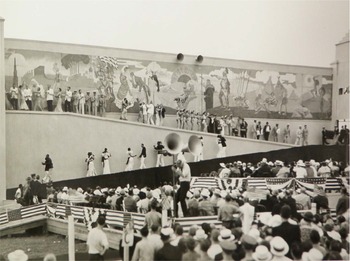
Many other historical pageants arose as well, all focused directly on local communities and their shared histories. The Arkansas FTP created a “tremendous living mural” that documented US history for an audience of 50,000 in June 1936 (fig. 1), in celebration of President and Mrs. Roosevelt’s visit to Little Rock (Meredith Reference Meredith1936:12). In Oregon, the state WPA director requested pageants for special events like the (very local) festival that accompanied the opening of three WPA-built flax manufacturing plants. A Paul Bunyan Festival uniting the Federal Art Project, the Federal Music Project, and the Federal Writers’ Project was also in the works when the FTP closed (FTP 1937:11; Osborne Reference Osborne2011:145–47). The FTP’s ability to create and execute these tailored special events — in numerous units across the country — demonstrates its potential to build communities by employing members of those communities and connecting them to shared histories.
This “tremendous living mural,” America Sings, played to an audience of 50,000 in honor of the President and First Lady’s June 1936 visit to Little Rock, Arkansas. (Courtesy of the Library of Congress, Music Division, Federal Theatre Project Collection)

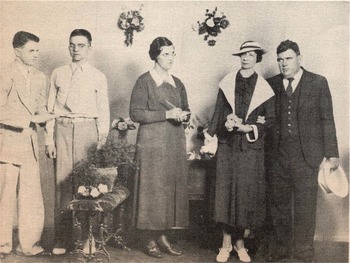
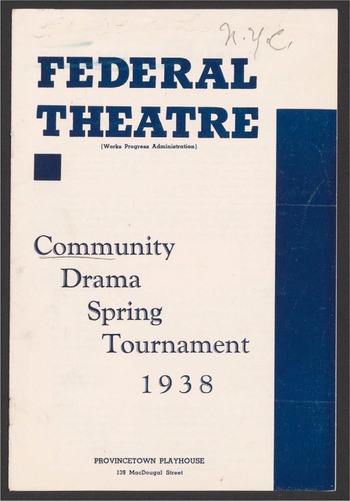
Community building became a core value for FTP leadership, and they created targeted companies based on the needs of individual communities while building opportunities for local artists to grow theatrical and leadership skills through national programs. The FTP designed a theatre for the blind in conjunction with the Oklahoma School for the Blind (fig. 2). With only two FTP employees — director Floyd Qualls, one of the only blind professional directors in the country, and supervisor Gladys Fearnside — productions featured students from the school (Flanagan Reference Flanagan1940:99; Dunn Reference Dunn1937:10, 28). Similarly, the FTP’s Cleveland Theatre for Youth worked in conjunction with local schools to bring theatre to more than 100,000 children and teens within 50 miles of the city. By the time the FTP closed, the Cleveland Theatre for Youth had garnered enough community support that it carried on as a private enterprise (Flanagan Reference Flanagan1940:169–70). The New York Community Drama Program, which operated out of the Provincetown Playhouse in Greenwich Village, made such programs possible by training FTP workers who wished to found or build on community theatres in small towns and rural areas (fig. 3). The FTP then funded their work, with the hope that the community would step in and support the theatre.
Director Floyd Qualls rehearsing with performers from Oklahoma’s Federal Theatre for the Blind. Qualls graduated from the Oklahoma School for the Blind before pursuing further training and professional experience, then returned to Muskogee to direct for the FTP. (Photo from “Oklahoma’s Federal Theatre for the Blind,” Federal Theatre 2, 1:10, NARA, Records of the WPA, Federal Theatre Project, Box 358)

The Community Drama Spring Tournament culminated in the awarding of the Jacob Riis Memorial Cup to an amateur group under the direction of the Federal Theatre Project’s Community Drama Unit in New York. This unit provided training for professional theatre people seeking to share their expertise with communities nationwide. (Courtesy of the Library of Congress, Music Division, Federal Theatre Project Collection)

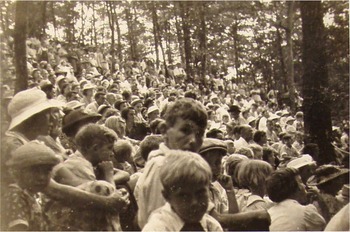
The FTP’s experimental work in Crossville, Tennessee, serves as one example of the potential of community building that operated through an interorganizational partnership with the Farm Security Administration (FSA). The FTP dispatched community drama director Sande Jaffray to Crossville in April 1938. There, he collaborated with FSA drama supervisor Margaret Valiant to write and direct a pageant documenting 100 years of the town’s past by tracking the “history” of a fictional family. In just over five months, Jaffray conducted research, engaged town elders in oral histories, vetted content through a town advisory committee, cowrote and staged the pageant, supervised the design and construction of a large outdoor theatre, and piloted a high school program that used drama to work toward specific community objectives (Jaffray Reference Jaffray1938b:1–4). The pageant attracted an audience of 3,500 from Cumberland Homesteads and the neighboring towns (fig. 4) — 1,000 more people than the new amphitheatre could seat — and the school projects manifested in sketches that premiered on “School Nite” for 550 children and their parents (Jaffray Reference Jaffray1938b:1, 4). The program focused on building trust across different community groups. Spending time with one another in creative pursuits encouraged Homesteaders to get to know one another: “in place of the mutual suspicion and distrust that was prevalent in some quarters, an atmosphere of mutual interest has been fostered. Instead of individuals being only for themselves, they are beginning to realize that there is a greater common good that is worth attaining” (Jaffray Reference Jaffray1938a:1). This particular sentiment — of using theatre to help different groups of people find common ground — seems particularly relevant now as the United States works through enduring divisions that culminated in a violent insurrection at the Capitol on 6 January 2021.
Sande Jaffray’s “Report on Activities at Cumberland Homesteads” included this image of the pageant audience from 28 July 1938. (Courtesy of the NARA, Records of the WPA, Federal Theatre Project, Box 4)

The community drama program’s focus on empathy, listening to others, and chipping away at a pervasive atmosphere of “mutual suspicion and distrust” offers a model for moving forward with a Green Federal Theatre. Extensive research has shown the value of the arts in promoting collaboration and creative problem solving, as well as building empathy for different perspectives.Footnote 7 A 21st-century “federation of theatres” could recruit, train, and deploy community drama specialists in a coordinated national effort to help local residents move beyond their differences. In a nation that has become increasingly polarized and siloed, such a practice could encourage individuals to listen, making previously solid boundaries that reinforced difference suddenly permeable. Reminding communities of shared histories, encouraging project collaborations, and introducing people to their neighbors in a low-stakes environment would create the common ground necessary for meaningful conversation once the stakes are raised. This work is already being done successfully by organizations like Appalshop’s Roadside Theater, which unites artistic excellence and advocacy with community work in the Appalachian region (Fink Reference Fink2020). Such processes empower individuals and communities to work toward major social change.
The Green Federal Theatre
Ocasio-Cortez pitched the Green New Deal as a “Request for Proposals” that will help to define the scope of the many crises the United States faces today: climate change, racism, sexism, homophobia, lack of affordable healthcare, widespread wage and wealth inequities, and more. These issues require major changes in a society that is more divided than at any time since the Civil War. In addition to the massive infrastructure changes, technology, and research, this level of social change requires the nation’s extraordinarily diverse citizenry to buy in to such an enterprise. Theatre can help build empathy and understanding by sharing human stories, and deploy its practices to build empowered communities ready to take action. The National Service Bureau and the Community Drama Program demonstrate two ways that the FTP served these needs one community at a time. They connected the theatre to people’s daily lives and they explored ways of using theatre practice to bring people together for difficult conversations.
To date, conversations around a new FTP have largely argued for its existence. Assuming that we are convinced that a Green Federal Theatre is both necessary and broadly beneficial, what comes next? What strategies might we distill from the historical FTP, what must we jettison, and how can we imagine something that better addresses contemporary needs and lays the foundation for an enduring Green Federal Theatre? Drawing on the examples above and my own oeuvre, I thus offer the following manifesto as a point of departure in anticipation of robust further conversation.
A Manifesto for a Green Federal Theatre
1. A Green Federal Theatre will employ tens of thousands of unemployed theatre workers at a fair, living wage, with options for retirement planning.Footnote 8 In so doing, the Green Federal Theatre will sustain the performing arts by preserving both artists and their skills through Covid-19’s devastation, its aftermath, and the broader systemic changes required in the field. However, its mandate must extend beyond simple employment.
-
a. The Green Federal Theatre must be values driven, not profit driven. It will employ theatre and performance to bring communities together, engage in important and meaningful exchanges, and advocate for the widespread inclusion of theatre and all the arts in daily life.
-
b. Core values for the Green Federal Theatre will include supporting the decentralization of the theatre, creating new economic and administrative structures for the field, forwarding sustainable and equitable working practices, building up communities, developing new and experimental work — particularly from marginalized voices and in historically underserved communities — and spreading theatrical pedagogy and practice throughout the nation.
-
c. The challenges the industry — and the nation — face are enormous. The national response must be proportional. According to the Bureau of Economic Analysis, the arts and culture sector accounted for $919.7 billion in 2019 — 4.3% of the US gross domestic product (USBEA 2021). The four-year FTP cost $46 million during the Great Depression, a sum equivalent to roughly $855 million today. The Green Federal Theatre I propose here is larger, and will require approximately $1 billion in operation costs over its first two years — a figure roughly equal to one-tenth of 1% of the arts’ contributions to the national economy in 2019. These funds will be an investment in the arts, society, and economic strength of the nation.
-
d. Great democratic societies thrive when the arts encourage conversation, spur audiences to explore new ideas, and challenge norms. By their very nature, these processes may elicit strong responses, including discomfort or disagreement. A Green Federal Theatre must be free from censorship and from the self-censoring that results from the expectation that funding relies on innocuous or uncontroversial content.
2. Core administrative frameworks and approaches will expand and apply the above values to specific structures that support the Green Federal Theatre.
-
a. Funding: Rather than applying the majority of the funds at the federal level and allowing them to trickle down to the states, I advocate a system that blends the structure of the 1973 Comprehensive Employment and Training Act (CETA) with that of more traditional works programs. CETA attempted to strike a balance between federal and local interests by designating hundreds of “prime sponsors” (city or county governments, state sponsors, employment programs, etc.) that will propose programs based on community needs (ACIR 1977:34–35). This structure will create a partnership between the Green Federal Theatre and existing educational, community, and professional nonprofit theatres, thus sustaining organizations looking to support the Green Federal Theatre’s mission, creating or tweaking education and training programs, and ensuring some level of community-based work. Moreover, this structure will put financial decisions at the local level once funding is awarded.
-
b. Leadership: Responding to inequities in the theatre and nation, and working hand in hand with the Green New Deal’s focus on equity and reparations, the Green Federal Theatre’s leadership structure will prioritize BIPOC, LGBTQ+, women, and disabled artists, administrators, and scholars. In addition to providing immediate widespread relief and diversifying the industry, this approach will create a training pipeline for members of these groups to pursue leadership opportunities in the field. This will encourage individuals to move between the Green Federal Theatre and nonprofit/commercial theatre employment with extensive real-world experience.
-
c. Equitable Representation: The Green Federal Theatre will recognize diverse and equitable representation as a necessity. The field has historically favored white, cisgender, male artists and stories while marginalizing BIPOC, LGBTQ+, women, and disabled individuals. The Green Federal Theatre will strive to engender equity in representation, leadership and funding structures, and documentation, and to encourage scholarship that makes this work visible in the historical narrative.
-
d. Antiracist Practice: Building on the need for equitable representation, “The Living Document of BIPOC Experiences in Bay Area Theater Companies: BIPOC Equity Action Plan” documents numerous examples of racist practices and offers suggestions for establishing antiracist models moving forward (“The Living Document…” 2020). The Green Federal Theatre will adopt many of these recommendations, recognizing the complexity of, necessity for, and ongoing commitment to diversity, equity, and inclusion — DEI work — in the field.Footnote 9 In addition to emphasizing transparency in projects and funding, and annual reassessments of its own organizational structures, the Green Federal Theatre will: 1) Seek out BIPOC artists and community partnerships, and support work that shares unheard stories or practices with new audiences and/or is created by BIPOC artists creating work for and about their own communities; 2) Empower BIPOC artists to build and emulate the structures, goals, and ways of working that satisfy the needs and desires of their artmaking and their communities. The Green Federal Theatre further acknowledges that the term “BIPOC” covers diverse communities with different priorities, challenges, and ways of working, and seeks to genuinely engage with those differences at every level; 3) Create/support networking/collaboration across the larger BIPOC community, and also within the individual Black, Indigenous, Latinx, and Asian and Pacific Islander communities; and 4) Bring together experts to provide training for cultural consultants and support theatres seeking out culturally competent expertise.
-
e. Research, Records, and Communications: The survival of the Green Federal Theatre will depend on tracking its activities and demonstrating the importance of those activities to the nation. It thus will require an efficient, centralized entity — akin to the FTP’s National Service Bureau — to document activities; read and analyze vast numbers of plays; create and share resources and publications; support new play development; negotiate contracts, royalties, and permissions; coordinate communications across professional, educational, and community theatres; and liaise between the theatre and other fields. The Research, Records, and Communications branch will also serve as a hub of creative and scholarly research that draws scholars from across the globe and seeks ways to put their research into practice in the theatre and/or in the broader public conversation about culture and the arts. This division will be accessible to all organizations and individuals in the United States, even those without a local performing arts unit, and can begin work quickly. Resources must be freely shared and federal funds guaranteed.
-
f. Sustainable Practice: As part of the Green New Deal, the Green Federal Theatre must advocate for and model field-wide sustainability. The Sustainable Practice branch will bring together scientists, engineers, and creative scholars and artists interested in exploring creative solutions to national crises, including climate change. Performances connected to this unit will share the results of this research with audiences, domestically and internationally, and will deploy face-to-face, digital, and hybrid performances to do so. In addition, this vital branch seeks out structural models that sustain the people who make the performing arts possible by devoting attention to their long-term psychological and physical health.
-
g. Performance in Transformation: Just as contemporary US theatre is on the cusp of transformation, so, too, was the FTP. The “talkies” — widespread by the late 1920s — shuttered theatres and eliminated jobs. Rather than attempt to compete with this popular new entertainment, Flanagan challenged her workers to focus on theatre’s unique appeal to audiences. Today, the proliferation of digital performance, which has become widespread during the Covid-19 pandemic, catalyzes a similar call to action. The Green Federal Theatre thus will challenge artists to reconceptualize theatre for a postpandemic world so as to capitalize on technologies that increase widespread accessibility, and to ensure that this work complements the face-to-face work in communities nationwide.
-
h. Performance for the Future: The Green Federal Theatre recognizes that some audiences receive less attention and resources than others. As such, the Performance for the Future branch will seek out new ways of connecting to young and emerging audiences, particularly in historically marginalized communities. This branch will work in concert with Sustainable Practice by seeking out ways to ensure that both theatre and humanity have a future, including messaging about the numerous crises that threaten US society, and prioritizing healthy ways of working that value individuals and their labor, honor the need for work/life balance, and create safe spaces for everyone.
-
i. Flexibility: Through its long history, theatre has served communities through storytelling, entertainment, education, activism, creative outlet, political expression, ritual, and more. The Green Federal Theatre will strive for flexibility and adaptability so as to best serve its varied communities. Production units located throughout every region will present plays on topics important to the community and/or nation. Touring companies will introduce new ideas, forms, and works into many cities and towns. Specialty units will focus on the stories and issues connected to individual groups, offering support for work creation and production for BIPOC, LGBTQ+, poor and working-class individuals, women, and other historically marginalized communities.Footnote 10 Community drama units will draw attention to theatre’s potential social and recreational uses. Technology units will bring together artists, designers, and engineers to develop new tools for the future. Community and artist needs will guide the Green Federal Theatre.
3. In addition to its own work, the Green Federal Theatre will support the field through training, jobs creation, sustainable practices, corporate and private partnerships, and direct funding.
-
a. Training: In response to the ongoing need for professional development and preservation of skills, the Green Federal Theatre will collaborate with educational institutions and the wider field to offer free and low-cost training opportunities, particularly to BIPOC, LGBTQ+, women, and disabled artists. Examples of training include writing and workshopping intensives for new plays, master classes with expert artists across an array of specializations, summer intensives, and courses in community outreach practices.
-
b. Artist Support: The Green Federal Theatre will fund fellowships or residencies that prioritize BIPOC, LGBTQ+, women, and disabled artists in existing theatrical organizations.
-
c. Sustainability: “Green Grants,” overseen by the Sustainable Practice branch, will provide funding and expert consultations for nonprofit, educational, and community theatres interested in powering existing theatre spaces with renewable energy.
-
d. Financial Support: The Green Federal Theatre will recognize that the existing regional theatre system requires financial support to implement structural change and recover from Covid-19. Actors’ Equity reports that League of Resident Theatres (LORT) institutions were the second largest source of employment nationwide and, in the 2016/17 season, 40% of all Equity workweeks took place in regional theatres (Actors’ Equity 2019). Yet these theatres have historically dealt with three primary economic problems: 1) Lack of long-term financial stability due to inconsistent grants/donations and widespread absence of sufficient endowments; 2) a high percentage of existing budgets earmarked as salary; and 3) labor costs that do not diminish over time. This combination of economic factors leaves regional theatres — and the artists they employ — in extraordinarily precarious positions. The Green Federal Theatre will oversee loans and grants that provide: 1) seed money for artist salaries, with particular attention to organizations looking to ensure equitable salaries at a living wage, with health insurance and retirement planning; and 2) starter funds and advice for theatres looking to build endowments and/or long-term financial stability.
-
e. External Funding Initiative: Recognizing the vital role that external funding plays in the performing arts, the Green Federal Theatre will facilitate partnerships between performing arts organizations, foundations, and private businesses, focusing particularly on small, mid-size, and BIPOC theatres. This will address major inequities enumerated in Helicon Collaborative’s Reference Collaborative2017 study of arts funding, which points to the largest organizations with annual budgets in excess of $5 million and predominantly white and upper-class audiences receiving the majority of foundation funds (Helicon Collaborative Reference Collaborative2017).
-
f. Professional Theatre Partnerships: The Green Federal Theatre will be simultaneously a works program, a field-wide hub of communications, and an advocate for the long-term place of the performing arts in US society. It must work in concert with commercial and regional theatres, rather than in opposition. With artist exchanges, equipment rentals, and fair wages, artists and resources can move between the Green Federal Theatre and outside performance organizations as needed.
4. The Green Federal Theatre must create performances by, in, and for communities. To do so, it must embrace the diversity of the United States and its people.
-
a. Community Focus: Like the FTP’s Community Drama program, the Green Federal Theatre will send qualified and engaged workers (and financial support) to communities nationwide, regardless of whether those communities include artists who qualify for government relief. This work will focus on finding shared stories, learning/remembering history (from a multiplicity of perspectives), and working through challenges facing each community so as to increase meaningful communication, empathy, and idea exchange. Green Federal Theatre workers will adapt to the needs and interests of the community, engage community members in meaningful work, and ensure that the community has access to that work when presented.
-
b. Employment of Local Artists: Community-focused work requires a commitment to local concerns. Whenever possible, local artists will be invited to identify key topics and contribute to Green Federal Theatre work.
-
c. Training for Community Work: An outside eye can offer new perspectives on important issues, but this must be balanced with local points of view. The Green Federal Theatre thus will dispatch artists in pairs — one from the community and one from outside. To facilitate this, the Green Federal Theatre will offer free and low-cost training to those wishing to work in these programs. Opportunities will prioritize those planning to return to their own communities, particularly BIPOC, LGBTQ+, women, and disabled artists.
-
d. Teaching and Advocacy: Theatre-makers employ myriad skills and ways of working. The Green Federal Theatre will encourage community-focused artists in the community drama program to teach in local schools or community centers, create low-cost after-school programs for children, build alliances with local businesses and organizations, and initiate programs that use theatre-inspired pedagogy to build skills like critical thinking, creative problem solving, and teamwork.
-
e. Arts as an Economic Engine: As demonstrated by large outdoor pageants like The Lost Colony (Manteo, North Carolina), numerous thriving historical reenactment communities, and local community-driven folk plays like Swamp Gravy (Colquitt, Georgia), theatre can attract large audiences, create direct and indirect jobs, and drive the local economy (Malone and King Reference Malone and King2018; Geer Reference Geer1996). The Green Federal Theatre will recognize that the arts are powerful economic drivers and will seek communities interested in building up the arts through unique theatrical experiences. Support will come in the form of expert advisors (for production creation, architectural design, and financial planning) and starter grants for approved projects, as well as networking assistance to connect producers with local businesses and local and state municipalities.
5. Advocates and Ambassadors: The performing arts are a valuable tool for building community, bridging difference, coordinating clear messaging, sharing stories, representing new ideas, and initiating shifts in cultural norms. The Green Federal Theatre will coordinate deployment of artists and scholars as advocates and ambassadors.
-
a. Secretary of Arts and Culture: Numerous artists have called for a cabinet-level position dedicated to the arts and culture in the past few decades, and that call has recently intensified (Garber Reference Garber2013; Swed Reference Swed2021). A 2020 petition by theatre directors Rachel Chavkin and Jenny Koons has garnered more than 10,000 signatures to date (Chavkin Reference Chavkin and Koons2020; Marks Reference Marks2020). The Green Federal Theatre will join the call for the creation of this necessary position in the US Cabinet.
-
b. Domestic Cultural Ambassadors: The Green Federal Theatre will serve as a central point of communications for federal organizations, connecting those with overlapping purposes and values and seeking out opportunities to deploy theatre performances and practice. Branches of the government that would benefit from such alliances include the National Park Service, the Department of Labor, the Environmental Protection Agency, the Department of Energy, and the Department of Education. Domestic cultural ambassadors will also liaise with nonprofit and corporate partners that employ performance (film/television, theme parks, tourism and hospitality, etc.), as well as those that could use performance practices for reinforcing trust, collaborative skills, communication skills, creative problem solving, etc.
-
c. International Exchange: The Green Federal Theatre will recognize the extraordinary potential of the arts to connect individuals across borders. Building on initiatives like the US Department of State’s Art in Embassies Program, and in consultation with the Global Theater Initiative — an alliance between TCG and Georgetown University’s Laboratory for Global Performance and Politics — the Green Federal Theatre will provide funding and coordination for an artist exchange program (ITI 2016; USDS n.d.). Dedicated to artistic collaborations and cultural exchange, the program will enable US-based theatre artists to partner with international artists — both domestically and abroad — and to create work that encourages artistic experimentation with new techniques and technologies, builds cultural awareness, and promotes long-term international partnerships. Through this work, audiences can encounter alternative perspectives that inform and humanize individuals — their customs, joys, and challenges — so as to build empathy and understanding. This program will also support dramaturgical and scholarly exchanges so that these experiences can be observed, analyzed, and documented for the future.
-
d. Field Liaison: The Green Federal Theatre will serve as a communications hub, cataloging the concerns of professional, community, and educational theatres and creating regular points of collaboration and problem-solving. This communications network will buttress the field by bringing together a broad array of resources, including deep research and analysis, and encouraging further discussion around key issues like artist training, sustainability, local relevance, and community building. The Green Federal Theatre will host periodic gatherings to address the challenges of the field, conduct research, and publish results for a wider audience.
-
e. Service and Social Good: The FTP created traveling theatre companies focused on specific needs including the 1937 Flood Tour that brought theatre to mid-sized refugee camps across 12 states and a CCC Division that brought participatory plays to the Civilian Conservation Corps camps. The Green Federal Theatre will seek out opportunities in which theatre can raise morale, support public health initiatives, and work with targeted populations.
A Green Federal Theatre brims with endless possibility. This manifesto — wide-ranging though it may be — is a starting point that considers the values, priorities, and structures that could create a sustainable national organization. I imagine a Green Federal Theatre that aids artists, challenges troubling practices in the field, and benefits communities all across the United States. It is both necessary and attainable, and I look forward to further conversation.