


Introduction
Wearable devices have tremendously grown over the years due to the limitless on-body and off-body applications demanding such technology [Reference Hall and Hao1]. For instance, army, sports, saving lives duties, and smart wearable devices are some of the applications necessitating wearable technology. The wrist is considered the most attractive human part to monitor the human health, as various vital signs can be measured at it, such as the blood pressure and pulse rate. Using the wearable device, wireless transmission of such information to a physician for analysis and evaluation is valid. In that way, physicians can take quick decisions to save human lives.
Wearable devices require antennas of certain characteristics. For instance, being of small size for appealing purposes, flexible to a certain degree to accommodate the user orientation and posture, high in gain and efficiency, exhibiting directional radiation pattern to reduce back radiations absorbed by the human body, and thus, displaying low specific absorption rate (SAR). According to the published literature, monopole and patch antenna types are suitable for wearable antennas, where they have utilized substrate materials as dielectric textiles [Reference Gao, Hu, Wang and Yang2–Reference Tak and Choi20], ultra-thin polyimides [Reference El Atrash, Abdalla and Elhennawy21–Reference Zahran, Abdalla and Gaafar23], and composite materials [Reference Jiang, Cui, Yue, Zhu and Werner24, Reference Simorangkir, Kiourti and Esselle25] to attain flexibility.
In specific applications point of view, the need for health monitoring applications has pushed the research for using multi-band frequency channels using the same antenna [Reference Sabban26]. To satisfy this trend, different wearable antennas were presented using different design approaches to attain multi-band and wideband resonances [Reference Sangeetha, Sundarsingh, Kanagasabai, Sarma, Sivasamy and Pakkathillam27–Reference Zahran, Abdalla and Gaafar35]. Through the design of these antennas, they were required to have a small effect on the human body by demonstrating low SAR. SAR measures the amount of power radiated and absorbed by the human body. It is worth to mention that the Federal Communications Commission (FCC) and International Electrotechnical Commission (IEC) have set two renowned standards of 1.6 W/kg, averaged over 1 g tissue, and 2 W/kg, averaged over 10 g tissue, respectively, where all wearable antennas should abide to.
For achieving a directional radiation pattern leading to enhancements in gain and reductions in SAR levels, the wearable antenna is backed with a reflector referred to as an artificial magnetic conductor (AMC), often termed electromagnetic band gap (EBG) structures [Reference Gao, Hu, Wang and Yang2–Reference Ashyap, Abidin, Dahlan, Majid, Mohd Shah, Kamarudin and Alomainy5, Reference El Atrash, Abdalla and Elhennawy21]. Additionally, metasurfaces [Reference Gao, Yang, Hu, Zhang and Wang6] and substrate-integrated waveguide cavities [Reference Hong, Tak and Choi7] were utilized as backing structures for shielding purposes. Furthermore, reported in [Reference Gao, Yang, Hu, Zhang and Wang8–Reference Tak and Choi20] and [Reference Jiang, Cui, Yue, Zhu and Werner24, Reference Simorangkir, Kiourti and Esselle25] are simple ground planes incorporated to decouple the antenna from the human body. Nevertheless, ground planes, recognized as perfect electric conductors, suffer from the out-of-phase reflection feature, which leads to a sudden drop in the total efficiency and storage of energy in the antenna near-field region [Reference Sievenpiper, Zhang, Broas, Alexopolous and Yablonovitch36]. Another conventional method is to increase the air-gap separation in-between the wearable antenna and the human body [Reference El Atrash, Abdalla and Elhennawy22, Reference Zahran, Abdalla and Gaafar23]. Despite its success, it leads to an increase in the overall form factor; therefore, the tradeoff of performance against size.
It is challenging to attain a wideband wearable antenna that is high in gain and radiation efficiency, as well as possesses a high degree of flexibility. For instance, in [Reference Ashyap, Abidin, Dahlan, Majid, Mohd Shah, Kamarudin and Alomainy5] and [Reference El Atrash, Abdalla and Elhennawy37–Reference El Atrash, Abdalla and Elhennawy39], conformable wearable antennas that achieved high gain and radiation efficiency performance parameters were proposed. However, they did not possess a wideband resonance specification.
As such, proposed in this paper is an all-textile slotted triangular monopole antenna that is backed by an all-textile 2 × 2 AMC array structure, which is referred to throughout the paper as the integrated design. The integrated design is wideband, compact in size, highly conformable, demonstrates high gain, and exhibits low SAR levels when operating at close distances from the human body. Compared to all reported work in literature, the wideband along with the compactness, high gain, and flexibility is one major contribution. Also, the whole integrated textile antenna is another contribution which makes the antenna suitable for many applications. Finally, the paper presents a comparison between textile and other materials. With such form factor and performance, the integrated design can be integrated into wristbands to monitor the user's vital signs; thus, it serves as a good candidate for WiMAX and medical applications. Conducted in section “The flat all-textile integrated design performance against the human wrist” is the flat simulated and tested results, along with analysis, against the specific anthropomorphic mannequin (SAM) human model and user's wrist. Moreover, presented is a study on the pros of realizing an all-textile design over an all-polyimide-based design. Finally, highlighted in section “The bent all-textile integrated design performance against the human wrist” is the bent integrated antenna design performance over the SAM and a subject's wrist.
The flat all-textile integrated design performance against the human wrist
The all-textile integrated design comprises a slotted-triangular co-planar waveguide (CPW) fed antenna loaded with a 2 × 2 AMC array arrangement. The full methodology of how the design was achieved, including the effects of the incorporated slots, is found in [Reference El Atrash, Abdalla and Elhennawy21]. It is worth noting that a 2 × 2 array size was specifically selected to maintain the low profile feature of the overall integrated design. The added value in the proposed work than [Reference El Atrash, Abdalla and Elhennawy21] is that the proposed one is all-textile based to integrate with a wristband worn by athletes for monitoring the user's health conditions, such as blood pressure and pulse rate, at the wrist. Such valuable information is then transmitted wirelessly to a physician for diagnosing the vital signs. Moreover, the all-textile proposed work attained wideband resonance, whereas that in [Reference El Atrash, Abdalla and Elhennawy21] was dual-band. Finally, by realizing an all-textile design, the proposed design is highly flexible, which is desired for wearable applications.
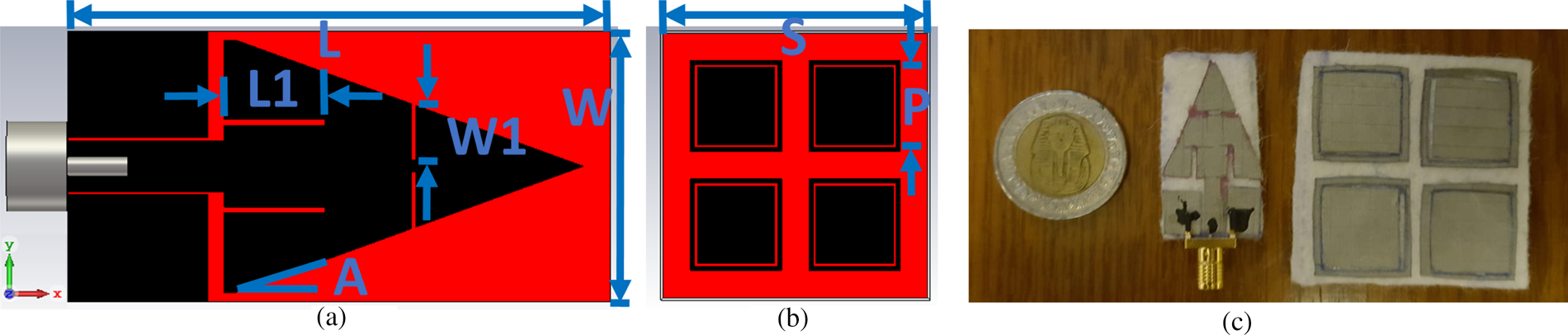
Figure 1(a) illustrates the top view of the monopole antenna and Fig. 1(b) displays the top view of the 2 × 2 AMC array structure. Moreover, depicted in Fig. 1(c) are the fabricated prototypes of each structure, which are highly compact in comparison with a one-pound coin. However, techniques such as designing the antenna based on the composite right/left-handed transmission line methodology [Reference Yan and Vandenbosch14, Reference Yan, Soh and Vandenbosch18, Reference Mengjun, Ze, Jianfei, Jianhui, Jianying, Lulu, Tao, Hongxing and Erping40], as well as the fractal design concept [Reference Sangeetha, Sundarsingh, Kanagasabai, Sarma, Sivasamy and Pakkathillam27], could further reduce the antenna size. The patch and ground structures are realized using the conductive textile ShieldIt Super [41]. It possesses a thickness of 0.17 mm and an estimated conductivity of 1.18 × 10⁵ S/m. The antenna and AMC substrates are made of Felt [42], with the difference being in the thicknesses. For the monopole antenna, the substrate thickness is 1.5 mm, while that for the AMC is 3 mm. Felt has a relative permittivity and loss tangent of 1.2 and 0.044, respectively. When integrated, both structures are separated by 3 mm, which, practically, is realized by foam.
The textile-integrated design separate structures 2D layout top view: (a) Monopole antenna (L = 36 mm, W = 18 mm, L1 = 6.5 mm, W1 = 3.14 mm, A = 20°); (b) AMC array (S = 45.3 mm, P = 20.3 mm); (c) Fabricated all-textile prototype, demonstrating compactness against a one pound coin.
Since the motivation behind the proposed work is to design an all-textile wearable antenna for human wrist applications, the integrated design performance was assessed at 3 mm from the SAM human hand phantom, as illustrated in Fig. 2. Such a separation was intentionally left for the wristband on which the design will be integrated onto. The SAM can be found in the Computer Simulation Technology (CST) software tool libraries. It consists of a liquid, enclosed by a shell, which emulates a human tissue. It possesses a relative permittivity, conductivity, and mass density of 37.005, 2.0249 S/m, and 1090 kg/m3, respectively. The benefit of utilizing the SAM hand phantom, in the simulations, is that it is time-efficient in determining the SAR levels. At such setup, the all-textile integrated design was evaluated in terms of its performance parameters.
The integrated design flat layout against the SAM human hand model.

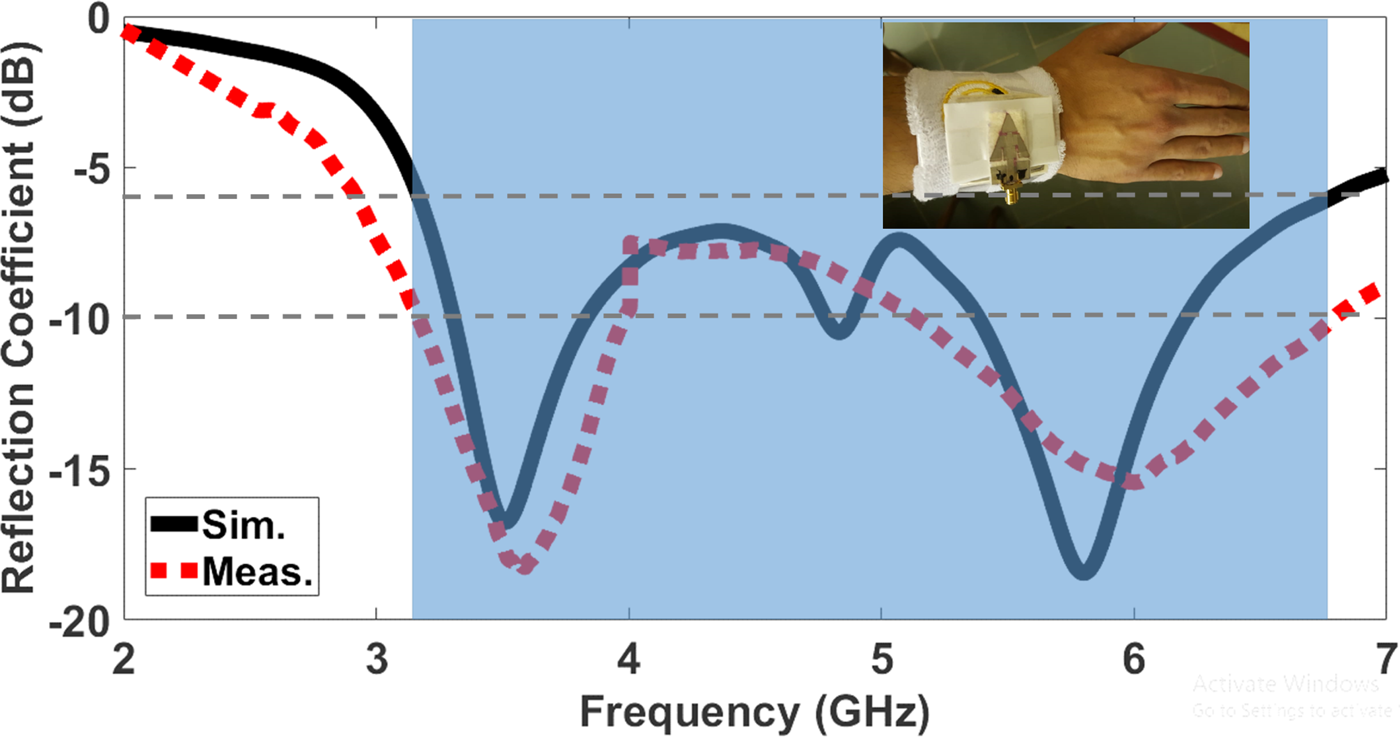
Depicted in Fig. 3 enclosure is the arrangement for measuring the all-textile flat integrated design fabricated prototype reflection coefficient over a subject's wrist. Rohde & Schwarz ZVB20 Vector Network Analyzer (VNA) was incorporated for conducting the measurement. As observed, the integrated design is mounted over a wristband to imitate the scenario targeted. The simulated (solid black) and measured (dotted red) reflection coefficients are benchmarked against one another in Fig. 3. Courtesy of the thick textile-based AMC material, and with respect to the −6 dB threshold, the integrated design displayed a simulated wide-band resonance ranging from 3.2 to 6.8 GHz (−6 dB impedance bandwidth of 3.6 GHz), whereas the measured result achieved a wider bandwidth ranging from 2.8 to 7 GHz (with a –6 dB bandwidth of 4.2 GHz).
Comparison between the simulated and measured flat integrated design reflection coefficients against the human wrist, with an inset of the setup for measuring the fabricated prototype reflection coefficient.
The slight discrepancies between both sets of results could be attributed to the fact that fabrication was done manually, where the thin slots are not as accurate as the simulated design. Such narrow separations are very subtle and greatly manipulate the results. This is also the case for the fabricated dual-band AMC, where it is clear that the fabricated square patches are not as accurate as the simulated ones. Finally, the simulation environment does not take into consideration the presence of the different subjects and objects that are in the measurement environment.
Thanks to the AMC array arrangement, the integrated antenna design possessed the patch-like unidirectional radiation pattern, which is highly desirable for wearable applications. In other words, the back radiations, which were toward the human body, were minimized and reflected in the opposite direction with respect to the human body. This justifies the high gain values achieved within the wideband spectrum, as observed in Fig. 4. Observing the left Y-axis scale of Fig. 4, the realized gain varied from 5 to 8.3 dBi; however, with a reduction to 3.5 dBi at 4.8 GHz. Moreover, perceiving the right Y-axis scale of Fig. 4, the radiation efficiency varied from 58 to 81%; though, with a reduction to 50% at 4.8 GHz. The reductions exhibited at 4.8 GHz are acceptable for textile wearable antennas and are close and better than the average of [Reference Simorangkir, Kiourti and Esselle25]. Moreover, the gain at 4.8 GHz is 4 dBi, which differs from the realized gain that takes into consideration the matching losses.
The flat integrated antenna design simulated realized gain and radiation efficiency against the human wrist within the wideband spectrum.
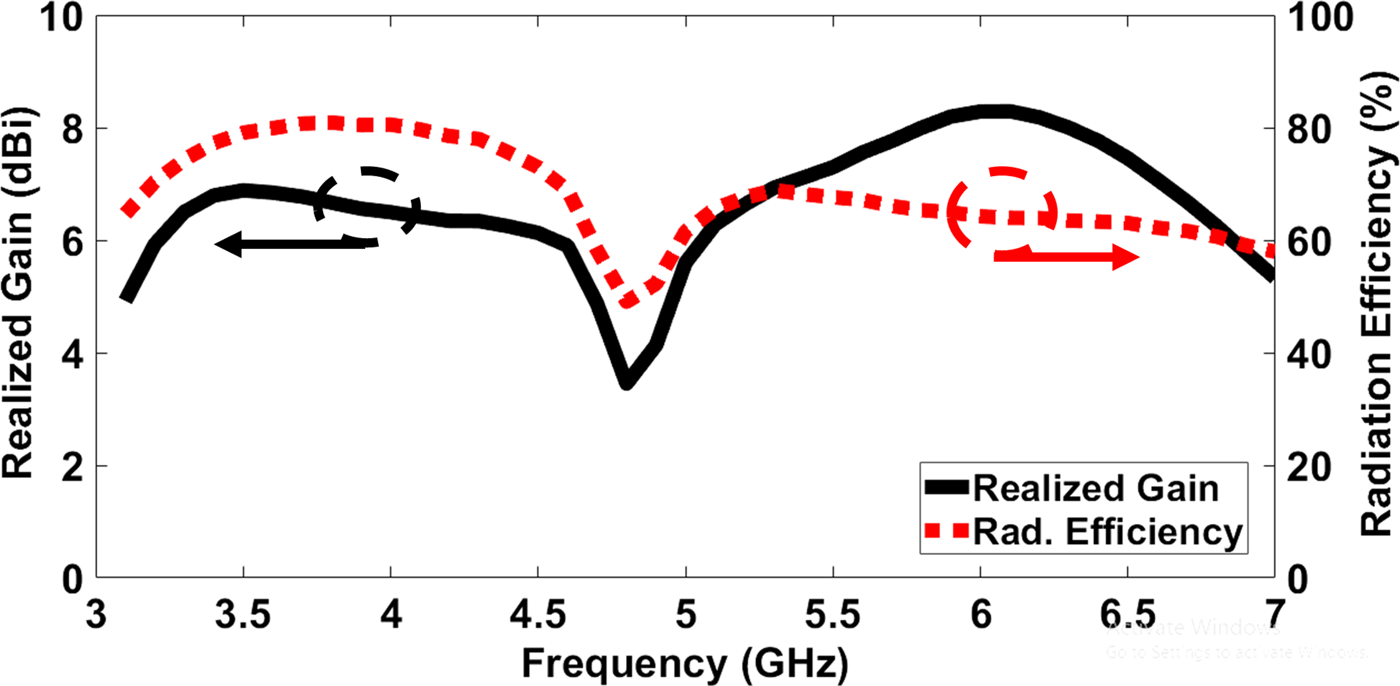
Focusing on the two main resonant frequencies of 3.5 and 5.8 GHz of the Industrial, Scientific, and Medical (ISM)-band, the integrated antenna design attained a peak realized gain of 6.71 and 7.82 dBi, respectively. Furthermore, it achieved good radiation efficiencies of 79.1 and 66.1%, respectively. Hence, it can be concluded that the antenna is robust against human hand loading, since it maintained its wide-band resonance, along with high gain and radiation efficiency performances.
For the sake of comparison, and to show the good achieved characteristics of the designed textile antenna, presented in this section, as well, is a study on the advantage of utilizing textile materials over polyimide materials. The antenna substrate materials included the 1.5 mm-thick Felt and 0.1 mm-thick Rogers ULTRALAM 3850. Moreover, the AMC substrate materials included the 3 mm-thick Felt and 1.52 mm-thick RO3003. Such materials were specifically chosen to match those incorporated in [Reference El Atrash, Abdalla and Elhennawy21].
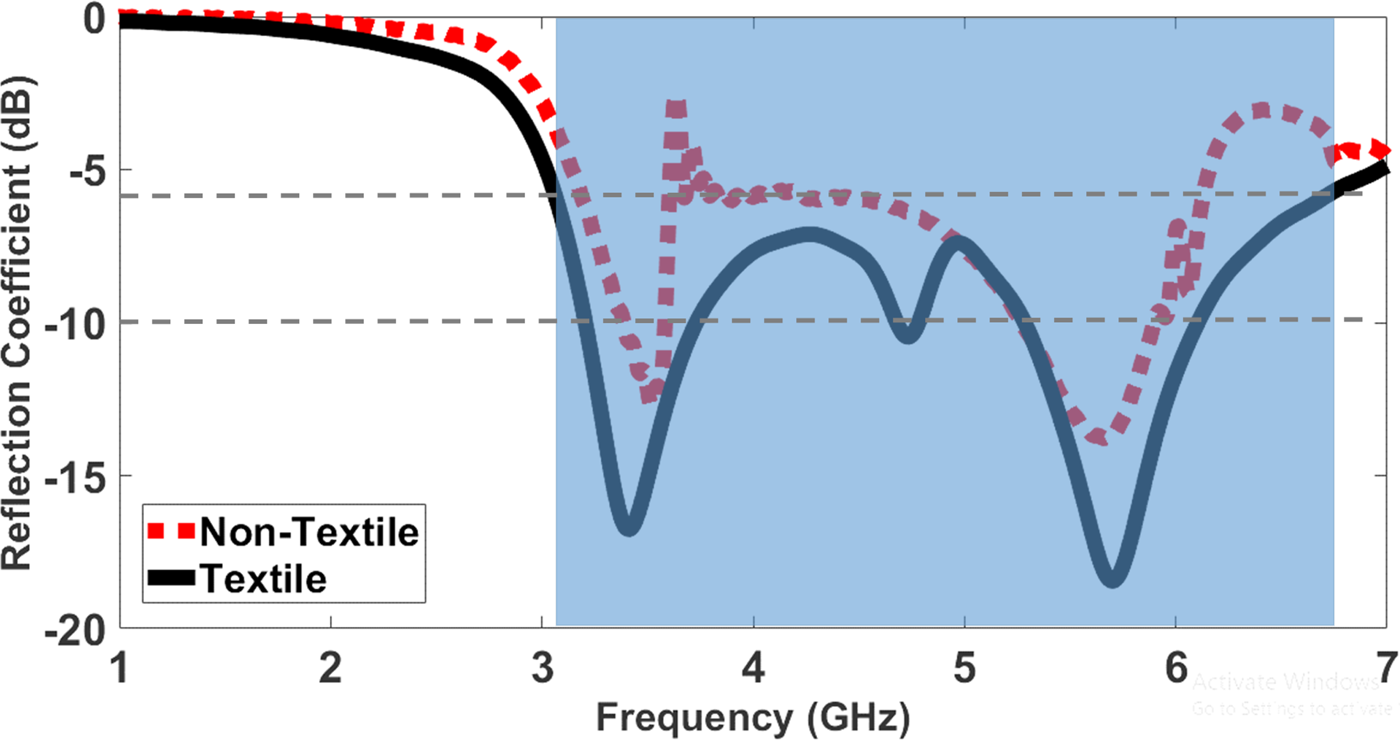
Displayed in Fig. 5 is the reflection coefficient of the proposed all-textile design benchmarked against that of the polyimide-based design when evaluated nearby the SAM human hand phantom. As perceived, the all-textile design achieved wideband resonance, with respect to the –6 dB threshold, ranging from 3.2 to 6.8 GHz, courtesy of the thick textile-based AMC material. This feature was lost when evaluating the all-polyimide-based design. This is considered the first advantage of utilizing textile materials over non-textile materials.
Comparison with respect to the simulated integrated design reflection coefficients between the all-textile and polyimide-based designs.
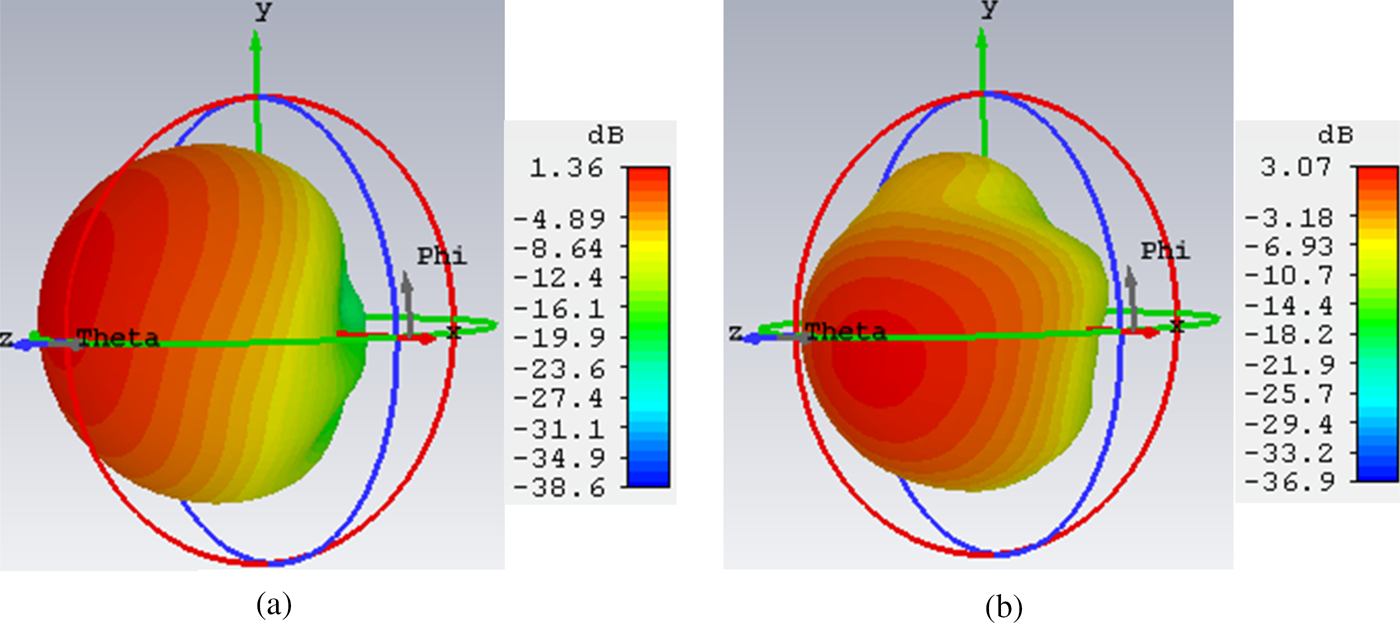
The second advantage is the high gain associated with the proposed all-textile-based design over the polyimide-based one. Putting emphasis on the two main resonant frequencies of 3.5 and 5.8 GHz, portrayed in Fig. 6 are the 3D gain radiation pattern of the all-polyimide design. As shown, the design exhibited gain values of 1.36 and 3.07 dBi at 3.5 and 5.8 GHz, respectively. Those values are lower than the proposed all-textile design, observed in Fig. 7, of 6.71 and 7.82 dBi at 3.5 and 5.8 GHz, respectively. This phenomenon was reported in [Reference Rita, Caroline, Ricardo and Pedro43], where it was described that textile antennas attain high gain due to the fact that the dielectric textiles dielectric constants are lower than polyimide ones. As such, the surface wave losses and spatial waves are minimized and improved, respectively.
The polyimide-based integrated design, placed on the SAM human hand phantom, 3D gain radiation pattern at: (a) 3.5 GHz; (b) 5.8 GHz.
The flat all-textile integrated design, placed on the SAM human hand phantom, 3D gain radiation pattern at: (a) 3.5 GHz; (b) 5.8 GHz.

From another point of view, SAR is calculated by defining the conductivity of the human tissue (σ), near-field electric field (E), and mass density of the human tissue (ρ) as stated in (1).

Thus, the all-textile flat integrated antenna design SAR levels, averaged over 1 g of tissue, at 3.5 and 5.8 GHz are highlighted in Fig. 8. A transmittal power level of 100 mW was input to the antenna to guarantee fair and accurate benchmarking with the literature. The achieved peak SAR levels, averaged over 1 g of tissue, of 3.28 × 10⁻⁶ and 9.37 × 10⁻⁷ W/kg are considerably lesser than the threshold of 1.6 W/kg. Hence, in the flat circumstance, the all-textile integrated antenna design complies with the American standard and is safe to the human body. It is worth mentioning that the SAR value, averaged over 1 g of tissue, is lower at the higher band than at the lower band because the human body conductivity is higher at 5.8 GHz than at 3.5 GHz, as reported in [Reference Mengjun, Ze, Jianfei, Jianhui, Jianying, Lulu, Tao, Hongxing and Erping40] and [44]. Furthermore, due to the close separation with the human body, this in turn affected the antenna radiation efficiency, which decreased at the higher band than at the lower band, as was depicted in Fig. 4.
The flat integrated antenna design SAR levels at: (a) 3.5 GHz; (b) 5.8 GHz.

The bent all-textile integrated design performance against the human wrist
Due to the fact that the integrated design is all-textile, it is essential to evaluate its performance under bending scenarios. Hence, depicted in Fig. 9 is the all-textile bent integrated design over the SAM human hand phantom. The design was bent over angles of 20 and 40° along the X-axis. At such an arrangement, the all-textile integrated design was evaluated in terms of its performance parameters; for instance, the reflection coefficient, the 3D gain radiation pattern, and the SAR levels. Portrayed in the inset of Fig. 10 is the setup for measuring the all-textile bent integrated design fabricated prototype reflection coefficient over a subject's wrist. As observed, the integrated design is mounted over a wristband to imitate the scenario targeted.
The integrated design bent layout against the SAM human hand model.

Comparison between the simulated and measured bent integrated design reflection coefficients against the human wrist, with an inset of the setup for measuring the fabricated prototype reflection coefficient.

Compared in Fig. 10 are the simulated (solid black and dashed blue for 20 and 40° bents, respectively) and measured (dotted red) reflection coefficients. Whether bent at 20 or 40°, the integrated design achieved a wide-band resonance; however, the measured outcome was wider than was its simulated counterpart. Furthermore, there are some frequency shifts that might be as a consequence of conducting fabrication manually, as well as the absence of the factors, that affect the measurement enviornment, in the simulation environment. The design displayed a simulated −6 dB impedance bandwidth ranging from 3.2 to 6.5 GHz (impedance bandwidth of 3.3 GHz). Whereas the attained measured −6 dB impedance bandwidth ranged from 2 to 6.5 GHz (impedance bandwidth of 4.5 GHz). As perceived, the bent case displayed a wider impedance bandwidth than the flat case, which could be due to the fact that the antenna was bent along the X-axis, which is the axis at which the antenna is excited. Hence, the currents are highly disturbed and their paths are modified leading to different electrical lengths.
Portrayed in Fig. 11 are the all-textile bent, at an angle of 20°, integrated antenna design 3D gain radiation patterns at the two main resonant frequencies. The integrated design maintained its patch-like unidirectional pattern, courtesy of the reflecting AMC array structure. The antenna radiates in the boresight direction, which is along the positive Z-axis, as depicted in Fig. 11. This indicates that maximum power radiated is opposite to the human hand. At 3.5 and 5.8 GHz, the bent integrated antenna design attained peak realized gain of 2.77 and 3.55 dBi, as highlighted in Figs. 11(a) and 11(b), respectively. In addition, it achieved good radiation efficiencies of 78.74 and 64.43%, respectively.
The bent, at an angle of 20°, integrated antenna design 3D gain radiation pattern, against the SAM human hand phantom, at: (a) 3.5 GHz; (b) 5.8 GHz.

Observing the left Y-axis scale of Fig. 12, the realized gain varied from 0.5 to 3.6 dBi; however, with a reduction to −0.4 dBi at 4.85 GHz. Moreover, perceiving the right Y-axis scale of Fig. 12, the radiation efficiency varied from 58 to 81%; though, with a reduction to 48.5% at 4.85 GHz. The reductions exhibited at 4.85 GHz are acceptable for bent textile wearable antennas. Moreover, the gain at 4.85 GHz is −0.1 dBi, which differs from the realized gain that takes into consideration the matching losses. Therefore, the integrated antenna design is robust against bending scenarios over the human wrist.
The bent, at an angle of 20°, integrated design simulated realized gain and radiation efficiency against the human wrist.

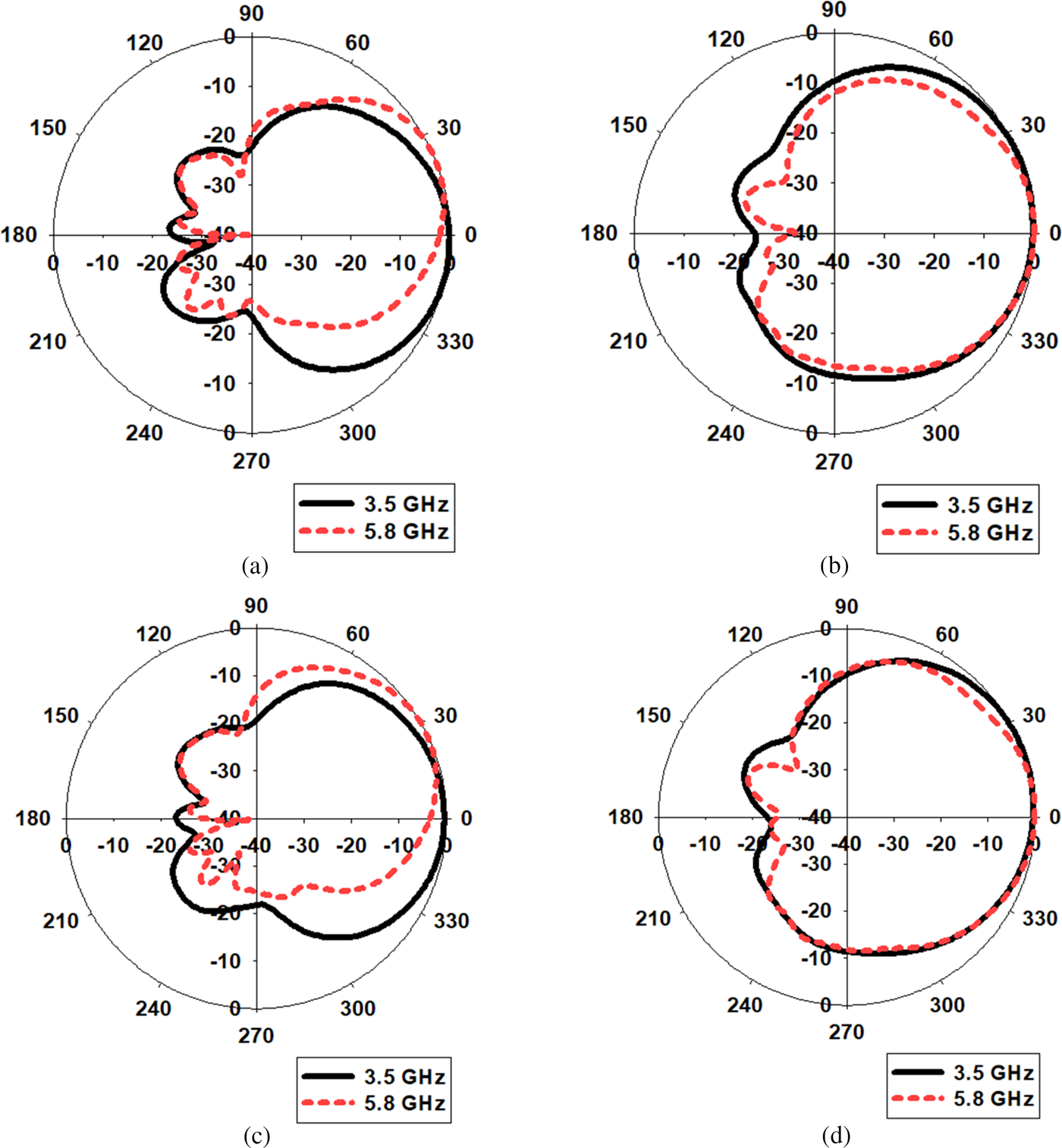
Furthermore, displayed in Fig. 13 is a comparison between the normalized gain radiation patterns in polar plots representation at both resonant frequencies and in the principal planes (X-Z and Y-Z planes). Figures 13(a) and 13(b) display such a comparison for the flat scenario in the X-Z plane and Y-Z plane, respectively. On the other hand, Figs 13(c) and 13(d) illustrate such a comparison for the bent scenario, at an angle of 20°, in the X-Z plane and Y-Z plane, respectively. As observed, the antenna radiates in the θ = 0° direction, which is normal to the user's hand. It is noticed that the main lobe direction is tilted to approximately 20° for the 5.8 GHz resonance in the X-Z plane, whether in the flat or bent scenarios. Yet, it is still acceptable since that direction is opposite to the human hand. Besides the good gain and radiation efficiency performances, the proposed all-textile integrated design displayed a high front-to-back ratio of 22 dB, as depicted in Figs 13(a) and 13(c), representing the X-Z plane. While in the Y-Z plane, it is 20 and 18 dB, in the flat (Fig. 13(b)) and bent (Fig. 13(d)) cases, respectively.
Comparison between the integrated antenna design, placed over the SAM human hand phantom, normalized gain radiation pattern polar plots at 3.5 and 5.8 GHz when: (a) Flat in the E-plane, (b) Flat in the H-plane, (c) Bent, at an angle of 20°, in the E-plane, (d) Bent, at an angle of 20°, in the H-plane.
With a power level of 100 mW, the all-textile bent integrated antenna design SAR levels are tabulated in Table 1. At 3.5 and 5.8 GHz, it exhibited maximum SAR levels of 3.34×10⁻⁶ and 9.43×10⁻⁷ W/kg, averaged over 1 g of tissue, respectively. Similar to the flat case, it is worth noting that the SAR value, averaged over 1 g of tissue, is lower at the higher band than at the lower band because the human body conductivity is higher at 5.8 GHz than at the lower resonant frequency, as reported in [Reference Mengjun, Ze, Jianfei, Jianhui, Jianying, Lulu, Tao, Hongxing and Erping40] and [44]. In addition, due to the close separation with the human body, this in turn affected the antenna radiation efficiency, which decreased at the higher band than at the lower band, as was demonstrated in Fig. 12. Hence, it is concluded that the antenna is robust against bending conditions and there are no health issues to be afraid of.
The bent integrated antenna design peak SAR levels at 3.5 and 5.8 GHz

Finally, tabulated in Table 2 is a comparison between the all-textile proposed design and recent published antennas when evaluated within the vicinity of the human body. Comparison factors include the radiator electrical size and type, de-coupling structure size and type, substrate material, relative permittivity, thickness, realized gain, radiation efficiency, and SAR levels, averaged over 1 g of tissue. As tabulated, the proposed radiator electrical size is smaller than [Reference Mersani, Osman and Ribero3, Reference Alemaryeen and Noghanian4] and [Reference Simorangkir, Kiourti and Esselle25], at 5.8 GHz. Furthermore, the suggested de-coupling structure is compact than all references besides [Reference Gao, Yang, Hu, Zhang and Wang6]. Finally, the proposed integrated antenna design displayed the lowest SAR levels, averaged over 1 g of tissue, in comparison with the benchmarked references.
Comparison between the characteristics and performances of the all-textile antenna and recent published antennas against the human body

Conclusion
A wideband integrated wearable antenna consisting of a compact slotted triangular monopole antenna, of an overall form factor of 36 mm × 18 mm (electrical size of 0.42 λ 0 × 0.21 λ 0 at 3.5 GHz), with a 3 mm-thick 2 × 2 textile AMC, of a physical size of 45.3 mm × 45.3 mm, was presented. Since the motivation was to design an integrated antenna for combination with a wristband for monitoring the human health conditions at the wrist, the design is all textile-based. Flat and bent simulations and measurements were conducted within the vicinity of the human wrist, precisely at a separation of 3 mm for the wristband. The integrated design achieved wideband resonance, where the emphasis was on the two main resonant frequencies of 3.5 and 5.8 GHz. The integrated design achieved acceptable high gain and radiation efficiency levels at both resonant frequencies. Furthermore, it is safe to the human wrist, according to the achieved SAR levels, averaged over 1 g of tissue, at both resonant frequencies. By displaying a wideband resonance, exhibiting high gain and radiation efficiency, as well as maintaining a high degree of flexibility, it is safe to say that the proposed all-textile integrated antenna design is greatly suggested for wearable WiMAX and medical applications.
 Mohamed El Atrash received the B.Sc. degree (with honors) in electrical engineering from the Electrical Systems Engineering Department, October University for Modern Sciences and Arts (MSA), Cairo, Egypt, in 2011. He also received the M.Sc. degree (with distinction) in wireless mobile communications systems engineering from the University of Greenwich (UoG), UK, in 2014. Currently, he is pursuing his Ph.D. degree in electrical engineering at Ain Shams University, Cairo, Egypt. His research interests include flexible wearable antennas, high gain, thin, low profile antennas, and EBG/AMC design. Out of his research, he published articles in the IEEE Transactions on Antennas & Propagation, IET Microwaves, Antennas & Propagation, and the International Journal of Microwave and Wireless Technologies, as well as, a number of conference papers. He is a reviewer in the IET Microwaves, Antennas & Propagation, since 2019, where he has reviewed 15 journals.
 Mahmmoud A. Abdalla was born in 1973, received the B.Sc. and M.Sc. degrees in electrical engineering from Military Technical College, Cairo, Egypt in 1995 and 2000. He received the Ph.D. degree from the School of Electrical Engineering, University of Manchester, UK, in 2009. He is now a professor leading the electromagnetic waves group in Electronic Engineering Department, Military Technical College. Dr. Mahmoud was the recipient of Egyptian encouragement state prize for engineering sciences in 2014. He published more than 200 peer-reviewed journal and conference papers. His research is focusing on miniaturized, multiband, and wideband microwave/millimeter antennas and components and also absorbing materials employing metamaterial/EBG, structures. He is a senior member of the IEEE/URSI and the European Microwave Association EuMA. He is a reviewer in many high ranked journals where he was awarded the top 1% Publon worldwide reviewer award for 2018 and 2019.
 Hadia M. Elhennawy received the B.Sc. and M.Sc. degrees from Ain Shams University, Cairo, Egypt, in 1972 and 1976, respectively, and the Doctorate of Engineering (Dr.-Ing.) degree from the Technische Universitat Braunschweig, Braunschweig, Germany, in 1982. Since 1992, she has been a Professor of communication engineering with the Electronics and Communications Engineering Department, Ain Shams University. In 2004, she became a Vice-Dean for graduate study and research. In 2005, she became the Dean of the Faculty of Engineering, Ain Shams University. Her research interests include microwave devices and subsystems, as well as filters and antennas for modern radar and wireless communications applications.



