1. Introduction
Let M be a
 $C^{\infty}$
-smooth d-dimensional closed Riemannian manifold and
 $f,g:M\to M$
be two maps. We say that f is topologically conjugate to g if there exists a homeomorphism
 $h:M\to M$
homotopic to the identity Id
 $_M$
such that
 $h\circ f=g\circ h$
. The topological conjugacy builds a dynamical equivalence of maps, since two conjugate maps have exactly the same dynamical behavior up to a homeomorphism. However, it is almost impossible to classify all maps without any restriction. For local topological conjugacy, we say a
 $C^r$
-map
 $f:M\to M$
is
 $C^r$
-structurally stable if every
 $g:M\to M$
that is
 $C^r$
-close to f is topologically conjugate to f. The classic structurally stable systems are expanding maps and Anosov diffeomorphisms, which inspires us to give a full classification of them up to topological conjugacy.
We say a local diffeomorphism
 $f:M\to M$
is an expanding map if the co-norm
 $m(D_xf)>1$
for every
 $x\in M$
, where
 $m(D_xf):=\inf\{\|D_xfv\| \,|\, v\in T_xM, \|v\|=1\}$
. Shub [Reference ShubShu69] proved that the universal cover of M is the Euclidean space
 $\mathbb{R}^d$
, and that f is topologically conjugate to an affine expanding endomorphism of an infra-nilmanifold if
 $\pi_1(M)$
is nilpotent. Later, Franks [Reference FranksFra70] showed that
 $\pi_1(M)$
has polynomial growth if
 $f:M\to M$
is an expanding map. Finally, Gromov [Reference GromovGro81] proved that a finitely generated group is virtually nilpotent, which implies that if
 $f:M\to M$
is expanding, then M is an infra-nilmanifold and f is topologically conjugate to an affine expanding endomorphism. This gives a complete topological classification of expanding maps. Recently, Gogolev and Rodriguez Hertz [Reference Gogolev and Rodriguez HertzGRH23b] have given a smooth classification of expanding maps via Jacobians of return maps at periodic points; see Remark 1.13 for details.
Recall that a diffeomorphism
 $f:M\to M$
is Anosov if there exists a continuous Df-invariant splitting
 $TM=E^s \oplus E^u$
such that Df is uniformly contracting in
 $E^s$
and uniformly expanding in
 $E^u$
. The global classification of Anosov diffeomorphisms is widely open. If
 $f:M\to M$
is a codimension-one Anosov diffeomorphism, i.e., dim
 $E^s=1$
or dim
 $E^u=1$
, then M must be the d-torus
 $\mathbb{T}^d$
[Reference FranksFra70, Reference NewhouseNew70]. If we restrict to the d-torus
 $\mathbb{T}^d$
(or nilmanifold), then every Anosov diffeomorphism
 $f:\mathbb{T}^d\to \mathbb{T}^d$
is topologically conjugate [Reference FranksFra69, Reference ManningMan74] to its linear part
 $f_*:\pi_1(\mathbb{T}^d)\to \pi_1(\mathbb{T}^d)$
. In particular, this implies that every Anosov diffeomorphism on a closed surface must be topologically conjugate to a hyperbolic automorphism
 $A\in\textrm{GL}_2(\mathbb{Z})$
on the 2-torus
 $\mathbb{T}^2$
.
In 1974, Mañé and Pugh [Reference Mañé and PughMP75] introduced the definition of an Anosov map, which unifies the concepts of an Anosov diffeomorphism and an expanding map.
Definition 1.1 [Reference Mañé and PughMP75]. Let
 $f:M\to M$
be a
 $C^1$
local diffeomorphism. We say that f is an Anosov map if there exists a continuous Df-invariant subbundle
 $E_f^s\subset TM$
such that Df is uniformly contracting on
 $E_f^s$
and uniformly expanding on the quotient bundle
 $TM/E_f^s$
.
Remark 1.2. Since the expanding direction of a point depends on its negative orbit, it is possible for a non-invertible non-expanding Anosov map to have different expanding directions at a point. See [Reference PrzytyckiPrz76] for an example with infinitely many expanding directions at a certain point; such points can even form a residual set on the ambient manifold [Reference Costa and MicenaCM22, Reference Micena and TahzibiMT16]. Moreover, the Anosov maps without invariant unstable bundles are
 $C^r$
-open dense in the set of non-invertible non-expanding Anosov maps [Reference An, Gan, Gu and ShiAGGS23, Reference Mañé and PughMP75, Reference Moosavi and TajbakhshMT19b].
The simplest non-invertible Anosov map with a non-trivial stable bundle is
 $$A_k=\begin{bmatrix} k&1\\ 1&1\end{bmatrix} :\mathbb{T}^2\to\mathbb{T}^2, \quad \forall k\in\mathbb{N}_{\geq 3}.$$
Surprisingly, the linear Anosov map
 $A_k\ (k\geq3)$
can be
 $C^1$
-approximated by Anosov maps which are not topologically conjugate to
 $A_k$
. In fact, Mañé and Pugh [Reference Mañé and PughMP75] and Przytycki [Reference PrzytyckiPrz76] proved the following theorem.
Theorem 1.3 [Reference Mañé and PughMP75, Reference PrzytyckiPrz76]. A non-invertible Anosov map is
 $C^1$
-structurally stable if and only if it is an expanding map.
This theorem makes the topological classification of non-invertible Anosov maps with non-trivial stable bundles difficult (even in a small neighborhood) when compared with expanding maps and Anosov diffeomorphisms.
Notation. For
 $r\geq 1$
or
 $r=+\infty$
, we denote by
 $\mathbf{A}^r(M)$
the set of
 $C^r$
-smooth Anosov maps on M. We denote by
 $\mathbf{N}^r(M)$
the subset of
 $\mathbf{A}^r(M)$
which consists of non-invertible maps. We use
 $k+\alpha$
in the superscript, thus writing, for example,
 $\mathbf{A}^{k+\alpha}(M)$
, to emphasize that
 $k\in\mathbb{N}$
and
 $0<\alpha<1$
. We mark the dimension of the stable bundle with the subscript, so, for example,
 $\mathbf{A}^r_s(M)$
, and then
 $\mathbf{N}^{r+\alpha}_s(M)$
consists of maps with s-dimensional stable bundles, for
 $0\leq s<d$
. We denote by
 $\textrm{Home}_0(M)$
the set of homeomorphisms homotopic to the identity on M.
1.1 Topological classification of Anosov maps
In this paper, we give a complete topological classification of non-invertible Anosov maps on torus, using the stable Lyapunov exponents at periodic points.
Before stating the result precisely, we explain how to match periodic points of two homotopic Anosov maps. If two Anosov maps are conjugate, it is natural to match their periodic points by the conjugacy. When there is no a priori conjugacy, we use the (stable) leaf conjugacy. In fact, let
 $f,g :\mathbb{T}^2\to \mathbb{T}^2$
be two homotopic Anosov maps. Then f is leaf conjugate to g [Reference Hall and HammerlindlHH21] (see also Proposition 2.14), i.e., there exists
 $h\in\textrm{Home}_0(\mathbb{T}^2)$
such that
 \begin{align} h\circ f (\mathcal{F}_f^s(x))= g \circ h (\mathcal{F}_f^s(x)),\quad \forall x\in\mathbb{T}^2,\end{align}
where
 $\mathcal{F}_f^s(x)$
is the stable leaf of f at x (see § 2.1 for the definition). Since f is uniformly contracting along every leaf
 $\mathcal{F}_f^s(x)$
, it follows from the Banach fixed point theorem that every periodic stable leaf of f admits a unique periodic point. Hence a leaf conjugacy h induces a bijection between the sets of periodic points of f and g, denoted by
 \begin{align} h^P:\textrm{Per}(f)\to \textrm{Per}(g).\end{align}
The points
 $p\in \textrm{Per}(f)$
and
 $h^P(p)\in \textrm{Per}(g)$
are called corresponding periodic points.
Theorem 1.4. Let
 $f,g \in\mathbf{N}^r(\mathbb{T}^2)\ (r>1)$
be homotopic. Then f is topologically conjugate to g if and only if f and g have the same Lyapunov exponents on stable bundles at corresponding periodic points.
For every periodic point p of f with a positive period
 $n_p$
, denote by
 $\lambda^s_f(p)$
the Lyapunov exponent on the stable bundle (the stable Lyapunov exponent) of p for f,
 \[ \lambda^s_f(p):= \frac{1}{n_p}\log\|Df^{n_p}|_{E_f^s(p)}\|. \]
We say that f and g admit the same stable periodic data with respect to a leaf conjugacy h between f and g if the stable Lyapunov exponents of the periodic points are in correspondence by h, i.e.
 \begin{align} \lambda^s_f(p)=\lambda^s_g( h^P(p) ), \quad \forall p\in\textrm{Per}(f),\end{align}
where
 $h^P$
is given by (1.2). Hence Theorem 1.4 means that having the same stable periodic data implies that the leaf conjugacy can be deformed to a topological conjugacy.
Theorem 1.4 has the following interesting corollary, which exhibits the rigid phenomenon that ‘weak equivalence’ (topological conjugacy) implies ‘strong equivalence’ (smooth conjugacy).
Corollary 1.5. Let
 $f,g \in \mathbf{N}^r(\mathbb{T}^2)\ (r>1)$
. If f is topologically conjugate to g, then the conjugacy is
 $C^r$
-smooth along the stable foliation.
Remark 1.6. Both Theorem 1.4 and Corollary 1.5 automatically hold for expanding maps since such maps have trivial stable bundles, but they do not hold for Anosov diffeomorphisms.
Remark 1.7. For higher-dimensional torus we obtain the same results in the case that f is irreducible with a one-dimensional stable bundle; see § 2.4.
Remark 1.8. The topological classification in Theorem 1.4 extends the results of [Reference An, Gan, Gu and ShiAGGS23] and can be compared to a similar phenomenon for Anosov diffeomorphisms [Reference Gan and ShiGS20]. We would like to explain their correlation.
-
– In [Reference An, Gan, Gu and ShiAGGS23], the authors proved Theorem 1.4 in the case of
 $g=f_*$
. Recall that
$f_*$
is the linear part of f. Note that the stable Lyapunov exponent of
$f_*$
is constant, so there is no problem in matching the stable periodic data of f and
$f_*$
. Moreover, f is topologically conjugate to
$f_*$
if and only if f admits an invariant unstable bundle (see Proposition 2.2). Hence Theorem 1.4 will be more important in the case that f has no invariant unstable bundle. This case holds for
$C^r$
-open dense Anosov maps on
$\mathbb{T}^2$
(see Remark 1.2). We refer to § 2.4 for more details about the different techniques between the proofs of Theorem 1.4 and the results of [Reference An, Gan, Gu and ShiAGGS23].
-
– In [Reference Gan and ShiGS20], the authors show that, for an Anosov diffeomorphism
$f_1$
on
$\mathbb{T}^3$
with partially hyperbolic splitting
$T\mathbb{T}^3=E^{ss}_1\oplus E^{ws}_1\oplus E^u_1$
, if
$E^{ss}_1\oplus E^u_1$
is jointly integrable, then the center Lyapunov exponents of
$f_1$
at all periodic points along
$E^{ws}_1$
are equal to the center Lyapunov exponent of its linear part. Let
$f\in\mathbf{N}^r(\mathbb{T}^2)\ (r>1)$
. If one views the f-preimage set of a point x as its strongest stable ‘bundle’, then
$E^s_f$
corresponds to
$E^{ws}_1$
of
$f_1$
; and f admitting an invariant unstable bundle can be treated as the joint integrability of the unstable direction and the preimage set. Hence the results of [Reference Gan and ShiGS20] and [Reference An, Gan, Gu and ShiAGGS23] are comparable. We also refer to [Reference Gogolev and ShiGS23] for the rigidity of the joint integrability of higher-dimensional Anosov diffeomorphisms on
$\mathbb{T}^d$
.


Remark 1.9. Recently, Gogolev and Rodriguez Hertz have researched the same type of phenomenon as that which appears in Corollary 1.5, usually called a ‘bootstrap’, for contact Anosov flows and codimension-one Anosov flows. They showed that, under some additional assumption such as bunching conditions or excluding the flows being constant roof suspensions over Anosov diffeomorphisms, the topological conjugacy between two Anosov flows must be smooth [Reference Gogolev and Rodriguez HertzGRH23a, Reference Gogolev and Rodriguez HertzGRH22].
There are other ways to match the stable periodic data of f and g. Although there is no a priori conjugacy between two homotopic Anosov maps on
 $\mathbb{T}^2$
, there exist conjugacies on the level of the universal cover
 $\mathbb{R}^2$
, on inverse limit spaces [Reference Aoki and HiraideAH94] and also on the (stable) leaf spaces. Moreover, we build a connection among these three types of conjugacy and the leaf conjugacy in (1.1). Hence we can translate (1.3) into the corresponding stable periodic data via the above three different types of conjugacy. Here we give a quick view of this; please consult § 2.2 for more details.
Let
 $f,g\in\mathbf{A}^1(\mathbb{T}^2)$
be homotopic. Denote by F and G any two lifts of f and g, respectively, by the natural projection
 $\pi:\mathbb{R}^2\to\mathbb{T}^2$
. Then there exists a conjugacy H at bounded distance from Id
 $_{\mathbb{R}^2}$
between F and G ([Reference Aoki and HiraideAH94]; see also Proposition 2.6).
-
– For
$\tau=f\ \textrm{or}\ g$
, let
$\mathbb{T}^2_{\tau}$
be the inverse limit space and
$\sigma_{\tau}:\mathbb{T}^2_{\tau}\to\mathbb{T}^2_{\tau}$
be the (left) shift homeomorphism (see § 2.1 for definitions).-
– H induces a conjugacy
$\bar{h}$
between
$\sigma_f$
and
$\sigma_g$
.
-
-
– For
$\tau=f\ \textrm{or}\ g$
, recall that
$\mathcal{F}^s_{\tau}$
is the stable foliation of
$\tau$
. Define the stable leaf space
$S_{\tau}:=\mathbb{T}^2/\mathcal{F}^s_{\tau}$
, then
$\tau$
induces the map
$\tau_s:S_{\tau}\to S_{\tau}$
.-
* A leaf conjugacy homotopic to Id
$_{\mathbb{T}^2}$
in the sense of (1.1) induces a conjugacy s between
$f_s$
and
$g_s$
. -
* H induces a conjugacy s between
$f_s$
and
$g_s$
. -
* A conjugacy s between
$f_s$
and
$g_s$
induces a conjugacy H between some lifts F and G.
-


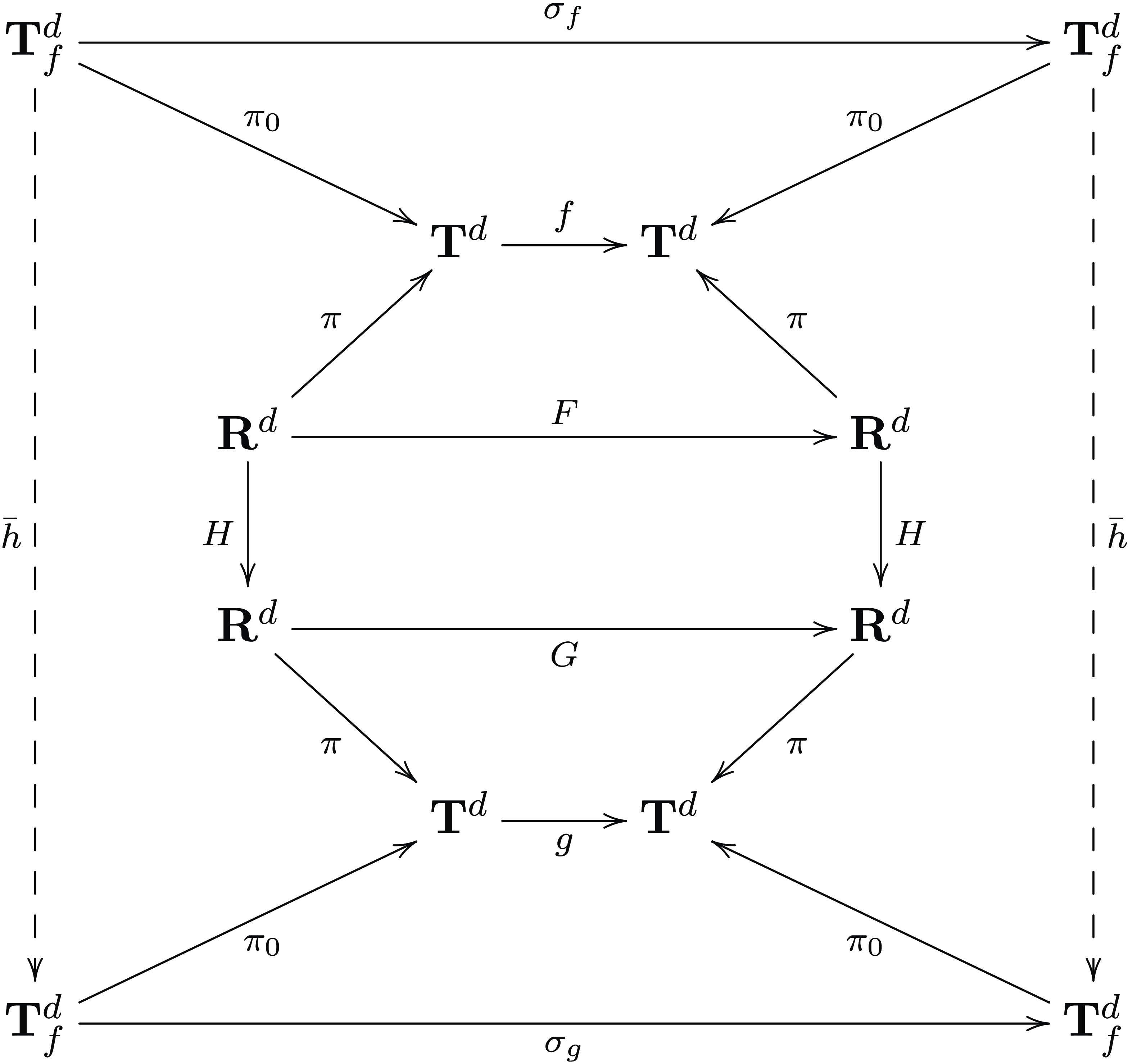
As a result, we have the following commutative diagram (Figure 1) in which
 $\pi_0:(\mathbb{T}^2)^{\mathbb{Z}}\to \mathbb{T}^2$
is the projection
 $\pi_0((x_i))=x_0$
and
 $\bar{\pi}$
projects orbits on
 $\mathbb{R}^2$
to orbits on
 $\mathbb{T}^2$
. Note that the leaf conjugacy may not be commutative with f and g.
The relationships between the four types of conjugacy.

Now we explain Theorem 1.4 in the sense of mapping spaces, with the help of Figure 1. Recall that if
 $f\in\mathbf{A}^1(\mathbb{T}^d)\ (d\geq 2)$
, then its linearization
 $A=f_*:\pi_1(\mathbb{T}^d) \to \pi_1(\mathbb{T}^d)$
also induces a non-invertible Anosov map on
 $\mathbb{T}^d$
[Reference Aoki and HiraideAH94, Theorem 8.1.1].
Let
 $A\in GL_2(\mathbb{R})\cap M_2(\mathbb{Z})$
which induces an non-invertible Anosov map on
 $\mathbb{T}^2$
. Denote by
 $\mathbf{A}^r(A)$
 $(r>1)$
the set of
 $C^r$
-smooth Anosov maps homotopic to A. Define
 \begin{align} \tilde{\mathbf{A}}^r(A)= \{ (f,H)&~|~f\in\mathbf{A}^r(A),~H:\mathbb{R}^2\to\mathbb{R}^2~ \text{is a homeomorphism such that} \notag\\ &\|H-\mathrm{Id}_{\mathbb{R}^2}\|_{C^0}<\infty,~A\circ H=H\circ F ~\text{where}~F:\mathbb{R}^2\to\mathbb{R}^2~\text{is a lift of}~f\}.\end{align}
We say that two tuples
 $(f_1,H_1), (f_2,H_2)\in \tilde{\mathbf{A}}^r(A)$
are topologically equivalent on torus, which we denote by
 $(f_1,H_1)\sim_H (f_2,H_2)$
, if
 $H_2^{-1}\circ H_1: \mathbb{R}^2\to\mathbb{R}^2$
is commutative with deck transformations:
 $$H_2^{-1}\circ H_1(x+n)=H_2^{-1}\circ H_1(x)+n,\quad \forall x\in\mathbb{R}^2, \forall n\in\mathbb{Z}^2.$$
This implies
 $H_2^{-1}\circ H_1$
can descend to
 $\mathbb{T}^2$
, i.e., there exists
 $h\in\textrm{Home}_0(\mathbb{T}^2)$
such that
 $$\pi\circ (H_2^{-1}\circ H_1)=h\circ\pi\quad \text{and} \quad \circ f_1=f_2\circ h.$$
Note that h is a priori only Hölder continuous.
We say that
 $(f_1,H_1), (f_2,H_2)\in \tilde{\mathbf{A}}^r(A)$
are smoothly equivalent along the stable foliation on torus, which we denote by
 $(f_1,H_1)\sim_s (f_2,H_2)$
, if we further assume the conjugacy
 $h\in\textrm{Home}_0(\mathbb{T}^2)$
is
 $C^r$
-smooth along the stable foliation of
 $f_1$
.
We denote by
 $$\mathbf{T}^r_H(A)=\tilde{\mathbf{A}}^r(A)/_{\sim_H}\quad \text{and} \quad\mathbf{T}^r_s(A)=\tilde{\mathbf{A}}^r(A)/_{\sim_s}$$
the spaces of two equivalence classes of such tuples, which are Teichmüller spaces of Anosov maps by Hölder conjugacies, and, by Hölder conjugacies, which are
 $C^r$
-smooth along stable foliations, respectively.
Denote by
 $\mathbf{F}^\textrm{H}(\mathbb{T}^2_A)$
the set of Hölder functions on
 $\mathbb{T}^2_A$
. Define an equivalence relation
 $\text{`}\sim_{\sigma_A}\text{'}$
in
 $ \mathbf{F}^\textrm{H}(\mathbb{T}^2_A)$
as
 $$\tilde{\phi}_1 \sim_{\sigma_A}\tilde{ \phi}_2 \iff \exists\; \mathrm{H\ddot{o}lder} \;\tilde{u}:\mathbb{T}^2_A\to \mathbb{R} \textrm{ such that } \tilde{\phi}_1-\tilde{\phi}_2=\tilde{u}\circ \sigma_A-\tilde{u}.$$
This means
 $\tilde{\phi}_1$
and
 $\tilde{ \phi}_2$
are cohomologous via
 $\sigma_A$
on
 $\mathbb{T}^2_A$
.
We can restate Theorem 1.4 and Corollary 1.5 as follows. As mentioned before, for any
 $(f,H)\in \tilde{\mathbf{A}}^r(A)$
, H can induce a conjugacy
 $\bar{h}:\mathbb{T}^2_f\to \mathbb{T}^2_A$
between
 $\sigma_f$
and
 $\sigma_A$
(also see Proposition 2.17).
Theorem 1.1’.
Let
 $A\in GL_2(\mathbb{R})\cap M_2(\mathbb{Z})$
which induces a non-invertible Anosov map on
 $\mathbb{T}^2$
, and
 $(f_i,H_i)\in \tilde{\mathbf{A}}^{r}(A)\ (r>1)$
for
 $i=1,2$
. Then
 $$ (f_1,H_1)\sim_H (f_2,H_2) \iff \log\|Df_1|_{E^s_{f_1}}\|\circ \bar{h}_1^{-1} \sim_{\sigma_A} \log\|Df_2|_{E^s_{f_2}}\|\circ \bar{h}_2^{-1} \iff (f_1,H_1)\sim_s (f_2,H_2), $$
where
 $\bar{h}_i$
is the conjugacy induced by
 $H_i$
on
 $\mathbb{T}^2_A$
. In particular, there is a natural injection
 \begin{align} \mathbf{T}^r_H(A)= \mathbf{T}^r_s(A)\hookrightarrow \mathbf{F}^\textrm{H}(\mathbb{T}^2_A)/_{\sim_{\sigma_A}}, \quad (f,H)\mapsto\log\|Df|_{E^s_f}\|\circ \bar{h}^{-1}. \end{align}
Here
 $\bar{h}:\mathbb{T}^2_f\to \mathbb{T}^2_A$
is the conjugacy induced by H.


1.2 Smooth classification of Anosov maps
Based on the topological classification stated in Theorem 1.4, we give a smooth classification of non-invertible Anosov maps on torus with non-trivial stable bundles via the Jacobians of return maps at periodic points. For
 $r>1$
, let
 $$r_*=\Big\{\! \begin{array}{ll} r-{\varepsilon}, & \ r\in\mathbb{N}, \\ r, & \ r\notin \mathbb{N}, \ \textrm{or}\ r=+\infty,\end{array}$$
where
 ${\varepsilon}>0$
can be arbitrarily small.
Theorem 1.11.
Assume
 $f,g \in\mathbf{N}^r_1(\mathbb{T}^2)\ (r>1)$
and f is topologically conjugate to g by
 $h\in\textrm {Home}_0(\mathbb{T}^2)$
. If
 $$ \textrm{Jac}(f^n)(p)=\textrm{Jac}(g^n)(h(p)), \quad \forall n\in\mathbb{N},\ \forall p=f^n(p), $$
then h is a
 $C^{r_*}$
-smooth diffeomorphism.
Remark 1.12. From Corollary 1.5, we already have that the topological conjugacy is smooth along the stable foliation. It follows from the Journé Lemma (see Lemma 6.2) that we just need to prove the regularity of conjugacy restricted on the unstable direction by the method originally given in [Reference de la LlavedlL92, Reference Gogolev and GuysinskyGG08]; see also [Reference Radu and YangRY19].
Remark 1.13. Gogolev and Rodriguez Hertz discovered that, surprisingly, for two conjugate irreducible
 $C^{r}$
-smooth
 $(r\geq 2)$
expanding maps f and g on d-torus
 $(d\geq 2)$
, if they have the same periodic Jacobian data and the Jacobian determinant of f is not cohomologous to a constant, then f is
 $C^{r-1}$
-smoothly conjugate to g (see [Reference Gogolev and Rodriguez HertzGRH23b, Corollary 2.6]). We would like to point out a little difference in Theorem 1.11, where the Jacobian determinant of the map would be allowed to be cohomologous to a constant.
Remark 1.14. We mention that [Reference MicenaMic23] gives a smooth classification of topologically conjugate Anosov maps which have unstable subbundles on
 $\mathbb{T}^2$
, via both stable and unstable Lyapunov exponents at periodic points. Our work also deals with the case with no unstable subbundles, which presents us with an obstacle.
We also give a view of Theorem 1.11 in the sense of mapping spaces. For any
 $f\!\in\!\mathbf{A}_1^r(\mathbb{T}^2) (r>1)$
, let
 $$\tilde{\mathbf{A}}^r_{\mathbb{T}^2}(f)=\{(g,h)~|~ g\in\mathbf{A}_1^r(\mathbb{T}^2),h\in\textrm{Home}_0(\mathbb{T}^2), \text{such that}~h\circ f= g\circ h \}.$$
We say that two tuples
 $(g_1,h_1), (g_2,h_2)\in \tilde{\mathbf{A}}^r_{\mathbb{T}^2}(f)$
are
 $C^{r_*}$
-equivalent, denoted by
 $(g_1,h_1)\sim_{r_*}(g_2,h_2)$
, if the homeomorphism
 $h_1\circ h_2^{-1}\in\textrm{Home}_0(\mathbb{T}^2)$
is
 $C^{r_*}$
-smooth.
The Teichmüller space
 $\mathbf{T}^{r_*}_{\mathbb{T}^2}(f)$
is the space of
 $\sim_{r_*}$
-equivalence classes of such tuples
 \begin{align} \mathbf{T}^{r_*}_{\mathbb{T}^2}(f)= \tilde{\mathbf{A}}^r_{\mathbb{T}^2}(f)/_{\sim_{r_*}}. \end{align}
Denote by
 $\mathbf{F}^\textrm{H}(\mathbb{T}^2)$
the set of Hölder functions on
 $\mathbb{T}^2$
. Define the equivalence relation
 $\sim_f$
in
 $\mathbf{F}^{\rm H}(\mathbb{T}^2)$
as
 \begin{align} \phi_1 \sim_f \phi_2 \iff \exists\; \mathrm{H\ddot{o}lder} \;u:\mathbb{T}^2\to \mathbb{R} \textrm{ such that } \phi_1-\phi_2=u\circ f- u. \end{align}
Since the Livschitz Theorem holds for Anosov maps on torus (see § 2.3), Theorem 1.11 immediately implies the following theorem.
Theorem 1.3’.
Let
 $f\in\mathbf{N}_1^r(\mathbb{T}^2)\ (r>1)$
and
 $(g_i,h_i)\in \tilde{\mathbf{A}}^r_{\mathbb{T}^2}(f)$
for
 $i=1,2$
. Then
 $$ (g_1,h_1)\sim_{r_*}(g_2,h_2)\iff \log(\textrm{Jac}(g_1)\circ h_1) \sim_f \log({\rm Jac}(g_2)\circ h_2). $$
In particular, there is a natural injection
 $$ \mathbf{T}^{r_*}_{\mathbb{T}^2}(f)~\hookrightarrow~ \mathbf{F}^\textrm{H}(\mathbb{T}^2)/_{\sim_f}, \quad (g,h)~\mapsto~\log(\textrm{Jac}(g)\circ h). $$
Finally, we can give a global picture of Anosov maps on
 $\mathbb{T}^2$
up to smooth conjugacy in a fixed homotopy class. Let
 $A\in GL_2(\mathbb{R})\cap M_2(\mathbb{Z})$
which induces a linear Anosov map in
 $\mathbf{N}_1^r(\mathbb{T}^2)$
. For instance, we can take
 $$A=\begin{bmatrix} k&1\\ 1&1\end{bmatrix}, \quad \forall k\in\mathbb{N}_{\geq 3}.$$
Let
 $\tilde{\mathbf{A}}^r(A)$
be the set of tuples (f,H), where
 $f\in\mathbf{A}^r(A)$
is an Anosov map homotopic to A and H is the conjugacy in
 $\mathbb{R}^2$
(see (1.4)). We say that two tuples
 $(f_1,H_1), (f_2,H_2)\in \tilde{\mathbf{A}}^r(A)$
are
 $C^{r_*}$
-smoothly equivalent on torus, which we denote by
 $(f_1,H_1)\sim_{r_*} (f_2,H_2)$
if
 $H_2^{-1}\circ H_1$
is
 $\mathbb{Z}^2$
-periodic and
 $C^{r_*}$
-smooth. This implies that there exists a
 $C^{r_*}$
-diffeomorphism
 $h:\mathbb{T}^2\to\mathbb{T}^2$
such that
 $$\pi\circ (H_2^{-1}\circ H_1)=h\circ\pi\quad \text{and} \quad \circ f_1=f_2\circ h. $$
The Teichmüller space of Anosov maps homotopic to A is the quotient space
 $$\mathbf{T}^{r_*}(A)=\tilde{\mathbf{A}}^r(A)/_{\sim_{r_*}}.$$
Combining Theorems 1.1’ and 1.3’, we have the following corollary.
Corollary 1.15.
Let
 $A\in GL_2(\mathbb{R})\cap M_2(\mathbb{Z})$
which induces a linear Anosov map in
 $\mathbf{N}_1^r(\mathbb{T}^2)$
. Then
 $$ \mathbf{T}^{r_*}(A)~=~ \mathbf{T}^r_H(A)\ltimes_f\mathbf{T}^{r_*}_{\mathbb{T}^2}(f)~:=~ \bigcup_{\langle(f,H)\rangle\in\mathbf{T}^r_H(A)}\mathbf{T}^{r_*}_{\mathbb{T}^2}(f). $$
Here
 $\langle(f,H)\rangle$
is the equivalence class of (f,H) in
 $\mathbf{T}^r_H(A)$
by Hölder conjugacy. In particular, there exists a natural injection
 $$ \mathbf{T}^{r_*}(A)~\hookrightarrow~ \mathbf{F}^\textrm{H}(\mathbb{T}^2_A)/_{\sim_{\sigma_A}} \ltimes_f\mathbf{F}^\textrm{H}(\mathbb{T}^2)/_{\sim_f}. $$
Remark 1.16. The Teichmüller space of an Anosov diffeomorphism on
 $\mathbb{T}^2$
already has a complete characterization in [Reference CawleyCaw93, Reference de la LlavedlL87, Reference Marco and MoriyónMM87a, Reference Marco and MoriyónMM87b, Reference de la LlavedlL92]. Let
 $f:\mathbb{T}^2\to \mathbb{T}^2$
be a
 $C^r$
-smooth Anosov diffeomorphism. Denote the Teichmüller space of f consisting of
 $C^r$
-equivalence classes by
 $\mathbf{T}_{\mathbb{T}^2}^{r}(f)$
in the same way as in (1.6). Define the equivalence relation
 $\sim_f$
in
 $\mathbf{F}^\textrm{H}(\mathbb{T}^2)$
in the same way as in (1.7). Define the SRB map on
 $\mathbf{T}_{\mathbb{T}^2}^{r}(f)$
as
 \begin{align*} \textrm{SRB}:\ \ \mathbf{T}_{\mathbb{T}^2}^{r}(f) &\longrightarrow \mathbf{F}^\textrm{H}(\mathbb{T}^2)/_{\sim_f}\times \mathbf{F}^\textrm{H}(\mathbb{T}^2)/_{\sim_f},\quad \\ \langle(g,h)\rangle&\longmapsto (\langle-\log( \textrm{Jac} (g|_{E^u_g}))\circ h\rangle ,\ \langle\log( \textrm{Jac} (g|_{E^s_g}))\circ h\rangle), \end{align*}
where
 $\langle(g,h)\rangle$
and
 $\langle\phi\rangle$
are equivalence classes in
 $\mathbf{T}_{\mathbb{T}^2}^{r}(f)$
and
 $\mathbf{F}^\textrm{H}(\mathbb{T}^2)/_{\sim_f}$
respectively. This map is well defined by the Livschitz Theorem. It has been proved in [Reference de la LlavedlL87, Reference Marco and MoriyónMM87a, Reference Marco and MoriyónMM87b, Reference de la LlavedlL92] that the SRB map is an injection. In the case of
 $r=1+\textrm{H}$
, that is
 $r=1+\alpha$
for some
 $0<\alpha<1$
, [Reference CawleyCaw93] showed that the SRB map is simultaneously a surjection if one considers the equivalence relation
 $\sim_f$
in
 $\mathbf{F}^\textrm{H}(\mathbb{T}^2)$
as ‘almost coboundary’, which allows a constant error on the coboundary (1.7); for more details, see [Reference CawleyCaw93]. A natural question is that, in the sense of ‘almost coboundary’, is the injection in Theorem 1.3’ also a surjection?
1.3 Organization of this paper
In § 2, we recall some general properties of Anosov maps, give some useful properties of the assumptions of Theorem 1.4 and sketch our proof of Theorem 1.4. In § 3, we prove the ‘sufficient’ part of Theorem 1.4, which states that the same stable periodic data implies the existence of conjugacy. In § 4, we give a dichotomy for the toral Anosov maps in the sense of accessibility, and this is helpful for the ‘necessary’ part of Theorem 1.4. In § 5, we prove the ‘necessary’ part of Theorem 1.4 and also show Corollary 1.5. In § 6, we prove Theorem 1.11.
2. Topological and leaf conjugacies of Anosov maps
2.1 Anosov maps
There are two classical ways to study an Anosov map. One is by using the inverse limit space and the other is by observations on the universal cover space. In this subsection, we recall these two methods and some useful propositions for this paper.
We first introduce the dynamics on the inverse limit space. Let (M,d) be a compact metric space and
 $M^{\mathbb{Z}}:=\{(x_i) \;|\;x_i\in M, \forall i\in \mathbb{Z} \}$
be the product topological space. It is clear that
 $M^{\mathbb{Z}}$
is compact and metrizable by the metric
 \begin{align*} \bar{d}((x_i),(y_i))= \sum_{-\infty}^{+\infty} \frac{d(x_i,y_i)}{2^{|i|}}.\end{align*}
For any
 $\bar{x}=(x_i)\in M^{\mathbb{Z}}$
, let
 $(\bar{x})_0:=x_0$
and
 $\pi_0:M^{\mathbb{Z}}\to M$
be the projection
 $\pi_0((x_i))=x_0$
. Let
 $\sigma: M^{\mathbb{Z}}\to M^{\mathbb{Z}}$
be the (left) shift homeomorphism
 $(\sigma (x_i))_j=x_{j+1}$
, for all
 $j\in \mathbb{Z}$
. For a continuous map
 $f:M\to M$
, define the inverse limit space of f as
 \begin{align} M_f:=\{(x_i) \;|\; x_i\in M \ \textrm{and} \ f(x_i)=x_{i+1}, \forall i\in \mathbb{Z} \}.\end{align}
Denote the restriction of
 $\sigma$
on
 $M_f$
by
 $\sigma_f$
. It is clear that the inverse limit space
 $(M_f,\bar{d})$
is a
 $\sigma_f$
-invariant and compact metric space.
Definition 2.1 [Reference PrzytyckiPrz76]. A
 $C^1$
local diffeomorphism
 $f:M\to M$
is called an Anosov map if there exist constants
 $C>0$
and
 $0<\mu<1$
such that, for every
 $\tilde{x}=(x_i) \in M_f$
, there exists a splitting
 \begin{align*} T_{x_i}M=E_f^s(x_i,\tilde{x})\oplus E_f^u(x_i,\tilde{x}),\quad \forall i\in \mathbb{Z}, \end{align*}
which is Df-invariant so
 \begin{align*} D_{x_i}f(E_f^{s}(x_i,\tilde{x})) =E_f^s(x_{i+1},\tilde{x}) \quad\textrm{and}\quad D_{x_i}f(E_f^{u}(x_i,\tilde{x})) =E_f^u(x_{i+1},\tilde{x}), \quad\forall i\in\mathbb{Z}, \end{align*}
and, for all
 $n>0$
, one has that
 \begin{align*} &\|D_{x_i}f^n (v)\|\le C\mu^n\|v\|, \qquad\quad \forall v\in E_f^s(x_i,\tilde{x}), \;\;\forall i\in\mathbb{Z},\\ &\|D_{x_i}f^n (v)\|\ge C^{-1}\mu^{-n}\|v\|, \;\;\quad \forall v\in E_f^u(x_i,\tilde{x}),\;\;\forall i\in\mathbb{Z}. \end{align*}
Note that Definition 2.1 is equivalent to Definition 1.1 [Reference SakaiSak87]. In particular, by Definition 2.1 with the concept of cone-fields (see [Reference An, Gan, Gu and ShiAGGS23, Proposition 2.12]), the stable bundle
 $E^s_f$
is independent of the choice of orbit for every point. Meanwhile, the unstable direction relies on the negative orbits. We say
 $f\in\mathbf{A}^1(M)$
is special if the unstable directions on each point are independent of the negative orbits, i.e., there exists a Df-invariant continuous splitting
 $TM=E^s_f\oplus E^u_f$
such that Df is uniformly contracting in
 $E_f^s$
and uniformly expanding in
 $E^u_f$
. Note that Anosov diffeomorphisms and expanding maps are always special.
Since every Anosov map on
 $\mathbb{T}^d$
is transitive ([Reference Aoki and HiraideAH94], and see also [Reference An, Gan, Gu and ShiAGGS23, § 4]), it follows from [Reference PrzytyckiPrz76, Reference Micena and TahzibiMT16] that non-special Anosov maps are
 $C^1$
-dense non-invertible Anosov maps with non-trivial stable bundles and that each of them admits a residual set in which each point has infinitely many unstable directions. In particular, let
 $f\in\mathbf{A}^1(\mathbb{T}^d)$
be non-special, then f is not conjugate to its linearization
 $f_*:\pi_1(\mathbb{T}^d) \to \pi_1(\mathbb{T}^d)$
. In fact, one has the following proposition.
Proposition 2.2 [Reference Moosavi and TajbakhshMT19a]. Let
 $f\in\mathbf{A}^1(\mathbb{T}^d)$
. Then f is conjugate to its linearization
 $f_*:\pi_1(\mathbb{T}^d) \to \pi_1(\mathbb{T}^d)$
if and only if f is special.
Despite all this, there exists a conjugacy on the level of inverse limit spaces for toral Anosov maps. For convenience, we state it here.
Proposition 2.3 [Reference Aoki and HiraideAH94]. Let
 $f\in\mathbf{A}^1(\mathbb{T}^d)$
and
 $A=f_*$
. Then there exists a homeomorphism
 $\tilde{h}:\mathbb{T}^d_f \to \mathbb{T}^d_A$
such that
 $\tilde{h} \circ \sigma_f = \sigma_A \circ \tilde{h}$
.
For
 $f\in \mathbf{N}^1(\mathbb{T}^d)$
and
 $x\in\mathbb{T}^d$
, define the preimage set P(x,f) of x by
 \begin{align} P(x,f)=\bigcup_{k\geq 0} P_k(x,f) \quad \textrm{where } P_k(x,f)=\{y\in\mathbb{T}^d\;|\; f^k(y)=f^k(x)\}.\end{align}
We also have the stable foliation, just as in the case of an Anosov diffeomorphism, and each leaf of this is also independent of the choice of orbits. Note that in this sense we cannot define the stable leaf of a point x by collecting points whose positive orbits are closed to one of x, since we need to exclude its k-preimage set
 $P_k(x,f)$
for any
 $k\in\mathbb{N}$
. We must therefore redefine the stable leaf in the strong sense (see [Reference Aoki and HiraideAH94, § 5.1]) by linking the local stable leaves with small size
 $R>0$
,
 $$\mathcal{F}_{f,R}^s(x)=\{ y\in\ M \;|\; d(f^i(x),f^i(y))<R, \; \forall i\geq 0 \}.$$
We also have the (local) unstable leaf, but this relies on the choice of negative orbits. Let
 $\tilde{x}=(x_i)\in M_f$
and
 $R>0$
. We define the local unstable leaf of
 $x_0$
for
 $\tilde{x}$
with size R by
 $$\mathcal{F}_{f,R}^u(x_0,\tilde{x})=\{ y\in M\;|\; \exists(y_i)\in M_f \ \textrm{with}\ y_0=y \;\;\textrm{such that}\;\; d(x_{-i},y_{-i})<R, \; \forall i\leq0 \}.$$
It is clear that the stable leaf
 $\mathcal{F}_f^s(x)$
and the local unstable leaf
 $\mathcal{F}_{f,R}^u(x_0,\tilde{x})$
are both submanifolds and are tangent to
 $E^s_f(x_0)$
and
 $E^u_f(x_0,\tilde{x})$
, respectively (see [Reference PrzytyckiPrz76, Reference Qian, Xie and ZhuQXZ09]). Moreover, as in the case of Anosov diffeomorphisms, the local stable leaves of an Anosov map form a family of embeddings varying continuously with
 $x\in M$
in
 $C^1$
-topology. In particular, one has a similar property for local unstable leaves as follows.
Proposition 2.4 [Reference PrzytyckiPrz76]. Let
 $\tilde{x}^k=(x_i^k)_{i\in\mathbb{Z}}\in M_f (k\in\mathbb{N})$
be a sequence of orbits. If
 $\tilde{x}^k\to \tilde{y}=(y_i)\in M_f$
as
 $k\to+\infty$
, then for any
 $R>0$
,
 $$\mathcal{F}_{f,R}^u(x_0^k,\tilde{x}^k)\longrightarrow \mathcal{F}_{f,R}^u(y_0,\tilde{y}),$$
in
 $C^1$
-topology as
 $k\to+\infty$
. In particular,
 $E^u_f(y_0,\tilde{y})$
is continuous with respect to
 $(y_0,\tilde{y})\in M\times M_f$
.
We also have the Local Product Structure for Anosov maps (see [Reference Aoki and HiraideAH94, § 5.2] and [Reference Qian, Xie and ZhuQXZ09, IV.2]) as in the following proposition.
Proposition 2.5 [Reference Qian, Xie and ZhuQXZ09]. There exist
 $\delta>0$
and
 $0<{\varepsilon}<\delta$
such that for any
 $x_0\in M$
and any
 $\tilde{y}=(y_i)\in M_f$
, if
 $d(x_0,y_0)<{\varepsilon}$
, then
 $\mathcal{F}_{f}^u(y_0,\tilde{y},\delta)$
transversely intersects with
 $\mathcal{F}_{f}^s(x_0,\delta)$
at a unique point
 $z(x_0,\tilde{y})$
. In particular,
 $z(x_0,\tilde{y})$
is continuous with respect to
 $(x_0,\tilde{y})\in M \times M_f$
. Moreover, there exists a unique orbit
 $\tilde{z}=(z_i)\in M_f$
such that
 $z_0=z(x_0,\tilde{y})$
and
 $d(z_{-i},y_{-i})<\delta$
for all
 $i\geq 0$
.
Although the inverse limit space has compactness, which the universal cover lacks, observing the dynamics on the universal cover has some added convenience. In fact, for a local diffeomorphism f on a closed Riemannian manifold M, Ma
 $\rm \widetilde{n} \acute{e}$
and Pugh [Reference Mañé and PughMP75] proved that it is an Anosov map if and only if its lift
 $F:\widetilde{M}\to \widetilde{M}$
on the universal cover is an Anosov diffeomorphism, i.e., there exist constants
 $C>0$
,
 $0<\mu<1$
and a DF-invariant splitting
 $T\widetilde{M}=E^s_F\oplus E^u_F$
such that for all
 $n>0$
and all
 $x\in\widetilde{M}$
, one has
 \begin{align*} &\|D_{x}F^n (v)\|\le C\mu^n\|v\|, \quad \quad\quad \forall v\in E_F^s(x),\\ &\|D_{x}F^n (v)\|\ge C^{-1}\mu^{-n}\|v\|, \;\;\quad \forall v\in E_F^u(x).\end{align*}
Moreover, when we restrict to
 $\mathbb{T}^d$
, the lifts on
 $\mathbb{R}^d$
of an Anosov map and its linearization are conjugate [Reference Aoki and HiraideAH94, Proposition 8.2.1 and Proposition 8.4.2]. For convenience, we restate these as the following proposition.
In the remainder of this subsection, we always assume that
 $f\in\mathbf{A}^1(\mathbb{T}^d)$
and
 $A:=f_*:\pi_1(\mathbb{T}^d)\to\pi_1(\mathbb{T}^d)$
is its linearization. Let
 $F:\mathbb{R}^d \to \mathbb{R}^d$
be a lift of f by the natural projection
 $\pi:\mathbb{R}^d\to \mathbb{T}^d$
. For short, we denote by
 $A:\mathbb{R}^d\to \mathbb{R}^d$
a lift of A by
 $\pi$
, if there is no confusion. Recall that if
 $f\in\mathbf{A}^1(\mathbb{T}^d)$
, then its linearization A is in
 $ \mathbf{A}^1(\mathbb{T}^d)$
[Reference Aoki and HiraideAH94, Theorem 8.1.1].
Proposition 2.6 [Reference Aoki and HiraideAH94]. There is a unique bijection
 $H:\mathbb{R}^d\to \mathbb{R}^d$
such that:
-
(i)
$H\circ F=A\circ H$
; -
(ii) H and
$H^{-1}$
are both uniformly continuous; and
-
(iii) there exists
$C>0$
such that
$\|H-\mathrm{Id}_{\mathbb{R}^d}\|_{C^0}<C$
and
$\|H^{-1}-\mathrm{Id}_{\mathbb{R}^d}\|_{C^0}<C$
.


For any
 $n\in\mathbb{Z}^d$
, let
 $T_n:\mathbb{R}^d\to \mathbb{R}^d$
be the deck transformations (or
 $\mathbb{Z}^d$
-action)
 $T_n(x)=x+n$
. By Proposition 2.2, one has that f is special if and only if H is commutative with deck transformations, namely,
 $$H(x+n)=H(x)+n,\quad \forall x\in\mathbb{R}^d \quad\textrm{and}\quad \forall n\in\mathbb{Z}^d.$$
Recall that the stable manifolds of the lift F, denoted by
 $\widetilde{\mathcal{F}}_f^s(x)$
, have the following topological characterization
 $$ \widetilde{\mathcal{F}}_f^s(x):=\{y\in \mathbb{R}^d \; |\; d(F^k(y),F^k(x))\to 0 \;\;\textrm{as}\;\; k\to +\infty \},$$
for all
 $x\in \mathbb{R}^d$
, and the unstable manifolds
 $\widetilde{\mathcal{F}}_f^u(x)$
by iterating backwards. Note that the two foliations
 $\widetilde{\mathcal{F}}_f^s$
and
 $\widetilde{\mathcal{F}}_f^u$
admit the Global Product Structure, namely that any two leaves
 $\widetilde{\mathcal{F}}_f^s(x)$
and
 $\widetilde{\mathcal{F}}_f^u(y)$
transversely intersect at a unique point in
 $\mathbb{R}^d$
.
For short, we denote the stable/unstable bundles and foliations of the linearization A on
 $\mathbb{T}^d$
by
 $L^{s/u}$
,
 $\mathcal{L}^{s/u}$
and on
 $\mathbb{R}^d$
by
 $\tilde{L}^{s/u}$
,
 $\widetilde{\mathcal{L}}^{s/u}$
, respectively. In the following, the local (un)stable manifolds with size
 $\delta$
of F, denoted by
 $\widetilde{\mathcal{F}}_f^{s/u}(x,\delta)$
, means
 $$\widetilde{\mathcal{F}}_f^{s/u}(x,\delta):=\{y\in \widetilde{\mathcal{F}}_f^{s/u}(x) \; |\; d_{\widetilde{\mathcal{F}}_f^{s/u}}(x,y)\leq \delta \}, $$
for all
 $x\in \mathbb{R}^d$
, where
 $d_{\widetilde{\mathcal{F}}_f^{s/u}}(\cdot,\cdot)$
is induced by restriction of the metric on
 $\mathbb{R}^d$
along the leaves of
 $\widetilde{\mathcal{F}}_f^{s/u}$
. We also denote by
 $\mathcal{F}_f^s(x_0,\delta)$
and
 $\mathcal{F}_f^u(x_0,\tilde{x},\delta)$
the local stable and unstable leaves of f for
 $(x_i)=\tilde{x}\in \mathbb{T}^d_f$
with size
 $\delta$
measured by metrics along leaves.
It is clear that H maps the stable/unstable leaf of F to one of A, from the topological character of a stable/unstable leaf, namely,
 \begin{align} H(\widetilde{\mathcal{F}}_f^{s/u}(x))=\widetilde{\mathcal{L}}^{s/u}(H(x)),\quad \forall x\in\mathbb{R}^d.\end{align}
We denote the map in the stable leaf space of F by
 $F_s:\mathbb{R}^d/ \widetilde{\mathcal{F}}_f^{s} \to \mathbb{R}^d/ \widetilde{\mathcal{F}}_f^{s}$
with
 $F_s( \widetilde{\mathcal{F}}_f^s(x))=\widetilde{\mathcal{F}}_f^s(F(x))$
. It follows from (2.3) that H induces a conjugacy between the stable leaf spaces,
 \begin{align} H_{s}:\mathbb{R}^d/ \widetilde{\mathcal{F}}_f^{s} \to \mathbb{R}^d/ \widetilde{\mathcal{L}}^{s},\end{align}
with
 $H_s(\widetilde{\mathcal{F}}_f^s(x) )=\widetilde{\mathcal{L}}^s(H(x))$
such that
 $H_s\circ F_s= A_s\circ H_s$
.
Although in general H cannot be commutative with deck transformations, the next proposition says that
 $H_s$
is always commutative with deck transformations.
Proposition 2.7 [Reference An, Gan, Gu and ShiAGGS23]. Assume that H is given by Proposition 2.6. Then for any
 $x\in\mathbb{R}^d$
and
 $n\in\mathbb{Z}^d$
,
 $$H(x+n)-n\in \widetilde{\mathcal{L}}^s(H(x)) \quad \textrm{and } \quad H^{-1}(x+n)-n\in \widetilde{\mathcal{F}}_f^s(H^{-1}(x)).$$
By Proposition 2.7, one can get the following proposition, which means that H is ‘asymptotically’ commutative with the deck transformation
 $T_n$
, for
 $n\in A^m\mathbb{Z}^d$
with
 $m\to+\infty$
.
Proposition 2.8 [Reference An, Gan, Gu and ShiAGGS23]. Assume that H is given by Proposition 2.6. There exist
 $C>0$
and
 $\{\varepsilon_m\}$
with
 $\varepsilon_m\to 0$
as
 $m\to +\infty$
, such that for every
 $x\in\mathbb{R}^d$
and every
 $n_m\in A^m\mathbb{Z}^d$
, one has
 $$|H(x+n_m)-H(x)-n_m|<C\cdot \| A|_{\widetilde{\mathcal{L}}^s}\|^m$$
and
 $$|H^{-1}(x+n_m)-H^{-1}(x)-n_m|<\varepsilon_m.$$
Remark 2.9. Obviously, if we let
 $n_m=|\textrm{det}(A)|^m n$
for any
 $n\in\mathbb{Z}^d$
and
 $m\in\mathbb{N}$
, we have
 $A^{-i}n_m\in\mathbb{Z}^d$
for all
 $1\leq i\leq m$
. This observation will be used in § 3.
To end this subsection, we state two properties of stable and unstable foliations of Anosov maps, whose proofs are quite similar to the case of Anosov diffeomorphisms.
Proposition 2.10.
The stable and unstable foliations
 $\widetilde{\mathcal{F}}_f^s$
and
 $\widetilde{\mathcal{F}}_f^u$
are both absolutely continuous. Moreover, if
 $\widetilde{\mathcal{F}}_f^{s/u}$
is codimension-one, then it is
 $C^1$
-smooth.
The proof of this proposition uses a local analysis just like in [Reference PesinPes04, Theorem 7.1]. We mention that one may use the compactness of the dynamics of F induced by that of
 $\sigma_{\textit{f}}$
after projection.
Proposition 2.11.
If
 $\widetilde{\mathcal{F}}_f^{s/u}$
is a one-dimensional foliation, then it is quasi-isometric, i.e., there exist constants
 $a,b>0$
such that
 $d_{\widetilde{\mathcal{F}}_f^{s/u}}(x,y)<a\cdot d(x,y)+b$
for any
 $x\in\mathbb{R}^d$
and
 $y\in \widetilde{\mathcal{F}}_f^{s/u}(x)$
, so there exists
 $C>1$
such that
 $d_{\widetilde{\mathcal{F}}_f^{s/u}}(x,y)<C \cdot d(x,y)$
for any
 $x\in\mathbb{R}^d$
and
 $y\in \widetilde{\mathcal{F}}_f^{s/u}(x)$
.
Proof. We refer to [Reference Brin, Burago and IvanovBBI09] for proof of the diffeomorphism case. One can find an adaptation for the case of
 $\widetilde{\mathcal{F}}_f^s$
in [Reference An, Gan, Gu and ShiAGGS23]. However, since the unstable foliation
 $\widetilde{\mathcal{F}}_f^u$
may not be commutative with deck transformations, we will show this case. We first claim that, for any
 $C_1>0$
, there exists
 $R>0$
such that, for any
 $y\in\mathbb{R}^d$
and
 $z\in\widetilde{\mathcal{F}}_f^u(y)$
,
 \begin{align} \textrm{if} \ \ d(y,z)<C_1 \quad \textrm{then}\ d_{\widetilde{\mathcal{F}}_f^u}(y,z)<R. \end{align}
Note that (2.5) is obvious for special Anosov maps, since via the deck transformations one can move the local leaf with endpoints y and z to the
 $(C_1+\sqrt{d})$
-ball at 0 in which the local leaves have a uniform size. For the coherence of the proofs of this proposition and the later Lemma 4.3, we leave the proof of this claim to Claim 4.4.
Let H be the conjugacy between F and A given by Proposition 2.6. In particular,
 $\|H-\textrm{ Id}_{\mathbb{R}^d}\|_{C_0}<C_0$
. Since H maps
 $\widetilde{\mathcal{F}}_f^{s/u}$
to
 $\widetilde{\mathcal{L}}^{s/u}$
, one has that
 $\widetilde{\mathcal{F}}_f^{s/u}(x)$
is contained in the
 $2C_0$
-neighborhood of
 $ \widetilde{\mathcal{L}}^{s/u}(x)$
, namely,
 $\widetilde{\mathcal{F}}_f^{s/u}(x)\subset B_{2C_0}( \widetilde{\mathcal{L}}^{s/u}(x))$
for any
 $x\in\mathbb{R}^d$
. Fix
 $n\in\mathbb{Z}^d$
such that
 $d(x+n, \widetilde{\mathcal{L}}^s(x))> 5C_0$
for all
 $x\in\mathbb{R}^d$
. Then one has
 \begin{align} d_H( \widetilde{\mathcal{L}}^s(x), \widetilde{\mathcal{F}}_f^s(x+n) )> C_0,\quad \forall x\in\mathbb{R}^d,\end{align}
where
 $d_H(\cdot,\cdot)$
is the Hausdorff distance.
Claim 2.12.
Let n be given as above. Then there exists
 $L_0>0$
such that for any
 $x\in\mathbb{R}^d$
,
 $\widetilde{\mathcal{F}}_f^u(x,L_0)$
intersects with
 $\widetilde{\mathcal{F}}_f^s(x+n)$
at a unique point w and
 $d_H( \widetilde{\mathcal{L}}^s(w), \widetilde{\mathcal{L}}^s(x) )> C_0$
.
Proof of Claim 2.12. The existence and uniqueness of the intersection point w follows from the Global Product Structure. By (2.6), we have
 \[d_H(\widetilde{\mathcal{L}}^s(w), \widetilde{\mathcal{L}}^s(x))= d(w, \widetilde{\mathcal{L}}^s(x))>d_H( \widetilde{\mathcal{F}}_f^s(x+n), \widetilde{\mathcal{L}}^s(x) )>C_0.\]
Moreover, there exists
 $C_2>0$
depending only on
 $n\in\mathbb{N}$
such that
 $w\in B_{C_2}(\widetilde{\mathcal{L}}^s(x))$
. It follows that
 $w\in B_{C_2}(\widetilde{\mathcal{L}}^s(x))\bigcap B_{2C_0}(\widetilde{\mathcal{L}}^u(x))$
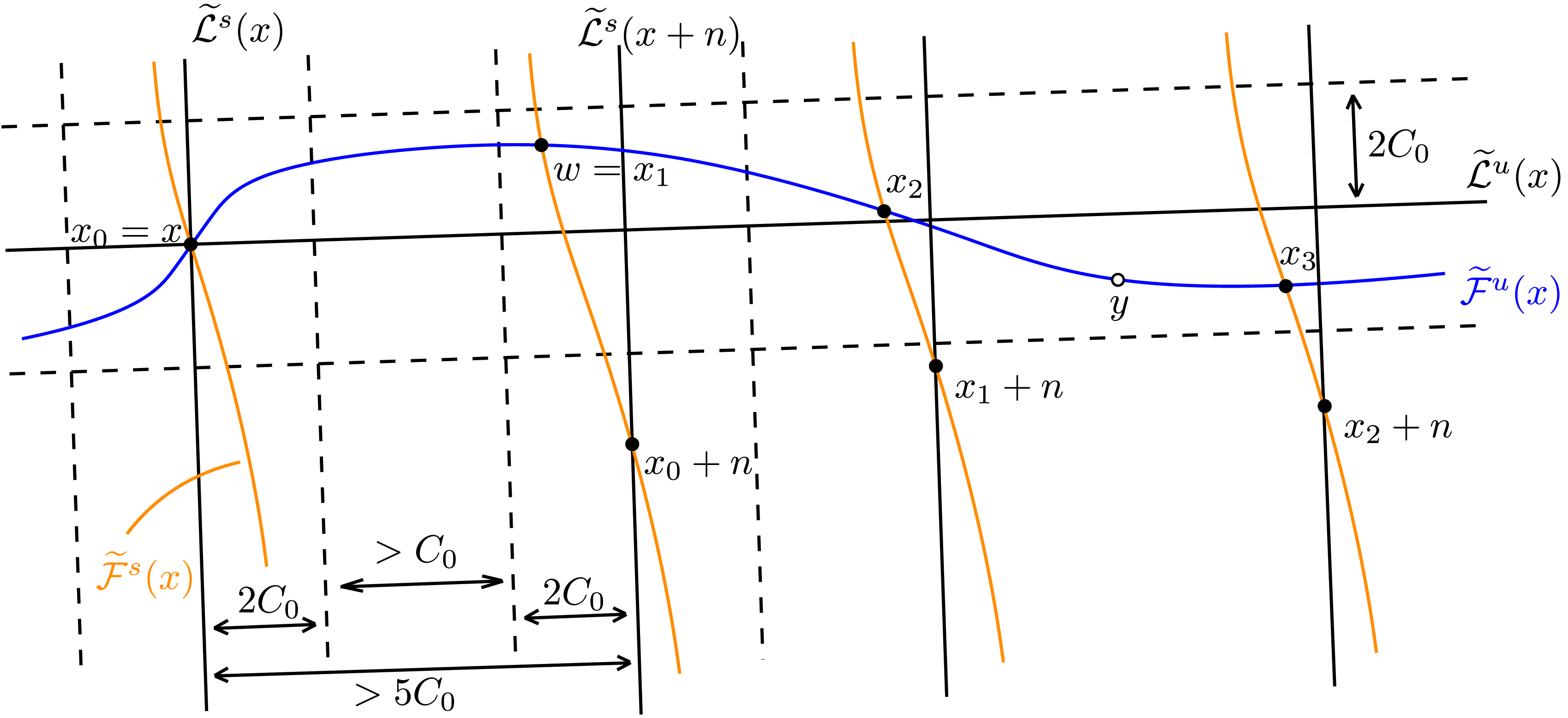
and hence d(w,x) has a uniform upper bound. See Figure 2. By (2.5) we get the existence of
 $L_0$
.
Cut unstable leaf into curves with length no more than
 $L_0$
and
 $\widetilde{\mathcal{L}}^s$
-distance bigger than
 $C_0$
.

Now for any
 $x\in\mathbb{R}^d$
and
 $y\in\widetilde{\mathcal{F}}_f^u(x)$
, we denote
 $x_0=x$
. By induction and starting from
 $x_0$
, we apply Claim 2.12 to
 $x_k\ (k\geq 0)$
and get
 $\{x_{k+1}\}=\widetilde{\mathcal{F}}_f^u(x_k) \bigcap \widetilde{\mathcal{F}}_f^s(x_k+n)$
such that
 $d_H( \widetilde{\mathcal{L}}^s(x_{k+1}), \widetilde{\mathcal{L}}^s(x_k) )> C_0$
and
 $d_{\widetilde{\mathcal{F}}_f^u}(x_{k+1},x_k)<L_0$
. See Figure 2. Since
 $\widetilde{\mathcal{F}}_f^u$
is one-dimensional, each leaf can be endowed with an order
 $\prec$
and we can assume that
 $x_k\prec x_{k+1}\ (k\geq 0)$
and
 $x=x_0\prec y$
. Then there exists
 $k\geq 0$
such that
 $x_k\prec y \prec x_{k+1}$
or
 $y=x_k$
. It follows that
 \[d_{\widetilde{\mathcal{F}}_f^u}(y,x)<d_{\widetilde{\mathcal{F}}_f^u}(x_0,x_{k+1})\leq (k+1)L_0 \]
and
 \[ d(y,x)\geq d_H( \widetilde{\mathcal{L}}^s(y), \widetilde{\mathcal{L}}^s(x) )\geq d_H( \widetilde{\mathcal{L}}^s(x_k), \widetilde{\mathcal{L}}^s(x) )>kC_0.\]
Let
 $a={L_0}/{C_0}$
and
 $b=L_0$
. We get
 \begin{align} d_{\widetilde{\mathcal{F}}_f^{u}}(x,y)<a\cdot d(x,y)+b, \quad \forall x\in\mathbb{R}^d, \forall y\in \widetilde{\mathcal{F}}_f^u(x).\end{align}
Moreover, since
 $\widetilde{\mathcal{F}}_f^u$
is tangent to
 $E^u_F$
, which is uniformly continuous (see Proposition 2.4), the distances along the unstable leaf and in the ambient space are comparable at a small scale. Namely, there exist
 $C_3>1$
and
 ${\varepsilon}_0>0$
such that for any
 $x\in\mathbb{R}^d$
and
 $y\in\widetilde{\mathcal{F}}_f^u(x)$
, if
 $d(x,y)\leq {\varepsilon}_0$
, then
 $d_{\widetilde{\mathcal{F}}_f^u}(x,y)<C_3d(x,y)$
. Let
 $C=\textrm{max}\{ C_3, a+{b}/{{\varepsilon}_0}\}$
. By (2.7), we have
 $d_{\widetilde{\mathcal{F}}_f^{u}}(x,y)<C \cdot d(x,y)$
for any
 $x\in\mathbb{R}^d$
and
 $y\in \widetilde{\mathcal{F}}_f^{u}(x)$
.
2.2 Conjugacies of Anosov maps
In this subsection, we always assume that
 $f,g\in\mathbf{A}^1(\mathbb{T}^d)$
and f is homotopic to g. Without loss of generality, we can suppose
 $f_*=g_*:\pi_1(\mathbb{T}^d)\to\pi_1(\mathbb{T}^d)$
and
 $f_*$
induces
 $A:\mathbb{T}^d \to\mathbb{T}^d$
. We will explain the connections between the different conjugacies, that on the universal cover given by Proposition 2.6, that on the inverse limit spaces given by Proposition 2.3 and that on the stable leaf spaces given by (2.4), and also the leaf conjugacy (see (1.1)). As a corollary, we can ‘translate’ the stable periodic data condition given by the leaf conjugacy into the stable periodic condition given by conjugacies on the leaf space and inverse limit space. Here we mention that the last two ways to match the periodic data on the stable bundle can be extended to the case of dim
 $E^s_f>1$
.
First of all, we introduce the conjugacy on a (stable) leaf space. Here the (stable) leaf spaces for f and g are the quotient spaces
 $\mathbb{T}^d/ \mathcal{F}_f^s$
and
 $\mathbb{T}^d/ \mathcal{F}_g^s$
, respectively. For any
 $x\in\mathbb{T}^d$
, denote the equivalence classes of x in
 $\mathbb{T}^d/{\mathcal{F}_f^s}$
and
 $\mathbb{T}^d/{\mathcal{F}_g^s}$
by
 $[x]_f$
and
 $[x]_g$
, respectively. Then f and g induce maps on their spaces of stable leaves:
 $$f_s:\mathbb{T}^d/{\mathcal{F}_f^s}\to\mathbb{T}^d/{\mathcal{F}_f^s}\quad \textrm{and} \quad g_s: \mathbb{T}^d/{\mathcal{F}_g^s}\to \mathbb{T}^d/{\mathcal{F}_g^s} \ ,$$
with
 $f_s([x]_f)=[f(x)]_f$
and
 $g_s([x]_g)=[g(x)]_g$
for any
 $x\in\mathbb{T}^d$
. A homeomorphism
 $$s:\mathbb{T}^d/{\mathcal{F}_f^s}\to \mathbb{T}^d/{\mathcal{F}_g^s} \ $$
is called a conjugacy on (stable) leaf spaces between
 $f_s$
and
 $g_s$
if
 $s\circ f_s ([x]_f)= g_s\circ s([x]_f)$
for any
 $x\in\mathbb{T}^d$
. Using the conjugacy on leaf spaces is a natural way to connect the periodic points of f with the periodic points of g and match their periodic data. Indeed, let s be a conjugacy between
 $f_s$
and
 $g_s$
. Since s maps a periodic leaf of f to one of g and any periodic stable leaf admits a unique periodic point, s induces a map between the sets of periodic points, denoted by
 \begin{align} s^P:\textrm{Per}(f)\to \textrm{Per}(g).\end{align}
A natural way to obtain a conjugacy on leaf spaces is by projecting from the universal cover. For convenience, we collect all conjugacies given by Proposition 2.6 between all lifts of f and g by the natural projection
 $\pi:\mathbb{R}^d\to\mathbb{T}^d$
and denote this set by
 $\mathcal{H}(f,g)$
. Let
 $H\in\mathcal{H}(f,g)$
be the conjugacy between lifts F and G with
 $H\circ F=G\circ H$
. Let
 $H_s:\mathbb{R}^d/ \widetilde{\mathcal{F}}_f^s \to \mathbb{R}^d/ \widetilde{\mathcal{F}}_g^s$
be the conjugacy between
 $F_s$
and
 $G_s$
induced by H in the sense of (2.4) such that
 $H_s\circ F_s= G_s\circ H_s$
. Note that
 $\widetilde{\mathcal{F}}_f^s(x+n)=\widetilde{\mathcal{F}}_f^s(x)+n$
for all
 $x\in\mathbb{R}^d$
and all
 $n\in\mathbb{Z}^d$
; moreover, we have
 $\pi(\widetilde{\mathcal{F}}_f^s(x))=\mathcal{F}_f^s(\pi(x))$
. Then by Proposition 2.7 we can project
 $H_s$
to d-torus by
 $\pi$
and induce a conjugacy between
 $f_s$
and
 $g_s$
. This gives us a map from
 $\mathcal{H}(f,g)$
to
 $$\mathcal{S}^*(f,g):=\{ s: \mathbb{T}^d/{\mathcal{F}_f^s}\to \mathbb{T}^d/{\mathcal{F}_g^s}\; \;\textrm{homeomorphism}\ |\; s\circ f_s=g_s\circ s \},$$
the space of conjugacies on leaf spaces. Namely, the map
 \begin{align} \mathcal{S}_{f,g}:\mathcal{H}(f,g) \longrightarrow \mathcal{S}^*(f,g), \end{align}
such that
 $\mathcal{S}_{f,g}(H)([x]_f):=\pi \circ H_s( \pi^{-1} [x]_f)$
, is well defined.
We will give a restriction called ‘at bounded distance from Id’ to the conjugacies on leaf space. We will see that this condition is similar to being homotopic to Id
 $_{\mathbb{T}^d}$
if one observes it on the universal cover space
 $\mathbb{R}^d$
.
To make this statement precise, we need to mark lifts by fixed points. Indeed, any lift F of f by
 $\pi$
has exactly one fixed point (see [Reference FranksFra69] and [Reference Aoki and HiraideAH94, Theorem 8.1.3]). We use the notation
 $(F,p_0)$
to mark the unique fixed point
 $p_0$
of a given lift F. It follows from the Global Product Structure that the quotient space
 $\mathbb{R}^d/{\widetilde{\mathcal{F}}_f^s}$
is homeomorphic to
 $\widetilde{\mathcal{F}}_f^u(p_0)$
. Since the lift
 $(F,p_0)$
induces a homeomorphism
 $F_s:\mathbb{R}^d/{\widetilde{\mathcal{F}}_f^s}\to \mathbb{R}^d/{\widetilde{\mathcal{F}}_f^s}$
, and in order not to introduce too many symbols, by a slight abuse of notation we still denote by
 $F_s$
the map
 $$F_s:\widetilde{\mathcal{F}}_f^u(p_0)\to \widetilde{\mathcal{F}}_f^u(p_0).$$
Let
 $x\in\mathbb{R}^d$
. Denote the equivalence class of x in
 $\mathbb{R}^d/{\widetilde{\mathcal{F}}_f^s}$
by
 $[x]_F$
and let
 $x^u=\widetilde{\mathcal{F}}_f^s(x)\cap\widetilde{\mathcal{F}}_f^u(p_0)$
. Note that
 $F_s(x^u)=F(x^u)=(F(x))^u$
, which means that
 $F_s$
is in fact the restriction of F on
 $\widetilde{\mathcal{F}}_f^u(p_0)$
. Define a metric
 $d_F(\cdot,\cdot)$
on
 $\mathbb{R}^d/{\widetilde{\mathcal{F}}_f^s}$
by
 $$d_F([x]_F,[y]_F):=d(x^u,y^u),$$
where
 $d(\cdot,\cdot)$
is the Euclidean metric on
 $\mathbb{R}^d$
.
Let
 $s\in \mathcal{S}^*(f,g)$
. Then
 $s^P$
given by (2.8) maps a fixed point of f to one of g. Let
 $p\in\textrm{Fix}(f)$
and
 $q\in{\rm Fix}(g)$
with
 $s([p]_f)=[q]_g$
. Fix
 $p_0\in \pi^{-1}(p)$
and
 $q_0\in\pi^{-1}(q)$
. Then there are lifts F and G such that
 $p_0$
and
 $q_0$
are corresponding fixed points, respectively. It is clear that s can be lifted to the universal cover spaces
 $\mathbb{R}^d/{\widetilde{\mathcal{F}}_f^s}$
and
 $\mathbb{R}^d/{\widetilde{\mathcal{F}}_g^s}$
given by
 $(F,p_0)$
and
 $(G,q_0)$
,
 $$\tilde{s}_{p_0,q_0}:\mathbb{R}^d/{\widetilde{\mathcal{F}}_f^s}\to \mathbb{R}^d/{\widetilde{\mathcal{F}}_g^s}.$$
For short, we denote
 $\tilde{s}_{p_0,q_0}$
by
 $\tilde{s}$
, if there is no confusion. Again by the Global Product Structure, we can consider
 $\tilde{s}$
as
 $\tilde{s}:\widetilde{\mathcal{F}}_f^u(p_0) \to \widetilde{\mathcal{F}}_g^u(q_0)$
.
We say that
 $\tilde{s}$
is at bounded distance from Id if there exists
 $C>0$
such that for any
 $x\in\mathbb{R}^d$
,
 $$d_G([x]_G, \tilde{s}([x]_F))<C.$$
One can see in the following proposition that this is equivalent to the existence of a constant
 $C>0$
such that
 $$d(x, \tilde{s}(x))<C, \ \ \forall x\in \widetilde{\mathcal{F}}_f^u(p_0).$$
We mention in advance that this restriction for s is equivalent to the fact that the corresponding leaf conjugacy h is homotopic to Id
 $_{\mathbb{T}^d}$
(see Remark 2.16).
Define the set
 $\mathcal{S}(f,g)$
by
 \begin{align*} \mathcal{S}(f,g):= \{ s: \mathbb{T}^d/{\mathcal{F}_f^s}\to \mathbb{T}^d/{\mathcal{F}_g^s}\; \;\textrm{ homeomorphism} \ |\;& s\circ f_s=g_s\circ s\\ &\textrm{and}\;\; \exists\;\tilde{s} {\rm\ at \ bounded \ distance\ from \ Id} \}.\end{align*}
The following proposition says that the map
 $\mathcal{S}_{f,g}$
is actually a surjection from
 $\mathcal{H}(f,g)$
to
 $\mathcal{S}(f,g)$
.
Proposition 2.13. Let
 $f,g\in \mathbf{A}^1(\mathbb{T}^d)$
be homotopic and
 $\mathcal{S}_{f,g}:\mathcal{H}(f,g) \to \mathcal{S}^*(f,g)$
be the map given by (2.9). Then one has the following two items.
-
(i) For any
$H\in\mathcal{H}(f,g)$
, one has that
$\mathcal{S}_{f,g}(H)\in\mathcal{S}(f,g)$
and for any
$x\in\mathbb{R}^d$
, (2.10)where
\begin{align} \mathcal{S}_{f,g}(H)\circ\pi( [x]_F )=\pi([H(x)]_G), \end{align}
$(F,p_0)$
and
$(G,q_0)$
are lifts of f and g by
$\pi$
and are conjugate via H.
-
(ii) For any
$s\in\mathcal{S}(f,g)$
, there exists
$H\in\mathcal{H}(f,g)$
such that
$s=\mathcal{S}_{f,g}(H)$
.


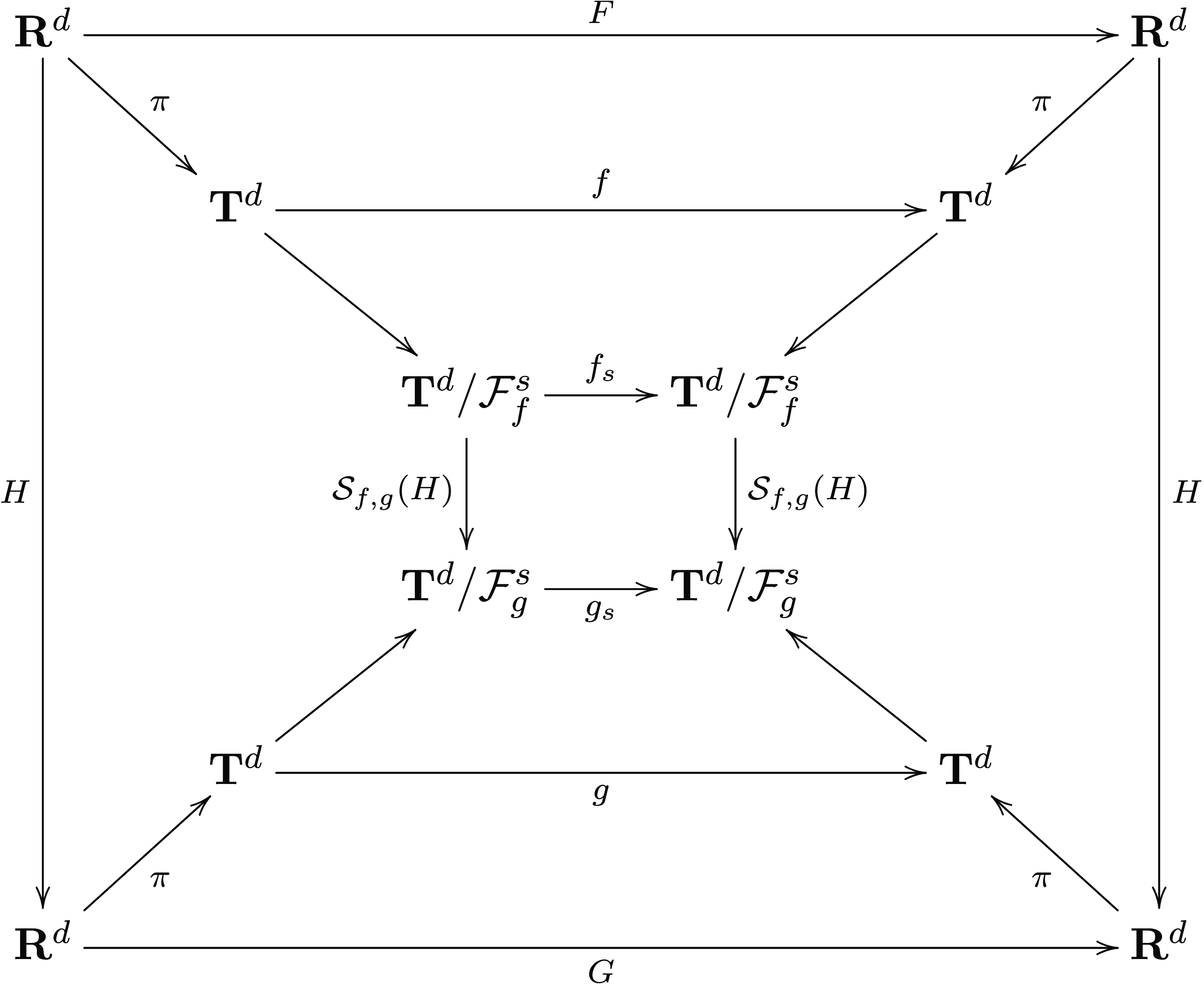
See the following commutative diagram (Figure 3).
The map
 $\mathcal{S}_{f,g}:\mathcal{H}(f,g) \to \mathcal{S}^*(f,g)$
is surjective.

Proof. It is clear that
 $\mathcal{S}_{f,g}(H)$
is a homeomorphism satisfying (2.10). To prove the first item, it suffices to prove that
 $H_s$
is at bounded distance from Id.
By Proposition 2.6, there exists
 $C_1>0$
such that
 $\|H-\mathrm{Id}_{\mathbb{R}^d}\|_{C^0}<C_1$
. Moreover, we claim that there exists
 $C_0>0$
such that
 \begin{align} \widetilde{\mathcal{F}}^{s/u}_{\sigma}(x)\subset B_{C_0}(\widetilde{\mathcal{L}}^{s/u}(x)) ,\quad \forall x\in\mathbb{R}^d \quad \textrm{and }\quad \sigma=f,g, \end{align}
where
 $B_{C_0}(\mathcal{L})$
is the
 $C_0$
neighborhood of the set
 $\mathcal{L}$
. We just need to prove the claim for
 $\widetilde{\mathcal{F}}_f^s$
. Indeed, let
 $H_F$
be the conjugacy between F and A given by Proposition 2.6 and take
 $C_2$
such that
 $\|H_F-\mathrm{Id}_{\mathbb{R}^d}\|_{C^0}<C_2$
. Then for any
 $y\in\widetilde{\mathcal{F}}_f^s(x)$
one has that
 $y\in B_{C_2}( \widetilde{\mathcal{L}}^s( H_F(x) ))$
. It follows that
 $y\in B_{2C_2}( \widetilde{\mathcal{L}}^s( x))$
and we can take
 $C_0=2C_2$
.
By (2.11), one has
 $\widetilde{\mathcal{F}}_g^u(q_0)\subset B_{C_0}(\widetilde{\mathcal{L}}^u(q_0))$
and
 $\widetilde{\mathcal{F}}_g^s( H(x))\subset B_{C_1}( \widetilde{\mathcal{F}}_f^s(x) ) \subset B_{C_0+C_1}(\widetilde{\mathcal{L}}^s(x)) $
for any
 $x\in\mathbb{R}^d$
. Then we have that
 $$x^u:=\ \widetilde{\mathcal{F}}_g^u(q_0) \cap\widetilde{\mathcal{F}}_g^s(x) \in B_{C_0}(\widetilde{\mathcal{L}}^u(q_0)) \cap B_{C_0+C_1}(\widetilde{\mathcal{L}}^s(x)),$$
and
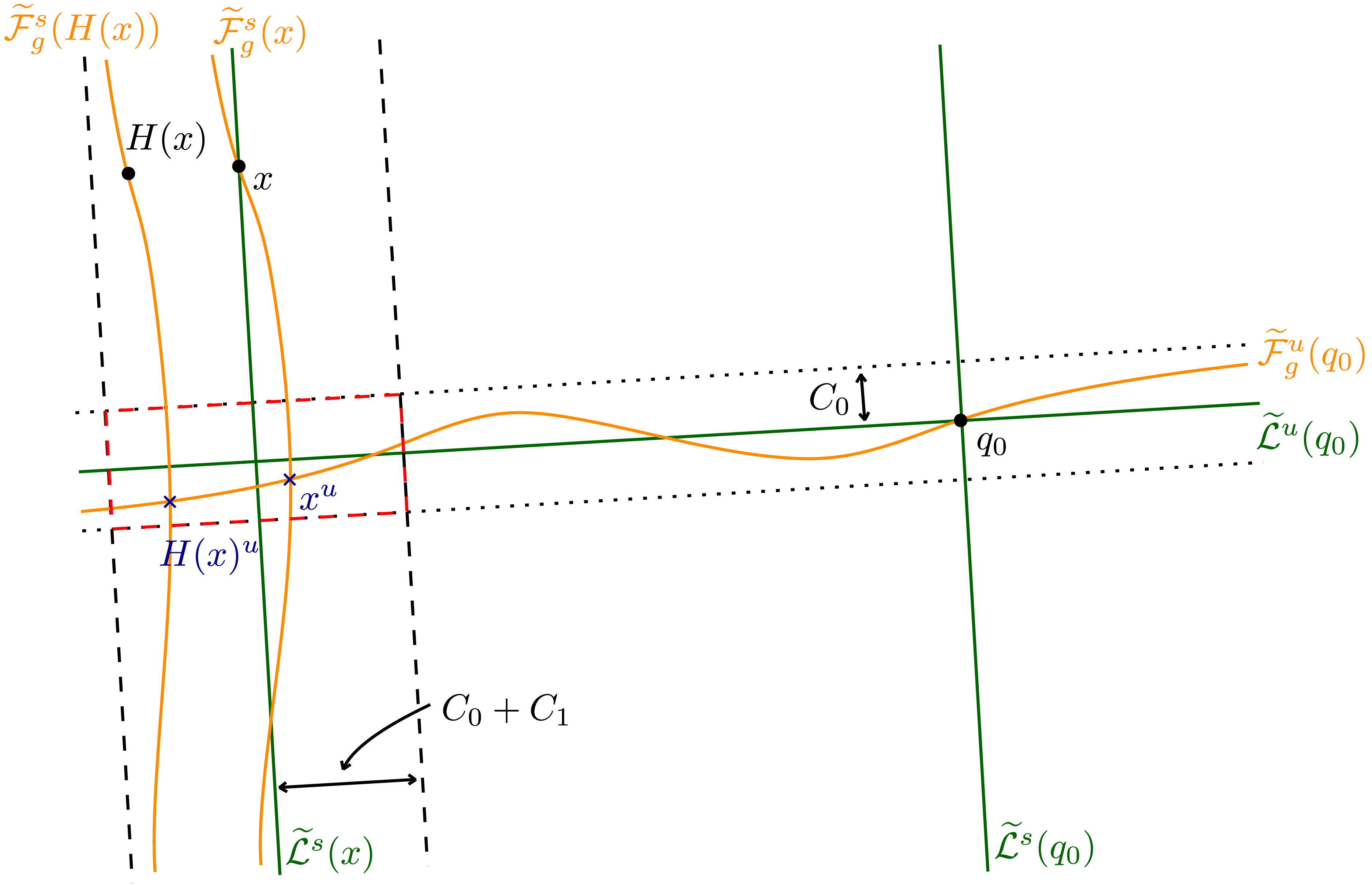
 $$H(x)^u:=\ \widetilde{\mathcal{F}}_g^u(q_0)\cap \widetilde{\mathcal{F}}_g^s( H(x)) \in B_{C_0}(\widetilde{\mathcal{L}}^u(q_0)) \cap B_{C_0+C_1}(\widetilde{\mathcal{L}}^s(x)).$$
See Figure 4. It follows that
 $d_G([x]_G, H^s([x]_F))= d(x^u, H(x)^u)$
is uniformly bounded for all
 $x\in\mathbb{R}^d$
, and hence
 $H_s$
is at bounded distance from Id.
The points
 $H(x)^u$
and
 $x^u$
in the dashed box, which has uniform size.

Now we prove the second item. Let
 $s\in\mathcal{S}(f,g)$
and
 $s^P$
be given by (2.8). By the definition of
 $\mathcal{S}(f,g)$
, there exist lifts
 $(F,p_0)$
and
 $(G,q_0)$
of f and g with
 $s^P(\pi(p_0))=\pi(q_0)\in\textrm{ Fix}(g)$
such that the lift
 $\tilde{s}$
of s corresponding to
 $(F,p_0)$
and
 $(G,q_0)$
is at bounded distance from Id. For short, let
 $p=\pi(p_0)$
and
 $q=\pi(q_0)$
.
Let H be the conjugacy between F and G given by Proposition 2.6. By the first item, we already have
 $\mathcal{S}_{f,g}(H)\in\mathcal{S}(f,g)$
. Hence it suffices to prove that the conjugacy which is at bounded distance from Id between
 $F_s:\mathbb{R}^d/\widetilde{\mathcal{F}}_f^s\to \mathbb{R}^d/\widetilde{\mathcal{F}}_f^s$
and
 $G_s:\mathbb{R}^d/\widetilde{\mathcal{F}}_g^s\to \mathbb{R}^d/\widetilde{\mathcal{F}}_g^s$
is unique and hence
 $\mathcal{S}_{f,g}(H)=s$
.
Indeed, assume that there exist two different conjugacies
 $h_i:\mathbb{R}^d/\widetilde{\mathcal{F}}_f^s\to \mathbb{R}^d/\widetilde{\mathcal{F}}_g^s\ (i=1,2)$
and that both of them are at bounded distance from Id. Then there exists
 $x\in\mathbb{R}^d$
such that
 $h_1([x]_F)\neq h_2([x]_F)$
and this implies that these two leaves intersect
 $\widetilde{\mathcal{F}}_g^u(q_0)$
at two distinct points
 $y_1$
and
 $y_2$
. Note that for any
 $n\in\mathbb{Z}$
, one has
 $$G^ny_i=h_i( [F^nx]_F )\cap \widetilde{\mathcal{F}}_g^u(q_0), \quad i=1,2.$$
Let
 $H_G$
be the conjugacy between
 $(G,q_0)$
and (A,0). Then
 $H_G(y_1)\in \widetilde{\mathcal{L}}^u( H_G(y_2) )$
and
 $$d( H_G(G^ny_1),H_G(G^ny_2) )= d( A^n\circ H_G(y_1), A^n\circ H_G(y_2) ) \to +\infty, $$
as
 $n\to + \infty$
. It follows that
 $d(G^ny_1,G^ny_2 )\to +\infty$
since
 $d_{C^0}(H_G,\mathrm{Id}_{\mathbb{R}^d})$
is bounded. Note that the assumption that
 $h_1$
and
 $h_2$
are both at bounded distance from Id implies that both
 $G^ny_1$
and
 $G^ny_2$
have bounded distance with
 $[F^nx]_G\cap \widetilde{\mathcal{F}}_g^u(q_0)$
, for any
 $n\in\mathbb{N}$
. This is a contradiction.
Recall that a (stable) leaf conjugacy
 $h\in\textrm{Home}_0(\mathbb{T}^d)$
between f and g maps stable leaves of f to stable leaves of g such that
 $h\circ f(\mathcal{F}_f^s(x))= g \circ h (\mathcal{F}_f^s(x))$
for every
 $x\in\mathbb{T}^d$
. Let
 $f,g\in\mathbf{A}^1_1(\mathbb{T}^d)$
be homotopic. The next proposition actually says that there exists leaf conjugacy between f and g.
Proposition 2.14. Let
 $f\in\mathbf{A}^1_1(\mathbb{T}^d)$
and A be its linearization. Then f is leaf conjugate to A.
Proof. Let
 $H:\mathbb{R}^d\to \mathbb{R}^d$
be the unique conjugacy given by Proposition 2.6 such that
 $H\circ F=A\circ H$
. Then by averaging H over all
 $\mathbb{Z}^d$
-actions, we can get a leaf conjugacy on
 $\mathbb{R}^d$
which can descend to
 $\mathbb{T}^d$
. This method can be found in [Reference HammerlindlHam13, § 6], where one may get more details. We sketch the proof here.
-
(i) Let
$H_n(x) = H(x-n)+n$
for all
$n\in \mathbb{Z}^d$
and
$x\in \mathbb{R}^d$
. Then by Proposition 2.7, for any
$k>0$
, where
\begin{align*} \overline{H}_k:=\sum_{n\in C_k}\frac{1}{(2k+1)^d}H_n, \end{align*}
$C_k=\{(k_1,\ldots,k_d)\in \mathbb{Z}^d | \textrm{max} \{ |k_1|,\ldots,|k_d|\}\le k \}$
is well defined on each stable leaf.
-
(ii)
$\{\overline{H}_k\}_{k\in \mathbb{N}}$
is uniformly equicontinuous and is at uniform distance from Id
$_{\mathbb{R}^d}$
; note that these two properties are inherited from
$\{ H_n \}_{n\in \mathbb{Z}^d}$
. By the Arzelà–Ascoli theorem, we obtain an accumulation point of
$\{\overline{H}_k\}_{k\in \mathbb{N}}$
, denoted by
$\tilde{H}$
. For short, let
$\overline{H}_k\to \tilde{H}$
as
$k\to +\infty$
. -
(iii)
$\tilde{H}$
is a leaf conjugacy between F and A which is at uniform distance from Id
$_{\mathbb{R}^d}$
and satisfies
$\tilde{H}(x+n)=\tilde{H}(x)+n$
for all
$n\in \mathbb{Z}^d$
. Moreover,
$\tilde{H}$
is injective. Descend
$\tilde{H}$
to
$h:\mathbb{T}^d\to\mathbb{T}^d$
, then
$h\in \textrm{Home}_0(\mathbb{T}^d)$
is a leaf conjugacy.


We note that the proof of the third item, especially the injection
 $\tilde{H}$
, relies on the one-dimensional stable bundle. Indeed, let
 $x\in \mathbb{R}^d$
and
 $y\in \widetilde{\mathcal{F}}_f^s(x)$
with
 $d(x,y)=\delta>0$
. Since H is uniformly bi-continuous and preserves the stable leaves, there exists
 ${\varepsilon}={\varepsilon}(\delta)>0$
such that for any
 $n\in\mathbb{N}$
, one has
 $$ d_{\widetilde{\mathcal{L}}^s}(H_n(x),H_n(y) )=d_{\widetilde{\mathcal{L}}^s}(H(x-n),H(y-n) )>{\varepsilon}.$$
If dim
 $E_f^s=1$
, we can give each leaf of
 $\widetilde{\mathcal{F}}_f^s$
and
 $\widetilde{\mathcal{L}}^s$
an order
 $\prec$
and assume that H preserves this order, i.e., the orientation of these leaves. In particular, if
 $y\prec x$
, then
 $H_n(y)\prec H_n(x)$
. It follows that
 \[d_{\widetilde{\mathcal{L}}^s}(\overline{H}_k(x), \overline{H}_k(y))=\frac{1}{(2k+1)^d}\sum_{n\in C_k}d_{\widetilde{\mathcal{L}}^s}(H_n(x),H_n(y))\geq \frac{1}{(2k+1)^d}\sum_{n\in C_k}{\varepsilon}={\varepsilon}. \]
Since
 $\overline{H}_k\to \tilde{H}$
as
 $k\to +\infty$
, one has
 ${\varepsilon} \leq d_{\widetilde{\mathcal{L}}^s}(\overline{H}_k(x), \overline{H}_k(y))\to d_{\widetilde{\mathcal{L}}^s}(\tilde{H}(x), \tilde{H}(y))=d( \tilde{H}(x), \tilde{H}(y) )$
. Hence
 $ \tilde{H}(x)\neq \tilde{H}(y )$
and
 $\tilde{H}$
is injective.
Remark 2.15. Let
 $f,g\in\mathbf{A}^1_1(\mathbb{T}^d)$
be homotopic. The last proposition actually shows that any conjugacy
 $H\in \mathcal{H}(f,g)$
can induce a leaf conjugacy
 $h\in \textrm{Home}_0(\mathbb{T}^d)$
. It is not hard to see that for any leaf conjugacy
 $h\in \textrm{Home}_0(\mathbb{T}^d)$
between f and g, there exist lifts F and G such that the conjugacy
 $H\in \mathcal{H}(f,g)$
between F and G induces h. Indeed, since
 $h\in \textrm{Home}_0(\mathbb{T}^d)$
naturally induces a conjugacy on leaf space whose lift is at bounded distance from Id, by Proposition 2.13, one can find F, G and H.
Remark 2.16. Through the conjugacy on the stable leaf spaces, we redefine the fact that
 $f,g\in\mathbf{A}^1_1(\mathbb{T}^d)$
admit the same stable periodic data by matching periodic points via some
 $s\in\mathcal{S}(f,g)$
, namely,
 \begin{align} \lambda^s_f(p)=\lambda^s_g( s^P(p) ), \quad \forall p\in\textrm{Per}(f), \end{align}
where
 $s^P$
is given by (2.8). This is equivalent to the definition given by leaf conjugacy (see (1.3)). Indeed, on the one hand, let
 $h\in \textrm{Home}_0(\mathbb{T}^d)$
be a leaf conjugacy between f and g given by (1.3) and
 $H\in \mathcal{H}(f,g)$
be a conjugacy on
 $\mathbb{R}^d$
corresponding to h. Then H induces
 $s=\mathcal{S}_{f,g}(H)\in \mathcal{S}(f,g)$
by Proposition 2.13 and it follows that s satisfies (2.12). On the other hand, let
 $s\in\mathcal{S}(f,g)$
satisfy (2.12). Then s induces a conjugacy
 $H\in\mathcal{H}(f,g)$
by the second item of Proposition 2.13 and H induces a leaf conjugacy
 $h\in \textrm{Home}_0(\mathbb{T}^d)$
given by Proposition 2.14. It is clear that h satisfies (1.3).
The following proposition says that every conjugacy
 $H\in \mathcal{H}(f,g)$
on
 $\mathbb{R}^d$
can induce a conjugacy on inverse limit spaces. This will be helpful for ‘translating’ the condition of matching stable periodic data on the leaf space into that on the inverse limit space (see Corollary 2.20).
Proposition 2.17. Let
 $f,g\in \mathbf{A}^1(\mathbb{T}^d)$
be homotopic and F,G be any two lifts of f,g by
 $\pi$
. Assume that
 $H:\mathbb{R}^d\to \mathbb{R}^d$
is the conjugacy given by Proposition 2.6 between F and G with
 $H\circ F=G\circ H$
. Then there exists a conjugacy
 $\bar{h}:\mathbb{T}^d_f\to \mathbb{T}^d_g$
between
 $\sigma_f:\mathbb{T}^d_f\to\mathbb{T}^d_f$
and
 $\sigma_g:\mathbb{T}^d_g\to\mathbb{T}^d_g$
such that
 $\bar{h}\circ\sigma_f=\sigma_g\circ \bar{h}$
and
 \begin{align} \bar{h}\circ\pi( \textrm{Orb}_F(x) ) = \pi( {\rm Orb}_G(H(x)) ),\ \ \forall x\in\mathbb{R}^d. \end{align}
See the following commutative diagram (Figure 5), where
 $\pi_0:\mathbb{T}^d_{f/g}\to \mathbb{T}^d$
is the projection
 $\pi_0((x_i))=x_0$
.
The conjugacy H induces a conjugacy
 $\bar{h}$
on the inverse limit space.

Proof. Let
 $\mathbb{R}^d_F$
be the orbit space of
 $F:\mathbb{R}^d\to \mathbb{R}^d$
and
 $\sigma_F:\mathbb{R}^d_F\to\mathbb{R}^d_F$
be the (left) shift homeomorphism just as in (2.1), and define
 $\sigma_G:\mathbb{R}^d_G\to\mathbb{R}^d_G$
in the same way. Then H induces a conjugacy
 $\overline{H}: \mathbb{R}^d_F\to \mathbb{R}^d_G$
between the shift maps
 $\sigma_F$
and
 $\sigma_G$
such that
 $\overline{H}\circ \sigma_F= \sigma_G\circ \overline{H}$
and
 $\overline{H}(\textrm{Orb}_F(x))= \textrm{Orb}_G(H(x))$
for all
 $x\in\mathbb{R}^d$
. It is clear that
 \begin{align} \mathbb{T}^d_f=\overline{\bigcup_{x\in\mathbb{R}^d} \pi ( \textrm{Orb}_F(x) )}.\end{align}
Indeed, for any
 $\tilde{x}=(x_i)\in \mathbb{T}^d_f$
and
 $k\leq 0$
, let
 $y_k$
be a lift of
 $x_k$
. Then the projection of the F-orbit of
 $F^k(y_k)$
approaches
 $\tilde{x}$
. If needed, we refer to [Reference Micena and TahzibiMT16, Proposition 2.5] for more details of (2.14).
We are going to prove that
 $\overline{H}$
can descend to
 $\mathbb{T}^d_f$
by the following lemma. Recall that the metric
 $\bar{d}(\cdot,\cdot)$
of the inverse limit space
 $\mathbb{T}^d_f$
is given by
 $\bar{d}(\bar{x},\bar{y})= \sum_{-\infty}^{+\infty} ({d(x_i,y_i)}/{2^{|i|}})$
, for all
 $\bar{x}=(x_i)$
and
 $\bar{y}=(y_i)\in \mathbb{T}^d_f$
.
Lemma 2.18.
For any orbit
 $\bar{x}\in\mathbb{T}^d_f$
and any two sequences
 $\{y_k\}$
and
 $\{z_k\}$
with
 $\pi( \textrm{Orb}_F(y_k) ) \to \bar{x}$
and
 $\pi( \textrm{Orb}_F(z_k) ) \to \bar{x}$
as
 $k\to +\infty$
, one has
 $$\bar{d} ( \pi( \textrm{Orb}_G(H(y_k)) ) , \; \pi ( \textrm{Orb}_G(H(z_k))) )\to 0. $$
Proof of Lemma 2.18. It is clear that for any
 ${\varepsilon}>0$
, there exists
 $\alpha>0$
such that for any
 $x,y\in\mathbb{R}^d$
with
 $d(x,y)<\alpha$
, one has
 \begin{align} \bar{d} ( \pi( \textrm{Orb}_G(x) ) , \; \pi ( {\rm Orb}_G(y)) ) <\frac{{\varepsilon}}{2}.\end{align}
For any
 ${\varepsilon}>0$
, there exists
 $I_0\in\mathbb{N}$
such that for all
 $x\in\mathbb{R}^d$
, all
 $i\geq I_0$
and all
 $n\in A^i\mathbb{Z}^d$
, one has
 \begin{align} \bar{d} ( \pi( \textrm{Orb}_G(x) )\; , \; \pi ( \textrm{Orb}_G(x+n)) ) <\frac{{\varepsilon}}{2}. \end{align}
Indeed, just note that
 $\pi(G^j(x+n))=\pi(G^jx)$
, for any
 $n\in A^i\mathbb{Z}^d$
and
 $-i\leq j <+\infty$
.
By Proposition 2.8, for given
 $\alpha>0$
, there exists
 $I_1\in\mathbb{N}$
such that for any
 $x\in\mathbb{R}^d$
,
 $i\geq I_1$
and
 $n\in A^i\mathbb{Z}^d$
, one has
 \begin{align} d( H(x+n),\; H(x)+n )<\frac{\alpha}{2}.\end{align}
By the uniform continuity of H, there exists
 $\delta>0$
such that if
 $d(x,y)<\delta$
, one has
 \begin{align} d(H(x),H(y))<\frac{\alpha}{2}.\end{align}
Now fix
 ${\varepsilon}>0$
, then we can fix
 $\alpha>0$
,
 $\delta>0$
and
 $i_0\geq\textrm{max}\{I_0,I_1\}$
. The conditions that both
 $\pi( \textrm{Orb}_F(y_k) ) $
and
 $\pi( \textrm{Orb}_F(z_k) ) $
converge to
 $ \bar{x}$
means that there exists
 $N_0\in\mathbb{N}$
such that for every
 $k\geq N_0$
, there exists
 $n_k\in\mathbb{Z}^d$
satisfying
 $$d(F^j(F^{-i_0}z_k+n_k ),\; F^j\circ F^{-i_0}(y_k))<\delta$$
for any
 $0\leq j\leq 2i_0$
. In particular, one has
 $d(z_k+ A^{i_0}n_k \; ,\; y_k)<\delta$
and by (2.18)
 \begin{align} d(H(z_k+ A^{i_0}n_k)\; , \; H(y_k))<\frac{\alpha}{2}.\end{align}
Since
 $i_0\geq I_1$
, it follows from (2.17) that
 $d(H(z_k+ A^{i_0}n_k) , H(z_k)+ A^{i_0}n_k) < {\alpha}/{2}$
. Combining this with (2.19), one has
 $$d( H(z_k)+ A^{i_0}n_k \; , \; H(y_k) )<\alpha.$$
Then by (2.15) we get
 \begin{align} \bar{d} ( \pi(\textrm{Orb }_G(H(z_k)+A^{i_0}n_k)),\; \pi( \textrm{Orb}_G(H(y_k)) ) )<\frac{{\varepsilon}}{2}. \end{align}
On the other hand, since
 $i_0\geq I_0$
, by (2.16), we have
 \begin{align} \bar{d} ( \pi(\textrm{Orb }_G(H(z_k)+A^{i_0}n_k)),\; \pi( \textrm{Orb}_G(H(z_k)) ) )<\frac{{\varepsilon}}{2}.\end{align}
It follows from (2.20) and (2.21) that for any
 ${\varepsilon}>0$
, there exists
 $N_0\in\mathbb{N}$
such that if
 $k\geq N_0$
, then
 $$\bar{d} ( \pi(\textrm{Orb }_G(H(y_k))),\; \pi( \textrm{Orb}_G(H(z_k)) ) )<{\varepsilon}. $$
This completes the proof of the lemma.
Remark 2.19. Lemma 2.18 also implies that the sequence
 $\{ \pi( \textrm{ Orb}_G(H(y_k)))\}$
is convergent in
 $\mathbb{T}^d_g$
, as
 $\pi( \textrm{Orb}_F(y_k) ) \to \bar{x}$
. Indeed, using the same notation as in the proof of Lemma 2.18, for every
 ${\varepsilon}>0$
, every
 $i_0\geq {\rm max}\{I_0,I_1\}$
and every Cauchy sequence
 $\{\pi( {\rm Orb}_F(y_k) )\}\subset \mathbb{T}^d_f$
, there exists
 $N>0$
such that for any
 $k,m>N$
, there exists
 $n\in\mathbb{Z}^d$
with
 $$d(F^j\circ F^{-i_0}(y_k),\; F^j(F^{-i_0}y_m+n) )<\delta,$$
for all
 $0\leq j\leq 2i_0$
. Then one has
 $$\bar{d}( \pi\circ \textrm{Orb}_G(H(y_m)),\; \pi\circ \textrm{Orb}_G(H(y_k)) )< {\varepsilon}.$$
So
 $\{ \pi\circ \textrm{Orb}_G(H(y_k)) \}$
is a Cauchy sequence and hence convergent in the compact metric space
 $(\mathbb{T}^d_g,\bar{d})$
.
We continue to prove Proposition 2.17. For any
 $\bar{x}\in\mathbb{T}^d_f$
, there exists
 $\{y_k\}\subset\mathbb{R}^d$
such that
 $\pi( \textrm{Orb}_F(y_k) )$
converges to
 $ \bar{x}$
. By Lemma 2.18, we can define
 $\bar{h}: \mathbb{T}^d_f\to \mathbb{T}^d_g$
as
 \begin{align} \bar{h}(\bar{x})= \lim_{k\to\infty}\pi( \textrm{Orb }_G(H(y_k))).\end{align}
By the proof of Lemma 2.18, we also get that
 $\bar{h}$
is a continuous.
Similarly, for any
 $\bar{x}\in \mathbb{T}^d_g$
and
 $\{z_k\}\subset \mathbb{R}^d$
with
 $\pi( \textrm{Orb}_G(z_k) )$
converging to
 $ \bar{x}$
, let
 $\bar{h}^{-1}$
be defined by
 $$\bar{h}^{-1}(\bar{x})= \lim_{n\to\infty}\pi( \textrm{Orb }_F(H^{-1}(z_k))). $$
This is well defined and also continuous. Note that
 $\bar{h}\circ\bar{h}^{-1}=\mathrm{Id}_{\mathbb{T}^d_g}$
and
 $\bar{h}^{-1}\circ\bar{h}=\mathrm{Id}_{\mathbb{T}^d_f}$
by the definition, so we have that
 $\bar{h}$
is a homeomorphism. Recall that
 $y_k$
satisfies (2.22). Hence
 \begin{align*} \sigma_g\circ \bar{h} (\bar{x}) &= \sigma_g \big(\lim_{k\to\infty} \pi \circ \textrm{Orb}_G(H(y_k))\big),\\ &= \lim_{k\to\infty} ( g \circ \pi \circ G^i(H(y_k)) )_{i\in\mathbb{Z}},\\ &= \lim_{k\to\infty} ( \pi \circ G \circ G^i(H(y_k)) )_{i\in\mathbb{Z}},\\ &= \lim_{k\to\infty} ( \pi \circ G^i(H(F(y_k))) )_{i\in\mathbb{Z}},\\ &= \lim_{k\to\infty} \pi \circ \textrm{Orb}_G(H(F(y_k))). \end{align*}
Since
 $\pi( \textrm{Orb}_F(y_k) )\to \bar{x}$
, we have
 $\pi( \textrm{Orb}_F(F(y_k)) )\to \sigma_f (\bar{x})$
. Replacing
 $\bar{x}$
and
 $y_k$
of (2.22) by
 $\sigma_f (\bar{x})$
and
 $F(y_k)$
, respectively, we get
 $$\sigma_g\circ \bar{h} (\bar{x})=\lim_{k\to\infty} \pi \circ \textrm{Orb}_G(H(F(y_k)))=\bar{h}\circ \sigma_f(\bar{x}).$$
This completes the proof of the proposition.
Let
 $\bar{h}:\mathbb{T}^d_f\to\mathbb{T}^d_g$
be a conjugacy between
 $\sigma_f:\mathbb{T}^d_f\to\mathbb{T}^d_f$
and
 $\sigma_g:\mathbb{T}^d_g\to\mathbb{T}^d_g$
. For any
 $p\in\textrm{Per}(f)$
, we denote the periodic f-orbit of p by
 $\bar{p}\in\mathbb{T}^d_f$
. It is clear that
 $\bar{h}(\bar{p})$
is a periodic point of
 $\sigma_g:\mathbb{T}^d_g\to\mathbb{T}^d_g$
with the same period as
 $\bar{p}$
. We further assume that
 $f\in\mathbf{A}^1_1(\mathbb{T}^d)$
, and define the stable Lyapunov exponent for
 $\bar{p}\in\textrm{Per}(\sigma_f)$
by
 $$\lambda^s(f,\bar{p}):=\lambda^s_f(\pi_0(\bar{p})) ,$$
where
 $\lambda^s_f(x)$
is the stable Lyapunov exponent of x for f.
Corollary 2.20. Let
 $f,g\in\mathbf{A}^1_1(\mathbb{T}^d)$
be homotopic. If f and g admit the same periodic data on the stable bundles, then there exist lifts F and G of f and g by
 $\pi$
such that the conjugacy
 $\bar{h}:\mathbb{T}^d_f \to \mathbb{T}^d_g$
between
 $\sigma_f$
and
 $\sigma_g$
given by Proposition 2.17 satisfies
 $$\lambda^s(f,\bar{p})=\lambda^s(g,\bar{h}(\bar{p})), \quad \forall \bar{p}\in \textrm{Per}(\sigma_f).$$
Proof. By the assumption and Remark 2.16, there exists
 $s\in\mathcal{S}(f,g)$
such that
 $\lambda^s_f(p)=\lambda^s_g( s^P(p) )$
for all
 $p\in\textrm{Per}(f)$
. Let
 $\bar{h}$
be given by Proposition 2.17 with H being given by the second item of Proposition 2.13. Take
 $\bar{p}\in\textrm{Per}(\sigma_f)$
. We will show that
 $\bar{h}(\bar{p})$
and
 $s^P(p)$
are in the same periodic orbit and that in fact
 $(\bar{h}(\bar{p}))_0=s^P(p)$
. It follows that
 $\lambda^s(f,\bar{p})= \lambda^s_f(p)=\lambda^s_g(s^P(p))=\lambda^s(g,\bar{h}(\bar{p}))$
.
Since
 $\bar{h}(\bar{p})\in\textrm{Per}(\sigma_g)$
and every periodic stable leaf admits exactly one periodic point, it suffices to prove that
 $$\mathcal{F}_g^s((\bar{h}(\bar{p}))_0)=\mathcal{F}_g^s( s^P(p)).$$
Indeed, let
 $p_n\in\mathbb{R}^d$
with
 $\pi(p_n)=p$
such that
 $\pi\circ\textrm{Orb}_F(p_n)\to \bar{p}$
as
 $n\to +\infty$
. Then by (2.13) or (2.22), one has
 $$\bar{h}(\bar{p})= \lim_{n\to +\infty} \pi\circ \textrm{ Orb}_G(H(p_n)).$$
By the second item of Proposition 2.13 and 2.10, one has
 $$[\pi (H(p_n))]_g=\pi[ H(p_n) ]_G=s\circ\pi ([p_n]_F)= s([p]_f)=[s^P(p)]_g.$$
Therefore,
 \begin{align*}[(\bar{h}(\bar{p}))_0]_g=\lim_{n\to+\infty}[\pi(H(p_n))]_g=[s^P(p)]_g.\\[-35pt]\end{align*}
2.3 Livschitz Theorem on the inverse limit space
In this subsection, we find a Livschitz Theorem for shift homeomorphisms on the inverse limit spaces of Anosov maps. This will be helpful for constructing an affine structure in § 3. Although we already have the Livschitz Theorem for Anosov maps (see Theorem 2.21), we can only use the Livschitz Theorem for the inverse limit space on the assumption of Corollary 2.20. Recall that M is a
 $C^{\infty}$
-smooth closed Riemannian manifold.
Theorem 2.21 (Livschitz Theorem for Anosov maps [Reference Katok and HasselblattKH95]). Let
 $f\in\mathbf{A}^{1+\alpha}(M)$
be transitive and
 $\psi_1, \psi_2 :M\to \mathbb{R}$
be two Hölder functions with
 \begin{align*}\sum_{i=1}^{\pi({p})}\psi_1(f^i({p}))= \sum_{i=1}^{\pi({p})}\psi_2(f^i({p})), \quad \forall p\in \textrm{Per}(f),\end{align*}
where
 $\pi({p})$
is the period of p. Then there exists a Hölder function
 $v:M\to \mathbb{R}$
such that
 $$\psi_1(x)=\psi_2(x)+v\circ f(x)-v(x),\quad \forall x\in M.$$
As stated in [Reference An, Gan, Gu and ShiAGGS23, § 4], the proof is quite similar to the proof of the Livschitz Theorem for transitive Anosov diffeomorphisms, which can be found in [Reference Katok and HasselblattKH95, Corollary 6.4.17 and Theorem 19.2.1]. Note that we still have the Local Product Structure (see Proposition 2.5) which is useful for obtaining the exponential Anosov closing lemma (see [Reference Katok and HasselblattKH95, Corollary 6.4.17]) and hence the Livschitz Theorem for Anosov maps.
Theorem 2.22 (Livschitz Theorem on the inverse limit space). Let
 $f\in\mathbf{A}^{1+\alpha}(M)$
be transitive and
 $\sigma_f:M_f\to M_f$
be the shift homeomorphism on the inverse limit space. Assume that
 ${\varphi}_1, {\varphi}_2 :M_f\to \mathbb{R}$
are two Hölder functions with
 $$\sum_{i=1}^{\pi(\bar{p})}{\varphi}_1(\sigma_f^i(\bar{p}))= \sum_{i=1}^{\pi(\bar{p})}{\varphi}_2(\sigma_f^i(\bar{p})), \quad \forall \bar{p}\in \textrm{Per}(\sigma_f),$$
where
 $\pi(\bar{p})$
is the period of
 $\bar{p}$
. Then
 ${\varphi}_1$
is Hölder-cohomologous to
 ${\varphi}_2$
, i.e., there exists a Hölder function
 $u:M_f\to \mathbb{R}$
such that
 $${\varphi}_1(\bar{x})={\varphi}_2(\bar{x})+u\circ \sigma_f(\bar{x})-u(\bar{x}),\quad \forall \bar{x}\in M_f.$$
Since we already have Theorem 2.21, we just need to reduce Theorem 2.22 to the above case. This can be done by the following lemma. Briefly, it says that a function on the inverse limit space can be made cohomologous to a function on the base manifold by ‘cutting’ the backward orbit. We mention that this method originated from the case of the shift homeomorphism of finite type in [Reference BowenBow75, § 1]. However, our case is not discrete and we need a more delicate calculation with the help of the Local Product Structure (see Proposition 2.5). Note that this lemma only needs f to be
 $C^{1}$
-smooth.
Lemma 2.23.
Let
 $f\in\mathbf{A}^1(M)$
and
 ${\varphi}:M_f\to \mathbb{R}$
be a Hölder function. Then there exists a Hölder function
 $\psi:M_f\to \mathbb{R}$
which is Hölder-cohomologous to
 ${\varphi}$
such that, for all
 $\bar{x},\bar{y}\in M_f$
, if
 $x_i=y_i$
for all
 $i\geq 0$
, then
 $\psi(\bar{x})=\psi(\bar{y})$
. In particular,
 $\psi$
can descend to M.
Proof. For any
 $x\in M$
, we fix an orbit
 $\bar{a}(x)=(a_i(x))\in M_f$
with
 $a_0(x)=x$
. Let
 $r: M_f\to M_f$
be defined as
 $r(\bar{y})=\bar{y}^*$
such that
 $(\bar{y}^*)_i=y_i$
for
 $i\geq 0$
and
 $(\bar{y}^*)_i=a_{i}(y_0)$
for
 $i\leq 0$
. Let
 $$u(\bar{y})=\sum_{j=0}^{+\infty}( {\varphi} \circ \sigma_f^j(\bar{y})- {\varphi} \circ \sigma_f^j\circ r(\bar{y}) ).$$
First, we claim that
 $u: M\to \mathbb{R}$
is well defined and bounded. Indeed, let
 ${\varphi}$
be Hölder with constant
 $C_{{\varphi}}>0$
and exponent
 $\alpha\in(0,1)$
. Then for any
 $j>0$
, since
 $(\sigma_f^j(\bar{y}))_i= (\sigma_f^j\circ r(\bar{y}) )_i$
for
 $i\geq -j$
, we have
 \begin{align*} | {\varphi} \circ \sigma_f^j(\bar{y}) - {\varphi} \circ \sigma_f^j\circ r(\bar{y}) | \leq C_{{\varphi}}\cdot \bar{d}^{\alpha}( \sigma_f^j(\bar{y}), \sigma_f^j\circ r(\bar{y}) ) \leq C_{{\varphi}} \cdot \bigg( \sum_{i=j+1}^{+\infty} \frac{1}{2^i} \bigg) ^{\!\alpha} \leq C_{{\varphi}} \cdot 2^{-j\alpha}. \end{align*}
It follows that
 $u(\bar{y})\leq C_{{\varphi}} \cdot \sum_{j=0}^{+\infty}2^{-j\alpha}<\infty$
.
Then we prove that
 $r:M_f \to M_f$
is Hölder continuous. Let
 $\delta_0$
satisfy the size of the Local Product Structure (see Proposition 2.5). Then there exists
 $C_1=C_1(\delta)>0$
such that, for any
 ${\varepsilon}<\delta_0$
, any two points
 $y_0,z_0$
with
 $d(y_0,z_0)<{\varepsilon}$
and any
 $\bar{z}\in M_f$
with
 $(\bar{z})_0=z_0$
, one has that
 $\mathcal{F}_f^s(y_0,C_1{\varepsilon})\cap \mathcal{F}_f^u(z_0,\bar{z}, C_1{\varepsilon})$
is a single point set. Denote this point by
 $w_0=w_0(y_0,\bar{z})$
and let the orbit
 $\bar{w}=(w_i)$
be that given by Proposition 2.5. Let
 $\lambda :=\textrm{sup}_{\bar{x}\in\mathbb{T}^d_f}\|Df^{-1}|_{E_f^s(\bar{x})}\| $
. Then for
 $0\leq i\leq i_{{\varepsilon}}:= [\log_{\lambda}({\delta_0}/{2C_1{\varepsilon}})]$
, one has
 \begin{align*} d( r(\bar{y})_{-i}, r(\bar{z})_{-i} ) \leq d_{\mathcal{F}_f^s}(r(\bar{y})_{-i}, w_{-i} ) +d_{\mathcal{F}_f^u} (r(\bar{z})_{-i}, w_{-i} ) \leq 2 C_1{\varepsilon}\lambda^i<\delta_0. \end{align*}
So when
 $\bar{d}(\bar{y},\bar{z})={\varepsilon}\ll\delta_0$
, we have
 \begin{align*} \bar{d}(r(\bar{y}), r(\bar{z})) &=\sum_{i=i_{{\varepsilon}}+1}^{+\infty}\frac{d(r(\bar{y})_{-i}, r(\bar{z})_{-i})}{2^i} +\sum_{i=1}^{i_{{\varepsilon}}}\frac{d( r(\bar{y})_{-i}, r(\bar{z})_{-i})}{2^i} +\sum_{i=0}^{+\infty}\frac{d(y_i, z_i)}{2^i},\\ &\leq C\cdot 2^{-i_{{\varepsilon}}} + 2C_1 {\varepsilon} \cdot \sum_{i=1}^{i_{{\varepsilon}}}\frac{\lambda^i}{2^i} + \bar{d}(\bar{y},\bar{z}),\\ &\leq C \cdot \bigg( \frac{2C_1{\varepsilon}}{\delta_0} \bigg)^{\!{\ln 2}/{\ln \lambda} } + 2C{\varepsilon} \bigg( \frac{2C_1{\varepsilon}}{\delta_0} \bigg)^{\!{-}{\ln({\lambda}/{2})}/{\ln\lambda}} +{\varepsilon}, \end{align*}
for some
 $C>1$
. We can assume that
 $\lambda>2$
, otherwise the sum
 $\sum_{i=1}^{i_{{\varepsilon}}}({\lambda^i}/{2^i})$
is controlled by a constant. Then there exist
 $C_{\delta_0}$
and
 $0<\beta<1$
such that
 \begin{align} \bar{d}(r(\bar{y}), r(\bar{z})) \leq C_{\delta_0}\cdot {\varepsilon}^{\beta}= C_{\delta_0}\cdot \bar{d}(\bar{y},\bar{z})^{\beta}. \end{align}
Now we show that u is Hölder continuous. Note that for all
 $\bar{y}=(y_i), \bar{z}=(z_i) \in M_f$
, one has
 \begin{align} \bar{d}(\sigma_f(\bar{y}),\sigma_f(\bar{z}) ) \leq 2\bar{d}(\bar{y},\bar{z}). \end{align}
Indeed, this follows from the next two equations
 \begin{align*} \sum_{i=1}^{+\infty} \frac{ d( (\sigma_f\bar{y})_{-i}, (\sigma_f\bar{z})_{-i} )}{2^i} = \frac{1}{2}\cdot\sum_{i=1}^{+\infty} \frac{ d( y_{1-i}, z_{1-i} )}{2^{i-1}} =\frac{1}{2}\cdot\sum_{i=0}^{+\infty} \frac{ d( y_{-i}, z_{-i} )}{2^{i}} \end{align*}
and
 \begin{align*} \sum_{i=0}^{+\infty} \frac{ d\left( (\sigma_f\bar{y})_i, (\sigma_f\bar{z})_i \right)}{2^i} = 2\cdot\sum_{i=0}^{+\infty} \frac{ d\left( y_{i+1}, z_{i+1} \right)}{2^{i+1}} = 2\cdot\sum_{i=1}^{+\infty} \frac{ d\left( y_{i}, z_{i} \right)}{2^{i}}. \end{align*}
Let
 ${\varepsilon}:=\bar{d}(\bar{y},\bar{z})$
and
 ${\varepsilon}_0={\varepsilon}^{1/2}$
. Then for
 $0\leq j\leq j_0:= [\textrm{ log}_2({{\varepsilon}_0}/{{\varepsilon}})]$
, by (2.24),
 \begin{align} | {\varphi} \circ \sigma_f^j(\bar{y}) - {\varphi} \circ \sigma_f^j(\bar{z}) | \leq C_{{\varphi}} \cdot (2^j {\varepsilon})^{\alpha} \leq C_{{\varphi}} \cdot {\varepsilon}_0^{\alpha}.\end{align}
Therefore by the choice of
 $j_0$
and equations (2.23) and (2.25), we have
 \begin{align*} |u(\bar{y})- u(\bar{z})| &\leq \sum_{j=0}^{j_0}| {\varphi} \circ \sigma_f^j(\bar{y}) - {\varphi} \circ \sigma_f^j(\bar{z}) | + \sum_{j=0}^{j_0}| {\varphi} \circ \sigma_f^j\circ r (\bar{y}) - {\varphi} \circ \sigma_f^j\circ r (\bar{z}) |\\ &\quad + \sum_{j=j_0+1}^{\infty}| {\varphi} \circ \sigma_f^j(\bar{y})- {\varphi} \circ \sigma_f^j\circ r(\bar{y}) | + \sum_{j=j_0+1}^{\infty}| {\varphi} \circ \sigma_f^j(\bar{z})- {\varphi} \circ \sigma_f^j\circ r(\bar{z}) |,\\ &\leq \sum_{j=0}^{j_0} C_{{\varphi}} \cdot (2^j {\varepsilon})^{\alpha} + \sum_{j=0}^{j_0} C_{{\varphi}} C_{\delta_0} \cdot (2^j {\varepsilon})^{\alpha\beta} + 2\sum_{j=j_0+1}^{\infty} C_{{\varphi}} \cdot 2^{-j\alpha},\\ &\leq C\cdot 2^{j_0\alpha}{\varepsilon}^{\alpha} + C\cdot 2^{j_0\alpha\beta}{\varepsilon}^{\alpha\beta} + C\cdot 2^{-j_0\alpha},\\ &\leq C\cdot {\varepsilon}^{\alpha/2} + C\cdot {\varepsilon}^{\alpha\beta/2} + C\cdot {\varepsilon}^{\alpha/2} \leq C\cdot \bar{d}(\bar{y},\bar{z})^{\alpha_0}, \end{align*}
where
 $0<\alpha_0<1$
and both
 $\alpha_0$
and C only depend on
 ${\varphi}$
and f. Hence u is Hölder continuous.
Finally, let
 \begin{align*} \psi(\bar{y})&= {\varphi}(\bar{y})+u\circ \sigma_f(\bar{y})- u(\bar{y}),\\ &= {\varphi}(r(\bar{y}))+ \sum_{j=0}^{+\infty}( {\varphi}(\sigma_f^{j+1}\circ r(\bar{y}))- {\varphi}(\sigma_f^j\circ r(\sigma_f\bar{y})) ). \end{align*}
It follows that
 $\psi(\bar{y})$
only depends on
 $\{y_i \}_{i\geq 0}$
and is Hölder continuous.
Proof of Theorem 2.22. By Lemma 2.23, there exist two Hölder functions
 $u_1$
and
 $u_2$
defined on
 $ M_f$
such that
 $\psi_1={\varphi}_1+u_1\circ\sigma_f-u_1$
and
 $\psi_2={\varphi}_2+u_2\circ\sigma_f-u_2$
are both independent of negative orbits. This means that
 $\psi_1$
and
 $\psi_2$
are actually functions defined on M. Then, by the Livschitz Theorem for Anosov maps, there exists a Hölder function
 $v: M\to\mathbb{R}$
such that
 $\psi_1=\psi_2+v\circ f-v$
. Denote the lift of v on the inverse limit space
 $M_f$
by
 $v_0$
. It is clear that
 $v_0: M_f\to \mathbb{R}$
is Hölder continuous under the metric
 $\bar{d}(\cdot,\cdot)$
. Now, let
 $u=v_0+u_2-u_1$
, so we have that
 $${\varphi}_1={\varphi}_2 +u\circ \sigma_f - u,$$
where
 $u: M_f\to \mathbb{R}$
is Hölder continuous.
2.4 Topological classification for higher-dimensional Anosov maps
As mentioned in the Introduction, Theorem 1.4 and Corollary 1.5 also hold for d-torus
 $(d\geq 2)$
on the assumption that
 $f\in\mathbf{N}^r_1(\mathbb{T}^d)$
 $(r>1)$
is irreducible. In this subsection, we state these two results and give the frame to prove them and also Theorem 1.4.
We say that an Anosov map
 $f\in\mathbf{A}^1(\mathbb{T}^d)$
is irreducible if its linearization
 $A=f_*: \pi_1(\mathbb{T}^d)\to \pi_1(\mathbb{T}^d)$
has irreducible characteristic polynomial over
 $\mathbb{Q}$
as a matrix
 $A\in GL_d(\mathbb{R})\cap M_d(\mathbb{Z})$
.
It is clear that Theorem 1.4 is a direct corollary of the following theorem.
Theorem 2.24. Let
 $f,g\in \mathbf{N}^{r}_1(\mathbb{T}^d)\ (r>1)$
be homotopic and irreducible. Then f is conjugate to g if and only if f and g admit the same stable periodic data.
Here we mention that in this d-torus case, we also have leaf conjugacy (see Proposition 2.14) to match the stable periodic data of f and g in the sense of (1.3). The case that g is special has been studied in [Reference An, Gan, Gu and ShiAGGS23] as the following theorem.
Theorem 2.25 [Reference An, Gan, Gu and ShiAGGS23]. Let
 $f\in \mathbf{N}^{r}_1(\mathbb{T}^d)\ (r>1)$
be irreducible. Then f is conjugate to its linearization A if and only if f admits the same stable periodic data as A. Moreover, both conditions imply that the conjugacy is smooth along each leaf of the stable foliation.
Remark 2.26. The irreducibility in Theorem 2.25 guarantees the following two properties of the linearization
 $A:\mathbb{T}^d\to \mathbb{T}^d$
.
-
– There exist
$C>1, 0<\alpha<1$
such that for any
$x\in \mathbb{T}^d$
and
$k\in\mathbb{N}$
, its k-preimage set
$P_k(x):=\{y\in\mathbb{T}^d\ |\ A^k(y)=x\}$
is becoming dense exponentially, i.e, the set
$P_k(x)$
is
$C\alpha^k$
-dense in
$\mathbb{T}^d$
. -
– The stable foliation
$\mathcal{L}^s$
is minimal, i.e., each stable leaf is dense in
$\mathbb{T}^d$
.


The first item is a key tool for getting the same stable periodic data from topological conjugacy (see [Reference An, Gan, Gu and ShiAGGS23, Theorem 3.1]) and the second item is useful for the converse (see [Reference An, Gan, Gu and ShiAGGS23, Theorem 5.1]). Note that the proof that the same stable periodic data implies smoothness of the topological conjugacy along stable leaves just needs the minimality of the unstable foliation
 $\mathcal{L}^u$
, which is independent of the irreducibility (see [Reference An, Gan, Gu and ShiAGGS23, Proposition 5.1]).
The sufficient part in [Reference An, Gan, Gu and ShiAGGS23] relies on the existence of an affine metric on each leaf of the stable foliation
 $\mathcal{F}_f^s$
, which requires the periodic stable Lyapunov exponents of f actually to be constant. Instead of the above affine metric, we will build a relation between affine structures of
 $\widetilde{\mathcal{F}}_f^s$
and
 $\widetilde{\mathcal{F}}_g^s$
via the Livschitz Theorem on the inverse limit space (see Theorem 2.22). For this, we need to match the stable periodic data by the conjugacy on inverse limit spaces, by Corollary 2.20. Hence it suffices to prove the following theorem for obtaining the sufficient part of Theorem 2.24. We mention that the proof in this paper for the sufficient part of Theorem 2.24 is also effective in the case of [Reference An, Gan, Gu and ShiAGGS23].
Theorem 2.27. Let
 $f,g\in\mathbf{A}^{r}_1(\mathbb{T}^d)\ (r>1)$
be homotopic and irreducible. Let F,G be lifts of f,g respectively by
 $\pi:\mathbb{R}^d\to \mathbb{T}^d$
. Let
 $H:\mathbb{R}^d \to \mathbb{R}^d$
be the conjugacy given by Proposition 2.6 such that
 $H\circ F= G\circ H$
. Denote by
 $\bar{h}:\mathbb{T}^d_f\to \mathbb{T}^d_g$
the conjugacy induced by H given by Proposition 2.17. If
 $$\lambda^s(f,\bar{p})=\lambda^s(g,\bar{h}(\bar{p})), \quad \forall \bar{p}\in \textrm{Per}(\sigma_f), $$
then H is commutative with deck transformations. This implies that f is topologically conjugate to g on
 $\mathbb{T}^d$
.
We prove this theorem in § 3.
For the necessary part of Theorem 2.24, and especially for the non-special case, we first give a dichotomy for
 $f\in\mathbf{A}^1_1(\mathbb{T}^d)$
which says that a non-special Anosov map possesses a kind of accessibility.
Przytycki constructed, in [Reference PrzytyckiPrz76], a class of Anosov maps on
 $\mathbb{T}^d$
such that each of them admits a certain point on which the set of unstable directions contains a curve homeomorphic to an interval in the (dim
 $M-$
dim
 $E^s$
)-Grassman space. By this, it is reasonable to use the following definition for the u-accessible class for
 $f\in\mathbf{A}^1(M)$
.
Definition 2.28. For any
 $f\in\mathbf{A}^1(M)$
and any
 $x\in M$
, the u-accessible class of x for f is defined as
 \begin{align*} \textrm{Acc}(x,f):=\{ y\in\mathbb{T}^d \; | \; \exists x=y^0, y^1,\ldots,y^k=y \; \; &\textrm{and} \;\; \tilde{y}^i\in M_f \;\; \textrm{with}\;\; (\tilde{y}^i)_0=y^i \\ &\textrm{such that} \;\; y^{i+1}\in\mathcal{F}_f^u (y^i,\tilde{y}^i), \forall 0\leq i\leq k-1 \}. \end{align*}
We say f is u-accessible if
 $\textrm{Acc}(x,f)=M$
for any
 $x\in M$
. This means that every pair of points on M can be connected by a path of unstable manifolds with respect to different negative orbits.
We have the following dichotomy which will be proved in § 4.
Proposition 2.29. Let
 $f\in \mathbf{A}^1_1(\mathbb{T}^d)$
. Then either f is special or f is u-accessible.
Remark 2.30. We give another view of u-accessibility in the sense of seeing the preimage set (2.2) of a point as its strongest stable leaf. Let
 $f_1:\mathbb{T}^3\to\mathbb{T}^3$
be an Anosov diffeomorphism with partially hyperbolic splitting
 $T\mathbb{T}^3=E_{f_1}^{ss}\oplus E_{f_1}^{ws}\oplus E_{f_1}^u$
. If
 $E_{f_1}^{ss}$
and
 $E_{f_1}^u$
are not jointly integrable, then
 $f_1$
is su-accessible (see [Reference Hammerlindl and UresHU14, Reference Gan, Ren and ZhangGRZ17]), i.e., any two points on
 $\mathbb{T}^3$
can be connected by finitely many strong stable manifolds tangent to
 $E_{f_1}^{ss}$
and unstable manifolds. Hence, one can see the joint integrability of
 $E_{f_1}^{ss}\oplus E_{f_1}^u$
as the special property of f and see the su-accessibility of
 $f_1$
as the u-accessiblity of f. There are also famous works about the su-accessible classes of partially hyperbolic diffeomorphisms, e.g. [Reference Rodriguez HertzRH05, Reference Rodriguez Hertz, Rodriguez Hertz and UresRHR+08]. Meanwhile, some reseachers have studied the accessibility of non-invertible partially hyperbolic local diffeomorphisms, e.g. [Reference HeHe17].
Let
 $f,g\in \mathbf{N}^{r}_1(\mathbb{T}^d)\ (r>1)$
be homotopic and irreducible. Since f is special if and only if f is conjugate to its linearization A, by Proposition 2.2, we have that f and g are both special or u-accessible simultaneously, from Proposition 2.29. If f and g are special, then by Theorem 2.25 one has
 \begin{align*}\lambda^s_f(p)=\lambda^s(A)=\lambda^s_g(h(p)),\quad \forall p\in\textrm{Per}(f), \end{align*}
where
 $h\in {\rm Home}_0(\mathbb{T}^d)$
is a conjugacy between f and g. The necessary part of Theorem 2.24 can be deduced from the following theorem.
Theorem 2.31.
Let
 $f,g\in\mathbf{N}^r_1(\mathbb{T}^d)$
 $(r>1)$
be conjugate via a homeomorphism
 $h:\mathbb{T}^d\to \mathbb{T}^d$
. If f is u-accessible, then
 $\lambda_f^s(p)=\lambda_g^s(h(p))$
for every
 $p\in\textrm{Per}(f)$
.
We mention that in the u-accessible case, there is no need to assume that f is irreducible for the necessary part of Theorem 2.24. However, in the special case, f must be a priori irreducible (see [Reference An, Gan, Gu and ShiAGGS23]).
We also have a version of Corollary 1.5 for the higher-dimensional case. Note that Theorem 2.25 states only the
 $C^{1+\alpha}$
-regularity of conjugacy along stable leaves. Hence we give the corollary for both the special case and the u-accessible case.
Corollary 2.32.
Let
 $f,g\in\mathbf{N}^r_1(\mathbb{T}^d)$
 $(r>1)$
be irreducible and conjugate via a homeomorphism
 $h:\mathbb{T}^d\to \mathbb{T}^d$
. Then h is
 $C^r$
-smooth along the stable foliation.
We will give the proofs of Theorem 2.31 and Corollary 2.32 in § 5.
To end this subsection, we explain Theorem 2.24 in the sense of mapping spaces. For a linear Anosov map
 $A\in\mathbf{N}^1_1(\mathbb{T}^d)\ (d\geq 2)$
, let
 $f\in\mathbf{A}^r(A)$
and
 $(f,H)\in\tilde{\mathbf{A}}^r(A)$
be a tuple defined by (1.4), where
 $H\in\mathcal{H}(f,A)$
with
 $A\circ H=H\circ F$
for some lift F of f. Say that two tuples
 $(f_1,H_1), (f_2,H_2)$
are equivalent, which we denote by
 $(f_1,H_1)\sim_H (f_2,H_2)$
, if
 $H_2^{-1}\circ H_1: \mathbb{R}^d\to\mathbb{R}^d$
can descend to
 $h\in\textrm{Home}_0(\mathbb{T}^d)$
. Denote by
 $\mathbf{T}^r_H(A)$
the space of equivalence classes of such tuples. Denote by
 $\mathbf{F}^\textrm{H}(\mathbb{T}^d_A)$
the set of Hölder functions on
 $\mathbb{T}^2_A$
. Define
 $\tilde{\phi}_1 \sim_{\sigma_A}\tilde{ \phi}_2 $
in
 $\mathbf{F}^{\rm H}(\mathbb{T}^d_A)$
as
 $$\tilde{\phi}_1 \sim_{\sigma_A}\tilde{ \phi}_2 \iff \exists\;\mathrm{H\ddot{o}lder} \;\tilde{u}:\mathbb{T}^d_A\to \mathbb{R}\quad\textrm{such that}\; \tilde{\phi}_1-\tilde{\phi}_2=\tilde{u}\circ \sigma_A-\tilde{u}.$$
Theorem 1.1’ is a direct corollary of the following theorem.
Theorem 2.1’. Let
 $A\in GL_d(\mathbb{R})\cap M_d(\mathbb{Z})$
induce a non-invertible irreducible Anosov map with one-dimensional stable bundle. Then for every
 $r>1$
there is a natural injection
 \begin{align*} \mathbf{T}^r_{H}(A)\hookrightarrow \mathbf{F}^\textrm{H}(\mathbb{T}^d_A)/_{\sim_{\sigma_A}},\quad\ (f,H)\mapsto \log\|Df|_{E_f^s}\|\circ \bar{h}^{-1}, \end{align*}
where
 $\bar{h}$
is induced by H via Proposition 2.17.
Proof. Let
 $f\in\mathbf{A}^r(A)$
, and F,A be lifts of f,A by
 $\pi$
respectively. Let (f,H) be the tuple such that H is the unique conjugacy between F and A given by Proposition 2.6, such that
 $A\circ H= H\circ F$
. Let
 $$i:(f,H)\mapsto \log\|Df|_{E_f^s}\|\circ \bar{h}^{-1}, $$
where
 $\bar{h}$
is induced by H via Proposition 2.17.
On the one hand, i naturally induces a well-defined map
 $\tilde{i}:\mathbf{T}^r_{H}(A)\to \mathbf{F}^\textrm{ H}(\mathbb{T}^d_A)/_{\sim_{\sigma_A}}$
. Indeed, let
 $(f_1,H_1)\sim (f_2,H_2)$
, and by definition the map
 $H=H_2^{-1}\circ H_1$
induces a homeomorphism
 $h\in\textrm{Home}_0(\mathbb{T}^d)$
such that
 $h \circ f_1=f_2\circ h$
. Then by Theorem 2.31 and the Livschitz Theorem for Anosov maps (see Theorem 2.21), one has that there exists a Hölder function
 $u:\mathbb{T}^d\to\mathbb{R}$
such that
 $$ \log\|Df_2|_{E_{f_2}^s}\|\circ h=\log\|Df_1|_{E_{f_1}^s}\|+u\circ f_1-u. $$
Define
 $\bar{u}:\mathbb{T}^d_{f_1}\to\mathbb{R}$
as
 $\bar{u}(\bar{x}):=u( (\bar{x})_0)$
. Then we have
 $$\log\|Df_2|_{E_{f_2}^s}\|\circ \bar{h}=\log\|Df_1|_{E_{f_1}^s}\|+\bar{u}\circ \sigma_{f_1}-\bar{u}.$$
Let
 $\bar{h}_i\ (i=1,2)$
be the conjugacy between
 $\sigma_{f_i}$
and
 $\sigma_A$
induced by
 $H_i$
by Proposition 2.17. Composing
 $\bar{h}_1^{-1}$
to the last equation, we get
 $$\log\|Df_2|_{E_{f_2}^s}\|\circ \bar{h}_2^{-1}=\textrm{ log}\|Df_1|_{E_{f_1}^s}\|\circ\bar{h}_1^{-1}+(\bar{u}\circ\bar{h}_1^{-1})\circ \sigma_A-(\bar{u}\circ\bar{h}_1^{-1}).$$
It is clear that
 $\bar{u}\circ\bar{h}_1^{-1 }$
is a Hölder function defined on
 $\mathbb{T}^d_A$
.
On the other hand,
 $\bar{i}$
is injective. In fact, let
 $(f_1,H_1)$
and
 $(f_2,H_2)$
satisfy
 $$\textrm{ log}\|Df_1|_{E_{f_1}^s}\|\circ \bar{h}_1^{-1}\sim_{\sigma_A} \log\|Df_2|_{E_{f_2}^s}\|\circ \bar{h}_2^{-1}.$$
Denote
 $\bar{h}=\bar{h}_2^{-1} \circ \bar{h}_1$
, then one has that
 \begin{align} \log\|Df_1|_{E_{f_1}^s}\| \sim_{\sigma_{f_1}} \log\|Df_2|_{E_{f_2}^s}\|\circ \bar{h}.\end{align}
Since both
 $\bar{h}_1$
and
 $\bar{h}_2$
satisfy Proposition 2.17, the conjugacy
 $\bar{h}$
can be given by
 $H_2^{-1}\circ H_1$
by Proposition 2.17. Hence (2.26) actually gives us the condition stated in Theorem 2.27. It follows that
 $H_2^{-1}\circ H_1$
can descend to
 $\mathbb{T}^d$
.
3. The existence of topological conjugacy on
$\mathbb{T}^d$

In this section, we prove Theorem 2.27. Assume that
 $f,g\in\mathbf{A}^{1+\alpha}_1(\mathbb{T}^d)$
are homotopic and irreducible. Let F,G be lifts of f,g respectively by the natural projection
 $\pi:\mathbb{R}^d\to \mathbb{T}^d$
. Let
 $H:\mathbb{R}^d \to \mathbb{R}^d$
be the conjugacy such that
 $H\circ F= G\circ H$
given by Proposition 2.6, which induces a conjugacy
 $\bar{h}:\mathbb{T}^d_f\to \mathbb{T}^d_g$
between
 $\sigma_f$
and
 $\sigma_g$
by Proposition 2.17. Suppose
 $$\lambda^s(f,\bar{p})=\lambda^s(g,\bar{h}(\bar{p})), \quad \forall \bar{p}\in \textrm{Per}(\sigma_f).$$
Theorem 2.27 says that to obtain the conjugacy between f and g it is sufficient to prove that H is commutative with deck transformations.
First, we endow affine structures on each leaf of stable foliations of F and G on
 $\mathbb{R}^d$
. Denote the stable/unstable bundle of
 $F/G$
by
 $E^{s/u}_{F/G}$
respectively. For any
 $x\in\mathbb{R}^d$
and
 $y\in\widetilde{\mathcal{F}}_f^s(x)$
, define the density function
 $$\rho_F(x,y):=\prod_{i=0}^{+\infty} \frac{\| DF|_{E^s_F(F^i(y))} \|}{\| DF|_{E^s_F(F^i(x))} \|}.$$
Note that
 $D\pi(E^s_F(x))=E^s_f(\pi(x))$
for all
 $x\in\mathbb{R}^d$
. Hence
 $\rho_F(\cdot,\cdot)$
can descend to
 $\mathbb{T}^d$
, denoted by
 $\rho_f(\cdot,\cdot)$
, since
 $\| DF|_{E^s_F(x)} \|=\| Df|_{E^s_f(\pi (x))} \|=\| DF|_{E^s_F(x+n)} \|$
for any
 $x\in\mathbb{R}^d$
and
 $n\in\mathbb{Z}^d$
.
Proposition 3.1.
The function
 $\rho_F(\cdot,\cdot)$
has the following properties.
-
(i) For any
$x\in\mathbb{R}^d$
,
$\rho_F(x,\cdot)$
is well defined and uniformly continuous.
-
(ii) For any
$y,z\in \widetilde{\mathcal{F}}_f^s(x)$
,
$\rho_F(x,y) \rho_F(y,z)= \rho_F(x,z)$
. -
(iii) For any
$y\in\widetilde{\mathcal{F}}_f^s(x)$
,
$\rho_F(F(x),F(y))= ({ \| DF|_{E^s_F(x)} \|}/{\| DF|_{E^s_F(y)} \|}) \rho_F(x,y) $
. -
(iv) The function
$\rho_F(\cdot,\cdot)$
is the only uniformly continuous function satisfying
$\rho_F(x,x)=1$
and the third property.
-
(v) For any
$K>0$
, there exists
$C>1$
such that, if
$d_{\widetilde{\mathcal{F}}_f^s}(x,y)<K$
, then
$C^{-1}<\rho_F(x,y)<C$
.


By the lift
 $\rho_f(\cdot,\cdot)$
on
 $\mathbb{T}^d$
, one can get these properties of
 $\rho_F(\cdot,\cdot)$
from the properties of
 $\rho_f(\cdot,\cdot)$
which can be found in [Reference Gogolev and GuysinskyGG08, § 4.2]. However, we would like to explain the fourth property, the uniqueness of
 $\rho_F(\cdot,\cdot)$
. Indeed, if there are points
 $x\in\mathbb{R}^d, y\in\widetilde{\mathcal{F}}_f^s(x)$
and a function
 $\bar{\rho}(x,y)\neq \rho_F(x,y)$
satisfing the third property, then one has that
 $$\lim_{n\to +\infty}\frac{\bar{\rho}(F^n(x),F^n(y))}{\rho_F(F^n(x),F^n(y))}=\lim_{n\to +\infty} \frac{\bar{\rho}(x,y)}{\rho_F(x,y)}\neq 1.$$
On the other hand, since
 $\rho_F(x,x)=1=\bar{\rho}(x,x)$
for any
 $x\in\mathbb{R}^d$
, we have that, as
 $n\to +\infty$
,
 $d(F^n(x),F^n(y))\to 0$
and hence
 $\bar{\rho}(F^n(x),F^n(y))\to 1$
,
 $\rho_F(F^n(x),F^n(y))\to 1$
. By uniform continuity, one has
 $$\lim_{n\to +\infty}\frac{\bar{\rho}(F^n(x),F^n(y))}{\rho_F(F^n(x),F^n(y))}=1,$$
which is a contradiction.
Let
 $d^s_F(\cdot,\cdot)$
be a function defined on
 $\widetilde{\mathcal{F}}_f^s$
as
 $$d^s_F(x,y):=\int_{x}^{y} \rho_F(z,x) \,d\textrm{Leb}_{\widetilde{\mathcal{F}}_f^s}(z),$$
where
 $y\in\widetilde{\mathcal{F}}_f^s(x)$
. Note that
 $d^s_F(\cdot,\cdot)$
can also descend to
 $\mathbb{T}^d$
, denoted by
 $d^s_f(\cdot,\cdot)$
.
Proposition 3.2. The function
 $d^s_F(\cdot,\cdot)$
satisfies the following properties.
-
(i) For any
$y\in\widetilde{\mathcal{F}}_f^s(x)$
,
$d^s_F(x,y)=d_{\widetilde{\mathcal{F}}_f^s}(x,y)+o( d_{\widetilde{\mathcal{F}}_f^s}(x,y))$
. That is, for given
$x\in\mathbb{R}^d$
, and the convergence is uniform with respect to x.
$$\lim_{y\to x}\ \frac{d^s_F(x,y)}{d_{\widetilde{\mathcal{F}}_f^s}(x,y)}=1,$$
-
(ii) For any
$y\in\widetilde{\mathcal{F}}_f^s(x)$
,
$d^s_F(Fx,Fy)= \| DF|_{E^s_F(x)} \| \cdot d^s_F(x,y)$
. -
(iii) For any
$K>0$
, there exists
$C>1$
such that, if
$d_{\widetilde{\mathcal{F}}_f^s}(x,y)<K$
, then
$C^{-1}\cdot d_{\widetilde{\mathcal{F}}_f^s}(x,y)\leq d^s_F(x,y )\leq C\cdot d_{\widetilde{\mathcal{F}}_f^s}(x,y)$
.


Proposition 3.2 is a direct corollary of Proposition 3.1. One can also get these properties of
 $d^s_F(\cdot,\cdot)$
from the properties of
 $d^s_f(\cdot,\cdot)$
on
 $\mathbb{T}^d$
which are given in [Reference Gogolev and GuysinskyGG08, § 4.2]. We can similarly define
 $\rho_G(\cdot,\cdot),\rho_g(\cdot,\cdot)$
and
 $d^s_G(\cdot,\cdot), d^s_g(\cdot,\cdot)$
. These also have the properties stated in Proposition 3.1 and Proposition 3.2.
Defining an order
 $\prec$
on each leaf of
 $\widetilde{\mathcal{F}}_f^s$
and
 $\widetilde{\mathcal{F}}_g^s$
, we can assume that all of F,G and H preserve this order. We use
 $`x\preceq y$
to mean that
 $x\prec y$
or
 $x=y$
.
Remark 3.3. The function
 $d^s_F(\cdot,\cdot)$
fails to be symmetric, so it cannot be a metric on the stable leaf. Moreover, on each one-dimensional stable leaf, it is not additive. Indeed, we have the following.
-
(i) For any
$x\in\mathbb{R}^d$
and
$y\in\widetilde{\mathcal{F}}_f^s(x)$
,
\begin{align*} d^s_F(y,x)=\int_{y}^{x} \rho_F(z,y) \,d\textrm{Leb}_{\widetilde{\mathcal{F}}_f^s}(z)= \rho_F(x,y)\cdot \int_{y}^{x} \rho_F(z,x) \,d\textrm{Leb}_{\widetilde{\mathcal{F}}_f^s}(z)=\rho_F(x,y)d^s_F(x,y). \end{align*}
-
(ii) For any
$x\in\mathbb{R}^d$
and
$y,w\in\widetilde{\mathcal{F}}_f^s(x)$
with
$x\prec y\prec w$
,
\begin{align*} d^s_F(x,w)&=\int_{x}^{w} \rho_F(z,x) \,d\textrm{Leb}_{\widetilde{\mathcal{F}}_f^s}(z)=\int_{x}^{y} \rho_F(z,x) \,d\textrm{Leb}_{\widetilde{\mathcal{F}}_f^s}(z)+\int_{y}^{w} \rho_F(z,x) \,d\textrm{Leb}_{\widetilde{\mathcal{F}}_f^s}(z),\\ &=d^s_F(x,y)+ \rho_F(y,x)\cdot \int_{y}^{w} \rho_F(z,y) \,d\textrm{Leb}_{\widetilde{\mathcal{F}}_f^s}(z)= d^s(x,y)+ \rho_F(y,x)\cdot d^s_F(y,w). \end{align*}


This is different from the situation of periodic data on the stable bundle being constant, in [Reference An, Gan, Gu and ShiAGGS23].
To prove that H is commutative with deck transformations on the assumption that f and g admit the same stable periodic data, we first show that H is bi-differentiable along each leaf of the stable foliation
 $\widetilde{\mathcal{F}}_f^s$
. The preparation step is that H is Lipschitz continuous along stable leaves, with the help of the affine structure and the Livschitz Theorem. The following lemma is an adaption of the Livschitz Theorem for the universal cover
 $\mathbb{R}^d$
.
Lemma 3.4.
If
 $\lambda^s(f,\bar{p})=\lambda^s(g,\bar{h}(\bar{p}))$
, for all
 $\bar{p}\in\textrm{Per}(\sigma_f)$
, then there exist Hölder continuous
 $u:\mathbb{T}^d_f\to\mathbb{R}$
and
 $U:\mathbb{R}^d\to \mathbb{R}$
such that
 $$\log\| Df|_{E^s_f(\bar{x})}\| = \log \| Dg|_{E^s_g(\bar{h}(\bar{x}))}\|+u\circ \sigma_f(\bar{x})- u(\bar{x}),\quad \forall \bar{x}\in \mathbb{T}^d_f,$$
and
 $$ \log\| DF|_{E^s_F(x)}\|= \log\| DG|_{E^s_G(H(x))}\|+U\circ F(x)- U(x),\quad \forall x\in\mathbb{R}^d.$$
Moreover, U is bounded and uniformly continuous on
 $\mathbb{R}^d$
.
Proof. Note that for any
 $x\in\mathbb{R}^d$
and any
 $(x_i)=\bar{x}\in \mathbb{T}^d_f$
with
 $x_0=\pi(x)$
, one has
 $$D\pi\circ DF|_{E^s_F(x)}= Df|_{E^s_f(\pi(x))}= Df|_{E^s_f(\bar{x})}.$$
By Proposition 2.17,
 \begin{align*} D\pi\circ DG|_{E^s_G(H(x))} &= Dg|_{E^s_g(\pi\circ H(x))}= Dg|_{E^s_g(\pi\circ \textrm{Orb}_G\circ H(x))},\\ &= Dg|_{E^s_g(\bar{h}\circ\pi \circ \textrm{Orb}_F(x))}= Dg|_{E^s_g(\bar{h}(\bar{x}))}. \end{align*}
Since Anosov maps on d-torus are always transitive ([Reference Aoki and HiraideAH94], see also [Reference An, Gan, Gu and ShiAGGS23, § 4]), then by the stable periodic data condition and the Livschitz Theorem on the inverse limit space (Theorem 2.22), there exists a Hölder continuous
 $u:\mathbb{T}^d_f\to\mathbb{R}$
such that
 $$\log\| Df|_{E^s_f(\bar{x})}\| = {\rm log} \| Dg|_{E^s_g(\bar{h}(\bar{x}))}\|+u\circ \sigma_f(\bar{x})- u(\bar{x}).$$
Since
 $\bar{h}$
is given by Proposition 2.17, it follows that
 $$ \log\| DF|_{E^s_F(x)}\|= \log\| DG|_{E^s_G(H(x))}\|+U\circ F(x)- U(x) ,$$
where the function
 $U:\mathbb{R}^d\to \mathbb{R}$
defined as
 $U(x)=u\circ \pi(\textrm{Orb}_F(x))$
is bounded and Hölder continuous. Note that
 $\pi\circ\textrm{Orb}_F: (\mathbb{R}^d, d(\cdot,\cdot) )\to (\mathbb{T}^d_f, \bar{d}(\cdot,\cdot))$
is Hölder continuous. Indeed if we choose
 $\bar{d}$
related to the hyperbolic rate, such as
 $$\bar{d}(\bar{x},\bar{y}):=\sum_{i=-\infty}^{+\infty}\frac{d(x_i,y_i)}{(2\lambda)^{|i|}},$$
where
 $\lambda:=\textrm{sup}_{\bar{x}\in\mathbb{T}^d_f}\{\|Df^{-1}|_{E^s_f(\bar{x})}\|, \|Df|_{E^u_f(\bar{x})}\| \}$
, then
 $\pi\circ\textrm{Orb}_F$
would be Lipschitz continuous.
Now we will prove the Lipschitz continuity of H restricted on each stable leaf.
Proposition 3.5.
There exists
 $C_0>0$
such that for every
 $x\in\mathbb{R}^d$
and
 $y\in\widetilde{\mathcal{F}}_f^s(x)$
, one has
 $$d_{\widetilde{\mathcal{F}}_g^s}(H(x),H(y) )< C_0\cdot d_{\widetilde{\mathcal{F}}_f^s}(x,y).$$
Proof. By Proposition 2.6, there exists
 $C_1$
such that
 $\|H-\mathrm{Id}_{\mathbb{R}^d}\|_{C^0}<C_1$
. Then for any
 $x,y\in\mathbb{R}^d$
with
 $d(x,y)\geq C_1$
, one has
 $$d(H(x),H(y))<d(x,y)+2C_1<3d(x,y).$$
Note that the one-dimensional foliation
 $\widetilde{\mathcal{F}}_{\sigma}^s$
 $(\sigma=f,g)$
is quasi-isometric (see Proposition 2.11), i.e., there exists
 $C_2>1$
such that
 $$d_{\widetilde{\mathcal{F}}_{\sigma}^s}(x,y)\leq C_2\cdot d(x,y), \quad \forall x\in\mathbb{R}^d, \forall y\in\widetilde{\mathcal{F}}_{\sigma}^s(x).$$
Hence let
 $x\in\mathbb{R}^d$
and
 $y\in\widetilde{\mathcal{F}}_f^s(x)$
with
 $d_{\widetilde{\mathcal{F}}_f^s}(x,y)\geq C_1\cdot C_2$
. We have
 \begin{align} d_{\widetilde{\mathcal{F}}_g^s}(H(x),H(y))<C_2\cdot d(H(x),H(y))<3C_2\cdot d(x,y)\leq 3C_2 \cdot d_{\widetilde{\mathcal{F}}_f^s}(x,y). \end{align}
Now for every
 $x\in\mathbb{R}^d$
and
 $y\in\widetilde{\mathcal{F}}_f^s(x)$
with
 $d_{\widetilde{\mathcal{F}}_f^s}(x,y)<C_1\cdot C_2$
, we can choose the smallest
 $N\in\mathbb{N}$
such that
 $d_{\widetilde{\mathcal{F}}_f^s}(F^{-N}(x),F^{-N}(y))$
is bigger than
 $C_1\cdot C_2$
. It follows that
 \begin{align} C_1\cdot C_2 <d_{\widetilde{\mathcal{F}}_f^s}(F^{-N}(x),F^{-N}(y))\leq C_1\cdot C_2\cdot \sup_{z\in\mathbb{T}^d}\|Df|_{E_f^s(z)}\|^{-1}. \end{align}
Again by
 $\|H-\mathrm{Id}_{\mathbb{R}^d}\|_{C^0}<C_1$
and the quasi-isometric property of
 $\widetilde{\mathcal{F}}_g^s$
, there exists
 $C_3>0$
such that
 \begin{align} d_{\widetilde{\mathcal{F}}_g^s}(G^{-N}\circ H(x),\; G^{-N}\circ H(y))\leq C_3.\end{align}
By the affine structure and the Livschitz Theorem, one has
 \begin{align} \frac{d_G^s(H(x),H(y))}{d^s_F(x,y)} &=\prod_{i=-N}^{-1}\frac{\|DG|_{E^s_G(G^i\circ H(x))}\|}{\|DF|_{E^s_F(F^i(x))}\|} \cdot \frac{d_G^s(G^{-N}\circ H(x) \; ,\; G^{-N}\circ H(y))}{d_F^s( F^{-N}(x) \; ,\; F^{-N}(y))},\nonumber\\ &= \frac{P(F^{-N}(x))}{P(x)}\cdot \frac{d_G^s(G^{-N}\circ H(x) \; ,\; G^{-N}\circ H(y))}{d_F^s( F^{-N}(x) \; ,\; F^{-N}(y))}, \end{align}
where
 $P(x)=e^{U(x)}$
and U(x) is given by Lemma 3.4. Note that P(x) is uniformly away from 0 and upper bounded. By (3.2) and (3.3), it follows from the third item of Proposition 3.2 for both
 $d_F^s(\cdot,\cdot)$
and
 $d_G^s(\cdot,\cdot)$
that there exists
 $C_4>0$
such that
 $$\frac{d_{\widetilde{\mathcal{F}}_g^s}(H(x),H(y) )}{d_{\widetilde{\mathcal{F}}_f^s}(x,y)} \leq C_4\cdot \frac{d_{\widetilde{\mathcal{F}}_g^s}(G^{-N}\circ H(x), G^{-N}\circ H(y) )}{d_{\widetilde{\mathcal{F}}_f^s}(F^{-N}(x),F^{-N}(y))}.$$
Finally, by (3.1) and (3.3), there exists
 $C_0>0$
such that
 $d_{\widetilde{\mathcal{F}}_g^s}(H(x),H(y) ) <C_0 \cdot d_{\widetilde{\mathcal{F}}_f^s}(x,y)$
.
Remark 3.6. Similarly, we have that
 $H^{-1}$
is also Lipschitz continuous along stable leaves. It follows that there exist bi-differentiable points which form a full Lebesgue set restricted on a local stable leaf.
To prove the total differentiability of H restricted on
 $\widetilde{\mathcal{F}}_f^s$
, we need some compactness, which can be obtained on the inverse limit space. Therefore, we will discuss the ‘differentiability’ on
 $\mathbb{T}^d_f$
.
Recall that
 $\pi_0:(\mathbb{T}^d)^{\mathbb{Z}}\to \mathbb{T}^d$
is the projection on the 0th position. Define
 $\bar{h}_0:\mathbb{T}^d_f\to \mathbb{T}^d$
as
 $\bar{h}_0(\tilde{x})=\pi_0\circ \bar{h}(\tilde{x})$
. Let
 $\tilde{x}=(x_i),\tilde{y}=(y_i)\in\mathbb{T}^d_f$
. We use
 $\tilde{y}\in \mathcal{F}_f^s(\tilde{x},R)$
to denote
 $y_i\in\mathcal{F}_f^s(x_i) (i\in\mathbb{Z})$
and
 $y_0\in\mathcal{F}_f^s(x_0,R)$
. It is clear that
 $\bar{h}_0(\tilde{y})\in \mathcal{F}_g^s(\bar{h}_0(\tilde{x}))$
. By Lemma 3.4 and the proof of Proposition 3.5, we have the following corollary.
Corollary 3.7.
There exists
 $C_0>1$
such that for every
 $\tilde{x}\in\mathbb{T}^d_f$
and
 $\tilde{y}\in\mathcal{F}_f^s(\tilde{x})$
, one has
 $$C_0^{-1}<\frac{d_{\mathcal{F}_g^s}(\bar{h}_0(\tilde{x}),\bar{h}_0(\tilde{y}) )}{d_{\mathcal{F}_f^s}(\pi_0(\tilde{x}),\pi_0(\tilde{y}))}<C_0.$$
Hence, for every
 $\tilde{x}\in\mathbb{T}^d_f$
, there is a full Lebesgue set
 $\Gamma(\tilde{x})$
on
 $\mathcal{F}_f^s(\pi_0(\tilde{x}), R)$
for some
 $R>0$
such that for any
 $ y\in \Gamma(\tilde{x})$
and the unique point
 $\tilde{y}\in \mathcal{F}_f^s(\tilde{x},R)$
with
 $\pi_0(\tilde{y})=y$
, one has that the restriction
 $\bar{h}_0|_{\mathcal{F}_f^s(\pi_0(\tilde{x}))} : \mathcal{F}_f^s(\pi_0(\tilde{x})) \to \mathcal{F}_g^s(\bar{h}_0(\tilde{x}))$
by
 $y \mapsto \bar{h}_0(\tilde{y})$
is differentiable at y. Denote the derivative by
 $D\bar{h}_0|_{E^s_f(\tilde{y})}$
.
Let
 $\tilde{P}(\tilde{x})=e^{u(\tilde{x})}$
, for any
 $\tilde{x}\in \mathbb{T}^d_f$
where
 $u:\mathbb{T}^d_f\to \mathbb{R}$
is given by Lemma 3.4. Note that
 $\tilde{P}$
is Hölder continuous, bounded and uniformly away from 0. By a method originating from [Reference Gogolev and GuysinskyGG08], we can get the following proposition from Corollary 3.7.
Proposition 3.8.
For any
 $\tilde{x}\in\mathbb{T}^d_f$
, the derivative
 $D\bar{h}_0|_{E^s_f(\tilde{x})}$
exists. Moreover,
 $$\|D\bar{h}_0|_{E^s_f(\tilde{y})}\|=\frac{\tilde{P}(\tilde{x})}{\tilde{P}(\tilde{y})}\cdot\|D\bar{h}_0|_{E^s_f(\tilde{x})}\|,\quad \forall \tilde{y}\in\mathbb{T}^d_f.$$
Although the proof of Proposition 3.8 looks like a version of [Reference Gogolev and GuysinskyGG08] in the case of Anosov maps instead of Anosov diffeomorphisms, there is something quite different. For the cohesiveness of this paper, we leave the proof to the Appendix. Since
 $\bar{h}$
is induced by H in the way described in Proposition 2.17, we immediately have the following corollary from Proposition 3.8.
Corollary 3.9.
For any
 $x\in\mathbb{R}^d$
, H is differentiable at x along
 $\widetilde{\mathcal{F}}_f^s(x)$
and
 $$\|DH|_{E^s_F(y)}\|=\frac{P(x)}{P(y)}\cdot\|DH|_{E^s_F(x)}\|,\quad \forall y\in\mathbb{R}^d,$$
where
 $P(x)=e^{U(x)}$
and U(x) is given by Lemma 3.4.
By Corollary 3.9, we can obtain the following properties of the derivative of H along
 $\widetilde{\mathcal{F}}_f^s$
.
Proposition 3.10. The conjugacy H restricted on
 $\widetilde{\mathcal{F}}_f^s$
satisfies the following three properties.
-
(i) (Boundedness.) There exists
$C>1$
such that for every
$x\in\mathbb{R}^d$
,
$$ C^{-1}< \|DH|_{E^s_F(x)}\|<C.$$
-
(ii) (Uniform continuity.) For every
${\varepsilon}>0$
, there exists
$\delta>0$
such that for any
$x,y\in\mathbb{R}^d$
with
$d(x,y)<\delta$
,
$$| \|DH|_{E^s_F(x)}\|-\|DH|_{E^s_F(y)}\| |<{\varepsilon}.$$
-
(iii) (Uniform convergence.) For every
${\varepsilon}>0$
, there exists
$\delta>0$
such that for any
$x\in\mathbb{R}^d$
and
$y\in\widetilde{\mathcal{F}}_f^s(x,\delta)$
,
$$\bigg| \frac{d_{\widetilde{\mathcal{F}}_g^s}(H(x),H(y))}{d_{\widetilde{\mathcal{F}}_f^s}(x,y)}-\|DH|_{E^s_F(x)}\| \bigg|< {\varepsilon}.$$


Proof. Fix
 $x_0\in\mathbb{R}^d$
, by Corollary 3.9, we have that
 $$\|DH|_{E^s_F(y)}\|=\frac{P(x_0)}{P(y)}\cdot\|DH|_{E^s_F(x_0)}\|,\quad \forall y\in\mathbb{R}^d.$$
Note that
 $P(x)=e^{U(x)}$
is uniformly continuous, bounded and uniformly away from 0. Then one can immediately get the first two properties.
Let us now show the third property. For any
 ${\varepsilon}>0$
, there exists
 $\delta>0$
such that
 $| \|DH|_{E^s_F(x)}\|-\|DH|_{E^s_F(z)}\| |<{\varepsilon},$
for any x and
 $z\in\widetilde{\mathcal{F}}_f^s(x,\delta)$
by the second property. Then by
 $$d_{\widetilde{\mathcal{F}}_g^s}(H(x),H(y))=\int_{x}^{y} \|DH|_{E^s_F(z)}\| \,d\textrm{Leb}_{\widetilde{\mathcal{F}}_f^s} (z),$$
one has that
 $$\frac{d_{\widetilde{\mathcal{F}}_g^s}(H(x),H(y))}{d_{\widetilde{\mathcal{F}}_f^s}(x,y)}\in [ \|DH|_{E^s_F(x)}\|-{\varepsilon} ,\; \|DH|_{E^s_F(x)}\|+{\varepsilon} ].$$
This completes the proof.
Now, we prove Theorem 2.27.
Proof of Theorem 2.27. Recall that
 $H(x+n)-n\in\widetilde{\mathcal{F}}_g^s( H(x) )$
for all
 $x\in\mathbb{R}^d$
and
 $n\in\mathbb{Z}^d$
by Proposition 2.7. Assume by contradiction that there exist
 $x_0\in\mathbb{R}^d$
and
 $n\in\mathbb{Z}^d$
such that
 \begin{align} d_{\widetilde{\mathcal{F}}_g^s} ( H(x_0) ,\; H(x_0+n)-n )=\alpha>0. \end{align}
Without loss of generality, we assume that
 $H(x_0)\prec H(x_0+n)-n$
.
Lemma 3.11.
There exists
 $C_0>1$
such that, for all points
 $z\in\widetilde{\mathcal{F}}_f^s(x_0)$
, if
 $d_{\widetilde{\mathcal{F}}_f^s}\left(x_0, z \right)>C_0$
then
 $$d_{\widetilde{\mathcal{F}}_g^s}(H(z+n)-n, H(z) )>0.$$
Moreover, one has
 $ H(z) \prec H(z+n)-n$
.
Proof of Lemma 3.11. Without loss of generality, we assume that
 $x_0\prec z$
. For short, let
 $$y_0=H^{-1}(H(x_0)+n)\quad \textrm{and}\quad w=H^{-1}(H(z)+n). $$
It is clear that
 $y_0, w\in\widetilde{\mathcal{F}}_f^s(x_0+n)$
and
 $y_0\prec x_0+n\prec w$
. Indeed, since
 $x_0\prec z$
, we have
 $x_0+n \prec z+n$
and
 $H(x_0)+n\prec H(x_0+n)\prec H(z+n)$
. Moreover, since H is at bounded distance from Id
 $_{\mathbb{R}^d}$
and
 $\widetilde{\mathcal{F}}^s_{\sigma}$
 $(\sigma=f,g)$
is quasi-isometric, there exists
 $C_0>0$
such that if
 $d_{\widetilde{\mathcal{F}}_f^s}(x,z)>C_0$
, one has
 $H(x_0)+n\prec H(x_0+n)\prec H(z)+n$
.
Now, we are going to prove
 $w\prec z+n$
, and this completes the proof of this lemma. By the third property of Proposition 3.10 and Proposition 3.2, for each
 ${\varepsilon}>0$
there exists
 $K\in\mathbb{N}$
such that if
 $k>K$
, we have
 \begin{align} \bigg|\frac{d^s_G( G^k\circ H(x_0), G^k\circ H(z) )}{d^s_F( F^k(x_0), F^k(z) )} - \|DH|_{E^s_F(F^k(x_0))}\| \bigg|<{\varepsilon} \end{align}
and
 \begin{equation} \bigg|\frac{d^s_G( G^k\circ H(y_0), G^k\circ H(w) )}{d^s_F( F^k(y_0), F^k(w) )} - \|DH|_{E^s_F(F^k(y_0))}\| \bigg|<{\varepsilon}. \end{equation}
Claim 3.12.
For every
 ${\varepsilon}>0$
, there exists
 $K>0$
such that when
 $k>K$
,
 \begin{equation} | \|DH|_{E^s_F(F^k(x_0))}\| -\|DH|_{E^s_F(F^k(y_0))}\| | <{\varepsilon}.\end{equation}
Proof of Claim 3.12. Since
 $F^k(y_0)= F^k ( H^{-1}(H(x_0)+n) ) =H^{-1} ( H\circ F^k(x_0) + A^kn)$
, then by Proposition 2.8, we have
 $$d(F^k(y_0),\; H^{-1} ( H\circ F^k(x_0) ) + A^kn ) \to 0, $$
as
 $k\to +\infty$
. It follows that
 $d(F^k(y_0),\; F^k(x_0) + A^kn ) \to 0,$
as
 $k\to +\infty$
. By the second property of Proposition 3.10, it suffices to show that for any
 ${\varepsilon}>0$
, there exists
 $K\in\mathbb{N}$
such that when
 $k>K$
,
 \begin{align} | \|DH|_{E^s_F(x)}\| -\|DH|_{E^s_F(x+A^kn)}\| | <{\varepsilon}\end{align}
for any
 $x\in\mathbb{R}^d$
and any
 $n\in\mathbb{Z}^d$
.
Indeed, by the uniform convergence in Proposition 3.10, for fixed
 ${\varepsilon}>0$
, we take
 $\delta>0$
such that for any
 $x\in\mathbb{R}^d$
and any
 $x'\in\widetilde{\mathcal{F}}_f^s(x,\delta)$
,
 \begin{align} \Bigg| \frac{d_{\widetilde{\mathcal{F}}_g^s}(H(x),H(x'))}{d_{\widetilde{\mathcal{F}}_f^s}(x,x')}-\|DH|_{E^s_F(x)}\| \Bigg|< {\varepsilon}. \end{align}
For this
 $\delta$
, there is
 $K\in\mathbb{N}$
such that for any
 $k>K$
, any
 $x\in\mathbb{R}^d$
and any
 $x'\in\widetilde{\mathcal{F}}_f^s(x)$
with
 $d_{\widetilde{\mathcal{F}}_f^s}(x,x')=({\delta}/{2})$
, one has
 \begin{align} \big|d_{\widetilde{\mathcal{F}}_g^s}(H(x),H(x'))- d_{\widetilde{\mathcal{F}}_g^s}(H(x+A^kn),H(x'+A^kn))\big|<\frac{\delta}{2}\cdot {\varepsilon}, \end{align}
Now for given
 ${\varepsilon}>0$
, we fix
 $\delta>0$
and
 $K\in \mathbb{N}$
. And for given
 $x\in\mathbb{R}^d$
, we fix
 $x'\in\widetilde{\mathcal{F}}_f^s(x,\delta)$
satisfying (3.10) and (3.11). Applying (3.10) to the points
 $x+A^kn$
and
 $x'+A^kn \in \widetilde{\mathcal{F}}_f^s(x+A^kn,\delta)$
, we have
 \begin{align} \Bigg| \frac{d_{\widetilde{\mathcal{F}}_g^s}(H(x+A^kn),H(x'+A^kn))}{d_{\widetilde{\mathcal{F}}_f^s}(x+A^kn,x'+A^kn))}-\|DH|_{E^s_F(x+A^kn)}\| \Bigg|< {\varepsilon}. \end{align}
Combining (3.10), (3.11) and (3.12), one has
 \begin{align*} | \|DH|_{E^s_F(x)}\| -\|DH|_{E^s_F(x+A^kn)}\| |&< 2{\varepsilon}+ \Bigg| \frac{d_{\widetilde{\mathcal{F}}_g^s}(H(x+A^kn),H(x'+A^kn))}{d_{\widetilde{\mathcal{F}}_f^s}(x+A^kn,x'+A^kn))}-\frac{d_{\widetilde{\mathcal{F}}_g^s}(H(x),H(x'))}{d_{\widetilde{\mathcal{F}}_f^s}(x,x')}\Bigg|\\ &<2{\varepsilon}+ \Big(\frac{\delta}{2}\cdot {\varepsilon}\Big) / \frac{\delta}{2}=3{\varepsilon}. \end{align*}
This completes the proof of this claim.
It is clear that for any
 $k\in\mathbb{N}$
,
 \begin{align*} d^s_F( F^k(x_0), F^k(z) )= d^s_F( F^k(x_0+n), F^k(z+n) ) \end{align*}
and
 \[ d^s_G( G^k \circ H(x_0), G^k\circ H(z) )= d^s_G( G^k\circ H(y_0), G^k \circ H(w) ). \]
Hence, combining (3.6) with (3.7) and (3.8), we have
 \begin{align} \frac{\|DH|_{E^s_F(F^k(x_0))}\| -2{\varepsilon}}{\|DH|_{E^s_F(F^k(x_0))}\| +{\varepsilon}} < \frac{d^s_F\left( F^k(x_0+n), F^k(z+n) \right) }{d^s_F\left( F^k(y_0), F^k(w) \right) } < \frac{\|DH|_{E^s_F(F^k(x_0))}\| +2{\varepsilon}}{\|DH|_{E^s_F(F^k(x_0))}\| -{\varepsilon}}. \end{align}
Since
 $\|DH|_{E^s_F(F^k(x_0))}\|$
is bounded and uniformly away from 0 (see the first property of Proposition 3.10), when
 ${\varepsilon}\to 0$
and
 $k\to+\infty$
, one has
 \begin{align} \frac{d^s_F\left( F^k(x_0+n), F^k(z+n) \right) }{d^s_F\left( F^k(y_0), F^k(w) \right) } \longrightarrow 1.\end{align}
On the other hand, since
 $y_0\prec x_0+n\prec w$
and by Remark 3.3,
 \begin{align*} d^s_F( F^k(y_0), F^k(w) ) &= d^s_F( F^k(y_0), F^k(x_0+n) ) \\ &\quad + \rho_F ( F^k(x_0+n),F^k(y_0)) \cdot d^s_F( F^k(x_0+n), F^k(w) ),\\ &= \rho_F (F^k(x_0+n), F^k(y_0)) \cdot d^s_F( F^k(x_0+n), F^k(y_0) ) \\ & \quad + \rho_F( F^k(x_0+n),F^k(y_0)) \cdot d^s_F( F^k(x_0+n), F^k(w) ). \end{align*}
Then by (3.14) and
 $d^s_F\left( F^k(x_0+n), F^k(x) \right) =\prod_{i=0}^{k-1}\|DF|_{E_F^s(F^i(x_0+n))}\| \cdot d^s_F(x_0+n,x)$
for all
 $x\in\widetilde{\mathcal{F}}_f^s(x_0+n)$
, we have
 \begin{align} \frac{d^s_F( x_0+n, z+n ) }{ \rho_F (F^k(x_0+n), F^k(y_0)) \cdot (d^s_F ( x_0+n, y_0 ) + d^s_F( x_0+n, w ))} \longrightarrow 1.\end{align}
Since
 $\bar{d}\left( \pi\circ \textrm{Orb}_F(F^k(x_0)), \pi\circ \textrm{Orb}_F(F^k(y_0)) \right) \to 0$
as
 $k\to +\infty$
, then
 $\rho_F \left(F^k(x_0+n), F^k(y_0)\right) \to 1$
and
 $$ d^s_F( x_0+n, z+n ) = d^s_F ( x_0+n, y_0 ) + d^s_F( x_0+n, w ). $$
It follows that
 $y_0\prec x_0+n\prec w\prec z+n$
. Moreover,
 \begin{align*} d^s_F ( x_0+n, y_0 ) + d^s_F( x_0+n, w ) &=d^s_F( x_0+n, z+n ) ,\\ &= d^s_F( x_0+n, w ) +\rho_F(w, x_0+n )d^s_F( w, z+n ). \end{align*}
Hence
 $ d^s_F ( x_0+n, y_0 ) =\rho_F(w, x_0+n )d^s_F( w, z+n )$
.
We mention that, for the case of
 $H(x_0)+n\prec H(x_0+n)$
and
 $z\prec x_0$
, in the same way, one has
 $$d_F^s(y_0,w)=d^s_F(y_0,x_0+n)+d^s_F(y_0,z+n).$$
It follows that
 $w\prec z+n\prec y_0\prec x_0+n$
and
 $d^s_F(y_0,x_0+n)=\rho_F(z+n,y_0)d^s_F(z+n,w)$
.
Now we continue to prove Theorem 2.27. Since
 $A=f_*$
is irreducible, one has that the foliation
 $\mathcal{L}^s$
is minimal, i.e.,
 $\mathcal{L}^s(x)$
is dense in
 $\mathbb{T}^d$
for every
 $x\in\mathbb{T}^d$
. Then, by the leaf conjugacy between f and A (see Proposition 2.14),
 $\mathcal{F}_f^s$
is also minimal. Combining the minimal foliation with Lemma 3.11, we can get a stronger lemma as follows.
Lemma 3.13.
For any
 $y\in \mathbb{R}^d$
,
 $H(y)\preceq H(y+n)-n$
.
Proof of Lemma 3.13. We assume that
 $H(y)\neq H(y+n)-n$
, so it suffices to prove that
 $H(y)\prec H(y+n)-n$
. Let
 $C_0$
be as given by Lemma 3.11. By Proposition 2.6 and Proposition 2.8, for any
 ${\varepsilon}>0$
, there exists
 $\delta>0$
and
 $N\in\mathbb{N}$
such that:
-
(i) for any
$x,y\in\mathbb{R}^d$
with
$d(x,y)<\delta$
, one has
$d(H(x),H(y))<{{\varepsilon}}/{2}$
; and -
(ii) for any
$x\in\mathbb{R}^d, m\geq N$
and
$k_m\in A^m\mathbb{Z}^d$
, one has
$d( H(x+k_m), H(x)+k_m )<{{\varepsilon}}/{2}$
.


Let
 ${\varepsilon}>0$
satisfy
 $d( H(y), H(y+n)-n )>4{\varepsilon}$
. Then we can fix
 $\delta>0$
and
 $N\in\mathbb{N}$
as above. Meanwhile, by the minimality of
 $\mathcal{F}_f^s$
, for any
 $y\in\mathbb{R}^d$
, there exist
 $z_m\in\widetilde{\mathcal{F}}_f^s(x_0)$
with
 $d_{\widetilde{\mathcal{F}}_f^s}(z_m,x_0)>C_0$
and
 $k_m\in A^N\mathbb{Z}^d$
such that
 $d(z_m+k_m , y)<\delta$
. Then, we have
 $$d(H(z_m+k_m), H(y))<\frac{{\varepsilon}}{2}\quad \textrm{and }\quad d(H(z_m)+k_m, H(z_m+k_m))<\frac{{\varepsilon}}{2}.$$
Hence,
 \begin{align} d(H(z_m)+k_m, H(y))<{\varepsilon}.\end{align}
Meanwhile, since
 $d(z_m+k_m+n, y+n)<\delta$
, we also have
 $$d(H(z_m+n)+k_m, H(y+n))<{\varepsilon}.$$
Hence,
 \begin{align} d(H(z_m+n)-n+k_m, H(y+n)-n)<{\varepsilon}.\end{align}
By Lemma 3.11, we have
 $H(z_m)\prec H(z_m+n)-n$
, so it follows that
 \begin{align} H(z_m)+k_m\prec H(z_m+n)-n+k_m.\end{align}
Since
 $d( H(y), H(y+n)-n )>4{\varepsilon}$
, combining (3.16), (3.17) and (3.18), we have
 \begin{align*}H(y)\prec H(y+n)-n.\\[-30pt]\end{align*}
Applying Lemma 3.13 for
 $y=x_0+ln$
, for all
 $l\in\mathbb{N}$
, we have
 $$ H(x_0+ln) \preceq H(x_0+ln+n)-n,$$
and it follows that
 $$ H(x_0+ln)-ln \preceq H(x_0+(l+1)n)-(l+1)n.$$
Then, by the assumption (3.5), we have that for all
 $l\in\mathbb{N}$
,
 \begin{align} d_{\widetilde{\mathcal{F}}_g^s} ( H(x_0+ln)-ln ,\; H(x_0))\geq \alpha.\end{align}
Now let
 $l_k=|\textrm{det}(A)|^k$
, for any
 $k\in\mathbb{N}$
. Then we have
 $l_kn\in A^k\mathbb{Z}^d$
. By Proposition 2.8, we have
 $$d_{\widetilde{\mathcal{F}}_g^s} ( H(x_0+l_kn)-l_kn ,\; H(x_0))\to 0, \quad\textrm{as}\;\; k\to+\infty.$$
This contradicts (3.19).
Consequently, for all
 $x\in\mathbb{R}^d$
and all
 $n\in\mathbb{Z}^d$
, we must have
 $H(x+n)-n=H(x)$
. This means that H is commutative with deck transformations and hence can descend to
 $h:\mathbb{T}^d\to\mathbb{T}^d$
such that
 $h\circ \pi=\pi\circ H$
. Then h is a topological conjugacy on
 $\mathbb{T}^d$
between f and g. Moreover, H is differentiable along each leaf of the stable foliation
 $\widetilde{\mathcal{F}}_f^s$
, and so is h along
 $\mathcal{F}_f^s$
.
4. Accessibility of non-invertible Anosov maps
Let
 $f\in\mathbf{A}^1(M)$
. Recall that the set
 $\textrm{Acc}(x,f)$
, the u-accessible class of
 $x\in M$
, collects points which can be reached from x by finitely many unstable manifolds (see Definition 2.28). We say that f is u-accessible if
 $\textrm{Acc}(x,f)=M$
for some x. In this section, we prove Proposition 2.29, which says that, for
 $f\in\mathbf{A}^1_1(\mathbb{T}^d)$
, if f is not special then it is u-accessible. Moreover, in the u-accessible case, we show that for any two points on
 $\mathbb{T}^d$
, there exist at most four local unstable manifolds with uniformly bounded size connecting them (see Proposition 4.5). We refer readers to [Reference Rodriguez Hertz and UresRHU19] for a class of Anosov diffeomorphisms with one-dimensional center bundles, where two points can be connected by at most three stable and unstable manifolds.
We first consider
 $f\in\mathbf{A}^1_1(M)$
. Recall that M is a
 $C^{\infty}$
-smooth closed Riemannian manifold. Let
 $\tilde{M}$
be the universal cover of M and
 $\pi:\tilde{M}\to M$
the natural projection. The following lemma focuses on the local property of u-accessible classes.
Lemma 4.1. Let
 $f\in\mathbf{A}^1_1(M)$
. If f is not special, then there exists
 $x_0\in M$
such that
 $x_0\in \textrm{Int}\;\textrm{Acc}(x_0,f)$
. Moreover, we have the following two properties.
-
(i) There exists an open neighborhood
$V_0$
of
$x_0$
and constant
$r>0$
, such that for any
$y,z\in V_0$
, there exist
$\tilde{y},\tilde{z}\in M_f$
with
$(\tilde{y})_0=y$
and
$(\tilde{z})_0=z$
such that
$$\mathcal{F}_f^u(y,\tilde{y},r)\cap \mathcal{F}_f^u(z,\tilde{z},r) \neq \emptyset.$$
-
(ii) There exist two points
$x^*,x_*\in \tilde{M}$
with
$\pi(x^*)=\pi(x_*)=x_0$
, an open set
$U_0\subset M$
and a constant
$r>0$
such that for any
$z\in U_0$
and
$\tilde{z} \in M_f$
with
$(\tilde{z})_0=z$
, where
$$\mathcal{F}_f^u(x_0,\bar{x}^*,r)\cap \mathcal{F}_f^u(z,\tilde{z},r) \neq \emptyset \quad \textrm{or} \quad \mathcal{F}_f^u(x_0,\bar{x}_*,r)\cap \mathcal{F}_f^u(z,\tilde{z},r) \neq \emptyset, $$
$\bar{x}^*= \pi( \textrm{Orb}_F(x^*))$
and
$\bar{x}_*= \pi( \textrm{Orb}_F(x_*))$
.


Proof. Since f is not special and dim
 $E^s=1$
, there exist a point
 $x_0\in M$
and two orbits
 $\bar{x}^*, \bar{x}_*\in M_f$
such that
 $E^u_f(x_0,\bar{x}^*)+E^u_f(x_0,\bar{x}_*)=T_xM$
. For the same reason as in (2.14), one has
 \begin{align} \bigcup_{\tilde{x}\in M_f , (\tilde{x})_0=x} E^s_f(x,\tilde{x})= \overline{\bigcup_{y\in \tilde{M}, \pi(y)=x} D\pi (\tilde{E}^s_f(y))}. \end{align}
Then we can assume that
 $\bar{x}^*$
and
 $\bar{x}_*$
are both projections of two F-orbits for points
 $x^*\in \tilde{M}$
and
 $x_*\in \tilde{M}$
respectively. Namely,
 $\bar{x}^*= \pi( \textrm{Orb}_F(x^*))$
and
 $\bar{x}_*= \pi( \textrm{ Orb}_F(x_*))$
.
Let
 $\angle(\cdot,\cdot)$
be the angle between two subspaces in
 $\mathbb{R}^d$
, defined as
 $$\angle(A_1,A_2):=\max \Big\{ \max_{v\in A_1, \|v\|=1} \Big\{ \min_{w\in A_2}\|v-w\|\Big\},\; \max_{v\in A_2, \|v\|=1} \Big\{\min_{w\in A_1}\|v-w\| \Big\} \Big\}.$$
Assume that
 $$\angle(E^u_f(x_0,\bar{x}^*), E^u_f(x_0,\bar{x}_*))=\alpha>0.$$
By the continuity of unstable directions with respect to f-orbits (see Proposition 2.4), for any
 ${\varepsilon}>0$
there exists
 $r'>0$
such that for every
 $z\in\mathcal{F}_f^s(x_0,r')$
, there exists
 $\bar{z}^*\in M_f$
with
 $(\bar{z}^*)_0=z$
satisfying
 $$\angle(E^u_f(z,\bar{z}^*), E^u_f(x_0,\bar{x}^*))<\alpha/4. $$
This implies that
 $E^u_f(z,\bar{z}^*)$
intersects with
 $E^u_f(x_0,\bar{x}_*)$
as two subspaces in
 $\mathbb{R}^d$
since dim
 $E^s_f=1$
. Note that the unstable manifolds
 $\mathcal{F}_f^u(x_0,\bar{x}^*,r)$
and
 $\mathcal{F}_f^u(x_0,\bar{x}_*,r)$
are
 $C^1$
-smooth and tangents to
 $E^u_f(x_0,\bar{x}^*)$
and
 $E^u_f(x_0,\bar{x}_*)$
, respectively. Hence, fix
 $r>0$
and take
 ${\varepsilon}>0$
small enough, there exists
 $r'>0$
such that for every
 $z\in\mathcal{F}_f^s(x_0,r')$
, then there exists
 $\bar{z}^*\in M_f$
with
 $(\bar{z}^*)_0=z$
satisfying
 $$ \mathcal{F}_f^u(z,\bar{z}^*,r)\cap \mathcal{F}_f^u(x_0, \bar{x}_*,r) \neq \emptyset.$$
In particular, we can choose
 $z^*\in \widetilde{\mathcal{F}}_f^s(x^*,r')$
such that
 $\bar{z}^*=\pi( \textrm{Orb}_F(z^*))$
.
It is clear that
 $x_0$
is an interior point of the set
 $$U(x_0):=\bigcup_{ z\in\mathcal{F}_f^s(x_0,r')} \mathcal{F}_f^u(z,\bar{z}^*,r),$$
and
 $U(x_0)\subset \textrm{Acc}(x_0,f)$
. Hence,
 $x_0\in \textrm{Int}\; \textrm{Acc}(x_0,f)$
.
For the first item, again by Proposition 2.4, there exists a neighborhood
 $V_0$
of
 $x_0$
such that for every point
 $y\in V_0$
, there exist two orbits
 $\bar{y}^*, \bar{y}_* \in M_f$
such that
 $$\angle(E^u_f(x_0,\bar{x}^*), E^u_f(y,\bar{y}^*))<\alpha/4 \quad \textrm{and} \quad \angle(E^u_f(x_0,\bar{x}_*), E^u_f(y,\bar{y}_*))<\alpha/4.$$
It follows that for any
 $y,z\in V_0$
there exist
 $\bar{y}^*, \bar{z}_*\in M_f$
such that
 \begin{align} \angle(E^u_f(y,\bar{y}^*), E^u_f(z,\bar{z}_*))>\alpha/2. \end{align}
Up to shrinking
 $V_0$
, (4.2) implies that
 $\mathcal{F}_f^u(y,\bar{y}^*,r)\cap \mathcal{F}_f^u(z,\bar{z}_*,r)\neq \emptyset$
.
For the second item, let
 $B(x_0,\delta)\subset U(x_0)$
be a
 $\delta$
-ball of
 $x_0$
. Then there exists
 $\delta'>0$
such that
 $B(x_0,\delta)$
is divided into four connected components by
 $U_1:=\mathcal{F}_f^u(x_0, \bar{x}^*,\delta')$
and
 $U_2:=\mathcal{F}_f^u(x_0, \bar{x}_*,\delta') $
. Indeed, we give an orientation to the local stable leaf
 $\mathcal{F}_f^s(x_0,r')$
. Then by the Local Product Structure,
 $U_1$
cuts
 $B(x_0,\delta)$
into two components
 $U_1^+$
and
 $U_1^-$
, where
 $U_1^+$
contains the positive-orientation part of
 $\mathcal{F}_f^s(x_0,r')\cap B(x_0,\delta)$
and
 $U_1^-$
the other part. Similarly, we get
 $U_2^+$
and
 $U_2^-$
. Hence one has that
 $$U^{\tau,\sigma}=U_1^{\tau}\cap U_2^{\sigma},\quad \tau,\sigma\in\{+,-\}, $$
are the four components. Note that
 $\mathcal{F}_f^s(x_0,r')\cap B(x_0,\delta)\setminus \{x_0\}$
is located in
 $U^{+,+}$
and
 $U^{-,-}$
.
Now let
 $U_0\subset U^{+,-}$
be an open set. Again by the Local Product Structure and up to shortening r, for every point
 $z\in U_0$
and every
 $\tilde{z}\in M_f$
, the local unstable manifold
 $\mathcal{F}_f^u(z,\tilde{z},r)\subset B(x_0,\delta)$
intersects
 $\mathcal{F}_f^s(x_0,r')\cap B(x_0,\delta)$
, hence it should intersect one of
 $U_1$
and
 $U_2$
.
Remark 4.2. As mentioned in § 2.1, if f is transitive and not special, then there exists a residual set
 $\mathcal{R}$
on M in which each point has infinitely many u-directions [Reference Micena and TahzibiMT16]. Combining this with Lemma 4.1, one has that every point
 $x\in \mathcal{R}$
is an interior point of
 $\textrm{Acc}(x,f)$
. Recall that when
 $M=\mathbb{T}^d$
, the Anosov map f is always transitive.
The next lemma implies that every unstable manifold (relying on orbits) of f is dense in
 $\mathbb{T}^d$
, when we restrict M to be
 $\mathbb{T}^d$
(see also [Reference Aoki and HiraideAH94, Lemma 8.6.1]). This is the key point to get the u-accessibility of f from Lemma 4.1.
Lemma 4.3.
Let
 $f\in\mathbf{A}^1(\mathbb{T}^d)$
. Let
 $F:\mathbb{R}^d\to \mathbb{R}^d$
be a lift of f by
 $\pi:\mathbb{R}^d\to \mathbb{T}^d$
. Then for any
 $\delta>0$
, there exists
 $R>0$
such that for any
 $x\in\mathbb{R}^d$
and
 $y\in \mathbb{R}^d$
,
 $$\widetilde{\mathcal{F}}_f^u(y,R) \cap ( B(x,\delta) +\mathbb{Z}^d ) \neq \emptyset.$$
In particular,
 $\pi(\widetilde{\mathcal{F}}_f^u(y))$
is dense in
 $\mathbb{T}^d$
for all
 $y\in\mathbb{R}^d$
.
Proof. Let
 $H:\mathbb{R}^d\to \mathbb{R}^d$
be the conjugacy between F and its linearization A. By the uniform continuity of
 $H^{-1}$
, for any
 $\delta >0$
there exists
 ${\varepsilon}>0$
such that
 $H^{-1} ( B( H(x), {\varepsilon} ) ) \subseteq B(x,\delta)$
, for every
 $x\in\mathbb{R}^d$
. By Proposition 2.8, fix
 ${\varepsilon}>0$
, then there exists
 $m_0\in\mathbb{N}$
such that for any
 $z\in\mathbb{R}^d$
and
 $n\in A^{m_0}\mathbb{Z}^d$
, one has
 \begin{align} d( H(z+n), H(z)+n)\leq \frac{{\varepsilon}}{2}.\end{align}
On the other hand, since the unstable foliation of A is minimal on
 $\mathbb{T}^d$
, if we fix
 $m_0\in\mathbb{N}$
, there exists
 $C=C(m_0)>0$
such that there exist
 $w\in\widetilde{\mathcal{L}}^u( H(y), C )$
and
 $n\in A^{m_0}\mathbb{Z}^d$
satisfying
 \begin{align} (w+n)\in B\Big(H(x),\frac{{\varepsilon}}{2} \Big),\end{align}
for any
 $x,y\in\mathbb{R}^d$
. Let
 $z=H^{-1}(w)\in \widetilde{\mathcal{F}}_f^u(y)$
. By (4.3) and (4.4), one has
 $H(z+n)\in B(H(x),{\varepsilon})$
. It follows that
 $(z+n)\in B(x,\delta)$
.
Since
 $d(H(y),w )\leq C(m_0)$
and
 $\|H-\mathrm{Id}_{\mathbb{R}^d}\|_{C^0}<C_0$
, we have
 \begin{align*} d(y,z)\leq C+2C_0. \end{align*}
Then the proof for this lemma is completed by the following claim.
Claim 4.4.
For any
 $C_1>0$
there exists
 $R>0$
such that for any
 $y\in\mathbb{R}^d$
and
 $z\in\widetilde{\mathcal{F}}_f^u(y)$
, if
 $d(y,z)<C_1$
, then
 $d_{\widetilde{\mathcal{F}}_f^u}(y,z)<R$
.
Proof of Claim 4.4. We mention that, for the case where dim
 $E^u_f=1$
, the claim follows from the quasi-isometric property (see Proposition 2.11).
Let
 $\widetilde{\mathcal{F}}^u_{f,C_1}(y)$
be the local leaf containing all points in
 $B(y,C_1)\cap \widetilde{\mathcal{F}}_f^u(y)$
. We claim that for any
 ${\varepsilon}_1>0$
, there exists
 $m_1\in\mathbb{N}$
such that for any
 $y'\in\mathbb{R}^d$
and
 $n\in A^{m_1}\mathbb{Z}^d$
, one has
 \begin{align} d_{C^1}( \widetilde{\mathcal{F}}^u_{f,C_1}(y'+n)-n,\; \widetilde{\mathcal{F}}^u_{f,C_1}(y') )<{\varepsilon}_1,\end{align}
where
 $d_{C^1}(\cdot,\cdot)$
is the
 $C^1$
-topology metric for treating the local unstable leaf as a
 $C^1$
-immersion. Indeed, this claim is just a corollary of the continuity of unstable manifolds (see Proposition 2.4), since
 $\pi\left(\textrm{Orb}_F(y'+n)\right)$
is arbitrarily close to
 $\pi\left(\textrm{Orb}_F(y')\right)$
when
 $m_1$
is big enough.
Now we fix
 ${\varepsilon}_1>0$
and
 $m_1\in\mathbb{N}$
. It is clear that there exists
 $R'>0$
such that for any
 $y'\in A^{m_1}([0,1]^d)$
, one has
 \begin{align} d_{\widetilde{\mathcal{F}}_f^u}(y',z')<R', \quad \forall z'\in \widetilde{\mathcal{F}}^u_{f,C_1}(y'), \end{align}
Let
 $R=(1+2{\varepsilon}_1)R'$
, where
 ${\varepsilon}_1$
is given by (4.5).
Let
 $y\in\mathbb{R}^d$
and
 $z\in \widetilde{\mathcal{F}}^u_{f,C_1}(y)$
. Then there exist
 $y'\in A^{m_1}([0,1]^d)$
and
 $n\in A^{m_1}\mathbb{Z}^d$
such that
 $y=y'+n$
. Let
 $z'=z-n$
and hence
 $z'\in \widetilde{\mathcal{F}}^u_{f,C_1}(y'+n)-n$
. Recall that the local manifolds
 $\widetilde{\mathcal{F}}^u_{f,C_1}(y'+n)-n$
and
 $\widetilde{\mathcal{F}}^u_{f,C_1}(y')$
are embedded and we denote the two corresponding maps by
 $\phi_1$
and
 $\phi_2:\mathbb{R}^{d-1}\to \mathbb{R}^d$
, respectively. Assume that
 $\phi_1(0)=\phi_2(0)=y'$
. Let l be a shortest geodesic of
 $\widetilde{\mathcal{F}}^u_{f,C_1}(y')$
from y’ to
 $\phi_2\circ \phi_1^{-1}(z')$
. Then by (4.5) and (4.6), the length of
 $l'=\phi_1\circ \phi_2^{-1}(l)$
is smaller than
 $R'+{\varepsilon}_1R'$
. Note that
 $y',z'\in l'$
. It follows that
 \[d_{\widetilde{\mathcal{F}}_f^u}(y,z)=d_{\widetilde{\mathcal{F}}^u_{f,C_1}(y'+n)-n}(y',z')<\textrm{ length}(l')<R'+{\varepsilon}_1R'<R.\]
This completes the proof of the claim.
The proof of Lemma 4.3 is now also complete.
Now we can get Proposition 2.29. In particular, for an easy use in § 5, we show as the following proposition that there exist two unstable manifolds such that any unstable manifold intersects one of them. This also implies that any two points can be connected by at most four unstable manifolds.
Proposition 4.5.
Let
 $f\in\mathbf{A}^1_1(\mathbb{T}^d)$
. Then:
-
(i) either f is special,
-
(ii) or f is u-accessible.
Moreover, there exist
 $x_0\in \mathbb{T}^d$
and
 $R>0$
such that for any
 $y\in\mathbb{T}^d$
and
 $\tilde{y} \in \mathbb{T}^d_f$
with
 $(\tilde{y})_0=y$
, there exists
 $\tilde{x} \in \mathbb{T}^d_f$
with
 $(\tilde{x})_0=x_0$
satisfying
 $$ \mathcal{F}_f^u(y,\tilde{y},R)\cap \mathcal{F}_f^u(x_0,\tilde{x},R)\neq \emptyset.$$
In particular,
 $\tilde{x}$
can be chosen in the set
 $\{\bar{x}^*,\bar{x}_*\}$
given by Lemma 4.1.
Proof. Assume f is not special, then we can take
 $x_0$
and
 $U_0$
given by Lemma 4.1. For any
 $y\in\mathbb{T}^d$
and
 $\tilde{y} \in \mathbb{T}^d_f$
with
 $(\tilde{y})_0=y$
, we can choose lifts
 $y_n=\pi^{-1}(y)\in\mathbb{R}^d$
of y such that
 $\pi( \textrm{Orb}_F(y_n)) \to \tilde{y}$
. Applying Lemma 4.3 to
 $y_n$
, there exists
 $R>0$
such that
 $\pi(\widetilde{\mathcal{F}}_f^u(y_n, R))\cap U_0\neq\emptyset$
. It follows that
 $\mathcal{F}_f^u(y,\tilde{y}, R)\cap U_0\neq\emptyset$
. This completes the proof of the proposition by the second item of Lemma 4.1.
5. The topological conjugacy is smooth along stable leaves
In this section, we prove Theorem 2.31 and Corollary 2.32. For convenience, we restate them as follows. Recall that we already have the dichotomy that, for
 $f\in \mathbf{A}^1_1(\mathbb{T}^d)$
, either it is special or it is u-accessible (see Proposition 2.29 and Proposition 4.5).
Theorem 5.1.
Let
 $f,g\in\mathbf{N}^r_1(\mathbb{T}^d)$
 $(r>1)$
be conjugate via a homeomorphism
 $h:\mathbb{T}^d\to \mathbb{T}^d$
. If f satisfies one of the two conditions,
-
– f is u-accessible or
-
– f is special and irreducible,
then
 $\lambda_f^s(p)=\lambda_g^s(h(p))$
for every
 $p\in\textrm{Per}(f)$
. Moreover, h is
 $C^r$
-smooth along the stable foliation.
The irreducibility condition in the special case guarantees a preimage-density estimate which is important for this case; for more details see Remark 2.26.
Proof. We first prove that the stable periodic data of f and g coincide. By the analysis in § 2.4, we need only prove this for the case that f and g are both u-accessible. Assume for a contradiction that there exists
 $p\in\textrm{ Per}(f)$
such that
 $\lambda^s(p,f)\neq \lambda^s(h(p),g)$
. Without loss of generality, let
 $\lambda^s(p,f)> \lambda^s(h(p),g)$
. If
 $\lambda^s(p,f)< \lambda^s(h(p),g)$
, we can do the same proof for
 $h^{-1}$
.
Lemma 5.2.
The restriction
 $h:\mathcal{F}_f^s(p) \to \mathcal{F}_g^s(h(p))$
is differentiable at p. Moreover,
 $\|Dh|_{E^s_f(p)}\|=0$
.
Proof of Lemma 5.2. We can assume that p is a fixed point of f (otherwise we go through the proof replacing f by
 $f^{n_0}$
, where
 $n_0$
is a period of p). For convenience, we denote by
 $f_0^{-1}(x)$
the f-preimage of
 $x\in \mathcal{F}_f^s(p)$
on
 $\mathcal{F}_f^s(p)$
and similarly
 $g_0^{-1}(x)$
for
 $x\in \mathcal{F}_g^s(h(p))$
. Note that
 $f_0^{-1}(x)$
is well defined. Indeed, if there exist points
 $x_1\neq x_2$
and
 $x_0$
on
 $\mathcal{F}_f^s(p)$
such that
 $f(x_1)=f(x_2)=x_0$
, then
 $f|_{\mathcal{F}_f^s(p)}:\mathcal{F}_f^s(p)\to \mathcal{F}_f^s(p)$
maps a curve on
 $\mathcal{F}_f^s(p)$
with endpoints
 $x_1\neq x_2$
to a point
 $x_0$
. This contradicts the fact that
 $\|Df|_{E^s_f(x)}\|$
is uniformly away from 0.
For short, let
 $\tau_f:= \textrm{exp}(\lambda_f^s(p) )$
,
 $\tau_g:= \textrm{exp}(\lambda_g^s(h(p)) )$
and
 ${\varepsilon}_0:=\tau_f-\tau_g>0$
. By the adapted metric [Reference An, Gan, Gu and ShiAGGS23, Claim 2.18], there exists
 $\delta_0>0$
such that for every
 $x\in\mathcal{F}_f^s(p,\delta_0)$
, one has
 $$\|Df|_{E^s_f(f_0^{-1}(x))}\| \in \Big[\tau_f-\frac{{\varepsilon}_0}{3},\tau_f+\frac{{\varepsilon}_0}{3}\Big] \quad \textrm{ and}\quad \|Dg|_{E^s_g(g_0^{-1}\circ h(x))}\| \in \Big[\tau_g-\frac{{\varepsilon}_0}{3},\tau_g+\frac{{\varepsilon}_0}{3}\Big].$$
Fix
 $\delta_1>0$
such that
 $\delta_2:=\delta_1\cdot(\tau_f-{{\varepsilon}_0}/{3})^{-1}\leq \delta_0$
. Since h is uniformly continuous and the local stable leaves are
 $C^{r}$
submanifolds, there exist
 $\delta_1'>0$
and
 $\delta_2'>0$
such that for any two points
 $x_0,y_0\in\mathcal{F}_f^s(p,\delta_0)$
with
 $d_{\mathcal{F}_f^s}(x_0,y_0)\in [\delta_1,\delta_2]$
, one has
 $d_{\mathcal{F}_g^s}(h(x_0),h(y_0))\in [\delta_1',\delta_2']$
. It follows that there exists
 $C>0$
such that
 $d_{\mathcal{F}_g^s}(h(x_0),h(y_0))<C\cdot d_{\mathcal{F}_f^s}(x_0,y_0)$
.
For any
 $\delta<\delta_1$
and any point
 $x\in\mathcal{F}_f^s(p,\delta)$
, there exists
 $k\in\mathbb{N}$
such that
 $$d_{\mathcal{F}_f^s}(f_0^{-k}(x), f_0^{-k}(p))\in [\delta_1,\delta_2].$$
Note that
 $k\to +\infty$
as
 $\delta\to 0$
. Let k be taken as above. Then one has
 \begin{align*} \Big(\tau_g+\frac{{\varepsilon}_0}{3}\Big)^{\!{-}k} d_{\mathcal{F}_g^s}(h(x),h(p)) &\leq d_{\mathcal{F}_g^s}(g_0^{-k}\circ h(x),g_0^{-k}\circ h(p)),\\ &\leq C\cdot d_{\mathcal{F}_f^s}(f_0^{-k}(x),f_0^{-k}(p)),\\ &\leq C\cdot \Big(\tau_f-\frac{{\varepsilon}_0}{3}\Big)^{\!{-}k} d_{\mathcal{F}_f^s}(x,p). \end{align*}
It follows that
 $$\frac{d_{\mathcal{F}_g^s}(h(x),h(p))}{d_{\mathcal{F}_f^s}(x,p)} \leq C\cdot \left(\frac{\tau_g+{{\varepsilon}_0}/{3}}{\tau_f-{{\varepsilon}_0}/{3}} \right)^k \to 0,$$
as
 $\delta \to 0$
. Hence, we get
 $\|Dh|_{E^s_f(p)}\|=0$
.
Since dim
 $E_{f/g}^s=1$
, the holonomy maps along the unstable manifolds are smooth (Proposition 2.10). By the second item of Proposition 4.5, we can send the differentiability point p to the whole
 $\mathbb{T}^d$
so that h is differentiable along the stable leaf at every point. It is convenient to achieve this on the universal cover
 $\mathbb{R}^d$
. Let
 $H:\mathbb{R}^d \to \mathbb{R}^d$
be the lift of h, and note that
 \begin{align} H(x+n)=H(x)+n \quad \textrm{for every}\;\; x\in\mathbb{R}^d\;\; \textrm{and} \;\;n\in \mathbb{Z}^d. \end{align}
Lemma 5.3.
Assume that
 $H:\widetilde{\mathcal{F}}_f^s(y)\to \widetilde{\mathcal{F}}_g^s(H(y))$
is differentiable at some point
 $y\in \mathbb{R}^d$
. Fix
 $R>0$
. Then for any
 $z\in\widetilde{\mathcal{F}}_f^u(y,R)$
, any
 $n\in\mathbb{Z}^d$
and
 $w\in\widetilde{\mathcal{F}}_f^u(z+n,R)$
, the map
 $H:\widetilde{\mathcal{F}}_f^s(w)\to \widetilde{\mathcal{F}}_g^s(H(w))$
is differentiable at the point w.
Proof of Lemma 5.3. For
 $\sigma=f$
or g, let Hol
 $^{\sigma}_{x,x'}: \widetilde{\mathcal{F}}_{\sigma}^s(x)\to \widetilde{\mathcal{F}}_{\sigma}^s(x')$
be the holonomy map along the unstable foliation
 $\widetilde{\mathcal{F}}_{\sigma}^u$
, defined as
 $$\textrm{Hol}^{\sigma}_{x,x'}(y)=\widetilde{\mathcal{F}}_{\sigma}^u(y)\cap \widetilde{\mathcal{F}}_{\sigma}^s(x'), \quad \forall x,x'\in\mathbb{R}^d\;\; \textrm{and}\;\; y\in\widetilde{\mathcal{F}}_{\sigma}^s(x).$$
Note that
 $\textrm{Hol}^{\sigma}_{x,x'}$
is well defined by the Global Product Structure, i.e., every stable leaf and unstable leaf on
 $\mathbb{R}^d$
intersect at exactly one point. Since H maps
 $\widetilde{\mathcal{F}}_f^{s/u}$
to
 $\widetilde{\mathcal{F}}_g^{s/u}$
, we have
 $$H\circ \textrm{ Hol}^f_{x,x'}(y) =\textrm{Hol}^g_{H(x),H(x')}(H(y))$$
for all
 $x,x'\in\mathbb{R}^d$
and
 $y\in\widetilde{\mathcal{F}}_f^s(x)$
. Recall that
 $T_n:\mathbb{R}^d \to \mathbb{R}^d$
with
 $ T_n(x)=x+n$
for all
 $x\in\mathbb{R}^d$
is the deck transformation for any
 $n\in\mathbb{Z}^d$
. Since H is commutative with the deck transformation
 $T_n$
(5.1), for any
 $\delta>0$
, we can redefine the map
 $H|_{\widetilde{\mathcal{F}}_f^s(w)}:\widetilde{\mathcal{F}}_f^s(w,\delta) \to \widetilde{\mathcal{F}}_g^s(H(w))$
as follows:
 $$H|_{\widetilde{\mathcal{F}}_f^s(w)}(x)= \textrm{Hol}^g_{H(z)+n,H(w)} \circ T_n \circ \textrm{Hol}^g_{H(y),H(z)}\circ H|_{\widetilde{\mathcal{F}}_f^s(y)} \circ \textrm{Hol}^f_{z,y}\circ T_{-n} \circ \textrm{Hol}^f_{w, z+n} (x)$$
for every
 $x\in \widetilde{\mathcal{F}}_f^s(w,\delta)$
, where
 $z\in\widetilde{\mathcal{F}}_f^u(y,R)$
and
 $w\in\widetilde{\mathcal{F}}_f^u(z+n,R)$
for some
 $n\in\mathbb{Z}^d$
and
 $R>0$
.
Note that within size R, the holonomy maps
 $\textrm{Hol}^f_{w, z+n}$
and
 ${\rm Hol}^f_{z,y}$
are both differentiable, by Proposition 2.10. Meanwhile, since
 $\|H-\mathrm{Id}_{\mathbb{R}^d}\|_{C^0}<C_0$
, one has
 $$d(H(y), H(z)) <R+2C_0 \quad \textrm{and} \quad d( H(z+n),H(w))<R+2C_0.$$
It follows that there exists
 $R'>0$
such that
 $$H(z)\in\widetilde{\mathcal{F}}_g^u(H(y),R') \quad \textrm{and} \quad H(z)+n=H(z+n)\in\widetilde{\mathcal{F}}_g^u(H(w),R'),$$
by Claim 4.4. Hence the holonomy maps
 $ \textrm{Hol}^g_{H(z)+n,H(w)}$
and
 $\textrm{Hol}^g_{H(y),H(z)}$
are also differentiable. It is clear that the deck transformation
 $T_n$
is differentiable along the stable foliation. As a result, we get the differentiability of H at w along
 $\widetilde{\mathcal{F}}_f^s(w)$
.
Let
 $p_0\in\pi^{-1}(p)$
be a lift of p, let
 $x_0$
and R be as given in Proposition 4.5, and let
 $x^*,x_*$
be the lifts of x given in Lemma 4.1. Note that H is differentiable at
 $x^*$
along
 $\widetilde{\mathcal{F}}_f^s(x^*)$
if and only if it is differentiable at
 $x_*$
along
 $\widetilde{\mathcal{F}}_f^s(x_*)$
. Applying Proposition 4.5 for p and
 $\tilde{p}:=\pi(\textrm{Orb}_F (p_0))$
, there exists
 $\tilde{x}=\bar{x}^* \;\textrm{or}\; \bar{x}_*$
such that
 $$ \mathcal{F}_f^u(p,\tilde{p},R)\cap \mathcal{F}_f^u(x_0,\tilde{x},R)\neq \emptyset,$$
and without loss of generality, we can take
 $\tilde{x}=\bar{x}_*=\pi(\textrm{Orb}_F (x_*))$
. Namely, there exists
 $z\in\widetilde{\mathcal{F}}_f^u(p_0,R)$
and
 $n\in\mathbb{Z}^d$
such that
 $z+n\in \widetilde{\mathcal{F}}_f^u(x_*,R)$
. Hence, by Lemma 5.3, one has that H is differentiable at
 $x_*$
along
 $\widetilde{\mathcal{F}}_f^s(x_*)$
. Moreover, by Lemma 5.2 we have
 $\|Dh|_{E^s_f(x_0)}\|=0$
.
For any
 $x\in\mathbb{T}^d$
, by the differentiability of h at
 $x_0$
along
 $\mathcal{F}_f^s(x_0)$
and repeating the above method, we get
 $$\|Dh|_{E^s_f(x)}\|=0, \quad \forall x\in\mathbb{T}^d.$$
This contradicts the fact that h is a homeomorphism along the stable foliation.
Now we show the regularity of the conjugacy h restricted on each leaf of
 $\mathcal{F}_f^s$
.
In the u-accessible case, we already have
 $\lambda^s(p,f)=\lambda^s(h(p),g)$
for all
 $p\in\textrm{Per}(f)$
. Then by Proposition 3.5, we have that h is bi-Lipschitz along each stable leaf. It follows that there exists
 $z_0\in\mathbb{T}^d$
such that h is bi-differentiable at
 $z_0$
along
 $\mathcal{F}_f^s(z_0)$
. Combining Proposition 4.5 and Lemma 5.3, we get that h is smooth along the stable foliation. In the special case, by Theorem 2.25, we have that h is also smooth along the stable foliation.
For both the cases, we show that the regularity of
 $h|_{\mathcal{F}_f^s}$
is the same as the regularity of f. Note that each stable leaf is a
 $C^r$
-smooth submanifold. Let
 \begin{align} \tilde{\rho}_g(h(x),h(y)):=\frac{\|Dh|_{E^s_f(x)}\|}{\|Dh|_{E^s_f(y)}\|}\cdot \rho_f(x,y), \quad \forall y\in\mathcal{F}_f^s(x).\end{align}
Since
 $\|Dh|_{E^s_f(f(x))}\|=\|Dg|_{E^s_g(h(x))}\|\cdot \|Dh|_{E^s_f(x)}\|\cdot\|Df|_{E^s_f(x)} \|^{-1}$
, by the fourth item of Proposition 3.1 one has
 $\tilde{\rho}_g=\rho_g$
. Moreover
 $\rho_f$
and
 $\rho_g$
are both
 $C^{r-1}$
-smooth when restricted on local leaves with uniform size (see [Reference de la LlavedlL92, Lemma 4.3] and [Reference GogolevGog17, Lemma 2.3 and Lemma 2.4]). Fixing
 $x\in\mathbb{T}^d$
and
 $R>0$
, one has that
 $Dh|_{E^s_f(y)}$
is
 $C^{r-1}$
-smooth for
 $y\in\mathcal{F}_f^s(x,R)$
. Hence, h is
 $C^r$
-smooth along each leaf of the stable foliation.
6. Jacobian rigidity
In this section, we prove Theorem 1.11. For convenience, we restate it as follows. Recall that for any
 $r\geq 1$
, we let
 $$r_*=\Big\{\! \begin{array}{ll} r-{\varepsilon}, &\ r\in\mathbb{N}, \\ r, &\ r\notin \mathbb{N} \ \textrm{or}\ r=+\infty,\end{array} $$
where
 ${\varepsilon}>0$
can be arbitrarily small.
Theorem 6.1.
Let
 $f,g \in \mathbf{N}^r_1(\mathbb{T}^2)$
 $(r>1)$
be topologically conjugate, with
 $h\circ f=g\circ h$
, where
 $h\in\textrm{Home}_0(\mathbb{T}^2)$
. Assume that for every periodic point
 $p=f^n(p)$
, we have
 $$ \textrm{Jac}(f^n)(p)=\textrm{Jac}(g^n)(h(p)). $$
Then h is a
 $C^{r_*}$
-smooth diffeomorphism.
Proof. By Theorem 5.1, we already have that h is
 $C^r$
-smooth along each stable leaf. From the following Journé Theorem, we can get the
 $C^{r_*}$
-smoothness of h by proving that it is
 $C^r$
-smooth along each unstable leaf.
Lemma 6.2 [Reference JournéJou88]. Let
 $M_i \; (i=1,2)$
be a smooth manifold and
 $\mathcal{F}_i^s, \mathcal{F}_i^u$
be continuous foliations on
 $M_i$
with uniformly
 $C^r$
-smooth leaves that intersect transversely with each other. Assume that
 $h:M_1\to M_2$
is a homeomorphism and maps
 $\mathcal{F}_1^{\sigma}$
to
 $\mathcal{F}^{\sigma}_2 (\sigma=s,u)$
. If h is uniformly
 $C^{r}$
-smooth restricted on each leaf of both
 $\mathcal{F}_1^s$
and
 $\mathcal{F}_1^u$
, then h is
 $C^{r_*}$
-smooth.
Denote the unstable Lyapunov exponent of f at the periodic point p by
 $\lambda_f^u(p)$
. By Theorem 5.1 again, we have that
 $\lambda_f^s(p)=\lambda_g^s(h(p))$
for every
 $p\in\textrm{Per}(f)$
. It follows from Jacobian rigidity that
 $\lambda_f^u(p)=\lambda_g^u(h(p))$
for every
 $p\in{\rm Per}(f)$
. Now we prove that h is differentiable restricted on
 $\mathcal{F}_f^u(x,\tilde{x})$
for any
 $x\in\mathbb{T}^2$
and some
 $\tilde{x}$
. More precisely, we have the following proposition which, combined with Lemma 6.2, implies Theorem 6.1.
Proposition 6.3.
Let
 $f,g \in \mathbf{N}^r_1(\mathbb{T}^2)$
 $(r>1)$
be conjugate via
 $h\in\textrm{Home}_0(\mathbb{T}^2)$
. Let H be a lift of h by the natural projection
 $\pi:\mathbb{R}^2\to \mathbb{T}^2$
. If
 $\lambda_f^u(p)=\lambda_g^u(h(p))$
for every
 $p\in\textrm{Per}(f)$
, then, for any
 $x\in\mathbb{T}^2$
, there is a neighborhood V(x) of x such that there exists a lift
 $V_0(x)\subset \mathbb{R}^2$
of V(x) by
 $\pi$
satisfying the condition that, for any
 $y\in V_0(x)$
, the restriction
 $H:\widetilde{\mathcal{F}}_f^u(y,\delta) \to \widetilde{\mathcal{F}}_g^u(H(y))$
is
 $C^r$
-smooth for some
 $\delta>0$
.
Proof. Let F,G and H, respectively, be lifts of f,g and h by the natural projection
 $\pi$
. Define the density function
 $\rho^u_F(\cdot,\cdot)$
and the affine structure
 $d^u_F(\cdot,\cdot)$
of
 $\widetilde{\mathcal{F}}_f^u$
by
 $$\rho^u_{F}(x,y):=\prod_{i=1}^{+\infty} \frac{\| DF|_{E^u_F(F^{-i}(y))} \|}{\| DF|_{E^u_F(F^{-i}(x))} \|}\quad \textrm{and}\quad d^u_F(x,y)=\int_{x}^{y} \rho^u_F(z,x) \,d\textrm{Leb}_{\widetilde{\mathcal{F}}_f^u}(z),$$
where
 $x\in\mathbb{R}^d$
and
 $y\in\widetilde{\mathcal{F}}_f^u(x)$
. We also define
 $\rho^u_G(\cdot,\cdot)$
and
 $d^u_G(\cdot,\cdot)$
for
 $\widetilde{\mathcal{F}}_g^u$
. It is clear that these functions satisfy all the analogous properties in Proposition 3.1 and Proposition 3.2 but descending to
 $\mathbb{T}^2$
. By the Livschitz Theorem for the inverse limit space, there exists a uniformly continuous and bounded function
 $P^u:\mathbb{R}^2\to \mathbb{R}$
such that
 $$\frac{\|DF|_{E^u_F(x)}\|}{\|DG|_{E^u_G(H(x))}\|}=\frac{P^u(F(x))}{P^u(x)}, \quad \forall x\in\mathbb{R}^2.$$
In particular, one has that h is bi-Lipschitz along every unstable leaf, from the proof of Proposition 3.5. Here we note that
 $\widetilde{\mathcal{F}}_f^u$
and
 $\widetilde{\mathcal{F}}_g^u$
are both quasi-isometric (see Proposition 2.11) so that the proof of Proposition 3.5 holds for this case. Then we have that, for every local unstable leaf, there exists a full-Lebesgue set consisting of points of differentiability along the unstable leaf.
It suffices to prove that H is differentiable along each leaf of
 ${\widetilde{\mathcal{F}}_f^u}$
, since we can apply the same method as in the proof of Theorem 5.1 (see (5.2)) to get the
 $C^r$
-regularity. By Proposition 2.2, f is special if and only if g is special. Then we can complete the proof by splitting it into two situations: the special case and the u-accessible case.
Note that when f is special, the differentiability of H along
 $\widetilde{\mathcal{F}}_f^u$
can be obtained in the same way as for Proposition 3.8 and Corollary 3.9, since the unstable foliation is well defined on
 $\mathbb{T}^d$
in this case. We refer to [Reference Gogolev and GuysinskyGG08] for the similar case of the differentiability along the weak unstable foliation of Anosov diffeomorphisms and to [Reference de la LlavedlL92] for the case of the unstable foliation of Anosov diffeomorphisms on
 $\mathbb{T}^2$
. We also refer to [Reference MicenaMic23, Theorem 1.10] for the case of special Anosov endomorphisms on
 $\mathbb{T}^2$
whose periodic data on the unstable bundle is constant.
Now we deal with the non-special case. Assume that f is not special. We first claim that there exist
 $x_0\in\mathbb{R}^2$
and
 $n\in\mathbb{Z}^2$
such that
 $DT_n( E^u_F(x_0))\neq E^u_F(x_0+n)$
and H is differentiable at
 $x_0$
restricted on
 $\widetilde{\mathcal{F}}_f^u(x_0)$
. Indeed, since f is not special, there exist
 $z\in\mathbb{T}^d$
that has at least two unstable directions. By the continuity of the unstable bundle with respect to orbits (see Proposition 2.4), there exists a neighborhood U of z such that each point in U has at least two unstable directions. Let
 $U_0$
be one of the lift components of U. Since every local unstable leaf in
 $U_0$
has a full-Lebesgue set with points differentiable along the unstable leaf, there exists
 $x_0\in U_0$
such that
 $H|_{\widetilde{\mathcal{F}}_f^u}$
is differentiable at the point
 $x_0$
and
 $\pi(x_0)\in U$
has at least two unstable directions. Since the projection of the F-orbit space on
 $\mathbb{R}^2$
is dense in
 $\mathbb{T}^s_f$
(see (4.1)) and the unstable direction is continuous with respect to orbits, there exists
 $n\in\mathbb{Z}^2$
such that
 $DT_n( E^u_F(x_0))\neq E^u_F(x_0+n)$
.
Then we claim that there exists a neighborhood
 $V_0$
of
 $x_0$
in which
 $H|_{\widetilde{\mathcal{F}}_f^u}$
is differentiable at every point. This can be done by using both stable and unstable
 $C^1$
-holonomy maps, as follows.
Since
 $DT_n( E^u_F(x_0))\neq E^u_F(x_0+n)$
, the manifold
 $\widetilde{\mathcal{F}}_f^u(x_0,\delta)$
transversely intersects with
 $\widetilde{\mathcal{F}}_f^u(x_0+n,\delta)-n$
at the point
 $x_0$
for some small size
 $\delta>0$
. Up to shrinking
 $\delta$
, we can show that
 $H|_{\widetilde{\mathcal{F}}_f^u}$
is differentiable at every point of
 $\widetilde{\mathcal{F}}_f^u(x_0+n,\delta)-n$
. Indeed, by the continuity of the local unstable leaf, there exists a neighborhood
 $V_1$
such that for any
 $y\in V_1$
and
 $z\in\widetilde{\mathcal{F}}_f^u(x_0+n,\delta)-n$
, one has that
 $\widetilde{\mathcal{F}}_f^u(z,\delta)$
transversely intersects with
 $\widetilde{\mathcal{F}}_f^u(y+n,\delta)-n$
. For short, let
 $\widetilde{\mathcal{F}}_f^{u,n}(y):=\widetilde{\mathcal{F}}_f^u(y+n,\delta)-n$
. It follows that we can define holonomy maps along
 $\widetilde{\mathcal{F}}_f^{u,n}$
between
 $\widetilde{\mathcal{F}}_f^u(x_0,\delta)$
and
 $\widetilde{\mathcal{F}}_f^u(z,\delta)$
by
 $$\textrm{Hol}^{u,n}_F(y):=\widetilde{\mathcal{F}}_f^{u,n}(y)\cap \widetilde{\mathcal{F}}_f^u(z,\delta)$$
for any
 $y\in \widetilde{\mathcal{F}}_f^u(x_0,\delta)$
. Since H is commutative with the deck transformation
 $T_n$
and preserves the unstable foliation, H maps
 $\widetilde{\mathcal{F}}_f^{u,n}(y)$
to
 $\widetilde{\mathcal{F}}_g^{u,n}(H(y)):=\widetilde{\mathcal{F}}_g^u(H(y)+n,{\varepsilon})-n$
for some
 ${\varepsilon}>0$
.
Note that we can assume that the manifold
 $\widetilde{\mathcal{F}}_g^u(w_1,{\varepsilon})$
transversely intersects with
 $\widetilde{\mathcal{F}}_g^{u,n}(w_2)$
for any two points
 $w_1,w_2\in H(V_1)$
. Indeed, the homeomorphism H maps the pair of transverse foliations
 $\widetilde{\mathcal{F}}_f^u$
and
 $\widetilde{\mathcal{F}}_f^{u,n}$
in
 $V_1$
to a pair of topologically transverse foliations
 $\widetilde{\mathcal{F}}_g^u$
and
 $\widetilde{\mathcal{F}}_g^{u,n}$
in
 $H(V_1)$
. We can find a point
 $w_0\in H(V_1)$
such that
 $\widetilde{\mathcal{F}}_g^u(w_0,{\varepsilon})$
transversely intersects with
 $\widetilde{\mathcal{F}}_g^{u,n}(w_0)$
, or these two foliations with
 $C^1$
-smooth leaves are tangent everywhere in
 $H(V_1)$
. Take a small neighborhood
 $V_2\subset H(V_1)$
of
 $w_0$
such that the transverse property is kept in
 $V_2$
, and let
 $H^{-1}(V_2), H^{-1}(w_0)$
replace
 $V_1, x_0$
, respectively. Now we can define the holonomy maps
 $\textrm{ Hol}^{u,n}_G:\widetilde{\mathcal{F}}_g^u(H(x_0),{\varepsilon})\to \widetilde{\mathcal{F}}_g^u(H(z),{\varepsilon})$
given by
 $\widetilde{\mathcal{F}}_g^{u,n}$
. Since H maps
 $\widetilde{\mathcal{F}}_f^u$
and
 $\widetilde{\mathcal{F}}_f^{u,n}$
to
 $\widetilde{\mathcal{F}}_g^u$
and
 $\widetilde{\mathcal{F}}_g^{u,n}$
, respectively, one has
 $$H|_{\widetilde{\mathcal{F}}_f^u(z)}(w)= \textrm{Hol}^{u,n}_G \circ H|_{\widetilde{\mathcal{F}}_f^u(x_0)} \circ(\textrm{Hol}^{u,n}_F)^{-1}(w) : \widetilde{\mathcal{F}}_f^u(z,\delta)\to \widetilde{\mathcal{F}}_g^u(H(z))$$
for any
 $w\in \widetilde{\mathcal{F}}_f^u(z,\delta)$
(see Figure 6). Then we get that
 $H|_{\widetilde{\mathcal{F}}_f^u}$
is differentiable at any point
 $z\in \widetilde{\mathcal{F}}_f^{u,n}(x_0)$
, since both
 $\textrm{Hol}^{u,n}_F$
and
 $\textrm{ Hol}^{u,n}_G$
are
 $C^1$
-smooth by Proposition 2.10.
H is commutative with the holonomy maps induced by
 $\widetilde{\mathcal{F}}_f^{u,n}$
and
 $\widetilde{\mathcal{F}}_g^{u,n}$
.

In the same way, since the holonomy map along
 $\widetilde{\mathcal{F}}_f^s$
is
 $C^1$
-smooth and H maps
 $\widetilde{\mathcal{F}}_f^{s/u}$
to
 $\widetilde{\mathcal{F}}_g^{s/u}$
, if
 $H|_{\widetilde{\mathcal{F}}_f^u}$
is differentiable at
 $x\in\mathbb{R}^2$
, then it is also differentiable at every point in
 $\widetilde{\mathcal{F}}_f^s(x,R)$
for any
 $R>0$
. Hence, for any
 $z\in \widetilde{\mathcal{F}}_f^{u,n}(x)$
and
 $w\in\widetilde{\mathcal{F}}_f^s(z,R)$
, one has
 $H|_{\widetilde{\mathcal{F}}_f^u}$
is differentiable. Since
 $\widetilde{\mathcal{F}}_f^s$
is commutative with the deck transformation
 $T_n$
, one has that
 $\widetilde{\mathcal{F}}_f^{u,n}$
and
 $\widetilde{\mathcal{F}}_f^s$
also admit the Local Product Structure and by this we get the neighborhood
 $V_0$
of the point
 $x_0$
in the above claim.
Moreover, for any
 $x\in V_0$
and
 $R>0$
,
 $H|_{\widetilde{\mathcal{F}}_f^u}$
is differentiable at any point
 $y\in\widetilde{\mathcal{F}}_f^s(x,R)$
. Since the foliation
 $\mathcal{F}_f^s$
is minimal, by Proposition 2.14, we get Proposition 6.3 for non-special case by projecting these differentiable points on
 $\mathbb{R}^2$
to
 $\mathbb{T}^2$
.
This completes the proof of the theorem.
Remark 6.4. We still do not know whether the Jacobian rigidity implies the smoothness of conjugacy for Anosov diffeomorphisms on
 $\mathbb{T}^2$
. More precisely, let
 $f,g:\mathbb{T}^2\to \mathbb{T}^2$
be two
 $C^{r}$
non-conservative Anosov diffeomorphisms conjugate via h, and
 $\textrm{Jac}(f^n)(p)=\textrm{Jac}(g^n)(h(p))$
for every
 $p\in \textrm{Per}(f)$
with period n. Is h smooth or not?
Appendix: The differentiability of
$\bar{h}_0$

We will prove Proposition 3.8 in this Appendix. Although, as mentioned before the proof has a similar frame to the one in [Reference Gogolev and GuysinskyGG08], we would like to point out that Lemma A.2 and Lemma A.3 in the following proof have a different flavor from the orginal proof. For short, denote by
 $m^s$
the Lebesgue measure Leb
 $_{\mathcal{F}_f^s}$
on each leaf of
 $\mathcal{F}_f^s$
.
Proof of Proposition 3.8. We prove this in two steps. First of all, we show that there is a point
 $\tilde{z}\in\mathbb{T}^d$
such that
 $\tilde{z}$
is a transitive point of
 $\sigma_f^{-1}:\mathbb{T}^d_f\to\mathbb{T}^d_f$
and
 $D\bar{h}_0|_{E^s_f(\tilde{z})}$
exists. Then by the transitive property, which is in fact the existence of a point
 $\pi_0(\tilde{z})$
with dense preimage, we will get the differentiability of any other point
 $\tilde{y}\in\mathbb{T}^d_f$
.
For the first step, we construct a measure
 $\mu$
on
 $\mathbb{T}^d$
whose conditional measure on the local stable foliation
 $\mathcal{F}_f^s$
is absolutely continuous with respect to the Lebesgue measure
 $m^s$
, and for
 $\mu$
-almost every (a.e.)
 $z\in\mathbb{T}^d$
the preimage of z is dense in
 $\mathbb{T}^d$
. We mention that the construction of
 $\mu$
is quite similar to that in [Reference Gogolev and GuysinskyGG08]. However, to prove the
 $\sigma^{-1}_f$
-transitivity we need more discussion.
Let
 $x_0\in\mathbb{T}^d$
be a fixed point of f. Denote by
 $f^{-1}_0:\mathcal{F}_f^s(x_0)\to \mathcal{F}_f^s(x_0)$
the inverse of f restricted on
 $\mathcal{F}_f^s(x_0)$
. Fix
 $\delta_0>0$
, and denote by
 $V_0=\mathcal{F}_f^s(x_0,\delta_0)$
an open neighborhood of
 $x_0$
on
 $\mathcal{F}_f^s(x_0)$
. Let
 $\nu^0\in \mathcal{M}(\mathbb{T}^d)$
, the set of Borel probability measure on
 $\mathbb{T}^d$
, be supported on
 $V_0$
and define
 $$\nu^0(A)=\frac{\int_{A\cap V_0} \rho_f(x_0,z)\,dm^s(z)}{\int_{ V_0} \rho_f(x_0,z)\,dm^s(z)} \quad \text{where} \quad \rho_f(x_0,z)=\prod_{i=0}^{+\infty} \frac{\| Df|_{E^s_f(f^i(z))} \|}{\| Df|_{E^s_f(f^i(x_0))} \|}, $$
for any measurable set
 $A\subset \mathbb{T}^d$
. For any
 $n\in\mathbb{N}$
, let
 $V_n=f_0^{-n}(V_0)$
and
 $\nu^n=(f_0^{-n})_{*}\nu^0$
. Then one has
 $\nu^n$
is supported on
 $V_n$
and
 $$\nu^n(A)=\frac{\int_{A\cap V_n} \rho_f(x_0,z)\,dm^s(z)}{\int_{ V_n} \rho_f(x_0,z)\,dm^s(z)},$$
for any measurable set
 $A\subset \mathbb{T}^d$
, by the affine structure (the third item of Proposition 3.1).
Let
 $\mu^n= ({1}/{n})\sum_{i=0}^{n-1}\nu^i$
. By the compactness of
 $\mathcal{M}(\mathbb{T}^d)$
, there is a subsequence of
 $\{\mu^{n_k} \}$
convergent in
 $\mathcal{M}(\mathbb{T}^d)$
. For short, we write
 $\mu=\lim_{n\to+\infty}\mu^n$
. Note that
 $\mu$
is f-invariant. Indeed, since
 $\nu^{i}$
is supported on
 $V_{i}$
for all
 $i\geq 0$
and the preimages of each local stable leaf are disjoint local stable leaves, we have
 $\nu^i=(f_0)_*\nu^{i+1}=f_*\nu^{i+1}$
. Hence for every continuous function
 $\phi:\mathbb{T}^d\to \mathbb{R}$
, one has
 \begin{align*} | \mu^n(\phi)-f_{*}\mu^n(\phi)|&=\left|\frac{1}{n}\sum_{i=0}^{n-1}\nu^i(\phi)- \frac{1}{n}\sum_{i=0}^{n-1}f_{*}\nu^i(\phi)\right|\\ &=\frac{|\nu^{n-1}(\phi)-f_*\nu^0(\phi)|}{n} \\ &\leq \frac{2}{n}\|\phi\|_{C^0}. \end{align*}
It follows that
 $\mu$
is f-invariant.
Lemma A.1 The conditional measure of
 $\mu$
on each local leaf of
 $\mathcal{F}_f^s$
is absolutely continuous with respect to the Lebesgue measure
 $m^s$
.
Proof of Lemma A.1. The proof is actually as same as the proof of [Reference Gogolev and GuysinskyGG08, Lemma 5]. Hence we just sketch our proof here. For small
 $R>0$
, consider any small
 $\mathcal{F}_f^s$
foliation box
 $D=\bigcup_{x\in T} \mathcal{F}_f^s(x,R)\subset \mathbb{T}^d$
, where T is a
 $(n-1)$
-dimensional transversal of
 $\mathcal{F}_f^s$
in D. Let
 $p:D\to T$
be the projection along each local leaf of
 $\mathcal{F}_f^s$
in D. Denote by
 $\mu_T:=p_*(\mu)$
the transverse measure on T. Let
 $\mu_x$
be the conditional measure of
 $\mu$
on leaf
 $\mathcal{F}_f^s(x,R)$
for
 $x\in D$
. We can also define
 $\nu^n_T,\nu^n_x$
and
 $\mu^n_T, \mu^n_x$
.
-
(i) Considering the intersection of
$V_n$
with D, we can only deal with the case that the end points of
$V_n$
lie outside D. Let
$\{a_1,\ldots,a_m\}= V_n\cap T$
. Then we have and
$$\nu^n_T=\sum_{i=1}^{m}\bigg( \int_{\mathcal{F}_f^s(a_i,R)} \rho_f(x_0, x) \,d m^s_{a_i}(x)\bigg)\cdot \delta(a_i)$$
And the transverse measure
$$d\nu_x^n(y)=\sum_{i=1}^{m}\bigg( \int_{\mathcal{F}_f^s(x,R)} \rho_f(x, y) \,d m^s_{x}(y)\bigg)^{\!{-}1} \rho_f(x,y)\, d m^s_x(y).$$
$$\mu_T=\lim_{n\to+\infty}\mu^n_T=\lim_{n\to+\infty}\frac{1}{n}\sum_{i=0}^{n-1}\nu^i_T.$$
-
(ii) By the characterization of the conditional measure and the first item, let
$\phi:D\to \mathbb{R}$
be any continuous function, and we calculate directly, Hence for
\begin{align*} &\int_{T}d\mu_T(x)\int_{\mathcal{F}_f^s(x,R)}\phi(x,y)\,d\mu_x(y)= \int_{D}\phi \,d\mu\\ &\quad= \lim_{n\to +\infty} \int_{D}\phi \,d\mu^n=\lim_{n\to+\infty}\frac{1}{n}\sum_{i=0}^{n-1}\int_{D}\phi \,d\nu^n\\ &\quad=\lim_{n\to+\infty}\frac{1}{n}\sum_{i=0}^{n-1}\int_{T}d\nu^n_T(x)\int_{\mathcal{F}_f^s(x,R)}\phi(x,y)\,d\nu^n_x(y)\\ &\quad=\int_{T}\,d\mu_T(x) \bigg( \int_{\mathcal{F}_f^s(x,R)} \rho_f(x, y) \,d m^s_{x}(y)\bigg)^{\!{-}1} \int_{\mathcal{F}_f^s(x,R)}\phi(x,y) \rho_f(x,y)\,dm_x(y). \end{align*}
$\mu_T$
-a.e.
$x\in T$
, the conditional measure
$\mu_x$
is absolutely continuous with respect to
$m^s$
on
$\mathcal{F}_f^s(x,R)$
with the density
$ ( \int_{\mathcal{F}_f^s(x,R)} \rho_f(x, y) d m^s_{x}(y))^{-1}\cdot \rho_f(x,y)$
.
-
(iii) Recall that
$\mathcal{F}_f^s$
is minimal on
$\mathbb{T}^d$
since f is irreducible and a leaf conjugates to its linearization. Hence
$\mu$
is supported on the whole of
$\mathbb{T}^d$
.


By a standard method (see [Reference Qian, Xie and ZhuQXZ09, Proposition I.3.1]), there is a unique
 $\sigma_f$
-invariant measure
 $\tilde{\mu}\in \mathcal{M}(\mathbb{T}^d_f)$
such that
 $\mu=(\pi_0)_{*}(\tilde{\mu})$
. We mention that
 $$\tilde{\mu}([A_0,A_1,\ldots,A_n])=\mu\left(\bigcap_{i=0}^{n}f^{-i}(A_i) \right)\!,$$
for any cylinder
 $[A_0,A_1,\ldots,A_n]\subset \mathbb{T}^d_f$
.
Lemma A.2
There is a set
 $\Lambda\subset\mathbb{T}^d_f$
with
 $\tilde{\mu}(\Lambda)=1$
such that for any
 $\tilde{z}\in\Lambda$
,
 $\tilde{z}$
is
 $\sigma_f^{-1}$
-transitive point, i.e., the negative orbit
 $\{\sigma_f^{-n}(\tilde{z})\}_{n\in\mathbb{N}}$
is dense in
 $\mathbb{T}^d_f$
.
Proof of Lemma A.2. It suffices to show that, for any open ball
 $B\subset \mathbb{T}^d_f$
with radius
 $({1}/{m})\ (m\in \mathbb{N})$
which is actually a cylinder
 $[B_{-k},\ldots, B_0,\ldots, B_k]$
where
 $B_i$
is an open ball in
 $\mathbb{T}^d$
, one has that
 $\tilde{\mu}$
-a.e. points in
 $\mathbb{T}^d_f$
go through B infinity times by
 $\sigma_f^{-1}$
. Then covering
 $\mathbb{T}^d_f$
by the
 $({1}/{m})$
-ball and letting m go to infinity, one can get the full-
 $\tilde{\mu}$
transitivity.
Take an open ball
 $B=[B_{-k},\ldots, B_0,\ldots, B_k] \subset \mathbb{T}^d_f$
. For convenience, we see the set
 $B_0=\pi_0(B)$
, an open ball on
 $\mathbb{T}^d$
, as a foliation box of
 $\mathcal{F}_f^s$
. Since
 $\mathcal{F}_f^s$
is minimal, there exists
 $R>0$
such that
 $\mathbb{T}^d\subseteq \bigcup_{x\in B_0}\mathcal{F}_f^s(x,R)$
. Let
 $\psi:\mathbb{T}^d_f\to \mathbb{R}$
be a continuous function such that
 $\psi=1$
on B and
 $\psi$
is supported on a small neighborhood of B. By the Birkhoff Ergodic Theorem,
 $$\psi^+=\lim_{n\to+\infty} \frac{1}{n}\sum_{i=0}^{n-1} \psi\circ \sigma_f^{i}\ \ \ \in \textrm{L}^1(\mathbb{T}^d_f),$$
and
 $\int\psi^+ d\tilde{\mu}= \int \psi\,d\tilde{\mu}$
. Let
 $A=\{\tilde{x}\in\mathbb{T}^d_f \ |\ \psi^+(\tilde{x})=0\}$
. Note that A is
 $\sigma_f$
-invariant. By the Dominated Convergence Theorem and applying the Birkhoff Ergodic Theorem to
 $\psi\cdot \mathbb{1}_A$
where
 is the characteristic function of A, one has that

It follows that
 $\tilde{\mu}(A\cap B)=0$
and hence
 $\psi^+(\tilde{x})>0$
for
 $\tilde{\mu}$
-a.e.
 $\tilde{x}\in B$
. This means that for
 $\mu$
-a.e.
 $x_0\in B_0$
, there exists
 $\bar{x}\in B$
with
 $\pi_0(\bar{x})=x_0$
such that
 $\psi^+(\bar{x})>0$
, by the construction of B and the fact that
 $\mu$
is supported on
 $\mathbb{T}^d$
. Note that for any
 $\tilde{x}\in\mathbb{T}^d_f$
with
 $\pi_0(\tilde{x})=x_0$
, one has
 $\psi^+(\tilde{x})=\psi^+(\bar{x})>0$
. This implies that the function
 $\psi^+$
is in fact independent of the negative orbit. It follows that for any
 $y_0\in \mathcal{F}_f^s(x_0,R)$
and any
 $\tilde{y}\in\mathbb{T}^d_f$
with
 $\pi_0(\tilde{y})=y_0$
, one has
 $\psi^+(\tilde{y})=\psi^+(\tilde{x})>0$
. Applying the Hopf argument, for
 $\mu$
-a.e.
 $z\in\mathbb{T}^d$
and any
 $\tilde{z}\in\mathbb{T}^d_f$
with
 $\pi_0(\tilde{z})=z$
, we have
 $\psi^+(\tilde{z})>0$
, since the conditional measure of
 $\mu$
on each local stable leaf is absolutely continuous with respect to the Lebesgue measure
 $m^s$
. Denote the set of such
 $z\in\mathbb{T}^d$
by
 $C_0$
, then again
 $\mu(C_0)=1$
. Let
 $C=\{\tilde{z}\in\mathbb{T}^d_f\ |\ \pi_0(\tilde{z})\in C_0 \}$
. Then one has
 $\tilde{\mu}(C)=\lim_{n\to +\infty}\mu(\pi_{-n}(C))= \lim_{n\to +\infty}\mu(f^{-n}(C_0)) =1$
. Again, for any
 $\tilde{z}\in C$
,
 $\psi^+(\tilde{z})>0$
.
By the Birkhoff Ergodic Theorem again, there is a set
 $\Gamma\subset\mathbb{T}^d_f$
with
 $\tilde{\mu}(\Gamma)=1$
such that
 $$\psi^-(\tilde{x}):=\lim_{n\to+\infty} \frac{1}{n}\sum_{i=0}^{n-1} \psi\circ \sigma_f^{-i}(\tilde{x}) = \psi^+(\tilde{x}), \quad \forall \tilde{x}\in \Gamma.$$
Then
 $\tilde{\mu}(\Gamma\cap C)=1$
and for
 $\tilde{z}\in \Gamma\cap C$
, one has
 $\psi^-(\tilde{z})=\psi^+(\tilde{z})>0$
. This means that
 $\tilde{\mu}$
-a.e. points go through B infinity times by
 $\sigma_f^{-1}$
.
Lemma A.3.
There is a point
 $\tilde{z}\in \mathbb{T}^d_f$
such that
 $\tilde{z}$
is a transitive point of
 $\sigma_f^{-1}$
and the derivative
 $D\bar{h}_0|_{E^s_f(\tilde{z})}$
exists.
Proof of Lemma A.3. On the one hand let us consider the set
 $\mathcal{R}=\pi ( \textrm{Orb}_F(\mathbb{R}^d) )\subset \mathbb{T}^d_f$
, the projection of all orbits of F on the universal cover
 $\mathbb{R}^d$
. Recall that the closure of
 $\mathcal{R}$
equals the whole of
 $\mathbb{T}^d_f$
. Moreover, the cylinder of
 $\mathcal{R}$
from the
 $(-n)$
th to the 0th position is
 $\mathcal{R}_n=[\mathbb{T}^d,\ldots,\mathbb{T}^d ]_n$
since
 $\pi_{-i}(\mathcal{R})=\mathbb{T}^d$
for all
 $i\in\mathbb{N}$
. Then we have
 $\tilde{\mu}(\mathcal{R})=\lim_{n\to +\infty}\tilde{\mu}(\mathcal{R}_n)=\lim_{n\to +\infty}\mu (\mathbb{T}^d)=1$
. It follows that
 $\tilde{\mu}(\mathcal{R}\cap \Lambda)=1$
, where
 $\Lambda$
is given by Lemma A.2. Hence
 $\mu( \pi_0( \mathcal{R}\cap \Lambda ))=1$
. Let
 $A_0$
be a small stable foliation box on
 $\mathbb{T}^d$
. Then by the absolute continuity of the measure
 $\mu$
along
 $\mathcal{F}_f^s$
, one has that there exists a point
 $w\in A_0$
and a set
 $W^*\subset \mathcal{F}_f^s(w,R)$
with
 $m^s(W^*)=1$
such that for all
 $x\in W^*$
there exists
 $\tilde{x}\in \mathcal{R}\cap \Lambda$
with
 $\pi_0(\tilde{x})=x$
, where
 $\mathcal{F}_f^s(w,R)$
is the component of the local stable leaf in
 $A_0$
containing w.
On the other hand, let us fix the above leaf
 $\mathcal{F}_f^s(w,R)$
and fix the lift
 $w_0\in\mathbb{R}^d$
of w. By Proposition 3.5 or Corollary 3.7, for any
 $k\in\mathbb{Z}^d$
the differentiable points of H restricted on
 $\widetilde{\mathcal{F}}_f^s(w_0+k,R)$
constitute a full-
 $m^s$
set denoted by
 $W_k$
. Then we have that
 $W=\bigcap_{k\in\mathbb{Z}^d}\{W_k-k\}\subset \widetilde{\mathcal{F}}_f^s(w_0,R)$
and
 $m^s(W)=1$
since
 $\widetilde{\mathcal{F}}_f^s(x+k)=\widetilde{\mathcal{F}}_f^s(x)+k$
. This means that there is a full-
 $m_s$
set
 $W_*=\pi(W)\subset \mathcal{F}_f^s(w,R)$
such that for any
 $x\in W_*$
and any orbit
 $\tilde{x}\in \mathcal{R}$
of x, the derivative
 $D\bar{h}_0|_{E^s_f(\tilde{x})}$
exists. Then we have
 $m^s(W^*\cap W_*)=1$
. Hence there exists
 $z\in W^*\cap W_*$
. This means that there exists
 $\tilde{z}\in \mathcal{R}\cap \Lambda$
and
 $D\bar{h}_0|_{E^s_f(\tilde{z})}$
exists. Note that by Lemma A.2,
 $\tilde{z}$
is a
 $\sigma_f^{-1}$
-transitive point.
Let
 $\tilde{z}\in \mathbb{T}^d_f$
be as in Lemma A.3. Take any
 $\tilde{y}\in\mathbb{T}^d_f\setminus\{\tilde{z}\}$
. We prove that
 $\bar{h}_0$
is differentiable on
 $E^s_f(\tilde{y})$
and
 $$\|D\bar{h}_0|_{E^s_f(\tilde{y})}\|=\frac{\tilde{P}(\tilde{z})}{\tilde{P}(\tilde{y})}\cdot\|D\bar{h}_0|_{E^s_f(\tilde{z})}\|,\quad \forall \tilde{y}\in\mathbb{T}^d_f. $$
The proof of this part is similar to the proof in [Reference Gogolev and GuysinskyGG08] except that we deal with it on the inverse limit space. For completeness, we prove it as follows.
Let
 $\tilde{y}=(y_i)\in\mathbb{T}^d_f$
and
 $\tilde{y}'=(y_i')\in \mathcal{F}_f^s(\tilde{y},R)\setminus\{\tilde{y}\}$
for some
 $R>0$
. Assume the orientation
 $y_0\prec y'_0$
on
 $\mathcal{F}_f^s$
. Take
 $D\subset \mathbb{T}^d_f$
, a neighborhood of
 $\tilde{y}$
. Let
 $D'\subset\mathbb{T}^d_f$
be a neighborhood of
 $\tilde{y}'$
such that for any
 $\tilde{x}'=(x_i')\in D'$
, there exists
 $\tilde{x}=(x_i)\in D$
with
 $x_0\prec x'_0$
satisfying
 $d^s_f(x_0,x'_0)=d^s_f(y_0,y'_0)$
, where
 $d^s_f(\cdot,\cdot)$
is the affine structure on
 $\mathcal{F}_f^s$
given by Proposition 3.2.
For any
 ${\varepsilon}>0$
, by the uniform continuity of
 $\bar{h}$
and
 $\tilde{P}$
we can take D small enough such that:
-
– for any points
$\tilde{x}=(x_i)\in D, \tilde{x}'=(x_i')\in D'$
with
$x_0\prec x'_0$
and
$d^s_f(x_0,x_0')=d^s_f(y_0,y_0')$
, one has that
$|d^s_g(\bar{h}_0(\tilde{x}), \bar{h}_0(\tilde{x}')) \ - \ d^s_g(\bar{h}_0(\tilde{y}), \bar{h}_0(\tilde{y}'))|<{\varepsilon}$
; -
– for any
$\tilde{x}=(x_i)\in D$
,
$|\tilde{P}(\tilde{x})-\tilde{P}(\tilde{y})|<{\varepsilon}$
.


Since
 $\tilde{z}=(z_i)$
is a
 $\sigma_f^{-1}$
-transitive point, for any
 $N>0$
there exists
 $n>N$
such that
 $\sigma_f^{-n}(\tilde{z})\in D$
. Take
 $\tilde{z}'=(z_i')\in \mathcal{F}_f^s(\tilde{z},R)$
such that
 $z_{-n}\prec z_{-n}'$
and
 $d^s_f(z_{-n},z_{-n}')=d^s_f(y_0,y_0')$
. Note that
 $\sigma_f^{-n}(\tilde{z}')\in D'$
. For given
 ${\varepsilon}>0$
, let N be big enough that, for
 $n>N$
, the point
 $\tilde{z}'$
satisfies
 $$\bigg|\frac{d^s_g(\bar{h}_0(\tilde{z}), \bar{h}_0(\tilde{z}'))}{d^s_f(z_0,z_0')} \ -\ \|D\bar{h}_0|_{E^s_f(\tilde{z})}\|\bigg|<{\varepsilon}.$$
Now we fix this n. By the affine structure that is the second item of Proposition 3.2 and the Livschitz Theorem (see Lemma 3.4), one has that
 \begin{align*} \frac{d^s_g(\bar{h}_0(\tilde{z}), \bar{h}_0(\tilde{z}'))}{d^s_f(z_0,z_0')} &= \prod_{i=1}^{n}\frac{\|Dg|_{E^s_g(\bar{h}_{-i}(\tilde{z}))}\|}{\|Df|_{E^s_f(z_{-i})}\|} \cdot \frac{d^s_g(\bar{h}_{-n}(\tilde{z}), \bar{h}_{-n}(\tilde{z}'))}{d^s_f(z_{-n},z_{-n}')} \\ &=\frac{\tilde{P}(\sigma_f^{-n}(\tilde{z}))}{\tilde{P}(\tilde{z})} \cdot \frac{d^s_g(\bar{h}_{-n}(\tilde{z}), \bar{h}_{-n}(\tilde{z}'))}{d^s_f(z_{-n},z_{-n}')}, \end{align*}
where
 $\bar{h}_{-n}=\pi_{-n}\circ \bar{h}$
and
 $\pi_{-n}:(\mathbb{T}^d)^{\mathbb{Z}}\to \mathbb{T}^d$
is the projection to the
 $(-n)$
th position. Note that
 $$\bar{h}_{-n}=\pi_0\circ \sigma_g^{-n}\circ \bar{h}=\pi_0\circ \bar{h}\circ \sigma_f^{-n}=\bar{h}_0\circ \sigma_f^{-n}.$$
Since
 $\sigma_f^{-n}(\tilde{z})\in D, \sigma_f^{-n}(\tilde{z}')\in D'$
and
 $d_f^s(z_{-n},z_{-n}')=d^s_f(y_0,y_0')$
, we have that
 $$|d^s_g(\bar{h}_{-n}(\tilde{z}), \bar{h}_{-n}(\tilde{z}')) \ - \ d^s_g(\bar{h}_0(\tilde{y}), \bar{h}_0(\tilde{y}'))|<{\varepsilon}\quad \textrm{and}\quad |\tilde{P}(\sigma_f^{-n}(\tilde{z}))-\tilde{P}(\tilde{y})|<{\varepsilon}.$$
Recall that there exists
 $C>1$
and
 $C^{-1}<\tilde{P}(\tilde{x})<C$
for any
 $\tilde{x}\in\mathbb{T}^d_f$
. It follows that
 \begin{align*} &\bigg| \frac{\tilde{P}(\tilde{y})}{\tilde{P}(\tilde{z})} \cdot \frac{d^s_g(\bar{h}_{0}(\tilde{y}), \bar{h}_{0}(\tilde{y}'))}{d^s_f(y_{0},y_{0}')}\ -\ \frac{\tilde{P}(\sigma_f^{-n}(\tilde{z}))}{\tilde{P}(\tilde{z})} \cdot \frac{d^s_g(\bar{h}_{-n}(\tilde{z}), \bar{h}_{-n}(\tilde{z}'))}{d^s_f(z_{-n},z_{-n}')} \bigg|\\ &\quad=\bigg| \frac{ \tilde{P}(\tilde{y})\cdot d^s_g(\bar{h}_{0}(\tilde{y}), \bar{h}_{0}(\tilde{y}'))- \tilde{P}(\sigma_f^{-n}(\tilde{z}))\cdot d^s_g(\bar{h}_{-n}(\tilde{z}), \bar{h}_{-n}(\tilde{z}'))}{\tilde{P}(\tilde{z})\cdot d^s_f(y_{0},y_{0}')}\ \bigg|\\ &\quad<\frac{d^s_g(\bar{h}_{0}(\tilde{y}), \bar{h}_{0}(\tilde{y}')) + C}{d^s_f(y_0,y_0')}\cdot C\cdot {\varepsilon}. \end{align*}
Since
 $\tilde{y}'\in\mathbb{T}^d_f$
is given in advance, one has that
 $$\bigg| \frac{\tilde{P}(\tilde{y})}{\tilde{P}(\tilde{z})} \cdot \frac{d^s_g(\bar{h}_{0}(\tilde{y}), \bar{h}_{0}(\tilde{y}'))}{d^s_f(y_{0},y_{0}')}\ -\ \|D\bar{h}_0|_{E^s_f(\tilde{z})}\|\bigg| \to 0, $$
as
 ${\varepsilon}\to 0$
. Letting
 $\tilde{y}'\to \tilde{y}$
, we have that
 \begin{align*}\|D\bar{h}_0|_{E^s_f(\tilde{y})}\|=\frac{\tilde{P}(\tilde{z})}{\tilde{P}(\tilde{y})}\cdot\|D\bar{h}_0|_{E^s_f(\tilde{z})}\|,\quad \forall \tilde{y}\in\mathbb{T}^d_f.\\[-42pt]\end{align*}
Acknowledgements
The authors are very grateful to the anonymous referees for careful reading and helping us improve the manuscript.
Conflicts of interest
None.
Financial support
YS was partially supported by National Key R&D Program of China (2021YFA1001900) and NSFC (12090015). RG was partially supported by the Postdoctoral Fellowship Program of CPSF (GZB20240166), China Postdoctoral Science Foundation (2024M750486) and the New Cornerstone Science Foundation through the New Cornerstone Investigator Program.
Journal information
Compositio Mathematica is owned by the Foundation Compositio Mathematica and published by the London Mathematical Society in partnership with Cambridge University Press. All surplus income from the publication of Compositio Mathematica is returned to mathematics and higher education through the charitable activities of the Foundation, the London Mathematical Society and Cambridge University Press.