Introduction
Clarke et al. (Reference Clarke, Newman and Westmarland2007) argue that choice has emerged as an important concept on at least three different levels. Most widely, choice can be considered as the outcome of transnational globalising developments in capital, labour and governance. More locally, choice is seen as a rhetorical theme across a wide range of government policies, used to distinguish new, more flexible developments as different from past ‘one size fits all’ approaches. At this policy level, choice has carried a number of meanings and has been ascribed a number of effects, almost to the point that ‘If you want public service reform, you should take Choice™’ (Clarke et al., Reference Clarke, Smith and Vidler2006: 334). Choice is also proposed as a means to change relationships between individual actors and services, most often illustrated in consumerist levels of choice, as in the ‘right’ for parents to choose a school for their children.
Individual Budgets (IBs) in social care for adults were heralded as an important means of increasing individual choice in several UK policy documents (Prime Minister's Strategy Group, 2005; Department of Health, 2005, 2006). Following a brief history of choice in public services, we outline some of the conditions for developing a critique of the use of choice, using the organising themes or ‘antagonisms’ proposed by Clarke et al. (Reference Clarke, Newman and Westmarland2007). Interview data from the Individual Budgets Evaluation (the ‘IBSEN’ study, Glendinning et al., Reference Glendinning, Challis, Fernandez, Jacobs, Jones, Knapp, Manthorpe, Moran, Netten, Stevens and Wilberforce2008) are re-examined using these themes, in order to illustrate and contextualise perceptions of choice as offered through this mechanism. How these findings contribute to developing a critique of choice is discussed in the final section.
A brief history of choice
During the third quarter of the twentieth century, the state was responsible for the direct provision of many social, health and education services, as well as having a direct role in managing the economy (Burton and Kagan, Reference Burton and Kagan2006). One consequence of public sector dominance was that services were available only through professional assessment and on the basis of service availability, which, it was argued, entrenched the subordination of disabled people (Scourfield, Reference Scourfield2007a). Choice was therefore not an important driving factor. The end of the 1970s saw a radical change in thinking, dominated by ‘New Right’ or ‘neoliberal’ approaches, which reconceived the role of the state as commissioner and regulator, with direct provision increasingly the responsibility of the independent sector (Scourfield, Reference Scourfield2007b). Choice, especially in terms of choice of provider in a free market, became more important as a policy driver. A reduced role for the state in many areas was championed, along with the introduction of market forces to what publicly provided and publicly brokered services remained. For example, in health and social care services, market-like mechanisms were established in which professionals (care managers and GPs) became more involved in making purchasing choices on behalf of older and disabled people (Glendinning, Reference Glendinning2008). However, these professionals were only given limited control over budgets (Knapp et al., Reference Knapp, Hardy and Forder2001). The key element of this move is what Burton and Kagan (2006: 302) characterise as a ‘radical individualism’, which they argue was at the heart of the social policy and ideology of the period.
The election in 1997 of new Labour, with its ‘Third Way’, promised a focus on the new concerns of social exclusion, child poverty and partnership. However, these were in tension with and subservient to a strong emphasis on a similar economic approach, in which market forces and consumerism remained the key levers to improve the quality of services (Scourfield, Reference Scourfield2007a; Knapp et al., Reference Knapp, Hardy and Forder2001).
Choice played an important role in the New Right/Neoliberal agenda and subsequently the New Labour extension or adaptation of these policies (Scourfield, Reference Scourfield2007b). Choice of provider was seen to be the mechanism to increase the quality of services, through the conceptualisation of the individual as consumer:
Notionally, the idea was to transform the passive social services ‘client’ into a discriminating ‘consumer’ and, at the same time, discipline the ‘bureau-professionals’ who ran the system using an array of managerial techniques. (Scourfield, Reference Scourfield2007b: 108)
Of particular interest here is the continued importance placed by New Labour policies on individual responsibility as the pivotal agent.
Although these policies were implemented noticeably faster in the UK compared with other countries, for example Canada (Carey, Reference Carey2008), there is evidence that they are being taken up across many countries, particularly the ‘liberal welfare state’ nations such as the United States, Canada, Australia and New Zealand (Hanlon et al., Reference Hanlon, Rosenberg and Clasby2007: 344).
Choice was also a key element of the campaign, led by the disability movement (although older people played little part in this) for an ethical approach to social care, which maximises the autonomy of people using services (Morris, Reference Morris, Glendinning and Kemp2006; Ellis, Reference Ellis2007; Boyle, Reference Boyle2008). Existing services were experienced as inflexible and unreliable, and felt to create dependency (Morris, Reference Morris, Glendinning and Kemp2006). By receiving cash instead of such services, it was argued, disabled people would be able to exercise more choice and control over their own lives (Glasby and Littlechild, Reference Glasby, Littlechild, Leece and Bornat2006; Morris, Reference Morris, Glendinning and Kemp2006), something characterised as essential to quality of life. Choice over who provides social care services involving intimate personal care was argued to be of particular value, given the importance of the interaction between the person receiving and the person providing such care in shaping outcomes (Glendinning, Reference Glendinning2008).
In this light, choice is constructed as a means to overcome oppression and is related to concepts of autonomy, inclusion, rights and citizenship (Glendinning, Reference Glendinning2008). Critically, choice is therefore conceived in terms of a wider conception of autonomy, and related to choice of lifestyle, activities and living arrangements (Boyle, Reference Boyle2008); increase in choice is also, therefore, a key outcome of social care services (Glendinning, Reference Glendinning2008). Choice of social care provider was seen as just one means to achieve these ends. Addressing cultural and philosophical attitudes to disability and older people was given equal importance.
Cash for care schemes
The disability movement's campaign was influential in the development of Direct Payments and Individual Budgets, two policy vehicles designed to deliver increased choice in the provision of care and support. The campaign, dating back at least to the 1960s, has involved groups of disabled people setting up a range of user-led services, many of which adopted the idea of using money to purchase services. For example, the Hampshire Centre for Independent Living set up a ‘care attendant’ scheme that enabled people to purchase support rather than use existing services (Barnes, Reference Barnes2007). Crucially, such approaches were underpinned by advocacy for a social model of disability, which focused attention on the barriers created by society and away from an individualistic focus on personal deficits (Oliver, Reference Oliver, Swain, French, Barnes and Thomas2004). Direct Payments were introduced by the Community Care (Direct Payments) Act 1996 in the UK as a mechanism of increasing choice for disabled people of working age. The option was extended to people aged over 65 and to parents of disabled children in 2000, through amendments to the 1996 Act. In 2003, when the Health and Social Care Act 2001 was implemented, local authorities were required to offer Direct Payments to all people eligible for services (Department of Health, 2003; Ellis, Reference Ellis2007). A broad range of related schemes has developed across Europe and in the US, for example, with the broad aim of allowing people using services to receive cash to purchase care (Ungerson, Reference Ungerson2004). These have generated similar debates about the role of services, although of course in very different political, economic and social contexts (Leece and Leece, Reference Leece and Leece2006; Ellis, Reference Ellis2007).
IBs were first mentioned in Improving the Life Chances of Disabled People (Prime Minister's Strategy Group, 2005), being presented as an important mechanism to increase choice. A commitment to pilot the approach was made in the subsequent Green Paper, Independence, Wellbeing and Choice (Department of Health, 2005).
Several principles were outlined in these documents. First, people should play a more central role in assessing their needs. Second, people should be informed of the amount of money allocated to support them. Third, a number of deployment options were to be available, so that individuals unwilling or unable to take on Direct Payments could increase their control over money being spent on their behalf. Fourth, IBs were intended to integrate funding from a number of public sources (Supporting People, Independent Living Fund, Integrated Community Equipment Services, Access to Work and Disabled Facilities Grants). Fifth, people were to be encouraged to identify outcomes and preferred means of reaching these outcomes. Finally, a wider range of means to reach outcomes was to be acceptable, rather than a focus on traditional home care or employment of personal assistants. These were all key tenets of the Individual Budget pilots.
Developing a critique of the choice agenda
Clarke et al. (2006, 2007) propose a number of conditions for developing a critique of the choice agenda. They argue that ‘choice’ is used to condense a number of meanings, such as the abstract right to choose, choice of a particular service (such as a school), as well as the practice of choosing a service by exchange of money (Clarke et al., Reference Clarke, Newman and Westmarland2007). Further, choice has been defended on the basis that it increases equity, redresses power balances and develops better services through individual purchasing decisions creating a market pressure on quality. Choice of service purchasing is seen as giving ‘poorer people’ (Blair, Reference Blair2003, cited by Clarke et al., Reference Clarke, Smith and Vidler2006: 249) similar choices to people funding their own care. Further, it is supposed to alter the power dynamics of relationships between people using services, professionals and the organisations in which they work in relation to needs and how to meet them. Finally, it is argued that increasing individuals’ choice over the services they use will alter the impact of public decisions about priorities and resource allocation. Critiques of choice need therefore to address these different dimensions and to clarify which aspect of choice they are addressing. Similarly, supporters of ‘choice’ need to show how choice plays a part in the various aims that are given as justifying the focus on choice. Clarke et al. (Reference Clarke, Newman and Westmarland2007) outline three ‘antagonisms of choice’ as a means of exploring potential conflicts that arise from the focus of choice in public policy. These coalesce around issues of equity, the public nature of choice and power. For the purposes of this article, such concerns are valuable structuring themes for exploring the tensions of the choice agenda within a complex context of competing policy concerns (such as safeguarding or adult protection), established institutions (for example, local authorities) and roles (for example, social worker), with a range of often contradictory imperatives. In this section, we outline some of the relevant factors in developing a critical understanding of choice within the social care field. The three antagonisms are used as organising themes to re-examine the perspectives of participants in the IBSEN study. In combination, these may help generate further understanding of the meaning and impact of the policy focus on choice. The overall aim here is to develop a critique of the policy focus on choice, particularly the importance placed on purchasing decisions. The purpose of the critique is to highlight potential risks and a range of supplementary areas for development.
Equity
Clarke et al. (Reference Clarke, Newman and Westmarland2007) suggest that choice affects inequities in unpredictable ways, interacting with individuals’ existing social and financial resources. For example, Beattie et al. (Reference Beattie, Daker-White, Gillard and Means2005) outline the limited service options for younger people with dementia; they conclude that talk of choice (to avoid older people's services) in this situation may create inequities between groups of people. Choice also requires information about the kinds of services available. Acquiring information has variable costs for people according to their cognitive resources and social capital (Baxter et al., Reference Baxter, Glendinning and Clarke2008; Glendinning, Reference Glendinning2008), which again potentially increases inequity. More generally, policies emphasising choice are felt unfairly to favour people with existing financial and social capital (Leece and Leece, Reference Leece and Leece2006), who are able both to make best use of resources and to combine them with their own. Consequently, a focus on increasing choice at the expense of other concerns, such as variable levels of support for different groups and a wide range of affordable options to meet needs of different kinds, runs the risk of increasing inequity, harming the interests of certain groups.
Public versus private nature of using services
The emphasis on individual purchasing decisions tends to downplay external constraints on the extent to which such individual choice can be exercised, such as collective choices about resource management (Clarke et al., Reference Clarke, Smith and Vidler2006). For example, Burton and Kagan (Reference Burton and Kagan2006) highlight the potential for Direct Payments and IBs to act as a market-driven alternative to properly funded public services that people using services have a central role in developing. Furthermore, the general public has an interest in good-quality care to others (the ‘externality’ benefits of social care), which interacts with the individual nature of choice. On occasions, the right to choice by any one individual can be constrained by a perception of the collective good. For example, in some jurisdictions Long Term Care Insurance provides a lower level of resource as cash benefits than service eligibility, in order to provide incentives to use services rather than taking the cash, manifesting an underlying policy goal of developing service infrastructure for all (Brodsky et al., Reference Brodsky, Habib and Mizrahi2001).
However, Clarke et al. (Reference Clarke, Newman and Westmarland2007) argue that emphasising individual purchasing choice of care services may also reflect the personal element of public social care services, in which relationships are as important as transactions in terms of purchasing.
The focus on choice is therefore likely to have unpredictable impacts, given the nature of social care services and the complexities of market mechanisms in this area. The key question here is whether individual purchasing choices will cumulatively create a sort of ‘trickle-up’ effect on service development and quality, which will thereby impact on market supply.
Power relationships
Giving people using services more of a role in assessing their own needs and in making choices about the kinds of services they want to ‘purchase’ involves a challenge to existing power relationships with professionals, such as social workers, who have previously been key players in these decisions (Glendinning, Reference Glendinning2008). However, professionals retain their gate-keeping roles in terms of assessing eligibility and negotiating resource allocations. Further, Direct Payments and IBs have generated concerns about managing risk, due in large part to the increased choice they represent, particularly in the ability of individuals to use services that are less or not regulated. As Ellis notes:
social workers face a conflict between their ethical duty to empower on the one hand and their professional and legal obligation to prevent harm on the other. (2007: 407)
Such concerns relate to the existing power relations with social workers and thereby local authorities, whose duty of care can be expressed as a restraint on the choices to be made (Manthorpe et al., Reference Manthorpe, Stevens, Rapaport, Jacobs, Challis, Wilberforce, Netten, Knapp and Glendinning2010). As Ellis (Reference Ellis2007) also observes, systems of regulation and auditing put in place to allow local authorities to guard against the risk of misuse of public funds limit the flexibility offered by Direct Payments. This may mean that any increase in choice is restricted by local authorities’ power to determine the allocation of public funds and responsibility to enhance the wider societal benefits of social care. There has been an apparent convergence of policy around choice and the disability movement's campaign to change the nature of public services, which centres on changing power relationships.
Evaluation of Individual Budgets pilots (the IBSEN project)
In 2005, the Department of Health (DH) initiated a large-scale pilot of IBs in 13 local authority pilot sites across England, details of which were included in the research report (Glendinning et al., Reference Glendinning, Challis, Fernandez, Jacobs, Jones, Knapp, Manthorpe, Moran, Netten, Stevens and Wilberforce2008). In the same year, the DH commissioned a major evaluation of the pilot. The scope and profile given to this project were clear markers of the importance given to this policy development, in which choice is a central theme.
The research aimed to examine whether IBs were more cost-effective than traditional services and to identify which models worked best for whom. Second, the aim was to explore the impact on the workforce, and factors facilitating or inhibiting implementation. The research received ethics approval from a National Research Ethics Service Research Ethics Committee. In addition, it was supported by the Association of Directors of Adult Social Services Research Advisory system and received Research Governance approval from all 13 pilot sites. While the research was undertaken before the Mental Capacity Act 2005 came into operation, we sought advice from professionals and carers about the ability of people using services to consent to and take part in the research. Where this was not thought possible, we interviewed relatives or carers to give proxy interviews.
Methods
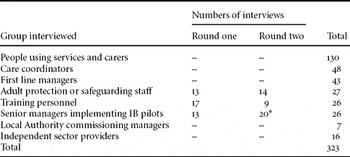
A multi-method approach was adopted, which has been described in detail elsewhere (Glendinning et al., Reference Glendinning, Challis, Fernandez, Jacobs, Jones, Knapp, Manthorpe, Moran, Netten, Stevens and Wilberforce2008). Very briefly, the overall impact of IBs was investigated through a large-scale randomised controlled trial involving random allocation of people using social care services to receive an IB or to continue with traditionally arranged services. Members of both groups were interviewed six months after the initial contact, using a structured interview schedule containing a number of standardised measures of social care and general wellbeing outcomes, as well as asking about care and support arrangements. In addition, semi-structured interviews were undertaken with a wide range of stakeholders, as shown in Table 1.
Interviews undertaken

Note: *Extra interviews were undertaken with these managers as part of a more in-depth exploration undertaken in seven sites.
The data used in this article emerge from semi-structured interviews with care coordinators (including qualified social workers and other care managers), first line managers and a subsample of 130 service users randomised to the IB group (IB holders) who were interviewed two months after the IB had been arranged. All of these participants had direct experience of making or supporting people making choices using IBs.
All interviews with these stakeholders were recorded, with permission, transcribed in full, and were entered into the N-Vivo or MaxQDA qualitative analysis software packages. A coding frame was developed through reading a number of interviews and in the light of theoretical concerns identified by the literature, relating generally to the importance of choice and risk. This was further developed following a process of template coding (DiCicco-Bloom and Crabtree, Reference DiCicco-Bloom and Crabtree2006) and subsequently reordered, as ideas about the importance of relevant themes emerged. During coding, the researchers were in regular contact and also developed descriptions of the major categories and subcategories, along with a series of analytical memos, which contributed greatly to developing understanding of the data. For example, during the coding for the main research, we considered how equity linked to the emerging thematic understanding. Part of the memo recorded in ‘N-Vivo’ is given below:
Equity is another cross cutting theme – i.e. this is a general theme and also appears in specific areas (e.g. Resource Allocation Systems). We will either need to code at both, [the general and specific themes] or think about bringing them together, while retaining their hierarchies. (Memo, original N-Vivo file)
Choice was a major theme in the analysis: data from over four-fifths (41/47) of the care coordinators and over two-thirds (34/46) of team managers interviewed in the IBSEN study were coded at a series of N-Vivo nodes under the rubric of ‘choice’. This subsample came from all sites. Furthermore, data from over half (24/46) of the first line team managers and about two-fifths (19/47) of care coordinators were coded at nodes relating to equity issues. Finally, data from over a third (18/47) of first line managers and almost half (22/47) of care coordinators were coded at nodes relating to power issues. Choice was also a major theme in the service user interviews: the benefits of choice were mentioned by almost half (57/130), 14 of whom cited increased choice as a reason for agreeing to take up an IB. Negative aspects related to choice, such as a concern about a lack of information, were mentioned by 21 service users.
For the purposes of this article, the original coding relating specifically to choice, power and equity was re-examined using the three antagonisms of choice as a theoretical framework. This involved resorting the original coding under new overarching themes mapping onto the three antagonisms of choice. For example, an N-Vivo node grouping discussions about ‘meeting needs differently’, which contained accounts of the challenges of decision-making about novel requests and ideas to use IBs (for example, to purchase large items), was originally coded under a general node of ‘whole process accounts’. The issues raised in the data coded under ‘meeting needs differently’ related to the dilemmas identified by Clarke et al.’s (2007) ‘Public versus private nature of choice’ antagonism and were therefore sorted under a new ‘grandparent node’ collecting all the coding relating to this issue. Other nodes relating to this antagonism included issues around risk, limits to budgets and eligibility. A similar process was undertaken with nodes relating to the other antagonisms, using some of the existing coding already identified as relating to power and equity and some additional nodes relating to related areas. The new coding aimed to develop understanding of the three antagonisms of choice by exploring how they were felt to manifest in the implementation of IBs and also through identification of some counter examples.
Findings
We have reported elsewhere (Glendinning et al., Reference Glendinning, Challis, Fernandez, Jacobs, Jones, Knapp, Manthorpe, Moran, Netten, Stevens and Wilberforce2008) the evidence from the randomised trial that some IB holders tended to have greater feelings of control over daily life, especially people with learning disabilities, which can be seen as a proxy for increased choice. After an initial illustration of general impressions of increased choice resulting from IBs, this article re-examines some of the findings from the stakeholder interviews to explore how IBs operationalised choice, using equity, power and the public–private nature of social care as organising themes. These sections use the conceptual framework represented by the ‘antagonisms of choice’ described above, to analyse these findings, further the theoretical framework through identifying new categories and relationships between ideas.
Increased choice
IBs were felt by many IB holders to allow more choice and control over their use of traditional services, as well as through some of the newer ways of achieving outcomes that they would not have been able to use under previous arrangements, such as going on holiday or gardening. Further, some people using services anticipated being more in control of their IB compared with their Direct Payment, paying only for the hours that their care workers actually worked (as opposed to agencies or individuals charging the local authority for time that was not fully worked); the opportunity to use the resources allocated to purchase items or activities for which Direct Payments could not be used, such as buying a computer or leisure expenses; and the possibility of being more involved in their own care:
There are so many restrictions around care and what agency carers can or cannot do. You're not allowed to assess your own risk and make a choice and we were hoping that with an individual budget we'd be able to do that more. (Person using services)
This flexibility was highly valued by those who were able to take advantage of it. For example, one IB holder at two months said that the ability to take her sister on holiday with her, as a paid carer, had ‘changed my life completely . . . It's given me more say and I can do more’ (Person with a physical disability).
Antagonisms of choice
Equity
Making effective choices about care services requires good information about what is available and at what cost and quality. Gaining access to such information requires social resources or capital, or indeed simple energy and know-how, which potentially advantages people without disabilities or those with better and more powerful networks. This creates a risk of increasing inequality: those with such advantages to start with gain most from the increased choice of services. For example, one older person described ‘shopping around’ for a service and finding a much better and cheaper alternative than that offered by the support planner. This required insight, energy and the ability to identify better buys, which someone with less acumen or with less energy might not be able to do:
I had said to [support planner] ‘Well, God, that's not very much left to have a gardener’ and she said ‘Well that's how it's been worked out’. But of course then I realised and appreciated that . . . the company I'd been put into, the agency, was about the dearest there is in [council district] . . . so I thought, right, well I can do this cheaper myself so . . . I went to a smaller, cheaper and far superior agency. (Person using services)
Indeed, some people using services identified the difficulties others might have in undertaking such market surveys:
You've got to be determined; some people couldn't manage it. I've been through the [telephone enquiry services] Yellow Pages, the Thomson Directory [trade enquiry directory], to get this off the ground. (Person using services)
Having competent and willing relatives also increased the amount of choice available to an individual, which was also borne out by the quantitative findings (Glendinning et al., Reference Glendinning, Challis, Fernandez, Jacobs, Jones, Knapp, Manthorpe, Moran, Netten, Stevens and Wilberforce2008), thus suggesting a risk of poorer outcomes for people without relatives to manage their IBs:
One family I had was really very . . . it was a daughter and son-in-law, very competent and very articulate, and said, fine, yeah, we get this completely and we can do this. They really didn't want that much help at all. (Care coordinator)
As a counter to this potential, other service users noted the value of support for people to access information in ameliorating such inequities and to increase choice in a more even way. Where information was available, users and carers were more easily able to compare the approximate costs of agency staff against directly employed Personal Assistants and thus felt in a better position to balance costs against the level of responsibility they were prepared to undertake:
I was given good guidelines by [social worker] and [broker] on the average cost. . . per hour, of an agency compared to hiring them myself personally and I did lose a few hours doing it the way that I've done it, but reasoned that it was easier than having to deal with employer liability insurance and all the rest of it. (Person using services)
Public versus private nature of using services
Being able to meet needs differently and to support a wider range of outcomes were reported by interviewees in all groups to be the most important benefits of IBs. However, choice was seen by many care management staff in relation to issues of the ‘legitimacy’ of different types of support in terms of publicly decided goals for social care. This is a very clear example of how choice, as realised in the IB pilots, was constructed with a strong normative framework of policy and socially determined constraints. For the purposes of developing a critique of the choice agenda, this suggests the importance of ongoing examination of such external constraints and how they are commonly understood by frontline professionals (a most relevant perspective here) whose decisions constitute the constraints. The following two examples illustrate the kinds of thinking underpinning decisions about legitimacy. For a team manager, deciding to replace personal care with housework services was seen as a ‘legitimate’ use of social care funds, because of the direct link with agreed outcomes:
I think when we get the support plans and we'll have a look at them to make sure that, if we have identified high care needs, then care is in place to provide care for that person. But at the end of the day, if that person chooses not to have the care and chooses to struggle and have something else, then that isn't . . . that's what they have to do. That's their choice. But they can't come back and say, well, no, I need care. . . He is a very proud man and doesn't want personal care. What he wants is other things, so that, when he is up and dressed and tired out, somebody will be there to do other things for him like, [keep] a house tidy. That is a legitimate way to spend their budget. (First line manager)
However, concerns were raised about the legitimacy of using of social care money to purchase, for example, material goods, such as computers or satellite navigation (‘sat nav’) systems for cars, where the link with agreed outcomes that were seen to fit with publicly sanctioned outcomes was felt to be too indirect or non-existent:
But for me about being confident driving around wasn't, that wasn't even essential . . . So you wouldn't spend it on a sat nav. But in another case it might be that the sat nav did meet that need. (First line manager)
This illustrates the key normative issue in terms of concerns over the legitimacy of using public money to purchase what some may regard as luxuries, which influence possible choice of goods and services and raise concerns about equity with similar individuals not in receipt of IBs or social care.
Risk was another major illustration of the difficulties of a focus on individual choice in the light of the tensions between the public and private nature of public services, in addition to external constraints in terms of acceptable goals. Choice was sometimes presented by care coordinators, first line managers and other personnel with responsibility for adult protection or safeguarding as in tension with public concerns about safeguarding vulnerable adults, which are based on an increased awareness of risk (Stevens et al., Reference Stevens, Manthorpe, Martineau, Hussein, Rapaport and Harris2008). These concerns illustrate the public nature of choice over the use of public funds, exercised through a publicly determined process. Public concern about risk has led to care coordinators and managers being mandated to scrutinise and potentially reject individual choice on the grounds of risks to the person, to others and to the public purse, in the sense of wasting public money. As such, this suggests a connection between the public–private tension and power relationships. At the same time, many care coordinators were generally aware of the positive side of risk-taking for development of skills and in terms of human rights. Consequently, choice is seen to be firmly placed within the public gaze and potentially constrained by the power underpinning the public concern, as illustrated by one care coordinator:
I suppose, ultimately, people have to make choices in life. And we can't . . . and we shouldn't, necessarily be protecting people or stopping people from making mistakes, because we all do that. But, at the same time, we have to recognise that some of these folk are definably vulnerable. So those checks and balances need to be in place through safeguarding adults, adult protection through the kind of risk assessment process that we would use from a health point of view. (Care coordinator)
Power relations
As suggested by the last section, power relationships in the context of social care services are intertwined with the public element of choice in this area. Front line social workers can be characterised as street-level bureaucrats (Lipsky, Reference Lipsky1980) who have a measure of discretion in the enactment of policy in direct interaction with members of the public (people using services). Exploring the roles of these professionals can therefore throw light on the implementation of the choice agenda within existing power relations, to explore the tensions described in the introductory discussion. As with the public nature of choice, the views of care coordinators and managers are the most relevant here. Care coordinators have powers over determining eligibility for publicly funded services and over resource allocation assessments. Further, support plans often needed to be signed off by team managers or panels involving more senior managers.
Care coordinators also had a role in promoting choice as coordinators, facilitators and developers of confidence, which suggested a subtle power relationship, involving a sense of taking responsibility for the decision-making process and for the actual decisions themselves. Many focused on exploring options and coordination as key tasks, which involved working with service users to help them identify and prioritise important but realistic goals and to identify the kinds of support needed in order to reach them, as this example demonstrates:
Trying to pull it all together and being clear about what the outcomes are, who can do what and agreeing that, you know, negotiating with people which bits they can do, which bits they could sign up to and what's the time framework. (Care coordinator)
In contrast, several care coordinators described their role in terms of building confidence or empowering service users and carers to think more broadly about their lives, to try to make the best use of the IB to support them in reaching their goals. This suggests a different kind of power relationship, in which the power of the care coordinator lies in their ability and responsibility to enable people using services to develop their potential for making choice (within the limits of acceptability):
And plus the fact, I mean if the client feels confident, if somebody goes out and speaks to them and they've obviously got background knowledge or whatever, and they've got to get that support from somebody else who's confident in that, then that's when you've got to instil more confidence in the service user or the carers or whatever. (Care coordinator)
However, a few social workers described being more directive with some service users and their families in situations where they lacked confidence and also because of a need to ensure that plans were realistic and safe in terms of the goals set. It is through such intervention that care coordinators acted as agents in enforcing the public constraints on decision-making described above, thus perpetuating power inequalities. Care coordinators felt that more emphasis was needed on devising support plans that would work for people through difficult periods, partly as a result of the extra freedom to use money differently, which might lead to such problems being overlooked:
Yes, it should have been thought of in the support plan that when the PA [Personal Assistant] has their four weeks holiday, we've got somebody to step in but where do I get somebody from? Agencies can't do it, you ring an agency and they'll say, when do you want somebody, I'll try and get somebody, but our people need to know who they are, you can't just walk in, oh I'm Fred I'm going to give you a bath today, our people need that reassurance need to get to know how to support them, so what do you do for that week when the PA's away, it's a nightmare. (Care manager)
This highlights the ongoing power relationships involved in such decision-making, and again suggests a sense of responsibility on the part of the professional for the person using services. This is also illustrated in continuing notions of a duty of care laid on the local authority, manifested in liability and culpability in situations of abuse (Law Commission, 2008).
More formal aspects of power relations were also important. After support plans have been devised, they have to be formally ‘signed off’ by the social services department. Some team managers were able to sign off plans, although, in some sites, support plans had to be submitted for approval to a panel of more senior managers. In addition to signing off plans, a small number of care coordinators said that team managers were monitoring or guiding what could go into plans, and questioning why certain services were not being used. Again, this illustrates the power of care coordinators and line managers to enact the public constraints on choice:
When you take the support plans to the managers they can tend to make sort of value judgements on, ‘Well I don't think this'll suit them’ and at one point 'cos we wanted to do a befriender, the manager said, ‘Well you know we've got a befriending service [where paid support workers develop generally supportive relationships with service users in relation to social activities] at the moment, why can't they use that?’ (Care coordinator)
Several care coordinators gave accounts of what they saw as inconsistent decisions being made by panels about components of plans, which created conflicts with service users and carers and between team members. A small number of service users and carers also felt that such difficulties had undermined opportunities for choice and control. Where plans had been sent back to the user to be revised, the reasoning was sometimes seen as difficult to understand. The following example, from a mental health service user, illustrates how choice and the presentation of choice were influenced by the power structures involved in gaining their acceptance:
We had such a palaver about how to word it. On the plan we put down ‘befriender’ and when we tried to get it signed off higher up, it got rejected because of that. So we all got back together and changed the word to ‘companion’. All that added an extra 4–5 days of our time. (Person using services)
Discussion
The qualitative interviews with IB holders and other stakeholders, and the randomised trial, provided evidence supporting the contention that IBs increased perceptions of choice. This fits with the randomised trial findings in relation to perceptions of increased control over daily life (Glendinning et al., Reference Glendinning, Challis, Fernandez, Jacobs, Jones, Knapp, Manthorpe, Moran, Netten, Stevens and Wilberforce2008). Knapp (Reference Knapp, Hills, Le Grand and Piachaud2007) argues that control requires more than being allowed to make decisions, needing more of a shift in power, for example by directly purchasing services. Thus, it is likely that perceptions of control are linked to increased choice. However, perceptions of choice and control can also be considered in relation to the three ‘antagonisms of choice’ proposed by Clark et al. (2007), which suggest tensions between increased levels of choice and issues of equity, and the public–private nature of decisions and power relationships.
Key to this argument is that the focus on choice of service and resources is at best insufficient and potentially counter to the overall goals of independent living and increased autonomy and rights as expressed both by government (Department of Health, 2007) and the Independent Living Movement (Morris, Reference Morris, Glendinning and Kemp2006; Boyle, Reference Boyle2008). This can be seen as a problem, not with the abstract concept of choice, but in the specific emphasis given in public policy to the market model of individual agents making free purchasing choices. The findings discussed in this article support a case for addressing issues of equity, power relations and the public nature of exercising choice in this sphere, in order to realise the potential advantages.
In the domain of social care services, choice will always carry a public element because of the connection with use of public funds, the various pertinent legal frameworks (Manthorpe, Reference Manthorpe2008) and wider public concern about good-quality social care services. These public aspects create power relationships. For example, care coordinators are mandated to exercise control over what are accepted as legitimate ways of spending public welfare funds, creating a built-in power imbalance. Such powers emanate from public concerns about choice, indicating the close connection between these two antagonisms.
Concerns about risk highlight perceived tensions between choice and both the public nature of choice and power relationships created by this public concern. Two accounts of risk in the literature chime with this finding. Boyle (Reference Boyle2008) highlights the need for risk management in order to promote autonomy when planning activities with older people in care homes. Beattie et al. (Reference Beattie, Daker-White, Gillard and Means2005) discuss the risks posed by service users with dementia as limiting their choice. Such limits were partly created because of the reluctance of more generic services to work with people with dementia arising from the perceived risk of harm (linked to aspects of challenging behaviour) posed to staff and other service users. Consequently, choice in social care is constrained by perceptions of the likelihood of people coming to harm through their choices or of the threat that they pose to other people (the public aspect of choice), combined with the degree of power held by care coordinators and social services managers.
Furthermore, giving individuals more choice over service use is likely to be accompanied by an increased responsibility to manage the stress and risks of so doing (Clarke et al., Reference Clarke, Smith and Vidler2006). It is likely that those with more social capital, particularly those with active and able family carers, will be better placed to understand and manage this element, which could exacerbate inequalities.
The analysis we have presented suggests choice has ramifications beyond the individual level to other levels pertinent to the care and support system which cannot be ignored. As Manthorpe (Reference Manthorpe2008) notes, working to clarify and spread understanding of the legal duty of care local authorities have towards people using services may be of value in supporting individual choice. This would serve explicitly to acknowledge the constraints imposed by the antagonism between choice and the public nature of decisions about using services and the power relationships thereby created. Further, the potential for increased inequity resulting from differences in abilities to access the benefits that choice could bring suggests the importance of targeted support provided in making such choices (Glendinning, Reference Glendinning2008). All of this highlights the importance of policy decisions about resources and the development of services to complement efforts to increase individual choice.
Acknowledgments and disclaimer
We are very grateful to all those who participated in this part of the evaluation and to colleagues and participants in the wider evaluation. We thank members of the Department of Health and the Care Services Improvement Partnership for their support and Professor Gerald Wistow for his guidance. The views expressed in this article are those of the authors alone and should not be taken as necessarily shared by the Department of Health. The evaluation was funded by the Policy Research Programme of the Department of Health.