Introduction
The acetolactate synthase (ALS) inhibitors are used for POST control of sedges (Cyperus spp.) in turfgrass. ALS-inhibiting herbicides have low use rates and provide broad-spectrum weed control with limited injury potential to tolerant turfgrasses (Blum et al. Reference Blum, Isgrigg and Yelverton2000; McCullough et al. Reference McCullough, Yu, Brosnan and Breeden2012; Sidhu et al. Reference Sidhu, Yu and McCullough2014). Halosulfuron-methyl (halosulfuron) is a commonly used herbicide for Cyperus control due to its tolerance across all major turfgrasses (Blum et al. Reference Blum, Isgrigg and Yelverton2000; McCullough et al. Reference McCullough, de Barreda, Reed, Yu and Waltz2014; Teuton et al. Reference Teuton, Main, Sorochan, McElroy, Hart, Sams and Mueller2008). Its efficacy on sedges has been well documented (McCullough et al. Reference McCullough, Yu, McElroy, Chen, Zhang, Grey and Czarnota2016a; Vencill et al. Reference Vencill, Richburg, Wilcut and Hawf1995). Application of halosulfuron to the soil or on the foliage of sedges can reduce total biomass and reproductive structures (Vencill et al. Reference Vencill, Richburg, Wilcut and Hawf1995; Webster and Grey Reference Webster and Grey2014; Yu and Boyd Reference Yu and Boyd2017; Yu et al. Reference Yu, Sharpe and Boyd2020). Halosulfuron is often used for Cyperus control when several turfgrass species are managed in golf course, home lawns, or sod production.
During the last decade, resistance to ALS-inhibiting herbicides has increased drastically in various cropping systems (Heap Reference Heap2015). ALS resistance in weeds can be attributed to enhanced herbicide metabolism or target-site alteration (Eberlein et al. Reference Eberlein, Guttieri, Berger, Fellman and Belknap1999; McCullough et al. Reference McCullough, McElroy, Yu, Zhang, Miller, Chen, Johnston and Czarnota2016b; Riar et al. Reference Riar, Tehranchian, Norsworthy, Nandula, McElroy, Srivastava, Chen, Bond and Scott2015; Tranel and Wright Reference Tranel and Wright2002). For these two types of resistance, target-site resistance is more frequently reported and often confers high levels of resistance (Eberlein et al. Reference Eberlein, Guttieri, Berger, Fellman and Belknap1999; McCullough et al. Reference McCullough, Yu, McElroy, Chen, Zhang, Grey and Czarnota2016a, 2016b; Shaner Reference Shaner1999; Whaley et al. Reference Whaley, Wilson and Westwood2006; Yu et al. Reference Yu, Han and Powles2008; Zheng et al. Reference Zheng, Kruger, Singh, Davis, Tranel, Weller and Johnson2011). There are presently six Cyperus species, annual sedge (Cyperus compressus L.), fragrant flatsedge (Cyperus odoratus L.), rice flatsedge (Cyperus iria L.), smallflower umbrella sedge (Cyperus difformis L.), shortleaf spike sedge (Kyllinga brevifolia Rottb.), and yellow nutsedge (Cyperus esculentus L.), that have developed resistance to ALS-inhibiting herbicides (Busi et al. Reference Busi, Vidotto, Fischer, Osuna, DePrado and Ferrero2006; Heap Reference Heap2015; Kuk et al. Reference Kuk, Kim, Kwon, Lee, Burgos, Jung and Guh2004; McCullough et al. Reference McCullough, Yu, McElroy, Chen, Zhang, Grey and Czarnota2016a; Merotto et al. Reference Merotto, Jasieniuk and Fischer2010; Ortiz et al. Reference Ortiz, Torres, Quintana and Lopez2015; Riar et al. Reference Riar, Tehranchian, Norsworthy, Nandula, McElroy, Srivastava, Chen, Bond and Scott2015; Tehranchian et al. Reference Tehranchian, Norsworthy, Bagavathiannan and Riar2015a, 2015b). Among these Cyperus species, C. compressus, C. odoratus, C. iria, and C. difformis are annuals, while the others are perennials. The information about C. compressus seed production is limited in the current literature (Reddi and Reddi Reference Reddi and Reddi2009; Sharma and Shiam Reference Sharma and Shiam1981). Cyperus compressus is an outcrossing species, and pollen-mediated gene flow of nuclear ALS-R alleles from resistant individuals to susceptible C. compressus populations may facilitate the spread of herbicide resistance. This has been documented in various weed species such as giant foxtail (Setaria faberi Herrm.), rigid ryegrass (Lolium rigidum Gaudin), Palmer amaranth (Amaranthus palmeri S. Watson), and wild radish (Raphanus raphanistrum L.) (Volenberg and Stoltenberg Reference Volenberg and Stoltenberg2002; Wise et al. Reference Wise, Grey, Prostko and Vencill2009; Yu et al. Reference Yu, Zhang, Hashem, Walsh and Powles2003, Reference Yu, Han and Powles2008).
Multiple populations of C. compressus with suspected resistance to ALS-inhibiting herbicides have been reported in Georgia turfgrass sod production. At all locations, control of C. compressus declined following the exclusive use of halosulfuron for over a decade. The objectives of this research were to investigate (1) the level of resistance of the two biotypes to ALS inhibitors and (2) molecular mechanisms associated with resistance.
Materials and Methods
Plant Material
Cyperus compressus plants were collected from centipedegrass [Eremochloa ophiuroides (Munro) Hack.] and zoysiagrass (Zoysia japonica Steud.) sod-production fields in July 2015. Locations will not be released in this report in order to protect the privacy of the landowners. At all locations, C. compressus plants uninjured by 70 g halosulfuron ha−1 were collected following routine application. Susceptible C. compressus plants were also collected in Griffin, GA (33.24°N, 84.26°E). The plant materials were transplanted to square plastic pots (Stuewe & Sons, Tangent, OR) with 79-cm2 surface areas and 10-cm depths filled with sand:peat moss (80:20 by volume). The transplanted C. compressus biotypes were then placed in a greenhouse set for 32/25 C (day/night) at the University of Georgia Griffin Campus. Roughly 20 plants of each C. compressus biotype were watered as needed to prevent soil moisture deficiencies. Seeds were collected by hand and dispersed over containers (Stuewe & Sons) with 3.8-cm diameters and 20-cm depths with the previously described soil. Plants were fertigated biweekly (MacroN 28-7-14 Sprayable Fertilizer, LESCO, Cleveland, OH) until reaching a height of ~10 cm before the initiation of the following experiments.
Herbicide Dose–Response Experiments
The C. compressus biotypes were treated with various rates of halosulfuron and imazaquin. Herbicide treatments were calibrated to deliver a spray volume of 187 L ha−1 and applied in a spray chamber with a flat-fan nozzle (8002E, TeeJet® Spraying Systems, Roswell, GA). The susceptible (S) biotype was treated with halosulfuron-methyl (Sandea® 75WG, Gowan, Yuma, AZ) at 4.4, 8.8, 17.5, 35, 70, 140, 280, 560, or 1,120 g ai ha−1. The resistant (R) biotypes were treated at 70, 140, 280, 560, 1,120, 2,240, 4,480, 8,960, or 17,920 g ha−1. Nontreated controls were included in each replication for all biotypes. A non-ionic surfactant (Chem Nut 80-20, mixture of alkyl and arkylaryl polyoxyethylene glycol, 80%, Chem Nut, Albany, GA) at 0.25% v/v was included in the herbicide treatment solution. In a separate experiment, the plants were treated with various doses of imazaquin (Image 70DG, BASF, Research Triangle Park, NC). The S biotype was treated with imazaquin at 35, 70, 140, 280, 560, 1,120, 2,240, 4,480, or 8,960 g ai ha−1. The R biotypes were treated at 280, 560, 1,120, 2,240, 4,480, 8,960, 17,920, 35,840, or 71,680 g ha−1.
At ~1 h after treatment (HAT), plants were placed back in the greenhouse. Irrigation was resumed at 24 HAT. Cyperus compressus control was visually evaluated at 4 wk after treatment on a percent scale, where 0 represented no injury and 100 represented complete foliar desiccation.
In Vitro Enzyme Assays
In vitro activities of ALS were measured in response to imazaquin based on the methods of Dayan et al. (Reference Dayan, Owens, Corniani, Silva, Watson, Howell and Shaner2015). Enzyme extracts from R- and S-biotypes were incubated with a range of imazaquin concentrations (0, 0.01, 0.1, 1, 10, 100, and 1,000 mM) at 37 C. Reactions were stopped, and acetolactate was converted to acetoin by the addition of H2SO4. Acetoin was quantified spectrophotometrically at 540 nm after derivatization with α-napthol, and 1 unit of activity was defined as the ability to produce 1 µg of acetoin g−1 of protein h−1. Response curves were developed using relative activity as a percent of control reactions.
ALS Gene Sequencing
Cyperus compressus leaves (~0.1 g) from two to three plants were harvested by hand and used to isolate cDNA via RNA extraction and reverse transcriptase conversion. For R biotypes, C. compressus plants that survived 70 g halosulfuron ha−1 were used for gene sequencing. A standard guanidinium thiocyanate-phenol-chloroform extraction method was used to perform the RNA extraction (TRIzol® LS Reagent, Life Technologies, Carlsbad, CA). RNA was converted to cDNA by reverse transcriptase polymerase chain reaction (PCR) using the RETROscript® kit (Life Technologies). Part of the ALS gene was sequenced according to the ALS sequence from C. esculentus (GenBank accession number: KM624613.1). Two primer pairs were designed to contain the regions near the Pro-197 and Trp-574 codons (Supplementary Table S1). Eurofins (Eurofins MWG Operon, Huntsville, AL) was used to synthesize the primers. PCR was performed according to the standard protocols in a 25-µl volume containing 250 ng cDNA, 200 µM dNTP, 0.625U Taq DNA polymerase, 4 µM forward and reverse primers, and 1× standard Taq reaction buffer. The PCR was conducted with a Mastercycler (Eppendorf, Hauppauge, NY) using the following method: 95 C for 1 min, 35 cycles of 95 C (denaturation) for 1 min, 60 C (annealing) for 90 s, and 68 C (extension) for 1 min, followed by a final extension step of 5 min at 68 C. The electrophoresis of PCR products was performed using 1.0% agarose gel, stained with ethidium bromide, and then visualized under UV light. After purification using an E.Z.N.A. Gel Extraction Kit (Omega Bio-Tek, Norcross, GA), the PCR products were purified and used for Sanger sequencing by the Genomic and Sequencing Laboratory at Auburn University (32.59°N, 85.49°E). The sequencing results indicated a 410-bp amplicon surrounding the Pro-197 codon (GenBank accession numbers KT150717 and KT150719 for R and S biotypes, respectively) and a 710-bp amplicon surrounding the Trp-574 codon (GenBank [https://www.ncbi.nlm.nih.gov/genbank] accession numbers KT150718 and KT150720 for R- and S-biotypes, respectively).
ALS Gene Expression
Gene expression for ALS was measured in the R and S biotypes using real-time quantitative PCR (qPCR). For R biotypes, C. compressus plants that survived 70 g halosulfuron ha−1 were used for studying ALS gene expression. Plant tissue was harvested and flash frozen in liquid nitrogen, and RNA was extracted using a Purelink RNA Kit (Invitrogen), then treated with Turbo DNase (ThermoFisher, Waltham, MA). A high-capacity cDNA synthesis kit was used to generate cDNA, and primers were designed using Primer3Plus (Supplementary Table S2) (Untergasser et al. Reference Untergasser, Cutcutache, Koressaar, Ye, Faircloth, Remm and Rozen2012). A Quantstudio 3 (ThermoFisher) machine was used to perform qPCR using a SYBR Green Master Mix (ThermoFisher). A total of four biological replicates were used in gene expression experiments in addition to three technical replicates per sample. Relative gene expression was uncovered with the ΔΔCT method, using actin as the endogenous control gene (Schmittgen and Livak Reference Schmittgen and Livak2008).
Copy number analysis for ALS was performed using qPCR (D’Haene et al. Reference D’Haene, Vandesompele and Hellemans2010). Plant genomic DNA was extracted using a PlantJET DNA extraction kit (ThermoFisher) and quantified using a nanodrop spectrophotometer. Relative quantification was performed using the ΔΔCT method to determine whether there were differences in gDNA copy numbers between biotypes (Gaines et al. Reference Gaines, Barker, Patterson, Westra, Westra, Wilson, Jha, Kumar and Kniss2016). The copy number of actin was predetermined to be equal between biotypes and therefore was used as the endogenous control gene; primer sequences are provided in Supplementary Table S2. A total of four biological replicates with three technical replicates per sample were used and melt-curve analysis was performed to ensure there were no off-target amplification products.
Experimental Design and Data Analysis
The greenhouse and laboratory experiments were designed as a randomized complete block with five and four replications, respectively. All experiments were conducted twice over time. In greenhouse experiments, all experimental units were arranged in a block design to reduce the potential variability of location on plant responses to treatments. In ALS inhibition experiments, the block design was used due to the duration of time needed to perform one replication and to minimize the potential variability of laboratory conditions over time.
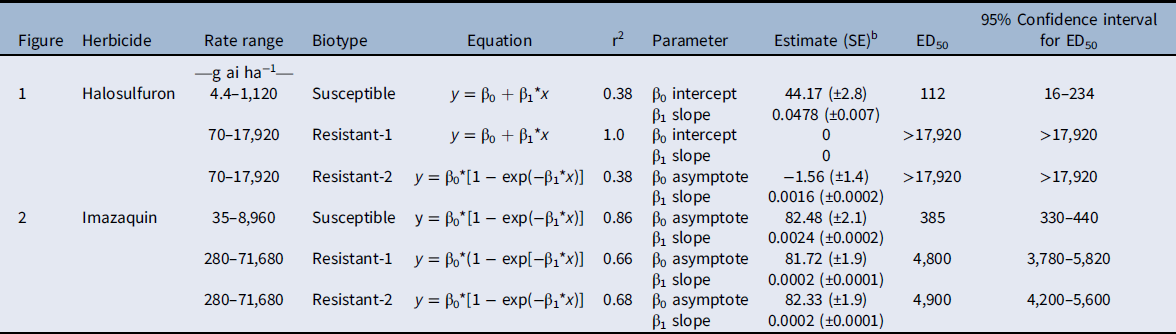
Data were analyzed in SAS with the PROC GLM (SAS v. 9.3, SAS Institute, Cary, NC). ANOVA was used to examine the significance of treatment by experimental run interaction. For the herbicide dose–response experiments, C. compressus control data were analyzed using a two-parameter exponential rise to maximum nonlinear regression analysis with the following equation:
 $$y = {\rm{\rbeta} _0}*\{ 1 - [\exp ( - {\rm{\rbeta} _1}*x)]\}$$
where y is control, β0 is the asymptote, β1 is the slope estimate, and x is herbicide rate; or linear regression analysis with the following equation:
 $$y = {\rm{\rbeta} _0} + {\rm{\rbeta} _1}*x$$
where y is control, β0 is the intercept, β1 is the slope estimate, and x is herbicide rate. The ED50, effective herbicide dose required to control 50% of C. compressus was determined from the regression curves. The ALS enzyme inhibition data were analyzed using a four-parameter sigmoid nonlinear regression analysis with the following equation:
 $$y = {\rm{\rbeta} _0} +{{\left( {{\rm{\rbeta} _1} - {\rm{\rbeta} _0}} \right)}\over{{{1 + \exp [ - {\rm{\rbeta} _2}(x - {\rm{\rbeta} _3})]}}$$
where y is the relative ALS enzyme activity compared with control plants, β0 is the lower asymptote, β1 is the upper asymptote, β2 is the growth rate, β3 is the inflection point, and x is the log concentration of imazaquin. The I50, the concentration of imazaquin that reduced ALS enzyme activity by 50% compared with control reactions, was determined from the regression curves. The regression models were selected because they illustrated the relationship of the herbicide dose–response curves with rate of herbicide after plotting treatment means in figures.
Results and Discussion
Resistance Levels to ALS Inhibitors
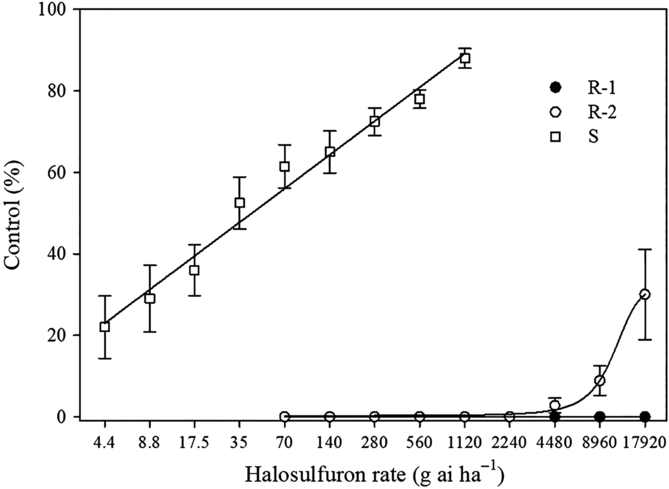
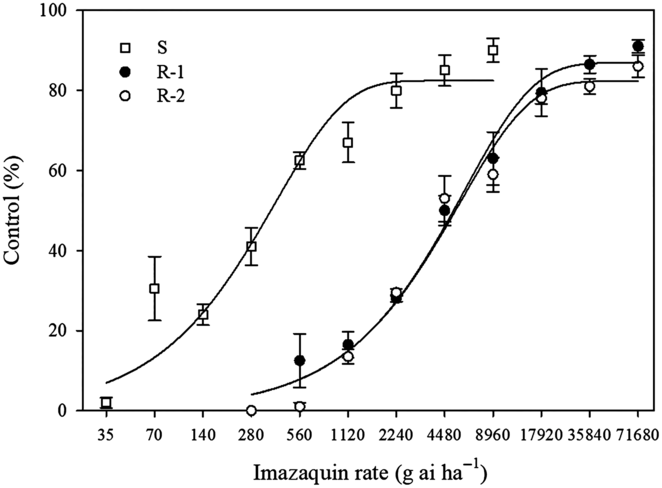
The R biotypes exhibited high levels of resistance to halosulfuron. The estimated ED50 of the S biotype was 112 g ha−1, while the ED50 of the R biotypes (both R-1 and R-2) was >17,920 g ha−1 (Table 1; Figure 1). All biotypes exhibited phytotoxicity to imazaquin after 4 wk, as the ED50 values were 385, 4,800, and 4,900 g ha−1 for the S, R-1, and R-2 biotypes, respectively (Table 1; Figure 2). The 95% confidence intervals for these estimates indicated that all R biotypes had statistically greater ED50 values than the S biotype but had comparable resistance levels to these herbicides. The resistance factors for the R biotypes measured >160 and 12 times greater than the S biotypes for halosulfuron and imazaquin, respectively.

Cyperus compressus control at 4 wk after halosulfuron treatments in two combined greenhouse experiments. Vertical bars represent standard errors of the means (n = 10).

Cyperus compressus control at 4 wk after imazaquin treatments in two combined greenhouse experiments. Vertical bars represent standard errors of the means (n = 10).

In Vitro Enzyme Activity
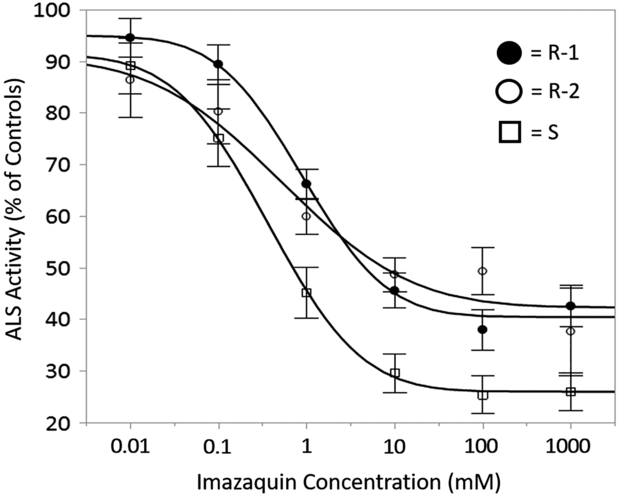
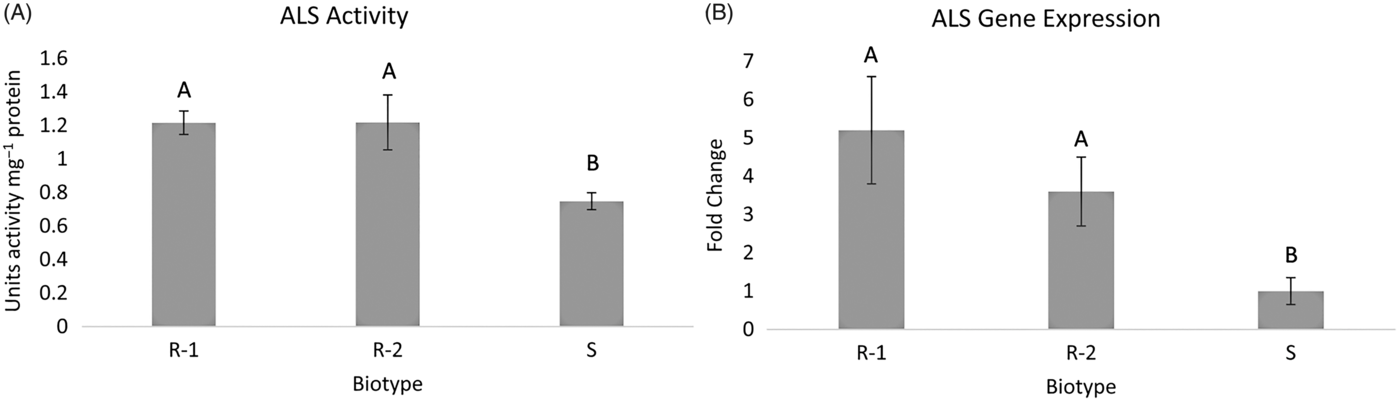
Addition of imazaquin resulted in a significant decrease in ALS enzyme activity for all biotypes. However, the S biotype was relatively more sensitive than R biotypes, with relative activity declining more rapidly and to a greater extent compared with control reactions when exposed to increasing imazaquin concentrations (Figure 3). The I50 value was 0.7 mM in the S biotype, which was significantly lower than in R biotypes, which had I50 values of 4.3 mM and 7.3 mM for R-1 and R-2, respectively (Table 2). Control reactions in R biotypes also had 63% greater ALS enzyme activity per milligram of extracted protein compared with the S biotype, with both R biotypes having 1.22 units of enzyme activity compared with 0.75 units in the S biotype (Figure 4A). A wide range of differences in relative in vitro ALS activity among resistant and susceptible biotypes due to point mutations has previously been found in other studies, from 2-fold more tolerant (Riar et al. Reference Riar, Norsworthy, Srivastava, Nandula, Bond and Scott2013) up to greater than 1,000-fold (Kuk et al. Reference Kuk, Kim, Kwon, Lee, Burgos, Jung and Guh2004). In vitro ALS assays are not only dependent on the specific genotype but also the chemistry being used, with different ALS inhibitors resulting in different levels of inhibition (Merotto et al. Reference Merotto, Jasieniuk, Osuna, Vidotto, Ferrero and Fisher2009; Saari et al. Reference Saari, Cotterman and Primiani1990). Furthermore, resistance to ALS inhibitors may involve multiple mechanisms, including non–target site and target site (Christopher et al. Reference Christopher, Powles and Holtum1992). Consistent with the finding in this study, increased ALS activity has been found in resistant plants with a Pro-197-Ser substitution, which may potentially also affect plant metabolism and herbicide resistance (Yu et al. Reference Yu, Zhang, Hashem, Walsh and Powles2003, Reference Yu, Nelson, Zheng, Jackson and Powles2007).
Response curves for in vitro acetolactate synthase (ALS) activity of resistant (R-1, R-2) and susceptible (S) biotypes in response to imazaquin relative to controls. Test imazaquin concentrations ranged from 0 to 1,000 mM and are presented on a log scale. Bars represent SE.

Regression parameters for in vitro inhibition of acetolactate synthase (ALS) activity by imazaquin.a

a The concentration of imazaquin required to cause 50% in vitro inhibition of ALS activity (I50) was calculated from concentration–response curves.
b SE, standard error of estimate.
In vitro activity (A) of acetolactate synthase (ALS) of resistant (R-1, R-2) and susceptible (S) biotypes in control plants represented as units of activity per milligram extracted protein. Gene expression (B) of ALS using real-time PCR comparing relative gene expression to the endogenous control gene actin. Bars represent SE and letters signify statistical groupings using Fisher’s protected LSD at P ≤ 0.05.

Comparative Sequence Analysis of the Genes Encoding ALS Enzymes
Previous research demonstrated that Pro-197 and Trp-574 are common amino acid substitution sites that confer a high-level resistance to sulfonylureas (Corbett and François Reference Corbett and François2006; Heap Reference Heap2015). It was reported that these amino acid substitutions in the ALS gene conferred resistance in C. difformis (Tehranchian et al. Reference Tehranchian, Riar, Norsworthy, Nandula, McElroy, Chen and Scott2015b), C. esculentus (Tehranchian et al. Reference Tehranchian, Norsworthy, Nandula, McElroy, Chen and Scott2014, Reference Tehranchian, Norsworthy, Bagavathiannan and Riar2015a), and C. iria (Riar et al. Reference Riar, Tehranchian, Norsworthy, Nandula, McElroy, Srivastava, Chen, Bond and Scott2015). Our data revealed a mutation (CCC-TCC) in the ALS enzymes resulting in a Pro-197-Ser amino acid substitution codon in all R biotypes. Mutations in the Trp-574 codon or other known target-site codons were not detected. It was reported that Pro-197-Ser substitution in ALS confers high levels of resistance to bispyribac, chlorimuron, cloransulam, chlorsulfuron, and imazethapyr (Guttieri et al. Reference Guttieri, Eberlein and Thill1995; Powles and Yu Reference Powles and Yu2010; Tal and Rubin Reference Tal and Rubin2004; Uchino and Watanbe Reference Uchino and Watanabe2002). Therefore, these findings confirmed that the Pro-197-Ser amino acid substitution conferred resistance in the R biotype of C. compressus.
Pro-197 amino acid substitutions in the ALS enzyme caused herbicide resistance in various weed species such as flixweed [Descurainia sophia (L.) Webb ex Prantl] (Zhang et al. Reference Zhang, Xu, Wang, Li and Zheng2018), horseweed [Conyza canadensis (L.) Cronquist] (Zheng et al. Reference Zheng, Kruger, Singh, Davis, Tranel, Weller and Johnson2011), kochia [Bassia scoparia (L.) A.J. Scott] (Legere et al. Reference Legere, Stevenson, Beckie, Warwick, Johnson, Hrynewich and Lozinski2013), shepherd’s purse [Capsella bursa-pastoris (L.) Medik.] (Jin et al. Reference Jin, Liu, Huan, Wu, Bi and Wang2011), and R. raphanistrum (Li et al. Reference Li, Uy, Han, Vila-Aiub and Powles2012; Yu et al Reference Yu, Zhang, Hashem, Walsh and Powles2003). Charest et al. (Reference Charest, Hattori, DeMoor, Iyer and Miki1990) noted cross-resistance to imidazolinones and sulfonylureas after inserting ALS genes from a mutant line of Arabidopsis thaliana (L.) into cultivated tobacco (Nicotiana tabacum L.). Wiersma et al. (Reference Wiersma, Schiemann, Condi, Crosby and Molone1989) confirmed resistance to ALS inhibitors when mutant ALS genes separated from canola (Brassica napus L.) were expressed in tobacco transformants.
The cross-resistance pattern caused by the ALS mutation is related to its specific site on the ALS gene (Liu et al. Reference Liu, Yuan, Du, Guo, Li, Bi and Wang2015; Tranel et al. Reference Tranel, Wu and Sadeque2017; Yang et al. Reference Yang, Deng, Wang, Liu, Li and Zheng2018; Yu and Powles Reference Yu and Powles2014). For example, previous studies found that mutations at Pro-197 conferred resistance to sulfonylurea but not imidazolinone (Yu et al. Reference Yu, Han and Powles2008), mutations at Ala-122 provided resistance to imidazolinone but not sulfonylurea (Yu and Powles Reference Yu and Powles2014), and mutations at Trp-574 caused a broad-spectrum resistance to imidazolinone, triazolopyrimidine, pyrimidinyl thiobenzoate, sulfonylamino-carbonyltriazolinone, and sulfonylurea herbicides (Powles and Yu Reference Powles and Yu2010; Wang et al. Reference Wang, Ge, Zhao, Zhang, You, Wang, Liu and Wang2019). Yu et al. (Reference Yu, Han and Powles2008) found several substitutions at Pro-197 in ALS-resistant L. rigidum from Australia. These mutations conferred resistance to the sulfonylurea herbicide sulfometuron but resulted in low or no resistance to an imidazolinone herbicide, imazapyr. Similarly, Panozzo et al. (Reference Panozzo, Scarabel, Tranel and Sattin2013) found two polyploid species of barnyardgrass [Echinochloa crus-galli (L.) P. Beauv.] populations in Italy were resistant to a sulfonylurea, azimsulfuron, but not to an imidazolinone, imazamox. In the present study, partial resistance may be occurring from the Pro-197-Ser substitution, which may explain the differences in resistance factors between halosulfuron and imazaquin in the C. compressus biotypes.
ALS Gene Expression
Compared with the S biotype, R-1 and R-2 had significantly higher ALS gene expression (P ≤ 0.05), being 5.2- and 3.6-fold greater, respectively (Figure 4B). No differences in gene copy number were found between any biotypes for the ALS gene. Greater accumulations of the ALS enzyme may account for the higher levels of enzymatic activity seen in control plants not treated with herbicide and may represent another factor influencing herbicide tolerance in sedges. Increased gene expression is a well-documented form of non–target site herbicide resistance (Powles and Yu Reference Powles and Yu2010; Yuan et al. Reference Yuan, Tranel and Stewart2007). Gene copy number can be an important factor influencing accumulation of enzymes targeted by herbicides; in A. palmeri, up to a 160-fold increase in 5-enolpyruvylshikimate-3-phosphate synthase copy number was responsible for herbicide resistance (Gaines et al. Reference Gaines, Zhang, Wang, Bukun, Chisholm, Shaner, Nissen, Patzoldt, Tranel, Culpepper, Grey, Webster, Vencill, Sammons and Jiang2010). However, in this study, there were no relative differences in copy number between resistant and susceptible biotypes, indicating that gene regulation and not increased copy number was responsible for elevated expression levels. While greater levels of gene expression or transcript stability may result in increased accumulation of the ALS enzyme, the contribution of these factors to overall herbicide resistance is unclear. Higher gene expression in R biotypes may be an important factor enhancing herbicide tolerance, but further studies are needed to fully support this conclusion, particularly because transcription does not always equal translation, and posttranslational regulation may affect actual protein levels (Kuhlemeier Reference Kuhlemeier, Schilperoort and Dure1992).
Research Summary and Implications from These Findings
ALS-inhibiting herbicides are effective for POST control of C. compressus in turfgrass systems. The present study confirms that the repeated use of halosulfuron selected resistance in C. compressus populations that were also partially resistant to imazaquin. A point mutation was detected from gene sequencing analysis and a Pro-197-Ser substitution in the ALS enzyme of R biotypes caused resistance to ALS inhibitors. The R biotypes exhibit higher ALS gene expression compared with the S biotype, although the gene copy numbers were similar between the biotypes. Overall, the herbicide resistance in these ALS-resistant C. compressus populations is associated with target-site mutations and enhanced ALS gene expression.
The confirmation of these ALS-resistant C. compressus populations has serious implications for sustainable weed management in turfgrass systems. Turfgrass managers need to use multiple weed control tactics, including hand weeding and mechanical weed suppression, in addition to chemical weed control. However, it is impractical to perform hand weeding in large turfgrass areas with heavy weed infestations. Pollen-mediated gene flow of nuclear ALS-resistant alleles from resistant individuals to susceptible populations may exacerbate the resistance problem, because C. compressus is an outcrossing species. Thus, herbicide-resistant C. compressus should be controlled before its flowering stage.
Alternating herbicide modes of action for control of C. compressus is important for herbicide resistance management. Rather than exclusively using ALS-inhibiting herbicides, other POST herbicides, such as bentazon, glyphosate, glufosinate, and sulfentrazone (Anonymous 2008, 2015; McCullough et al. Reference McCullough, Yu, McElroy, Chen, Zhang, Grey and Czarnota2016a), which offer different modes of action, will need to be incorporated into the weed management program for control of C. compressus. However, these herbicides may have limitations, such as herbicide drift, limited weed control efficacy, less turfgrass safety, and use-area restrictions. Rotating herbicide mechanism of action for PRE control of ALS-resistant C. compressus would be critical for sustainable management. In addition, several PRE herbicides, such as oxadiazon, sulfentrazone, or S-metolachlor (Anonymous 2008, 2011a, 2011b; Kamrozzaman et al. Reference Kamrozzaman, Khan, Ahmed and Quddus2016), can be used for control of C. compressus. Turfgrass managers who use ALS-inhibiting herbicides for C. compressus control may need to integrate these PRE herbicides to manage C. compressus populations in turfgrass systems.
Supplementary material
To view supplementary material for this article, please visit https://doi.org/10.1017/wsc.2020.59
Acknowledgments
This research received no specific grant from any funding agency or the commercial or not-for-profit sectors. No conflicts of interest have been declared.