Introduction
Kiwifruit (Actinidia deliciosa A. Chev. C.F. Liang and A.R. Ferguson; family Actinidiaceae) is a deciduous, perennial vine that belongs to the Stellatae section of the Actinidia genus. Most of the species in the Stellatae occur south of the Yangzi River where they probably evolved in association with the subtropical flora of South-East Asia (Ferguson and Huang, Reference Ferguson, Huang and Janick2007). The subtropical forest of China is characterized by high temperature and abundant rainfall in summer and low temperature with little rainfall in winter (Fang and Yoda, Reference Fang and Yoda1991). All Actinidia species live in the understorey, they can scramble along the ground but climb trees wherever possible, where they flower and fruit (Gao and Xie, Reference Gao and Xie1990; Ferguson and Huang, Reference Ferguson, Huang and Janick2007; Ferguson and Seal, Reference Ferguson, Seal and Hancock2008). Mature fruits are eaten by birds and seeds are subsequently dispersed (Logan and Xu, Reference Logan and Xu2006). It has been observed that new kiwifruit seedlings are established in light gaps in mixed evergreen–deciduous forests (Ferguson and Huang, Reference Ferguson, Huang and Janick2007). Although in the past 30–40 years some systematic domestication and widespread cultivation of the genus have occurred, kiwifruit is one such crop in which there was little selection pressure and it is still very similar to plants in the wild (Ferguson, Reference Ferguson2007).
Kiwifruit seed germination is poor or erratic because of dormancy. Seed dormancy is a physiological condition that restricts or prevents germination in otherwise favourable conditions (Baskin and Baskin, Reference Baskin and Baskin2004) and determines the range of conditions permissive for germination (Harper, Reference Harper1977; Bewley and Black, Reference Bewley and Black1994; Bradford, Reference Bradford2005; Finch-Savage and Leubner-Metzger, Reference Finch-Savage and Leubner-Metzger2006). The intrinsic molecular mechanisms determining dormancy can have an embryo and/or a coat component (Hilhorst, Reference Hilhorst1995; Bewley, Reference Bewley1997; Kucera et al. Reference Kucera, Cohn and Leubner-Metzger2005) that can interact to determine the degree of ‘whole-seed’ dormancy (Finch-Savage and Leubner-Metzger, Reference Finch-Savage and Leubner-Metzger2006). Dormancy can be affected by the environment through two kinds of factors: (1) those that govern changes in the depth of dormancy; and (2) those which, once the dormancy level is sufficiently low, remove the ultimate constraints and induce seed germination (Benech-Arnold et al., Reference Benech-Arnold, Sánchez, Forcella, Kruk and Ghersa2000; Batlla et al., Reference Batlla, Kruk, Benech-Arnold, Benech-Arnold and Sanchez2004). Temperature is one of the main factors that influence the depth of dormancy (Vleeshouwers et al., Reference Vleeshouwers, Bouwmeester and Karssen1995; Baskin and Baskin, Reference Baskin and Baskin2014). In some non-tropical species (i.e. summer annuals) a period of low temperatures during winter, sensed by hydrated seeds, assists in alleviating dormancy (Bewley and Black, Reference Bewley and Black1994). This way of relieving seeds from dormancy has been used traditionally in forestry and horticulture, and this practice is referred to as stratification. It is based on the simulation of the natural conditions that seeds endure before germination.
Light and fluctuating temperatures carry environmental information and are among the factors that can terminate dormancy (Taylorson and Borthwick, Reference Taylorson and Borthwick1969; Frankland, Reference Frankland and Smith1981; Probert, Reference Probert and Fenner1992; Benech-Arnold et al., Reference Benech-Arnold, Sánchez, Forcella, Kruk and Ghersa2000). The amplitude of daily fluctuating temperatures can be sensed by seeds, and it is generally considered as an indicator of depth of burial: the wider the temperature range occurring near the surface, for many species, the stronger the signal to terminate dormancy (Koller, Reference Koller and Kozlowski1972; Thompson et al., Reference Thompson, Grime and Mason1977; Thompson and Grime, Reference Thompson and Grime1979, Reference Thompson and Grime1983; Ghersa et al., Reference Ghersa, Benech-Arnold and Martinez-Ghersa1992). Furthermore, a high temperature fluctuation near the surface may indicate a sparse above-ground canopy, i.e. a low competition risk for the new seedling (Fenner, Reference Fenner2000). For seeds on or very near the surface, the amount of canopy cover (and thus future competition) can be detected not only through soil thermal amplitude (Thompson et al., Reference Thompson, Grime and Mason1977) but also by the spectral balance of incoming light (Górski, Reference Górski1975; King, Reference King1975; Fenner, Reference Fenner1980; Silvertown, Reference Silvertown1980). Since green tissues absorb efficiently in the human-visible range (including red light; R: ~680 nm) but reflects and transmits most of the far-red radiation (FR: ~720 nm), the presence of a canopy cover is characterized by a reduction in the R:FR ratio (Ballaré et al., Reference Ballaré, Sánchez, Scopel, Casal and Ghersa1987, Reference Ballaré, Scopel and Sánchez1990). This environmental signal can be perceived by the seed through common plant photoreceptors, the phytochromes, which can ultimately modulate dormancy and therefore seed germination (Smith, Reference Smith1982).
In different plant species, maternal factors can markedly influence the ability of seeds to germinate, so that separation of seeds from the fruit pulp can change germination patterns. It has been shown that several compounds present in the fruit pulp can reduce germination success by altering the microenvironment of the seeds [for example, osmotic pressure (Berry and Bewley, Reference Berry and Bewley1992) or light regime (Cipollini and Levey, Reference Cipollini and Levey1997)] and, more directly, blocking biochemical pathways of germination (Evenari, Reference Evenari1949; Mayer and Poljakoff Mayber, Reference Mayer and Poljakoff Mayber1989; Lisci and Pacini, Reference Lisci and Pacini1994; Cipollini and Levey, Reference Cipollini and Levey1997).
It is known that both stratification and fluctuating temperatures are required to obtain high germination levels from kiwifruit seeds (Smith and Toy, Reference Smith and Toy1967; Lawes and Anderson, Reference Lawes and Anderson1980). However, to our knowledge, no attempt to characterize the range of temperatures effective as a dormancy-alleviating factor, or the effect of light on germination, has been reported for this crop. In this study we performed experiments to characterize the dormancy-breaking and germination requirements of kiwifruit seeds, in particular the effect of temperature and duration of stratification on dormancy alleviation, as well as experiments to determine environmental factors such as temperature and light quality on dormancy termination. The involvement of seed coats and maternal tissues on germination were also investigated.
Materials and methods
Plant material
Intact fruits were collected from A. deliciosa (var. deliciosa cv. Bruno) plants grown in the orchard of the School of Agriculture (University of Buenos Aires) (34°35′S, 58°29′W), Buenos Aires, Argentina. Male plants were from cv. Tomuri. Fruits were harvested at physiological maturity when they reached 6.6% soluble solids (Harman, Reference Harman1981). At harvest, fruits were separated in two groups, one was placed in a cold room at 2°C and the other group was maintained at room temperature until use.
Water uptake by intact seeds
After initial mass determination, seeds were placed into Petri dishes (90 mm diameter) containing a layer of filter paper moistened with 4 ml of distilled water. After 0.5, 1, 2, 3, 12 and 24 h, seeds were removed from the dishes, lightly blotted with a paper towel and fresh weight was determined. There were four replicates of 20 seeds each. Fresh weight increase was calculated using the formula [(W f − W i)/W i] × 100, where W i is the initial seed weight and W f the weight after a certain time.
Imbibition conditions
Freshly harvested seeds were surface sterilized by immersion in a sodium hypochlorite solution, containing 1% chlorine, for 20 min to extract pulp remainders. The seeds were then washed three times with distilled water and placed in plastic Petri dishes (90 mm diameter) containing a layer of filter paper moistened with 4 ml of distilled water. Petri dishes were sealed with Parafilm and placed inside black polyethylene bags to avoid any exposure to light.
Germination test
Imbibed seeds were placed in darkness in two environmental chambers, each with a particular temperature regime. In one case, the temperature was kept constant at 25°C, whereas in the other the temperature alternated between 20°C (15 h) and 30°C (9 h), termed ‘fluctuating temperatures’ below. Seeds were visually inspected weekly under a green safe light (Burkart and Sánchez, Reference Burkart and Sánchez1969). Preliminary studies showed that incubation at alternating temperatures of 15/25°C showed the same results as incubation at 20/30°C, and that the performance of seeds incubated at a constant temperature of 20°C was similar to that of seeds incubated at 25°C. For simplicity, we present in this paper the results of 20/30°C and 25°C only. Germinated seeds were counted and removed. The remaining seeds were returned to their corresponding thermal regime. A radicle length of at least 1 mm was the criterion for germination.
Stratification treatments
Intact seeds were placed in Petri dishes, as described above. To test the effectiveness of different stratification temperatures, seeds were stratified at 2, 5 and 12°C. Weekly, for 5 weeks, three replicates containing 30 seeds each from each stratification temperature were transferred to constant (25°C) or fluctuating (20/30°C) temperatures to test for germination in darkness. For other experiments seeds were stratified at 4°C for 4 weeks and four replicates containing 50 seeds each were used for each light treatment (see below), and subsequent incubation at constant (25°C) or fluctuating (20/30°C) temperatures. To test if the presence of mesocarp could alter low-temperature perception by the seeds, intact fruits were stored at 2°C for 4 weeks. After this period seeds were extracted as described above.
Light treatments
For light treatments, imbibed seeds were handled under a green safe light (Burkart and Sánchez, Reference Burkart and Sánchez1969) in a dark room. A 20-min R or FR light pulse was given to the seeds. Incandescent bulbs in combination with a water filter were used as the light source and radiation was filtered through a red acetate filter for the R treatment, or a red acetate filter and six 2-mm-thick blue acrylic filters for the FR treatment (Paolini 2031; La Casa del Acetato, Buenos Aires, Argentina). The calculated Pfr/P was 87 and 10% for the R and FR treatment, respectively (Casal et al., Reference Casal, Sánchez, Benedetto and De Miguel1991). In the experiments designed to test the participation of phytochrome B (Phy B) in germination, FR and R pulses, as described above, were applied sequentially to the seeds, with a 1 h interval of darkness between the pulses. In all cases there were four replicates of 50 seeds each and control seeds were maintained in darkness.
Effect of the maternal tissue on seed germination
Seeds from fruits stored at 2°C for 4 weeks were extracted and surface sterilized as described above and placed on sterile filter paper moistened with sterile distilled water (4 ml) in eight sterile Petri dishes. Slices of kiwifruit were cut with a sterilized scalpel, after the fruit surface was sterilized by immersing in ethanol and flaming it. The sterilized slices were placed inside four of the Petri dishes, without covering the seeds. This procedure was carried out in a laminar flow cabinet. Petri dishes were sealed with Parafilm, placed in black plastic bags and transferred to a fluctuating-temperature chamber to test germination.
Seed coat removal
To soften the coats, surface-sterilized seeds were immersed in distilled water for 1 h prior to removal. Coats were removed with a scalpel under a stereoscopic microscope (Nikon SMZ 10; Nikon, Tokyo, Japan). De-coated seeds were placed in Petri dishes, as described above for intact seeds, and transferred to a refrigerator for 24 h prior to incubation at constant or fluctuating temperatures. Germination was assessed after 10 d. Seeds that did not germinate in this germination test were subjected to a tetrazolium test to assess viability. For chemical scarification, seeds were soaked in sulphuric acid (25% v/v) for 30 min and then washed thoroughly with distilled water before transfer to the germination process.
Viability test
To check the percentage of viable seeds, the tetrazolium test was applied to a subsample of the recently harvested seed batch used in the experiments shown in this paper. The whole seed coats were removed and the embryos were placed in tetrazolium solution (Sigma Chemical Co., St Louis, Missouri, USA). Seeds were immersed in a tetrazolium solution at 1%, incubated at 30°C for 48 h in darkness and then assessed for their coloration. There were three replicates of 20 seeds each. At the end of the seed coat removal experiment the same test was applied to the seeds that did not germinate, to check that seeds had not been damaged during seed manipulation.
Statistical analysis
To test for significant effects of incubation temperature, temperature and duration of stratification on the proportion of germinated seeds we used a generalized linear model in R (R Core Team, 2016) with a binomial distribution and logit link function. The number of germinated seeds divided by the total number of viable seeds was used as the dependent variable; stratification temperature, duration of stratification and incubation temperature were treated as fixed factors. When necessary, we corrected for overdispersion by applying the Williams’ method implemented in the package dispmod (Scrucca, Reference Scrucca2012). A full model including all interactions was analysed and significance was tested with Type II Likelihood Ratio Test (car package; Fox and Weisberg, Reference Fox and Weisberg2011). Significant interactions were tested with the lsmeans function (Lenth, Reference Lenth2016). The same procedures were used for the rest of the analyses performed. In all the experiments that involved the perception of light, light and incubation temperature were used as fixed factors. To test the effect of seed coat removal on seed germination, presence of seed coats and temperature of incubation were used as fixed factors. To test the effect of fruit pulp on seed germination, fruit pulp was used as the only fixed factor. To test the effect of seed coat chemical scarification on seed germination, acid treatment was used as the fixed factor. To test seed cover permeability we used a t-test to evaluate whether the average of weight gain was different from zero.
Results
Effect of temperature and time of stratification
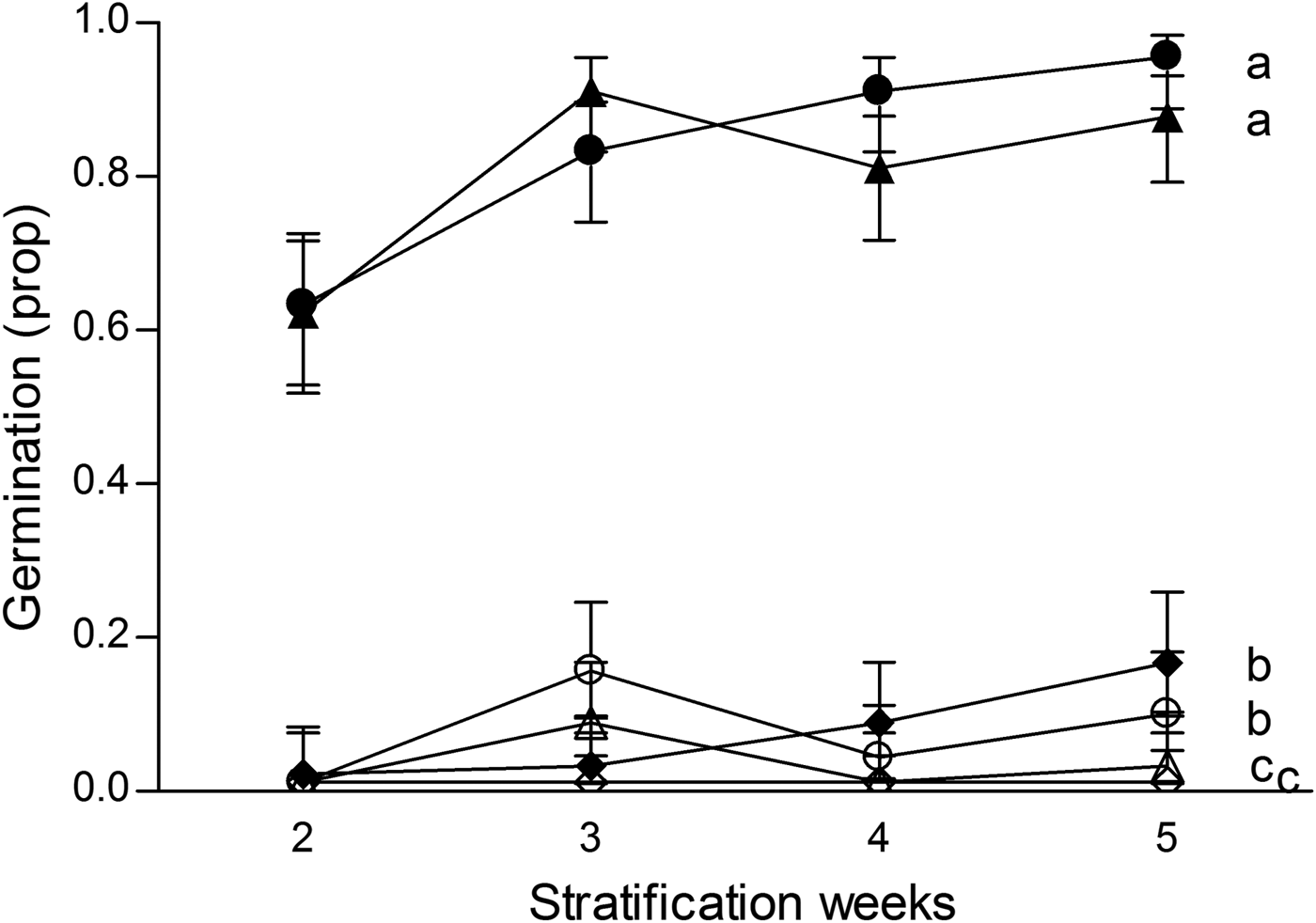
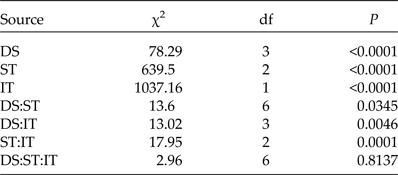
Intact, freshly harvested, mature seeds failed to germinate at constant or fluctuating temperatures in darkness, even though they were alive, as shown by the tetrazolium test (96 ± 2%). Stratification at 2 or 5°C followed by incubation at fluctuating temperatures significantly increased germination as stratification time increased (Fig. 1, Table 1). The maximum percentage of germination was reached after 3 weeks of stratification at both stratification temperatures. In contrast, if stratification was followed by incubation at constant temperature, germination was very low regardless the stratification time (Fig. 1, Table 1). Seeds stratified at 12°C showed low germination (<16%) in all the conditions tested (Fig. 1, Table 1).
Effect of temperature and duration of stratification, and subsequent temperature of incubation, on final germination of A. deliciosa. Seeds were stratified at 2 (circles), 5 (triangles) or 12°C (diamonds) for the indicated periods and then transferred to fluctuating temperatures (20/30°C, closed symbols) or constant temperature (25°C, open symbols) for germination in darkness. Different letters indicate significant differences between means (α = 0.05) regardless of stratification time. Each value is the mean (±95% binomial confidence intervals) of three replicate samples of 30 seeds each.

Test of the effect of temperature and duration of stratification (ST and DS, respectively) and subsequent incubation temperature (IT) on final germination of A. deliciosa. χ2 likelihood ratio tests based on type II analysis. For a full description of treatments, see Materials and methods and Fig. 1

Light quality perception by imbibed seeds
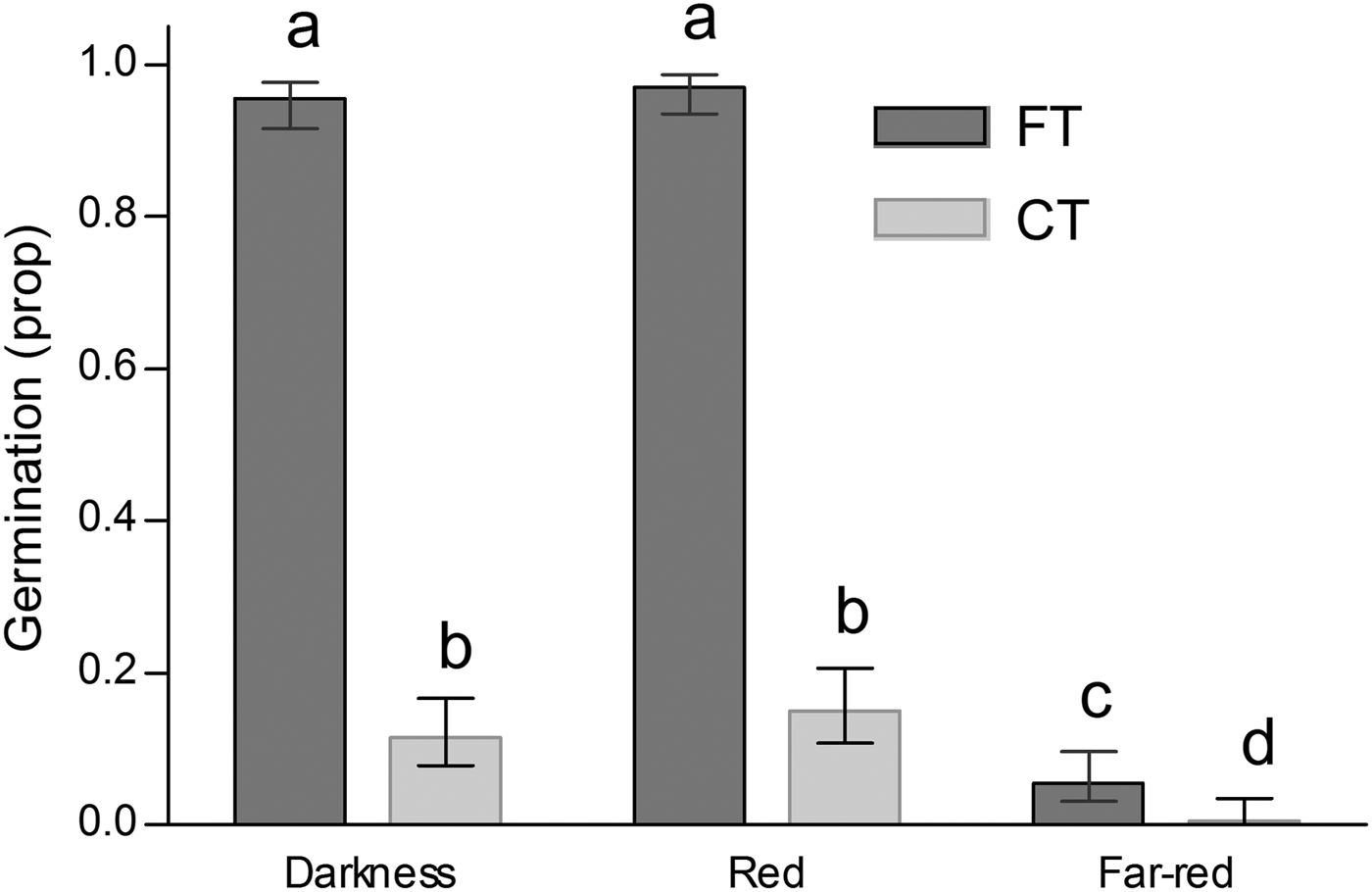
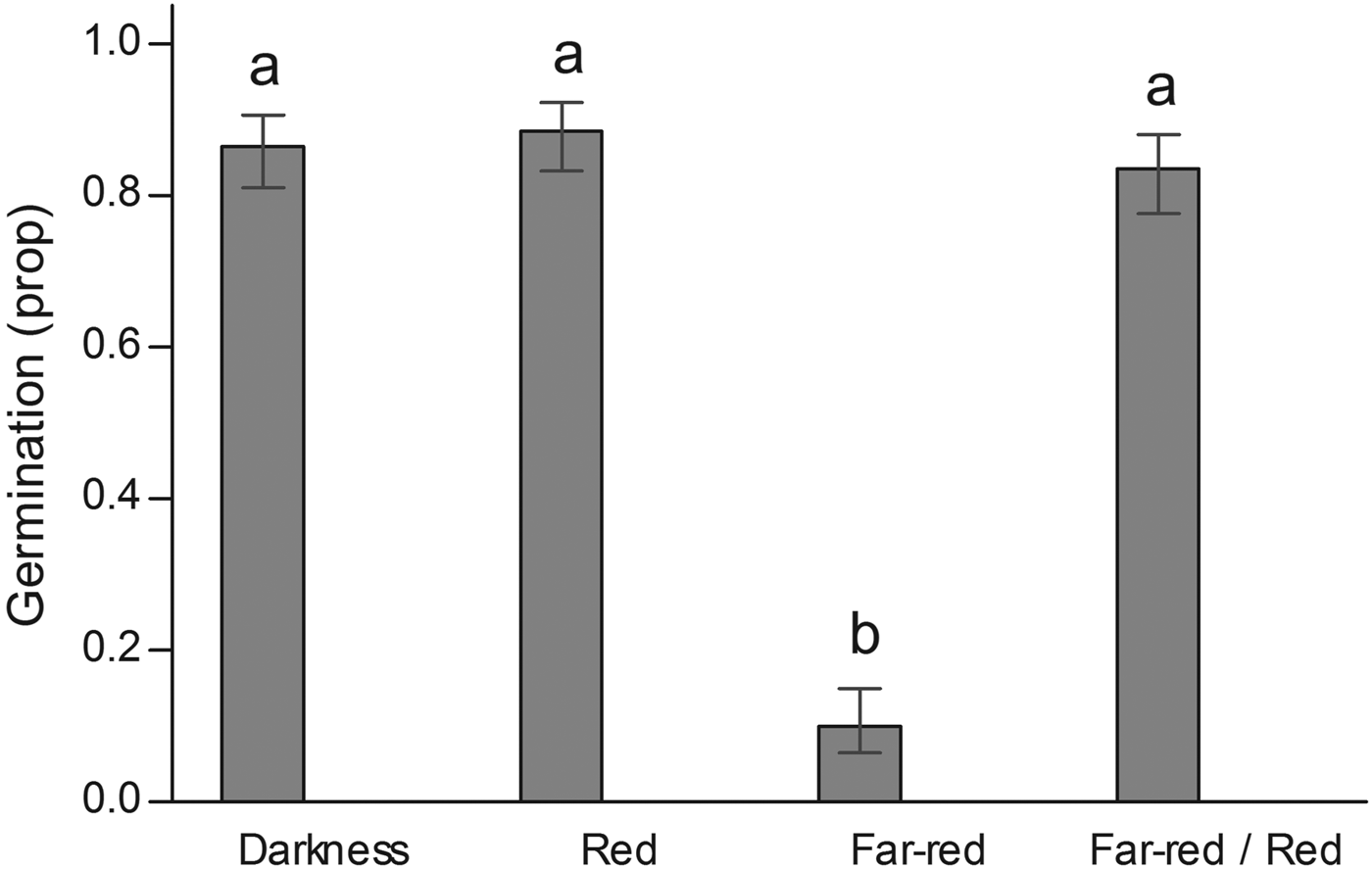
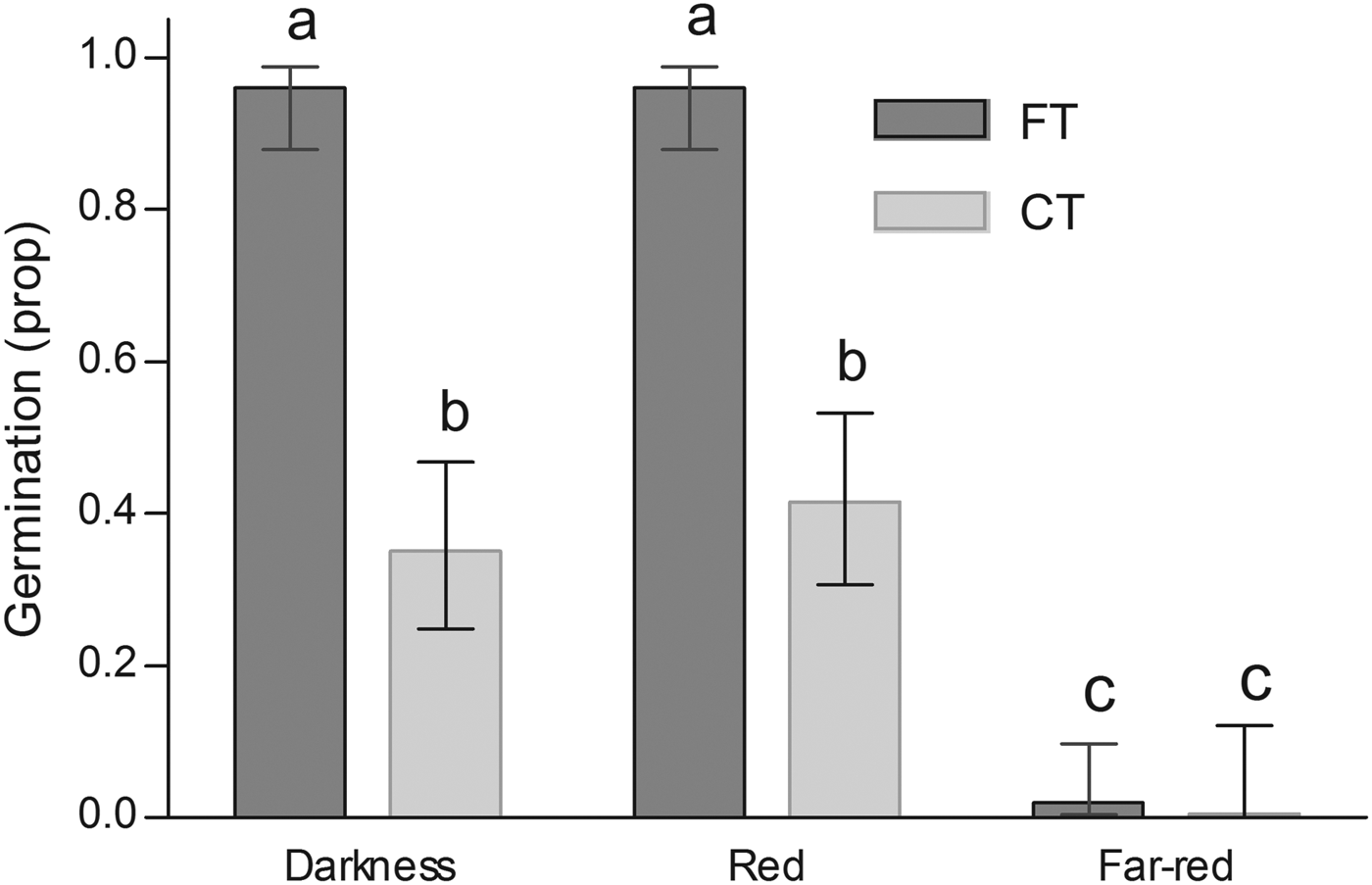
To assess the involvement of phytochromes in dormancy alleviation and germination, seeds stratified for 4 weeks received a pulse of R or FR light before the incubation at fluctuating or constant temperature. When incubated at 20/30°C fluctuating temperatures, control seeds, kept in darkness, germinated as well as those that had received an R pulse (Fig. 2), whereas the seeds that had received an FR pulse showed a significant inhibition of germination (Fig. 2, P < 0.0001). The percentage of germination reached only 14% and 10% for seeds that received an R pulse and control seeds, respectively, when seeds were incubated at constant temperature (Fig. 2, P < 0.0001). An FR pulse completely inhibited germination in this thermal regime, no significant interaction between treatments was observed (P = 0.356). To discard any effect of light during seed harvest, the same experiment was repeated, harvesting seeds under the green safe light. At fluctuating temperatures, the percentage of germination reached 82% and 79% for seeds that received an R pulse and control seeds, respectively. The percentage of germination of seeds that received an FR pulse was 0.5% (χ2 = 347.41, df = 2, P < 0.0001). As was explained in the Materials and methods section, we performed preliminary studies in which seeds were incubated at 15/25°C instead of 20/30°C as alternating temperatures, and 20°C instead of 25°C as constant temperature. In these cases, control seeds kept in darkness germinated as well as those that received an R pulse, while the seeds that received an FR pulse showed a significant inhibition of germination (χ2 = 413.50; df = 2; P < 0.0001). To test the involvement of Phy B in the response to FR light a reversion experiment was performed. The FR-pulse inhibition of germination was completely reverted when an R pulse was given to the stratified seeds 1 h after the FR pulse and then incubated at fluctuating temperatures (Fig. 3, χ2 = 403.03, df = 3, P < 0.0001).
Final germination proportion of extracted seeds stratified in Petri dishes. Seeds were extracted from the fruits and stratified at 4°C for 4 weeks. Light treatments were applied before incubation at fluctuating or constant temperatures. FT, fluctuating temperatures; CT, constant temperature. Different letters indicate significant differences between means (α = 0.05). Each value is the mean (±95% binomial confidence intervals) of four replicates of 50 seeds each.

Reversion of the FR light effect on germination by an R light pulse. Stratified seeds were exposed to a pulse of 20 min of R or FR light, while controls were maintained in darkness. One hour after the application of light pulses, one subgroup of FR-treated seeds was given a 20-min R light pulse. Control and light-treated seeds were subsequently incubated at fluctuating temperatures in darkness. Different letters indicate significant differences between means (α = 0.05). Each value is the mean (±95% binomial confidence intervals) of four replicates of 50 seeds each.

Effect of maternal tissues on dormancy and germination
To study the involvement of maternal tissue on seed dormancy, seed cover permeability was tested. After 24 h of imbibition the seed weight increased by 21.50% (t = 13.81, df = 3, P = 0.0008). When seeds extracted from recently harvested fruits were de-coated and incubated in darkness at fluctuating temperatures germination reached 40%, while at constant temperature germination reached just 5% (χ2 = 36.068, df = 1, P < 0.0001). Intact seeds did not germinate at fluctuating or constant incubation temperatures. Besides physical removal of the seed coats, acid scarification was performed. Sulphuric acid-treated seeds reached 40% germination, while control seeds reached 12.5% germination (χ2 = 9.49, df = 1, P = 0.002).
To test the involvement of other maternal tissues, germination assays of seeds stratified inside the fruits were carried out. Seeds extracted from fruits that were maintained for 4 weeks at 2°C responded similarly to moist seeds stratified in a Petri dish (Fig. 4). The percentage of germination was higher when seeds were incubated at fluctuating temperatures (P < 0.0001). FR significantly reduced germination at both thermal regimes (P < 0.0001) and no interaction between treatments was observed (P = 0.6175).
Final germination proportion of seeds stratified inside the fruit. Fruits were kept at 2°C for 4 weeks before seed extraction. Light treatments were applied before incubation at fluctuating or constant temperatures. FT, fluctuating temperatures; CT, constant temperature. Different letters indicate significant differences between means (α = 0.05). Each value is the mean (±95% binomial confidence intervals) of four replicates of 50 seeds each.

As seeds are sensitive to low temperatures inside the fruit, we wondered if stratified seeds were able to germinate in the presence of fruit tissues. For this, germination at fluctuating temperatures of seeds extracted from fruits maintained at 2°C for 4 weeks was tested with or without the presence of kiwifruit tissue. No seed germinated in the presence of kiwifruit pulp, while in its absence germination reached 73% (χ2 = 94.49, df = 1, P < 0.0001).
Discussion
New, mature kiwifruit seeds did not germinate when placed in favourable conditions for germination at any of the tested temperatures. This result is consistent with the findings for the same species presented in previous reports (Lawes and Anderson, Reference Lawes and Anderson1980; Chin et al., Reference Chin, Blanche and Bachireddy1992; Celik et al., Reference Celik, Zenginbal and Özcan2006). The failure of germination can be attributed to primary seed dormancy established during seed maturation on the mother plant (Hilhorst, Reference Hilhorst1995; Kucera et al., Reference Kucera, Cohn and Leubner-Metzger2005; Finch-Savage and Leubner-Metzger, Reference Finch-Savage and Leubner-Metzger2006). During stratification at 2 or 5°C seeds gradually gained the ability to germinate to high percentages when incubated at fluctuating temperatures (Fig. 1). A higher stratification temperature, such as 12°C, was not as effective in the removal of dormancy (Fig. 1). These results agree with those obtained for apple seeds by Côme (Reference Côme1980) and recreated in the Lewak review (see Fig. 1 in Lewak, Reference Lewak2011). A 3-week stratification period was sufficient for the seeds to reach the maximum percentage of germination when they were incubated at fluctuating temperatures. By contrast, germination levels were low when incubated at constant temperature, regardless of the stratification time at all the temperatures tested. These results show that stratification alleviates seed dormancy. In nature, low temperatures sensed and integrated by the seed over at least 3 weeks may indicate that winter has passed and spring, the favourable season for growing, is coming. However, seeds will not germinate until other blocks for germination are removed. For the kiwifruit seed, the requirement of fluctuating temperatures might be an ecologically meaningful proxy for burial depth (Thompson and Grime, Reference Thompson and Grime1979, Reference Thompson and Grime1983; Ghersa et al., Reference Ghersa, Benech-Arnold and Martinez-Ghersa1992) and/or a signal of an open gap. Gap detection is a critical requirement for seedling establishment in a place that provides favourable conditions for the completion of the life cycle (Thompson et al., Reference Thompson, Grime and Mason1977). The requirements, for kiwifruit seeds, of fluctuating temperatures (this study; Smith and Toy, Reference Smith and Toy1967; Lawes and Anderson, Reference Lawes and Anderson1980) and an environment without signals of neighbouring plants (low R:FR ratio, Figs 2, 3 and 4) seem to operate as a way to ensure the position of the future plant in a gap.
In this study we have shown that kiwifruit seeds germinate independently of exposure to a pulse of R or being kept in the dark. This result might suggest that light perceived by phytochromes is not important for germination of the seeds of this species or, alternatively, that the threshold value of the active form of phytochrome to sustain germination is already present in the seed. Our results support the second alternative, since stratified seeds exposed to an FR pulse before incubation at fluctuating temperatures had a significantly reduced germination rate (Fig. 2). Phytochrome activation during seed harvest can be ruled out since the same results were obtained when the seed harvest was performed under a green safe light. The FR inhibition of germination was reverted by a second pulse of R given 1 h later (Fig. 3); this strongly suggests that phytochromes, and particularly Phy B (see the reviews of Casal and Sánchez, Reference Casal and Sánchez1998 and Pons, Reference Pons and Fenner2000), are involved in kiwifruit seed germination. Thus, Phy B would be responsible for detecting the low R/FR ratio, an indicator of leaf canopy cover in the surroundings of the kiwifruit seeds. The presence of vegetation establishes a situation in which the seedling would be in a competitive situation that has little chance of being won. Even in species that have high germination rates in darkness, shading by a canopy inhibits germination and establishes additional light requirements for germination (Fenner, Reference Fenner1980). Our results show that this appears to be the case in the seeds of kiwifruit, because a requirement for light is observed after the seeds have detected the presence of canopy signals simulated by an FR pulse. The role of light and fluctuating temperatures in dormancy and germination is a matter of debate (Thompson and Ooi, Reference Thompson and Ooi2010, Reference Thompson and Ooi2013; Finch-Savage and Footitt, Reference Finch-Savage and Footitt2012). Some argue that light and fluctuating temperatures are the last steps in the dormancy-breaking process (e.g. Benech-Arnold et al., Reference Benech-Arnold, Sánchez, Forcella, Kruk and Ghersa2000; Batlla et al., Reference Batlla, Kruk, Benech-Arnold, Benech-Arnold and Sanchez2004; Finch-Savage and Leubner-Metzger, Reference Finch-Savage and Leubner-Metzger2006), others maintain that light and fluctuating temperatures are factors that stimulate germination (e.g. Vleeshouwers et al., Reference Vleeshouwers, Bouwmeester and Karssen1995; Thompson and Ooi, Reference Thompson and Ooi2010; Baskin and Baskin, Reference Baskin and Baskin2014). This controversy comes from a difference in concept of the end of dormancy and the induction of germination. Regardless of where we choose to put the limit, our results show that in kiwifruit seeds the action of a series of factors is necessary, in an ordered way, to remove the blocks to germination.
Besides the embryonic dormancy controls described above, the maternal tissues can also influence maintenance of dormancy. The slight increase in the germination of recently harvested seeds after removal of the seed covers indicates that these structures might have some control of dormancy. The inhibition of germination imposed by covers is not due to impermeability, because seed weight increased with imbibition time. However, the low percentage of germination of uncoated seeds indicates that dormancy in kiwifruit seeds is mainly imposed by physiological constraints.
In this study, seeds that were in contact with fruit pulp did not germinate at all, despite having been exposed to low temperatures and incubated at fluctuating temperatures. This result is consistent with previous reports suggesting the presence of germination inhibitors in the fruit pulp (Fukui, Reference Fukui1995; Yagihashi et al., Reference Yagihashi, Hayashida and Miyamoto1998; Mandon-Dalger et al., Reference Mandon-Dalger, Clergeau, Tassin, Rivière and Gatti2004; Chimera and Drake, Reference Chimera and Drake2010; Baskin and Baskin, Reference Baskin and Baskin2014). Although seed germination is inhibited by the fruit pulp, it prevents neither perception of low temperature nor change the light sensitivity of the seeds. The stratified seeds within the fruit, i.e. in the presence of pulp, responded in the same way as seeds stratified in the absence of pulp (Figs 2 and 4). It has been suggested that in certain species a delay in germination caused by inhibitors present in the fruit pulp could serve as a mechanism for seed dispersal in time (Kelly et al., Reference Kelly, Ladley and Robertson2004), since it would prevent the germination of all seeds at once.
Logan and Xu (Reference Logan and Xu2006) observed that germination of kiwifruit seeds ingested by birds increased substantially, and concluded that the removal of pulp allows germination. These results could lead us to think that kiwifruit seeds only require separation from fruit pulp and some form of scarification for germination to take place; however, the seeds consumed by birds used in the Logan and Xu (Reference Logan and Xu2006) study came from fruits stored at 1.5°C for 12 weeks. From our results we can say that the seeds used in that study were stratified inside the fruit at an effective temperature for a period longer than the minimum required to alleviate dormancy. The removal of the fruit pulp and the slight scarification of seed covers by the birds eliminated subsequent blocks to the completion of seed germination.
The story of kiwifruit domestication is recent; seeds from China were first introduced into New Zealand in 1906. By 1910 the plants obtained from those seeds bore fruits and many varieties were derived from those seeds, including the Bruno variety employed in this study (Schroederer and Fletcher, Reference Schroeder and Fletcher1967). Although the process of domestication could have affected the performance of germination, the requirement for stratification and alternating temperatures is found in other species of the genus Actinidia (Hsieh et al., Reference Hsieh, Nee and Chien2004), which leads us to think that germination behaviour reported in this paper for kiwifruit seeds is nearer to that occurring in nature; further studies with seeds from wild populations are required to confirm our results. As far as we know, this is the first report about the effect of light quality on germination of a member of the genus Actinidia.
Acknowledgements
We thank Gastón Maidana, Emiliano Rodríguez and Joaquin Gelosi for assistance with the experiments. We are especially grateful to Carlos Mazza for assistance with the figures and many helpful comments and suggestions.
Financial support
This work was supported by grants from the Universidad de Buenos Aires (UBACyT 20020130200141BA).
Conflicts of interest
None.