In 1366, Cassano Cigala, member of a wealthy Genoese noble family, acquired 5,300 lire worth of Genoa's communal debt: shares in the New Compera of Salt.Footnote 1 Within a few months, he had transferred those shares in eleven smaller parcels to a variety of individuals. The largest of these was 2,000 lire to Chilico Bondenario, a banker who subsequently broke his share into smaller ones that he passed on to yet more individuals. The registers recording these transactions do not include prices that could be used to calculate rates of profit, nor do they even explicitly name the transfers as sales.Footnote 2 Nevertheless, it is reasonable to assume, based on the pattern of activity, that these are among the oldest surviving traces of speculation in shares of Genoa's public debt.Footnote 3 Although speculation likely occurred as early as the late thirteenth century, popular rioting in 1339 included a public bonfire of most compere records before that date, making a precise search for the origins of speculation impossible.Footnote 4
The assumption that activity like this truly was speculative has underwritten a long tradition of scholarship linking the narrow history of Genoese communal finance with the broader story of the rise and development of capitalism in premodern Italy. Heinrich Sieveking's late nineteenth–century work, Studio sulle finanze genovesi nel medioevo, explicitly labeled the city's creditors as capitalists and described the city's government as an association of capitalists.Footnote 5 Sieveking invoked this label in part to show that economic change was possible in medieval Europe, rejecting Werner Sombart's arguments placing the origins of capitalism outside a supposedly “feudal” European society. This line of interpretation was continued by Jacques Heers, whose work on fifteenth-century Genoa used the purchase of compere shares as an example of “popular” capitalism, arguing that capitalist attitudes were spread well beyond a restricted group of elite merchants.Footnote 6 More broadly, Cigala's form of accumulation accords well with Fernand Braudel's definition of capitalism: a “game” that was limited to a restricted sphere of economic activity, one based on speculative activity, large quantities, and big business.Footnote 7
Among scholars of finance, the general consensus is that the expansion of urban public debts, whatever their specific form, led directly and immediately to “the emergence of a … financial market centered on state credits.”Footnote 8 Among economists, the guiding assumption is that the interest rates of public debts were determined by market forces, so that fluctuations in the (assumed) market are a transparent measure of “credibility”—a sovereign debtor's likelihood to repay its debts.Footnote 9 Heers assumed the same thing, that the compere were a sign of capitalism because participants “profit[ed] from the work of others … through the purchase and sale of stocks or shares.”Footnote 10
Recently, however, historians of premodern credit have been more cautious about applying the label “capitalism” to economic activity in the premodern period.Footnote 11 In some cases, the rejection of the label is explicit, as in Martha Howell's Commerce before Capitalism, which identifies several ways in which the premodern European economy differed from a modern capitalist one: prices did not converge over broad regions due to price negotiations, the overall economic system was not based on self-regulating markets, people did not imagine that allowing individuals to pursue their self-interest served the public good, capital was not imagined to reproduce itself infinitely, and commerce was more commonly geared toward consumption and display than accumulation and reinvestment.Footnote 12 Others retain the term for a subset of relationships or behaviors, contrasting social relationships based on “aristocratic political economy” with the “capitalist market economy.”Footnote 13 Even when the term is retained, though, these studies avoid drawing continuities with the present or framing their inquiry around the origins of contemporary ideas and practices. Instead, they aim at capturing the “essence” of a premodern economic culture and what makes it distinct from our own.Footnote 14
This shift in emphasis is due in no small part to the influence of anthropological models and categories on historical thinking. Though scholars do not always frame their analysis explicitly around the concept of gift exchange, they nevertheless retain a distinction between economies based on impersonal, price-making markets and those in which economic exchange was instead “embedded” in society.Footnote 15 For unrelated reasons, even studies that prefer economic modes of analysis to anthropological ones have become less likely to frame their studies in terms of capitalism. Instead, they organize inquiry around concepts like growth, economic performance, and institutions.Footnote 16 In both cases, scholars have moved away from thinking explicitly about capitalism yet remain concerned with the same underlying problematic: the origins and nature of market activity and its relationship to broader social, intellectual, and cultural forces.Footnote 17
The Genoese case is useful for addressing this issue, as the city's well-preserved archive and early experience with commercial development make it a laboratory rich in documents that can reveal how people coped—socially, economically, and intellectually—with a commercializing society. Nevertheless, the reticence of the quantitative sources makes it imperative to think carefully and precisely about how public debts really functioned in practice.Footnote 18 Cued by an interest in capitalism, it would be all too easy to assume that the profitmaking activity of individual actors defined public debts as institutions.Footnote 19 However, a fuller consideration of the terms (moral and social as well as economic) on which Genoese families engaged with their city's debts, undertaken below, shows that they were more often purposefully yoked to concerns about property and lineage than treated as a commodity on which to speculate. At the same time, profitmaking was a very real element in the life of the public debt. By putting accounting records in dialogue with the existing moral and conceptual framework around public credit, this article argues that Genoese communal finance was neither fully of the market nor separate from it. The interaction between different strategies for employing public debt simultaneously served traditional social goals and accustomed participants to dealing with abstract rights to future income streams based on nominal quantities of money whose value was negotiable. Because public finance depended on taxing trade, linking patrimony to public finance also indirectly and increasingly tied family wealth to the marketplace.
This finding is in keeping with social histories of other Italian cities in the late medieval and early modern periods.Footnote 20 Florentine records, especially those associated with the Monte delle doti, clearly indicate a strong link between family affairs and communal finance.Footnote 21 In Venice, too, shares in the city's debts were more important as a store of familial wealth than as a vehicle for an emerging financial capitalism.Footnote 22 Genoa is often mentioned alongside Florence and Venice in this context, yet it is the least studied of the three.Footnote 23 Despite the fact that the Ligurian city experimented with public indebtedness as early as the thirteenth century, little systematic research exists about the city's public credit prior to the fifteenth.Footnote 24 Valuable studies have been done, but they generally rely on static pictures of exemplary families or illustrative individuals rather than considering general patterns or changes over time.Footnote 25
Although this article argues that patterns in Genoa are similar to those found elsewhere, its credit practices developed locally. Thus, they are less familiar, even to specialists, than the famous monti of its better-studied peers, making a brief description of the relevant institutions and vocabulary useful. The key borrowing technique that shaped all Genoese public finance in the late Middle Ages was called a compera. This instrument had a few distinctive characteristics that conditioned its relationship with markets and property.Footnote 26 It was usually created by imposing a forced loan on the propertied inhabitants of Genoa. The money collected was intended to meet a short-term need for a large amount of cash. Though contributions were obligatory, the commune encouraged compliance by promising to pay participants (partecipes in the original Latin) in the compera a percentage of their contribution, usually 8 or 10 percent, annually in four installments. This payment (the paga or proventus) would be financed by one or more communal taxes assigned to the participants, who were also granted an important role in farming the city's tax collection apparatus out to private individuals or syndicates.Footnote 27 From at least 1300, shares (loca in the original Latin) in a compera and the associated payments were heritable and freely transferrable to third parties at whatever price they might agree upon, opening up the possibility of a market for shares and speculation on their future value. Repayment of the original contribution was always possible in theory but rare in practice, because the period from the mid-twelfth to the early fifteenth century was one of frequent warfare, leading to several large bursts of borrowing and then consolidation of compere.Footnote 28
Thus, when first created, a compera looked like a forced, interest-bearing loan from citizens to commune. Yet over time its character changed. As individual compere lasted longer without repayment and were progressively consolidated into larger bodies with many different tax revenues assigned to them, owning a share came to look increasingly like a perpetual annuity, a small percentage stake in communal tax collection, rather than a discrete loan secured by a specific tax. As such, these shares had unmistakable similarities to a piece of rental property or land, a congruence that exercised just as much influence on the compere's function as did their shares’ obvious marketability.
This institution can help us think about the origins of capitalism, but only if we make careful use of both quantitative and qualitative sources. By drawing on the administrative records of the compere, we can see how the Genoese used civic debt. These records of practice can be put into dialogue with the earliest surviving discussion of them: a fourteenth-century treatise on usury by Alexander of Alessandria, a Franciscan theologian.Footnote 29 Although it is tempting to see this dialogue as a confrontation between a moralizing church and an amoral market, a more careful reading of both sources in conjunction reveals two distinct but related understandings of what shares in a public debt meant and could do for their holders. On the one hand, the compere enabled market-driven speculation. On the other, they could also function like a piece of land, a piece of stable property that yielded fruit on an annual basis. Whether we label these uses capitalist and noncapitalist or market and nonmarket uses of property, each was necessary to the other.
Buying and Selling for Profit
Speculation and reselling were clearly baked into the creation of a new compera. The commune's need for money was predictable, and the process of organizing and collecting a forced loan was a protracted one, opening the possibility for those with means and inside knowledge to speculate on future value of shares in the new debt. In one well-documented case, the Great Venetian Loan of 1350, twenty months elapsed between November 1350, when the commune decreed its creation, and August of 1352, when its first participant was inscribed in the register with the amount of his contribution.Footnote 30 By that date, the first major phase of the campaign was over and the fleet that the compera ostensibly financed had already returned to port.Footnote 31 Eight months later, the commune had collected only eighty-one thousand of the three hundred thousand Genoese lire that was supposed to be raised. This gap in time created an opportunity for those with capital and confidence in the new compera to profit, by buying up the shares of those who either could not afford their mandated loan contribution or could not wait for the commune to begin paying the promised 10 percent return. Indeed, the records have many examples of either quick sales of a contribution or individuals who agreed to pay the forced contribution on behalf of an unwilling or unable party.
Cigala, mentioned above, provides evidence that insider knowledge continued to enable profitable speculation, even after a loan was collected. Although he had sold nearly all his stake in the New Compera of Salt in January 1367, he acquired around two thousand lire worth of the debt in February and March of 1368.Footnote 32 At that very moment, however, interest payments based on receipts of the communal salt monopoly had gone into free fall, delivering about 2 percent of the 10 percent promised by the commune for the year.Footnote 33 Excepting his activity and that of a few other individuals, transfer activity ground to a halt. Purchasing during a period of crisis almost certainly represents advance knowledge on Cigala's part that the commune would step in to rescue the troubled loan, for he was intimately acquainted with communal government and had brokered the sale of salt from Genoa to the Visconti rulers of Milan in previous years.Footnote 34
Turning from this pattern of economic activity to the available intellectual framework, we can see why scholars have focused on markets, speculation, and profitmaking by wealthy merchants as the central activities for understanding public debts like Genoa's compere. In the early fourteenth century, Alexander of Alessandria produced a quodlibetal disputation on the subject of usury.Footnote 35 In it, he considered the moral implications of the compere along with a variety of other credit-related economic practices.Footnote 36 In his treatise, the Franciscan theologian first summed up a long-standing debate among Parisian masters about the sale of annuities.Footnote 37 However, he went on to apply the principles developed in the debate to examples of economic practice from Genoa (though it is likely that the treatise was composed in Bologna, not in Genoa itself). Although the Franciscan theologian approved of several related credit practices, including the sale of annuities and the temporary sale of communal tax incomes to private parties, he specifically disapproved of the compere, arguing that a forced loan was still a loan. This, he argued, made the commune's promise of annual interest payments into usury.Footnote 38
Alexander of Alessandria's treatise even more clearly opposed the kind of activity in which Cigala engaged. Even legitimate credit instruments could become illegitimate when used for the wrong reasons. In principle, the theologian approved of selling rentes, a form of annuity in which the buyer paid the seller a one-time fee in exchange for a series of smaller future payments. However, at the end of the discussion of rents, the treatise specifically disapproves of the purchase of annuities by “a rich man who has enough for life, and who buys the annuity because of avarice, so he might become richer.”Footnote 39 In keeping with other scholastics, the Franciscan expressed suspicion of money transactions that seemed to promise certain gain at no risk.Footnote 40 Even otherwise acceptable credit contracts could become morally dubious when engaged in exclusively in order to accumulate more wealth.
Selecting limited examples from separate records of economic life and thought enables us to construct a picture of an emerging financial capitalism, where savvy merchants speculated on the future value of money and income, cleverly and successfully avoiding the repressive moralizing of the church.Footnote 41 This perspective is not always made explicit, but studies of Italian public finance have often operated on the basic assumption that “the development of public debts in Venice, Genoa and Florence was driven by political and economic forces too powerful to be effectively swayed by the dicta of theologians and canonists.”Footnote 42 It bears repeating that the moral concerns expressed by theologians like Alexander of Alessandria were not unfounded. Actors like Cigala did, in fact, engage in speculative activity in order to make as risk-free a profit as possible. Projecting this construction into the future, one can easily identify merchants and markets as forward looking and the church as backward looking and regressive.Footnote 43 Both speculation and disapproval were real, yet focusing too narrowly on them falsely implies that speculation was the core reason for the existence of urban public debts.
Patterns of Holding and Circulation
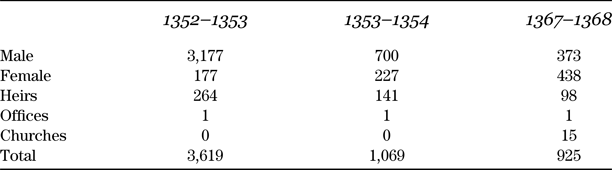
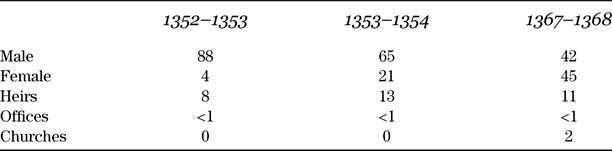
If we wish to make an informed historiographic judgment about how to position the compere in relation to the longer story of the development of capitalism, it is critical that we think about how they functioned in the aggregate, keeping the full range of strategies and patterns of use in view and not exclusively market-based profitmaking. Considering the compere as broadly as possible, it becomes clear that concerns about family, patrimony, and lineage were at least as central to Genoese thinking about public debt as profit and markets. As in late medieval Florence, Genoa's public debts were purposefully and deliberately yoked to wealthy families’ concerns about property.Footnote 44Tables 1, 2, and 3 use surviving registers of one large forced loan, the Great Venetian Compera of 1350, as a first entry into changes in shareholding over time.
Participants in the Great Venetian Compera of 1350, by Year

Source: Compere e mutui 1018, 1019, 1026, Archivio di Stato di Genova, Genoa.
Note: Each year, administrators for each compera created a new register in which they listed all participants, noted transfers, recorded encumbrances placed on shares, and kept track of interest paid. This table was compiled from registers listing all of a compera's shareholders or participants for a period of one year that started and ended in March. The Compera magna venetorum (Great Venetian Compera) was chosen because of its relatively large size and because its earliest registers are complete and undamaged. This allows analysis of changing patterns of shareholding in a new compera over time. Shares were categorized as belonging to individual men, individual women, groups of heirs, communal offices, or churches and monasteries.
Percentage of Capital Held in the Great Venetian Compera of 1350, by Year

Source: Compere e mutui 1018, 1019, 1026, Archivio di Stato di Genova, Genoa.
Female Participation in the Great Venetian Compera of 1350

Source: Compere e mutui 1018, 1019, 1026, Archivio di Stato di Genova, Genoa.
Note: In the registers, women were nearly always identified with reference to their father (Angelina de Bozolo quondam Bartolomei de Bozolo), husband (Marieta uxor quondam Eliani Catanei, Symona nunc uxor Iohannis de Pisano), or both (Andriola uxor Alberici Bartolomei filia quondam Ianoti Grilli). Women without a husband listed were assumed to be unmarried.
The general trends of shareholding over the first fifteen years of the compera's existence reveal three interrelated shifts. First, the total number of participants declined immediately and rapidly, which meant the debt was concentrated into many fewer hands (from 3,618 in 1353 to only 1,068 in 1354, a number that would hold roughly steady for years afterward). Second, the number of female participants increased immediately, leading to women outnumbering men as participants by 1367. This gender shift was accompanied by a shift in capital, as the debt that made up the compera came to be held equally between men and women. This transformation represents a change in the profile of participation. At first, participants were heads of property-owning households who had been constrained to lend to the commune. Thus, they were overwhelmingly male. Over time, the body shifted, later representing a group of individuals and families who chose to retain or acquire shares deliberately. Some of this transformation doubtless depended on the activities of intermediaries like Cigala, but the acceleration of wealth into female hands is a clear indication that something family related was taking place.
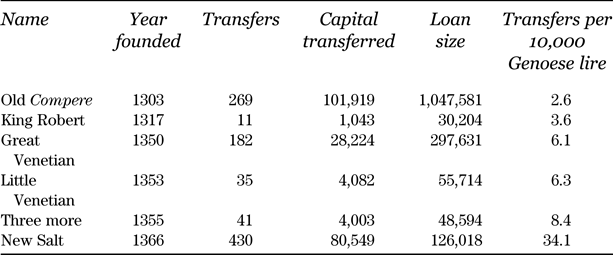
In fact, although market transactions never ceased, they became less and less frequent over time, and a compera's shares became increasingly static after its creation. The fragmentation of Genoa's public debt into multiple different compere with independent administrative records creates challenges for studying shareholding as a whole. However, it also opens up opportunities to trace changes over longer periods of time by considering how a particular loan circulated as a function of its age. Taking a year for which a good cross-section of records survives (1367–1368), it is possible to measure how actively different loans circulated (see Table 4).Footnote 45 As the table shows, transfer activity in a particular compera tended to decline significantly over time. While the largest loans saw the most activity in absolute terms, if we control for size it is clear that older loans had many fewer transfers than newer ones. As time passed, shares in public debt tended to become more stationary and to circulate less frequently. This progressively made shares in Genoa's public debts function more and more like a piece of real property—a relatively stable form of wealth whose primary function was to yield a predictable income over time.
Transfer Activity by Loan, 1367–1368

Source: Compere e mutui 379, 380, 381, 586, 1026, 1079, 1100, 1158, Archivio di Stato di Genova, Genoa.
Note: This table is based on data collected from all surviving lists of participants in six compere from 1367–1368, allowing comparison between loans of different ages. The year 1367–1368 was chosen as a sample because a relatively large percentage of registers survive for that year (six of fifteen loans are covered, mostly in complete registers). This comprises 43 percent of the capital of the known compere. These six loans attest about 3,400 creditors, suggesting a total number of creditors around 8,000. This table was produced by recording all transfers of capital and the size of those transfers. To measure the frequency of transfers required controlling for the fact that some compere were much larger than others and thus could be expected to have more activity. Dividing the number of transfers by the total capital of the loan produced numbers difficult to scan visually, so the final column shows the number of transfers per 10,000 lire of the compera's total value.
These patterns were not a quirk of the system but rather reflect the way Genoa's civic elite conceived of their commune's debts. Instead of favoring speculation, the legal rules constructed for this new form of property assumed that public debt would primarily do “lineage work” rather than be harnessed to commercial enterprises.Footnote 46 Individual shareholders were free to transfer their own shares as they saw fit. However, shares could be seized by third parties in only a few, limited cases and these did not include satisfying personal debts, meaning they were shielded from the rest of economic life in important ways. Third parties might have recourse to shares if they were part of a dowry or marriage gift, if they were part of an inheritance, if they were explicitly assigned in a will, or if the person in question were determined to be in open rebellion against the commune.Footnote 47 This privilege, renewed for the oldest compere after the general reform of communal finances in the 1340s, was universally extended to new compere at their creation. It would remain a significant element of the norms governing shares in the Casa di San Giorgio starting in the early fifteenth century.Footnote 48 By protecting compere shares from certain kinds of seizure, Genoa and its officers clearly anticipated that shares in the city's debts would be managed for family purposes rather than as an adjunct to a business or bank.
Reading these regulations alongside the quantitative sources is critical to understanding how Genoese engagement with public debt was related to market dynamics. Read in isolation, the formal apparatus of communal bookkeeping can imply purposes for late medieval actions that are not always consistent with reality. By the fourteenth century, transferring a share in a compera was common and may have required little more than verbal instruction from the person in whose name it was recorded, made in front of two witnesses.Footnote 49 This certainly enabled buying and selling shares for profit, enabling the assumption that recorded transfers of compere shares represent this kind of activity. Notarial records, though, indicate that the Genoese themselves often thought of public debt as just one part of a wider web of personal and property relationships.
For example, in 1352, three sons of Guglielmo de Salvo of Varazze—Pietro, Guglielmo, and Tommaso—met in the choir of the cathedral of San Lorenzo in Genoa to formally divide the contents of their recently deceased father's estate.Footnote 50 They were accompanied by Niccolò de Tolomeo, the legal guardian of Guglielmo and Tommaso, for the two younger brothers would not come of age for another decade. The brothers faced several related problems. First, they needed to divide two pieces of real property of uneven value among three people (a house in Genoa, estimated at 600 lire, and land in the nearby town of Noli, estimated at 418 lire). Second, they needed to secure a regular income for the younger brothers and prevent the squandering of their inheritance while they were young. Finally, there was the task of separating their mother's dowry and antefactum (marriage gift) from the inheritance as a whole and securing dowries for the brothers’ sisters. All these purposes were accomplished using shares in different compere. The brothers were able to retain and divide the real property by using shares in public debt to make up the difference in value between the land and the house. They dowried their female relations with shares in the public debt, hedging these grants with restrictions so that recipients could benefit from the income but not transfer the underlying capital. For this family, shares were less useful for their market value than for their ability to approximate the qualities of a piece of land. They were stable and secure, had a relatively predictable annual yield, and could be controlled to prevent their being squandered or alienated.
This document cannot be used for systematic analysis, for it is just a single random survival from a notarial cartulary. Nevertheless, it is critical for putting shareholding in Genoa's public debts in the proper perspective. Internal administrative records make it easy to identify speculators and brokers, because the transfers from which they profited show up clearly in the account books and can be easily quantified. Family-oriented choices, by contrast, are often only visible indirectly, implied in the patterns of shareholding and legal framework. In fact, several of the transactions described in the settlement of the de Salvo inheritance would be invisible from compere records, because some of the shares the brothers “assigned” to their mother, Castagna, were already recorded under her name. The document also reveals incidentally that the family had been drawing on the income of one hundred lire of debt recorded, under the name not of any current members of the family but of the father's deceased first wife. The quantitative documentation left behind by compere administrators is undeniably useful. Its laconic nature, however, can unintentionally obscure the goals and strategies of shareholders, particularly their concern for how public debt related to other forms of wealth, especially real property.
Families like the de Salvos made a different choice than individuals like Cigala. Rather than treat shares in a compera like a handful of coins or a commodity whose value derived from its market price, they treated them more like a piece of real property. They did this directly, when they used shares to balance the value of a house versus a piece of land. They did this indirectly, when they treated them like a fruitful good, a secure piece of property that would yield a periodic income to support either minor children or a widowed mother. Because of medieval Genoa's close association with commerce and merchants, it is easy to overlook the extent to which the city's wealthier inhabitants still relied on immoveable property as an essential part of ensuring a family's survival and continuity.Footnote 51 Some have even seen families’ interest in public debt as the sign of an economic “loss of nerve” and diversion of capital away from productive investment.Footnote 52 Because Genoa was such an active port with such a limited hinterland, it is easy to uncritically assent to the sentiments expressed by Gabriele Adorno, a fourteenth-century doge, when his legal code claimed that “one cannot firmly assess the wealth of the Genoese, as with the other nations of Italy that live from their possessions and cultivated lands, because they come and go through the danger of the seas. Because of this, some who are today rich in goods are perversely in need tomorrow.”Footnote 53 However, this was not an empirical statement based on assessment of the Genoese economy but a political and social statement about the dislike Genoese elites had for property taxes. Although much of Genoese wealth was generated through trade, their commercial dealings were grounded in networks of family and friends that were articulated and maintained through transfers of women and property.Footnote 54 Indeed, careful study of artisans’ economic activity suggests that the overall market for immobile property in Genoa was “rather static”—reputation for commerce notwithstanding.Footnote 55
It was once accepted wisdom that women's freedom to dispose of their property declined in the later Middle Ages, especially for aristocratic women relative to the artisan class.Footnote 56Compere registers reflect contemporary legal restrictions, as the consenting presence of two male relatives or neighbors was required to give a woman's instructions legal force.Footnote 57 Recent research, however, suggests that women may have retained a greater degree of independence in this regard than previously thought.Footnote 58 Even if men preferred to pass real property to other men and to dowry women with compere, we should not assume that decisions about the management of a family's wealth were the exclusive preserve of men.
If we read Alexander of Alessandria's treatise on usury for vocabulary, concepts, and ideas, rather than the narrow answer to whether the compere were licit, resonances appear between the property concerns of compere holders and scholastic reasoning about economic morality.Footnote 59 Early sections of the treatise build up a description of usury, as one would expect, based on Aristotle, scripture, the Church Fathers, papal decisions, and other scholastic opinions. When the friar turned from defining usury to identifying it in uncertain practical cases, a contrasting picture emerges. Here, the reasoning is punctuated with analogies to many different forms of medieval economic activity. Moral philosophy could rely on Aristotle to help define what usury was, but the ancient Greek philosopher could provide no assessment of medieval practices like the sale of lifetime annuities or forced loans by a communal government. Instead of relying on authority, Alexander of Alessandria resolved doubtful questions by triangulating between abstract principles and concrete analogies. If a doubtful practice was congruent with an obviously licit form of economic activity, such as buying or selling a horse or taking a lifetime lease on a piece of land belonging to the church, then it was permissible.Footnote 60 If, instead, it was congruent with an obviously illicit activity, such as handing someone 100 coins and demanding they repay 120 coins in a year, then the doubtful practice was usurious. For lifetime rents and other annuities, the dominant comparison drawn in the treatise was with how people dealt with land.Footnote 61 This is how the treatise legitimized key parts of communal tax farming, for example. The right to collect taxes could be sold in the same way that the rights to the fruit of a field could be sold: both were the sale of an income.Footnote 62 Indeed, those rights could also legitimately be resold to a third party for a different price than the face value of the income.Footnote 63 When shares in a public debt were used as part of a patrimonial strategy for their income, they might well appear more like the fruit of a field than a sack of coins given as a loan.
The compera was an instrument that did not fit neatly into a category of property, and so it posed a unique challenge to participants, who could employ and conceptualize its shares in very different ways. This led to an ongoing dialogue between theoretical or moral considerations and the practical choices made about shares. In the early fifteenth century, Genoa's premier jurisconsult, Bartolomeo Bosco, was asked to give an opinion about the trade in compere by the local chapter of the Carthusians. Bosco found that shares in compere were no different from other, more obviously legitimate, kinds of rents and incomes that churches were accustomed to holding.Footnote 64 When he introduced the compere for consideration, the jurist noted that when a compera was created, there developed “public trade in shares among the citizens and foreigners, and the money of children, widows, poor people, churches, monasteries and other pious places was converted into [shares].”Footnote 65 Here, he framed the basic issue in terms of who possessed shares and for what purposes. Just as Alexander of Alessandria drew analogies with other forms of economic practice to diagnose the compere, Bosco, too, considered what they did in practice. While it was not his only argument, the jurist contended that the compere were not loans (and therefore not usurious) because the Genoese did not use them like loans.Footnote 66 Instead, they functioned as part of the patrimony of a family or monastery much the same as a piece of land would have done. Jurists and theologians obviously drew on technical knowledge and expertise not possessed by most of their contemporaries. Yet their determinations were inevitably made in light of actual contemporary practices.Footnote 67 When lawyers or theologians justified holding shares in the compere by drawing an analogy with income from land, their determination clearly reflected the uses to which participants put these instruments. Rather than imposing a moral judgment on the market from outside, theological discussions of the compere activated the same set of practical and conceptual issues that faced creditors and shareholders.
Patrimony and Public Debt in European Perspective
In 1368, while Cigala was speculating on the value of shares in the New Compera of Salt, Genoa's communal government was busy deliberating about how to address the shortfall in payments to participants.Footnote 68 While a few isolated voices argued that nothing need be done at all, the majority favored finding a way to satisfy the commune's obligations fully. At the same time, some raised concerns about how best to protect the interests of widows, orphans, and religious institutions that relied on the shares. Although additional funding was required, it needed to be raised in such a way that it not damage the interests of “widows and orphans” who were participants in existing compere.Footnote 69 The Genoese understood the dynamics of taxation and revenue well. Raising the tax rate on salt might not increase (or might even decrease) income from the salt taxes overall. Yet their fears were articulated in terms of family interest rather than state revenue. A few decades later, when a French-appointed governor wished to raise money for an expedition to defend Genoese commercial interests in the eastern Mediterranean, he was forced to promise some kind of reform of the commune's debts in exchange for funding. Administrators for the compere complained of “poor rule” in the city and suggested that a regime interested in justice and good order should “take special care for widows, monastics, orphans, and other poor persons who own shares.”Footnote 70 When the compere underwent their most significant consolidation and reform, around 1407, being bundled together to form the Casa di San Giorgio, communal officials explained their decision as both the promotion of the public good and a move to protect the interests of widows, orphans, and other participants in the compere.Footnote 71 Patterns of shareholding and usage confirm that this was not simply a smokescreen for a desire to maximize profits from debt holding by a class of capitalists. Profitmaking and longer-term retention depended on each other. The fluctuating value that speculators took advantage of was grounded in the more stable ways this form of wealth could be used by propertied families.
The period in which the compere grew most rapidly, during the fourteenth and fifteenth centuries, was a period of socioeconomic consolidation in Genoese society.Footnote 72 This left its mark on the physical fabric of the city, as the great families concentrated into alberghi, family clans with clear internal structures and a distinctive architectural footprint in the city itself.Footnote 73 This consolidation is also visible in economic activities, as the rise of insurance contracts helped foster endogamous horizontal bonds within a more concentrated elite, as opposed to the more vertical and heterogeneous ties fostered by earlier forms of contracts.Footnote 74 Genoa's public debt, with its hybrid character, played an important role in this consolidation because of the way it interacted with other kinds of property. Even if members of the large clans tended to keep property separate between subsidiary lines, compere shares were critical to managing wealth and keeping immobile property in male hands.Footnote 75 While Genoa's urban elites undoubtedly engaged extensively in commerce, that engagement did not determine their economic attitudes as a whole. Despite their commercial potential, the compere were desirable primarily because of the way they could be employed in a basically conservative strategy to manage immobile wealth through marriages and inheritances.
This pattern puts Genoa in line with the developments in many late medieval cities, and not only in Italy. Yet thanks to a tight connection between the historiography of public borrowing and the historiography of the state, much of the research done on public debts remains circumscribed by national borders and pays greater attention to political dynamics than to social or economic ones.Footnote 76 This, in turn, has led to scholarship about public debts that tends to emphasize differences between different systems of urban borrowing, contrasting the techniques Italian cities used to borrow with techniques used in the Low Countries or in Iberia.Footnote 77 One important exception to the focus on politics is Anthony Molho's Marriage Alliance in Late Medieval Florence, which leveraged the exceptional volume of records of Florence's Monte delle doti to examine patterns of marriage and property holding at a depth impossible in other places. Yet even Molho emphasizes the “uniqueness” of the Florentine case, which differed from other premodern societies because of “the existence of a government institution [that] interjected itself in [the marriage] market, conditioning participants’ actions and shaping marriage plans and their realization.”Footnote 78 Examination of the compere in terms of market exchange and family patrimonies indicates that late medieval Florence and Genoa were entirely similar. What is distinctive about the Monte delle doti is not the mere fact of its existence; Genoa, too, had a public institution whose functioning was closely linked with marriage and family concerns. Rather, the Florentines are distinctive for how forthright and perceptive they were in making explicit a common link between family plans and urban public finance.
If we abandon a long-term genealogical project seeking the origins of modern financial practices in Italy, patterns across Europe begin to look very similar indeed. As late as the seventeenth century, the city of London based its credit in substantial part on controlling the property of orphaned children of citizens, which it would manage while paying a regular, small income for the upkeep of minor children's maintenance.Footnote 79 In fourteenth-century Valencia, the municipality used a long-term debt instrument called the censal to raise funds, basing this practice on a traditional agricultural contract, the census. Despite the different vocabulary, widows of communal officials and local notables were highly visible among debt holders.Footnote 80 These instruments quickly became the “basic tool to complement feudal rents and the principal way to support second sons and women.”Footnote 81 In the same period, Barcelona offered instruments called censals and violari to raise funds. Once again, given the opportunity to buy annuities, the civic elite of Barcelona perceived their city's debts as a way to safeguard personal and family property, creating a situation where women were prominent among creditors.Footnote 82 In the Low Countries, the instruments were called renten, but the set of choices remained largely the same.Footnote 83 Urban public credit developed independently in many places, based on familiar local forms of private credit, leading to a wide variety of vocabularies and specific instruments.
On a structural level, however, urban elites confronted the problems and possibilities offered by these new institutions in broadly similar terms. On the one hand, they offered an invaluable resource to safeguard property and to manage transfers of wealth through important moments of family transition, like death and marriage. Used in this way, they were easily assimilated conceptually and morally into immobile property. On the other hand, their fluctuating value and the need to transfer them between families opened up the possibility for speculative exchanges that appeared more usurious. Finally, these debts were serviced through taxes on trade. Even when employed to transfer wealth between generations, then, shares in public debts brought families’ patrimony into progressively greater dependence on the marketplace, indirectly as well as directly. These developments are especially easy to document in Italy because of the richness of the archives, yet they also occurred wherever urban elites faced choices about their family's property, their city's finances, and commerce.