Introduction
Younger ages on leaving school, leaving home, entering employment, forming partnerships, cohabitation, and family formation have all been linked with an increased risk of poor psychosocial functioning (Krohn et al. Reference Krohn, Lizotte and Perez1997; Maughan & Lindelow, Reference Maughan and Lindelow1997; Simon & Marcussen, Reference Simon and Marcussen1999; Maughan & Taylor, Reference Maughan and Taylor2001; Mirowsky & Ross, Reference Mirowsky and Ross2002). There has been a trend over recent years for the timing of transitions to adult roles to be delayed, with young adults enjoying a period of ‘emerging adulthood’ (Arnett, Reference Arnett2000), yet the prevalence of psychological well-being in early adulthood has not improved over the last two decades. Rates of depression and psychological distress have risen (Murphy, Reference Murphy1986; Joyce et al. Reference Joyce, Oakley-Browne, Wells, Bushnell and Hornblow1990; Mirowsky & Ross, Reference Mirowsky and Ross1992; Weissman, Reference Weissman1992; Sacker & Wiggins, Reference Sacker and Wiggins2002; Kasen et al. Reference Kasen, Cohen, Chen and Castille2003; Compton et al. Reference Compton, Conway, Stinson and Grant2006), and happiness and satisfaction with life have declined or at best remained relatively stable (Easterlin, Reference Easterlin1995; Blanchflower & Oswald, Reference Blanchflower and Oswald2000).
In Europe, it has been suggested that there has been a change towards individualization of the life course rather than a generalized shift in the timing of transitions (Côté, Reference Côté2000; Shanahan, Reference Shanahan2000); Clausen (Reference Clausen1991) proposed that a rational assessment of one's opportunities has replaced tradition in choices about employment, partnership and parenthood. Decisions involve consideration of the supports for and barriers to successful negotiation of the transition to adulthood and the taking up of adult roles.
Adolescent resources that the individual can draw on to support the transition to adult roles may function to expand educational and occupational opportunities and hence delay transitions. It is well established that psychosocial problems and low educational attainment in adolescence are linked with adult mental ill-health (Ferdinand et al. Reference Ferdinand, Stijnen, Verhulst and Van Der Reijden1999; Bartley et al. Reference Bartley, Sacker, Schoon, Kuh and Hardy2002; Gutman & Sameroff, Reference Gutman and Sameroff2004; Rutter et al. Reference Rutter, Kim-Cohen and Maughan2006). It has also been shown that psychosocial behaviour and educational achievement are individual resources that are related to delay in the timing of transitions (Clausen, Reference Clausen1991; Shanahan, Reference Shanahan2000; Maughan & Taylor, Reference Maughan and Taylor2001). The indirect mechanisms whereby psychosocial adjustment and educational attainment protect against later psychological distress may be via delays in the assumption of adult roles.
Structural factors such as social class and gender may also shape evaluations of life transitions, with disadvantage and female gender usually seen as restricting choices (Heinz & Kruger, Reference Heinz and Kruger2001; Côté & Schwartz, Reference Côté and Schwartz2002). Nevertheless, social and gender inequalities in psychological well-being have narrowed over the time that prevalence rates have increased, with indications that structural changes have not always been to the benefit of the more advantaged (Veenhoven, Reference Veenhoven2005). A consideration of the developmental implications of socio-historical changes may help here (Elder, Reference Elder1998).
Much of the evidence on development in context has been based on studies of the British cohort studies (Breen & Goldthorpe, Reference Breen and Goldthorpe2001; Ferri et al. Reference Ferri, Bynner and Wadsworth2003; Schoon, Reference Schoon2006). The 1958 and 1970 British birth cohorts are a natural experiment demonstrating how the times in which people live can affect their psychological health. The timing of transitions has been shown to be affected by the labour market and other economic systems (Kohli, Reference Kohli and Marshall1986). Those of the earlier-born cohort who left school at the minimum leaving age found jobs were plentiful, while their more educated peers entered the workforce during the recession of the 1980s. By contrast, the 1970 cohort completed their compulsory education during the 1980s recession. Those who left school without qualifications found it more difficult to gain employment. The lack of manufacturing jobs hit men hardest, as women were more able to take advantage of the new service opportunities. Then the 1990s recession took hold. The impact on the later-born cohort was potentially greater than on the earlier-born cohort that had more time to establish their occupational careers.
This economic perspective is consistent with the observed increases in levels of poor psychological health together with narrowing social and gender inequalities (Sacker & Wiggins, Reference Sacker and Wiggins2002). However, the economic climate affects more than just employment: without financial security, young people delay leaving home, entering partnerships and starting a family. An enforced rather than volitional delay in taking up adult roles might alter the relationship between the timing of transitions and psychological distress.
In this paper, a developmental-contextual approach is taken whereby social class and gender inequalities are believed to constrict life-course choices and individual resources enhance choices. We examine the role of the timing of transitions to adulthood for understanding psychological health in men and women in their early thirties in the context of these constraints and resources. The impact of the timing of four key transitions to adulthood for well-being will be assessed: school leaving age; leaving the family home; first cohabiting relationship; and becoming parents. We hypothesize that (i) psychological distress will follow earlier transitions, independent of lower levels of resources; (ii) social and gender inequalities in psychological distress among young adults are mediated, at least in part, by differences in the acquisition of resources and the timing of transitions to adulthood; (iii) the development of adult psychological distress is moderated by social position and gender; and (iv) the relationship between timing of transitions and adult psychological distress will be weaker for a cohort entering adulthood during times of economic decline than for a cohort entering adulthood during a time of economic growth.
Data and Method
Sample
The 1958 British birth cohort originated in the Perinatal Mortality Survey (Butler & Bonham, Reference Butler and Bonham1963) and has followed 98% of all births in England, Scotland and Wales born during the week 3–9 March, 1958. The cohort members, numbering some 17414 individuals in total, have been followed up and interviewed at regular intervals thereafter. Before the 2000 interviews, face-to-face interviews and self-completion sections were administered via a pen- and-paper interview (PAPI). Thereafter, computer-assisted personal interviewing (CAPI) has been used for the face-to-face sections and computer-assisted self interviews (CASI) for the self-completion sections.
The 1970 British birth cohort (Brewer et al. Reference Brewer, Haslum and Stewart-Brown1982) has followed children born in the week 5–11 April 1970 from birth through to adulthood. Data follow-ups have taken place at 5- to 10-year intervals since then. Similar to the 1958 cohort, the total sample size is over 17 000.
Reports on response bias at follow-up of these cohorts have shown that achieved samples do not differ from target samples across a number of critical variables (social class, parental education, and gender), despite a slight under-representation of males, and of the most disadvantaged groups (Shepherd, Reference Shepherd and Ferri1993, Reference Shepherd1995, Reference Shepherd2004; Plewis et al. Reference Plewis, Calderwood, Hawkes and Nathan2004).
The analysis sample for the 1958 cohort comprised all cohort members present in the survey at birth and at age 33 (n=10 831) and for the 1970 cohort all those present at birth and at age 30 (n=9710).
Measures
Background measures
Family social class is measured by the Registrar General's social class (RGSC): I, professional; II, managerial and technical; IIINM, skilled non-manual; IIIM, skilled manual; IV, partly skilled; V, non-skilled (Leete & Fox, Reference Leete and Fox1977). The RGSC is defined according to job status and the associated educational requirements and prestige conferred on different occupations (Office of Population Censuses and Surveys, 1980) or lifestyle (Marsh, Reference Marsh and Burgess1986).
Gender is coded as 0 for males and 1 for females.
Resource variables
Internalizing problems are assessed by the Rutter ‘A’ Scale (Rutter et al. Reference Rutter, Tizard and Whitmore1970), completed by a parent (usually the mother) as part of the home interview at 16 years. The scoring system of Macmillan et al. (Reference Macmillan, Kolvin, Garside, Nicol and Leitch1980) was used, giving a scale with range 0–16.
Externalizing problems are also assessed using the Macmillan et al. scoring of the Rutter ‘A’ Scale, range 0–18.
An exam score was calculated from the results of the externally set age 16 examinations. The actual examination results of the 1958 cohort were collected from schools in 1978, whereas 1970 cohort members reported their examination results in a follow-up study in 1986.Footnote † A simple scoring technique was applied to the results for each examination taken, giving a score of 3 to a grade A pass at O-level to a score of 1 for a grade C O-level or grade 1 CSE. Scores range from 0–34 in the 1958 cohort and from 0–36 in the 1970 cohort.
Transitions to adulthood
Age left full-time education was determined once the cohort member had a period of economic activity other than education lasting more than 4 months. Thus ‘continuous’ education allowed for short breaks such as temporary work after taking the age 16 exams before starting college in the autumn.
Age left family home was determined from the responses to questions on residential history and household composition in each residence.
Age first cohabited was ascertained from responses to questionnaire items on relationship history.
Age at birth of first child was derived from the set of questions in the adult surveys on parenthood. Only viable births were considered, pregnancies ending in a spontaneous or elective abortion were not.
The timing of transitions are recorded in years since birth and calculated from all available questionnaires, truncated below age 16. Where conflicting dates are recorded in different interviews, precedence is given to the interview data closest in time to the event. When age completed full-time education, age left home, age first cohabited and age at birth of first child are independent variables in a model, age is recoded into categories because of the nonlinear relationship between timing of transitions and adult psychological distress. The category cut-points for each transition are shown in Table 1. When the transition ages are dependent variables in a model and the transition had not taken place, age of transition is censored above 30 years (1970 cohort) or 33 years (1958 cohort).
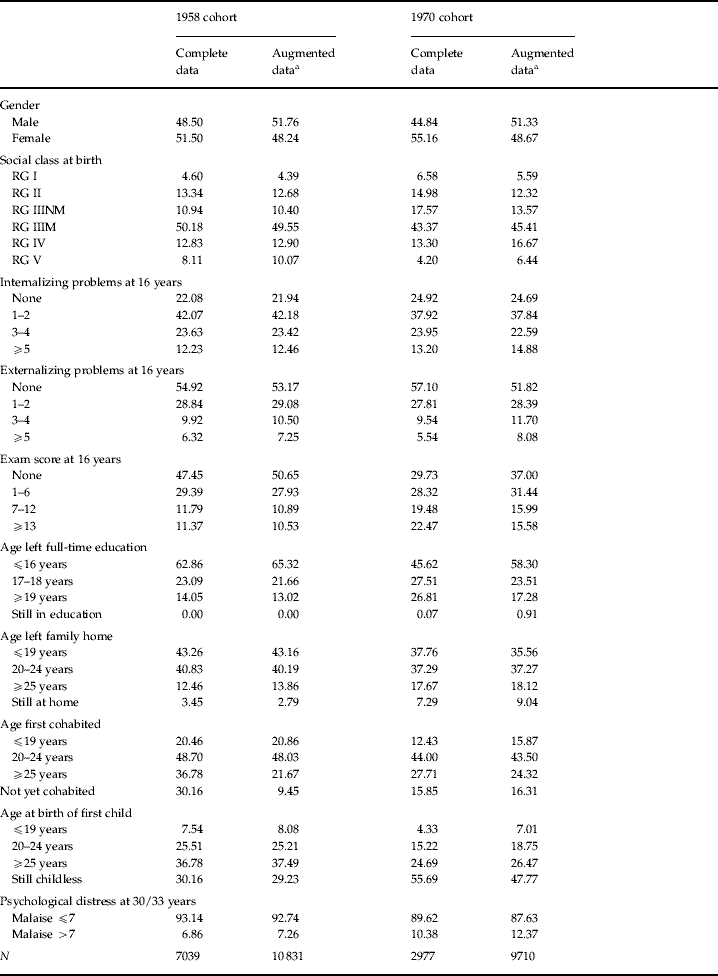
Distribution of variables (percentages) by gender in the 1958 and 1970 British birth cohorts for complete data and for the augmented data post imputation

a Weighted and averaged over five augmented datasets.
Adult psychological distress
Psychological distress in early adulthood is measured by the 24-item Malaise Inventory which was completed by respondents in the self-completion section of the interviews. The Malaise Inventory was developed from the Cornell Medical Index Questionnaire from which 14 of the items are derived (Rutter et al. Reference Rutter, Tizard and Whitmore1970). It includes statements relating to the symptoms of anxiety, depression and associated psychosomatic distress. A total symptom score is derived by counting the number of endorsed items. The 1-year test–retest reliability of the Malaise Inventory in a small sample of mothers of young children was around 0.80 (Coleman et al. Reference Coleman, Wolkind and Ashley1977). Internal consistency of the 24-item scale has been shown to be acceptable: Cronbach's alpha ranges between 0.77 and 0.82 (Grant et al. Reference Grant, Nolan and Ellis1990; Rodgers et al. Reference Rodgers, Pickles, Power, Collishaw and Maughan1999). The validity of the inventory for the detection of psychiatric morbidity has been shown to hold in different socio-economic groups (Rodgers et al. Reference Rodgers, Pickles, Power, Collishaw and Maughan1999). Total scores >7 are taken as an indication of psychiatric distress and identify those at risk for psychological disorder (Power & Manor, Reference Power and Manor1992).
Analytical approach
Propensity scores are used to adjust for drop-out bias at 30/33 years: logistic regression models are estimated that predicted drop-out from socio-economic, demographic and biological variables at birth (1958 cohort AUC 0.66; 1970 cohort AUC 0.72). Inversed propensity scores saved from the models are used to weight the sample in subsequent analyses.
Item non-response is filled in by multiple imputations using the multiple imputation by chained equations (ICE) programs implemented in Stata by Royston (Reference Royston2004). Five replicates of the data were created, giving 95% efficiency (Rubin, Reference Rubin1987). Average regression estimates over the set of augmented replicates are calculated, adjusting the standard errors for missing-data uncertainty according to Rubin's rule (Rubin, Reference Rubin1987).
Graphical chain models were selected as a suitable analytical tool to test hypotheses examining complex relationships between variables (Wermuth & Lauritzen, Reference Wermuth and Lauritzen1990; Hofler et al. Reference Hofler, Wittchen, Lieb, Hoyer and Friis2003). They are particularly suitable for modelling the complex set of dependencies involved here: of primary importance, graphical chain models are appropriate for the analysis of a set of variables with different measurement properties; they can explicitly model the cross-sectional and longitudinal associational chains; they lend themselves quite naturally to longitudinal models, where theory and temporal ordering suggest subsets of variables and the direction of associations.
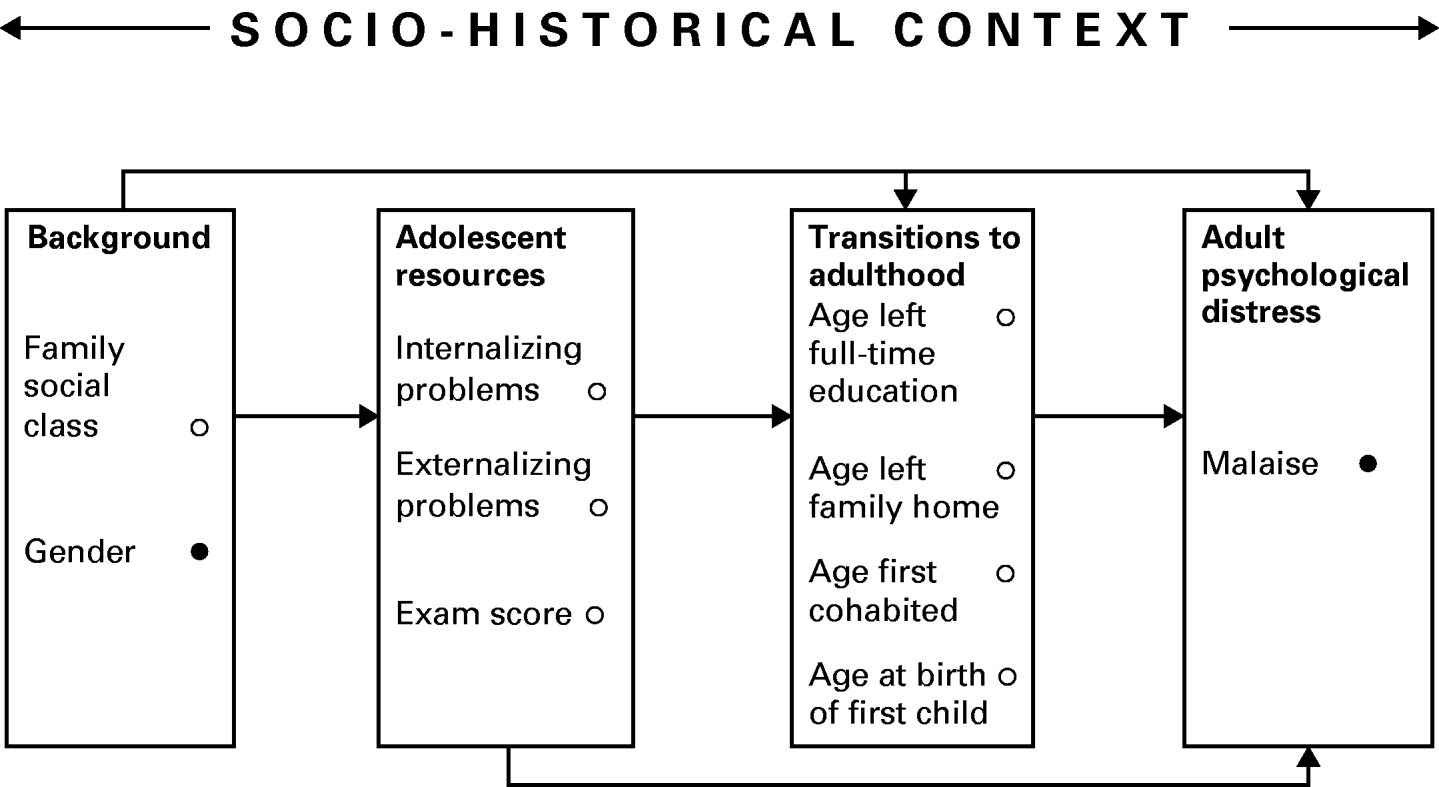
The graphical chain model depicting the associations running from the background variables to adult psychological distress through resources and transitions is illustrated by the chain graph in Fig. 1. A set of nodes represent the measured variables and subsets of nodes are partitioned into blocks. Multivariate, or simultaneous, regression models for all nodes in a block were estimated using the software program Mplus version 4.2 (Muthén & Muthén, Reference Muthén and Muthén2004). The analysis is carried out in steps as follows:
(1) Dependencies, or connections, within blocks (e.g. internalizing and externalizing problems with the exam scores) are assessed by non-parametric correlations.
(2) A logistic regression model is developed for the dependence of psychological distress on all the preceding variables in the model. We start with a main effects model and use backwards elimination of predictors which are conditionally independent of psychological distress. Checks are made for violations in the assumption of linearity in the relationship between the resource variables and psychological distress. No evidence of this was found. The number of categories needed to describe the relationship between the transitions and psychological distress is also checked and categories combined if no loss of information ensued. This is followed by forward selection of two-way interaction effects. No higher level interactions were found.
(3) Using the same backward and forward selection method, Cox regression models for the dependence of the timing of transitions on the resource and background variables are developed.
(4) Zero inflated Poisson regression models for the dependence of the resource variables on the background variables are similarly estimated. These models take account of an excessive number of zero scores under the assumption that the population is characterized by two groups, one where members always have zero counts, and one where members have zero or positive counts. The model jointly estimates the likelihood of being in the zero group and rate ratios associated with a higher count in the second group.
Chain graph of the model of inequalities in psychological distress. A set of nodes represent the measured variables. Continuous variables are represented by open symbols (○) and categorical variables by solid symbols (•). Nodes are connected by edges: a directed edge or ‘causal’ relationship is represented by an arrow, while undirected edges or correlations are shown by lines. Subsets of nodes are partitioned into blocks. Nodes within a block are connected by undirected edges but inter-block edges are always directed. For simplicity, blocks are connected when all nodes in one block have edges with all variables in a second block.

Results
The distributions of the variables are shown in Table 1 for completely observed and augmented cases. For the 1958 cohort, differences are small and in the direction predicted by known socio-demographic influences on non-response. For the 1970 cohort, some differences are quite marked. Listwise deletion reduced the sample to <3000, mainly attributable to exam results not being reported. This resulted in biases that were not observed when the augmented data were compared with raw data on a variable by variable basis (not shown). Consistent with these findings, graphical chain model estimates based on the complete data sample were almost identical to those reported below for the 1958 cohort but not for the 1970 cohort.
Based on the augmented data, there was a 70% increase in reported psychological distress of young adults from 1991 to 2000. Despite this, there was no evidence that the later-born cohort had fewer resources to draw from: there were similar rates of psychosocial problems at age 16 in both cohorts and the 1970 cohort had better exam scores than the 1958 cohort. Moreover, on average, the later-born cohort passed all the transition-to-adulthood milestones when they were older than the earlier-born cohort.
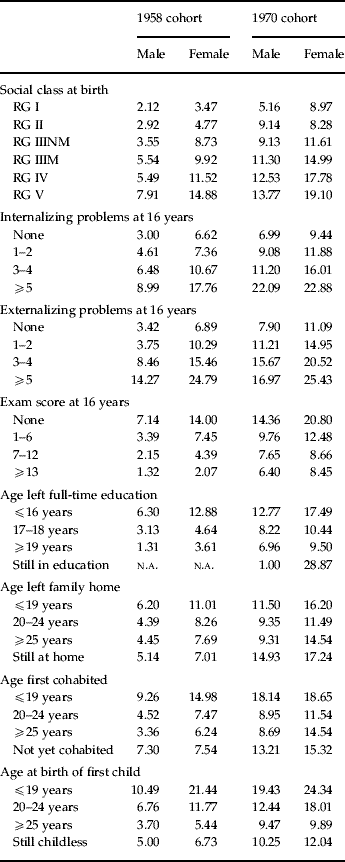
Gender and social inequalities in psychological distress are evident in both cohorts. Despite the increased levels of psychological distress in the 1970 cohort, the gaps appeared no wider than for the 1958 cohort (Table 2). Psychological distress increased with decreasing resources, more so for the 1958 cohort than the 1970 cohort. In general, there was an inverse relationship between rates of psychological distress and transition age although failing to make a transition to an adult role was associated with greater distress.
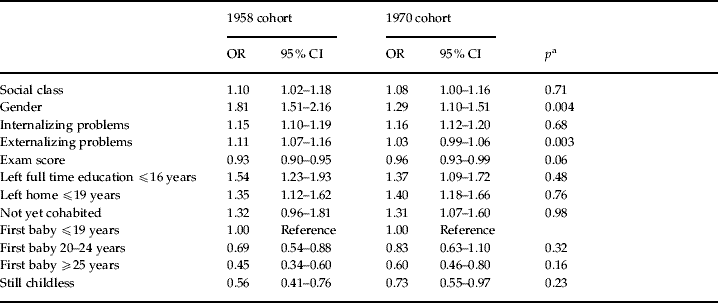
Prevalence of psychological distress at 33 years in the 1958 British birth cohort and at 30 years in the 1970 British birth cohort by age of transitions to adult roles, adolescent resources and background variables

Within-block associations in the graphical chain model
Co-morbid internalizing and externalizing problems are evident in both cohorts, but psychosocial problems correlate more strongly for the later-born respondents (rho=0.34 compared with rho=0.22). Externalizing problems are also associated with lower exam scores, more so for the 1958 cohort (1958: rho=−0.27; 1970: rho=−0.22).
Seventy-one percent of the 1958 cohort made the transitions in the ‘traditional’ order of education followed by leaving home and cohabiting then having a child. By contrast, only 60% of the 1970 cohort followed this route. Thus, the timings of these milestones were more highly correlated in the 1958 cohort than the 1970 cohort. For example, age first cohabited with age at first child correlated 0.65 for the former cohort, 0.54 for the latter.
Resources regressed on background variables
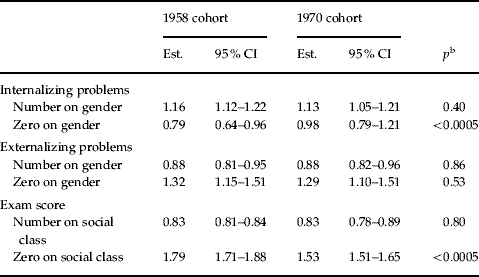
The estimates in Table 3 show that girls were more likely to have no externalizing problems but to have more internalizing problems. Boys were more likely to have a greater number of externalizing problems and to have no internalizing problems (1958 cohort only). A more advantaged social class (lower value) was associated with better exam scores while a disadvantaged class (higher value) was associated with the likelihood of no qualifications. This latter relationship was stronger for the 1958 cohort than the 1970 cohort.
EstimatesFootnote a and 95% confidence intervals (CI) from the zero inflated Poisson regression models of resources on background variables

a ‘Number’ estimates are rate ratios; ‘Zero’ estimates are odds ratios.
b Test of difference between estimates for 1958 and 1970 cohorts.
Transitions regressed on background and resources
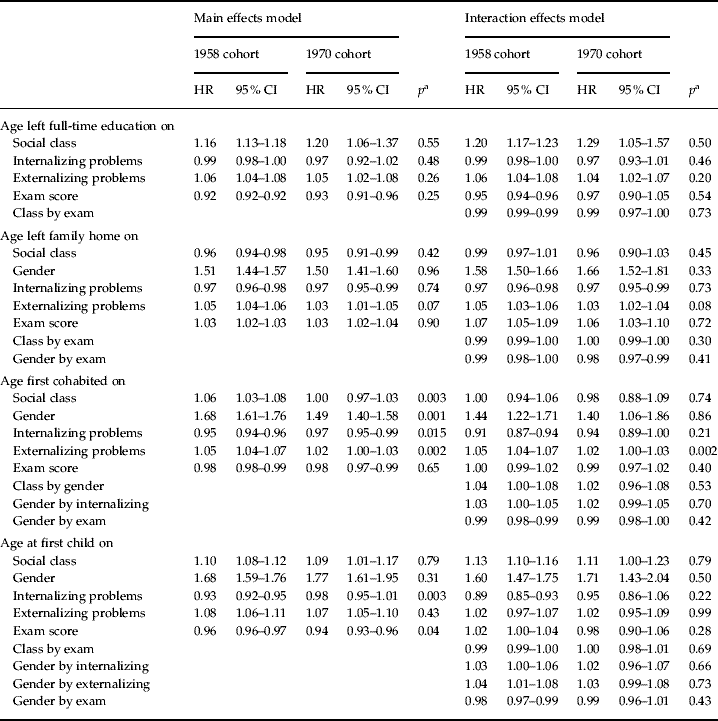
The Cox regression estimates are presented in Table 4. The three resources partially mediated the relationship between the background variables and the timing of transitions to adulthood (main effects). Social class at birth and gender also moderated the relationship between the resources and the timing of transitions to adult roles (interaction effects).
Estimated hazard ratios (HR) and 95% confidence intervals (CI) from the Cox regression models of transitions on resources and background variables

a Test of difference between hazard ratios for 1958 and 1970 cohorts.
A higher hazard ratio in the Cox model implies that an earlier transition is more likely. Thus, fewer internalizing problems and a higher exam score at 16 years increased the chance of staying on in education, whereas more externalizing problems and coming from a more disadvantaged social class predicted an earlier exit from full-time education. Social class moderated the relationship between exam scores and staying in education: a higher exam score had a stronger link with school retention among those from a more disadvantaged social class than it did if the student was from a more advantaged background. These associations were similar across cohorts.
Leaving the family home was more likely to be delayed for men, those in a more advantaged social class, those having more internalizing problems or fewer externalizing problems, and those with lower exam scores. Both social class and gender moderated the effect of exams on age left home. Given the same exam score, women and those from a more disadvantaged social class were older when they left home. There was no evidence of any inter-cohort differences in these relationships.
Being from a more advantaged social class (1958 cohort only) or male gender was related to delayed first cohabitation. Respondents were also more likely to be partnered at younger ages if they had more externalizing problems, fewer internalizing problems or lower exam scores in adolescence. With the exception of exam scores, all associations with timing of first cohabitation were stronger for the earlier-born cohort. Gender moderated some of these relationships. The risk of early partnership formation associated with lower exam scores and fewer internalizing problems were not as great among women as men. By contrast, the risk of early partnership formation associated with a more disadvantaged social class was greater among women than among men. However, even though the moderating effects were significant for the 1958 cohort only, the interaction terms were similar for the two cohorts. This suggests some caution in interpretation of these effects is warranted.
The final transition to adulthood, having a child, had the most complex relationship with the background factors and resources. Men and those from more advantaged social backgrounds were more likely to delay parenthood. Internalizing problems in the 1958 cohort and higher exam scores in both cohorts were also associated with delayed parenthood, with the effect of higher exam scores being greater in the 1970 cohort. By contrast, externalizing problems were related to earlier parenthood for all respondents. Gender moderated the relationship between resources and parenthood. Men with internalizing or externalizing problems were more likely to delay parenthood than women; women with higher exam scores were more likely to delay parenthood than men. In addition, a higher exam score was linked with delayed parenthood among those from more socially disadvantaged groups. As for the moderating influences on cohabitation, the moderating influence of the background variables on parenthood were only observed for the 1958 cohort despite non-significant differences in effect size between the cohorts.
Psychological distress regressed on background, resources and transitions
Adolescent resources directly affected the odds of psychological distress: psychosocial problems, either internalizing or externalizing, increased the odds of psychological distress as did a lower exam score (Table 5). The effect of internalizing problems was similar for both cohorts whereas more externalizing problems and, to a lesser extent, poorer exam scores were more strongly associated with psychological distress in adulthood in the earlier-born cohort than the later-born cohort.
Estimated odds ratios (OR) and 95% confidence intervals (CI) from the logistic regression models of psychological distress on transitions, resources and background variables

a Test of difference between odds ratios for 1958 and 1970 cohorts.
Leaving school at 16 increased the odds of psychological distress but the length of time remaining in education had no additional predictive power. Leaving home in the teenage years was associated with higher odds of later psychological distress than leaving in their twenties or remaining in the family home. Psychological distress was also more likely for those who had yet to form a cohabiting partnership by their early thirties. The odds of psychological distress were greatest if parenthood began before the age of 20 and lowest for those who had a child in their late twenties. Although the timing of transitions had changed in the 12 years between the cohorts, their relationship with psychological distress remained the same.
The independent unmediated effect of gender on adult distress was statistically significant for both cohorts. Nevertheless the effect was lower in magnitude for the 1970 cohort than that for the 1958 cohort. Social class was partially mediated by the intervening variables. The small independent association of disadvantage with psychological distress was similar in magnitude in both cohorts. Neither background factors nor resources moderated the relationship between transitions to adult roles and adult psychological distress.
Discussion
This study has focused on the timing of transitions to adult roles and psychological distress with a particular emphasis on the role of adolescent resources and structural constraints in understanding the relationship. A number of hypotheses were proposed, most of which were supported at least in part by the data. The graphical chain modelling approach has also highlighted the complexity of the life course (Materia & Baglio, Reference Materia and Baglio2005) and that statistical models need to be able to deal with nuanced developmental theory.
The main finding relating to the relationship between the timing of transitions and psychological distress is that early transitions to adult roles were associated with an increased risk for psychological distress but so was failing to make some key transitions. Leaving school at 16 years and leaving home in one's teens independently predicted later psychological distress, but so did failing to have had a cohabiting relationship. There was a suggestion of an inverse J-shaped relationship between age of becoming a parent and psychological distress, with first parenthood in one's late twenties being most favourable for psychological health. As expected, we found that a reasonable period of ‘emerging adulthood’ could be beneficial for later psychological health. Yet young adults were also at risk of psychological distress if they had still to make some of the key transitions to adulthood. The timings of transitions were not so highly correlated in the later-born cohort. In other words, there was evidence of greater individualization during the phase of entry into adulthood. There have been arguments for and against the health benefits of greater individualization (Veenhoven, Reference Veenhoven1999; Eckersley, Reference Eckersley2006). Our results give further insight, indicating that delaying transitions to adulthood may be an act of individualization promoting psychological health but failing to make a transition may not. Added to the health implications of delayed motherhood (Bewley et al. Reference Bewley, Davies and Braude2005), is the potential risk to psychological health. It has been shown that less depressed persons are not selected into cohabiting or marital partnerships; rather marriage protects against depression (Lamb et al. Reference Lamb, Lee and Demaris2003). This suggests that it is not failure to have had a cohabiting partnership that incurs a risk for distress but that a marital relationship is good for psychological well-being.
The study has confirmed that there are structural constraints on successful development. Social class at birth and gender inequalities in psychological distress were evident in both cohorts. Even when we take adolescent resources and transitions into adult roles into consideration, structural differentials remained. More optimistically, gender differences were narrower and residual social class differences only just significant for the later-born cohort. It remains to be seen whether structural constraints on well-being are further weakened for future generations, or indeed, on this cohort of young adults as they age.
As expected, psychosocial and educational resources in adolescence were related to better psychological health in early adulthood. Resources predicted adult psychological distress more strongly for the 1970 cohort, when control over their environment felt more threatened by economic recessions and loss of employment opportunities. Yet our hypothesis that the relationship between timing of transitions and adult psychological distress would be weaker for the 1970 cohort than for the 1958 cohort was not supported. If the economic climate at that time did remove some of the choice over the timing of transitions, it did not have detrimental implications for later psychological health. Ultimately, an analysis of the macro-environment and psychological distress may yet address the question of the temporal increase in psychological distress that remains unanswered by this study.
The effects of the background structural variables were mediated through different resources: social class was mediated by educational resources whereas gender was mediated by psychosocial resources. But the route to psychological distress via the timing of transitions was more complicated. On the one hand, class disadvantage was associated with leaving education and having children earlier which in turn were linked with higher odds of psychological distress. On the other hand, a more advantaged class was related to leaving home at a younger age and a greater likelihood of still being childless and having had no cohabiting relationships, all three of which increased the chances of psychological distress. These results emphasize the need to check assumptions of linearity in mediating relationships, as was done here, otherwise important findings can be overlooked and erroneous conclusions made.
Of special interest is the way that the background variables moderated the effects of adolescent resources on the timing of transitions. Young women with psychosocial problems were at greater risk of making early transitions than young men. Some adolescent externalizing problems are known to be time limiting (Moffitt, Reference Moffitt1993), unlike their consequences. Male externalizing problems tend to be expressed in delinquent acts whereas female problems are more likely to result in early sexual relationships (Bardone et al. Reference Bardone, Moffitt, Caspi, Dickson, Stanton and Silva1998; Woodward & Fergusson, Reference Woodward and Fergusson1999). Our findings suggest that teenage girls with externalizing problems may have to face greater and more far-reaching consequences than teenage boys.
Nevertheless, young people from disadvantaged backgrounds showed greater benefits after achieving higher exam scores at 16 years. The model suggests that educational success can promote resilience to later psychological health problems in disadvantaged youth by delaying the timing of transitions to adulthood. Higher exam scores also appeared to protect women from making early transitions more than men. There are government proposals to increase the school leaving age to 18 years in England (Department for Children Schools and Families, 2007). It remains to be seen whether this will impact on levels of adult psychological distress.
Young men in the 1970 cohort were older on average when making transitions to adulthood than in the 1958 cohort. The socially advantaged are also making later transitions than the more disadvantaged (Harley & Mortimer, Reference Harley and Mortimer1999; Ravanera et al. Reference Ravanera, Rajulton and Burch2006). Yet we found no evidence that gender or social background moderated the effect of transitions on adult psychological distress or that gender or social inequalities had increased over time: actually the gap narrowed. This unexpected result could have arisen because young adults were particularly at risk of psychological distress if they had yet to make some of the key transitions to adulthood.
In interpreting the findings, some limitations of the analysis should be noted. We have calculated the timing of transitions by linking data across several waves of data collection. Recall accuracy of dates is likely to decline with time and non-random biases could have been introduced into the derived data. Non-response bias especially that originating through sample attrition may also cause problems. We have used propensity score weighting together with multiple imputations as a ‘best effort’ approach to account for attrition and item non-response bias under a data missing at random assumption but the possibility of bias might still be present.
Some differences between the cohorts in the timing and method of data collection suggest some caution in the reading of the cross-cohort comparisons. The 3-year difference in age at adult interview could have a bearing on the findings, but it is less likely that PAPI- versus CASI-administered questionnaires could account for cross-cohort differences.
Nevertheless, the analyses provide a unique opportunity to assess changes and similarities in the timing of transitions in two birth cohorts born 12 years apart. Although participation in education has increased and more young people have delayed the assumption of adult roles, only some benefited from these demographic changes. It is beyond the scope of this study to identify the characteristics of those who remain childless or unpartnered or the impact of taking non-traditional transitions on psychological health in the early thirties age group. Further research to identify the life-course characteristics of these subgroups should have policy implications for adult mental health.
In conclusion, education may protect against psychological distress through the knock-on effect of delaying the timing of life transitions and of giving young people greater choice over the course that their lives will take. Policies targeting adult well-being could give greater consideration to factors associated with social class and gender that restrict young people's developmental options.
Acknowledgements
This work was funded by the UK Economic and Social Research Council grant no. L326253061. Data from the 1958 and 1970 British birth cohorts were supplied by the ESRC Data Archive. Those who carried out the original collection and analysis of the data bear no responsibility for its further analysis and interpretation.
Declaration of Interest
None.