Technical innovations tend to emerge in clusters of interrelated improvements. This is a characteristic of the contemporary world, where major scientific breakthroughs often pave the way for manifold industrial applications that unfold over a long period. Generally speaking, the greater the potential for long term improvement, for new fields of application, and for increasing returns to scale, the more likely it is that a technological development will hit the global economy and affect the everyday life of millions of people. It is not surprising, therefore, that the social sciences have taken increasing interest in ‘systems’, such as those brought about by the diffusion of the steam engine, telecommunications, electricity, the internal combustion engine, and information technologies. In this context, small and independent innovations can still be admired as beautiful, but ‘big’ technologies undoubtedly take the lead and their effects engulf the ‘small’ ones. The indirect payoffs attached to large technical systems include the gains from their widespread use throughout the economy; the technological complementarities passed into downstream productive sectors; the reinforcing effects of interrelation and network usages (what economists term externalities); and the building of socio-technical systems – that is, a corpus of institutions, infrastructures, financial resources, agents, and habits. In other words, the impacts of technical systems are not only extensive but also long-lasting and resilient.
As a result of these trends, the history of technology has advanced towards the long term. Yet this is a complex long term, grounded in the dynamic propagation of events across the macro, mezzo, and micro economy rather than an immovable or cyclical time made up of ‘repetition events’.Footnote 1 Steam, telecommunications, electricity, internal combustion, and information technologies constitute defining fields where action takes place – serial developments framed conceptually by the terms ‘general purpose technologies’ (Lipsey), ‘techno-economic paradigms’ (Perez), and ‘technological paradigms’ (Dosi), with an impact on ‘socio-technical systems’ (Hughes) and ‘systems of innovation’ (Edquist and Lundvall).Footnote 2 These concepts differ in tone and, while the first three are more focussed on the economic outcomes of revolutionary technical changes, the latter two are more concerned with the evolutionary process of technology leading to specific results. However, all approaches converge on a similar idea: the principle of a high level of interdependence between the development of modern capitalistic economies and the emergence of very generic technological systems. To some extent, it is capitalism as a forward-looking, well-organized, multinational system that is recast through the mix of generic technologies.
While this article does not dispute the central role played by general technological systems in the making of the modern world, it nonetheless recognizes that such an innovation-centric view tends to undermine the contribution made by time, technological mixes, and local resources in societies’ history. In effect, the role and scope of general technological systems can not be assessed without taking into account the windows of opportunity open at the moment of their introduction (the time-path);Footnote 3 the concrete mix with older technologies, traditions of usage, and infrastructures for maintenance and repair (technological mixes);Footnote 4 and the abundance and relative costs of the resources required to make the technology work (local resources).Footnote 5 It is specifically this last factor that is examined in this article. Just as the title suggests, I will analyse how oil as an energy carrier evolved alongside the earlier technology of the steam engine. This perspective corresponds to a viewpoint situated along the borderline of the ‘systems’. Chronologically, the gap between steam and internal combustion technologies covers the period from the 1880s to the 1930s. Although a transition technology has been identified in a number of case studies in some countries (namely in the United States and Russia), no comprehensive analysis has yet determined how it affected global history. This article links the micro account of technological developments with the macro records of energy consumption so as to reveal how steam technology set the stage for the commoditization of oil, the customary fuel of the internal combustion engine. What was at stake was the transformation of oil into a geostrategic good and the triggering of an international race for the seizure of fossil fuels.
The first part of the article traces the evolution of the oil industry in the United States and Russia, showing how the creation of a global market for kerosene stimulated the emergence of regional markets for other petroleum by-products, namely fuel oil. As it was not possible to produce illuminants without also obtaining large quantities of fuel oil, international economies in lighting supply had to mesh with regional economies in power generation. The second section highlights the invention and consolidation process of a market for the ‘secondary’ and little-valued by-products obtained by distilling crude, a process marked by the hybridization of existing steam technologies. Fuel oil was adapted to machines originally devised to be coal-fuelled, which led to the flexible switchover between energy carriers. Emphasis is given in the last section to the fact that ‘in-between technologies’ may have bold macro-economic consequences, and I explain the circumstances in which combined oil–steam technologies made some countries take distinctive paths of energy consumption.
Trading by-products
The discovery that seepages of ‘rock oil’ flowing from below the ground could unveil astonishing reservoirs of petroleum prompted a rush for deep drilling in Pennsylvania in the United States and, later, in Azerbaijan in the Russian empire. From 1859 and 1870 respectively onwards, the modern oil industry began to take hold, and the market swiftly organized the downstream areas of transport, storage, packing, refining, and distribution. One of the most distinctive traits of this ‘build and grow’ phase was the existence of a dual economy in the markets for products obtained by refining: while some products came to the fore as global goods (for example, kerosene for illumination and lubricating oils for greasing machines) that were soon integrated in worldwide distribution networks, the remaining by-products (naphtha, gas-oil, fuel oil, paraffin) lagged behind as regionally tradable goods, which meant that they could only be sold near their production source. From a technical standpoint, the bulk of these poorly tradable by-products came from the ‘bottom fraction’ of crude oil – the last fractions with heavier molecules removed from the stills or left over as residuum.
In the late nineteenth century, all distillation – the heart of refining operations – was performed in ‘straight-run’ stills by gradually raising the temperature so as to drive vapour from the boiling oil along a pipe. Once in the pipe, the steam was normally condensed to a liquid by means of a condenser box with many pipes containing running water. When the specific gravity of the distillate reached a certain level, thus becoming too heavy, it was separated or ‘cut’ by running the distillate into another tank. Through the application of more intensive heat, the next component of the crude was then removed, once again by means of steam and cooling devices. Since each successive still, with its higher temperature, was placed below the preceding one, gravity allowed the oil to flow steadily through the entire batch. The technical jargon ‘batch-operation’ precisely captures the system’s basic feature. In the end, the different fractions were separated by boiling edges ranging from the lighter by-products of naphtha and kerosene, through the medium boiling range of gas-oil, to the ‘bottom’ of heavier distillates: paraffin wax, lubricating oil, and fuel oil. The ‘batch-still’ process was accompanied by other methods that consisted of simply skimming or topping: that is, distillation of the naphtha and kerosene with steam and fire, followed by the extraction of the fuel oil.Footnote 6
Significantly, most of the technological improvements that appeared in the United States sought to improve the separation of the different cuts and, whenever possible, to convert the fractions of little market value to those of greater appeal.Footnote 7 At a time when the demand for private lighting was reaching extraordinary heights,Footnote 8 the kerosene fraction naturally became the most valued product and the mainstay of the oil economy. Moreover, its use in lamps had a profound effect on everyday life from Europe to the Pacific. The efficiency of kerosene was similar in candle-hours per unit of energy input to the existing alternatives of ‘portable’ light – tallow candles, colza oil, and whale oil, but it was cleaner, burned without unpleasant smells, required only half the storage space, and, above all, was much cheaper. Estimates of the prices of the light flux (dollars per lumen hours) with the available technology of nineteenth-century lamps revealed that kerosene was fourteen to twenty times cheaper than other substitutes of vegetable and animal oils.Footnote 9 On the basis of the high demand for this new substitute good, some of the first multinational corporations soon concentrated trade along five major routes: North America to western Europe; North America to South America and the Pacific; Romania and Poland (Galicia) to central and western Europe; the Dutch East Indies to East Asia; Burma to South Asia. As the integration process and competition in these markets began to take hold, the sales of the other by-products from crude oil receded into the background, as regionally tradable or even non-marketable goods: in the US, some fractions below the boiling range of kerosene – such as the volatile naphtha fraction – were generally thrown away, with ecological impacts on lands and lakes; at best, the heavier fractions of gas-oil and fuel oil were used by the oil enterprises for their own consumption in boilers and, at worst, ‘run into lakes of liquid petroleum which were set on fire to get rid of them’, or ‘carried by pipes into the sea’.Footnote 10 Whatever the method of disposal, fuel oil had little or no market value.Footnote 11
There are two explanations for why oil was wasted in this manner: first, the light density of the Pennsylvania crude made it suitable for refining into illuminants, allowing yields of 65–75% of kerosene until security and technical regulations were set. The potential for developing economies of scale for others by-products was substantially reduced because only small amounts of residuum were left over. Secondly, petroleum was discovered in the vicinity of major coal-producing centres, thus hampering its acceptance as a substitute fuel. Overall, the shortcomings that affected the bottom fractions of oil enabled the reinforcement of a highly competitive and globalized sector based on the ‘upper’ fractions of illuminants.
The situation in Russia was quite the reverse. A particular combination of circumstances led the petroleum industry around the city of Baku, in Azerbaijan, to concentrate on the production of fuel oil, with kerosene as a by-product. The chemical properties of Russian petroleum, its high density, and the fact that the bottom fraction represented an average of 70% of the oil distilled in the stills (compare to 13–18% in Pennsylvania) explain why the residuum was the chief commercial commodity from the outset. Though this refuse could not be volatilized by the application of heat, it could be broken up or divided into spray and used by injecting air or steam into it. Atomization allowed the oil to be burned in boilers just like coal, thus providing a technological bridge for its use in steam engines.
However, it was not only Russia’s ‘comparative advantage’ in terms of natural resources that was at work. Lack of capital and the dispersion of entrepreneurial initiative locked the 140 small refineries that appeared across the region into very primitive refining techniques resulting in high levels of waste, appalling environmental conditions, and poor-quality finished products. At the same time, the geographical location of the Baku oilfields near the Caspian Sea did not make export to European markets easy; on the contrary, it made the region inward-looking, strengthening local supplies in the perimeter of the Caspian and in southern parts of inner Russia via Astrakhan and the lower Volga.Footnote 12 Finally, and again in contrast to the US situation, not only was the oil province of Azerbaijan completely depleted of wood but it was also far from the Donetz Basin mines, which were Russia’s main centre for coal production.Footnote 13 This scarcity of energy sources enhanced the potential for petroleum’s new usages.
To sum up, the specific quality of Azerbaijan’s heavier crudes, combined with poor capital and technology, high transport costs, and depletion of natural resources, pushed the Russian industry towards the regionally tradable market for fuel oil, and made illuminants a secondary (by-)product. Given these constraints, it would seem to follow that the Russian industry should evolve along the track of slow capital accumulation, conceivably stepped up by some imperial reform. However, development proceeded at breakneck pace: Azerbaijan was turned in one fell swoop into the experimental laboratory of the world industry by the early arrival of foreign capital, foreign entrepreneurship, and technical ingenuity. Most observers described the oilfields as ‘deserts literally caked with petroleum which solidified into asphalt on which no vegetation could grow’; with ‘valuable by-products burned off or passed into the Caspian’, thereby transformed into a second Black Sea;Footnote 14 and ‘thousands and thousands of workmen living in damp, unlit, dark, dirty barracks where three sleep together in a small uncovered cot’.Footnote 15
However, on their arrival by chance in the region, the Nobel brothers foresaw a land of gilded opportunities, where most men discovered the materialization of hell on earth. Robert and Ludwig Nobel brought to Baku the experience and capital of one of the most distinguished European industrialist families, their personal engineering expertise, contacts with Swedish and British enterprises at the forefront of technological innovation, close acquaintances in Moscow governmental circles, and the capacity to influence Russian policy.Footnote 16 Nevertheless, it was the cascade of innovations that they introduced in a short time span that made the arrival of this special breed of foreigners astonishing: the purchase of the giant Balakhany oilfield near Baku in 1874 set the stage for: the subsequent building of a modern refinery (1875); the ground-breaking installation in Russia of a pipeline system powered by a 27-horsepower steam pump (1877); the design, assembly, and launch of the world’s first tank steamer, the Zoroaster, with revolutionary innovations such as the use of Bessemer steel and an improved system for boiling oil as a substitute for coal (1878); the successful experimentation of the new technology of continuous multi-still distillation for refining oil (1881); the application of chemical purifiers to improve the colour and flash point of the kerosene obtained in distillation (1881); the adaptation of the American prototype of railway tank-cars (1881); and the innovative recruitment of a geologist to a permanent position in a corporate petroleum undertaking (1885).Footnote 17
Thereafter, the largest Russian companies benefited from Ludwig Nobel’s policy of making no secret of his achievements and soon began to emulate Nobel’s best practices. The spectacular growth in output from Baku fields was due both to increased productivity in refining and transport and also to new discoveries in the relatively unscathed reservoir: from 1874 onwards, it was possible to strike a well and unleash a ‘petroleum fountain’ or gusher that delivered 6,500 to 43,000 barrels every twenty-four hours.
On top of these exceptional historic conditions, the transportation barrier that had largely confined the petroleum industry to the internal market was also removed. In fact, this barrier had a name: the Ottoman Empire. As long as the Ottomans were able to rule on the Black Sea and maintain a tight control over the Bosporus strait, inner Russia was cut off from direct links with the outer European–Mediterranean routes. The opportunity to redress this geostrategic equilibrium arose when a wave of rebellions broke out in the Balkans in 1875 and 1876. Calling upon its Pan-Slavic mission, Russia declared war on the Ottoman Empire and dealt a severe blow to the caliphate’s ambitions. Despite having to split the spoils of war with other European powers at a special international peace conference in Berlin in 1878, Russia was able to uphold its conquests in the Black Sea.Footnote 18 After that, the ‘Russification’ of the new territories proceeded as fast as possible, and within five years the railway connection between the oilfields of inner Baku and the free-trade harbour of Batumi on the Black Sea Coast was completed. The ensuing oil boom heightened Russia’s advance towards the Mediterranean route.
Thus, by the mid 1880s the industry was in fact moving toward a mixed production system based on internationally and regionally tradable goods. The spurt of technological innovation combined with the access to new commercial routes laid the ground for sales of good-quality kerosene obtained with a better yield in refining, as well as of the fuel-oil residuum, called mazout in Russian. The complementarities between these by-products can be understood as a self-reinforcing process supported by economies of scale and economies of scope: the cost of production per unit falls as the output from refining increases (scale), but the average total cost also falls as the number of different goods produced is augmented (scope).Footnote 19 Such double-edged dynamics meant that the larger the sales of Russian kerosene in world markets (Europe, but also the entire region east of the Suez Canal after 1891)Footnote 20, the more industrial applications had to be found to substitute fuel oil for coal. One thing could not advance without the other: the seizure of competitive international markets pushed the growth of homeland demand through innovation in energy carriers. As a consequence, at the end of the nineteenth century Russia moved towards a path of primary energy consumption that was distinct from all other nations.Footnote 21
In the meantime, the oil industry in the United States also underwent change. Following the discovery of new oilfields in Lima, on the border of Ohio and Indiana, in the mid 1880s, in California in the 1890s, and in Texas and Oklahoma in 1901, as well as the first imports of Mexican crude, heavier oil flooded the markets, some of which was unsuitable for refining into kerosene.Footnote 22 Thereafter, the conversion from coal into oil proceeded swiftly, albeit later than in Russia, and attained particular scope among the sectors of industrial power, railways, steamships, electricity production, and space heating. Small portions of the residuum also started to be used for road-building bitumen, particularly after 1918.Footnote 23 The switch in the United States was fostered not only by the availability of ample stocks of heavier crude in the west and south-west but, more particularly, by a very sharp downward trend in prices after the staggering discoveries in Texas and California: oil made its mark in comparison to coal thanks to crude barrels as low as 30% of the reference coal’s price (Pennsylvanian crude).Footnote 24
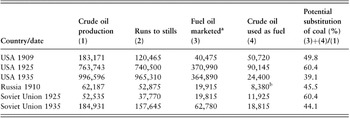
Despite taking different paths, Russia and the United States had both established robust branches in internationally and regionally tradable products of the oil industry by the beginning of the twentieth century. Moreover, Table 1 shows that the evolution of the regionally tradable branch was quite similar in the two nations. Columns 3 and 4 of the table present data on the two industrial products used for coal replacement: first the above-mentioned residuum of fuel oil and secondly the consumption of non-refined crude for general fuelling purposes. Together, their relative share of oil production amounted to almost 50% by 1910 and increased to 60% in 1925. This means that the by-products that could compete with coal attained the largest share of oil usages both in Russia and the United States. However, the relative importance of crude oil for fuel steadily declined over the years as the industry matured. Since crude provided approximately the same thermal energy as fuel oil at only a fraction of its costs, it was a very cheap alternative. But the experts soon realized that ‘by reason of its searching and corrosive effects, crude oil had a greater tendency than refined oil to attack the steams and tubes of modern boilers’.Footnote 25 Whenever forced-draft situations were at stake, this was a reckless option: in normal conditions, the low (variable) costs of crude entailed high costs of maintenance, cleaning, and repair of capital goods. Coal substitution was therefore based increasingly on fuel oil, and this trend was hastened by the tide of technical regulations and standardization procedures for hybrid steam engines that were introduced before the First World War and in the 1920s.Footnote 26
The production of oil substitutes for coal in the US and Russia, 1909–35, in thousands of US oil barrels (42 gallons)

a Includes gas-oil, residual oil, and distillate. b Author's estimate.
Sources: Sam H. Schurr and Bruce C. Netschert, Energy in the American economy, 1850–1975, Westport, CT: Greenwood Press, 1975, pp. 93–111; Alexander Gerschenkron and Nancy Nimitz, A dollar index of Soviet petroleum output, working paper, Project Rand Research Memorandum, US Air Force, 1952; Heinrich Hassman, Oil in the Soviet Union, Princeton, NJ: Princeton University Press, 1953, pp. 30–2; ‘Russians likely to exceed record’, Oil & Gas Journal, 29 December 1927.
Judging by the pre-eminence attained by coal substitutes, it is possible to see how the emergence of the new world market for illuminants drove the leading producing nations, Russia and the United States, along the distinct path of adapting oil to the steam age. But this was a national/regional phenomenon from the outset. Fuel-oil exports only attained any significance in intercontinental trade after 1911, with the conversion of specific vessels to carry ‘dirty cargoes’. Even then, fuel oil as a tradable commodity was largely limited to coal-poor enclaves: this was the case in the Caribbean and South America, where North American enterprises established controlled branch marketing stations to extend the kerosene sales to other petroleum by-products; in the Mediterranean and the Arabian Peninsula, where the British Anglo-Iranian Company set up a chain of bunkering stations along the shore; and in India, where the British government contracted regular fuel-oil supplies for the Indian railways.Footnote 27
The hybridization of steam
The initial contrast between the US and Russian industries meant that Russia was under greater pressure to discover efficient technologies, because of its excess residuum throughout the nineteenth century. Then, at the start of the new century, the mix of products refined in the two countries converged, so that the incentives to use oil as a source of power became more evenly spread. The following pages describe the history of this process.
Switching steam engines into hybrids fuelled by oil was a cheap, easy, and reversible process, simply involving the installation of new boilers, burners, and tubes without any interference in the engine itself. Since only the infrastructure for the furnace and storage rooms was affected, the conversion was a technological add-on, which could be removed in the years ahead if circumstances changed significantly. It is worth remembering that, irrespective of the pace of discoveries and estimated reserves, fears of shortages in oil supply were an onerous issue for private and public decision-makers.Footnote 28 Perhaps the most striking fact about this technological add-on is how a ‘light’ and reversible technical device had such an enormous effect on oil consumption patterns and transformed the primary energy balance of producing countries. Indeed, it was a case of minor and decentralized changes cumulatively paving the way for an overall shift in the macro economy.
From the outset, Russia was the hub around which most of the innovation revolved. Drawing upon the first successful applications to pulverize raw oil and blow it into a furnace in the form of spray, Thomas Urquhart, the superintendent of the Griazi–Tsaritzin Railway, converted some coal-burning locomotives to oil-burners in 1882. As this experiment obtained good technical and economic results, all circulating material running on the 423 miles of the railway line was gradually switched to oil. Given the scale of the enterprise, the Griazi–Tsaritzin Railway set a technical standard that was soon to be studied and emulated by American, Dutch, English, and other foreign engineers.
Urquhart’s ideas stemmed from the principle of conducting the oil through a central supply pipe onto a diaphragm from where it was driven into the furnace by a separate steam spray (an invention tested by the Russian Spakovsky in merchant ships in 1870),Footnote 29 together with upgrading a conical head with spiral grooves that gave the flame a rolling motion on entry (an invention tested by Ludwig Nobel in his tank ship in 1878).Footnote 30 Building on these principles, the Urquhart burner attempted to feed the furnace evenly and obtain a more uniformly distributed spray. After several tests conducted in experimental settings, Urquhart devised a burner where the steam tube and the oil mingled at the mouth of the nozzle and were injected as a fine spray into a fire-box. At this junction, there was an opening to the atmosphere through which the air was drawn by suction to the nozzle. The air, steam, and oil together triggered a mingled blast that broke the oil up into a very fine spray. Moreover, the overall process was facilitated by the design of a flare-shaped slotted opening that ensured that the jet spray was distributed in a fan-tailed effect.Footnote 31
The reports written by Urquhart underline an overall 43% decline in power costs, as well as savings on engine repair owing to the absence of sulphur in the oil. This was despite restrictions imposed by the Russian government that prohibited the railway company from adopting fuel oil unless they could prove that the fire-box could be changed at a moment’s notice to burn coal. Caution was the keyword, and the reversibility clause was to be fully implemented, with imperial support, when fuel oil prices soared in 1907 (reaching 43 kopecs per pud, double that of two years earlier) and a temporary return to coal was the order of the day.Footnote 32 Likewise, caution was the tenet of the American naval experts who, at the height of the oil boom in 1904, recommended ‘that no design of fuel oil installation should be permitted for marine purposes which would not permit the renewal of all grate and bearing bars within twenty-four hours, so that a return to coal could be accomplished within a reasonable time in case of failure in the oil supply’.Footnote 33 The commercial flexibility of private enterprises added to the geostrategic flexibility of energy switches as they installed coal- and oil-burners side by side to take advantage of price differentials in bunker stations for merchant ships, particularly between Suez and the Gulf of Mexico and the Pacific.Footnote 34
Despite reservations, there was a general feeling that the fuel-oil age was at hand. In the early 1900s, a spurt of entrepreneurial invention extended the catalogue of burning devices to every possible application, from portable burners operated by a single man to burners and furnaces for home heating, sugar and rubber plants, and metallurgical and shop furnaces. On the technical front, the range of options also grew, with two new possibilities that evolved alongside improvements in the Urquhart-type burner for steam atomization: the first was spraying induced by compressed air, the second was spraying induced by mechanical atomizing.Footnote 35 One company from Hannover, with a branch in Pennsylvania, achieved great success with their mechanical system based on the joint action of pump pressure on the oil and the centrifugal rotary action of screw guide blades. Named the Korting system after its inventors, this type of burner was particularly suitable for ships because it avoided both the load of fresh water for steam atomizers and the risks of compressed atomizer malfunction at sea. Moreover, the finer mist of oil droplets delivered by the whirling motion had the benefit of a lower smoke emission; this drew the attention of the most powerful navies in the world, pledged as they were to upholding the element of surprise in sea combat.Footnote 36 However, in terms of efficient combustion, the Korting mechanical burner did not differ much from its predecessor, the Urquhart steam burner, as both were able to evaporate a similar amount of water by unit weight of fuel oil (around 14 pounds of water per pound of fuel oil).Footnote 37 The comparison with the coal ratios of 7–8 pounds of water per pound of good-quality bituminous coal is therefore overwhelmingly significant.
From the steam engineer’s viewpoint, oil had two thermal advantages: a similar quantity of steam power could be produced with a smaller load in stockpiles and transport; and a larger amount of steam power, and therefore energy, could be produced with the same load in stockpiles and transport. The first idea suggests indirect savings in costs, while the second implies power intensity and speed. Either way, oil renewed the possibilities of steam technology, whose technical development appeared to have slowed almost to a standstill by the eve of the First World War. Entrepreneurs, politicians, and military men were able to alter their previous set of options by upgrading the existing engines with a higher grade of fuel using low-cost burners. The new margins in decision-making included the preference for alternative costs of fuel, the preference to save space, time, and work-hours, and the preference for increased power and speed. From this perspective, it is no accident that the buzz phrase ‘collateral advantages of oil’ gained strength within the industrial milieu. This expression means that, even accounting for lower prices of coal per unit of energy delivered, the ‘collateral advantages’ could well tip the balance in favour of oil.Footnote 38 If the technological options are run through several margins of decision-making in which price is just one of several factors, it is worth taking a more detailed look at each aspect that might foster the hybridization of steam: relative prices, indirect savings, power intensity.
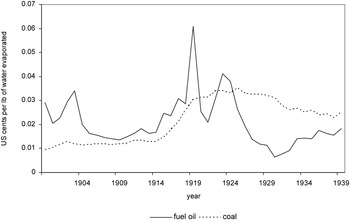
Starting with relative prices, Figure 1 depicts the evolution of the real technical cost of steam production using coal and fuel oil in US cents per pound of water evaporated. There is such a marked difference between the steady trend in coal and the more volatile evolution in fuel oil prices that it is unlikely that anyone wishing to avoid risk would bet on a technological switch. Rather, they would opt to stick to traditional fuels. Indeed, up to the First World War, the gap in prices was very small, though those burning coal were at a slight advantage. In other words, despite coal’s lower thermal efficiency, it was still a good economic option in terms of the final cost of energy produced. This context led to the consolidation of a geography of prices around the major producing regions, with both fuels holding sway over their hinterland and losing competitive ground whenever they were burdened with transport costs to more distant areas.
Fuel costs by power source of steam engines in the United States (1900–40). Wholesale prices of the fuel oil and coal needed to evaporate 1 pound of water in a steam engine.
Sources: Schurr and Netschert, Energy, pp. 93–111; John Lawrence Enos, Petroleum progress and profits: a history of process innovation, Cambridge, MA: MIT Press, 1962, pp. 292–3; Dunn, Industrial uses.

In addition to the effects of the war, a major change took place in the relative costs of steam: not only did the gulf widen in favour of cheap fuel oil but this shift was further enhanced by problems in adjusting coal supplies to peace times. Massive strikes in 1919 and 1922, disruption of traditional markets, excessive hoarding, speculation, and failure of cooperative regulation all ravaged the competitiveness of solid fossil fuels.Footnote 39 Globally, this imbalance confirms the data presented in Table 1 and the idea that fuel oil had a new competitive edge in the 1920s. To the delight of oil-burner enterprises, inter-fuel substitution advanced swiftly and receded only at the beginning of the 1930s (see below).
As stated above, indirect savings were a second margin of decision-making. Fundamentally, the savings result from the physical and chemical properties of oil. This happens in part because it can be moved simply by pumps and pressure devices, thus reducing the number of workers assigned to filling the tanks and feeding the boilers. Moreover, due to its high caloric content per unit of weight, oil enables a cut in both the storage space and its weight. Most contemporaries heralded these achievements but overlooked the fact that they followed in the footsteps of a long history of improvements. In fact, the adoption of the compound steam engine, the triple expansion engine, and the steam turbine had already almost halved the average coal consumption of engines in use between 1870 and 1914.Footnote 40 However, changes in engines were discrete and continuous, as opposed to the abrupt upheaval caused by burners – something that explains the enthusiasm for the novelty. Another difference is that, while the development of engines prompted the substitution of energy by capital, the introduction of oil-burners led to the substitution of labour by energy. The switch to higher-grade fuels had an immediate impact on the full range of services required by an energy carrier with minimum lower capital costs. It was precisely this change in the quality of energy services that Sam Schurr highlighted as the key driver to broader economic productivity.Footnote 41 For instance, the savings created by the conversion of a state-of-the-art, 9000-ton seagoing steamer amounted to 1030 cubic meters of storage space previously reserved for coal, of which 700 cubic meters of net area could be reserved as new cargo space. Furthermore, the operation of the boilers meant that the workforce in the fire-room could be halved and the time taken to refuel the tanks cut from a minimum of 30 hours to just 5 hours.Footnote 42 For the economies of railway and ship transport, these kinds of saving in space and manpower were particularly appealing, provided that fuel was available in different places at competitive prices.
In land installations that were based mainly on working furnaces, the switch to oil yielded similar results, particularly as hard muscle power was replaced by the supervision of supply and storage. The fact that ‘the work of firing requires no physical exertion’ and that ‘a clear eye and common sense is all that is required’Footnote 43 was fundamental here. Moreover, a side effect of transforming uneven operations into flow processes was that the regularity and control of the combustion enhanced the overall thermal efficiency and reduced the wear and tear on equipment. The third and final point is that the conversion to oil could also raise power intensity thresholds. Although few people seemed interested in pushing this option too far at the end of the nineteenth century, it was noticed by the engineers and high ranks of European, American, and Japanese navies, who sought every inch of technological progress that might tilt the balance of power. Raising speed a notch higher by adapting oil-burners in navy ships meant new prospects for tactical and strategic mobility and hastened the ongoing transformation of the fleets. In effect, speed became a key issue amid a feverish armaments race framed by burgeoning theories of naval warfare.
Conversion to oil could give a 20% head start in speed. From 1895 to 1907, naval strategists interpreted this advantage as particularly suited to non-capital ships that could act separately from the main battle fleet but were in close contact with the command. The recent introduction of wireless telegraphy, combined with the offensive and defensive capabilities of torpedoes equipped with guidance mechanisms, had the dual effect of a more widely distributed flotilla and the increased value of specialized ships. The Italian navy was the first to advance along the ‘speed’ path, in 1895–96 launching two armoured cruisers equipped with oil- and coal-fired engines. Although these cruisers had mainly scouting missions, the Italian concentration on the Mediterranean enabled the military to focus on high speed at the expense of seaworthiness, with subsequent reinforcements of exclusively oil-fired destroyers and torpedo boats.Footnote 44 By the end of the century, the French were committed to défenses mobiles and guerre de course, a warfare strategy also based on speed,Footnote 45 while the United States, Japan, and the British navy envisioned an approach based on compromise, in which fuel-oil usage was limited to coastal defensive ships.Footnote 46 Germany, with no access to secure oil supplies, refrained from these innovations, opting in favour of ‘big gun battleships’ instead.Footnote 47 In any case, the cumbersome issue of strategic logistics and tactical refuelling heightened military planning, with a twofold supply of energy carriers to the fleets and especially to the lighter steamers of cruisers, destroyers, and torpedo boats. Throughout this process, the institutionalization of special Boards, engineering staff, experimental stations, storage facilities, and private interests established socioeconomic infrastructures for the cause of ‘fuel oil adoption’.Footnote 48
After 1907, naval rivalry underwent significant change. The trade-off between speed on one side and endurance and offensive power on the other began to tilt in favour of offensive power. With the launch of a new type of heavy battleship, the dreadnoughts, equipped with centralized fire-control systems with twice the hitting power and twice the effective fighting range of the latest battleships, the advantage of speed was whittled away.Footnote 49 In addition, the new political realignment of the British, French, and Russian alliance against Germany set the stage for an armaments race in which new battleships and new submarines became the keystones of naval strategy. In the context of big, integrated, and powerful ‘blue water gun platforms’, conversion to fuel oil ceased to be a priority for most countries, though not for the United States, whose Navy Department took a step forward and decided to commission two battleships fuelled exclusively by oil. In 1913, the US Navy adopted the policy of building oil-burning vessels only;Footnote 50 similarly, after a prolonged debate and a series of vacillations in fleet conception, in 1914 the British government resolved to form a fast division out of the new dreadnoughts. Once the large ships were converted to oil, the smaller vessels naturally followed suit. What began as a quest for tactical speed in specialized navy steamers ended up as a bold change in the fuelling of the most important world navies.
The overall process depicts the pattern of a self-reinforcing sequence of events, where previous commitments had a cumulative effect on the decision at hand. Yet, despite continued knowledge, human resources, and institutions, there was a shift over time in the meaning of the decision to switch to fuel oil and to speed. Thanks to the technological innovation that came along with the dreadnought age, ‘speed’ was reallocated to serve the tactical mobility of the main fleet in its defensive and offensive extensions.Footnote 51 Most of the advantages of fuel conversion could therefore be summed up in the establishment of the same logistical and tactical standard for the fleet’s mobility along with inherent flexibility and savings: in the words of the Assistant Secretary of the US Navy, ‘fuel oil for the Navy gives increased speed and cruising radius, control of smoke-screens, reduces fire-room forces by 55%, increases the efficiency of refueling at sea by 23%, gives ability to sustain maximum speed for long periods of time without clogging the furnaces, flexibility in speed and finally greater safety from submarines’.Footnote 52 The problem was that such a step was only available to military forces that enjoyed secure access to homeland oilfields, storage facilities located on the seashore, and a network of bunker stations. This was the case for the United States but not for Britain. As some British politicians realized all too well, dragging the entire Royal Navy into dependence on overseas oil while abandoning the immense supply of top-quality steam coal located in Britain was, at best, a very risky move.
Time proved how bad things could get: oil dependence not only provoked chronic problems in the supply of British forces during the First World War, bringing the military effort to the brink of collapse by 1917, but, more importantly, it rendered any British imperial strategy in the Pacific impracticable after the peace settlement.Footnote 53 On the other hand, there was little operational utility for the speed factor in the modern naval warfare against Germany. When reviewing the reasoning behind the above-mentioned decision, history has naturally turned towards the internal logic of events and circumstances in British policy and made a more comprehensive assessment of the core vision of idiosyncratic decision-makers – in this case, the First Lord of the Admiralty, Winston Churchill, and the former First Sea Lord, John Fisher.Footnote 54
The most remarkable consequence was that this event ushered in a new era of a geopolitical clash for strategic energy sources. After the First World War, the disputes over influence zones were no longer in the hands of multinational enterprises but turned into a bitter global competition between nations. Again, it was the British decision to switch navy fuelling to oil and the subsequent acquisition by the government of a majority shareholding in a private oil company (the Anglo-Persian concessionary of Iranian oilfields) that disclosed the political relation between international oil sources and national security. This unusual interference in market affairs gave the British state an aura of cold imperialist foresight. And, since the key developed nations lacked this natural resource (contrary to the position with coal), they tried to emulate the British and seize available supplies by political means: oil became a geostrategic commodity along with and thanks to the technology of steam.Footnote 55 Henceforth, economic diplomacy took hold of international relations and tightened the grip over economic resources in Mexico, Russia, Romania, Iran, Iraq-Mesopotamia, the Dutch East Indies, and Venezuela.Footnote 56
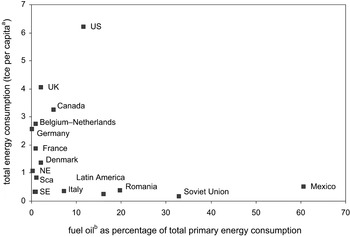
When fuel oil reached the heyday of its development, it still lagged far behind coal in most countries. Although some European countries were aware of the strategic implications of this energy carrier, its overall consumption was very limited. After the First World War, the only significant development that came to the fore was the increasing number of merchant steamers fitted to burn fuel oil, a trend that fostered the conversion of commercial fleets particularly in the United States, Norway, Italy, Great Britain, France, and The Netherlands.Footnote 57 Nonetheless, this localized effect was not enough to outweigh the overall dependence on coal, so that the more intensive nature of energy consumption in developed Europe continued to be associated with coal–steam rather than oil–steam technology (Figure 2). In contrast, the substitution effect in the United States was fully extended into the domestic, industrial, and transportation sectors, benefiting from both comparative advantages in relative prices and opportunities from indirect savings. The relative share of railroads and bunker oil for merchant and navy ships progressed steadily, reaching a plateau of 49% of fuel oil consumption by 1930. Other uses related to burning furnaces saw a steady decline in the applications for mining and manufacturing, manufacture of gas, and electric power generation, somewhat counterbalanced by the increase in demand for residential and home heating, particularly after 1930. At its peak, fuel oil represented about 32% of the total power sources used for electricity generation and 8% of those used in city gas.Footnote 58 Overall, it accounted for 11% of US inputs in primary commercial energy (see Figure 2).
Fuel oil consumption and total commercial primary energy consumption in selected countries, 1925.
a Tonnes of coal equivalent per capita.
b Fuel oil includes crude used as fuel.
Key: NE – northern Europe (weighted average of Poland, Czechoslovakia, Austria); SE – southern Europe (weighted average of Spain, Greece, Portugal, Albania, Bulgaria, Hungary, Yugoslavia); Sca – Scandinavia (weighted average of Norway, Sweden, Finland, Iceland).
Sources: Joel Darmstadter, Energy in the world economy: a statistical review of trends in output, trade, and consumption since 1925, Baltimore, MD: Johns Hopkins University Press, 1972, pp. 652–77; NICB, Oil conservation and fuel oil supply, New York: National Industrial Conference Board, 1930, pp. 156–7; Schurr and Netschert, Energy, pp. 93–111; Gerschenkron and Nimitz, Dollar index.

Although it is beyond the scope of this paper to enumerate the specific traits of the US energy market, from an international perspective it is nonetheless interesting to note that this pattern of entrenchment of oil in diversified productive activities rippled through the Caribbean and other islands, under the political and military dominance of the United States: by the mid 1920s, Hawaii was absorbing about three million oil barrels per year in its sugar and fruit-canning industries, public utilities, railways, and bunker facilities; Cuba took eight million barrels for the sugar industry, railways, and bunker facilities, and another million went to Puerto Rico’s transport and utilities.Footnote 59 Coupled with the strong presence of US entrepreneurs in these countries,Footnote 60 the opening of the Panama Canal in 1914 fostered extensive trade between the east and west coast ports, with large supplies of fuel oil coming to Cuba, Hawaii, and Puerto Rico. As a result, imports of fuel oil largely replaced coal imports in these islands. Further south, Chile was the only non-oil-producing nation in which a large fuel sector evolved, based on the supply of nitrate mines, railways, and ships.Footnote 61 As a rule, the American pattern of diversified usages was only to be found in the foremost oil-producing nations: Mexico, Russia, Romania, and the Dutch East Indies (see Figure 2).
Hence, it can be concluded that the use of oil in the steam age had a very asymmetrical effect on the world economy: whereas in most countries it touched only part of the merchant and navy fleets, in oil-producing countries it provided a real alternative to coal, with an ensuing impact on the energy balance. Poor rural economies bearing high transport costs for lignite, anthracite, and coke, with labour-intensive industries and very low levels of energy consumption benefited most from the outset. Stepping into the new fuel oil age assured these economies a basis for raising the competitiveness of industry and transport in ways otherwise unattainable.
Curiously, there was a sharp turnaround in the socio-technological situation when the hybridization of steam reached its peak in the 1920s. The causes are twofold: on the one hand, there was an awareness that oil was an exhaustible resource that could be depleted in about twenty years; on the other hand, there was the diffusion of the comparatively more efficient diesel combustion engine. Saving mineral resources became the priority of the day and this concern was best expressed by the comparison between the amount of potential energy contained in the fuel and the amount that is actually converted into power. Against this standard, oil-fired steam engines loomed largely as wasteful equipment because they were now contrasted with the performance of the diesel engine.
Rudolph Diesel set for himself the goal of developing a prototype for an ideal engine in which all heat added in could be converted to work on the piston. Its main focus was consequently to avoid all types of loss, while converting energy sources into mechanical power. From a practical perspective, Diesel devised the solution of a combustion chamber to which the fuel is directly driven at the time of maximum compression, becoming pulverized or atomized so that each particle of fuel can find a particle of oxygen with which to combine.Footnote 62 Compression-induced spontaneous combustion did away with the need for sparking devices and burning furnaces.
Diesel’s position in the markets was consolidated with enhanced sales of oil-fired engines. Based on the promise of fuel economy and a range of improvements introduced by German, French, Swiss, and Scandinavian enterprises, the engine finally won a niche within the stationary power market of the 1920s and was readily adopted for the production of locomotives, buses, and trucks.Footnote 63 However, public policy was not neutral and tried to sway the markets by means of a very interventionist stance: in the 1920s, the authorities both in the United States and in Soviet Union regarded the oil–steam combine as a technological aberration. This ‘aberration’ needed to be wiped out because it did not compel society to save energy and did not meet ‘ideal’ conservationist practices.
The new regulatory body in the United States, the Federal Oil Conservation Board (established in 1924), identified gasoline as the superior application, whereas fuel oil was scaled down as an inferior application, giving priority to inter-fuel substitution.Footnote 64 Moreover, the new technology of thermal cracking allowed the production of gasoline from the fuel-oil residuum. In the Soviet Union, oil was increasingly restricted to uses in internal combustion engines in trucks and tractors, serving the needs of massive agricultural industrialization. After the First Five-Year Plan (1928–32), the demand for boiler and furnace fuel oil declined sharply and, with the Second Plan (1933–37), all increases in production were absorbed by internal demand, so that Soviet Russia abandoned its position as an exporter of cheap petroleum by-products to the European market.Footnote 65 The picture of the 1920s is thus one of centralized policy attempts to contain the expansion of oil-fired steam engines and a decentralized boom in fuel-oil usage, followed by a progressive decline.
Conclusion
Between 1880 and 1930, oil became a large international business, an important energy carrier, and a key element in geostrategic world disputes. In terms of by-products, the time-frame is largely dominated by the production of fuel oil, an ideal substitute for coal. Initially, this commodity was simply discarded or ‘spoiled’ in crude and basic industrial activities, but engineers from the leading producing nations soon discovered a way to adapt the fuel to existing steam engines. It was in Russia, where the heavier fractions represented a larger share of the total oil distilled in the stills, that the major breakthroughs took place. After 1901, the conversion of fuel oil into power reached an all-time high in the United States, as new seepages of heavy oil were discovered and production sky-rocketed. Unlike Russian oil, which entered a crisis phase of political turmoil and technical exhaustion, the US industry was in its maturing stage.
The innovation and improvement of three types of burner to pulverize oil (steam, compressed air, and mechanical atomization), and to blow it into a furnace in spray form, assured a market for petroleum in the steam age. Through hybridization, it was possible to overcome the ‘dynamic inertia’ that characterizes the maturity phase of many technological systems, with choices of the time dependent on the prior decision and investment paths. Steam engines became more flexible. By the end of the nineteenth century, they could switch between energy carriers according to circumstances, since the reversibility of decisions was assured by the add-on of burners at a low fixed investment. Yet, despite the relative simplicity of technological solutions, the hybridization of steam had a significant macro-economic impact, with fuel oil consumption accounting for between 11% (USA) and 64% (Mexico) of total commercial primary energy in 1925. However, this was not a worldwide phenomenon. The economies of hybridization were above all a local opportunity, proving most effective where regional access to alternative coal supplies was difficult. It was therefore in oil-producing countries with little coal (such as Mexico, Romania, Venezuela, and the Dutch East Indies), when coal supply was disrupted, or at times of underinvestment or high costs (such as in the US and Russia) that combined oil–steam reached its peak. Conversely, jumping on the bandwagon implied large risks for outsiders. Great Britain is the best example of a non-producing country that tried to hybridize its fleet for military reasons. Suffice it to say that this decision triggered a chain of events that made oil the cause of world disputes.